
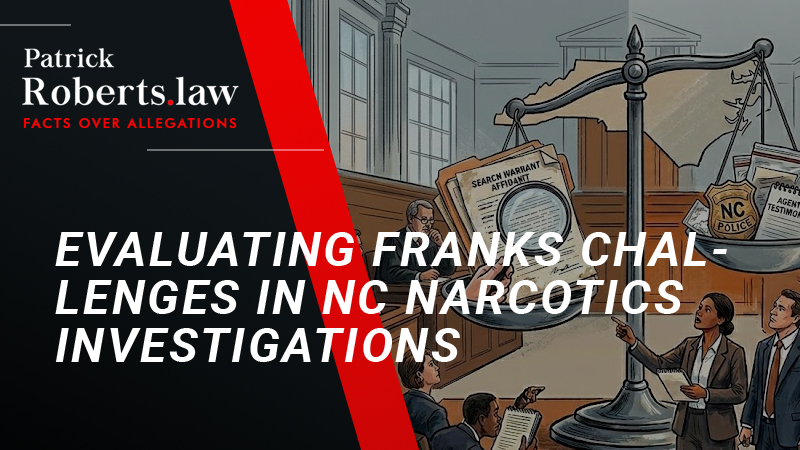
In North Carolina narcotics operations, law enforcement officers heavily rely on search warrants to seize evidence from vehicles, storage units, and private residences. These warrants are granted based on an officer’s sworn affidavit. Under the Fourth Amendment, a search warrant is valid only if it establishes probable cause within its “four corners.”
However, when an officer includes deliberate falsehoods or omits critical facts to secure a warrant, the defense can challenge its validity using the framework established in the landmark U.S. Supreme Court case Franks v. Delaware, 438 U.S. 154 (1778).
Applying Franks to drug trafficking cases in North Carolina requires navigating complex statutory rules and distinct federal and state court precedents. This analysis details the legal standards, the evidentiary hurdles, and the strategic mechanisms used to litigate these issues.
Read the rest of this entry »Is Your AI Chat the FBI’s Newest Witness?
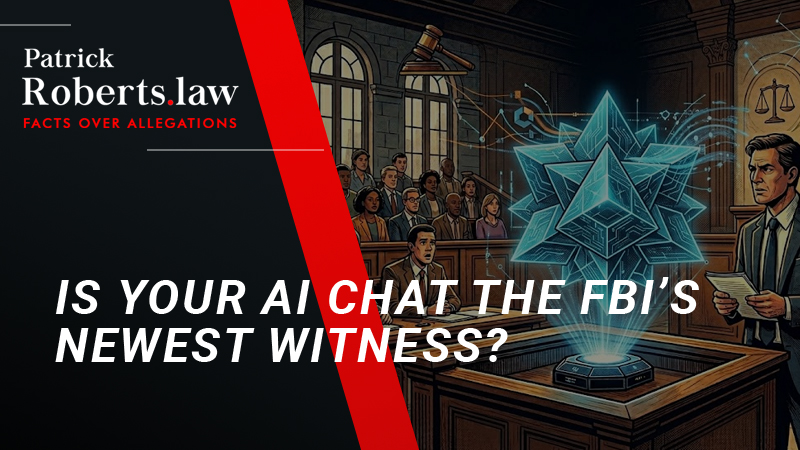
For those facing federal or state investigations, the “right to remain silent” has entered a complicated new era. While the integration of Artificial Intelligence into daily life has become seamless, a landmark 2026 ruling has turned these digital tools into a potential liability for the accused.
In United States v. Heppner, the Southern District of New York addressed a “question of first impression” that is already sending ripples through the legal community: Is your private conversation with an AI chatbot protected by attorney-client privilege?
The court’s answer was a resounding no. For defendants, this decision means that a casual query to a chatbot could become the prosecution’s strongest piece of evidence—effectively making the AI a “witness” for the government.
Read the rest of this entry »
Currently, North Carolina does not authorize the death penalty for child rape, as the 2008 Supreme Court ruling in Kennedy v. Louisiana remains the standing legal precedent. However, a recent wave of state-level legislation across the U.S. is actively challenging this boundary, creating a shifting legal landscape for those accused of high-level sex crimes.
Read the rest of this entry »North Carolina Fentanyl Laws: Mandatory Minimums, Death by Distribution, and Prosecution Trends
In North Carolina, the law classifies fentanyl trafficking as a weight-based offense with non-negotiable mandatory minimum sentences. Possession of as little as 4 grams triggers a mandatory prison term of 70 to 93 months and a $50,000 fine, regardless of intent to sell. Under the STRONG Act, prosecutors have prioritized “Death by Distribution” filings, reclassifying fatal overdoses as high-level felonies (Class B1 or B2) with extended lookback periods for prior convictions.
Read the rest of this entry »
In North Carolina, “sexting” is not a specific legal term found in the criminal code. Instead, the state relies on aggressive felony sexual exploitation of a minor statutes—the same laws used to prosecute high-level child pornography cases. This means that a single digital image involving anyone under the age of 18 can instantly transition from a “teen mistake” into a Class C, E, or H felony.
Understanding this distinction is critical for parents, teenagers, and adults alike. Under N.C.G.S. § 14-190.16 and § 14-190.17, prosecutors do not distinguish between “consensual sexting” and exploitation. If a minor is depicted, the law treats the creation, possession, or distribution of that image as a serious sex offense.
Read the rest of this entry »
If you searched “sexual assault vs. rape,” you’re probably trying to figure out whether these are two different crimes, how the law draws the line between them, and what the consequences look like for each. The short answer is that North Carolina doesn’t actually have a crime called “sexual assault.” The state uses a different set of terms — and the distinctions between them carry significant differences in charges, felony classifications, and sentencing ranges.
This page explains how North Carolina’s sex offense statutes actually categorize the conduct that most people refer to as “sexual assault” or “rape.” It covers why the legal label attached to a case matters as much as the facts themselves — and what to do if you or someone close to you is facing charges.
Read the rest of this entry »
Under North Carolina law, solicitation of a minor is a felony charge that does not require contact with an actual child. N.C.G.S. § 14-202.3 makes it a crime to use a computer or electronic device to solicit a person the defendant believes to be underage to commit an unlawful sex act. The offense requires that the defendant be at least 16 years old and at least 5 years older than the person the defendant believes to be a minor. The charge is complete the moment the solicitation occurs. No meeting needs to take place. No sexual act needs to happen. The person on the other end of the conversation does not need to be a real minor.
That last point is the one most people miss. It changes everything about how these cases work, how they are defended, and what is actually at stake.
This article covers the specific elements North Carolina prosecutors must prove, the penalties a conviction carries, and the defense strategies that apply to these cases.
Read the rest of this entry »What Does Child Enticement Mean? North Carolina Criminal Defense Lawyer Explains the Law
Child enticement, under North Carolina law, refers to using a computer or electronic device to solicit a minor — or someone believed to be a minor — to commit an unlawful sex act. The charge is set out in N.C.G.S. § 14-202.3, and it carries consequences that most people do not fully understand until they or someone they care about is facing them.
The legal definition is far broader than the everyday meaning of the word “enticement” suggests. The gap between what people assume and what the statute actually criminalizes is where serious mistakes happen.
This article breaks down exactly what the charge means in North Carolina, what prosecutors must prove, how law enforcement sting operations factor in, and what defenses may apply.
Read the rest of this entry »
An indecent exposure charge can be beaten by attacking the specific elements the prosecution is required to prove — willfulness, public setting, presence of another person, and in some cases, sexual intent. If any one of those elements falls apart, the charge does not hold. Below, we break down exactly what the state must prove under North Carolina law, the defense strategies that challenge each element, and what is realistically at stake if you are convicted.
Read the rest of this entry »
Most felony sexual assault charges in North Carolina have no statute of limitations. That means the state can bring charges five, ten, or twenty years after the alleged offense — there is no deadline. Because nearly every sexual assault offense in North Carolina is classified as a felony, this rule applies to the vast majority of cases.
That single fact shapes everything that follows. It matters whether you are trying to understand your legal options after an assault, whether you have just learned of an allegation against you from years ago, or whether you are a family member trying to make sense of the process for someone you care about.
But the full picture has layers. One category of sexual offense — misdemeanor sexual battery — does carry a time limit. Civil lawsuits operate on an entirely separate timeline from criminal charges. And recent changes to North Carolina law have shifted several of these deadlines significantly. Below is what you need to know, organized around the questions people in this situation are actually asking.
Read the rest of this entry »Former assistant district attorney
Contact Patrick Roberts
Facing criminal charges in North Carolina demands seasoned representation. Trust in the experience and dual perspective of Patrick Roberts. Reach out today for a confidential consultation.
-
Call Our Team
Calls answered 24/7







For more information on the selection criteria, go to www.martindale.com
*Each case is different and must be evaluated separately. Prior results achieved do not guarantee similar results can be achieved in future cases.