
Under Investigation for Cyber Offenses in NC? How Federal Authorities Build These Cases

Federal cyber crime enforcement in North Carolina has reached unprecedented levels, marked by proactive digital surveillance, multi-agency task force operations, and severe judicial outcomes. A prime example of this environment is the August 2026 sentencing of a Charlotte man to 15 years (180 months) in federal prison, followed by 30 years of supervised release and $23,000 in mandatory restitution, following a guilty plea to digital child exploitation distribution charges under federal jurisdiction.
Read the rest of this entry »Digital Forensics in NC Rideshare Crimes: How GPS Telemetry & Cell Phone Evidence Impact Criminal Defense
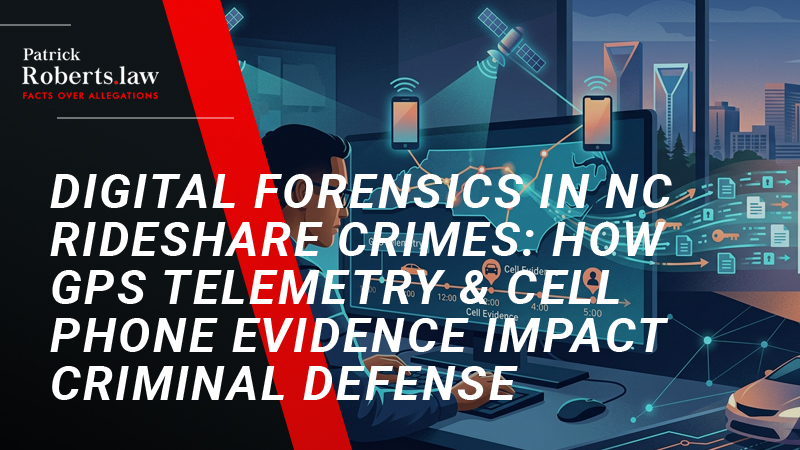
A $50 million civil lawsuit recently filed in Durham County Superior Court against Lyft has placed ridesharing safety standards and vetting protocols under intense public scrutiny. Filed on behalf of a victim alleging sexual assault during a rideshare trip, the civil complaint targets platform background check policies—specifically highlighting that the driver’s prior driving while impaired (DWI) conviction fell outside North Carolina’s statutory 7-year lookback window.
While civil proceedings evaluate corporate liability, the parallel criminal prosecution focuses on an entirely different evidentiary threshold: digital forensics, GPS telemetry, and the digital chain of custody.
Read the rest of this entry »Digital Privacy Rights: How the Supreme Court’s Ruling on Geofence Warrants Protects North Carolina Residents

When a family member or loved one is unexpectedly arrested or served with a search warrant, the situation is overwhelming. In the hours following a police intervention, families are often left with urgent questions about what happened, what evidence law enforcement collected, and whether officers overstepped their authority.
In modern law enforcement investigations, digital evidence—such as mobile phone location history, text messages, and app activity—frequently serves as the primary basis for an arrest. However, a landmark U.S. Supreme Court decision (Chatrie v. United States) significantly restricts how law enforcement can collect and use digital location tracking against North Carolina residents.
Read the rest of this entry »Possession of Meth With Intent to Distribute in North Carolina: What the Charge Really Means
In North Carolina, what people call “possession of meth with intent to distribute” is charged as possession with intent to sell or deliver methamphetamine — PWISD for short. It falls under N.C. Gen. Stat. § 90-95(a)(1), and it’s a Class H felony. But the single fact that changes everything is weight. At 28 grams, the same meth stops being a PWISD case and becomes trafficking. Trafficking carries mandatory prison time, no matter who you are.
Read the rest of this entry »Trafficking a Schedule VI Controlled Substance in North Carolina: What the Charge Actually Means
In North Carolina, there is no separate crime called “trafficking a Schedule VI controlled substance.” Schedule VI is simply the state’s classification for marijuana, hashish, and THC. The only one of those with its own trafficking law is marijuana. It’s charged under N.C. Gen. Stat. § 90-95(h) based on weight, not on the schedule number. This article explains what actually triggers a marijuana trafficking charge in NC, the weight tiers and mandatory prison terms attached to each, the two ways a person can get below those minimums, and how these cases are defended.
Read the rest of this entry »
In North Carolina, cocaine trafficking has almost nothing to do with selling. It’s about weight. If the State says you had 28 grams or more of cocaine, or any mixture containing cocaine, you can be charged with “trafficking.” That’s true even if you never sold, moved, or handed anything to anyone.
That single fact catches most people off guard, and it changes everything about how serious the charge is. Below, I’ll walk through what actually counts as trafficking here, the exact prison time and fines each weight level carries, why probation usually isn’t on the table, whether your case might end up in federal court, how the prosecution has to prove it, and — most importantly — where these cases can be challenged.
Read the rest of this entry »Aggravated Drug Trafficking in North Carolina: What the Charge Means and What You’re Facing
In North Carolina, there is no criminal charge that carries the exact name “aggravated drug trafficking.” What people usually mean by that phrase is one of three things: a high-weight trafficking charge under N.C. Gen. Stat. § 90-95(h), an ordinary drug charge pushed into a harsher category by an aggravating factor like a school zone or a sale to a minor, or a federal drug-trafficking case. Federal cases use “aggravating factor” language and are prosecuted heavily in this state.
Read the rest of this entry »Heroin Trafficking Charges in North Carolina: What You’re Facing and How the Charge Can Be Fought

In North Carolina, heroin trafficking is a charge built on weight, not on proof that anyone sold anything. Under N.C. Gen. Stat. § 90-95(h)(4), a person who possesses, transports, sells, manufactures, or delivers four grams or more of heroin — or any mixture that contains heroin — can be charged with trafficking. The charge holds even if there was no buyer, no scale, and no sale.
That catches most people off guard, because “trafficking” sounds like it should mean dealing. It doesn’t. Below is what the State actually has to prove, how much prison time each weight level carries, whether a judge can go below those numbers, how state and federal cases differ, and where these charges can be attacked.
Read the rest of this entry »
A drug trafficking charge in North Carolina gets dismissed when the State can’t lawfully prove one of the pieces it needs to convict you — not because you talk a prosecutor into believing you’re innocent. That distinction is the whole game, and most people searching this question have it backward.
Read the rest of this entry »Possession With Intent to Distribute in North Carolina: What the Charge Means and How It’s Defended
In North Carolina, “possession with intent to distribute” is charged as possession with intent to sell or deliver — often shortened to PWISD. It is a felony under N.C. Gen. Stat. § 90-95(a)(1). The critical thing to understand is that the State does not have to prove you sold anything to anyone; it only has to prove you intended to. That single word — intent — is what elevates the offense, and it’s also where most of these cases can be fought.
Read the rest of this entry »Former assistant district attorney
Contact Patrick Roberts
Facing criminal charges in North Carolina demands seasoned representation. Trust in the experience and dual perspective of Patrick Roberts. Reach out today for a confidential consultation.
-
Call Our Team
Calls answered 24/7






For more information on the selection criteria, go to www.martindale.com
*Each case is different and must be evaluated separately. Prior results achieved do not guarantee similar results can be achieved in future cases.