

Facing drug trafficking charges in North Carolina can be overwhelming, particularly if you have never been convicted of a drug offense before. Unlike simple possession charges, trafficking offenses are based on the quantity of drugs involved and carry serious felony classifications with mandatory minimum prison sentences. However, North Carolina law does provide specific provisions that may allow first-time offenders to receive reduced sentences under certain circumstances.
This article explains what constitutes drug trafficking under North Carolina law, the penalties you may face, and the options available to first-time offenders. If you are facing charges, securing experienced legal representation early in the process is critical to protecting your rights and exploring every available defense.
What Is Drug Trafficking in North Carolina?
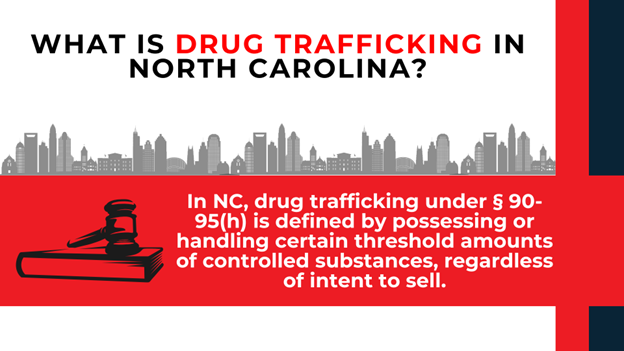
Drug trafficking in North Carolina is defined by statute based on the quantity of a controlled substance involved, not necessarily by proof that you intended to sell or distribute drugs. Under N.C. Gen. Stat. § 90-95(h), a person commits trafficking when they sell, manufacture, deliver, transport, or possess certain threshold amounts of specific controlled substances.
The key substances and their trafficking thresholds include:
- Marijuana: 10 pounds or more
- Cocaine: 28 grams or more
- Methamphetamine: 28 grams or more
- Heroin and opioids: 4 grams or more
- MDMA (Ecstasy): 100 tablets or 28 grams or more
- LSD: 100 dosage units or more
- Amphetamine: 28 grams or more
Because trafficking is a quantity-based offense, you can be charged with trafficking even if you possessed drugs solely for personal use and had no intent to sell or distribute them. This makes trafficking charges particularly serious for individuals who may have substance abuse issues but are not drug dealers.
How Does North Carolina Define a First-Time Offender for Drug Trafficking?
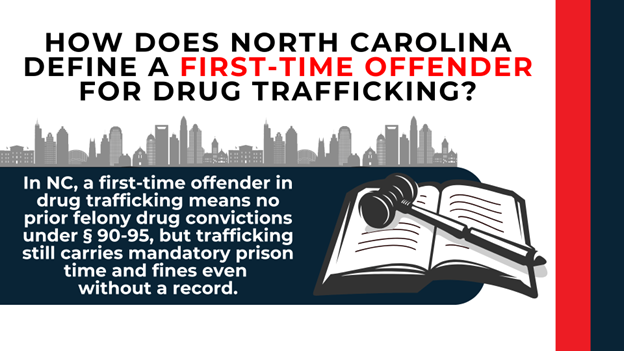
When discussing first-time offender drug trafficking in NC, the term “first-time offender” generally refers to someone who has not previously been convicted of a felony under N.C. Gen. Stat. § 90-95, which governs drug violations. Prior convictions for misdemeanor drug possession, including possession of marijuana, do not automatically disqualify someone from being considered a first-time offender for purposes of certain sentencing provisions.
However, it is important to understand that having no prior drug convictions does not eliminate the serious nature of trafficking charges. Trafficking offenses carry mandatory minimum prison sentences and substantial fines that apply even to individuals with no criminal history. The law does provide some limited relief for first-time offenders, but only under specific conditions that must be proven to the court.
What Are the Penalties for First-Time Drug Trafficking in NC?
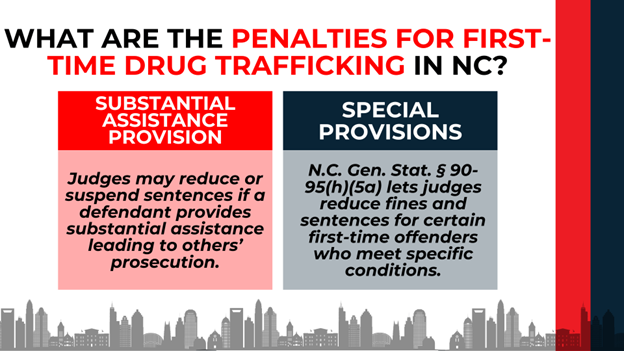
Drug trafficking in North Carolina is prosecuted as a felony offense, with the specific felony class determined by the type and quantity of the controlled substance involved. The law imposes mandatory minimum prison sentences for trafficking offenses, meaning that judges generally cannot suspend the sentence or place defendants on probation.
Key aspects of trafficking penalties include:
- Felony classifications: Trafficking offenses range from Class H felonies to Class C felonies, depending on the drug type and amount
- Mandatory minimum prison terms: The law requires minimum prison sentences that must be served
- Substantial fines: Convicted individuals face significant financial penalties in addition to imprisonment
- Consecutive sentences: If you are serving another sentence, the trafficking sentence must run consecutively, meaning it begins after the first sentence ends
- No probation or suspended sentences: With limited exceptions, courts cannot suspend trafficking sentences or grant probation
For first-time offenders, these penalties can be particularly devastating. Even individuals with no prior criminal record face the same mandatory minimum sentences as repeat offenders, unless they qualify for one of the narrow exceptions discussed below.
Can First-Time Offenders Receive Reduced Sentences for Drug Trafficking?
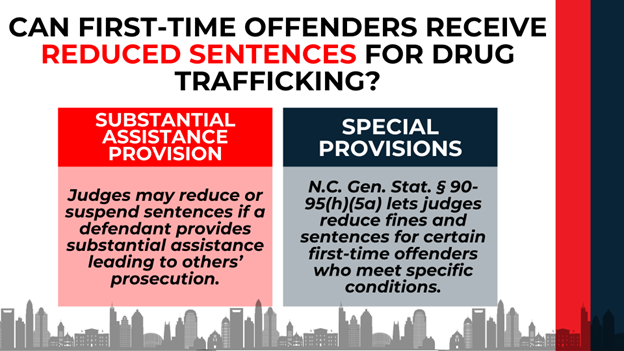
North Carolina law does provide two potential avenues for reducing sentences in trafficking cases, though both require meeting strict conditions.
Substantial Assistance Provision
Under N.C. Gen. Stat. § 90-95(h)(5), a sentencing judge may reduce the fine, impose a prison term less than the mandatory minimum, or suspend the sentence and place a defendant on probation if the person has, to the best of their knowledge, provided substantial assistance in the identification, arrest, or conviction of accomplices, accessories, co-conspirators, or principals. The judge must enter a finding in the record that the defendant rendered such substantial assistance.
This provision applies to all defendants, not just first-time offenders. Substantial assistance typically involves cooperating with law enforcement in ways that lead to the prosecution of other individuals involved in drug trafficking.
Special Provisions for First-Time Possession-Based Trafficking
N.C. Gen. Stat. § 90-95(h)(5a) establishes additional sentencing relief specifically designed for certain first-time offenders. Under this provision, a judge may reduce the fine and sentence a defendant consistent with their offense classification and prior record level if, after a hearing, the judge finds that all of the following conditions are met:
- The defendant has accepted responsibility for their criminal conduct
- The defendant has not previously been convicted of a felony under N.C. Gen. Stat. § 90-95
- The defendant did not use violence or a credible threat of violence, or possess a firearm or other dangerous weapon, in committing the trafficking offense
- The defendant did not use violence or threats, or possess weapons, in any other violation of law
- The defendant has admitted having a substance abuse disorder involving a controlled substance and has successfully completed a treatment program approved by the court
- Imposition of the mandatory minimum prison term would result in substantial injustice
- Imposition of the mandatory minimum sentence is not necessary for the protection of the public
- The defendant is being sentenced solely for trafficking or conspiracy to commit trafficking as a result of possession of a controlled substance
- There is no substantial evidence that the defendant has ever engaged in the transport for sale, sale, manufacture, or delivery of a controlled substance
- The defendant has provided all reasonable assistance in the identification, arrest, or conviction of any accomplices, accessories, co-conspirators, or principals
- The defendant is being sentenced for trafficking based on possession of an amount in the lowest quantity category for that particular controlled substance
This provision is narrowly tailored and requires proof of every element listed above. Notably, it applies only to defendants whose trafficking charges stem from simple possession, not from any conduct involving sale, delivery, or transport of drugs. Additionally, the defendant must have successfully completed a substance abuse treatment program before sentencing.
If a judge grants relief under this provision, the defendant can be sentenced according to their felony class and prior record level under the structured sentencing guidelines, rather than facing the mandatory minimum prison term. However, this relief is entirely discretionary, and judges are not required to grant it even when all conditions are met.
What Must the State Prove to Convict Someone of Drug Trafficking?
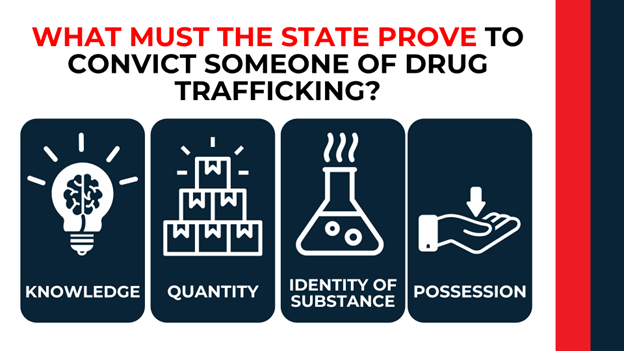
To secure a conviction for drug trafficking under N.C. Gen. Stat. § 90-95(h), the prosecution must prove beyond a reasonable doubt that the defendant knowingly sold, manufactured, delivered, transported, or possessed the requisite quantity of a controlled substance. Each element presents potential defenses depending on the facts of the case.
Knowledge and Possession
The state must prove that you knowingly possessed or controlled the drugs. If drugs were found in a location where multiple people had access, the prosecution must establish that you exercised dominion and control over the substances. In cases where drugs are found in a vehicle or residence occupied by several individuals, the state’s ability to prove knowing possession may be challenged. If the evidence does not clearly establish that you knew the drugs were present or that you had control over them, this element may not be satisfied.
Quantity
Because trafficking is defined by quantity, the state must accurately measure and prove the amount of the controlled substance involved. Errors in weighing, testing, or chain of custody procedures can undermine the prosecution’s case. If the actual weight falls below the statutory threshold due to measurement issues or improper testing, the trafficking charge may not be sustainable. Defense counsel may challenge the reliability of laboratory results or the procedures used to handle and weigh the evidence.
Identity of the Substance
The prosecution must prove that the substance in question is actually the controlled substance alleged in the charging document. This typically requires chemical analysis by a state laboratory. N.C. Gen. Stat. § 90-95(g) allows certified laboratory reports to be admitted into evidence without the testimony of the analyst, provided the defendant is given notice and does not object. If you file a timely written objection, the state must produce the analyst to testify, and their credentials, methodology, and conclusions can be challenged through cross-examination.
Constructive Possession and Joint Possession
In many trafficking cases, the drugs are not found directly on a person but in a location such as a vehicle, home, or storage unit. The state may attempt to prove constructive possession by showing that you had the power and intent to control the drugs, even if you did not have physical possession at the time of arrest. If the prosecution relies on circumstantial evidence to establish possession, the strength of that evidence may be subject to challenge. When drugs are found in areas accessible to multiple people, the state must prove that you specifically exercised control over them.
How Is Drug Trafficking Different from Drug Possession in North Carolina?
While both drug possession and drug trafficking are violations of N.C. Gen. Stat. § 90-95, they are distinct offenses with very different penalties.
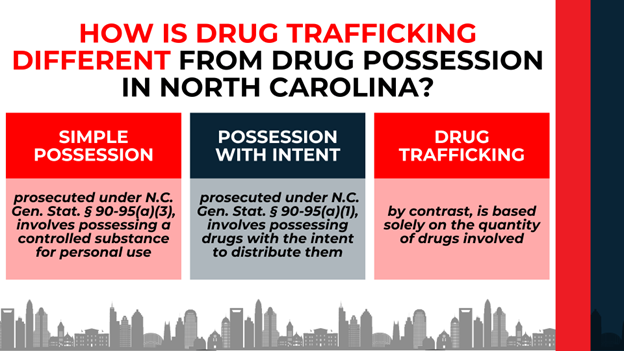
Simple possession, prosecuted under N.C. Gen. Stat. § 90-95(a)(3), involves possessing a controlled substance for personal use. The penalties for simple possession vary by the schedule of the drug but are generally far less severe than trafficking penalties. For example, possession of a Schedule I substance such as heroin is a Class I felony, while possession of a Schedule II, III, or IV substance is typically a Class 1 misdemeanor unless the quantity exceeds certain thresholds.
Possession with intent to sell or deliver, prosecuted under N.C. Gen. Stat. § 90-95(a)(1), involves possessing drugs with the intent to distribute them. The penalties are more serious than simple possession, ranging from Class I to Class G felonies depending on the schedule of the drug and whether the charge involves sale or mere possession with intent.
Drug trafficking, by contrast, is based solely on the quantity of drugs involved. There is no requirement that the state prove intent to sell, deliver, or distribute. If you possess the threshold amount, you can be charged with trafficking regardless of whether you intended to use the drugs yourself. This makes trafficking charges unique and particularly harsh for individuals struggling with substance abuse who may possess large quantities for personal consumption.
Importantly, the penalties for trafficking are far more severe. Trafficking offenses carry mandatory minimum prison sentences, while simple possession and even possession with intent to sell or deliver may allow for probation or suspended sentences in some cases.
Does Conspiracy to Commit Drug Trafficking Carry the Same Penalties?
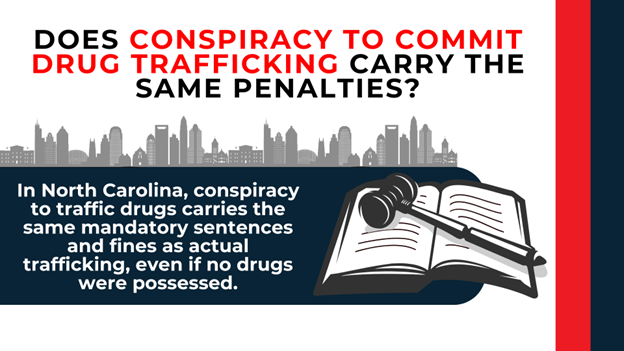
Yes. Under N.C. Gen. Stat. § 90-95(i), the penalties provided for trafficking offenses also apply to any person convicted of conspiracy to commit trafficking. This means that if you are charged with conspiring to traffic drugs, you face the same mandatory minimum prison sentences and fines as if you had actually committed the trafficking offense itself.
N.C. Gen. Stat. § 90-98 further clarifies that any attempt or conspiracy to commit an offense defined in the Controlled Substances Act is punishable as the same class of offense as the underlying crime. Conspiracy charges can be based on agreements to traffic drugs, even if the actual trafficking never occurred. The state must prove that you entered into an agreement with one or more people to engage in conduct that would constitute trafficking and that you took some step in furtherance of that agreement.
Conspiracy charges are particularly concerning because they allow the prosecution to pursue multiple defendants based on their roles in a broader drug operation, even if those defendants never personally possessed the threshold quantity of drugs. If you are charged with conspiracy to traffic drugs as a first-time offender, the same mandatory minimum sentences and limited sentencing relief provisions discussed above apply.
Why Do I Need an Attorney for First-Time Drug Trafficking Charges?
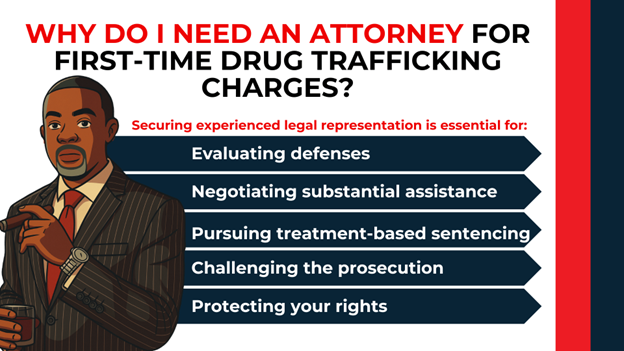
Drug trafficking cases involve complex legal issues, stringent mandatory sentencing provisions, and limited opportunities for sentencing relief. If you are a first-time offender facing drug trafficking charges in North Carolina, securing experienced legal representation is essential for several reasons:
- Evaluating defenses: An attorney can assess whether the state can prove every element of the offense, including knowledge, possession, and the quantity of drugs involved. Challenging the evidence early in the case may result in reduced charges or dismissal.
- Negotiating substantial assistance: If you have information about others involved in drug trafficking, an attorney can help you navigate cooperation with law enforcement in a way that may result in reduced sentences.
- Pursuing treatment-based sentencing relief: If you qualify for sentencing relief under N.C. Gen. Stat. § 90-95(h)(5a), an attorney can guide you through the process of enrolling in and completing a court-approved substance abuse treatment program, gathering evidence to support each required finding, and presenting a compelling case for reduced sentencing.
- Challenging the prosecution’s evidence: Drug cases often rely on scientific testing, chain of custody procedures, and search and seizure practices. An experienced attorney can identify weaknesses in the state’s case and file motions to suppress evidence obtained in violation of your constitutional rights.
- Protecting your rights: From the initial arrest through trial or plea negotiations, an attorney ensures that law enforcement and prosecutors follow proper procedures and that your constitutional rights are respected.
Drug trafficking is one of the most serious criminal charges in North Carolina, and the consequences of a conviction can affect your life for years to come. Even if you have no prior criminal record, the mandatory minimum sentences and substantial fines associated with trafficking offenses make it critical to have skilled legal counsel on your side.
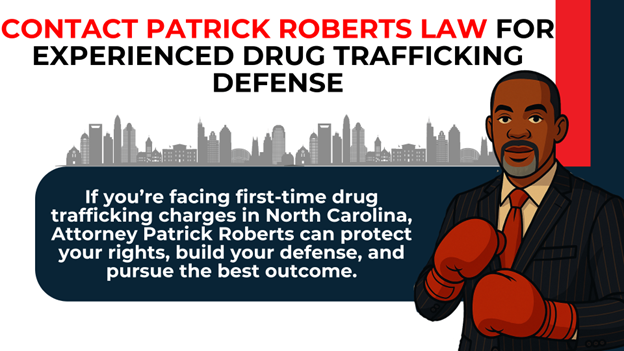
Contact Patrick Roberts Law for Experienced Drug Trafficking Defense
If you are facing first-time offender drug trafficking charges in North Carolina, you need an attorney who understands the complexities of state drug laws and the limited opportunities for sentencing relief. Attorney Patrick Roberts has extensive experience representing clients in serious criminal cases* and can help you explore every available defense and sentencing option.
The earlier you involve an attorney in your case, the more options you may have for protecting your rights and your future. Contact Patrick Roberts Law today to schedule a consultation and discuss your case.
*Disclaimer: Each case is different and must be evaluated separately. Prior results achieved do not guarantee similar results can be achieved in future cases.
Former assistant district attorney
Contact Patrick Roberts
Facing criminal charges in North Carolina demands seasoned representation. Trust in the experience and dual perspective of Patrick Roberts. Reach out today for a confidential consultation.
-
Call Our Team
Calls answered 24/7






For more information on the selection criteria, go to www.martindale.com
*Each case is different and must be evaluated separately. Prior results achieved do not guarantee similar results can be achieved in future cases.