

When someone is charged with manslaughter in North Carolina, the circumstances surrounding the killing become critically important. One type of manslaughter—often called “heat of passion” manslaughter—involves situations where a person kills another during a sudden emotional state triggered by provocation. Understanding how North Carolina law defines and treats this offense can make a significant difference in how a case is handled and resolved.
What Is Heat of Passion Manslaughter Under North Carolina Law?
Heat of passion manslaughter is formally known as voluntary manslaughter in North Carolina. It occurs when someone unlawfully kills another person without malice, premeditation, or deliberation. Unlike murder, this offense recognizes that the killing happened during a moment of intense emotion. That emotion must be suddenly aroused by sufficient provocation.
Under North Carolina law, voluntary manslaughter is the unlawful killing of a human being by an intentional act, but without the malice required for murder. The key distinction lies in the circumstances. The defendant must have acted in sudden anger or passion. That anger or passion must be triggered by adequate provocation—the kind that would affect a person of ordinary temperament.
This offense is classified as a Class D felony under N.C. Gen. Stat. § 14-18. The law recognizes that while the killing was intentional and unlawful, the circumstances surrounding it reduce the severity of the crime. Specifically, the emotional state of the defendant at the time reduces what might otherwise be murder to manslaughter.

How Does Heat of Passion Differ From Murder in North Carolina?
The primary difference between murder and heat of passion manslaughter centers on malice. Murder requires malice. This can be either express intent to kill or implied malice. Implied malice is demonstrated through extremely reckless conduct showing utter disregard for human life. Heat of passion manslaughter, by contrast, occurs when the emotional intensity of the moment negates the malice element.
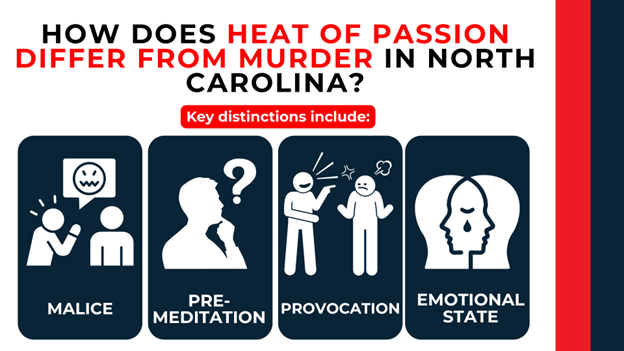
Key distinctions include:
- Malice: Murder requires malice; voluntary manslaughter does not
- Premeditation: First-degree murder requires premeditation and deliberation; voluntary manslaughter involves sudden passion without time to cool off
- Provocation: Voluntary manslaughter requires adequate provocation that would affect a reasonable person; murder does not depend on provocation
- Emotional state: The defendant in a voluntary manslaughter case acted under the influence of sudden passion; a murderer acted with a “cool mind” capable of reflection
The law recognizes that certain provocations can temporarily disturb a person’s reasoning. The disturbance can be so severe that they act impulsively rather than with calculated intent. When this happens, the offense may be reduced from murder to voluntary manslaughter.
What Constitutes Adequate Provocation for a Heat of Passion Defense?
Not every emotional reaction qualifies as adequate provocation under North Carolina law. The provocation must be sufficient to arouse sudden passion in a reasonable person of ordinary temperament. The standard is objective. It looks at whether the circumstances would cause a typical person to lose control. It does not simply look at whether this particular defendant lost control.
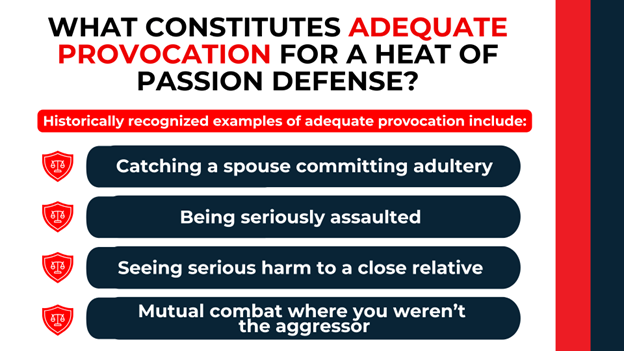
Historically recognized examples of adequate provocation include:
- Discovering a spouse in the act of adultery
- Being subjected to a serious physical assault
- Witnessing serious harm to a close family member
- Mutual combat situations where the defendant was not the initial aggressor
The provocation must be immediate. The killing must occur before there has been reasonable time for the passion to cool. If significant time passes between the provocation and the killing, the law presumes the defendant had an opportunity to regain composure. This eliminates the heat of passion defense.
Words alone, no matter how insulting or offensive, typically do not constitute adequate provocation under North Carolina law. However, abusive language combined with threatening gestures or actions may contribute to the overall circumstances. Together, these factors may support a heat of passion claim.
What Elements Must the State Prove for Voluntary Manslaughter?
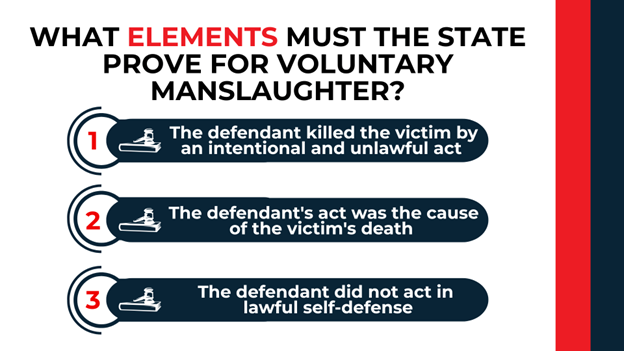
To convict someone of voluntary manslaughter in North Carolina, the prosecution must establish specific elements beyond a reasonable doubt:
First, the defendant killed the victim by an intentional and unlawful act. The act itself must be intentional. This means the defendant deliberately committed the act that caused death. Examples include stabbing, shooting, or striking the victim. This does not require proof that the defendant specifically intended to cause death. It only requires that the defendant intentionally committed an act that was a felony or likely to cause death or great bodily harm.
Second, the defendant’s act was the proximate cause of the victim’s death. Proximate cause means the act was a real cause—one without which the death would not have occurred. The defendant’s act need not be the only cause or the nearest cause. It is sufficient if it combined with other factors to produce the death.
Third, the defendant did not act in lawful self-defense. Or, if claiming self-defense, the defendant either was the aggressor in bringing on the confrontation or used excessive force under the circumstances.
The burden rests entirely on the state to prove each of these elements. The defendant does not have to prove innocence or establish any particular defense.

Can Self-Defense Apply to Heat of Passion Manslaughter Cases?
Self-defense can intersect with voluntary manslaughter charges in complex ways. When a defendant claims self-defense, the analysis focuses on whether the defendant’s use of force was justified under the circumstances.
A complete self-defense claim requires two things:
- It appeared to the defendant, and the defendant believed, that deadly force was necessary to prevent death or great bodily harm
- The circumstances as they appeared to the defendant were sufficient to create such a belief in the mind of a person of ordinary firmness
If these elements are satisfied, and the defendant was not the aggressor and did not use excessive force, the killing would be entirely justified. It would not be criminal at all.
However, imperfect self-defense can reduce a murder charge to voluntary manslaughter. This occurs when the defendant genuinely believed deadly force was necessary, but either:
- The defendant was the aggressor in bringing on the confrontation, or
- The defendant used more force than reasonably appeared necessary under the circumstances
North Carolina law recognizes that a defendant has no duty to retreat when in a place where the defendant has a lawful right to be. This “stand your ground” principle applies in several locations. These include the defendant’s home, workplace, motor vehicle, or any other location where the defendant is lawfully present. If the defendant is entitled to stand their ground and reasonably believes deadly force is necessary for self-protection, this can provide a complete defense. It does not merely reduce the charge to voluntary manslaughter.
The state bears the burden of disproving self-defense beyond a reasonable doubt. If the state cannot establish that the defendant either was the aggressor or used excessive force, the jury must find the defendant not guilty.
What Is the Difference Between Voluntary and Involuntary Manslaughter?
North Carolina recognizes two distinct types of manslaughter: voluntary and involuntary. The distinction primarily concerns the intent behind the underlying act and the nature of that act.
Voluntary manslaughter involves an intentional act that is a felony or inherently dangerous to human life. This might include a forceful assault that proximately causes death. The defendant intentionally committed the act, like stabbing or shooting. This is true even if the defendant did not specifically intend to kill the victim.
Involuntary manslaughter, by contrast, involves an unintentional killing. It must be proximately caused by either:
- An unlawful act not amounting to a felony and not naturally dangerous to human life, or
- A culpably negligent act or omission done with gross recklessness or carelessness showing heedless indifference to the safety of others
Involuntary manslaughter is classified as a Class F felony under N.C. Gen. Stat. § 14-18. This is a lesser offense than voluntary manslaughter.
The key differences include:
- Intent: Voluntary manslaughter requires an intentional act that is a felony or likely to cause serious harm; involuntary manslaughter may involve an act done without such intent
- Nature of the act: Voluntary manslaughter involves inherently dangerous conduct; involuntary manslaughter may involve misdemeanor conduct or culpable negligence
- Classification: Voluntary manslaughter is a Class D felony; involuntary manslaughter is a Class F felony
Even when a deadly weapon is used, the killing may constitute involuntary manslaughter. This can happen if the defendant acted without any intent to kill or inflict serious injury. For example, suppose a defendant grabbed a knife out of fear during a confrontation. If the victim was accidentally stabbed as they struggled, this could potentially be involuntary rather than voluntary manslaughter. The determination depends on the specific circumstances and the defendant’s state of mind.

What Role Does Being the Aggressor Play in These Cases?
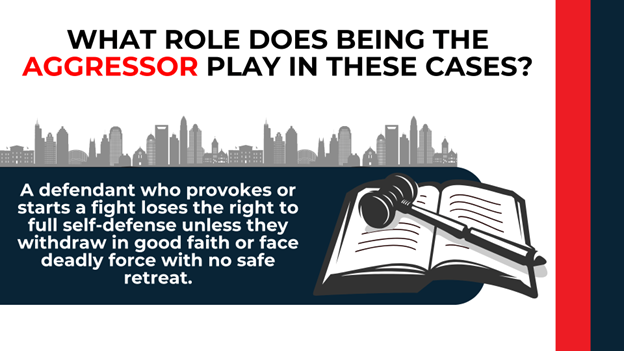
Whether the defendant was the aggressor in bringing on the confrontation significantly affects the legal analysis. A defendant who voluntarily and without provocation enters into a fight is considered the aggressor. That person loses the right to claim full self-defense.
Under North Carolina law, a person becomes the aggressor in two ways. The first is by using abusive language calculated and intended to provoke a fight. The second is by initiating physical violence without justification. However, even an initial aggressor can regain the right to self-defense by taking certain steps:
- Withdrawing in good faith from physical contact with the other person
- Clearly indicating the desire to withdraw and terminate the use of force
- Giving the other person notice of the withdrawal
There is also another scenario where an initial aggressor may use defensive force. If the person who was initially provoked responds with force so serious that the initial aggressor reasonably believes they are in imminent danger of death or serious bodily harm, the law recognizes an exception. The initial aggressor must have no reasonable means to retreat. The use of force likely to cause death or serious bodily harm must be the only way to escape the danger. Under these circumstances, the initial aggressor may be justified in using defensive force.
If the state establishes that the defendant was the aggressor and did not effectively withdraw, the defendant cannot claim complete self-defense. However, the defendant may still be convicted of voluntary manslaughter rather than murder. This happens when the defendant is acting under imperfect self-defense. This means the defendant genuinely believed force was necessary despite being the aggressor.
It is reversible error for a court to instruct a jury on the aggressor doctrine when the evidence does not support it. The record must contain evidence from which the jury could reasonably infer that the defendant was an aggressor at the time the defendant allegedly acted in self-defense.
What Penalties Can Result From a Voluntary Manslaughter Conviction?
A conviction for voluntary manslaughter as a Class D felony carries serious consequences. North Carolina’s structured sentencing guidelines generally require an active prison sentence. This is true even for defendants with no prior criminal record.
The actual sentence imposed depends on several factors:
- The defendant’s prior record level, which is determined by prior convictions and other factors
- Whether the court finds mitigating factors that justify a reduced sentence
- Whether the court finds aggravating factors that justify an increased sentence
For defendants with four or fewer prior record points, probation may be available. However, this requires the court to find extraordinary mitigation. This means exceptional circumstances beyond typical mitigating factors. Courts have discretion to determine whether mitigation rises to the “extraordinary” level necessary to justify probation.
Beyond incarceration, a voluntary manslaughter conviction creates a permanent felony record. This record can affect many areas of life:
- Employment opportunities
- Professional licensing
- Housing applications
- Firearm possession rights
- Voting rights (until restored)
The long-term collateral consequences of a felony conviction can be as significant as the immediate sentence imposed.

When Should Someone Charged With Voluntary Manslaughter Contact an Attorney?
Anyone facing a voluntary manslaughter charge should contact an experienced criminal defense attorney immediately. The same is true for anyone being investigated in connection with a death. Early legal representation provides critical advantages:
- Protection of rights: An attorney can ensure law enforcement respects constitutional rights during questioning and investigation
- Case evaluation: An experienced lawyer can assess the strength of the prosecution’s case and identify potential defenses
- Evidence preservation: Important evidence can be lost or destroyed if not preserved quickly. This includes witness statements, physical evidence, and electronic records
- Strategic planning: Early legal guidance allows for development of a comprehensive defense strategy before charges are formally filed
The difference between murder and manslaughter, or between conviction and acquittal, often depends on subtle factual and legal distinctions. An experienced attorney can identify and develop these distinctions. Voluntary manslaughter cases frequently involve complex issues. These include intent, provocation, self-defense, and the defendant’s state of mind. These are all areas where skilled legal representation is essential.
Prosecutors in homicide cases typically pursue the most serious charges supportable by the evidence. Without vigorous defense advocacy, a case that might be resolved as voluntary manslaughter could instead lead to a murder conviction. The same case might even result in acquittal with proper representation. The consequences of a murder conviction are far more severe.

Contact Patrick Roberts Law for Experienced Criminal Defense
If you or someone you care about is facing voluntary manslaughter charges, time is critical. The same is true if someone is under investigation for a death in North Carolina. Attorney Patrick Roberts brings substantial experience handling serious criminal cases* throughout North Carolina. He understands the complexities of defending against homicide charges.
Patrick Roberts Law provides:
- Thorough investigation of the facts and circumstances surrounding your case
- Aggressive advocacy to protect your constitutional rights
- Strategic defense planning tailored to your specific situation
- Experienced courtroom representation if your case goes to trial
Every case involving a death is serious. These cases require immediate attention from an attorney who understands both the law and the stakes involved. The sooner you secure legal representation, the better positioned you will be. You will be able to protect your rights and achieve the best possible outcome.*
Contact Patrick Roberts Law today to schedule a confidential consultation. Early legal representation can make all the difference in how your case is resolved.
*Disclaimer: Each case is different and must be evaluated separately. Prior results achieved do not guarantee similar results can be achieved in future cases.

Former assistant district attorney
Contact Patrick Roberts
Facing criminal charges in North Carolina demands seasoned representation. Trust in the experience and dual perspective of Patrick Roberts. Reach out today for a confidential consultation.
-
Call Our Team
Calls answered 24/7









For more information on the selection criteria, go to www.martindale.com
*Each case is different and must be evaluated separately. Prior results achieved do not guarantee similar results can be achieved in future cases.