

Facing allegations involving indecent liberties with a minor represents one of the most serious legal challenges anyone can encounter. For residents of Cary and the broader Wake County area, understanding these charges and their implications is critical. These offenses carry severe penalties under North Carolina law and can permanently alter your life, career, and relationships.
When accusations emerge—whether from a school investigation, a police inquiry by the Cary Police Department’s Special Victims Unit, or a complaint filed with the Wake County District Attorney’s Office—the stakes are extraordinarily high. The legal system moves quickly, and the decisions you make in the earliest stages of your case can determine the trajectory of your future.
What Does “Indecent Liberty with a Minor” Mean Under North Carolina Law?
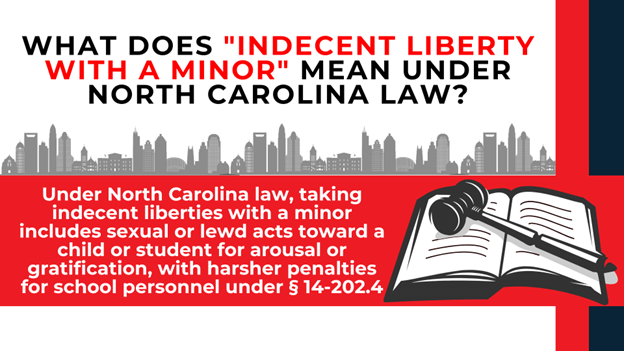
Under North Carolina law, taking indecent liberties with a minor encompasses several distinct offenses, each defined by specific circumstances and relationships between the accused and the alleged victim.
N.C. Gen. Stat. § 14-202.1 addresses the general offense of taking indecent liberties with children. This statute applies when a person who is at least 16 years old and at least five years older than a child under 16 years of age either:
- Willfully takes or attempts to take any immoral, improper, or indecent liberties with the child for the purpose of arousing or gratifying sexual desire, or
- Willfully commits or attempts to commit any lewd or lascivious act upon or with the body or any part of the body of the child
This offense is classified as a Class F felony, carrying substantial criminal consequences.
N.C. Gen. Stat. § 14-202.4 targets a specific category of offenders: school personnel who take indecent liberties with students. This statute recognizes the position of trust and authority that teachers, administrators, coaches, and other school personnel hold. The law applies when:
- The defendant is a teacher, school administrator, student teacher, school safety officer, coach, or other school personnel
- The defendant takes indecent liberties with a student at any time during or after they were present together in the same school
- The offense occurs before the victim ceases to be a student
For professionals working in Cary’s Wake County Public School System—which serves the community’s five high schools and numerous elementary and middle schools—these charges carry particular weight. The statute makes clear that consent is not a defense, and marriage to the student provides the only exception.
The definition of “indecent liberties” under this statute mirrors the general definition: willfully taking any immoral, improper, or indecent liberties with a student for the purpose of arousing or gratifying sexual desire, or willfully committing any lewd or lascivious act upon or with the student’s body. Notably, the term excludes vaginal intercourse or sexual acts, which fall under separate criminal statutes.
Who Can Be Charged with Taking Indecent Liberties with a Minor in Cary?
The scope of who can face these charges extends broadly under North Carolina law. Understanding the different categories helps clarify when these statutes apply.
General Population Cases
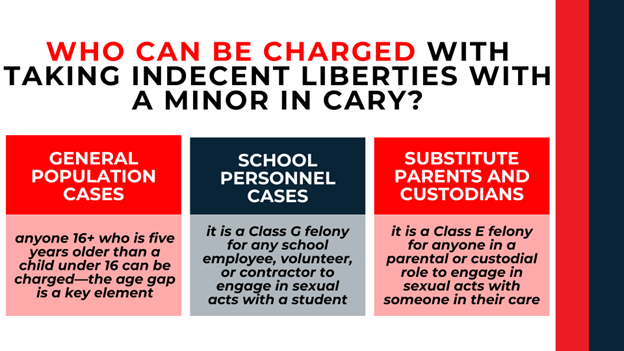
Any person who is at least 16 years old and five years older than a child under 16 can be charged under N.C. Gen. Stat. § 14-202.1. This means:
- An 18-year-old can be charged for conduct with a 12-year-old
- A 21-year-old can be charged for conduct with a 15-year-old
- A 30-year-old can be charged for conduct with a 14-year-old
The age differential requirement serves as a critical element of the offense. Prosecutors must prove this age gap beyond a reasonable doubt.
School Personnel Cases
N.C. Gen. Stat. § 14-202.4 specifically targets school personnel, defining this category broadly to include:
- Teachers at public schools, charter schools, and nonpublic schools
- School administrators
- Student teachers
- School safety officers and school resource officers
- Coaches
- Any person who volunteers at a school or school-sponsored activity
- Anyone employed by a school, including support staff
For school personnel who are at least four years older than the student, the offense is a Class G felony. For school personnel who are less than four years older than the student (but still school personnel), the offense remains a Class G felony under subsection (b).
In Cary’s highly educated community—where over 68% of adults hold bachelor’s degrees or higher—many residents work in educational settings. The Research Triangle Park area’s concentration of professionals means that educators, coaches, and school volunteers from Cary may find themselves particularly vulnerable to accusations, whether founded or unfounded.
Substitute Parents and Custodians
N.C. Gen. Stat. § 14-27.31 addresses a third category: those who have assumed the position of a parent in the home of a minor, or those who have custody of a victim of any age. This statute applies when:
- The defendant has assumed the position of a parent in the home
- The defendant has custody through employment or agency relationship with an institution
- The conduct involves vaginal intercourse or a sexual act
This offense is classified as a Class E felony and recognizes the vulnerability created by relationships of dependency and authority within the home.
What Actions Constitute Indecent Liberties Under North Carolina Law?
Understanding what conduct falls within the definition of “indecent liberties” requires examining both the statutory language and how North Carolina courts have interpreted these provisions.
The Statutory Framework
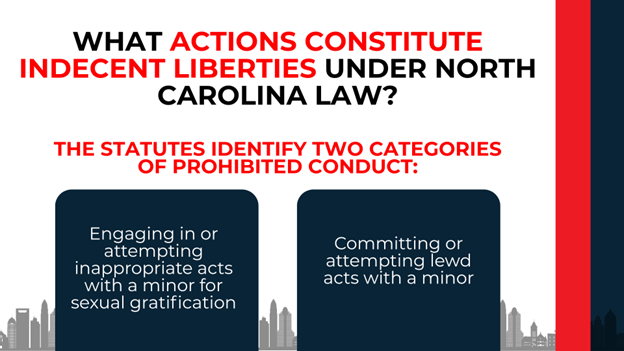
The statutes identify two categories of prohibited conduct:
- Taking or attempting to take any immoral, improper, or indecent liberties with a minor for the purpose of arousing or gratifying sexual desire
- Committing or attempting to commit any lewd or lascivious act upon or with the body of a minor
These definitions are intentionally broad, encompassing a wide range of behavior that falls short of sexual intercourse or sexual acts (which are charged under separate statutes).
Key Elements Prosecutors Must Prove
For a conviction under these statutes, the Wake County District Attorney’s Office must establish several elements beyond a reasonable doubt:
- The age requirements: The defendant and alleged victim meet the statutory age criteria
- Willful conduct: The defendant acted intentionally, not accidentally or inadvertently
- The nature of the act: The conduct was immoral, improper, indecent, lewd, or lascivious
- Sexual purpose: For the arousal/gratification prong, prosecutors must prove the defendant acted for the purpose of arousing or gratifying sexual desire
The requirement of sexual purpose represents a critical element. Not every inappropriate interaction with a minor constitutes indecent liberties under North Carolina law. The prosecution must prove the defendant’s specific intent.
Examples of Conduct That May Be Charged
While each case depends on its unique facts, prosecutors have pursued indecent liberties charges based on conduct including:
- Inappropriate touching of a minor’s body
- Exposing one’s genitals to a minor
- Requesting that a minor expose themselves
- Sexually explicit communications with a minor
- Arranging meetings with a minor for sexual purposes
- Showing sexually explicit material to a minor
In today’s digital age, many cases involve electronic communications. Residents of Cary—home to major technology employers like SAS Institute and located near the Research Triangle Park’s concentration of tech companies—should understand that text messages, social media communications, emails, and other digital evidence frequently form the basis of these prosecutions.
Does Consent Matter in Indecent Liberty Cases?
One of the most critical aspects of North Carolina’s indecent liberties statutes is the explicit rejection of consent as a defense.
Statutory Language on Consent
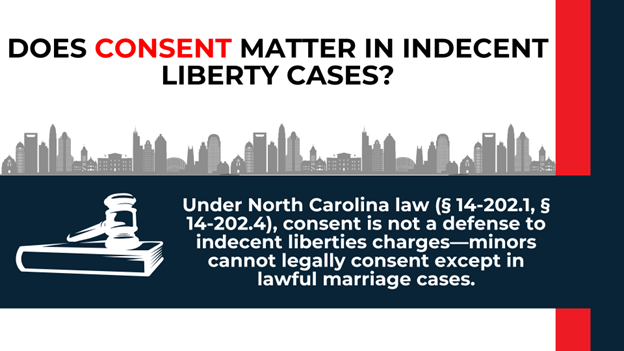
Both N.C. Gen. Stat. § 14-202.1 and N.C. Gen. Stat. § 14-202.4 state unequivocally: “Consent is not a defense to a charge under this section.”
This means that even if the minor appeared willing, actively participated, or even initiated the conduct, these facts do not provide a legal defense to the charge. North Carolina law recognizes that minors lack the legal capacity to consent to sexual conduct with adults, particularly those in positions of authority.
The Policy Behind the Consent Prohibition
This legal principle reflects several important policy considerations:
- Protection of vulnerable youth: Minors may not fully understand the implications of sexual conduct or may be unable to resist pressure from adults
- Recognition of power imbalances: Particularly in school settings, the inherent authority of teachers and other school personnel creates an unequal relationship
- Developmental considerations: Adolescents may lack the judgment and maturity to make informed decisions about sexual conduct
For those accused, this statutory provision eliminates what might otherwise seem like an obvious defense. The alleged victim’s statements indicating willingness or desire to participate do not negate the criminal nature of the conduct under North Carolina law.
Exceptions: Lawful Marriage
N.C. Gen. Stat. § 14-202.4 provides one narrow exception: “A person is not guilty of taking indecent liberties with a student if the person is lawfully married to the student.”
This exception applies only to the student-specific statute and requires a lawful marriage. It does not extend to the general indecent liberties statute or other related offenses.
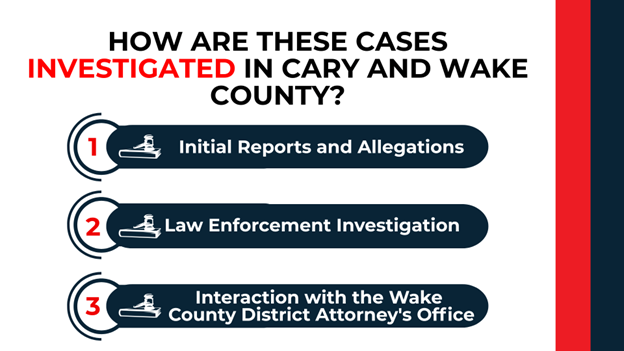
How Are These Cases Investigated in Cary and Wake County?
Understanding the investigation process helps those accused make informed decisions about their defense.
Initial Reports and Allegations
Investigations typically begin when someone reports alleged inappropriate conduct to authorities. Common sources of initial reports include:
- The alleged victim disclosing the conduct to a parent, teacher, counselor, or friend
- A third party observing concerning behavior
- Discovery of suspicious communications on a minor’s electronic device
- Mandatory reporting by professionals who work with children
In Cary, reports may come to the Cary Police Department directly, or they may first surface through the Wake County Public School System’s internal processes. North Carolina law requires certain professionals—including teachers, school personnel, and healthcare providers—to report suspected child abuse, including sexual abuse.
Law Enforcement Investigation
Once a report reaches law enforcement, the Cary Police Department’s Special Victims Unit typically handles the investigation. This specialized unit focuses specifically on cases involving domestic violence, sexual assault, and crimes against children.
The investigation may include:
- Forensic interviews of the alleged victim: Trained professionals conduct these interviews using techniques designed to elicit reliable information without leading or suggestive questioning
- Collection of physical evidence: This may include clothing, bedding, or other items that might contain DNA or other forensic evidence
- Analysis of electronic evidence: Investigators examine cell phones, computers, tablets, social media accounts, and other digital communications
- Witness interviews: Police speak with anyone who might have relevant information, including family members, friends, teachers, and others
- Interview of the suspect: Law enforcement may attempt to interview the accused person
The Cary Police Department collaborates with state and federal agencies on complex cases, including participation in multi-agency task forces such as Operation Southern Impact and the Invictus Project, which target child exploitation.
Interaction with the Wake County District Attorney’s Office
As the investigation progresses, the Cary Police Department works closely with the Wake County District Attorney’s Office, which will ultimately make charging decisions and handle prosecution if the case proceeds.
Prosecutors review the evidence to determine:
- Whether probable cause exists to support criminal charges
- Which specific charges are appropriate given the facts
- Whether the case can be proven beyond a reasonable doubt at trial
For cases involving alleged indecent liberties, prosecutors typically take an aggressive approach, reflecting the serious nature of these offenses and community concerns about protecting children.
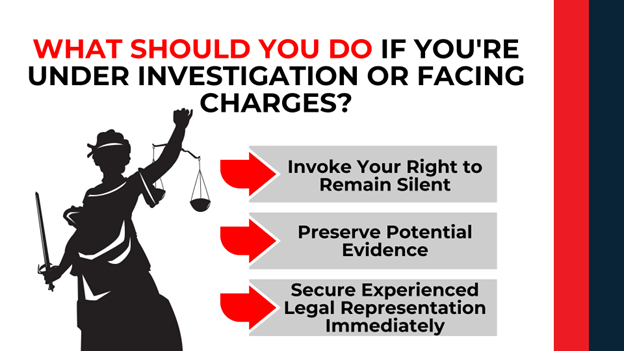
What Should You Do If You’re Under Investigation or Facing Charges?
The actions you take immediately after learning of an investigation or arrest can significantly impact the outcome of your case.
Invoke Your Right to Remain Silent
If law enforcement contacts you about an investigation:
- Do not make statements without an attorney present: Anything you say can and will be used against you in court
- Politely decline to answer questions: You have a constitutional right to remain silent, and exercising this right cannot be used against you
- Do not try to “explain away” the accusations: Many people facing accusations believe they can convince investigators of their innocence through conversation—this strategy almost always backfires
Even innocent explanations can be misconstrued or taken out of context. Investigators are trained in interrogation techniques designed to elicit admissions, even from innocent people. In Cary’s affluent, educated community, many residents have never had contact with law enforcement and may not understand how these investigations work—this unfamiliarity can lead to critical mistakes.
Preserve Potential Evidence
While you should not destroy any evidence:
- Do not delete communications: Deleting text messages, emails, or social media content can be charged as obstruction of justice or evidence tampering
- Do not contact the alleged victim or their family: Any contact can be misinterpreted as witness intimidation or tampering
- Do not discuss the case on social media: Anything you post can be discovered and used against you
Secure Experienced Legal Representation Immediately
Time is critical in these cases. The earlier you have an attorney involved, the better your chances of a favorable outcome.
An experienced criminal defense attorney can:
- Intervene in the investigation: Your attorney may be able to prevent charges* from being filed or negotiate reduced charges* before formal prosecution begins
- Protect your constitutional rights: Legal counsel ensures law enforcement follows proper procedures and respects your rights
- Begin building your defense immediately: Early investigation can uncover exculpatory evidence or witness statements that support your version of events
- Advise you on critical decisions: From whether to submit to questioning to how to respond to search warrants, your attorney guides you through complex legal choices
For Cary residents, finding an attorney with specific experience in sex crimes cases is essential. These cases involve unique legal issues, specialized forensic evidence, and prosecution strategies that differ from other criminal matters.
*Disclaimer: Each case is different and must be evaluated separately. Prior results achieved do not guarantee similar results can be achieved in future cases.
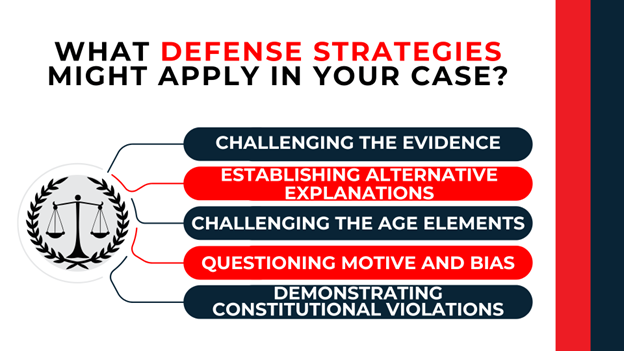
What Defense Strategies Might Apply in Your Case?
Every case is different, and the appropriate defense strategy depends on the specific facts and evidence. However, several common approaches may apply.
Challenging the Evidence
A thorough examination of the prosecution’s evidence often reveals weaknesses:
- Inconsistencies in the alleged victim’s account: Changes in the story, contradictions between different statements, or implausible details can undermine credibility
- Lack of corroboration: If the case rests entirely on one person’s word against another’s, without physical evidence or witness testimony, the prosecution may struggle to meet its burden of proof
- Improper investigative techniques: Suggestive questioning, leading interviews, or violations of proper forensic protocols can taint evidence
- Chain of custody issues: For physical or electronic evidence, any break in the chain of custody can render evidence inadmissible
In cases involving digital evidence—particularly relevant in Cary’s tech-savvy community—defense attorneys may challenge the authentication, collection, or analysis of electronic communications.
Establishing Alternative Explanations
In some cases, the defense can present evidence showing that:
- The conduct was misinterpreted: Actions that appeared inappropriate had innocent explanations
- The physical contact was accidental: Unintentional touching may have been perceived as deliberate
- The relationship was mischaracterized: The defendant’s role or position may not fit the statutory definitions
Challenging the Age Elements
Since the statutes require specific age differentials, proving or disproving ages becomes critical:
- Demonstrating the defendant is younger than alleged
- Establishing the alleged victim is older than claimed
- Proving the age gap doesn’t meet statutory requirements
Questioning Motive and Bias
Some cases involve allegations that stem from:
- Custody disputes: False accusations may emerge in contentious divorce or custody proceedings
- Teenage manipulation: Adolescents may make false reports to avoid punishment, seek attention, or retaliate for perceived slights
- Misunderstandings that escalate: Initial concerns or questions may snowball into formal accusations through misinterpretation
In Cary’s community, where residents often work in competitive professional environments and maintain complex social networks, the motivation behind accusations sometimes proves relevant to the defense.
Demonstrating Constitutional Violations
If law enforcement violated your constitutional rights during the investigation:
- Illegal searches: Evidence obtained through unlawful searches may be suppressed
- Coerced statements: Confessions obtained through improper interrogation techniques can be excluded
- Right to counsel violations: Statements made after you invoked your right to an attorney may be inadmissible
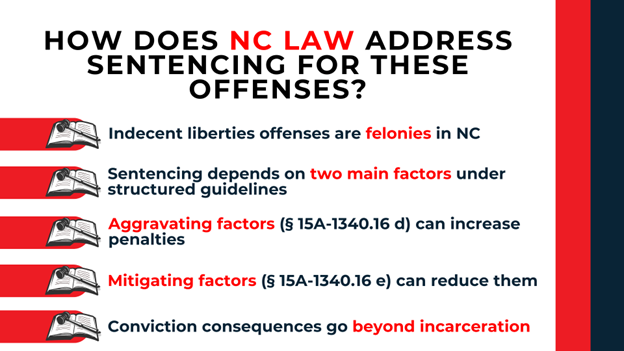
How Does North Carolina Law Address Sentencing for These Offenses?
While we cannot specify exact sentence lengths, understanding the sentencing framework helps you grasp the potential consequences you face.
Felony Classifications
North Carolina classifies indecent liberties offenses as felonies:
- Class F felony: N.C. Gen. Stat. § 14-202.1 (general indecent liberties with children)
- Class G felony: N.C. Gen. Stat. § 14-202.4 (indecent liberties with a student)
- Class E felony: N.C. Gen. Stat. § 14-27.31 (sexual activity by substitute parent or custodian)
These classifications reflect the seriousness with which North Carolina treats these offenses.
Structured Sentencing System
North Carolina uses a structured sentencing system that considers two primary factors:
- The offense class: The classification of the crime (Class E, F, or G)
- The defendant’s prior record level: Calculated based on previous convictions
N.C. Gen. Stat. § 15A-1340.16 provides for aggravating and mitigating factors that can affect sentencing. The court examines evidence of circumstances that make the offense more or less serious than typical cases.
Aggravating Factors
Under N.C. Gen. Stat. § 15A-1340.16(d), numerous aggravating factors may apply to these cases, including:
- The victim was very young or otherwise particularly vulnerable
- The defendant took advantage of a position of trust or confidence, including a domestic relationship
- The defendant involved a person under the age of 16 in the commission of the crime
- The defendant committed an offense knowing that a person under 18 who was not involved was in a position to see or hear the offense
- The offense was especially heinous, atrocious, or cruel
The state bears the burden of proving aggravating factors beyond a reasonable doubt. In most cases, a jury must determine whether aggravating factors exist before the court can impose an aggravated sentence.
Mitigating Factors
N.C. Gen. Stat. § 15A-1340.16(e) identifies mitigating factors that may support a reduced sentence, including:
- The defendant has been a person of good character or had a good reputation in the community
- The defendant supports the defendant’s family
- The defendant has accepted responsibility for the criminal conduct
- The defendant has a positive employment history or is gainfully employed
- The defendant has a good treatment prognosis and a workable treatment plan is available
The defendant bears the burden of proving mitigating factors by a preponderance of the evidence.
Collateral Consequences Beyond Incarceration
A conviction carries consequences that extend far beyond potential incarceration:
- Sex offender registration: Conviction requires registration as a sex offender, with regular reporting requirements, address restrictions, and public disclosure
- Employment impacts: Many professions become inaccessible, including teaching, healthcare, childcare, and positions requiring professional licenses
- Housing restrictions: Sex offender status limits where you can live, particularly regarding proximity to schools and childcare facilities
- Custody and visitation: Convictions can result in loss of parental rights or severely restricted access to your children
- Immigration consequences: Non-citizens face potential deportation and bars to naturalization
- Loss of civil rights: Felony convictions result in loss of the right to vote, possess firearms, and serve on juries
For Cary residents—many of whom work in professional fields requiring advanced degrees and credentials—these collateral consequences can be as devastating as the direct criminal penalties.
Why Does Patrick Roberts Law Bring Unique Advantages to These Cases?
When facing charges as serious as indecent liberties with a minor, the attorney you choose can make the difference between conviction and acquittal, between incarceration and freedom.
Prosecutor Experience in Sex Crimes
Attorney Patrick Roberts brings invaluable insight from his prior experience as a prosecutor handling sex crimes cases. This background provides several strategic advantages:
- Understanding prosecution strategy: Having built these cases from the state’s perspective, Patrick Roberts knows how prosecutors think, what evidence they prioritize, and what weaknesses they worry about
- Anticipating the state’s case: Prosecutor experience enables prediction of how the state will present its evidence and what arguments they’ll make
- Recognizing investigative flaws: Former prosecutors know proper investigative procedures and can quickly identify when law enforcement has cut corners or violated protocols
Patrick Roberts Law offers the powerful combination of insider knowledge from a former prosecutor and the dedicated defense advocacy your case demands.
Early Intervention Makes a Critical Difference
The earlier you secure experienced legal representation, the more options remain available:
- Pre-charge intervention: Before formal charges are filed, an attorney may present evidence or legal arguments that convince prosecutors not to pursue the case
- Bond and pretrial release: Immediate representation at the initial appearance increases the likelihood of reasonable bond conditions
- Evidence preservation: Early investigation prevents the loss of exculpatory evidence and identifies witnesses while memories remain fresh
- Protection of rights: Having an attorney from the outset ensures law enforcement respects your constitutional rights throughout the investigation
Many people make the critical mistake of waiting—hoping the investigation will go away, believing they can handle the matter themselves, or simply paralyzed by fear and uncertainty. This delay often proves devastating to the defense.
In Cary’s close-knit community, where reputations matter and word travels quickly through social networks and professional circles, early action to protect your interests becomes even more important. The sooner you engage experienced counsel, the better positioned you are to minimize damage to your reputation while we work to resolve the criminal charges.

Take Action Now to Protect Your Future
Accusations of indecent liberties with a minor strike at the core of your life—threatening your freedom, your family relationships, your career, and your standing in the community. In Cary, where the Special Victims Unit of the Cary Police Department and the Wake County District Attorney’s Office pursue these cases aggressively, you need a defense attorney who understands both the law and the prosecution’s approach.
The time to act is now—before you make statements that can’t be taken back, before evidence disappears, before options for your defense narrow. Patrick Roberts Law offers the combination of prosecutor experience and dedicated criminal defense advocacy that sex crimes cases demand. With specific knowledge of how the state builds these cases, we know how to dismantle the prosecution’s evidence and fight for the best possible outcome in your situation.
Don’t face these charges alone. Contact Patrick Roberts Law today to discuss your case* in a confidential consultation. Every day that passes without experienced legal counsel working on your behalf is a day lost in building your defense.
*Disclaimer: Each case is different and must be evaluated separately. Prior results achieved do not guarantee similar results can be achieved in future cases.

Former assistant district attorney
Contact Patrick Roberts
Facing criminal charges in North Carolina demands seasoned representation. Trust in the experience and dual perspective of Patrick Roberts. Reach out today for a confidential consultation.
-
Call Our Team
Calls answered 24/7







For more information on the selection criteria, go to www.martindale.com
*Each case is different and must be evaluated separately. Prior results achieved do not guarantee similar results can be achieved in future cases.