
How Do Bail Bonds Work in North Carolina?

When someone you care about is arrested, the hours that follow often feel chaotic and overwhelming. You’re fielding phone calls, trying to understand what happened, and hearing unfamiliar terms like “secured bond” and “surety” thrown around by officials who seem to assume you already know what they mean. The immediate question on everyone’s mind is straightforward: how do we get them out?
Understanding how bail bonds work in North Carolina is the first step toward navigating this process effectively. North Carolina law establishes specific procedures for pretrial release, defines what types of bonds courts can require, and sets clear obligations for defendants once they’re released. Recent legislative changes—including Iryna’s Law (Session Law 2025-93), effective December 1, 2025—have significantly tightened pretrial release standards for certain offenses, making it more important than ever to understand how the system works. This guide explains the North Carolina bail bond system from start to finish—what bail actually is, how judges decide whether and how much to require, what happens after bail is set, and what obligations come with being released on bond.
What Exactly Is a Bail Bond in North Carolina?
What Is the Purpose of Bail in the Criminal Justice System?
Bail exists to balance two competing interests: the defendant’s right to liberty before trial and the State’s interest in ensuring the defendant appears for court proceedings. A bail bond is essentially a promise—backed by financial consequences—that the defendant will show up when required.
Under N.C. Gen. Stat. § 15A-531, a bail bond is defined as “an undertaking by the defendant to appear in court as required upon penalty of forfeiting bail to the State in a stated amount.” The bond remains in effect throughout all stages of the proceeding until judgment is entered, unless terminated earlier under specific circumstances outlined in the statute.
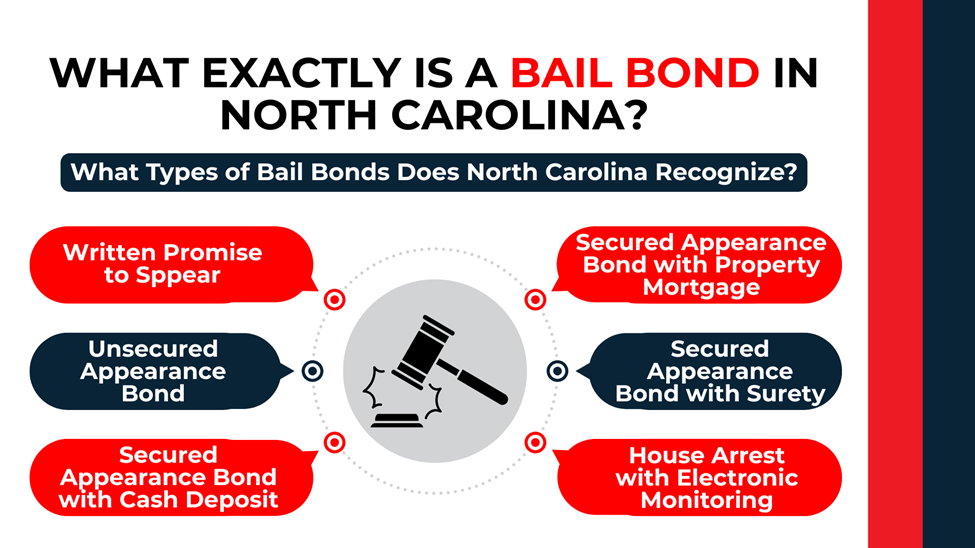
What Types of Bail Bonds Does North Carolina Recognize?
North Carolina law recognizes several distinct types of bail bonds, each with different requirements and financial implications. Understanding these options helps defendants and their families make informed decisions about how to secure release.
The primary types of bail bonds under North Carolina law include:
- Written promise to appear: The defendant signs a document promising to appear without any financial security required.
- Unsecured appearance bond: The defendant signs a bond for a specified amount but pays nothing upfront; the amount becomes due only if the defendant fails to appear.
- Secured appearance bond with cash deposit: The defendant or someone on their behalf deposits the full bond amount in cash with the court.
- Secured appearance bond with surety: A bail bondsman or insurance company guarantees the bond amount, typically in exchange for a non-refundable premium.
- Secured appearance bond with property mortgage: Real property is pledged as security under N.C. Gen. Stat. § 58-74-5.
- House arrest with electronic monitoring: The defendant is confined to their residence with exceptions for employment, counseling, or court-approved activities, monitored electronically.
The type of bond a court requires depends heavily on the nature of the charges, the defendant’s history, and—under recent changes to North Carolina law—whether the offense qualifies as a “violent offense.”
Who Are the Different Parties Involved in a Bail Bond?
The bail bond system involves several distinct roles. The “principal” is the defendant—the person obligated to appear in court. A “surety” is anyone who guarantees the defendant’s appearance, and North Carolina law recognizes three categories of sureties.
An “accommodation bondsman” is typically a friend or family member who pledges their own property as security without receiving any payment beyond the legal rights against the defendant if the bond is forfeited. A “professional bondsman” is licensed by the Commissioner of Insurance and pledges cash or approved securities as collateral for the bonds they write. A “bail agent” (sometimes called a surety bondsman) works on behalf of an insurance company, executing bonds under a power of attorney from the insurer.
How Does a Judge Decide Whether to Grant Bail?
What Factors Does the Court Consider When Setting Bail?
When determining conditions of pretrial release, judicial officials don’t simply pick a number. N.C. Gen. Stat. § 15A-534(c) requires them to consider specific factors based on available information, and under amendments effective December 1, 2025, judicial officials must now direct law enforcement, a pretrial services program, or the district attorney to provide a criminal history report for consideration.
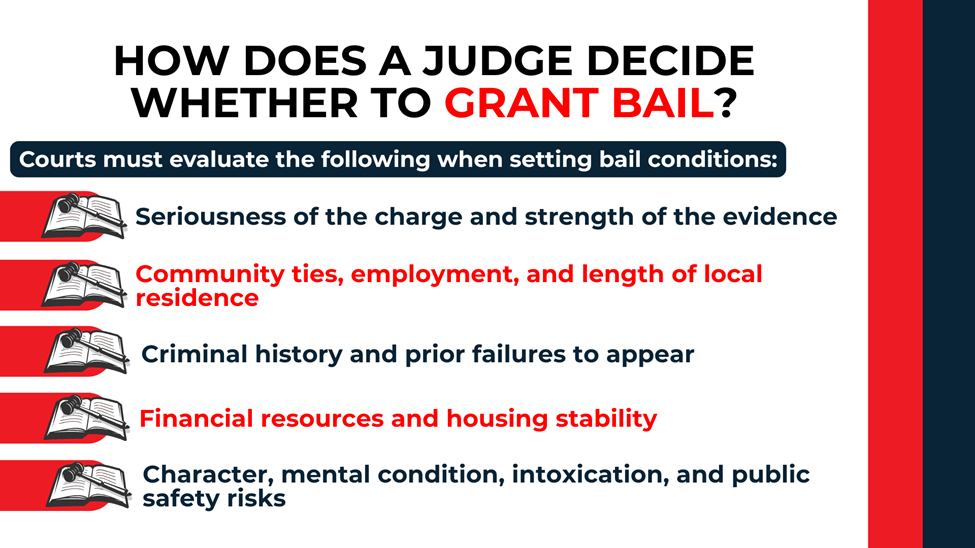
Courts must evaluate the following when setting bail conditions:
- The nature and circumstances of the offense charged
- The weight of the evidence against the defendant
- The defendant’s family ties and employment status
- The defendant’s financial resources
- The defendant’s character, housing situation, and mental condition
- Whether the defendant is intoxicated to a degree that would make unsupervised release dangerous
- The length of the defendant’s residence in the community
- The defendant’s record of prior convictions
- The defendant’s history of failing to appear for court proceedings or fleeing to avoid prosecution
- Any other evidence relevant to pretrial release
For most non-violent offenses, the statute still requires judges to impose the least restrictive conditions that will reasonably assure the defendant’s appearance and protect public safety. However, Iryna’s Law has fundamentally changed this calculus for offenses classified as “violent.”
Are There Charges Where Bail Can Be Denied in North Carolina?
North Carolina law gives judges discretion to deny bail entirely for certain serious offenses. Under N.C. Gen. Stat. § 15A-533(b), a judge determines in their discretion whether to grant pretrial release for charges including first or second degree murder, various degrees of rape and sexual offense, assault with a deadly weapon with intent to kill inflicting serious injury, first or second degree kidnapping, human trafficking, armed robbery, first degree burglary, and first degree arson.
Important change under Iryna’s Law: For defendants charged with any offense listed in G.S. 15A-533(b), there is now a rebuttable presumption that no condition of release will reasonably assure the defendant’s appearance and community safety. This shifts the burden—rather than the State arguing for detention, the defendant must overcome the presumption that release is inappropriate.
For capital offenses, judges have complete discretion under N.C. Gen. Stat. § 15A-533(c) to determine whether any release is appropriate.
The statute also creates rebuttable presumptions against release in specific circumstances, including when a defendant allegedly committed a drug trafficking offense while already on pretrial release for another offense, or when the offense involved illegal use of a firearm while the defendant was on pretrial release for another firearm-related offense.
What Role Does a Defendant’s Criminal History Play?
Criminal history significantly influences bail decisions—and recent legislative changes have made prior convictions even more consequential.
Under Iryna’s Law, if a defendant has been convicted of three or more offenses (each a Class 1 misdemeanor or higher) within the previous ten years, the judicial official must impose a secured appearance bond or house arrest with electronic monitoring. The less restrictive options—written promise to appear, unsecured bond, or supervised release—are no longer available for these defendants.
Additionally, for defendants charged with violent offenses or those with three or more qualifying prior convictions, the judicial official must now make written findings of fact explaining why the release conditions are appropriate based on the statutory factors. This documentation requirement adds accountability to bail decisions.
A history of failing to appear for court dates continues to weigh heavily against release on less restrictive terms. Under N.C. Gen. Stat. § 15A-534(d1), when a defendant has already failed to appear on one or more occasions for the charges at issue, the judicial official must impose at least the conditions recommended in any outstanding arrest order, or require a secured bond at least double the previous amount (with a minimum of $1,000).
What Happens After Bail Is Set?
How Do You Actually Post a Bail Bond?
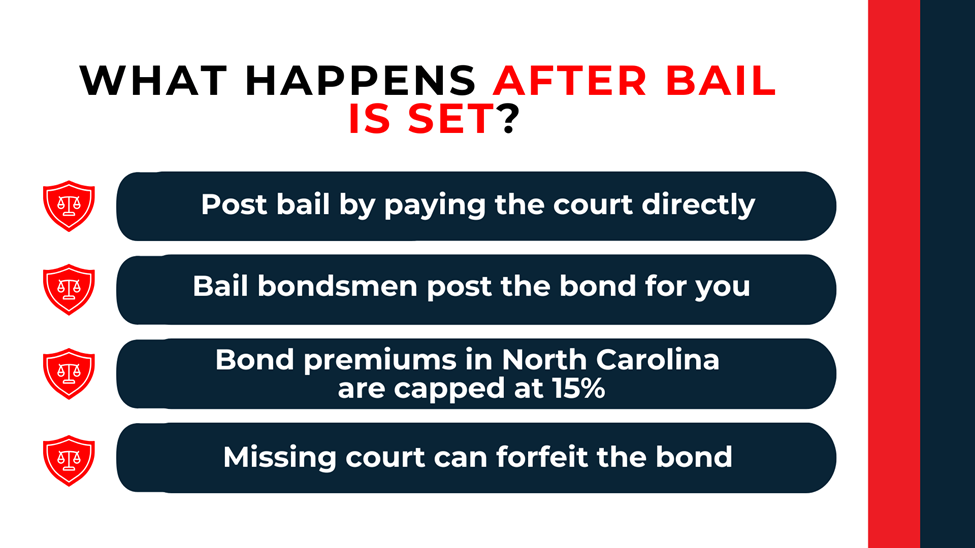
Once a judicial official sets bail conditions, the defendant or someone acting on their behalf must satisfy those conditions to secure release. For a cash bond, this means depositing the full amount with the court—funds that will be returned (minus any court costs or fees) when the case concludes, assuming all court appearances are made.
For a secured bond with a surety, the process typically involves contacting a licensed bail bondsman. The bondsman assesses the risk, collects a premium, may require collateral, and then posts the bond on the defendant’s behalf.
What Does a Bail Bondsman Do?
A bail bondsman essentially guarantees to the court that the defendant will appear as required. If the defendant fails to appear and the bond is forfeited, the bondsman becomes liable for the full bond amount.
To manage this risk, bondsmen are permitted under N.C. Gen. Stat. § 58-71-95 to require collateral security or other indemnity from the defendant or their family. This collateral must be “reasonable in relation to the amount of the bond” and must be returned within 15 days after the bond obligation terminates. Failure to return collateral valued over $1,500 is a Class I felony.
Bondsmen are also authorized under N.C. Gen. Stat. § 15A-540 to surrender a defendant to the sheriff and be relieved of their obligation—a power that incentivizes defendants to maintain contact with their bondsman and comply with all court requirements.
How Much Does a Bail Bond Cost in North Carolina?
North Carolina law caps the premium a bail bondsman can charge at fifteen percent of the face amount of the bond. This premium is non-refundable—it’s the bondsman’s fee for taking on the risk of guaranteeing the defendant’s appearance.
For example, on a $10,000 bond, the maximum premium would be $1,500. If the defendant makes all court appearances, the bondsman keeps this fee regardless of case outcome. If the defendant pays a cash bond directly to the court, however, they receive the full amount back (less any applicable fees) when the case concludes.
The financial strain bail creates for families is significant, which is why effective advocacy at the bail stage—arguing for the lowest appropriate bond amount and least restrictive conditions—can make a meaningful difference in a defendant’s ability to maintain employment and support their family while their case proceeds.
What Are Your Obligations Once You’re Released on Bond?
What Conditions Might the Court Impose on Your Release?
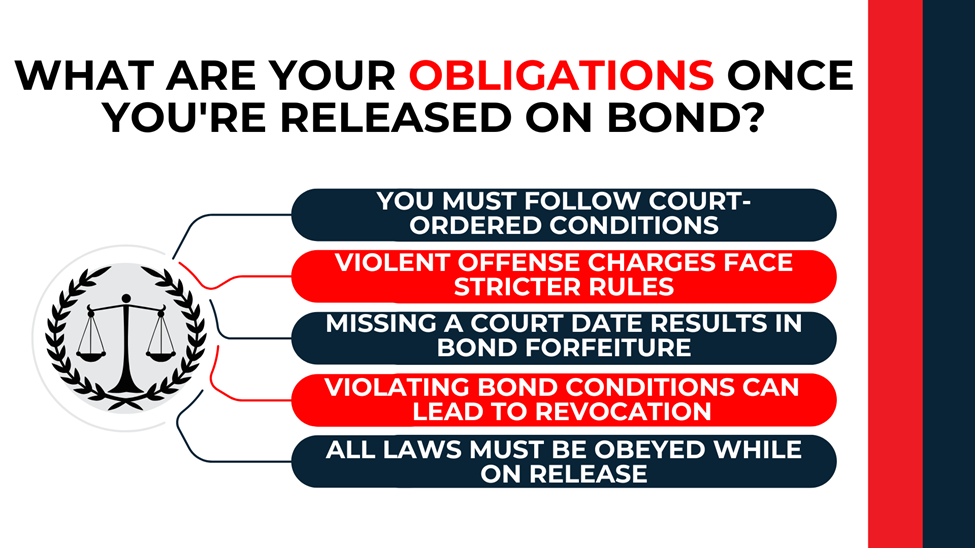
Release on bond isn’t unconditional. N.C. Gen. Stat. § 15A-534(a) authorizes judicial officials to place restrictions on travel, associations, conduct, or place of residence. Additional conditions may include electronic monitoring with house arrest, abstaining from alcohol consumption verified by continuous monitoring, or supervision by a designated person or organization.
Common conditions imposed on pretrial release include:
- Remaining within the jurisdiction or obtaining permission before traveling
- Maintaining employment or actively seeking employment
- Avoiding contact with alleged victims or witnesses
- Abstaining from alcohol or controlled substances
- Submitting to drug testing
- Surrendering firearms
- Obeying all laws
Note on Iryna’s Law and “violent offenses”: Under the new statutory framework effective December 1, 2025, defendants charged with “violent offenses”—a newly defined category under N.C. Gen. Stat. § 15A-531(9)—face a rebuttable presumption against release and mandatory minimum bond conditions. A “violent offense” now includes any Class A through G felony involving assault, physical force, or threat of force; any felony sex offense requiring registration; offenses like discharging a firearm into occupied property, first-degree burglary, indecent liberties with a child, stalking, and possession of a firearm by a felon; as well as fentanyl trafficking and attempts to commit any of these offenses.
For a first violent offense, if release is granted, the court must impose either a secured bond or house arrest with electronic monitoring. For a second or subsequent violent offense—whether following a prior conviction or while on pretrial release for a prior violent offense—the court must impose house arrest with electronic monitoring if available.
What Happens If You Miss a Court Date?
Missing a court date triggers serious consequences. Under N.C. Gen. Stat. § 15A-544.3, when a defendant fails to appear as required, the court enters a forfeiture for the full bond amount against both the defendant and any surety. Notice of this forfeiture is mailed to all parties, and the forfeiture becomes a final judgment—enforceable like any civil judgment—after 150 days unless set aside.
An order for arrest is typically issued, and when the defendant is eventually located, they’ll face not only the original charges but also the consequences of the failure to appear, including significantly higher bond requirements.
Can Your Bond Be Revoked?
Yes. Under N.C. Gen. Stat. § 15A-534(f), any judge may revoke an order of pretrial release for good cause shown. Violations of bond conditions, new criminal charges, or evidence suggesting the defendant poses a danger or flight risk can all justify revocation.
If bond is revoked, the defendant is taken back into custody. They may apply to have new conditions set, but the judge will consider the circumstances that led to revocation when determining whether and under what conditions to allow release.
Can Bail Be Reduced or Modified After It’s Set?
When Can You Request a Bond Reduction?
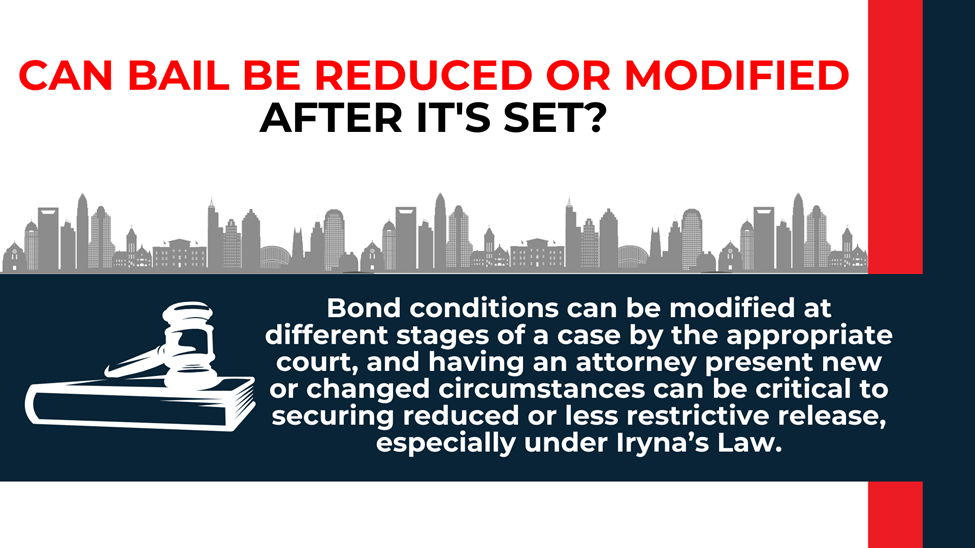
Bond conditions aren’t necessarily permanent. Under N.C. Gen. Stat. § 15A-534(e), different judicial officials can modify pretrial release orders at different stages of the case. A magistrate or clerk can modify their own order before the first district court appearance. After that appearance, a district court judge can modify earlier orders until the case moves to superior court or an appeal is noted. Once the case is in superior court, a superior court judge has modification authority.
What Evidence Helps Support a Bond Modification Request?
Successful bond modification requests typically present new information or changed circumstances that address the court’s original concerns. Evidence of strong community ties, stable employment, family responsibilities, and lack of criminal history all support arguments for reduced bond or less restrictive conditions.
When the underlying charges may be contested or the State’s evidence is weak, highlighting these issues can affect how courts weigh flight risk and danger to the community. The strength of the State’s case is a legitimate factor in bail determinations.
How Does Having an Attorney Affect Bond Hearings?
Having experienced defense counsel at bond hearings substantially affects outcomes. An attorney can present mitigating information effectively, challenge the State’s characterization of the evidence, and argue for specific conditions that address the court’s concerns while minimizing disruption to the defendant’s life.
Defense counsel can also identify when the State is seeking excessive restrictions and advocate for alternatives. The difference between a $50,000 secured bond and a $10,000 secured bond—or between secured and unsecured conditions—can determine whether a defendant waits months in jail or returns home to their family while their case proceeds.
This advocacy is particularly critical under Iryna’s Law, where the presumption has shifted against release for violent offenses and defendants must affirmatively demonstrate that release conditions can adequately protect the community and ensure appearance.
What Happens If a Bail Bond Is Forfeited?
How Does the Forfeiture Process Work?
When a defendant fails to appear, the court enters a forfeiture under N.C. Gen. Stat. § 15A-544.3. This forfeiture must contain specific information including the defendant’s name and address, the bond amount, the names of all sureties, and the date on which the forfeiture will become final if not set aside.
Notice is mailed to the defendant and each surety, and it becomes effective when mailed regardless of whether actually received. The notice includes detailed information about how the forfeiture can be set aside and warns that sureties will be prohibited from executing new bonds in that county until any final judgment is satisfied.
Can a Forfeiture Be Set Aside?
Yes, but only for specific reasons enumerated in N.C. Gen. Stat. § 15A-544.5. A forfeiture may be set aside if the failure to appear is stricken and any arrest order recalled, if all charges are finally disposed, if the defendant is surrendered by a surety, if the defendant is served with an order for arrest, if the defendant died before final judgment, or if the defendant was incarcerated at the time of the missed court date.
The motion to set aside must be filed within 150 days of the forfeiture notice and must include evidence supporting one of the permitted reasons. Courts have no discretion to set aside forfeitures for other reasons, no matter how sympathetic the circumstances.

Why Does Having an Experienced Defense Attorney Matter for Bail?
How Can a Defense Lawyer Help at the Bail Stage?
The bail stage is often underestimated, but decisions made here ripple throughout the entire case. A defendant who remains in custody has less ability to assist with their defense, maintain employment, or care for family. Studies consistently show that pretrial detention correlates with worse case outcomes, including higher conviction rates and longer sentences.
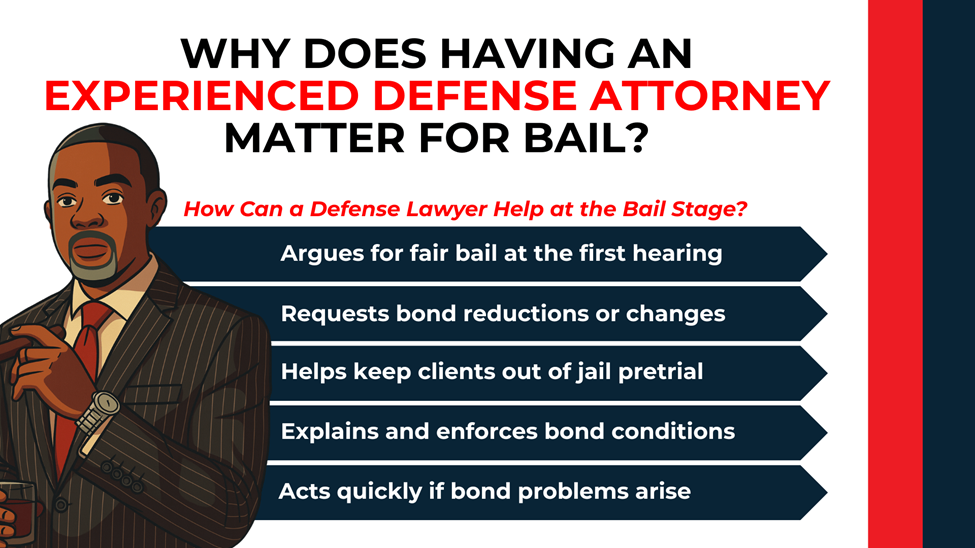
An experienced defense attorney can advocate for appropriate bond conditions at the initial hearing, prepare modification motions when circumstances warrant, ensure clients understand and comply with all conditions, and respond quickly if issues arise.
What Should You Look for in a Criminal Defense Attorney?
The bail system sits at the intersection of criminal procedure, client advocacy, and practical problem-solving. Effective representation requires understanding both the legal framework and the human stakes involved—particularly now, when recent legislative changes have made pretrial release significantly more difficult for certain categories of defendants.
Frequently Asked Questions About Bail Bonds in North Carolina
How long do you stay in jail if you can’t make bail in North Carolina?
If you cannot satisfy the bail conditions, you remain in custody until your case is resolved—which could mean weeks or months depending on court schedules and case complexity. This is why pursuing bond modification through an attorney is often worthwhile when initial conditions are unaffordable.
Can you bail yourself out of jail in North Carolina?
Yes, if you have access to funds. You can post a cash bond for the full amount, or a family member or friend can contact a bail bondsman on your behalf. The challenge is often practical: accessing funds and making arrangements while in custody.
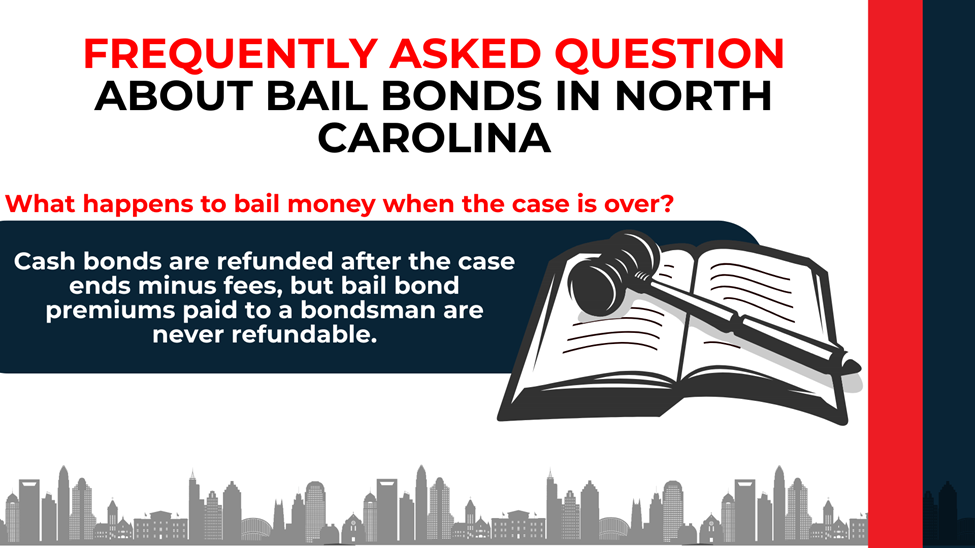
What happens to bail money when the case is over?
If you posted a cash bond directly with the court, the money is returned after the case concludes and all required appearances are made, minus any applicable court costs or fees. If you paid a premium to a bail bondsman, that fee is non-refundable regardless of the case outcome.
Can bail be denied in North Carolina?
Yes. Judges have discretion to deny bail for serious violent offenses including murder, rape, kidnapping, and armed robbery. Under Iryna’s Law (effective December 1, 2025), there is now a rebuttable presumption against release for these offenses—meaning defendants must overcome the assumption that no release conditions are adequate.
What’s the difference between bond and bail?
The terms are often used interchangeably in everyday conversation. Technically, “bail” refers to the security given to ensure a defendant’s appearance, while a “bond” is the written agreement documenting that undertaking. In practice, when someone asks about “bail,” they’re usually asking about the bond conditions and how to satisfy them.
Protect Your Rights from the Start
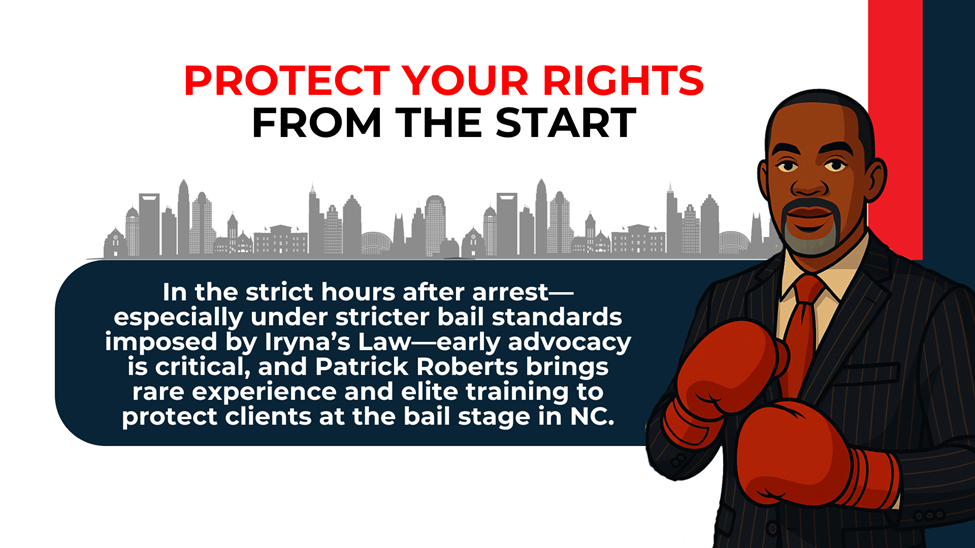
The hours after an arrest are critical. Bail decisions affect not just immediate freedom but the entire trajectory of a case. Understanding your options—and having an advocate who can present your circumstances effectively—makes a meaningful difference. With recent changes under Iryna’s Law tightening pretrial release standards for violent offenses and repeat offenders, effective advocacy at the bail stage has never been more important.
Attorney Patrick Roberts brings a unique combination of experience and training to criminal defense in North Carolina. As a former prosecutor, he handled drug crimes, sex offenses, and domestic violence cases—experience that provides critical insight into how the State builds cases and evaluates bail risk. He is a lifetime member of the National Association of Criminal Defense Lawyers (NACDL) and has completed extensive sex-crimes defense training through that organization. His training through the National Child Abuse Defense and Resource Center (NCADRC) focuses specifically on defending against false accusations, and he is the only North Carolina attorney listed on NCADRC’s registry at falseallegation.org. As a graduate of the National Criminal Defense College (NCDC), he continues pursuing advanced training in cross-examination and trial skills. He also trained directly with Gerry Spence at the renowned Trial Lawyers College, learning methods that emphasize connecting with juries and humanizing clients.
If you or someone you care about is facing criminal charges in North Carolina, contact Patrick Roberts Law to discuss your situation.
Disclaimer: The information on this website is for general information purposes only. Nothing on this site should be taken as legal advice for any individual case or situation. Case results depend upon a variety of factors unique to each case. Prior results do not guarantee a similar outcome.
Sexual Assault Defense Attorney in Cary, NC

If you’re facing sexual assault charges in Cary, NC, your freedom, reputation, and future are on the line. These are serious allegations that demand immediate action and skilled representation from a criminal defense attorney. Patrick Roberts understands the complexities of North Carolina’s sexual offense laws. He provides aggressive defense strategies for individuals accused of sexual assault throughout Wake County and the greater Triangle area. Call or contact Patrick Roberts Law online now. Time is not on your side, but we are.
Read the rest of this entry »
Being accused of first-degree sexual exploitation of a minor in Cary is among the most serious allegations anyone can face. This charge—prosecuted as a Class C or D felony in Wake County Superior Court—carries consequences that extend far beyond potential incarceration. For residents of Cary’s highly educated, professionally accomplished community, an accusation threatens careers built over decades, security clearances that enable work at Research Triangle Park employers, and standing in a family-oriented community known for its safety and quality of life.
Cary Police Department maintains the only dedicated Cyber Intelligence Unit among the Triangle’s four major police departments, giving these investigations specialized attention from the outset. Understanding what prosecutors must prove, how investigations unfold, and what defense options exist is essential for anyone facing these allegations or who has learned they are under investigation.
Read the rest of this entry »
Sexual exploitation of a minor is among the most aggressively prosecuted offenses in North Carolina. For Cary residents facing these allegations, the consequences extend far beyond the courtroom—threatening careers at Research Triangle Park companies, security clearances, professional licenses, and standing in a community where reputation matters deeply. Understanding exactly what North Carolina law prohibits, how Cary Police Department and federal task forces investigate these cases, and what defense options exist is essential for anyone confronting these charges.
North Carolina divides sexual exploitation into three degrees, each targeting different conduct related to material depicting minors engaged in sexual activity. Whether the allegation involves production, distribution, or possession, the State treats these as serious felonies with lasting consequences. This article explains what each charge means, how Wake County prosecutors approach these cases, and why experienced defense representation matters.
Read the rest of this entry »Online Solicitation Defense Attorney in Cary, NC

Patrick Roberts Law provides aggressive defense representation for individuals charged with internet-based solicitation offenses in Cary, NC and throughout Wake County.
An online solicitation conviction can result in prison time, substantial fines, sex offender registration, and a permanent criminal record that follows you for years. Don’t face these serious charges alone. Patrick Roberts offers free consultations and has earned excellent reviews from past clients for providing dedicated legal representation to Cary residents facing internet crime allegations.
Read the rest of this entry »Aggravated Assault Defense Attorney in Cary, NC
Serving Cary and the greater Wake County area, Patrick Roberts Law offers dedicated legal representation for those accused of aggravated assault.
An aggravated assault conviction comes with serious consequences, including lengthy prison sentences, steep fines, and a permanent criminal record that can affect your life for years. Don’t face these charges alone. Attorney Patrick Roberts provides free consultations and has earned hundreds of client reviews for his dedicated defense and case results.
Read the rest of this entry »Forcible Rape Defense Attorney in Cary, NC

When facing forcible rape charges in Cary, North Carolina, your freedom, reputation, and entire future hang in the balance. These are among the most serious criminal allegations in the North Carolina legal system, carrying severe penalties including lengthy prison sentences and mandatory sex offender registration. Patrick Roberts Law provides aggressive, strategic defense representation for individuals confronting these life-altering accusations in Wake County and throughout the Triangle area.
If you or a loved one has been charged with or is under investigation for forcible rape in Cary, immediate legal intervention is critical. Contact 919-746-7206 today or visit our contact page to schedule a free consultation with an experienced criminal defense attorney who understands the gravity of these charges.
Read the rest of this entry »
Domestic violence accusations carry serious consequences in North Carolina. If you face these charges in Cary or surrounding Wake County communities, you need to understand how the criminal justice system handles these cases. The question of whether domestic violence charges can be dropped is more complex than many realize.
The Wake County District Attorney’s Office prosecutes domestic violence cases aggressively. Even in a community known for safety like Cary—consistently ranked among North Carolina’s safest cities—these charges demand immediate attention and experienced legal representation.
Read the rest of this entry »
When accusations of family domestic violence arise in Cary, the consequences extend far beyond the courtroom. North Carolina law defines domestic violence broadly and prosecutes these cases aggressively. Residents of this highly educated, affluent community face unique challenges when charged—accusations here can threaten professional reputations, security clearances at Research Triangle Park employers, and family stability in ways that demand immediate, strategic legal intervention.
Read the rest of this entry »
Domestic violence charges in North Carolina can range from misdemeanors to serious felonies. The severity of the charge depends on several factors, including the nature of the alleged act, the defendant’s criminal history, and specific circumstances surrounding the incident. Understanding when domestic violence becomes a felony is crucial for anyone facing these serious accusations in Wake County courts.
Read the rest of this entry »Former assistant district attorney
Contact Patrick Roberts
Facing criminal charges in North Carolina demands seasoned representation. Trust in the experience and dual perspective of Patrick Roberts. Reach out today for a confidential consultation.
-
Call Our Team
Calls answered 24/7








For more information on the selection criteria, go to www.martindale.com
*Each case is different and must be evaluated separately. Prior results achieved do not guarantee similar results can be achieved in future cases.