
If you’re looking to understand the meaning of sexual battery in North Carolina, you’re in the right place. Sexual battery is a serious crime with big consequences. At Patrick Roberts Law, we know how confusing and scary this can be. This guide will explain what sexual battery means under North Carolina law, the penalties you could face, and how a good criminal defense lawyer can help you.
What Is Sexual Battery in North Carolina?
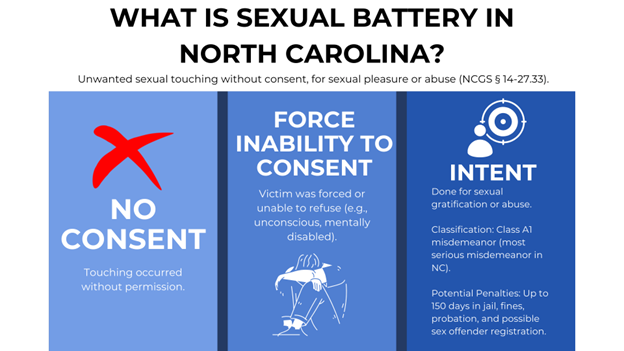
Sexual battery is a crime defined by North Carolina General Statute § 14-27.33. It happens when someone touches another person in a sexual way without their consent, for the purpose of sexual pleasure or abuse. Unlike more serious crimes like rape, sexual battery usually involves touching without penetration and is considered a Class A1 misdemeanor, the most serious type of misdemeanor in the state.
What Makes It Sexual Battery?
To prove sexual battery, the prosecution must show:
- No Consent (N.C.G.S. § 14-27.33(a)(1)): The touching happened without the other person’s permission. This includes touching private areas like the genitals, breasts, buttocks, or anus, or touching someone with your own private parts.
- Force or Taking Advantage (N.C.G.S. § 14-27.33(a)(1)-(2)): The touching was either done by force or involved someone who couldn’t consent because they were mentally disabled, passed out, or otherwise unable to say no.
- Intent (N.C.G.S. § 14-27.33(a)): The person doing the touching did it for sexual pleasure, gratification, or to abuse the other person.
Examples of Sexual Battery in North Carolina
Sexual battery can happen in many ways. Here are some examples:
- Grabbing or groping someone’s private areas without their permission.
- Forcing a kiss or touching someone with your own private parts.
- Ejaculating or placing bodily fluids on someone without their consent.
- Any other unwanted sexual touching that fits the legal definition.
Even if the act seems small, it can still lead to serious charges.
Penalties for Sexual Battery in North Carolina
If you’re convicted of sexual battery, the consequences can be life-changing. Here’s what you might face:
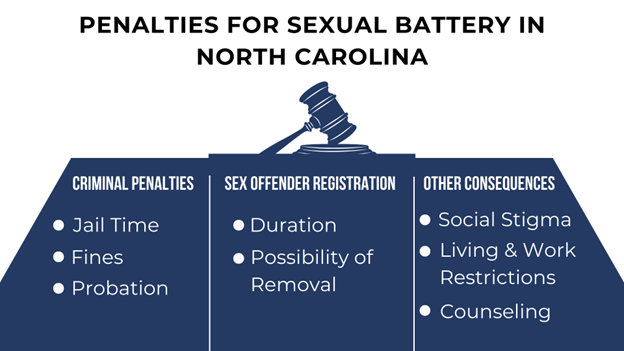
Criminal Penalties
- Jail Time (N.C.G.S. § 14-27.33(b), § 15A-1340.23): Up to 150 days in jail, depending on your criminal history.
- Fines (N.C.G.S. § 15A-1340.23): You may have to pay money as part of your punishment.
- Probation (N.C.G.S. § 15A-1343): The court might order probation, which means you’ll have to check in with a probation officer and follow certain rules.
Sex Offender Registration
One of the toughest parts of a sexual battery conviction is having to register as a sex offender. In North Carolina, this means:
- Your name will be on the North Carolina Sex Offender Registry for 10 to 30 years (N.C.G.S. § 14-208.7), depending on your case.
- In some cases, you can ask to be removed after 10 years (N.C.G.S. § 14-208.12A).
Other Consequences
- Social Stigma: Being labeled a sex offender can hurt your relationships and job opportunities.
- Restrictions on Where You Can Live and Work: You might not be allowed to live near schools or daycare centers.
- Counseling or Treatment: The court might require you to go to counseling or therapy.
How Is Sexual Battery Different from Sexual Assault in North Carolina?
In North Carolina, the terms sexual battery and sexual assault are often used interchangeably, but they refer to distinct crimes with different legal definitions and penalties. While North Carolina law does not explicitly define “sexual assault” as a standalone crime, it is commonly understood to encompass a range of serious sexual offenses, including rape and other forms of non-consensual penetration. Here’s a breakdown of the key differences:
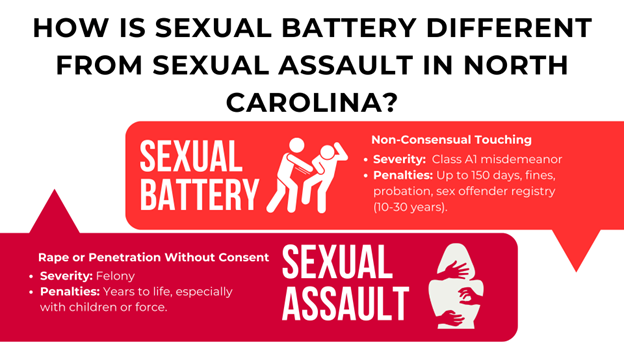
Sexual Battery
- Definition: Sexual battery is defined under North Carolina General Statute § 14-27.33 as non-consensual sexual contact for the purpose of sexual arousal, gratification, or abuse. This includes touching intimate areas like the genitals, anus, breasts, or buttocks, or touching someone with your own intimate body parts.
- Severity: It is classified as a Class A1 misdemeanor, the most serious level of misdemeanor in the state.
- Penalties: Conviction can result in up to 150 days in jail, fines, probation, and mandatory registration on the North Carolina Sex Offender Registry for 10 to 30 years.
Sexual Assault
- Definition: While North Carolina law does not explicitly define “sexual assault,” the term is often used to describe more severe sexual crimes, such as rape (N.C.G.S. § 14-27.21, § 14-27.22) or other sexual offenses (N.C.G.S. § 14-27.26, § 14-27.27), which involve non-consensual penetration (vaginal, anal, or oral) or other forms of sexual violence.
- Severity: These crimes are classified as felonies (N.C.G.S. § 14-27.21(b), § 14-27.22(b), § 14-27.26(b), § 14-27.27(b)), which carry much harsher penalties than misdemeanors.
- Penalties: Depending on the specific offense, penalties can range from several years in prison to life imprisonment (N.C.G.S. § 14-27.23(b)-(c), § 14-27.28(b)-(c)), especially in cases involving children or the use of force.
Defenses Against Sexual Battery Charges
If you’re accused of sexual battery, you need a good lawyer to help you fight the charges. Here are some possible defenses:
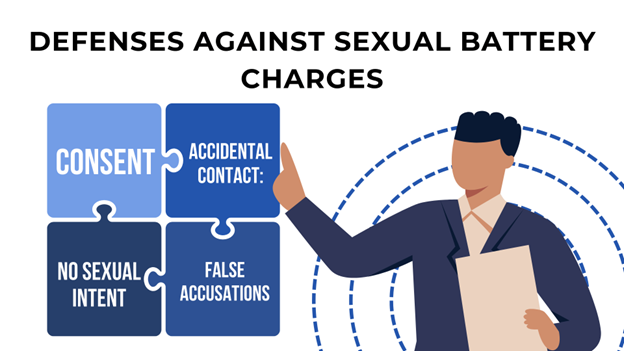
- Consent: Arguing that the other person agreed to the contact. But this won’t work if they were unable to consent, like if they were drunk or passed out.
- Accidental Contact: Showing that the touching was not on purpose.
- No Sexual Intent: Proving that the act wasn’t done for sexual reasons.
- False Accusations: Showing that the accusation is untrue or made up for revenge or other reasons.
A skilled lawyer can help you figure out the best defense for your case.
Why You Need a North Carolina Criminal Defense Attorney
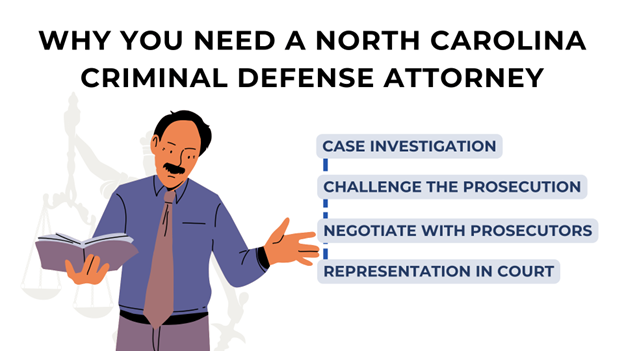
Facing sexual battery charges is scary, but you don’t have to go through it alone. A good lawyer can:
- Look into the facts of your case and find evidence to help you.
- Challenge the prosecution’s case.
- Talk to the prosecutors to try to reduce or drop the charges.
- Stand up for you in court and fight for the best outcome.
At Patrick Roberts Law, we’ve helped many people facing sexual battery charges in North Carolina. We know the law and will work hard to protect your rights and future.
Contact Us for a Free Consultation
If you or a loved one is facing sexual battery charges, you deserve a legal advocate with the experience and dedication to secure the best possible outcome. Attorney Patrick Roberts of Patrick Roberts Law has successfully defended numerous clients facing sexual battery charges.
Contact our firm today for a confidential consultation.
Former assistant district attorney
Contact Patrick Roberts
Facing criminal charges in North Carolina demands seasoned representation. Trust in the experience and dual perspective of Patrick Roberts. Reach out today for a confidential consultation.
-
Call Our Team
Calls answered 24/7







For more information on the selection criteria, go to www.martindale.com
*Each case is different and must be evaluated separately. Prior results achieved do not guarantee similar results can be achieved in future cases.