
Facing a charge for having drugs in a car in North Carolina can be overwhelming. Whether the drugs were found on your person or in your vehicle, the state treats these cases very seriously. In this guide, we dive into what this charge involves, the factors that influence your case, potential penalties, and effective defense strategies. We also explain how an experienced criminal defense attorney in North Carolina can help you navigate this complex legal terrain.
What Is a “Charge for Having Drugs in a Car”?
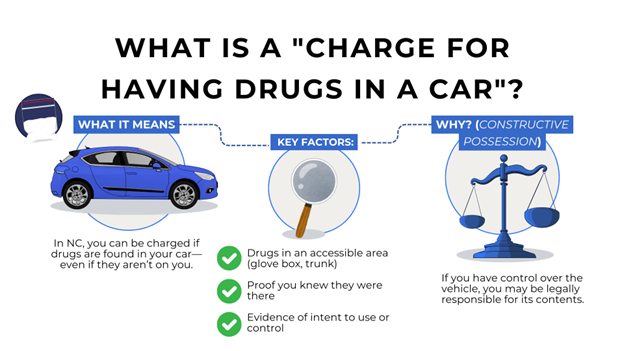
In North Carolina, drug possession isn’t limited to drugs found on your body. Under the principle of constructive possession, you can be charged if controlled substances are found in your vehicle—a place you have control over. This means that even if you were not actively carrying the drugs on your person, the fact that they were stored in your car may be enough to establish possession. Courts will consider whether you had the ability and intent to control or use the drugs. For example, if law enforcement discovers drugs in your glove compartment or trunk during a traffic stop, and there is evidence suggesting you knew about them, you could face a charge for having drugs in a car.
Factors That Influence the Charge
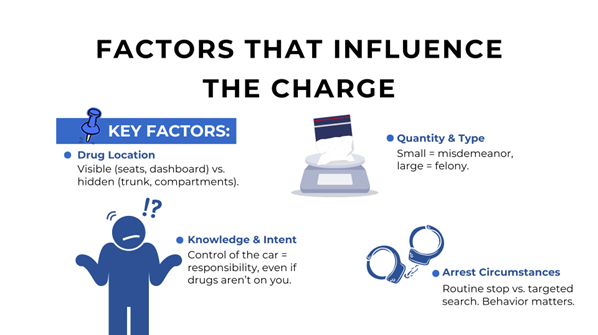
Several key factors affect whether you are charged and the severity of the charges you face:
1. Location of the Drugs
- Inside the Vehicle: Drugs found on the dashboard, seats, or within easy reach can indicate that you had control over them.
- Hidden Storage: Concealing drugs in compartments, under seats, or in the trunk further supports the argument for constructive possession.
2. Your Knowledge and Intent
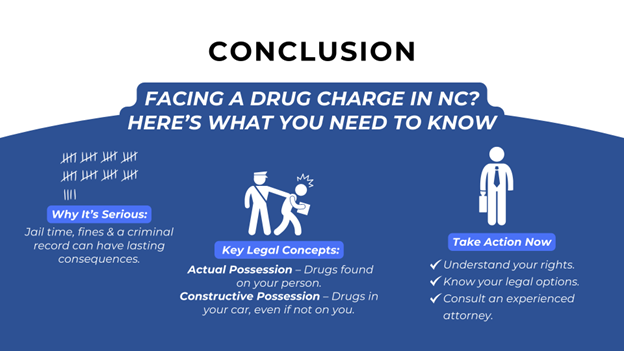
- Actual Possession: This occurs when the drugs are on your person (in your pocket, purse, or clothing) and you are aware of their presence.
- Constructive Possession: Even if the drugs are not physically on you, if they are in your car and you have control over the vehicle (for example, if you are the registered owner or regularly use the car), you can be charged. Evidence such as keys, personal belongings, or documents linking you to the vehicle can be used to prove your knowledge and intent.
3. Quantity and Type of Drug
- Small vs. Large Amounts: The amount of the drug is a critical factor. Possessing a minimal amount might result in misdemeanor charges, whereas larger quantities—especially those suggesting an intent to sell or distribute—can lead to felony charges.
- Drug Classification: North Carolina categorizes drugs into different schedules. Substances classified as Schedule I or II (such as heroin, cocaine, or methamphetamine) carry heavier penalties than those classified in lower schedules (such as certain forms of marijuana under specific circumstances).
4. Circumstances of the Arrest
- How the Drugs Were Discovered: Whether the drugs were found during a routine traffic stop or through a more targeted investigation can affect the charge. Improper search procedures may provide grounds for dismissing evidence if your constitutional rights were violated.
- Behavior at the Time of the Arrest: Suspicious behavior, such as attempts to hide evidence or erratic driving, can influence the severity of the charge.
Vehicle Searches and Your Constitutional Rights
The Fourth Amendment protects citizens against unreasonable searches and seizures, including those involving vehicles. Understanding when and how law enforcement can legally search your car is crucial if you face a charge for having drugs in a car in North Carolina.
The “Automobile Exception” and Probable Cause
Unlike your home, which typically requires a warrant to search, vehicles are subject to what courts call the “automobile exception.” Under this legal principle:
- Mobility Justification: Because vehicles can be quickly moved, courts allow searches without warrants in many circumstances.
- Reduced Privacy Expectation: The law recognizes a lower expectation of privacy in vehicles compared to homes.
- Probable Cause Requirement: Despite the exception, officers must still have probable cause—a reasonable belief that the vehicle contains evidence of a crime.
Legal Grounds for Vehicle Searches
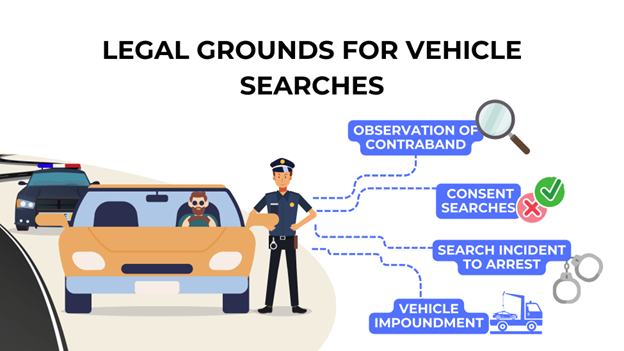
Several scenarios allow police to legally search your vehicle:
1. Observation of Contraband
- Plain View Doctrine: If an officer spots drugs, drug paraphernalia, or other contraband in plain view (such as on your dashboard or seat), this can establish probable cause for a more thorough search.
- Sensory Evidence: The smell of marijuana or other controlled substances can legally justify a vehicle search in North Carolina.
2. Consent Searches
- Voluntary Permission: If you give an officer permission to search your vehicle, anything found can typically be used as evidence.
- Right to Refuse: You have the legal right to decline a search request. A polite but firm statement such as, “I do not consent to searches” is legally sufficient.
- Scope Limitations: Even when consent is given, you can limit where officers search or withdraw consent at any time.
3. Search Incident to Arrest
- Limited Circumstances: If you’re arrested while in your vehicle, officers may search areas within your immediate reach—but only for weapons or evidence related to the arrest.
- Not Automatic: Following recent Supreme Court decisions, police cannot automatically search your entire vehicle simply because you were arrested; they must have reason to believe evidence related to the arrest might be found.
4. Vehicle Impoundment
- Inventory Searches: If your vehicle is lawfully impounded, officers may conduct an “inventory search” to document the vehicle’s contents.
- Must Follow Protocol: These searches must follow standardized department procedures and cannot be used as a pretext for an investigative search.
When Searches Become Unconstitutional
Several factors can render a vehicle search illegal:
Prolonged Traffic Stops (Rodriguez v. United States): The Supreme Court ruled in 2015 that officers cannot extend a traffic stop beyond the time necessary to address the traffic violation without additional reasonable suspicion. This means:
- Once the purpose of a stop is complete (ticket written, warning given), officers cannot detain you further to conduct searches or wait for drug dogs
- Any evidence discovered during an unlawfully prolonged stop may be suppressed
- The timing of events during your traffic stop becomes critically important to your defense.
Fishing Expeditions: Random searches without specific suspicion violate Fourth Amendment protections.
Coerced Consent: Consent must be voluntary; intimidation or misrepresentation invalidates “consent.”
Exceeding Scope: Searching areas beyond what was authorized by a warrant, consent, or other exception.
Documentation That Strengthens Your Defense
If you believe your vehicle was searched illegally, these details matter:
- The stated reason for the initial traffic stop
- Whether the officer mentioned observing or smelling contraband
- Exact wording of any request to search and your response
- How long you were detained before the search began
- Whether K-9 units were called and the timing of their arrival
- Witnesses who observed the interaction
Understanding these principles is vital because evidence obtained through an illegal search may be suppressed—potentially leading to dismissed charges. This legal principle, known as the “exclusionary rule,” is a powerful defense tool when your constitutional rights have been violated during a vehicle search.
Potential Penalties for a Drug Possession Charge Involving a Vehicle
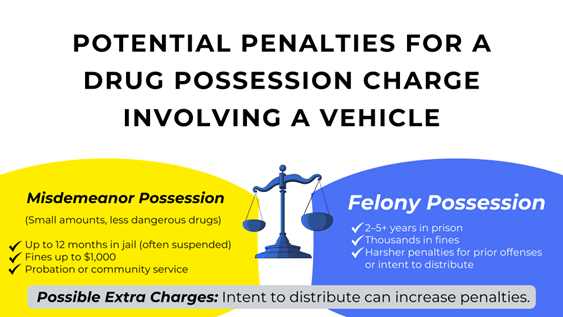
The penalties for a charge for having drugs in a car depend on multiple factors, including the type of drug, the quantity found, and your prior criminal record. Here’s a closer look at what you might face:
Misdemeanor Possession
- Small Quantities: For less dangerous substances—such as a small amount of marijuana—the charge may be classified as a misdemeanor.
- Penalties:
- Up to 12 months in jail (often with the jail sentence suspended)
- Fines of up to about $1,000
- Probation or community service
Felony Possession
- Large Quantities or High-Risk Drugs: If the drugs are of a type that is classified as Schedule I or II, or if the amount suggests intent to distribute, the charge can be elevated to a felony.
- Penalties:
- Several years of imprisonment, which could range from 2 to 5 years or more depending on the specific circumstances
- Hefty fines that can be several thousand dollars
- Potential enhancements if prior drug offenses or aggravating circumstances are present
In some cases, additional charges—such as possession with intent to distribute—may also be filed, further increasing the severity of the penalties.
Constructive Possession in North Carolina: What It Means for Your Case
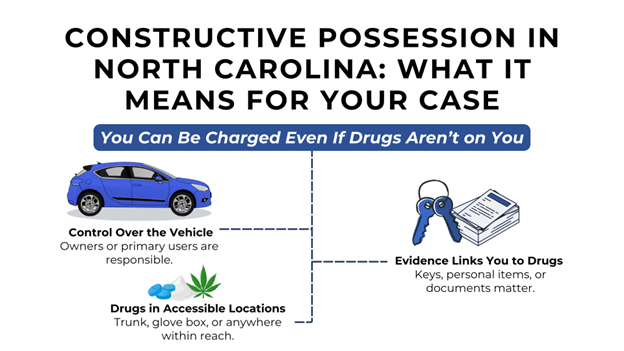
Constructive possession is a critical legal concept in drug cases involving vehicles. Even if you are not physically holding the drugs, the law considers you to have possession if:
- You have the ability to control the vehicle: As the owner or primary user, you can be held responsible for what is found inside.
- There is evidence linking you to the drugs: This may include personal items, keys, or documents indicating your control over the vehicle.
- The drugs are in a location accessible to you: For instance, drugs in a trunk or glove compartment that you can easily access may lead to a constructive possession charge.
This means that if you are stopped by police and drugs are discovered in your car, you could face a charge for having drugs in a car even if they were not on your body at the time.
Common Defense Strategies
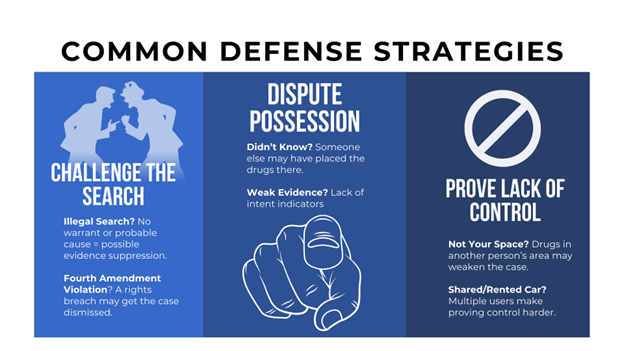
If you face a charge for having drugs in a car, several defense strategies might be available to you:
Challenge the Legality of the Search
- Unlawful Search and Seizure: If the police conducted the search without probable cause or a valid warrant, your attorney can argue that the evidence should be suppressed.
- Violation of Your Fourth Amendment Rights: Any breach of your constitutional rights during the search can be grounds for dismissing the charge.
Dispute Possession and Intent
- Lack of Knowledge: If you were unaware of the drugs in the vehicle—perhaps someone else stored them without your knowledge—you may argue that you did not have constructive possession.
- Questioning the Evidence: Your attorney may challenge the methods used to collect evidence, such as how the drugs were stored or the absence of other incriminating items like baggies or scales that would indicate intent to distribute.
Show Lack of Control Over the Vehicle
- No Direct Connection: If the drugs were found in a part of the vehicle that you did not have control over (for example, in a compartment used solely by another occupant), this can help cast doubt on the prosecution’s case.
- Shared or Rented Vehicles: In cases where the vehicle is used by multiple people or is a rental, proving that you were not the person in control can be a crucial defense.
The Role of an Experienced Criminal Defense Attorney
An experienced North Carolina criminal defense attorney can be invaluable when facing a charge for having drugs in a car. Here’s how legal representation can make a difference:
- Thorough Case Review: An attorney will scrutinize every detail—from the stop and search to the chain of custody of the evidence—to determine if your rights were violated.
- Customized Defense Strategy: Based on the facts, your attorney can develop a strategy tailored to your situation. This might include filing motions to suppress evidence, challenging the reliability of the evidence, or negotiating a plea deal.
- Experienced Negotiator: If the case is strong, your attorney might negotiate with the prosecution to reduce the charges, potentially avoiding a felony conviction.
- Courtroom Experience: A seasoned lawyer understands North Carolina’s court system and can effectively advocate on your behalf during trial, ensuring that the evidence against you is thoroughly challenged.
Additional Considerations
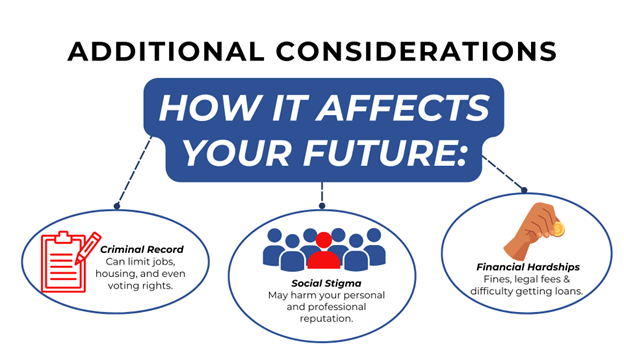
Impact on Your Future
A conviction for drug possession can have lasting consequences:
- Criminal Record: A felony or misdemeanor conviction can affect your employment opportunities, housing options, and even your right to vote.
- Financial Hardships: Beyond fines and legal fees, a conviction can make it challenging to secure loans or credit.
- Social Stigma: Drug-related charges can have a significant impact on your personal and professional reputation.
The Importance of Acting Quickly
If you are facing a charge for having drugs in a car, it is essential to consult with a criminal defense attorney as soon as possible. Early legal intervention can help:
- Preserve evidence that may later support your defense.
- Ensure that any possible constitutional violations are addressed.
- Give you the best chance to negotiate a favorable outcome, whether that means reducing the charge or obtaining alternative sentencing, such as probation or rehabilitation.
Conclusion
A charge for having drugs in a car in North Carolina is a serious offense that can lead to significant penalties, including jail time, fines, and a permanent criminal record. Understanding the nuances of actual and constructive possession, as well as the factors that influence drug charges, is vital for mounting an effective defense.
If you or someone you love is facing this charge, it is crucial to consult with an experienced criminal defense attorney who understands North Carolina’s drug laws and can help protect your rights. Attorney Patrick Roberts of Patrick Roberts Law has successfully defended numerous clients facing charges for having drugs in a car. Contact our firm today for a confidential consultation.
Former assistant district attorney
Contact Patrick Roberts
Facing criminal charges in North Carolina demands seasoned representation. Trust in the experience and dual perspective of Patrick Roberts. Reach out today for a confidential consultation.
-
Call Our Team
Calls answered 24/7









For more information on the selection criteria, go to www.martindale.com
*Each case is different and must be evaluated separately. Prior results achieved do not guarantee similar results can be achieved in future cases.