
Being accused of first-degree statutory sexual offense in North Carolina places everything you’ve built at risk—your freedom, your career, your family, and your reputation in the community. In Cary and throughout the Research Triangle, where professionals often hold positions requiring security clearances, professional licenses, or public trust, these accusations carry consequences that extend far beyond the courtroom. The charge itself is among the most serious in North Carolina’s criminal code, classified as a Class B1 felony with mandatory minimum sentencing requirements that can result in decades in prison.
North Carolina law treats sexual offenses involving children with maximum severity, and prosecutors in Wake County pursue these cases aggressively. Understanding exactly what the State must prove—and where the evidence may fall short—requires an attorney who has handled these cases from both sides. Patrick Roberts’ years as a prosecutor handling sex-offense cases gives him direct insight into how the State builds its case, what evidence it prioritizes, and where strategic weaknesses may exist.
Read the rest of this entry »
Few criminal accusations carry the immediate, devastating weight of solicitation of a child by computer charges. In Cary—a community where nearly 70% of adults hold bachelor’s degrees and thousands work in positions requiring security clearances at companies like Lockheed Martin, SAS Institute, and Epic Games—these charges threaten to destroy everything you’ve built. Your career, your family relationships, your standing in a community known for its safety and family-oriented character: all of it hangs in the balance from the moment an investigation begins.
North Carolina prosecutes these offenses under N.C. Gen. Stat. § 14-202.3, a statute that criminalizes using computers or electronic devices to arrange sexual contact with minors. What makes these cases particularly complex is that Cary Police Department operates the only dedicated Cyber Intelligence Unit among the Triangle’s four major police departments—a specialized team focused specifically on identifying online offenders and investigating child exploitation cases. Understanding what you’re facing requires experienced defense counsel who has handled these matters from both sides of the courtroom. Patrick Roberts’ years as a prosecutor handling sex crime cases gives him direct insight into how the state builds these prosecutions and where weaknesses in the evidence may exist.
Read the rest of this entry »Sexting With a Minor Charges in Cary, North Carolina

When Cary police or federal agents show up asking about text messages, images on your phone, or online conversations with someone who turned out to be younger than you thought, you’re facing some of the most serious charges North Carolina law imposes. What many people think of as “sexting”—exchanging explicit images or messages electronically—triggers sexual exploitation statutes when a minor is involved, carrying felony classifications that can follow you for the rest of your life.
For professionals working in the Research Triangle—the software engineers at SAS Institute, the defense contractors at Lockheed Martin, the financial services employees at MetLife—these accusations threaten more than freedom. They threaten the security clearances, professional licenses, and career trajectories that Cary families have spent decades building. In a community where nearly 70% of adults hold bachelor’s degrees and median household incomes exceed $129,000, the stakes extend far beyond the courtroom.
North Carolina doesn’t use the word “sexting” in its criminal code. Instead, prosecutors charge these cases under a tiered system of sexual exploitation statutes that can mean anything from a Class 1 misdemeanor to a Class C felony—depending on exactly what you’re accused of doing.
Read the rest of this entry »How to Bail Someone Out of Jail in North Carolina

Getting a phone call from a loved one who has been arrested is one of the most stressful experiences a family can face. The immediate priority becomes getting them released as quickly as possible, but the bail process can feel confusing and overwhelming—especially if you have never navigated it before. Understanding how pretrial release works in North Carolina helps families make informed decisions and take the right steps to bring their loved one home.
North Carolina law establishes a framework for pretrial release that balances the defendant’s right to freedom before trial against the need to ensure they appear in court and do not pose a danger to the community. The type of release ordered by a judicial official determines what steps you must take to secure someone’s release. Some defendants are released on a simple written promise, while others must post significant financial security before they can leave custody. Recent legislative changes, particularly Iryna’s Law effective December 1, 2025, have added new requirements for defendants charged with violent offenses that make understanding the current legal landscape even more important.
Read the rest of this entry »
A domestic violence arrest in North Carolina has always carried serious consequences. But as of December 1, 2025, certain defendants now face something far more significant: a felony charge that can escalate with each subsequent conviction. North Carolina’s new habitual domestic violence statute transforms what would otherwise be misdemeanor charges into felony prosecutions for individuals with qualifying prior convictions.
This law creates a standalone enhancement mechanism that prosecutors can use to pursue felony charges against defendants whose records show a pattern of domestic violence offenses. Understanding how this new offense works—what the prosecution must prove, how prior convictions factor into the analysis, and what punishment exposure exists—is essential for anyone facing these charges or concerned about how past convictions might affect their future.
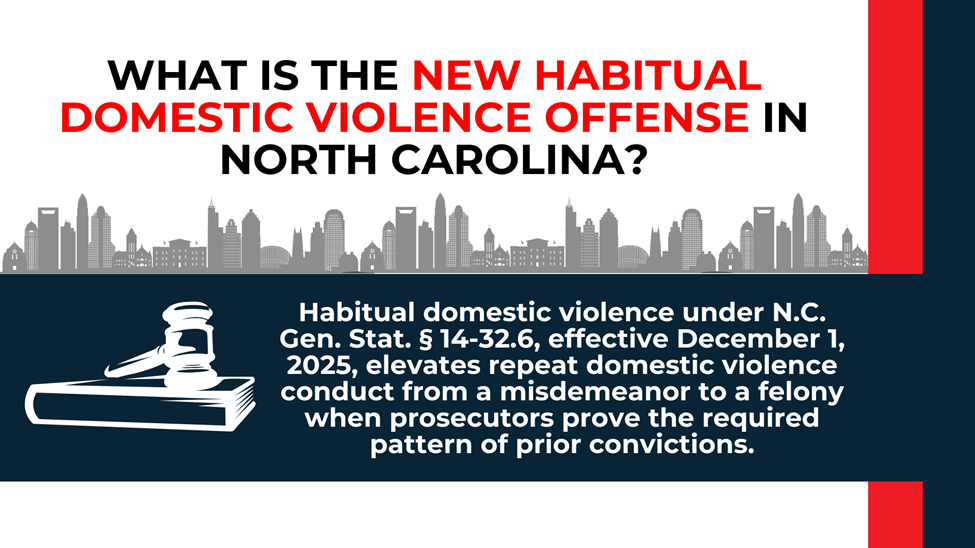
What Is the New Habitual Domestic Violence Offense in North Carolina?
How Does This Charge Differ from Misdemeanor Domestic Violence?
Traditional domestic violence charges in North Carolina are typically prosecuted as misdemeanors. The habitual domestic violence offense changes that framework entirely. When prosecutors can establish that a defendant has the required pattern of prior domestic violence convictions, they can pursue felony charges for conduct that would otherwise remain at the misdemeanor level.
This elevation from misdemeanor to felony status represents a fundamental shift in how repeat domestic violence offenders are prosecuted. Rather than facing the relatively limited consequences associated with misdemeanor convictions, defendants charged under this statute confront felony punishment classifications that carry substantially more severe consequences.
What Statute Governs This New Felony?
The habitual domestic violence offense is codified at N.C. Gen. Stat. § 14-32.6. This statute establishes the elements the prosecution must prove, defines which prior convictions qualify for enhancement purposes, and sets forth the punishment structure that applies to convictions under this section.
When Did This Law Take Effect?
The habitual domestic violence statute took effect on December 1, 2025. This effective date is critically important because the law applies only to offenses committed on or after that date. Conduct occurring before December 1, 2025, cannot form the basis of a habitual domestic violence charge, even if the defendant has the qualifying prior convictions. However, prior convictions from before the effective date can still count toward establishing habitual status for offenses committed after the law took effect.
What Must the Prosecution Prove to Convict Someone of Habitual Domestic Violence?
To secure a conviction under N.C. Gen. Stat. § 14-32.6, the prosecution must prove three distinct components: qualifying current conduct, the required prior conviction record, and compliance with the statutory lookback period.
What Current Conduct Qualifies Under This Statute?
The prosecution must first establish that the defendant committed either misdemeanor domestic violence under the existing statute or committed an assault against someone with whom they share a qualifying domestic relationship. This current offense forms the foundation of the habitual charge—without it, the enhancement cannot apply regardless of how many prior convictions exist.
How Many Prior Convictions Are Required?
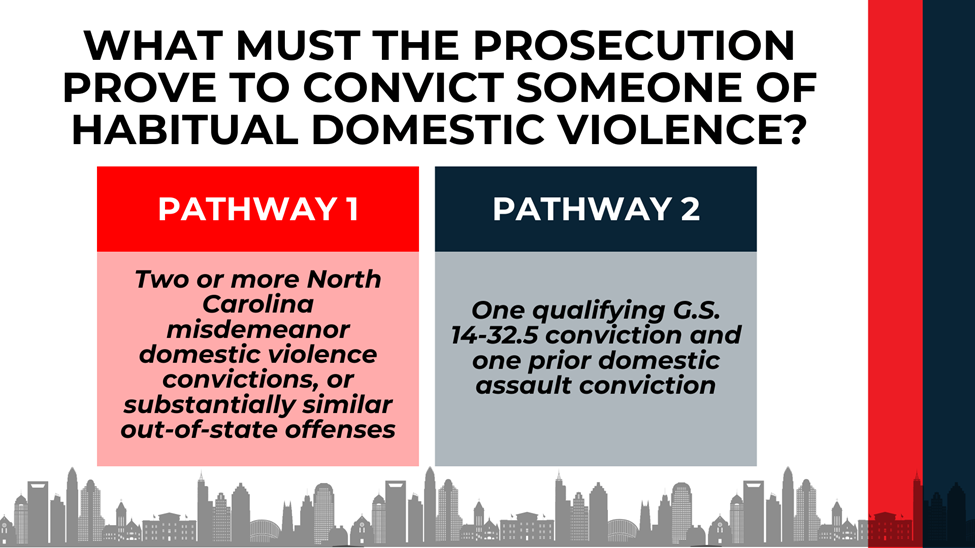
Beyond the current conduct, the prosecution must prove that the defendant has at least two prior convictions that qualify under the statute. The law establishes two pathways to meet this requirement:
- Pathway 1: Two or more convictions under North Carolina’s misdemeanor domestic violence statute (G.S. 14-32.5) or substantially similar offenses from other states.
- Pathway 2: One conviction under G.S. 14-32.5 (or a substantially similar out-of-state offense) plus at least one conviction for an assault involving a victim with whom the defendant shared a qualifying domestic relationship.
The critical distinction is that at least one prior must be an actual domestic violence statute conviction—two generic assault convictions involving domestic relationships are not sufficient on their own, even if both victims were intimate partners or family members.
What Is the 15-Year Lookback Period?
Not every prior conviction counts toward habitual status. The statute imposes a 15-year lookback period that limits which convictions the prosecution can use. Specifically, the earlier of the two required prior convictions must have occurred within 15 years of the current offense. Convictions that fall outside this window—meaning they occurred more than 15 years before the earliest qualifying prior—cannot be counted toward establishing habitual status.
This lookback calculation can become complex when a defendant has multiple prior convictions spanning many years. The timing of each conviction relative to both the current offense and the other priors matters significantly.
Do Out-of-State Convictions Count Toward Habitual Status?
Yes. The statute explicitly allows the prosecution to use “substantially similar convictions from other states” as qualifying priors. This means defendants who have domestic violence convictions from other jurisdictions remain exposed to felony enhancement in North Carolina, provided those out-of-state offenses are substantially similar to North Carolina’s domestic violence statutes.
Determining whether an out-of-state conviction is “substantially similar” often requires careful legal analysis of the elements of the foreign offense compared to North Carolina law.
What Are the Potential Punishments for a Habitual Domestic Violence Conviction?
The punishment structure for habitual domestic violence is designed to escalate with each subsequent conviction, reflecting the legislature’s intent to impose increasingly severe consequences for repeat offenders.
What Felony Class Applies to a First Habitual DV Conviction?
A first conviction under the habitual domestic violence statute is classified as a Class H felony. This represents a significant elevation from the misdemeanor classification that would otherwise apply to domestic violence charges without the habitual enhancement.
How Does Punishment Escalate with Subsequent Convictions?
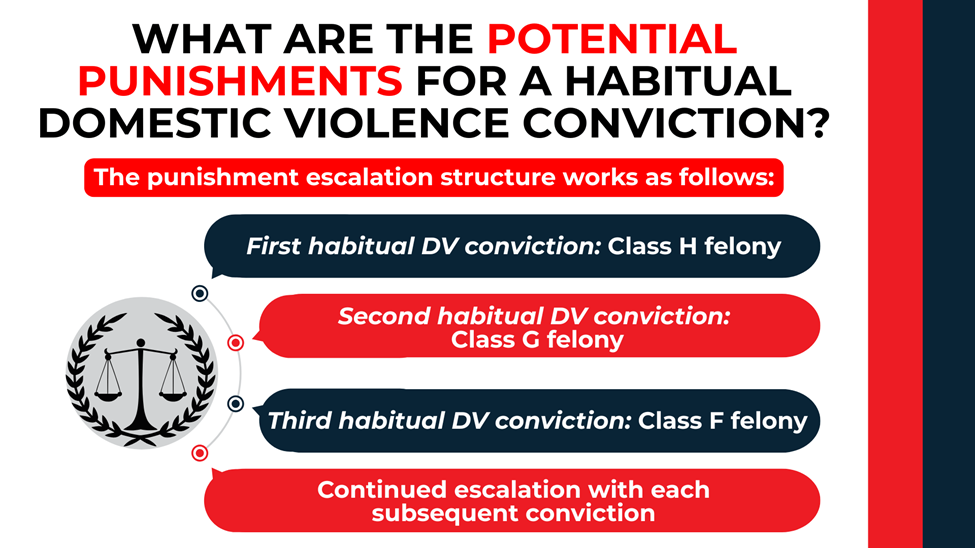
The statute creates an escalating punishment framework where each subsequent conviction under this section is punished one felony class higher than the defendant’s most recent habitual domestic violence conviction. The escalation structure works as follows:
- First habitual DV conviction: Class H felony
- Second habitual DV conviction: Class G felony
- Third habitual DV conviction: Class F felony
- Continued escalation with each subsequent conviction
This escalating structure means that defendants who continue to accumulate convictions under this statute face progressively more serious felony classifications.
What Is the Maximum Felony Classification?
The escalation caps at Class C felony status. Once a defendant reaches Class C classification, subsequent convictions remain at the Class C level rather than continuing to escalate. Class C felonies represent one of the more serious felony classifications in North Carolina’s structured sentencing system, carrying substantial prison exposure depending on the defendant’s prior record level.
How Does This Offense Interact with Other Domestic Violence Laws?
The habitual domestic violence statute functions as part of a broader package of changes affecting how domestic violence cases are handled in North Carolina.
Can a Habitual DV Conviction Be Used to Enhance Other Charges?
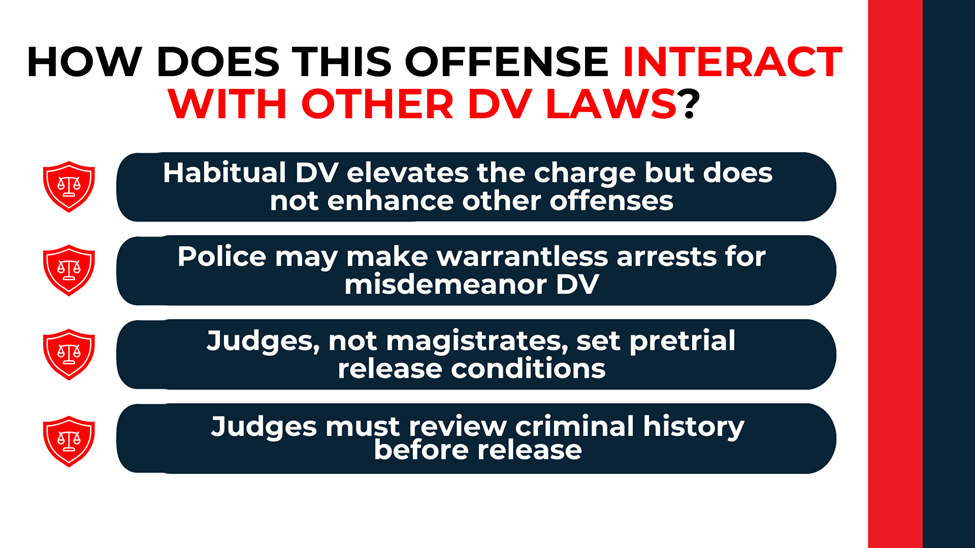
No. The statute specifically provides that a conviction under the habitual domestic violence section cannot be used as a prior conviction to enhance punishment under other habitual offense laws. This makes the habitual domestic violence enhancement a standalone mechanism—it elevates the current offense to felony status but does not feed into other habitual offender statutes.
What Arrest Powers Do Police Have Under the New Law?
Related legislative changes have expanded police authority in domestic violence cases. Officers can now arrest without a warrant for misdemeanor domestic violence offenses, extending their powers beyond traditional assault charges. This means law enforcement has greater flexibility to make immediate arrests in domestic violence situations without first obtaining judicial authorization.
The following changes affect how domestic violence arrests and pretrial proceedings work:
- Police may now make warrantless arrests for misdemeanor domestic violence
- Defendants charged with misdemeanor domestic violence must have pretrial release conditions set by a judge rather than a magistrate
- Judges must review the defendant’s criminal history before setting pretrial release conditions
How Have Pretrial Release Procedures Changed for DV Cases?
Defendants charged with misdemeanor domestic violence now face modified pretrial release procedures. Instead of having a magistrate set conditions of release, these defendants must appear before a judge who will review their criminal history before establishing appropriate conditions. This change ensures that judicial officers making pretrial release decisions have access to information about the defendant’s prior record, which may be particularly relevant given the new habitual enhancement statute.
What Defense Strategies Apply to Habitual Domestic Violence Charges?
Defending against habitual domestic violence charges requires attention to both the current conduct allegations and the prior conviction record the prosecution intends to use for enhancement purposes.
Can the Validity of Prior Convictions Be Challenged?
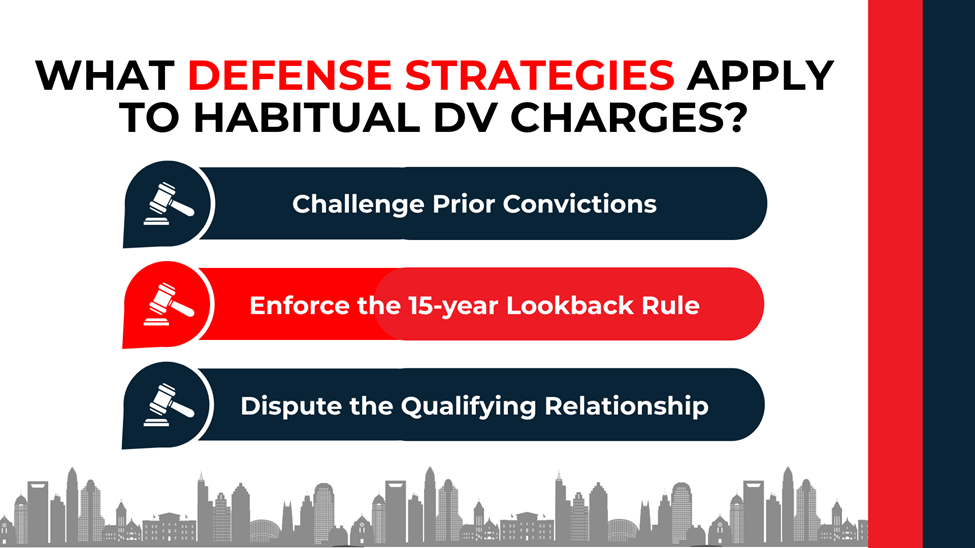
The prosecution’s ability to prove habitual status depends entirely on establishing that the defendant has qualifying prior convictions. Defense strategies may focus on whether prior convictions were constitutionally obtained, whether proper procedures were followed in earlier cases, and whether documentation adequately establishes the convictions the prosecution claims. If the validity of prior convictions can be successfully challenged, the enhancement may fail even if the current conduct is proven.
What If Prior Convictions Fall Outside the Lookback Period?
The 15-year lookback requirement creates a potential defense avenue when prior convictions are aged. If the earlier of the two required priors occurred more than 15 years before the current offense, it cannot count toward habitual status. Careful analysis of conviction dates relative to the current offense date can reveal whether the prosecution’s theory of habitual status actually satisfies the statutory timing requirements.
This calculation becomes particularly important when defendants have multiple prior convictions from different time periods. Identifying which convictions fall within and outside the lookback window may determine whether felony enhancement applies.
How Does the Qualifying Relationship Requirement Affect the Case?
Both the current conduct and the prior convictions must involve victims with whom the defendant shared a qualifying domestic relationship. If the prosecution cannot establish the required relationship element—either for the current offense or for the priors being used for enhancement—the habitual charge may not stand. Defense strategies may focus on whether the relationships at issue actually qualify under the statutory definitions.
Why Does Legal Representation Matter When Facing This Felony Charge?
What’s at Stake with a Felony Domestic Violence Conviction?
A habitual domestic violence conviction creates a felony record with all the collateral consequences that follow. Employment opportunities, housing options, professional licensing, and firearm rights can all be affected by felony convictions. The escalating punishment structure means that defendants who face multiple prosecutions under this statute confront increasingly serious felony classifications, potentially reaching Class C status with its substantial prison exposure.
The complexity of the habitual enhancement analysis—including prior conviction validity, lookback period calculations, and relationship requirement issues—demands careful legal attention to every element the prosecution must prove.
How Can an Attorney with Prosecutorial Experience Help?
Facing charges under a new statute requires understanding how prosecutors will interpret and apply the law in its early implementation. The habitual domestic violence offense creates multiple points of potential challenge, from the validity of prior convictions to the timing requirements of the lookback period.
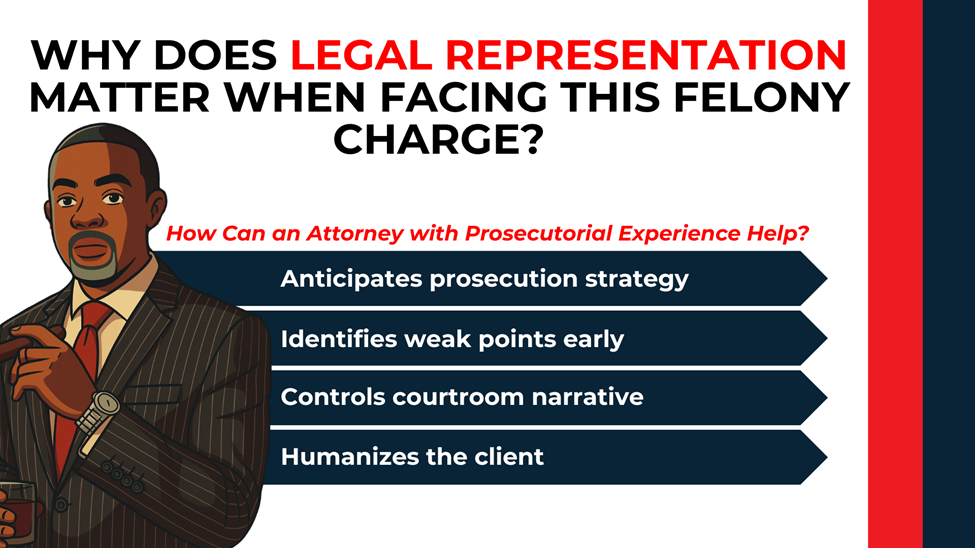
Attorney Patrick Roberts brings the perspective of a former prosecutor who handled domestic violence cases, meaning he understands how the State approaches these matters from investigation through trial. His training at the National Criminal Defense College, including ongoing participation in advanced cross-examination programs, provides the technical courtroom skills these cases demand. As a graduate of Gerry Spence’s Trial Lawyers College—where he trained directly with one of the most accomplished trial lawyers in the country—he brings a methodology focused on connecting with juries and humanizing clients facing serious allegations. Contact Patrick Roberts Law to discuss your case and understand your options under this new law.
Frequently Asked Questions
When did habitual domestic violence become a crime in North Carolina? The habitual domestic violence statute took effect on December 1, 2025. Only offenses committed on or after that date can be charged under this law, though prior convictions from before the effective date can still count toward establishing habitual status.
Can I be charged with habitual domestic violence if my prior convictions are from another state? Yes. The statute allows the prosecution to count “substantially similar convictions from other states” toward the required two prior convictions. Whether an out-of-state conviction qualifies requires analysis of whether that offense is substantially similar to North Carolina’s domestic violence laws.
What happens if I’m convicted of habitual domestic violence more than once? Each subsequent conviction is punished one felony class higher than your most recent habitual domestic violence conviction, starting at Class H and escalating up to a maximum of Class C.
Does the new law apply to conduct that occurred before December 1, 2025? No. Conduct occurring before the effective date cannot form the basis of a habitual domestic violence charge. However, prior convictions from before December 1, 2025, can still count toward establishing habitual status for offenses committed after the law took effect.
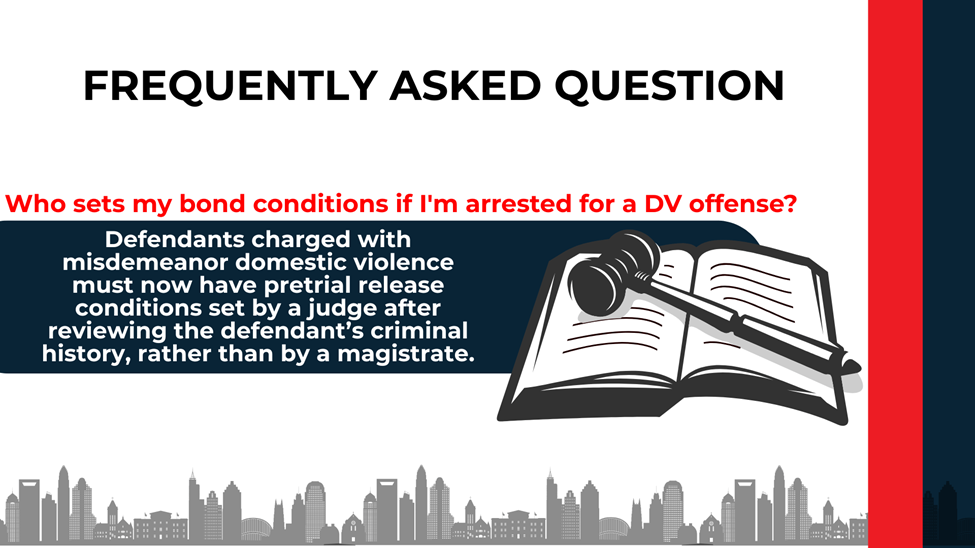
Who sets my bond conditions if I’m arrested for a domestic violence offense? Under related changes to domestic violence procedures, defendants charged with misdemeanor domestic violence must have pretrial release conditions set by a judge who reviews the defendant’s criminal history, rather than a magistrate.
Yoast SEO
Disclaimer: The information on this website is for general information purposes only. Nothing on this site should be taken as legal advice for any individual case or situation. Case results depend upon a variety of factors unique to each case. Prior results do not guarantee a similar outcome.
What Is Iryna’s Law in North Carolina?

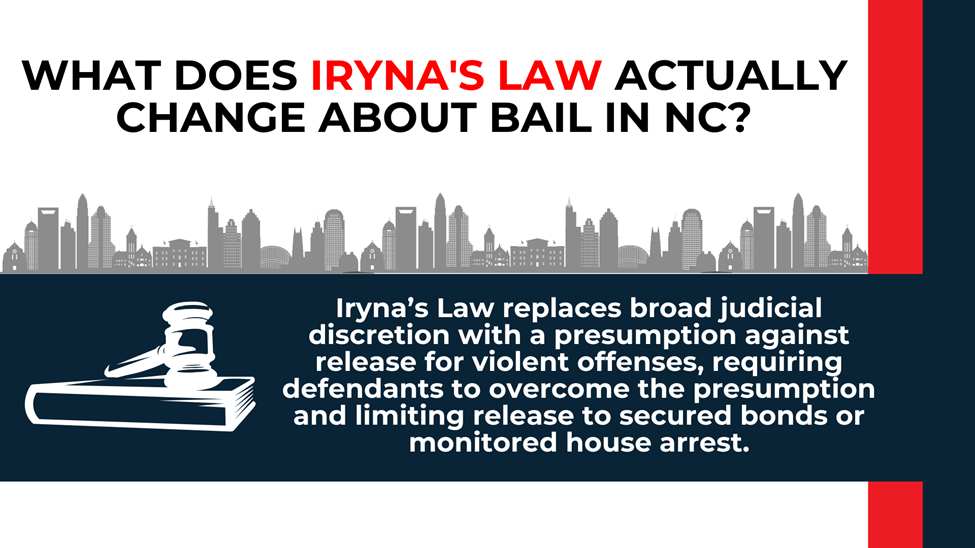
If you or someone you care about has been arrested for a serious criminal offense in North Carolina, the rules governing whether you can be released before trial have changed significantly. North Carolina Session Law 2025-93, commonly known as Iryna’s Law, took effect on December 1, 2025, and it fundamentally alters how courts approach pretrial release for defendants charged with violent offenses.
Under this new framework, defendants facing certain serious charges no longer start from a neutral position when seeking release. Instead, the law creates a presumption that no release conditions can adequately protect the public or ensure the defendant will appear for court. This shift places the burden squarely on the defendant to prove otherwise—a meaningful change from how bail determinations previously worked in North Carolina.
Understanding what Iryna’s Law does, which charges it covers, and how it affects your options is essential for anyone navigating the criminal justice system after December 1, 2025. This article breaks down the key provisions of the law, explains who it affects, and addresses common questions about how these new rules work in practice.
What Does Iryna’s Law Actually Change About Bail in North Carolina?
What Was Pretrial Release Like Before This Law?
Before Iryna’s Law took effect, judicial officials in North Carolina had considerable discretion when setting conditions for pretrial release. While judges and magistrates always considered factors like the seriousness of the charge, the defendant’s ties to the community, and any prior criminal history, the system did not impose a blanket presumption against release for any particular category of offenses. Defendants charged with serious crimes could still potentially secure release through various mechanisms, including unsecured bonds in some circumstances.
What Is a “Rebuttable Presumption” Against Release?
Iryna’s Law creates what legal professionals call a “rebuttable presumption” against pretrial release for defendants charged with violent offenses. In practical terms, this means the law assumes from the start that no conditions of release can adequately ensure public safety or guarantee that the defendant will appear for future court dates. The defendant must actively overcome this presumption by presenting evidence or arguments that convince the court otherwise.
This represents a significant procedural shift. Rather than the State bearing the burden of explaining why a defendant should remain in custody, the defendant now carries the burden of demonstrating why release is appropriate. The presumption does not make release impossible, but it creates a substantial hurdle that must be cleared.
What Types of Release Are Still Available Under This Law?
For defendants charged with violent offenses under Iryna’s Law, judicial officials must require one of two forms of release if they determine release is appropriate:
- A secured appearance bond, which requires the defendant or a bondsman to post money or property as a guarantee of appearance
- House arrest with electronic monitoring, which confines the defendant to their residence and tracks their location
The law eliminates unsecured release options for violent offense charges. Previously, some defendants could secure release by simply promising to pay a specified amount if they failed to appear—without putting up any money or collateral in advance. That option is no longer available when Iryna’s Law applies.
Which Charges Qualify as “Violent Offenses” Under Iryna’s Law?
What Felony Classes Are Included?
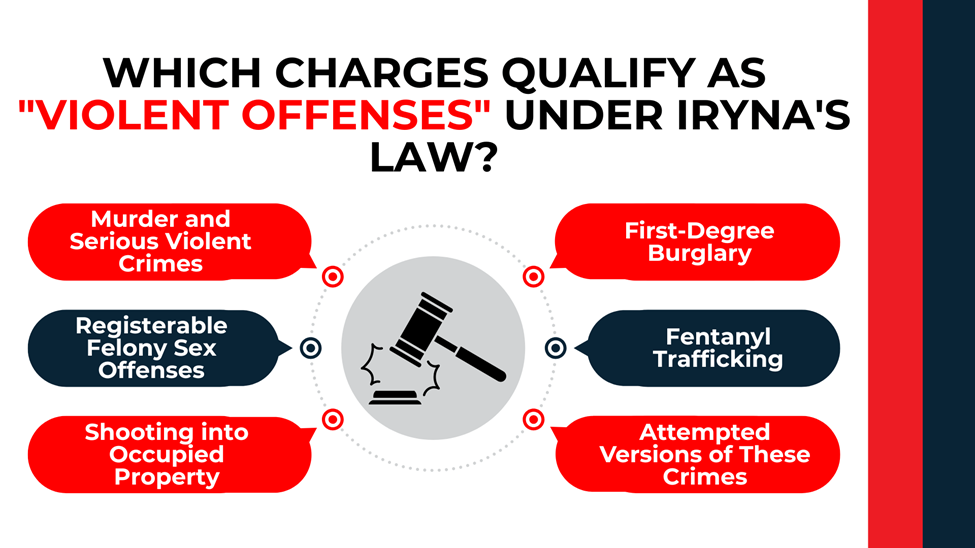
Iryna’s Law does not apply to all criminal charges or even all felony charges. The law specifically defines “violent offense” to include Class A through Class G felonies that involve assault, physical force, or threats of force. North Carolina’s felony classification system ranks offenses from Class A (the most serious) through Class I (the least serious), so this law targets the upper half of the felony spectrum—but only when the offense involves violence or the threat of violence.
What Specific Crimes Does the Law Cover?
The statutory definition of “violent offense” encompasses several specific categories of criminal conduct:
- Murder and related serious crimes
- Felony sex offenses that require registration on the North Carolina Sex Offender Registry
- Discharging a firearm into occupied property
- First-degree burglary
- Fentanyl trafficking offenses
- Attempts to commit any of the above crimes
This list captures a broad range of serious criminal conduct, from violent crimes against persons to drug trafficking offenses involving fentanyl. The inclusion of attempted charges means that even incomplete crimes can trigger the law’s provisions if they would have constituted a violent offense if completed. This list is not exhaustive—the statute includes additional specific offenses
Does This Apply to All Felony Charges?
No. Iryna’s Law applies only to charges that meet the specific “violent offense” definition. A defendant charged with a Class H or Class I felony would not face the rebuttable presumption against release, nor would a defendant charged with a higher-class felony that does not involve assault, physical force, or threats of force. Similarly, misdemeanor charges fall outside the scope of this law regardless of the underlying conduct.
The distinction matters because it determines whether the defendant starts from a presumption of detention or proceeds under the traditional pretrial release framework. Identifying whether a specific charge qualifies as a “violent offense” under this statute is one of the first questions that must be answered when someone is arrested.
What Happens If Someone Is Already on Pretrial Release When Charged?
What Is the “Second Violent Offense” Rule?
Iryna’s Law includes special provisions for defendants who have prior involvement with violent offense charges. If a defendant is charged with a violent offense and either has a prior conviction for a violent offense or is currently on pretrial release for a prior violent offense charge, the law imposes an additional requirement: the defendant must be placed on house arrest with electronic monitoring if that option is available in the jurisdiction.
This provision targets repeat situations involving violent conduct. The law treats defendants with prior violent convictions—or those who allegedly committed a new violent offense while already awaiting trial on another—as presenting heightened concerns that warrant the most restrictive form of release available short of detention.
What If Someone Is Arrested for Any New Offense While on Release?
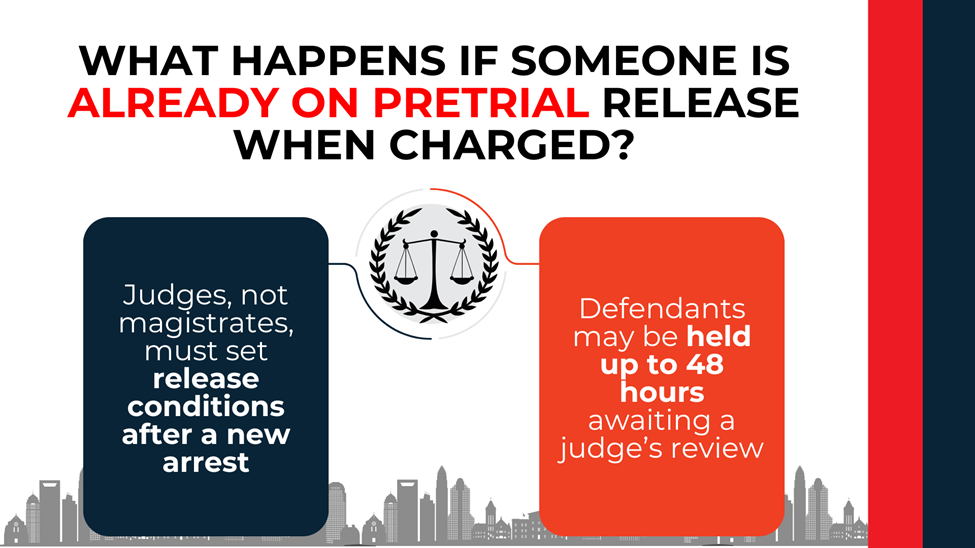
The law also addresses what happens when any defendant on pretrial release is arrested for a new offense, regardless of whether the new charge qualifies as a violent offense. In these situations, a judge—not a magistrate—must set the conditions of release. This requirement elevates the decision-making authority to a higher judicial officer.
Additionally, the defendant can be held for up to 48 hours awaiting this judicial determination. This holding period ensures that a judge has the opportunity to review the situation before the defendant is released, rather than allowing immediate release through a magistrate’s determination.
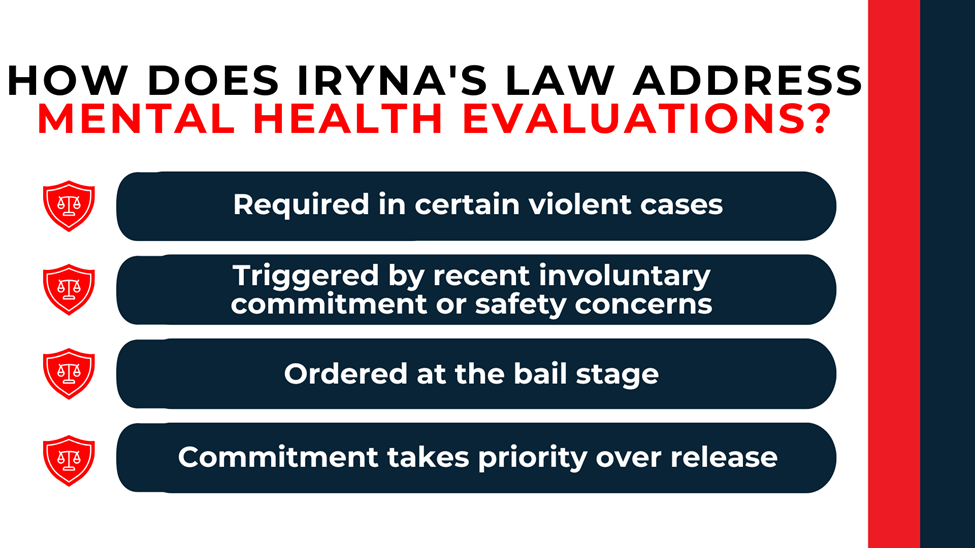
How Does Iryna’s Law Address Mental Health Evaluations?
When Is a Mental Health Evaluation Required?
Iryna’s Law incorporates a mental health component that can affect the pretrial release process. The law mandates a mental health evaluation at the bail stage when either of two circumstances exists:
- The defendant is charged with a violent offense and has been involuntarily committed within the past three years
- The judicial official has reasonable grounds to believe the defendant poses a danger to themselves or others
These triggers focus on situations where mental health concerns intersect with violent offense allegations. The first criterion is objective—either the defendant has a documented involuntary commitment within the specified timeframe or they do not. The second criterion involves judicial discretion based on the information available at the time of the bail determination.
What Happens During the Evaluation Process?
When a mental health evaluation is triggered under Iryna’s Law, the arresting officers must transport the defendant to a hospital emergency department or crisis facility. There, a commitment examiner conducts an examination to assess whether grounds for involuntary commitment exist.
This process occurs at the bail stage, meaning it happens early in the case—typically within hours of arrest. The evaluation is not optional when the triggering circumstances are present; the law mandates that it occur.
How Does This Affect the Pretrial Release Timeline?
If the commitment examiner determines that grounds for involuntary commitment exist, that process takes priority over standard pretrial release procedures. In other words, the mental health commitment process supersedes the normal bail determination. The defendant may be committed for treatment rather than proceeding through the typical pretrial release framework.
This integration of mental health evaluation into the bail process reflects an approach that attempts to identify defendants who may need mental health intervention rather than simply pretrial supervision. For defendants and their families, understanding that this evaluation may occur—and that it can redirect the process toward commitment rather than release—is important.
When Did Iryna’s Law Take Effect and Who Does It Apply To?
What Is the Effective Date?
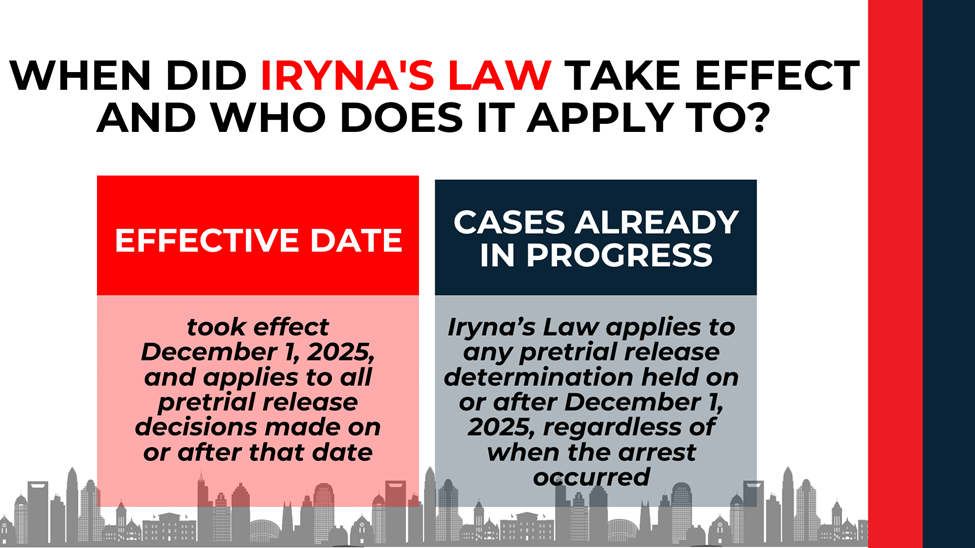
Iryna’s Law became effective on December 1, 2025. Governor Josh Stein signed the legislation—formally designated as House Bill 307—on October 3, 2025, and the law applies to all pretrial release determinations occurring on or after the effective date.
Does This Law Apply to Cases Already in Progress?
The law applies to all persons appearing for pretrial release determinations on or after December 1, 2025. This means that even if an arrest occurred before the effective date, if the pretrial release determination happens on or after December 1, 2025, the new provisions apply.
For defendants whose cases were already in the system before the effective date, the timing of their pretrial release hearing—not the timing of their arrest—determines whether Iryna’s Law governs their situation.
Why Does Legal Representation Matter More Under These New Rules?
What Must Defendants Prove to Overcome the Presumption?
Because Iryna’s Law creates a presumption against release, defendants charged with violent offenses must affirmatively demonstrate that conditions exist which can adequately ensure public safety and their appearance at future court dates. This is not simply a matter of arguing that detention is unnecessary; the defendant must present a compelling case for why release is appropriate despite the statutory presumption.
The types of evidence and arguments that may help overcome the presumption can include stable employment, strong community ties, lack of prior failures to appear, the specific circumstances of the alleged offense, and proposed release conditions that address any identified concerns. Marshaling this evidence effectively requires preparation and knowledge of what courts consider persuasive.
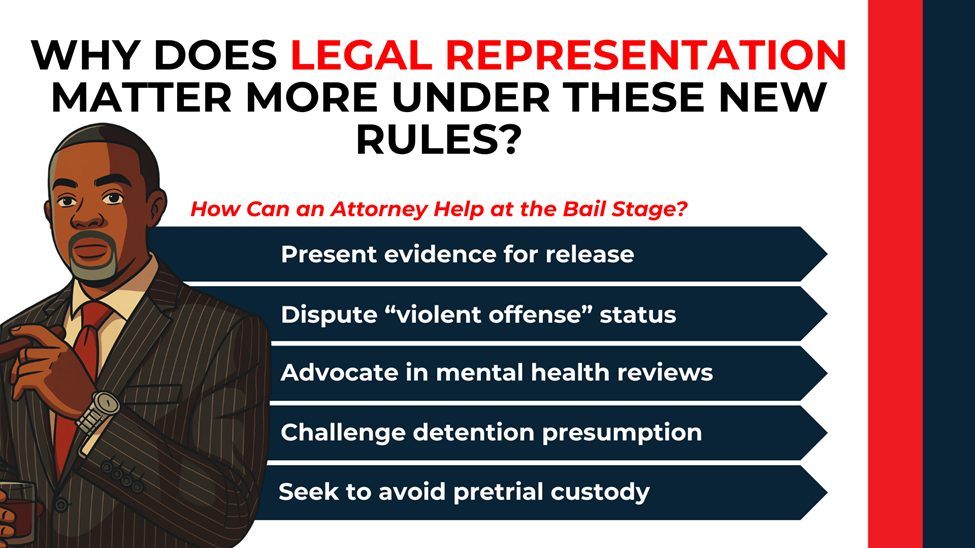
How Can an Attorney Help at the Bail Stage?
Legal representation at the initial bail determination has always mattered, but Iryna’s Law raises the stakes considerably. An attorney can help in several critical ways. First, counsel can gather and present evidence supporting release before the hearing occurs, rather than leaving the defendant to address these issues without preparation. Second, an attorney can make legal arguments about whether the charge actually qualifies as a “violent offense” under the statute’s definition—a determination that affects whether the presumption applies at all. Third, if the mental health evaluation provisions are triggered, an attorney can help navigate that process and advocate for the defendant’s interests.
The early stages of a case often set the trajectory for everything that follows. A defendant who remains in custody faces practical challenges in assisting with their defense, maintaining employment, and supporting their family. Under Iryna’s Law, securing release when facing violent offense charges requires overcoming a significant legal presumption—making skilled advocacy at the bail stage more important than ever.
Frequently Asked Questions About Iryna’s Law
Does Iryna’s Law apply to misdemeanor charges?
No. The law’s definition of “violent offense” is limited to Class A through Class G felonies involving assault, physical force, or threats of force, along with specific enumerated offenses. Misdemeanor charges do not trigger the rebuttable presumption against release created by this law.
Can a defendant be released on their own recognizance under this law?
For charges that qualify as violent offenses under Iryna’s Law, release on an unsecured basis is not available. The law requires either a secured appearance bond or house arrest with electronic monitoring. A written promise to appear without posting any money or collateral does not satisfy these requirements.
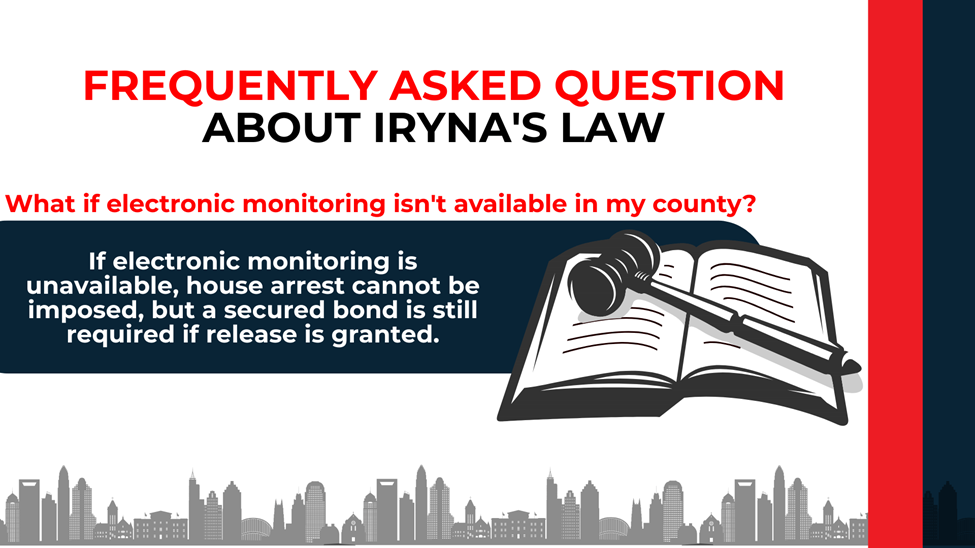
What if electronic monitoring isn’t available in my county?
The law’s provisions regarding house arrest with electronic monitoring apply “if available.” If electronic monitoring is not available in a particular jurisdiction, that option cannot be imposed. However, the unavailability of electronic monitoring does not eliminate the requirement for secured bond if release is granted.
How long can someone be held before seeing a judge under the new rules?
When a defendant who is already on pretrial release is arrested for a new offense, they can be held for up to 48 hours awaiting a judicial determination on release conditions. For initial arrests, the timeline depends on various factors, but the mental health evaluation provisions can affect how quickly the standard pretrial release process proceeds.
Discuss Your Case With an Experienced North Carolina Criminal Defense Attorney
Facing charges that fall under Iryna’s Law means confronting a legal system that now presumes you should not be released before trial. Overcoming that presumption requires immediate, focused effort—and an attorney who understands how prosecutors approach violent offense cases from the inside.
Attorney Patrick Roberts served as a prosecutor handling serious criminal matters, including violent offenses, before becoming a criminal defense attorney. That prosecutorial background provides insight into how the State evaluates these cases and what arguments carry weight with judges at the bail stage. His training at Gerry Spence’s Trial Lawyers College—where he trained directly with Gerry Spence, one of the most accomplished trial lawyers in the country—shapes his approach to presenting compelling narratives on behalf of clients. The advanced cross-examination and trial skills developed through his graduate work at the National Criminal Defense College prepare him to advocate effectively at every stage of a case, including the critical early hearings where pretrial release is determined.
For defendants facing charges involving sex offenses that trigger Iryna’s Law, Attorney Patrick Roberts brings additional specialized preparation: extensive training through the National Association of Criminal Defense Lawyers’ sex-crimes defense seminars as a lifetime NACDL member, and certification through the National Child Abuse Defense and Resource Center. He is the only attorney in North Carolina as of December 2025 who is listed on the NCADRC website at falseallegation.org.
If you or someone you care about is facing violent offense charges in North Carolina under these new rules, contact Patrick Roberts Law to discuss your situation and explore your options for seeking pretrial release.
Disclaimer: The information on this website is for general information purposes only. Nothing on this site should be taken as legal advice for any individual case or situation. Case results depend upon a variety of factors unique to each case. Prior results do not guarantee a similar outcome.
A third-degree sexual exploitation of a minor charge in North Carolina carries serious criminal penalties and life-altering consequences. For Cary residents—many of whom hold professional positions in Research Triangle Park’s technology sector or maintain security clearances for defense contractors—an arrest on these charges threatens far more than freedom. Careers built over decades, professional licenses, and family stability all hang in the balance.
Understanding exactly what the State must prove, how the Cary Police Department investigates these allegations, and what defense options exist is essential for anyone facing this charge. This article explains North Carolina’s third-degree sexual exploitation statute, the investigation and prosecution process in Wake County, and the defense strategies that may apply to your situation.
What Is Third-Degree Sexual Exploitation of a Minor Under North Carolina Law?
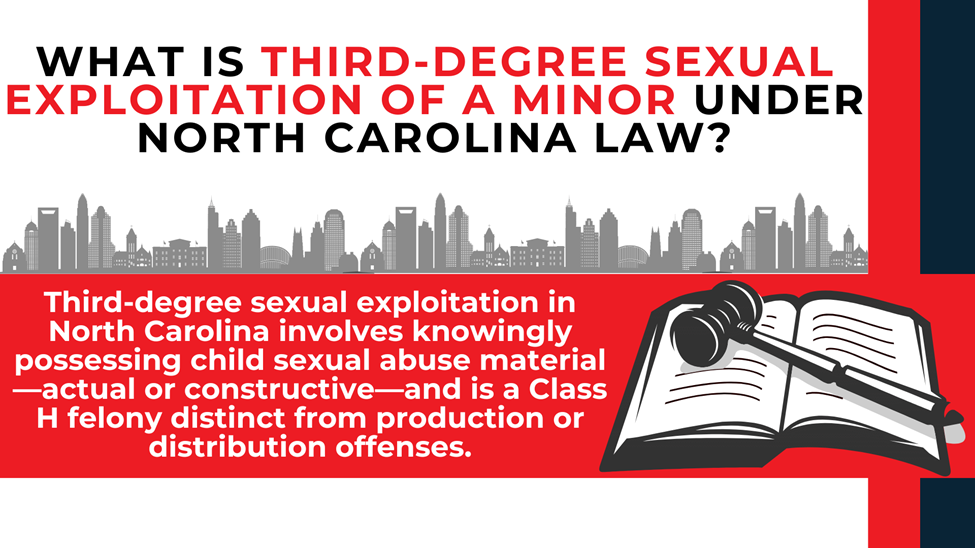
Third-degree sexual exploitation of a minor is defined under N.C. Gen. Stat. § 14-190.17A. Unlike first- and second-degree charges—which involve producing, distributing, or profiting from child sexual abuse material—third-degree charges focus specifically on possession. This distinction is critical because it affects both the severity of potential penalties and the defense strategies that apply.
What Does “Possession” Mean in These Cases?
Under North Carolina law, possession can be actual or constructive. Actual possession means the material is physically present on a device you control. Constructive possession means you have the ability to access and control material even if it’s stored elsewhere—such as in cloud storage or on a shared network.
Cary Police Department’s Cyber Intelligence Unit—the only dedicated cyber investigation unit among the Triangle’s four major police departments—focuses significant resources on identifying individuals who possess this material. Unlike Raleigh, Durham, or Chapel Hill, Cary maintains specialized investigators trained specifically in digital forensics and online offender identification. This means cases originating in Cary often involve sophisticated technical analysis from the outset.
What Types of Material Does This Statute Cover?
The statute covers two categories of prohibited material:
- Visual representations depicting a minor engaged in sexual activity
- Material that has been created, adapted, or modified to appear that an identifiable minor is engaging in sexual activity (including digitally altered images)
- Child sex dolls designed to represent minors
- Any digital files, physical photographs, or other media containing qualifying depictions
- Cached files, deleted files that remain recoverable, and cloud-stored material
The law specifically provides that the trier of fact—judge or jury—may infer that a depicted person is a minor based on the material’s title, text, visual representations, or other context.
How Does Third-Degree Differ from First- and Second-Degree Charges?
The degree of the charge depends primarily on the defendant’s conduct beyond mere possession. First-degree sexual exploitation under N.C. Gen. Stat. § 14-190.16 involves producing material, using minors in live performances, or creating material for sale or financial gain—these are Class C or D felonies depending on specific circumstances. Second-degree under N.C. Gen. Stat. § 14-190.17 covers distribution, receiving, selling, or exchanging material—a Class E felony.
Third-degree charges apply when the State alleges only knowing possession without evidence of production, distribution, or financial motive. This makes it a Class H felony—the least severe of the three classifications, but still carrying significant criminal penalties and mandatory sex offender registration.
What Must Prosecutors Prove to Secure a Conviction?
Wake County prosecutors handling third-degree sexual exploitation cases must prove specific elements beyond a reasonable doubt. The District Attorney’s office coordinates closely with Cary Police investigators to build these cases, and understanding what they must establish is the foundation of any defense strategy.
What Does “Knowing the Character or Content” Require?
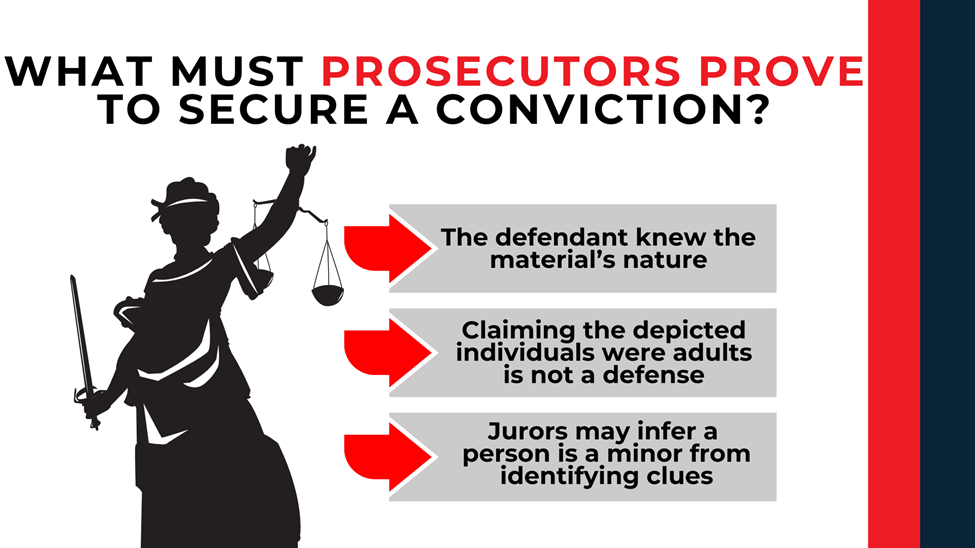
The prosecution must prove the defendant knew the character or content of the material. This means more than simply possessing a device where material exists—the State must establish that the defendant was aware of what the material depicted.
Patrick Roberts prosecuted exploitation cases earlier in his career. That experience provides direct insight into how the State builds its case around the knowledge element—and where weaknesses in that proof may exist.
The required elements include:
- Possession of qualifying material (visual depictions of minors in sexual activity) or a child sex doll
- Knowledge of the character or content of what was possessed
- The material depicts—or appears to depict—a minor engaged in sexual activity
Can Mistake About the Person’s Age Be a Defense?
No. The statute explicitly states that mistake of age is not a defense to prosecution. This means a defendant cannot avoid conviction by claiming they believed the depicted individuals were adults. This strict liability provision applies to all three degrees of sexual exploitation charges in North Carolina.
How Do Prosecutors Establish That Depicted Individuals Are Minors?
North Carolina law allows prosecutors to establish age through circumstantial evidence. The statute provides that jurors may infer a depicted person is a minor based on the material’s title, text, visual representations, or other identifying information. Prosecutors do not necessarily need to identify the specific victim or prove an exact age—the inference provision allows conviction based on how the material presents the depicted individual.
How Do Cary Police Investigate Sexual Exploitation Allegations?
Sexual exploitation investigations in Cary involve specialized units and multi-agency coordination that distinguish them from typical criminal investigations. Understanding this process helps defendants recognize where defense opportunities may exist.
What Role Does Cary’s Cyber Intelligence Unit Play?
Cary Police Department operates the only dedicated cyber intelligence unit among the Triangle’s four major police departments. This team focuses specifically on identifying and investigating online offenders, with particular expertise in child sexual abuse material cases. While Raleigh, Durham, and Chapel Hill handle similar investigations through general detective units, Cary’s specialized approach means these cases receive focused technical attention from investigators trained specifically in digital forensics.
The Cyber Intelligence Unit conducts proactive identification of potential offenders—not just reactive investigation of reported crimes. This may involve monitoring file-sharing networks, following up on tips from the National Center for Missing & Exploited Children, or coordinating with federal databases that track known illegal content.
Which Agencies Coordinate on These Investigations?
Third-degree exploitation cases in Cary frequently involve multiple agencies working together:
- Cary Police Department’s Special Victims Unit and Cyber Intelligence Unit
- North Carolina State Bureau of Investigation (SBI) Cyber Crimes Unit
- Federal agencies including the FBI and Department of Homeland Security
- Internet Crimes Against Children (ICAC) task force
- National Center for Missing & Exploited Children (NCMEC)
This multi-agency approach means significant resources are directed at these investigations. Task force operations like Operation Southern Impact and the Invictus Project bring federal investigative capabilities to local cases.
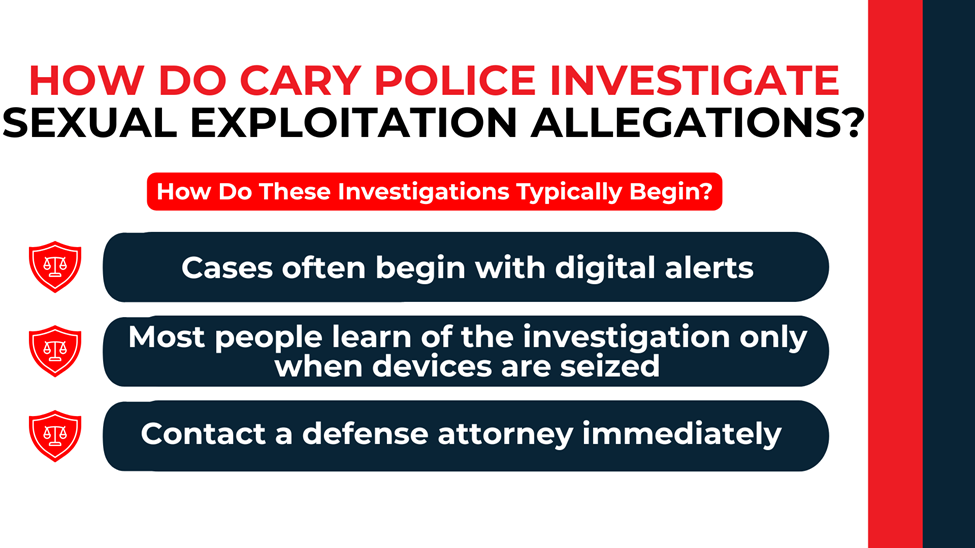
How Do These Investigations Typically Begin?
In Cary’s high-tech environment, these investigations often begin through digital trails rather than traditional tips or complaints. Common starting points include automated detection by internet service providers, employer IT departments discovering suspicious files on work devices, file-sharing network monitoring by law enforcement, and tips submitted to the NCMEC CyberTipline.
Many defendants first learn they’re under investigation when law enforcement arrives with a search warrant to seize devices. By that point, the investigation may have been ongoing for months.
If Cary Police or federal agents have contacted you about a sexual exploitation investigation—or seized your devices—speaking with a defense attorney immediately can make a significant difference in how your case proceeds.
What Are the Consequences of a Conviction in Wake County?
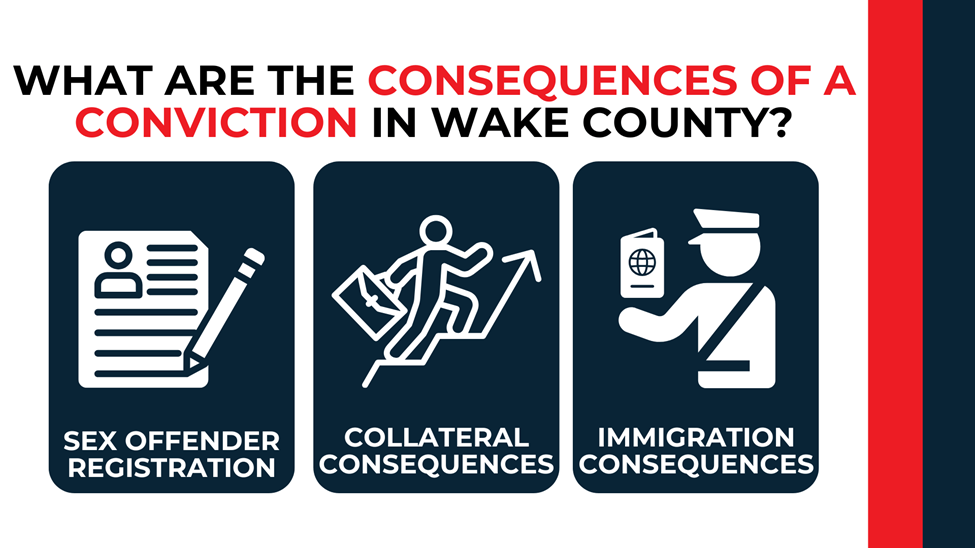
A third-degree sexual exploitation conviction extends far beyond the criminal sentence. For Cary residents—particularly those in professional careers—the collateral consequences often prove more devastating than the court-imposed penalties.
What Does Sex Offender Registration Require?
Conviction for third-degree sexual exploitation of a minor requires registration as a sex offender in North Carolina. This registration is public, meaning employers, neighbors, and anyone conducting a background check will discover the conviction. Registration requirements include providing current address, employment information, and vehicle details to law enforcement, with strict compliance obligations that continue for years.
How Could a Conviction Affect Your Career in the Research Triangle?
For professionals working in the Research Triangle, these charges threaten careers in ways few other offenses can match. In a community where 68.4% of adults hold bachelor’s degrees and the median household income exceeds $129,000, the stakes are exceptionally high.
Collateral consequences include:
- Immediate termination from most professional positions
- Revocation of security clearances required for defense contractors like Lockheed Martin
- Loss of professional licenses in healthcare, education, finance, and law
- Ineligibility for positions at major employers including SAS Institute, Epic Games, and MetLife
- Permanent barriers to employment in any field involving children or vulnerable populations
- Housing restrictions limiting where registrants may live
For employees working under security clearances—common among Cary residents employed by defense contractors and government agencies—an arrest alone may trigger clearance suspension, effectively ending the career before trial.
What Immigration Consequences Apply to Non-Citizens?
For Cary’s substantial immigrant population—approximately 22% of residents are foreign-born, many working in the technology sector on employment visas—a conviction triggers severe immigration consequences. Sexual exploitation of a minor is considered an aggravated felony under federal immigration law, making deportation virtually certain for non-citizens convicted of this offense. Even lawful permanent residents face removal proceedings.
What Defense Strategies Apply to Third-Degree Charges?
Third-degree sexual exploitation charges require defense strategies tailored to digital evidence and the specific elements of this offense. Through the National Association of Criminal Defense Lawyers’ specialized sex-crimes defense training, Patrick Roberts has studied current approaches to challenging digital evidence and forensic analysis methods.
How Can the “Knowledge” Element Be Challenged?
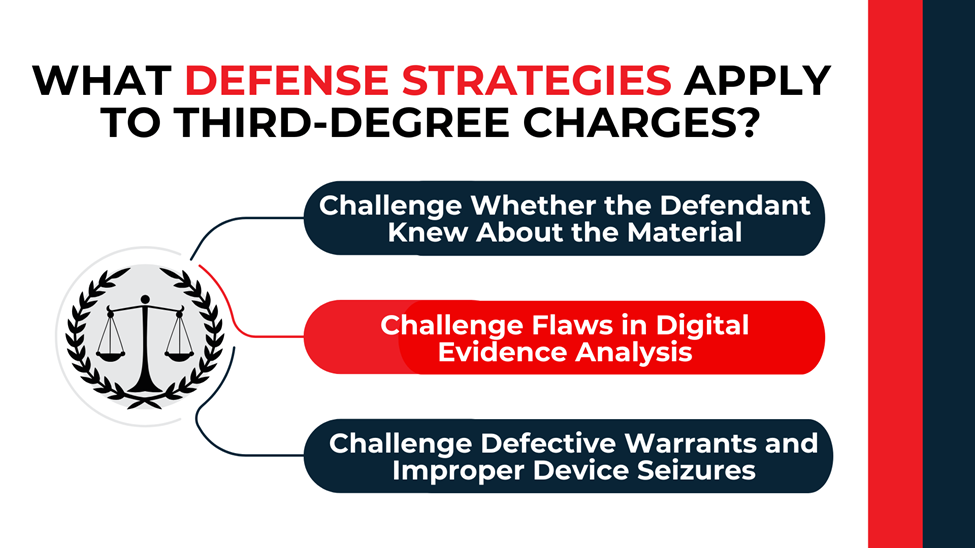
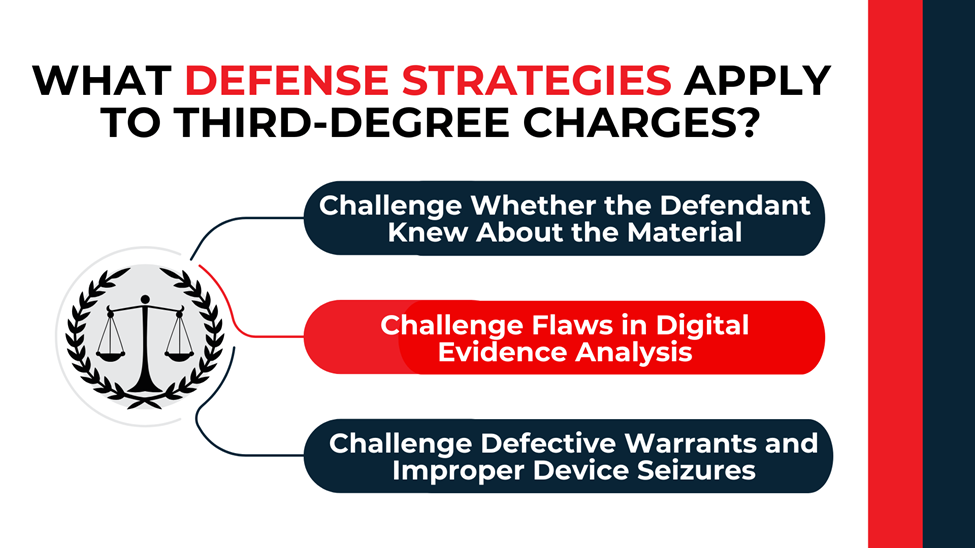
The prosecution must prove the defendant knew the character or content of the material—mere presence on a device is not enough. Defense strategies challenging knowledge may include demonstrating that others had access to the device, that malware or remote access could have placed files without the owner’s knowledge, or that automatic downloads or cached files accumulated without active user involvement.
In Cary’s technology-centered community, work computers and employer-provided devices frequently appear in these cases. Multiple users may have accessed a shared device, and IT administrators often have remote access capabilities that complicate proving who placed material on a system.
As the only North Carolina attorney listed on the National Child Abuse Defense and Resource Center’s website (falseallegation.org), Patrick Roberts brings advanced training in evaluating and challenging these allegations—including close analysis of digital forensics evidence.
What Digital Forensics Issues Might Affect Your Case?
Digital evidence requires careful forensic analysis, and forensic conclusions are not always as definitive as prosecutors may suggest. Potential issues include incomplete forensic examination, failure to exclude alternative explanations for how files arrived on a device, improper handling of digital evidence affecting chain of custody, and reliance on metadata that may have been altered or corrupted.
Defense analysis may reveal that files were never actually accessed or viewed, that timestamps indicate activity inconsistent with the defendant’s known whereabouts, or that the forensic examiner failed to investigate exculpatory possibilities.
Are There Constitutional Challenges to How Evidence Was Obtained?
The Fourth Amendment protects against unreasonable searches and seizures—including searches of digital devices. If law enforcement obtained a search warrant based on insufficient probable cause, exceeded the scope of a valid warrant, or seized devices without proper legal authority, the resulting evidence may be subject to suppression.
Constitutional challenges require careful analysis of how the investigation unfolded, what information supported the warrant application, and whether officers followed proper procedures during the search and seizure process.
Third-degree sexual exploitation charges involve complex digital evidence that requires careful analysis. Patrick Roberts can evaluate the specific circumstances of your case and identify potential defense strategies.
Why Does Experienced Legal Representation Matter for These Charges?
Sexual exploitation cases involve technical evidence, specialized investigation methods, and consequences that extend far beyond typical criminal matters. The right defense attorney brings both legal knowledge and practical experience with how these cases unfold in Wake County courts.
What Should You Look for in a Defense Attorney for These Charges?
Defending third-degree exploitation charges requires understanding digital forensics, familiarity with how Wake County prosecutors build these cases, and the trial skills to challenge evidence effectively. As a graduate of the National Criminal Defense College—with current participation in their cross-examination training program—Attorney Patrick Roberts brings intensive trial preparation skills to every case.
An attorney’s background matters in these cases. Understanding how prosecutors think, what evidence they prioritize, and how they present technical material to juries provides strategic advantages that general criminal defense experience cannot match.
How Does Early Legal Involvement Affect Case Outcomes?
Early involvement by defense counsel can influence how a case develops before charges are even filed. During the investigation stage, an experienced attorney may be able to present mitigating information to prosecutors, challenge the legal sufficiency of the State’s evidence, or identify constitutional issues that affect what evidence can be used.
Once charges are filed, early preparation allows time for independent forensic analysis, thorough investigation of the circumstances, and development of a comprehensive defense strategy rather than reactive responses to prosecution moves.
Frequently Asked Questions
Is third-degree sexual exploitation of a minor a felony in North Carolina?
Yes. Third-degree sexual exploitation of a minor is classified as a Class H felony under N.C. Gen. Stat. § 14-190.17A. While this is the least severe of the three exploitation classifications, it remains a felony conviction with mandatory sex offender registration and significant collateral consequences for employment, housing, and professional licensing.
Can I be charged if someone else used my computer or device?
The prosecution must prove you knowingly possessed the material—not simply that it existed on a device you owned. If others had access to your computer, if the device was compromised by malware, or if files accumulated through automatic processes without your knowledge, these facts may form the basis of a defense. Forensic analysis can often determine when files were accessed and how they arrived on a device.
Will I have to register as a sex offender if convicted in Wake County?
Yes. A conviction for third-degree sexual exploitation of a minor requires sex offender registration in North Carolina. This registration is public information, includes residence and employment details, and carries strict compliance requirements. The registration follows you regardless of where you move within the United States.
How long do these investigations take before charges are filed?
Sexual exploitation investigations often proceed for months before the target becomes aware. Cary Police Department’s Cyber Intelligence Unit may conduct digital surveillance, coordinate with federal agencies, and build substantial evidence before executing a search warrant. Many defendants first learn of an investigation when officers arrive to seize devices—by which point significant investigative work has already occurred.
Can these charges be reduced or dismissed?
Every case depends on its specific facts and evidence. Some cases present opportunities for dismissal based on constitutional violations, insufficient evidence of knowledge, or other legal deficiencies. Others may be resolved through negotiation with Wake County prosecutors. No ethical attorney can guarantee any particular outcome, but experienced defense counsel can identify the strongest arguments available in your situation.
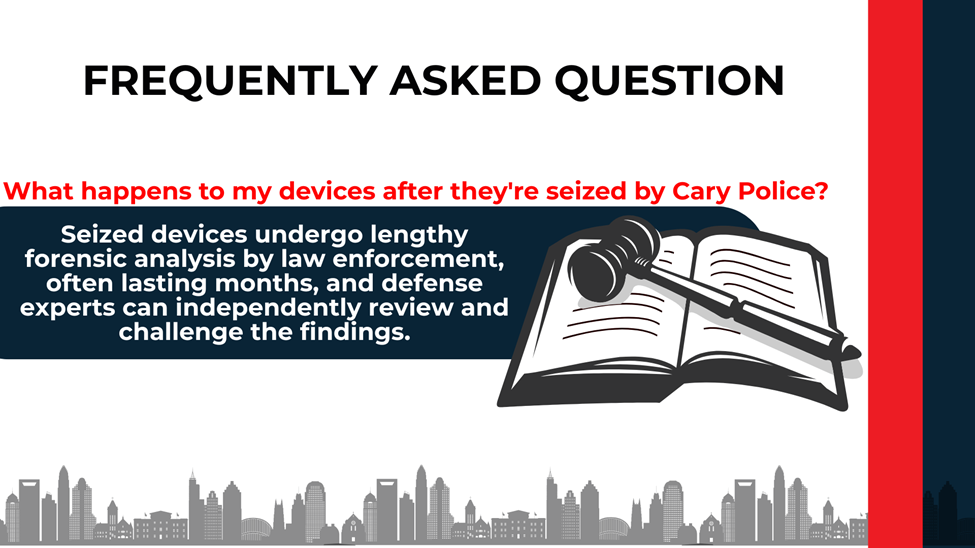
What happens to my devices after they’re seized by Cary Police?
Seized devices undergo forensic examination by law enforcement analysts, often including specialists from the SBI Cyber Crimes Unit or federal agencies. This process involves creating forensic copies of all data, searching for prohibited material, and analyzing metadata to determine when files were accessed. The examination can take weeks or months, and devices may be held as evidence throughout the prosecution. An independent forensic analysis by defense experts can challenge or verify law enforcement conclusions.
Take Action to Protect Your Future
Facing third-degree sexual exploitation charges in Wake County places your freedom, career, and reputation at risk. These cases require defense counsel who understands both the technical evidence involved and how Wake County prosecutors approach these matters.
Attorney Patrick Roberts trained directly with legendary trial attorney Gerry Spence at the Trial Lawyers College, where he learned that effective defense requires understanding the human being behind every case—not just the legal elements of the charge. Combined with his prosecutorial background and ongoing specialized training, this approach ensures every client receives a thorough, prepared, and committed defense.
If you’re facing third-degree sexual exploitation charges in Wake County, Patrick Roberts offers confidential consultations to discuss your situation and explain your options. Early involvement by experienced defense counsel can significantly affect how your case proceeds.
Disclaimer: The information on this website is for general information purposes only. Nothing on this site should be taken as legal advice for any individual case or situation. Case results depend upon a variety of factors unique to each case. Prior results do not guarantee a similar outcome.
A statutory sexual offense charge in North Carolina represents one of the most serious accusations a person can face. For Cary residents—many of whom hold advanced degrees and work in Research Triangle Park’s demanding professional environment—these allegations threaten to unravel careers, families, and futures built over decades. The consequences extend far beyond potential prison time to include mandatory sex offender registration, satellite-based monitoring, and the permanent destruction of professional credentials.
North Carolina law defines multiple forms of statutory sexual offense, each carrying different elements and penalties depending on the ages of the individuals involved. Understanding these distinctions matters because Wake County prosecutors make strategic charging decisions that can dramatically affect your case outcome. Attorney Patrick Roberts brings a perspective few defense attorneys can offer: years of prosecutorial experience handling sex crimes cases in North Carolina. That background means he understands not just the law, but how prosecutors build these cases and where weaknesses in the evidence may exist.
What Exactly Is a Statutory Sexual Offense Under North Carolina Law?
How Does North Carolina Define “Sexual Act” in These Cases?
Statutory sexual offense charges in North Carolina involve what the law terms a “sexual act”—which is distinct from sexual intercourse. While the statutes reference sexual acts, the precise legal definition encompasses specific conduct beyond intercourse. Wake County prosecutors pursuing these charges must prove the occurrence of a qualifying sexual act as an element of the offense.
What Age Requirements Trigger These Charges?
North Carolina’s statutory sexual offense laws focus primarily on the ages of both the defendant and the alleged victim. The age combinations determine which specific statute applies and, consequently, the severity of the charges. For Cary residents facing accusations, understanding these age thresholds is essential because they dictate whether a charge is even legally valid.
How Do the Three Different Statutory Sexual Offense Laws Differ?
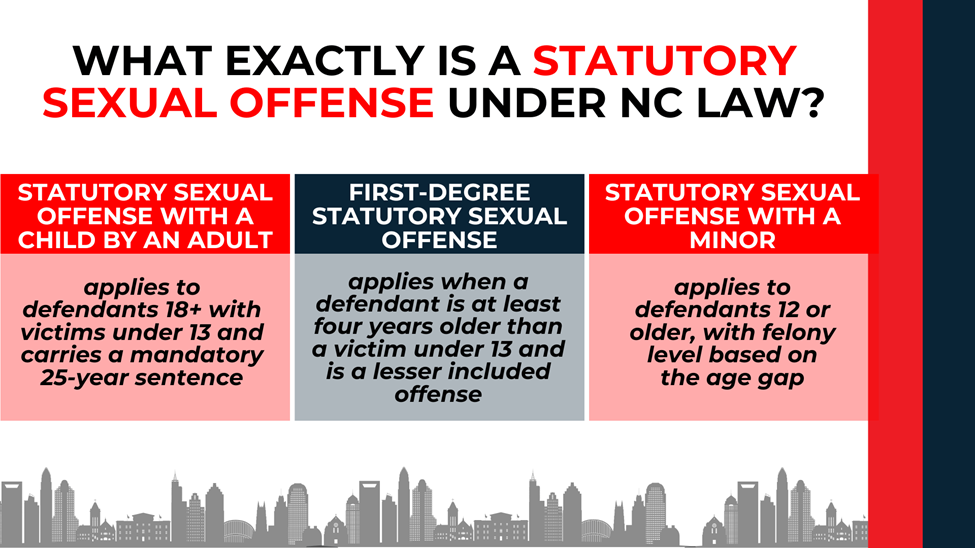
North Carolina has three distinct statutory sexual offense statutes, each addressing different circumstances. When Wake County prosecutors review a case originating from Cary, they select the appropriate charge based on these criteria:
- N.C. Gen. Stat. § 14-27.28 (Statutory Sexual Offense with a Child by an Adult): Applies when the defendant is at least 18 years old and the victim is under 13 years of age. This is a Class B1 felony carrying a mandatory minimum of 300 months (25 years) of active punishment.
- N.C. Gen. Stat. § 14-27.29 (First-Degree Statutory Sexual Offense): Applies when the defendant is at least 12 years old, at least four years older than the victim, and the victim is under 13 years of age. This is a Class B1 felony. Notably, this offense is a lesser included offense of § 14-27.28.
- N.C. Gen. Stat. § 14-27.30 (Statutory Sexual Offense with a Person 15 or Younger): Applies when the defendant is at least 12 years old and the victim is 15 or younger. If the defendant is at least six years older, it is a Class B1 felony. If the defendant is more than four but less than six years older, it is a Class C felony. A marriage exception exists under this statute.
Attorney Patrick Roberts’ experience prosecuting sex crimes cases means he understands how district attorneys evaluate evidence and select charges. That insight proves invaluable when developing defense strategy.
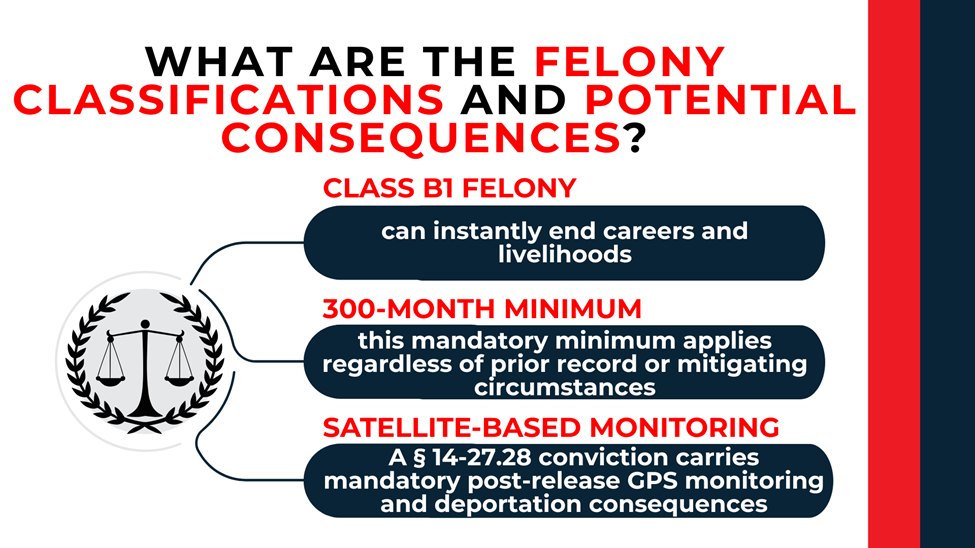
What Are the Felony Classifications and Potential Consequences?
What Makes a Class B1 Felony So Serious?
Class B1 felonies represent the second-most-serious felony classification in North Carolina’s structured sentencing system. For professionals working at companies like SAS Institute or defense contractors such as Lockheed Martin—employers prevalent throughout the Research Triangle—a Class B1 felony conviction destroys careers instantly. Security clearances are revoked. Professional licenses are suspended or permanently lost. The median household income of $129,399 that supports a Cary family disappears.
When Does the Mandatory 300-Month Minimum Apply?
Under N.C. Gen. Stat. § 14-27.28, when an adult defendant (18 or older) is convicted of statutory sexual offense with a child under 13, the court must impose a minimum of 300 months—25 years—of active punishment. This mandatory minimum exists regardless of a defendant’s prior record or other mitigating circumstances. The statute further authorizes enhanced sentencing up to and including life imprisonment without parole when the court finds the offense involved extraordinary brutality, duration, severity, or scope.
What Is Satellite-Based Monitoring and When Is It Required?
Following the termination of active punishment for a conviction under § 14-27.28, defendants are subject to enrollment in satellite-based monitoring as provided under Part 5 of Article 27A of Chapter 14 of the General Statutes. This GPS tracking requirement extends supervision well beyond prison release. For Cary’s substantial immigrant population—approximately 22% of residents are foreign-born, many working in the tech sector on employment visas—conviction also triggers deportation consequences that compound these penalties.
Patrick Roberts’ ongoing sex-crimes defense training through NACDL, where he holds lifetime membership, ensures he stays current on the evolving legal landscape surrounding these serious charges.
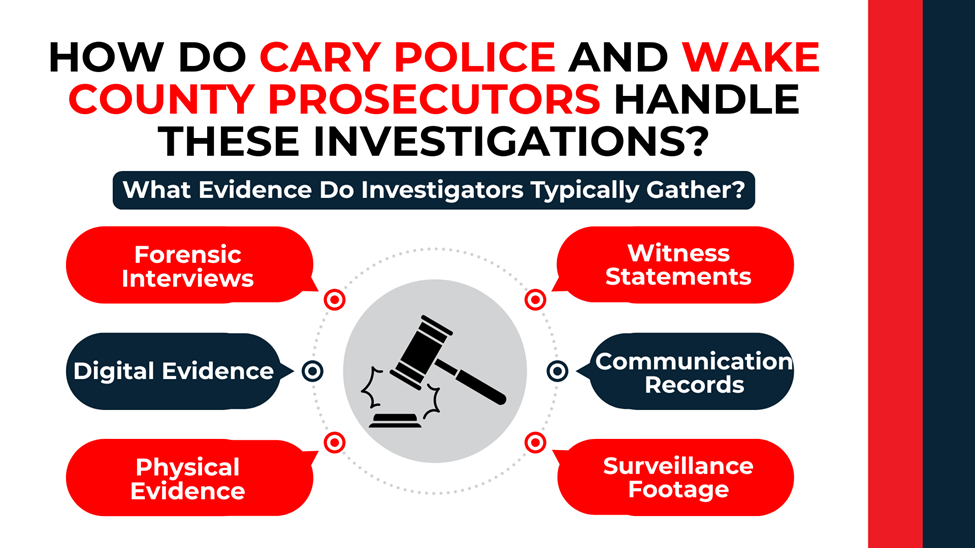
How Do Cary Police and Wake County Prosecutors Handle These Investigations?
What Role Does Cary PD’s Special Victims Unit Play?
When allegations of statutory sexual offense arise in Cary, the Cary Police Department’s Special Victims Unit typically handles the investigation. This dedicated unit within CPD’s Investigations Division focuses specifically on sexual assault, child exploitation, and related sensitive crimes. SVU detectives receive specialized training in interviewing alleged victims and gathering evidence in these cases. For allegations involving digital evidence, CPD’s Cyber Intelligence Unit—the only dedicated unit of its kind among the Triangle’s four major police departments—may also become involved.
How Does the Wake County District Attorney’s Office Approach These Cases?
All Cary criminal cases are prosecuted through the Wake County District Attorney’s office, which maintains specialized prosecutors who focus specifically on sex crime cases. These prosecutors coordinate closely with Cary PD throughout case development, from investigation through trial. Having handled these cases as a prosecutor, Patrick Roberts understands how the Wake County DA’s office evaluates evidence, makes charging decisions, and prepares for trial.
What Evidence Do Investigators Typically Gather?
Investigations into statutory sexual offense allegations are thorough and multifaceted. Cary’s high-tech community environment means digital evidence often plays a central role. Investigators commonly pursue several categories of evidence:
- Forensic interviews with the alleged victim, often conducted by trained child forensic interviewers
- Digital evidence from phones, computers, and cloud storage accounts
- Physical evidence and forensic examinations
- Witness statements from family members, teachers, or other individuals
- Communication records including text messages, social media, and email
- Any available surveillance footage or photographic evidence
Understanding what evidence exists—and what evidence may be missing or unreliable—is central to building an effective defense.
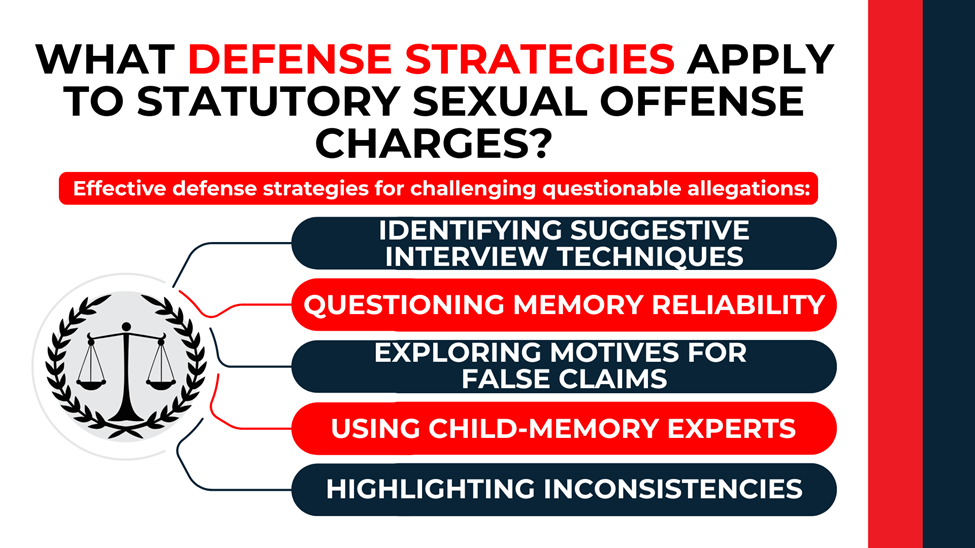
What Defense Strategies Apply to Statutory Sexual Offense Charges?
Can Age Mistake Ever Be a Defense in North Carolina?
In statutory sexual offense cases, the defendant’s knowledge of or mistake about the alleged victim’s age is generally not a defense under North Carolina law. These are strict liability offenses with respect to age. However, the prosecution must still prove the alleged victim’s actual age beyond a reasonable doubt as an element of the offense. Cases sometimes involve disputes about age documentation or evidence.
How Can False Allegations Be Challenged?
False allegations occur in sex offense cases for various reasons: custody disputes, family conflicts, misunderstandings, or suggestive interviewing techniques. In a family-oriented community like Cary, where accusations carry enormous social weight even before any conviction, wrongful allegations can devastate innocent people. Patrick Roberts holds specialized training from the National Child Abuse Defense and Resource Center (NCADRC) focused specifically on defending against false accusations. He is the only attorney in North Carolina listed on the NCADRC website at falseallegation.org—a distinction reflecting his commitment to this specialized area. Effective defense strategies for challenging questionable allegations include:
- Analyzing forensic interview recordings for suggestive or leading questioning techniques
- Examining the alleged victim’s memory and any factors affecting reliability
- Investigating potential motives for false reporting
- Consulting with experts on child suggestibility and memory
- Challenging inconsistencies in the allegation over time
The trial advocacy methods Patrick Roberts learned at Gerry Spence’s Trial Lawyers College—where he trained directly with the legendary attorney who never lost a criminal trial—emphasize connecting with juries and humanizing clients facing serious accusations.
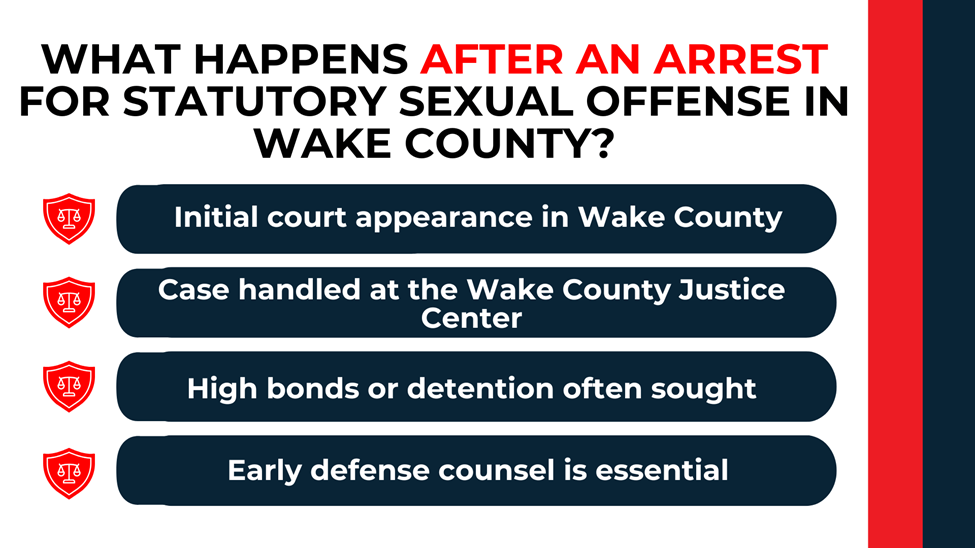
What Happens After an Arrest for Statutory Sexual Offense in Wake County?
What Should You Expect at the Initial Court Appearance?
Following an arrest for statutory sexual offense, defendants appear before a magistrate and then in Wake County District Court for initial proceedings. Cases are processed through the Wake County Justice Center in Raleigh. Bond is typically set, though prosecutors often request substantial bonds or pretrial detention in these cases. Having defense counsel present as early as possible helps protect your rights during these critical initial stages.
How Long Does the Court Process Typically Take?
Felony cases in Wake County’s 10th Judicial District, particularly Class B1 felonies like statutory sexual offense, often take many months or longer to resolve. The timeline depends on factors including the complexity of the evidence, whether forensic testing is required, and whether the case proceeds to trial or resolves through negotiation. Defense counsel who understands Wake County procedures can navigate the system efficiently while protecting the client’s interests throughout.
What Pretrial Conditions Might Be Imposed?
Courts commonly impose restrictive pretrial conditions in statutory sexual offense cases. These may include GPS monitoring, no-contact orders with the alleged victim, residence restrictions, employment limitations, and internet usage prohibitions. For Cary professionals whose work requires technology access or security clearances, these conditions can be professionally devastating even before any conviction. The cross-examination and trial preparation techniques Patrick Roberts developed through the National Criminal Defense College help ensure clients are prepared to challenge the prosecution’s case.
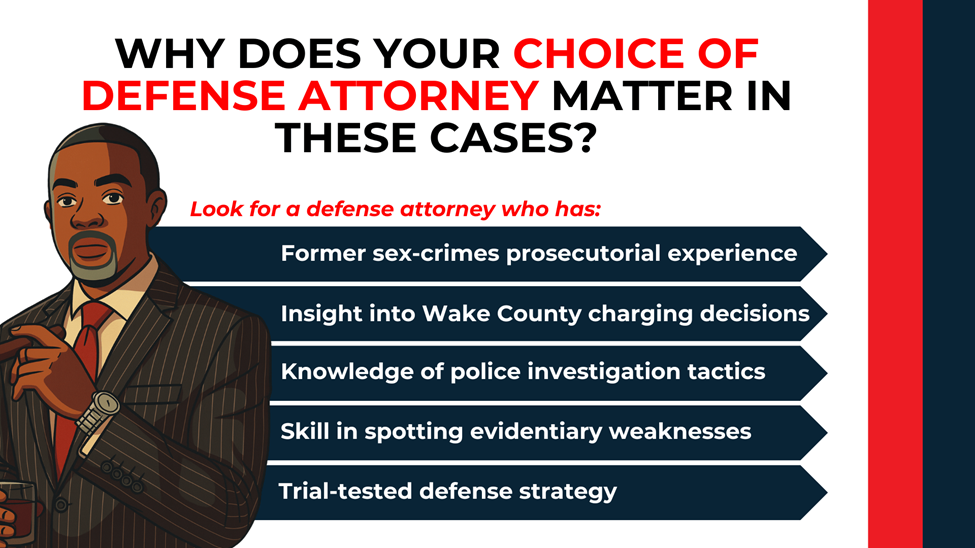
Why Does Your Choice of Defense Attorney Matter in These Cases?
What Advantages Does Former Prosecution Experience Provide?
Statutory sexual offense cases require defense counsel who understands both sides of the courtroom. Patrick Roberts’ years as a prosecutor handling sex crimes cases provide insight that defense-only attorneys simply cannot match. He knows how Wake County prosecutors evaluate evidence, make charging decisions, and prepare for trial. He understands the investigation techniques law enforcement uses and where weaknesses in the State’s case may exist. That prosecutorial perspective shapes every aspect of defense strategy.
Why Is Specialized Sex-Crimes Training Important?
Beyond courtroom experience, defending against sex offense charges requires specialized knowledge that general criminal defense attorneys may lack. Patrick Roberts has invested heavily in ongoing professional development focused specifically on these cases. His credentials include lifetime NACDL membership with extensive sex-crimes defense training at recent national seminars. His NCADRC training addresses the specific challenges of false allegation defense—and his listing as the only North Carolina attorney on falseallegation.org reflects that commitment. The advanced cross-examination techniques he continues to develop through NCDC training, combined with the jury connection methods from the Gerry Spence Trial Lawyers College, provide a comprehensive skill set tailored to these complex cases
Frequently Asked Questions
Where will my statutory sexual offense case be heard?
Cases arising from Cary are prosecuted in Wake County Superior Court, located at the Wake County Justice Center in Raleigh. Having defense counsel familiar with Wake County procedures and prosecutors provides a meaningful advantage.
What is the difference between statutory sexual offense and statutory rape?
Statutory rape involves sexual intercourse, while statutory sexual offense involves other sexual acts as defined by North Carolina law. Both carry severe penalties, and the specific charge depends on the conduct alleged.
Can these charges be reduced or dismissed?
Every case is different, and outcomes depend on the specific facts and evidence. Potential strategies include challenging the sufficiency of evidence, exposing problems with the investigation, demonstrating false allegations, or negotiating with prosecutors. An attorney who understands how the Wake County District Attorney’s office approaches these cases can evaluate the options realistically.
Will I have to register as a sex offender if convicted?
Yes. Conviction for statutory sexual offense requires sex offender registration in North Carolina. For convictions under § 14-27.28 specifically, satellite-based monitoring is also mandated following release from active punishment.
Protecting Your Future Starts Now
Facing statutory sexual offense charges in Cary threatens everything you have built—your career in the Research Triangle’s competitive professional environment, your family relationships, and your freedom. These allegations demand defense counsel who combines prosecutorial insight with specialized training in sex-crimes defense.
Mr. Patrick Roberts brings experience that few North Carolina attorneys can match. His background prosecuting these cases means he understands how the Wake County District Attorney’s office builds its case against you. His distinction as the only North Carolina attorney listed on the National Child Abuse Defense and Resource Center’s falseallegation.org registry as of December 2025 reflects his commitment to defending the wrongly accused.
If you or someone you love faces statutory sexual offense charges in Cary, Wake County, or anywhere in the Research Triangle area, contact Patrick Roberts Law to discuss your case and your defense options.

Disclaimer: The information on this website is for general information purposes only. Nothing on this site should be taken as legal advice for any individual case or situation. Case results depend upon a variety of factors unique to each case. Prior results do not guarantee a similar outcome.
A statutory rape accusation in Cary, North Carolina threatens everything you’ve built. In this Research Triangle community—where nearly 70% of adults hold college degrees and median household incomes exceed $129,000—the stakes extend far beyond the courtroom. Careers at SAS Institute, Epic Games, or defense contractors like Lockheed Martin can end before a case ever reaches trial. Security clearances evaporate. Professional licenses face suspension. The life you’ve established in one of North Carolina’s most successful communities hangs in the balance.
North Carolina prosecutes statutory rape under multiple statutes, each carrying severe felony penalties. Unlike forcible rape charges, these offenses do not require proof of force or lack of consent—the alleged victim’s age alone can establish criminal liability. This legal reality makes these cases uniquely challenging to defend and demands an attorney who understands both how prosecutors build these cases and how to dismantle them.
Mr. Patrick Roberts, a former prosecutor who handled sex offense cases throughout his prosecutorial career, now defends Cary residents facing these life-altering accusations. His experience on both sides of the courtroom provides critical insight into the strategies Wake County prosecutors employ—and the weaknesses in their cases that effective defense can exploit.
What Is Statutory Rape Under North Carolina Law?
How Does North Carolina Define Statutory Rape Differently From Other Sex Offenses?
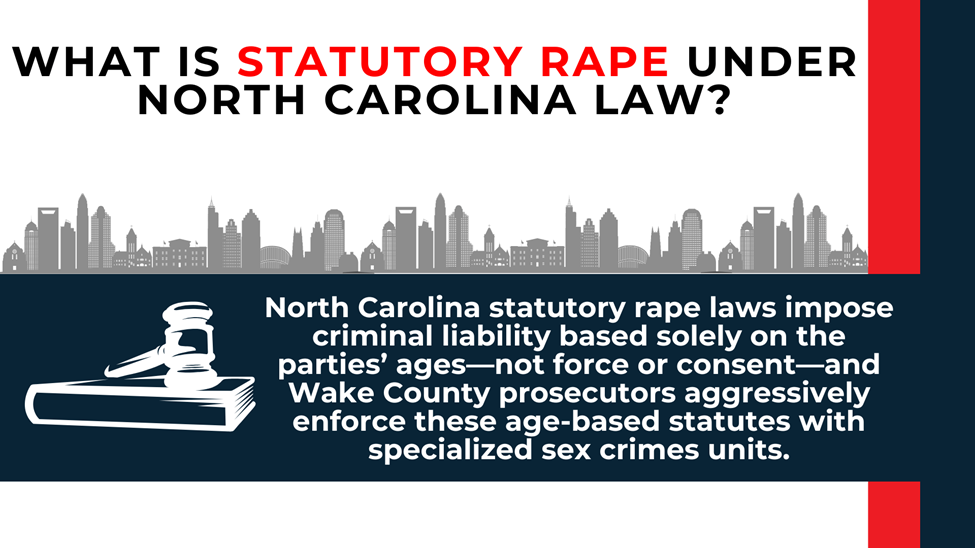
North Carolina’s statutory rape laws criminalize sexual conduct based primarily on the ages of the parties involved rather than on whether force or coercion occurred. Under these statutes, specific age combinations create criminal liability regardless of the circumstances surrounding the encounter. The Wake County District Attorney’s office prosecutes these cases aggressively, and their specialized sex crimes prosecutors understand every nuance of these statutes.
The term “statutory” refers to the fact that these offenses are defined entirely by statute—by the ages written into the law—rather than by the presence of force, threat, or lack of consent. This distinction matters enormously for defense strategy because it changes what the prosecution must prove and what arguments are available to the defense.
What Makes These Charges “Statutory” Rather Than Forcible?
Forcible rape requires the prosecution to prove that sexual conduct occurred through force, threat, or when the victim was physically helpless or mentally incapacitated. Statutory rape requires no such proof. Instead, the prosecution need only establish that the alleged sexual conduct occurred and that the parties fell within prohibited age categories.
This prosecutorial framework means that cases which might seem consensual can still result in serious felony charges. Patrick Roberts’ background prosecuting these exact cases gives him perspective that few defense attorneys possess—he knows the evidence standards prosecutors must meet and where their cases often fall short.
Does the Alleged Victim’s Consent Matter in These Cases?
Under North Carolina’s statutory rape laws, consent is not a legal defense. The statutes presume that individuals below certain ages cannot legally consent to sexual activity with older partners. This legal presumption exists regardless of what the alleged victim says occurred, regardless of who initiated contact, and regardless of any relationship between the parties.
This reality shapes how Wake County prosecutors approach these cases. They do not need to prove the alleged victim objected or resisted—they need only prove the conduct occurred and that the age requirements were met.
What Are the Different Types of Statutory Rape Charges in North Carolina?
What Is Statutory Rape of a Child by an Adult Under N.C. Gen. Stat. § 14-27.23?
North Carolina’s most serious statutory rape charge applies when a defendant who is at least 18 years old engages in vaginal intercourse with a victim who is under 13 years old. Under N.C. Gen. Stat. § 14-27.23, this offense is classified as a Class B1 felony with a mandatory minimum active sentence of 300 months—25 years—in prison. Following release, the defendant faces mandatory enrollment in satellite-based monitoring.
The statute also permits enhanced sentencing up to and including life imprisonment without parole if the court finds egregious aggravating factors such as extraordinary brutality, the extraordinarily young age of the victim, or depraved conduct beyond what the basic offense contemplates.
Cary Police Department’s Special Victims Unit investigates these allegations with dedicated detectives trained specifically in child sex crimes. When CPD suspects this offense, they often coordinate with the North Carolina State Bureau of Investigation and federal task forces, bringing substantial investigative resources to bear.
How Is First-Degree Statutory Rape Defined Under N.C. Gen. Stat. § 14-27.24?
First-degree statutory rape under N.C. Gen. Stat. § 14-27.24 applies when the defendant is at least 12 years old, is at least four years older than the victim, and the victim is under 13 years old. This Class B1 felony carries severe consequences, though without the mandatory 300-month minimum that applies to adult defendants under § 14-27.23.
This statute functions as a lesser included offense of § 14-27.23, meaning prosecutors can charge under either statute depending on the defendant’s age and the evidence available. Understanding this relationship between statutes is essential for effective defense—Patrick Roberts’ lifetime membership in the National Association of Criminal Defense Lawyers and his advanced sex-crimes defense training through NACDL help him navigate these complex charging decisions.
When Does N.C. Gen. Stat. § 14-27.25 Apply to Victims 15 or Younger?
When the alleged victim is 15 years old or younger—but not under 13—North Carolina applies a tiered approach based on the age difference between the parties. The key statutory provisions include:
- A Class B1 felony applies when the defendant is at least 12 years old and at least six years older than the alleged victim, unless the parties are lawfully married.
- A Class C felony applies when the defendant is at least 12 years old and more than four but less than six years older than the alleged victim, unless covered by another statute providing greater punishment or the parties are lawfully married.
These age-gap calculations can become central to defense strategy. A one-year difference in ages can mean the difference between a Class B1 and Class C felony—or between criminal liability and no offense at all. The precision required in establishing exact ages and the dates of alleged conduct creates opportunities for experienced defense counsel to challenge the prosecution’s case.
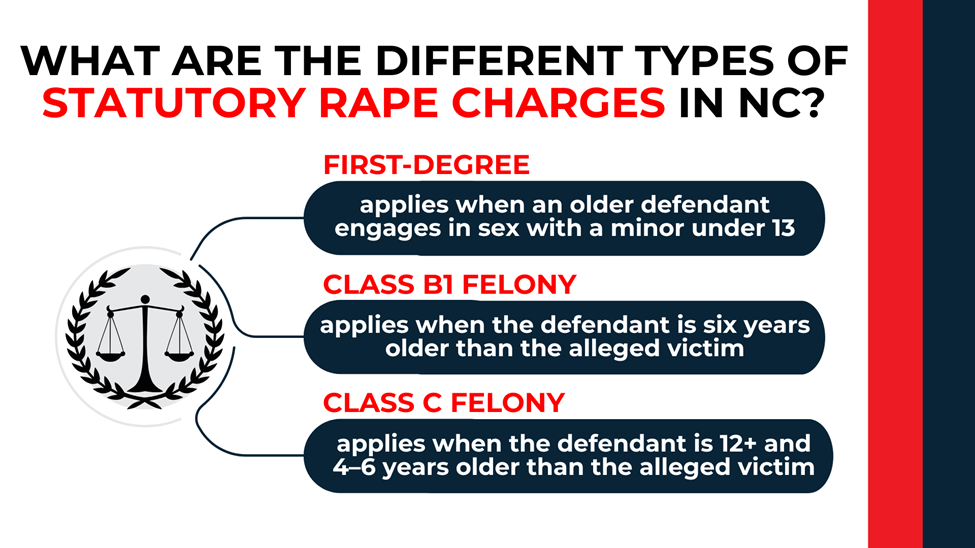
What Are the Potential Consequences of a Statutory Rape Conviction?
What Prison Sentences Do These Charges Carry?
Statutory rape convictions carry substantial prison sentences under North Carolina’s structured sentencing guidelines. Class B1 felonies—which include the most serious statutory rape charges—place defendants in the most severe sentencing category for non-capital offenses. For charges under N.C. Gen. Stat. § 14-27.23 involving adult defendants and victims under 13, the mandatory minimum of 300 months means no defendant can receive less than 25 years of active imprisonment regardless of other factors.
Class C felonies under N.C. Gen. Stat. § 14-27.25(b) carry somewhat less severe but still substantial sentencing ranges under North Carolina’s guidelines.
Will a Conviction Require Sex Offender Registration?
A statutory rape conviction triggers mandatory sex offender registration in North Carolina. For the most serious offenses under N.C. Gen. Stat. § 14-27.23 and § 14-27.28, defendants also face mandatory satellite-based monitoring following release from prison—meaning GPS tracking for the remainder of their lives.
Sex offender registration affects where you can live, where you can work, and how you interact with your community. In Cary’s family-oriented neighborhoods—from Amberly to Preston to Lochmere—registration requirements can make finding suitable housing nearly impossible.
How Would a Conviction Affect Professional Licenses and Security Clearances?
For Cary residents, the professional consequences of a statutory rape conviction often prove as devastating as incarceration. Patrick Roberts has completed extensive training through the National Child Abuse Defense and Resource Center, and he is the only attorney in North Carolina listed on NCADRC’s website at falseallegation.org—training that emphasizes understanding the full scope of what defendants face.
The career consequences for professionals in the Research Triangle are severe and often permanent:
- Engineers and researchers at SAS Institute or Epic Games face immediate termination and industry blacklisting.
- Defense contractor employees at Lockheed Martin lose security clearances instantly upon arrest—not conviction—ending careers in the defense sector permanently.
- Financial services professionals at companies like MetLife face licensing revocation that extends nationwide.
- Healthcare workers, teachers, and licensed professionals lose the credentials they spent years obtaining.
- Government employees face termination and permanent bars on public sector employment.
For Cary’s substantial immigrant population—many working in the tech sector on employment visas—a conviction triggers deportation proceedings regardless of how long they’ve lived in the United States.
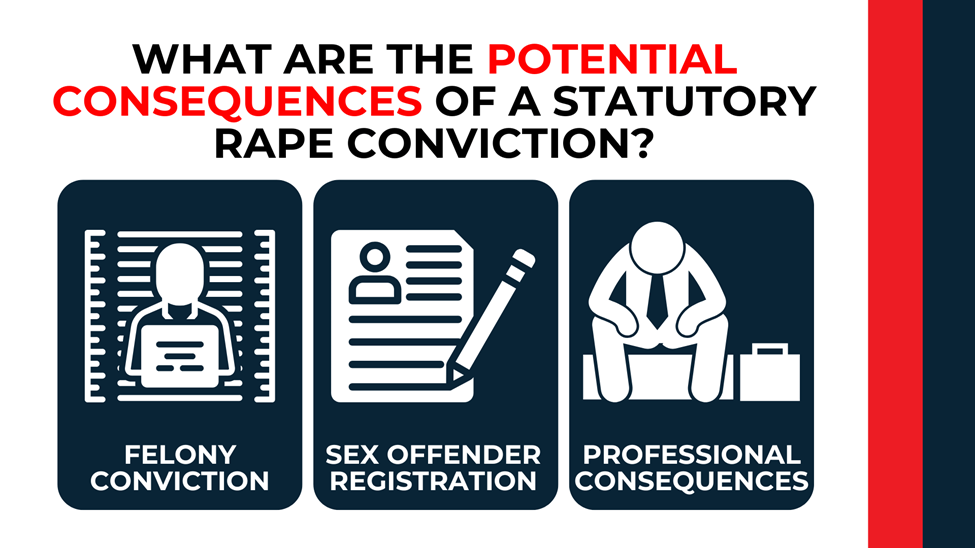
How Do Cary Police and Wake County Prosecutors Handle These Cases?
What Role Does Cary PD’s Special Victims Unit Play in Investigations?
Cary Police Department maintains a Special Victims Unit within its Investigations Division specifically tasked with handling sexual assault, child exploitation, and domestic violence cases. SVU detectives receive specialized training in interviewing techniques, evidence collection, and the unique dynamics of sex offense investigations.
When allegations arise in Cary, SVU detectives typically conduct initial interviews, gather physical evidence, obtain electronic records, and coordinate with prosecutors before charges are filed. In Cary’s technology-driven environment, digital evidence from phones, computers, and cloud storage often plays a central role in these investigations.
How Does the Wake County District Attorney’s Office Approach Statutory Rape Prosecutions?
All criminal cases originating in Cary are prosecuted by the Wake County District Attorney’s office, which maintains prosecutors who focus specifically on sex offense cases. These experienced prosecutors handle cases from initial charging decisions through trial, and they coordinate closely with Cary PD during investigations.
Understanding how Wake County prosecutors build these cases is essential for effective defense. Patrick Roberts’ years prosecuting sex offenses in North Carolina give him direct insight into the evidence prosecutors prioritize, the weaknesses they try to hide, and the strategies they employ at trial. Having worked inside the prosecution, he now uses that knowledge to protect his clients.
What Evidence Do Investigators Typically Gather?
Statutory rape investigations in Wake County typically involve multiple evidence categories. Investigators seek physical evidence when available, electronic communications between the parties, witness statements, forensic interviews with the alleged victim, and any documentation of the relationship between the accused and the accuser.
For cases involving digital evidence, CPD’s Cyber Intelligence Unit—the only dedicated unit of its kind among the Triangle’s four major police departments—brings specialized expertise in extracting and analyzing electronic data. Multi-agency coordination with the SBI Cyber Crimes Unit and federal task forces often occurs in cases involving child exploitation.
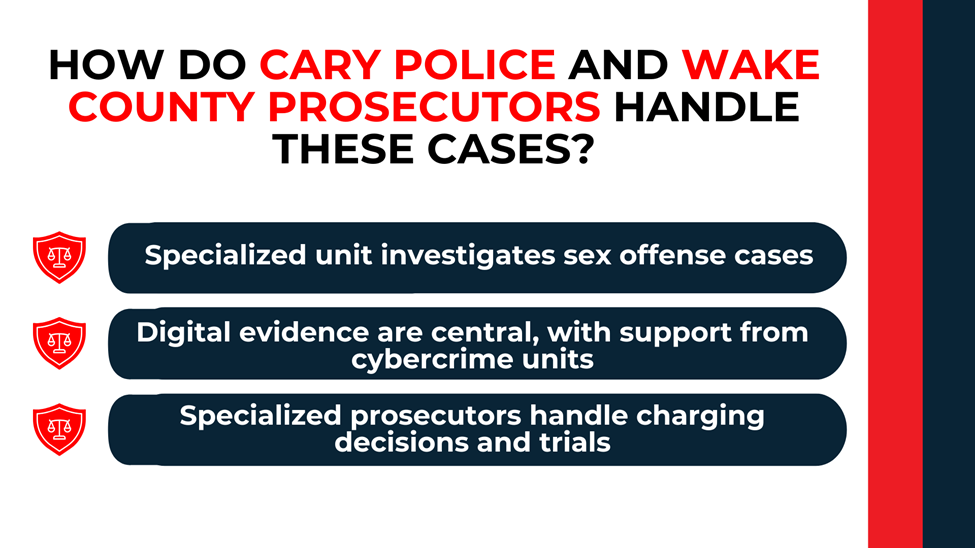
What Defense Strategies Apply to Statutory Rape Cases?
Can Mistaken Age Ever Be a Defense in North Carolina?
North Carolina’s statutory rape laws are strict liability offenses regarding age—meaning the defendant’s belief about the alleged victim’s age is generally not a defense. Even if an alleged victim lied about their age, presented false identification, or appeared significantly older than their actual age, the defendant may still face conviction if the prohibited conduct occurred.
This harsh legal reality makes other defense strategies essential. Challenging whether the alleged conduct actually occurred, attacking the reliability of the evidence, and exposing weaknesses in witness testimony become central to effective defense.
How Can Defense Counsel Challenge the State’s Evidence?
Effective defense in statutory rape cases requires meticulous analysis of every piece of evidence the prosecution plans to use. Patrick Roberts’ training at the National Criminal Defense College, including advanced cross-examination techniques, proves essential when challenging witness credibility and exposing evidentiary weaknesses.
A strategic defense approach examines multiple potential weaknesses:
- Inconsistencies in the alleged victim’s statements across multiple interviews
- Problems with how forensic interviews were conducted
- Chain of custody issues with physical or digital evidence
- Witness credibility and potential motives for false allegations
- Constitutional violations during investigation that may require evidence suppression
What Role Does Forensic Interview Analysis Play in These Cases?
Many statutory rape cases rely heavily on the alleged victim’s account as provided in forensic interviews. These recorded interviews, typically conducted at child advocacy centers, often become the prosecution’s primary evidence.
Patrick Roberts’ extensive NCADRC training focuses specifically on analyzing forensic interviews for suggestive questioning, improper techniques, and signs that a child’s account may have been influenced by adults. As the only North Carolina attorney listed on falseallegation.org’s registry of NCADRC-trained defenders, he brings specialized knowledge to evaluating whether interview procedures met accepted standards or whether they may have contaminated the alleged victim’s account.
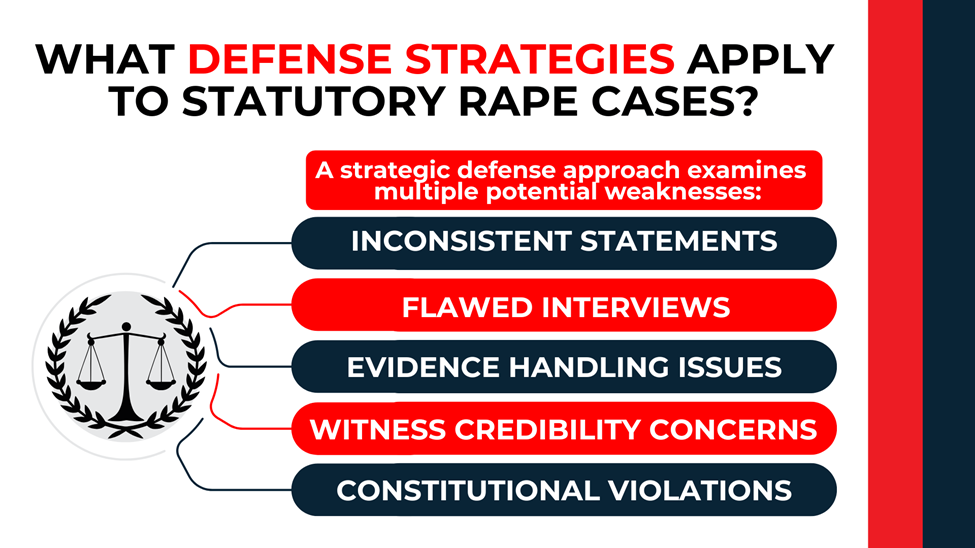
Why Does Your Choice of Defense Attorney Matter in Statutory Rape Cases?
What Should You Look for in a Statutory Rape Defense Attorney?
Statutory rape cases demand an attorney with specific experience and training in sex offense defense. These cases involve unique evidentiary issues, specialized forensic considerations, and consequences that extend far beyond incarceration. General criminal defense experience, while valuable, does not substitute for focused training in this complex area.
Wake County courts see these cases regularly, and the prosecutors handling them are experienced and well-resourced. Effective defense requires counsel who understands local procedures, knows how Wake County prosecutors approach these cases, and can match their preparation and expertise.
How Does a Former Prosecutor’s Perspective Help the Defense?
Attorney Patrick Roberts’ prosecutorial background provides a strategic advantage that few defense attorneys can offer. Having built these cases as a prosecutor, he understands how the State constructs its evidence, what arguments persuade judges and juries, and where prosecutorial cases typically show weakness.
His training at the Gerry Spence Trial Lawyers College—where he learned directly from one of America’s most accomplished trial attorneys—shapes how he connects with juries and humanizes his clients in the courtroom. In cases where the charges alone can prejudice jurors, this ability to tell a client’s story effectively often determines outcomes.
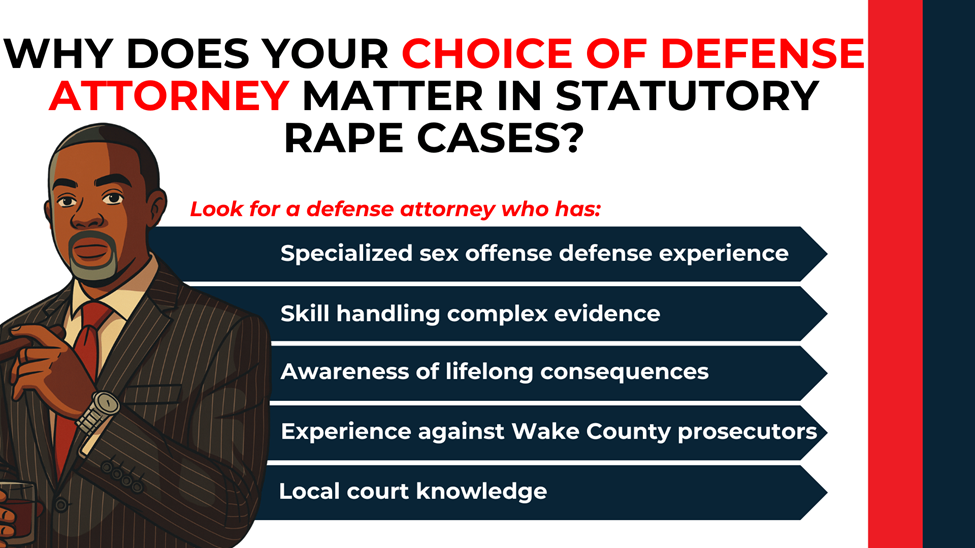
Frequently Asked Questions
Can statutory rape charges be reduced or dismissed in Wake County?
Outcomes depend on the specific facts of each case, the evidence available, and the defense strategy employed. Some cases result in dismissal when evidence proves insufficient. Others may be resolved through negotiation depending on circumstances. An experienced defense attorney can evaluate your case and explain realistic possibilities based on the evidence.
How long do statutory rape investigations typically take in Cary?
Investigation timelines vary significantly. Some cases move quickly from accusation to arrest, while others involve months of investigation before charges are filed. Cary PD’s Special Victims Unit conducts thorough investigations, and complex cases involving digital evidence or multiple agencies may extend investigation timelines considerably.
Will I be arrested immediately after an accusation?
Not necessarily. Many statutory rape investigations proceed for weeks or months before any arrest occurs. However, some cases—particularly those involving young children or perceived flight risks—result in rapid arrest. If you learn you’re under investigation, consulting defense counsel immediately is essential.
What should I do if Cary police want to question me about statutory rape allegations?
You have the constitutional right to remain silent and the right to have an attorney present during any questioning. Politely decline to answer questions and request to speak with an attorney. Statements made to police, even statements you believe are exculpatory, can be used against you and may damage your defense.
Are there immigration consequences for non-citizens convicted of statutory rape?
Yes. Statutory rape convictions constitute aggravated felonies under federal immigration law, triggering mandatory deportation for non-citizens regardless of how long they’ve resided in the United States or their family ties here. For Cary’s substantial immigrant community—many holding H-1B visas or green cards—these immigration consequences demand serious consideration.
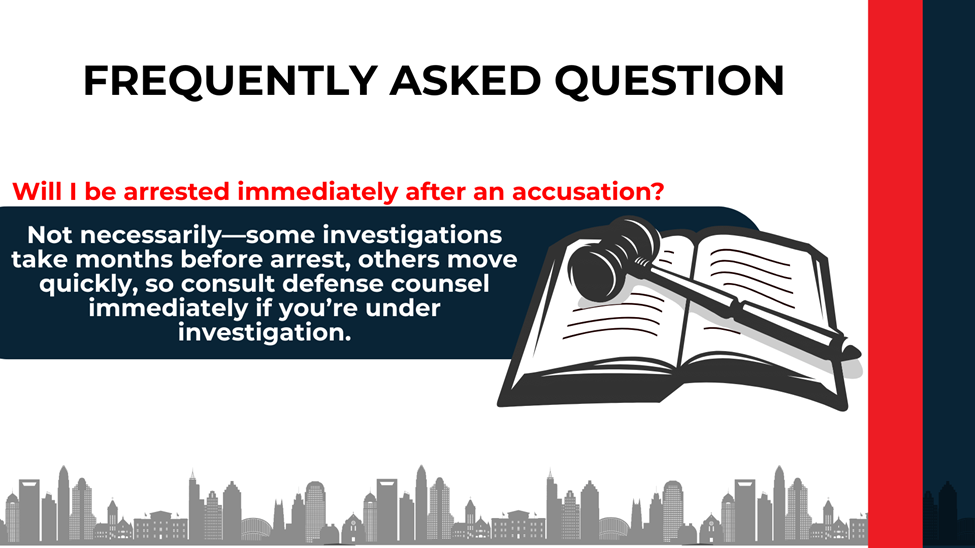
Protecting Your Future Starts Now
Statutory rape charges in North Carolina eliminate consent as a defense, placing enormous pressure on defendants from the moment accusations arise. In these cases, the prosecution doesn’t need to prove you acted against anyone’s will—they need only prove the conduct occurred and that the ages fit the statutory requirements. Fighting back requires an attorney who understands exactly how these cases are built and how to challenge them effectively.
Mr. Patrick Roberts brings the perspective of a former prosecutor who handled sex offense cases, combined with specialized training through NCADRC in defending against false accusations. For Cary residents and families throughout Wake County facing these devastating charges, his experience on both sides of the courtroom provides the insight needed to mount an effective defense.
Contact Patrick Roberts Law to discuss your case in a confidential consultation.
Disclaimer: The information on this website is for general information purposes only. Nothing on this site should be taken as legal advice for any individual case or situation. Case results depend upon a variety of factors unique to each case. Prior results do not guarantee a similar outcome.
Being accused of second-degree sexual exploitation of a minor in Cary, North Carolina puts everything at risk—your career in the Research Triangle, your professional licenses, your family’s stability, and your future. This is a Class E felony under North Carolina law, and Wake County prosecutors take these cases seriously. Understanding exactly what you face is the first step toward building an effective defense. North Carolina’s exploitation statutes target the creation, distribution, and possession of visual material depicting minors engaged in sexual activity. Second-degree sexual exploitation occupies the middle tier of these offenses, focusing primarily on distribution, receipt, and non-commercial recording of such material. For Cary residents—many of whom work in technology, defense, or other fields requiring security clearances—the consequences extend far beyond the courtroom.
What Is Second-Degree Sexual Exploitation of a Minor Under North Carolina Law?
What Specific Conduct Does This Statute Prohibit?
N.C. Gen. Stat. § 14-190.17 defines second-degree sexual exploitation of a minor. The statute prohibits several distinct types of conduct when a person knows the character or content of the material involved.
Prohibited conduct under this statute includes:
- Recording, photographing, filming, developing, or duplicating material containing a visual representation of a minor engaged in sexual activity
- Distributing or transporting such material
- Exhibiting such material
- Receiving such material
- Selling, purchasing, or exchanging such material
- Soliciting such material
- Distributing, transporting, exhibiting, receiving, selling, purchasing, exchanging, or soliciting a child sex doll
Each of these acts constitutes a separate violation. In Cary’s digital environment—where cloud storage, work devices, and electronic communications are ubiquitous—investigators often examine multiple platforms and accounts when building these cases.
How Does Second-Degree Differ From First-Degree and Third-Degree Charges?
North Carolina divides sexual exploitation offenses into three degrees based on the nature of the conduct involved.
- First-degree sexual exploitation under N.C. Gen. Stat. § 14-190.16 is a Class C felony that targets those who use, employ, or coerce minors to engage in sexual activity for live performances or material production—or who produce such material for sale or pecuniary gain. This is the production-focused offense.
- Third-degree sexual exploitation under N.C. Gen. Stat. § 14-190.17A is a Class H felony that covers knowing possession of such material without the distribution or commercial elements.
Second-degree falls between these extremes. It addresses the distribution chain—those who spread, receive, or solicit the material—without requiring proof of commercial motive or direct involvement in production. Wake County prosecutors frequently charge second-degree offenses when digital evidence shows material was shared, downloaded, or requested.
Why Does North Carolina Treat These Offenses So Seriously?
North Carolina’s General Assembly has classified these offenses as serious felonies because of the ongoing harm to the minors depicted in such material. Every time material is distributed or received, it perpetuates the exploitation of the child involved. This policy rationale shapes how aggressively these cases are investigated and prosecuted throughout the state, including in Wake County.
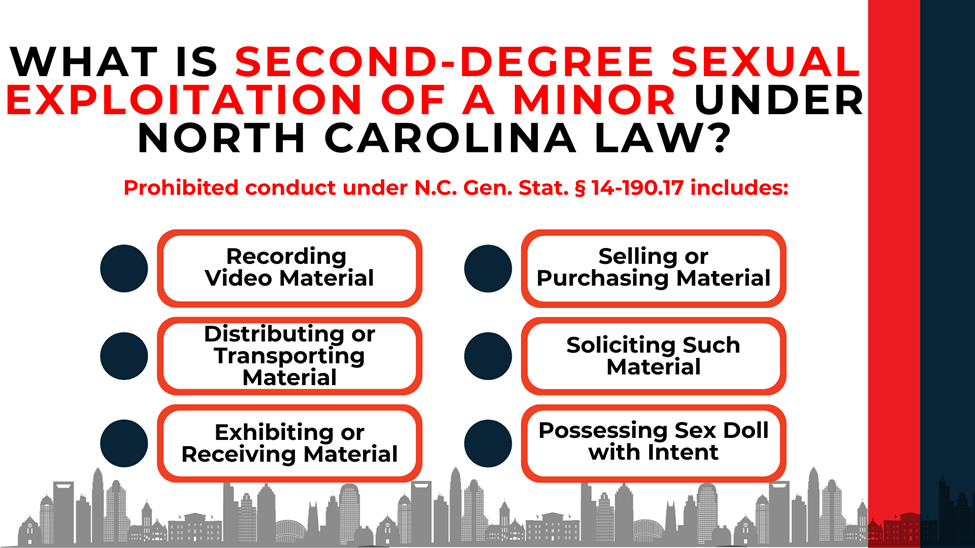
What Must the Prosecution Prove to Convict You?
The Wake County District Attorney’s office must prove every element of second-degree sexual exploitation beyond a reasonable doubt. Understanding these elements is essential for identifying where the prosecution’s case may be vulnerable.
Attorney Patrick Roberts handled sex crimes cases as a prosecutor earlier in his career, giving him direct insight into how the state constructs these cases and what evidence they prioritize. That dual-perspective now fundamentally informs his defense strategy: he knows precisely where to look for procedural errors and evidentiary weaknesses because he once had the burden of proving those very elements himself.
What Does “Knowing the Character or Content” Mean?
The statute requires that the defendant acted “knowing the character or content of the material.” This knowledge element is critical. The prosecution must prove you actually knew what the material depicted—not merely that you should have known or were negligent in failing to discover it.
The elements the prosecution must establish include:
- The defendant engaged in one of the prohibited acts (distributing, receiving, soliciting, recording, etc.)
- The material contained a visual representation of a minor engaged in sexual activity
- The defendant knew the character or content of the material
This knowledge requirement creates important defense opportunities. Malware, unauthorized access to devices, file-sharing programs that download content automatically, and shared network environments can all complicate the prosecution’s ability to prove knowing conduct.
What Qualifies as “Material Containing a Visual Representation”?
Under North Carolina law, the material must contain a “visual representation” of a minor engaged in “sexual activity.” The statute also covers material that has been “created, adapted, or modified to appear that an identifiable minor is engaged in sexual activity.”
Sexual activity, as defined in the broader sex offense statutes, includes various forms of sexual conduct. The visual representation can be photographs, videos, digital images, or other visual media. In Wake County prosecutions, digital files—recovered from computers, phones, cloud storage, and external drives—constitute the most common form of evidence.
Can Mistake of Age Be Raised as a Defense?
No. The statute explicitly states that “mistake of age is not a defense to a prosecution under this section.” Even if you genuinely believed the person depicted was an adult, this belief provides no legal defense.
However, the prosecution still bears the burden of proving the person depicted was actually a minor. The statute allows the trier of fact to “infer” that a participant is a minor based on how the material represents or depicts them—but this inference can be challenged. Defense strategies may focus on the actual age of the person depicted or the reliability of age determinations based on visual assessment alone.
How Do Cary Police and Federal Agencies Investigate These Cases?
Sexual exploitation investigations in Cary involve specialized law enforcement units with significant resources and technical capabilities. Understanding how these investigations unfold helps defendants recognize both the evidence they may face and the potential vulnerabilities in the investigation process.
Attorney Patrick Roberts has completed rigorous training through the National Child Abuse Defense and Resource Center. As of December 2025, he is the only attorney in North Carolina listed on the NCADRC’s website at falseallegation.org—a reflection of his focused preparation for defending these sensitive cases. This specialized training emphasizes understanding investigation methods and identifying where procedures may have compromised evidence reliability.
What Role Does Cary’s Cyber Intelligence Unit Play?
Cary Police Department operates the only dedicated cyber intelligence unit among the Triangle’s four major police departments. Unlike Raleigh, Durham, or Chapel Hill, Cary maintains specialized personnel focused specifically on identifying online offenders and investigating digital exploitation cases.
This unit employs proactive identification techniques—they don’t simply wait for reports. They actively monitor for potential offenders, coordinate with internet service providers, and participate in multi-jurisdictional operations. For defendants, this means investigations may have begun long before any arrest or search warrant.
How Do Multi-Agency Task Forces Coordinate These Investigations?
Exploitation investigations in Wake County rarely involve just one agency. Cary’s Special Victims Unit and Cyber Intelligence Unit frequently coordinate with the North Carolina State Bureau of Investigation’s Cyber Crimes Unit, federal agencies including the FBI and Homeland Security Investigations, and the Internet Crimes Against Children (ICAC) task force.
This multi-agency approach means investigations often have federal involvement from the outset. Task force participation—including operations like Operation Southern Impact and the Invictus Project—brings additional resources and investigative techniques to bear. Defendants may face evidence gathered through multiple agencies with different procedures and oversight requirements.
What Types of Digital Evidence Will Investigators Examine?
In Cary’s technology-driven community, digital evidence plays a central role in these prosecutions. Investigators typically examine computers, laptops, tablets, and smartphones; cloud storage accounts; email and messaging applications; file-sharing program logs and histories; internet browsing history and cached files; external storage devices; and work computers and employer-provided devices.
For professionals working at companies like SAS Institute, Epic Games, or other Research Triangle employers, work devices present particular concerns. IT departments sometimes discover and report suspected material, triggering investigations that extend into personal devices and accounts. The interconnected nature of modern digital life means a search warrant for one device often leads to examination of linked accounts and cloud-synced content.
If you’re under investigation for second-degree exploitation charges in Wake County, the decisions you make now will shape your defense options going forward. Contact Patrick Roberts Law to discuss your situation before speaking with investigators.
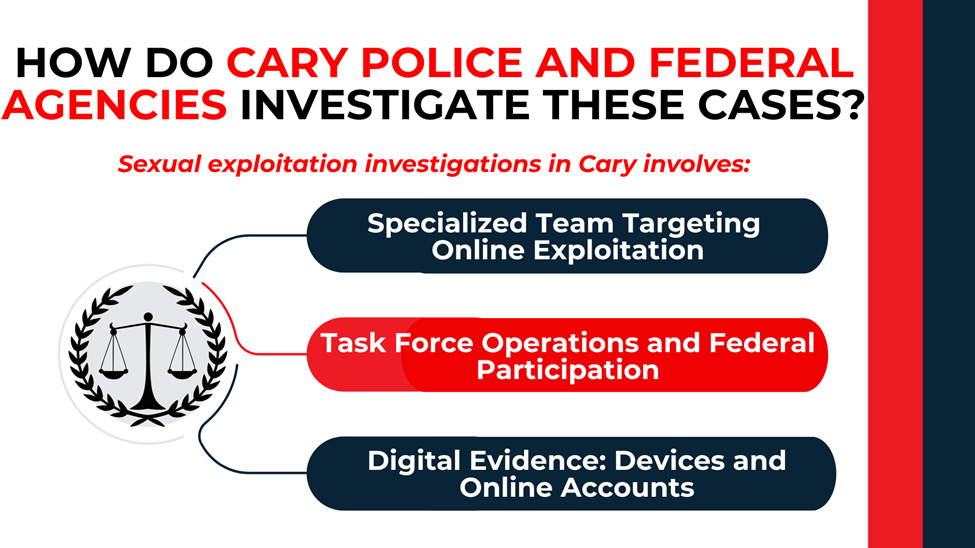
What Consequences Could a Conviction Bring?
A conviction for second-degree sexual exploitation of a minor carries consequences that extend far beyond the criminal sentence itself. For Cary residents—with careers built in the Research Triangle’s professional economy—these collateral consequences can be devastating.
What Is the Felony Classification for This Offense?
Second-degree sexual exploitation of a minor is a Class E felony under North Carolina law. The specific sentence in any case depends on factors including prior record level and the circumstances of the offense. What matters for most defendants is understanding that this is a serious felony conviction that will follow them permanently.
Will You Be Required to Register as a Sex Offender?
Convictions for sexual exploitation of a minor trigger sex offender registration requirements under North Carolina law. Registration creates a public record that affects where you can live, where you can work, and how your community perceives you. In a community like Cary—where 68% of adults hold bachelor’s degrees and professional reputation matters enormously—registration creates social consequences that compound the legal ones.
How Could a Conviction Affect Your Career in the Research Triangle?
For professionals working in Research Triangle Park and the surrounding area, a sexual exploitation conviction effectively ends careers that took decades to build. The collateral consequences for Cary residents are particularly severe.
Employment and professional consequences include:
- Immediate termination from most professional positions
- Revocation of security clearances required for defense contractors like Lockheed Martin
- Loss of professional licenses in fields including law, medicine, education, and finance
- Disqualification from positions involving minors or vulnerable populations
- Background check failures blocking future employment in most professional fields
- Exclusion from employer-provided housing, relocation assistance, and other benefits
For Cary’s substantial immigrant population—many working in the technology sector on employment visas or holding green cards—a conviction triggers immigration consequences including potential deportation. With 22% of Cary residents born outside the United States, this consequence affects a significant portion of those who may face these charges.
The $129,000 median household income that supports a Cary family depends on continued professional employment. A conviction doesn’t just threaten freedom—it threatens the entire financial foundation of a defendant’s family.
What Defense Strategies Apply to These Charges?
Effective defense in second-degree exploitation cases requires understanding both the technical complexity of digital evidence and the specific elements the prosecution must prove. Through ongoing training with the National Association of Criminal Defense Lawyers—including sex-crimes defense seminars held as recently as late 2025—Mr. Roberts stays current on evolving defense strategies and forensic interview analysis techniques.
How Can the “Knowledge” Requirement Be Challenged?
The prosecution must prove the defendant knew the character or content of the material. This knowledge element creates significant defense opportunities in certain cases.
Potential defense approaches include:
- Challenging whether the defendant actually accessed or viewed the material
- Demonstrating that malware, viruses, or unauthorized access placed material on the device
- Showing that automatic download features in file-sharing programs operated without user knowledge
- Establishing that multiple users had access to the device or account
- Questioning the reliability of forensic analysis methods or conclusions
- Challenging chain of custody for digital evidence
- Identifying constitutional violations in how evidence was obtained
Every case presents different facts, and not every defense applies in every situation. An attorney who understands how Wake County prosecutors approach these cases can evaluate which strategies offer the best path forward.
What Constitutional Issues Might Apply to Your Case?
The Fourth Amendment protects against unreasonable searches and seizures. In digital exploitation cases, constitutional challenges may arise regarding the validity of search warrants, the scope of searches conducted, and whether law enforcement exceeded the authority granted by warrants.
Challenges to how internet service provider data was obtained, whether consent to search was truly voluntary, and whether search warrant applications contained material misrepresentations can all affect the admissibility of evidence. Suppressing key evidence may fundamentally change the prosecution’s ability to proceed.
When Might Negotiation Be the Right Approach?
Not every case should go to trial. When the evidence is strong, skilled negotiation may achieve outcomes—including reduced charges or alternative sentencing—that serve the defendant’s interests better than trial would.
Understanding the Wake County District Attorney’s approach to these cases matters enormously in negotiation. Prosecutors have discretion in how they charge cases and what resolutions they’ll accept. An attorney who has worked with these prosecutors, who understands their priorities, and who can present mitigating factors effectively positions clients for the best possible outcomes when negotiation is appropriate.
The stakes in second-degree exploitation cases demand experienced representation from the earliest stages. Contact Patrick Roberts Law to discuss defense strategies specific to your situation.
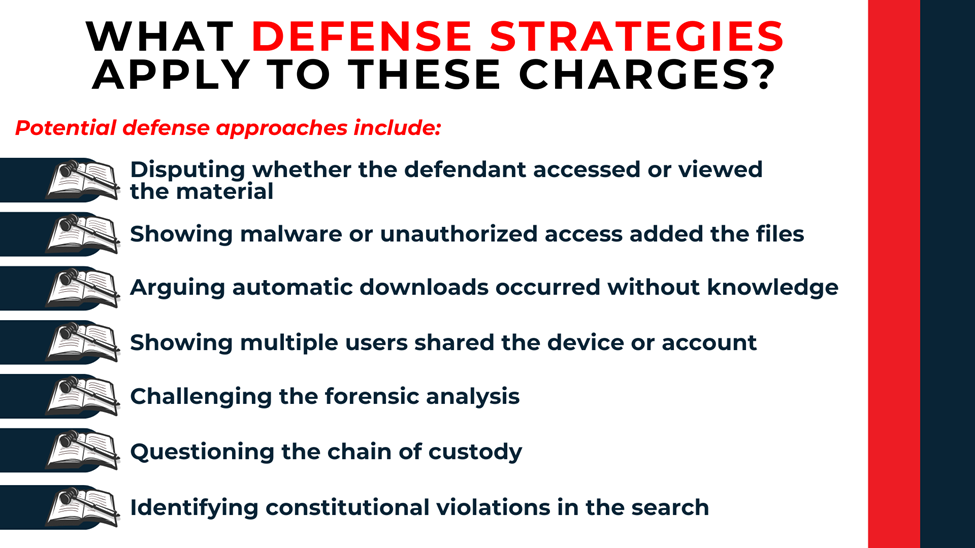
Why Does Your Choice of Defense Attorney Matter in These Cases?
Sexual exploitation charges combine legal complexity, technical evidence challenges, and life-altering consequences. The attorney you choose shapes how your case unfolds from investigation through resolution.
What Should You Look for in a Defense Attorney for Exploitation Charges?
These cases demand specific knowledge and preparation. Understanding digital forensics, knowing how to challenge technical evidence, and having relationships with expert witnesses who can evaluate prosecution claims all matter. Familiarity with Wake County courts—knowing how local judges handle these matters and how prosecutors in this jurisdiction approach case evaluation—provides advantages that general criminal defense experience cannot match.
As a graduate of the National Criminal Defense College, with recent participation in their advanced cross-examination program, Patrick Roberts brings intensive trial preparation skills to every case. That training translates directly to the courtroom—knowing how to examine forensic analysts, challenge investigation methods, and present technical defenses clearly to judges and juries.
How Does Prosecutorial Experience Benefit Your Defense?
An attorney who has prosecuted these cases understands how the state thinks. He knows what evidence prosecutors consider essential, where they expect defense challenges, and how they evaluate case strength. That perspective—seeing the case from the prosecution’s viewpoint—reveals opportunities that might otherwise remain hidden.
Attorney Patrick Roberts brings that dual perspective to every exploitation case. His years handling these matters as a prosecutor inform his defense strategy at every stage.
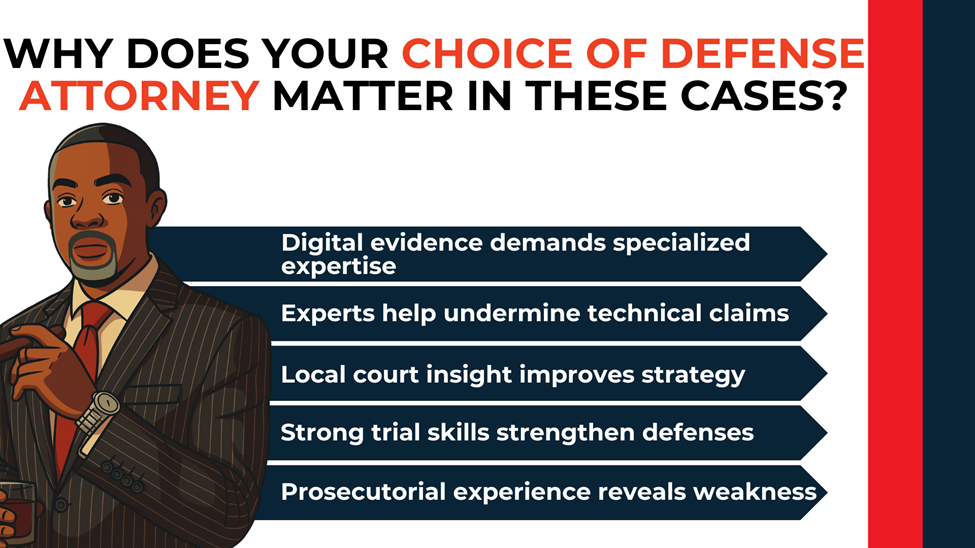
Frequently Asked Questions
What is the difference between second-degree and third-degree sexual exploitation?
Second-degree sexual exploitation under N.C. Gen. Stat. § 14-190.17 focuses on distribution, receipt, and solicitation of material depicting minors engaged in sexual activity—the spreading of such material. Third-degree exploitation under § 14-190.17A covers knowing possession without the distribution element. Second-degree is a Class E felony while third-degree is a Class H felony, reflecting the more serious nature of distribution conduct.
Can I be charged if I didn’t know the person in the images was a minor?
Mistake of age is explicitly not a defense under this statute. However, the prosecution still must prove the person depicted was actually a minor. The statute allows juries to infer someone is a minor based on how the material depicts them, but this inference can be challenged through defense evidence and expert testimony regarding age determination.
Where will my case be prosecuted if I’m arrested in Cary?
Cary is located in Wake County, which is part of North Carolina’s 10th Judicial District. Your case will be prosecuted by the Wake County District Attorney’s office and tried in Wake County Superior Court at the Justice Center in Raleigh. Having defense counsel familiar with Wake County procedures and prosecutors provides important advantages in these proceedings.
Will I have to register as a sex offender if convicted?
Yes. A conviction for second-degree sexual exploitation of a minor requires sex offender registration under North Carolina law. Registration creates ongoing obligations and restrictions that affect housing, employment, and community presence for years after the criminal case concludes.
How do police typically discover these cases in the Cary area?
Investigations may begin through multiple channels. Cary Police Department’s Cyber Intelligence Unit—the only dedicated unit of its kind among the Triangle’s four major police departments—conducts proactive investigations. Cases also originate from reports by internet service providers, tips to the National Center for Missing and Exploited Children’s CyberTipline, multi-agency task force operations, and sometimes through discoveries by employers or family members who encounter material on shared devices.
Should I talk to investigators before hiring an attorney?
No. You have an absolute right to remain silent and to have an attorney present during questioning. Statements made to investigators—even statements you believe are exculpatory—can be used against you and may limit defense options later. Contact an attorney before speaking with law enforcement about any aspect of an exploitation investigation.
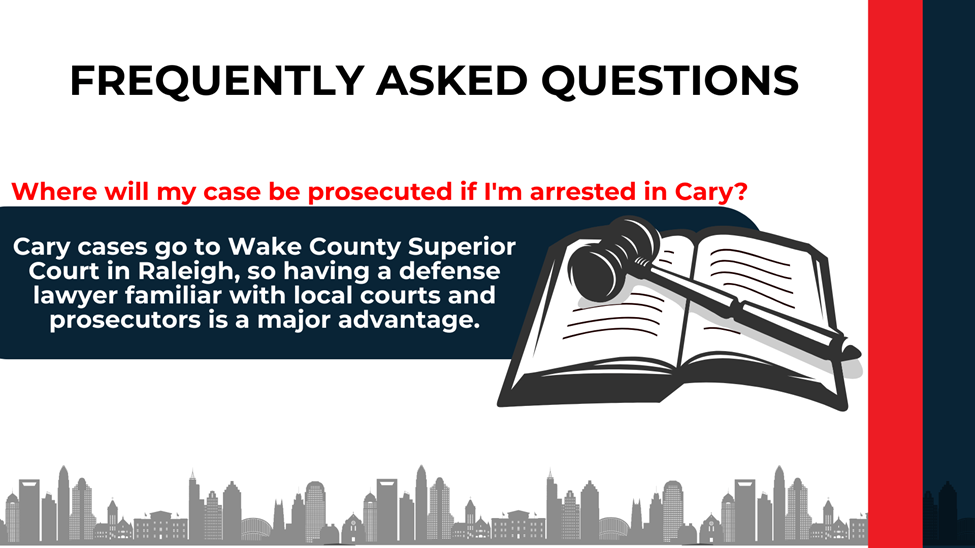
Protect Your Future
A second-degree sexual exploitation charge in Wake County threatens everything you’ve built—your career in the Research Triangle, your professional standing, your family’s security. These cases are complex, the consequences are severe, and the prosecution has significant resources.
Patrick Roberts is a graduate of the Gerry Spence Trial Lawyers College, where he trained directly with one of America’s most accomplished trial attorneys. That training emphasized a client-centered philosophy that treats every case as the most important one. Combined with his prosecutorial background, sex-crimes defense training, and familiarity with Wake County courts, he brings the preparation these serious charges demand.
If you face second-degree exploitation charges in Cary or anywhere in Wake County, contact Patrick Roberts Law to discuss your defense.

Disclaimer: The information on this website is for general information purposes only. Nothing on this site should be taken as legal advice for any individual case or situation. Case results depend upon a variety of factors unique to each case. Prior results do not guarantee a similar outcome.
Former assistant district attorney
Contact Patrick Roberts
Facing criminal charges in North Carolina demands seasoned representation. Trust in the experience and dual perspective of Patrick Roberts. Reach out today for a confidential consultation.
-
Call Our Team
Calls answered 24/7

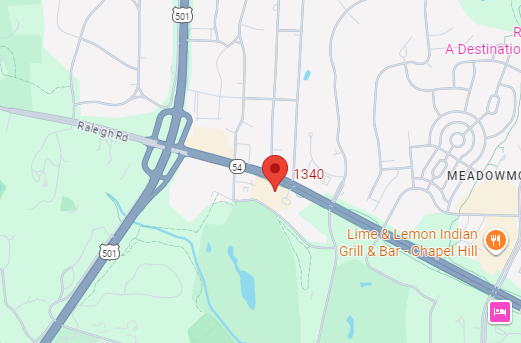






For more information on the selection criteria, go to www.martindale.com
*Each case is different and must be evaluated separately. Prior results achieved do not guarantee similar results can be achieved in future cases.