
Facing drug charges in North Carolina when you’ve never been in trouble before can be scary and confusing. This guide explains what happens with felony drug charges for first-time offenders, what penalties you might face, and what options could help you avoid the worst consequences.
How Does North Carolina Group Different Drugs?
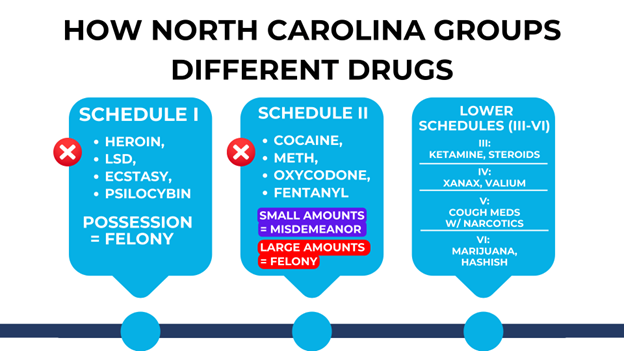
North Carolina groups drugs (called “controlled substances”) into six categories (Schedules I-VI) based on how dangerous they are and whether they have medical uses. These groupings affect how serious your charges might be.
Schedule I Drugs
These drugs are considered the most dangerous with no accepted medical use:
- Heroin
- Ecstasy (MDMA)
- LSD
- Mushrooms (psilocybin)
- Some synthetic marijuana
Even if it’s your first offense, possessing Schedule I drugs can result in felony charges. Under North Carolina law, possession of Schedule I drugs is a Class I felony (N.C.G.S. § 90-95(d)(1)).
Schedule II Drugs
These drugs are considered dangerous but have some medical uses:
- Cocaine
- Methamphetamine
- Oxycodone
- Fentanyl
- Hydrocodone
Having small amounts may lead to misdemeanor charges, but larger amounts or evidence you planned to sell them can lead to felony charges (N.C.G.S. § 90-90).
Lower Schedule Drugs (III-VI)
These include:
- Schedule III: Ketamine, steroids (N.C.G.S. § 90-91)
- Schedule IV: Xanax, Valium (N.C.G.S. § 90-92)
- Schedule V: Some cough medicines with small amounts of narcotics (N.C.G.S. § 90-93)
- Schedule VI: Marijuana and hashish (N.C.G.S. § 90-94)
Even these “less dangerous” drugs can lead to felony charges depending on how much you have and whether you intended to sell them.
When Do First Offenses Become Felonies?
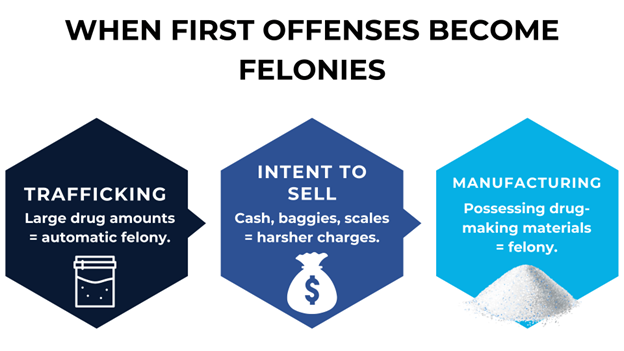
Even first-time offenders can face felony charges in several situations:
Drug Trafficking
Having certain amounts of drugs automatically counts as trafficking, which brings mandatory prison time even for first offenses (N.C.G.S. § 90-95(h)):
- Marijuana: More than 10 pounds
- Cocaine: 28 grams or more
- Methamphetamine: 28 grams or more
- Heroin/Opioids: 4 grams or more
- LSD: 100 doses or more
- MDMA/Ecstasy: 100 pills or more
Intent to Sell
Signs that prosecutors look for to prove you planned to sell drugs (which makes charges more serious):
- Digital scales
- Multiple baggies
- Large amounts of cash
- Multiple cell phones
- Lists of customers or sales
If you’re a first-time offender and prosecutors believe you intended to sell Schedule I or II drugs, you’ll likely face a Class H felony. Actually selling these drugs is a Class G felony (N.C.G.S. § 90-95(b)(1)).
Making Drugs
Having chemicals used to make drugs (especially methamphetamine) is a Class H felony even for first-time offenders (N.C.G.S. § 90-95(d1)(2)).
What Are the Punishment Levels for First-Time Drug Felonies?
First-time offenders usually have a “Prior Record Level I” in North Carolina’s sentencing system, which is the lowest level.
Class I Felonies (Least Serious)
- Common charges: Having Schedule I or II drugs
- Likelihood of prison time: Low for first-time offenders
- Example: A college student caught with a small amount of cocaine
First-time offenders with Class I felonies often receive probation instead of jail time, but this isn’t guaranteed.
Class H Felonies
- Common charges: Possession with intent to sell Schedule III-VI drugs
- Likelihood of prison time: Medium, depending on circumstances
- Example: Someone caught with multiple prescription pills packaged for sale
Class G Felonies
- Common charges: Selling Schedule I or II drugs, smaller trafficking offenses
- Likelihood of prison time: Higher, even for first-time offenders
- Example: Selling cocaine to an undercover officer
More Serious Felonies (Class F-C)
Trafficking larger amounts of drugs brings mandatory prison sentences, even for first-time offenders, with very limited exceptions.
What Options Exist Besides Prison for First-Time Offenders?
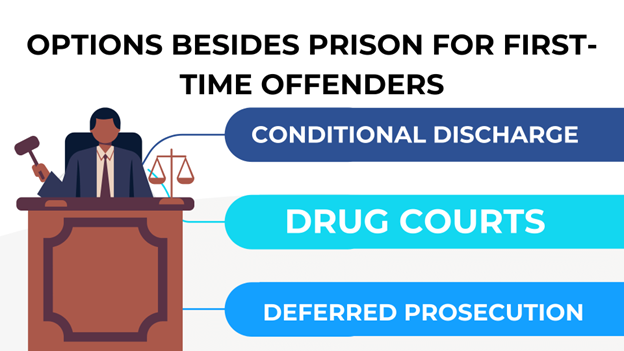
North Carolina offers several programs that can help first-time offenders avoid the worst consequences.
How Does Conditional Discharge (G.S. § 90-96) Work?
This important program lets eligible first-time offenders avoid a conviction if they complete probation successfully.
Who’s Eligible
You may qualify if you (N.C.G.S. § 90-96(a)):
- Have no prior felony convictions
- Have no prior drug convictions
- Are charged with drug possession or paraphernalia possession
Program Requirements
You’ll typically need to:
- Complete a drug education program
- Take regular drug tests
- Follow all probation rules
- Pay program fees (unless you can’t afford them)
- Stay out of trouble during probation
Benefits of Completing the Program
If you succeed:
- Your charges get dismissed
- You avoid a criminal conviction
- You may be able to clear the arrest from your record
This option is especially valuable because it helps you avoid the lasting problems that come with a felony conviction.
How Do Drug Treatment Courts Help First-Time Offenders?
Many North Carolina counties have special courts focused on treatment rather than punishment.
How These Programs Work
They typically involve:
- Regular court appearances
- Required drug treatment
- Frequent drug testing
- Help with finding services you need
- Increasing penalties for program violations
Who Can Participate
While rules vary by county, most programs:
- Focus on non-violent offenders
- Look for people with actual drug problems
- Require you to admit guilt
- Need approval from the prosecutor and judge
Benefits of Completion
If you complete the program, you might get:
- Reduced charges
- Dismissed charges
- No jail time
- Access to more recovery services
Deferred Prosecution
Some district attorneys offer agreements that delay and potentially avoid prosecution if you meet certain conditions. These agreements depend on individual district attorney policies and often include community service, drug education, and staying out of trouble for a specified time.
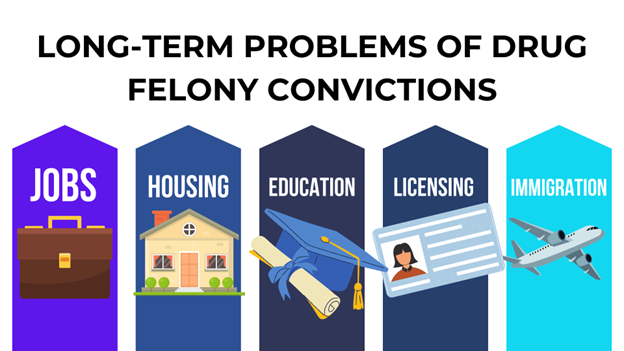
What Are the Long-Term Problems of Drug Felony Convictions?
Even for first-time offenders, a felony drug conviction can cause serious problems beyond any sentence.
Job Problems
Many North Carolina employers do background checks and may not hire people with felony drug convictions. Some jobs simply won’t consider applicants with drug convictions.
Housing Difficulties
Both public and private housing often screen for criminal records. Public housing may deny applications based on drug convictions, and many landlords do background checks.
Education Issues
A drug conviction can affect:
- Federal financial aid eligibility
- Acceptance to certain education programs
- On-campus housing eligibility
- Participation in internships
Professional License Restrictions
Many professions in North Carolina require licenses that might be denied if you have a felony drug conviction:
- Healthcare jobs
- Legal practice
- Teaching
- Real estate
- Insurance
- Banking
Immigration Problems
For non-citizens, drug convictions can lead to deportation, denial of citizenship, or being barred from re-entering the United States.
What Defense Strategies Work for First-Time Offenders?
Working with an experienced North Carolina defense attorney can greatly impact the outcome of your case. Common defenses include:
Constitutional Challenges
Many drug cases depend on whether evidence was legally obtained. Your attorney might argue that:
- Police searched without a warrant or valid reason
- Officers kept you stopped too long without reasonable suspicion
- Police forced you to consent to a search
- The search went beyond what was allowed
Challenging Possession
Prosecutors must prove you knowingly possessed the drugs. Defense strategies might include:
- Arguing you didn’t know the drugs were there
- Showing the drugs belonged to someone else
- Proving you had no control over where the drugs were found
- Demonstrating you didn’t intend to control the substance
Laboratory Testing Issues
Drug charges require scientific confirmation of the substance. Your attorney might:
- Request independent testing
- Challenge how the evidence was handled (N.C.G.S. § 90-95(g))
- Question laboratory procedures
- Dispute the weight or what the substance actually is
Focusing on Treatment
For first-time offenders, showing you’re serious about addressing any drug problems can positively influence your case. This might include:
- Entering treatment before court dates
- Getting substance use evaluations
- Joining support groups
- Creating a plan for staying sober
How Have North Carolina Drug Laws Recently Changed?
North Carolina’s approach to drug crimes continues to evolve, with several recent changes that might help first-time offenders.
Expanded Eligibility for Conditional Discharge
Recent changes to G.S. § 90-96 have expanded who can qualify for conditional discharge, which especially helps first-time offenders.
Justice Reinvestment Act
This law has shifted resources toward treatment and supervision rather than jail for many non-violent drug offenders.
Limited Relief from Mandatory Minimum Sentences
Under G.S. § 90-95(h)(5a), judges now have limited power to avoid mandatory minimum sentences for certain trafficking offenses when specific criteria are met.
Changing Prosecution Priorities
Some district attorneys across North Carolina have implemented new policies that prioritize treatment over jail for non-violent drug offenses, especially for first-time offenders.
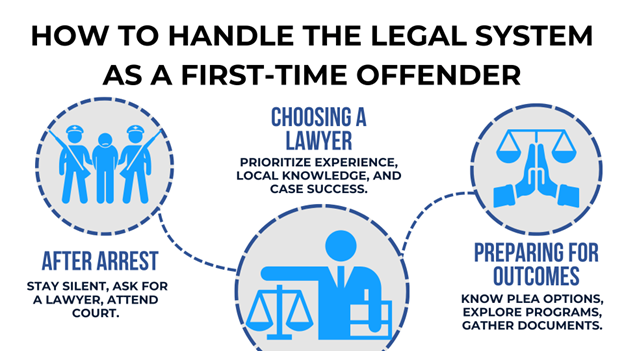
How to Handle the Legal System as a First-Time Offender
Taking smart steps can help protect your rights and improve your chances for a better outcome.
What to Do After Arrest
- Use your right to remain silent
- Ask for an attorney before answering questions
- Don’t discuss your case with anyone except your attorney
- Write down everything you remember about the arrest and search
- Show up to all court dates on time
Choosing the Right Attorney
When selecting a North Carolina defense attorney, consider:
- Experience with drug cases in your area
- Familiarity with local courts and prosecutors
- Track record with first-time offenders
- Knowledge of alternative sentencing options
- Communication style and accessibility
Preparing for Different Outcomes
Work with your attorney to:
- Understand the consequences of different plea options
- Explore eligibility for diversion or treatment programs
- Gather documentation of employment, education, and character
- Address any underlying substance use issues
- Create a plan for managing potential consequences
How Can You Move Forward After Felony Drug Charges?
For first-time offenders facing felony drug charges in North Carolina, the future may seem uncertain. However, with good legal help, a commitment to addressing any underlying issues, and knowledge of available options, many first-time offenders can get through this difficult situation with minimal long-term damage.
The law recognizes that first-time offenders often deserve a chance to learn from mistakes without permanent life-altering consequences. Programs like conditional discharge, drug treatment courts, and deferred prosecution provide paths to recovery rather than just punishment.
If you or a loved one are facing felony drug charge as a first-time offender, you deserve a legal advocate with the experience and dedication to secure the best possible outcome. Attorney Patrick Roberts of Patrick Roberts Law has successfully defended numerous clients facing felony drug charges. Contact our firm today for a confidential consultation.
Former assistant district attorney
Contact Patrick Roberts
Facing criminal charges in North Carolina demands seasoned representation. Trust in the experience and dual perspective of Patrick Roberts. Reach out today for a confidential consultation.
-
Call Our Team
Calls answered 24/7






For more information on the selection criteria, go to www.martindale.com
*Each case is different and must be evaluated separately. Prior results achieved do not guarantee similar results can be achieved in future cases.