Blog / Criminal Defense

Blog

All Criminal Defense Criminal Defense Lawyer Sex Defense Felony Charges Lawyer Drug Charges Sex Defense Lawyer Murder Charges Rape Case Statutory Rape Charges Drug Crimes & Violations Drug Trafficking Violent Crime Domestic Violence Child Exploitation Charges Indecent Liberties North Carolina Criminal Law Sexual Assault North Carolina Law Fentanyl Crimes indecent liberties with a minor Sex Crimes Sex Crimes Defense Sex Offender Registry Sexual exploitantion of minors Meth Trafficking Age of Consent Aggravated Sexual Assault Artificial Intelligence Child Enticement Charges child grooming Child Rape Constitutional Rights & Warrants Criminal Defense & Travel Law Criminal Justice Criminal Law Cybercrime Defense Data Privacy Digital Evidence Entrapment defense False Accusations Family Law Federal Offenses Indecent Exposure Legal Defense Strategies Legal Resources Legal Updates Possession with intent to sell Sex Crimes & Registry Sex Crimes Defense Strategies Sex Offender Registration Requirements Sex Offender Registry Compliance Sex Offense Defense Sexting Laws solicitation of a child by computer Solicitation of a Minor Charge State vs. Federal Laws Statute of Limitations Statutory Sex Offense
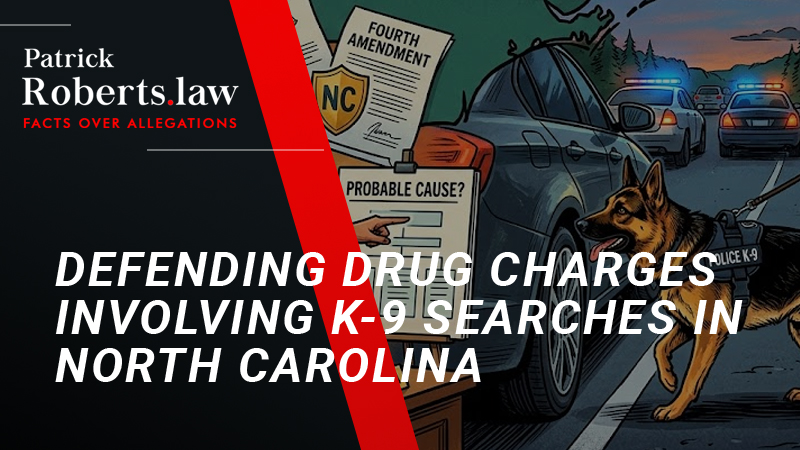
Cover Image: Defending Drug Charges Involving K-9 Searches in North Carolina

Defending Drug Charges Involving K-9 Searches in North Carolina

The use of narcotics-detection dogs, commonly referred to as K-9 units, is a staple of law enforcement activity across North Carolina. From the I-95 corridor to local traffic stops in Wake or Mecklenburg County, K-9 searches often serve as the bridge between a routine roadside interaction and a felony drug indictment. However, the presence of a K-9 does not grant law enforcement unfettered authority. The intersection of the Fourth Amendment and K-9 sniffs is governed by a complex web of United States Supreme Court precedents and North Carolina appellate rulings. For individuals facing drug charges stemming from a K-9 alert, understanding the constitutional limits placed on police is the first step toward a successful defense. This guide examines the legal framework, the common pitfalls of K-9 deployments, and the strategic avenues available for challenging the evidence in court. more Is a K-9 Sniff Considered a "Search" Under the Fourth Amendment? One of the most frequent misconceptions regarding K-9 units is what legally constitutes a "search." Under current Fourth Amendment jurisprudence, the answer depends heavily on the location of the sniff. Public Airspace and Traffic Stops ​The North Carolina Supreme Court ruled in State v. Bullock (2017) that an officer does not unlawfully violate the Fourth Amendment during a traffic stop by completing routine tasks—such as checking a driver's license, running warrant checks, and ordering the driver out of the vehicle—before deploying a narcotics-detection dog. The legal framework aligns with federal precedent establishing that a dog sniff of the exterior of a vehicle in public airspace during a lawful stop does not constitute a "search." However, the boundaries are strict: the North Carolina Court of Appeals clarified in State v. Miller (2019) and State v. Bedient (2016) that if an officer stalls, pauses routine paperwork, or prolongs the detention even briefly after the initial purpose of the stop is completed, the sniff becomes unlawful unless independent reasonable suspicion exists. ​The Curtilage of the Home ​The rules change drastically when a K-9 is brought to a private residence within North Carolina. Following federal standards, state courts maintain that the area immediately surrounding and associated with the home—known as the "curtilage"—enjoys the highest level of Fourth Amendment protection. Operating a drug-sniffing dog on the front porch or within the curtilage of a home to investigate its contents constitutes a search. Because this space is treated with the same privacy expectations as the home itself, law enforcement officers in North Carolina must secure a valid search warrant or demonstrate a recognized emergency exception before deploying a K-9 unit on a suspect's private residential property. How Long Can Police Detain You for a K-9 Unit to Arrive? The most significant legal battleground in North Carolina K-9 cases is the duration of the stop. This is governed by the landmark case Rodriguez v. United States (2015). The "Rodriguez Rule" states that a police officer may not extend a completed traffic stop for any amount of time to conduct a K-9 sniff, absent reasonable suspicion of criminal activity beyond the initial traffic violation. The "Mission" of the Traffic Stop When an officer pulls a vehicle over for a speeding violation or a broken taillight, the "mission" of the stop is limited to: Checking the driver’s license. Checking the vehicle registration and proof of insurance. Determining if there are outstanding warrants for the driver. Issuing a warning or a citation. Once these tasks are completed, or should have been completed with "reasonable diligence," the authority for the stop ends. If an officer finishes writing a ticket but makes the driver wait five minutes for a K-9 unit to arrive without a specific reason to suspect drug trafficking, any evidence found during that search may be suppressed. What Constitutes "Unlawful Prolongation"? North Carolina courts scrutinize the timeline of a stop second-by-second. Factors that defense attorneys look for include: Stalling tactics: Did the officer ask repetitive questions unrelated to the traffic stop to buy time? Delaying the computer check:  Did the officer wait to run the driver's license until the K-9 unit was nearby? The "De Facto" arrest: Was the driver told they were free to leave, or were they ordered to stand by the patrol car while waiting for the dog? Establishing Probable Cause: When Does the Alert Justify a Search? If a K-9 performs a "hit" or "alert" on a vehicle, law enforcement claims this provides the "probable cause" necessary to search the interior of the vehicle without a warrant under the "automobile exception." However, an alert is only as reliable as the dog and the handler. The "Reliability" Standard Following the foundational principles applied in North Carolina courts, the state must prove a K-9 is reliable for its alert to constitute probable cause. Reliability within North Carolina’s legal framework is typically evaluated through a totality-of-the-circumstances approach focusing on: ​Training records and certifications. ​The dog's performance in controlled testing environments. ​The handler's ability to accurately interpret the dog's signals. False Positives and Residual Odors Drug dogs are trained to detect the odor of narcotics, not the physical presence of the drugs themselves. This distinction is vital. A dog may alert to "residual odor"—the scent left behind by a person who previously smoked marijuana in the car or handled cash that was once near narcotics. In North Carolina, the defense often argues that a "hit" without the recovery of drugs proves the dog’s unreliability or the presence of a false positive, which can weaken the prosecution's case. Challenging the K-9 Search: A Step-by-Step Defense Strategy Defending against drug charges involving a K-9 requires a methodical deconstruction of the police encounter. A defense attorney will typically follow these steps to identify constitutional violations: Step 1: Analyze the Initial Stop The search is only legal if the initial stop was legal. If the officer did not have "reasonable suspicion" that a traffic violation or crime occurred, the entire interaction is "fruit of the poisonous tree." We examine dashcam and bodycam footage to verify if the alleged speeding or swerving actually happened. Step 2: Calculate the "Rodriguez" Timeline We create a minute-by-minute chronology of the stop. 0:00: Vehicle pulled over. 2:00: Officer requests ID. 8:00: Officer finishes the citation. 12:00: K-9 unit arrives and begins the sniff. In this scenario, if the officer had no other reason to suspect drugs at the 8-minute mark, the 4-minute delay is unconstitutional. Step 3: Evaluate the Dog’s Behavior Not every movement a dog makes is a legal "alert." A dog might scratch at a door because it wants a toy or because the handler gave a subconscious physical cue (known as "cueing"). The video is reviewed to see if the handler led the dog or signaled it to sit or bark at a specific spot. Step 4: Review K-9 Training and Field Logs We subpoena the "longitudinal" records of the dog. If the dog has a high rate of "false alerts" (signaling drugs when none are found) in the field, we argue that the dog is not a reliable "neutral mobile magistrate" and its alert did not provide probable cause. Step 5: File a Motion to Suppress If any of the above steps reveal a violation of rights, the defense files a Motion to Suppress. If the judge grants this motion, the evidence (the drugs found) cannot be used against the defendant. Without the drugs, the prosecution's case usually collapses, leading to a dismissal of charges. The Impact of Marijuana Legalization and Decriminalization Trends The legal landscape regarding K-9s is currently shifting due to the changing status of marijuana and hemp. The "Hemp vs. Marijuana" Dilemma In North Carolina, industrial hemp is legal, while marijuana remains illegal. The problem? Most K-9s currently in service are trained to alert to THC, and they cannot distinguish between the scent of legal hemp and illegal marijuana. Furthermore, as other states move toward legalization, North Carolina courts are beginning to grapple with whether the "odor of marijuana" alone still provides probable cause for a full vehicle search. While North Carolina appellate courts have been slow to strip police of this power, a skilled defense attorney can use the "indistinguishable odor" argument to challenge the validity of a K-9 alert. Common Questions Regarding K-9 Searches in North Carolina Can I refuse a K-9 sniff? You cannot physically interfere with a K-9 sniff of the exterior of your car during a valid stop. However, you should never give consent to a search. If the officer asks, "Do you mind if I run the dog around the car?" or "Can we search the vehicle?", the answer should always be a polite but firm: "I do not consent to any searches." This preserves your right to challenge the search in court later. What if the dog jumped inside my car? If the K-9 enters the interior of the vehicle through an open window or door before it has officially alerted on the outside, this may constitute an illegal search. The dog is considered an "instrument of the state," and its entry into the private interior of the car without prior probable cause is a Fourth Amendment violation. Do police have to show me the dog's certification? Not at the scene of the stop. However, your attorney has the right to demand those certifications during the discovery phase of your legal proceedings. What happens if the K-9 was wrong? If the K-9 alerts and the police search your car but find nothing, your rights may still have been violated, but there is no "evidence" to suppress because nothing was found. If they did find something else (like a firearm you aren't supposed to have), the fact that the dog was "wrong" about the drugs can be used to challenge the legality of the search that uncovered the firearm. Why Technical Knowledge Matters in K-9 Cases Narcotics cases involving K-9s are rarely about whether the drugs were there; they are about whether the police followed the rules of the Constitution to find them. These cases are won or lost on technicalities—the timing of a radio call, the angle of a dog’s tail, or the specific wording of a training manual. The state has significant resources, including specialized K-9 units and expert handlers. To level the playing field, a defense must be rooted in a deep understanding of: The Science of Olfaction: Understanding how scent "cones" move and how environmental factors like wind or heat affect a dog's performance. The Law of Seizure: Knowing exactly when a "stop" becomes a "detention." Data Analysis: Scrutinizing K-9 records for patterns of bias or inaccuracy. Potential Outcomes of Challenging a K-9 Search When a defense attorney successfully challenges a K-9 search, several outcomes are possible: Evidence Suppression: The most common goal. The judge rules the search was illegal and the drugs cannot be mentioned at trial. Charge Reduction: The prosecution may realize their case is weak and offer a plea to a much lesser offense (e.g., from Trafficking to Simple Possession). Dismissal: If the suppressed evidence was the entirety of the state's case, the District Attorney will be forced to dismiss all charges. Protecting Your Rights in North Carolina A drug charge can carry life-altering consequences, including mandatory minimum prison sentences and a permanent criminal record. In North Carolina, the "Automobile Exception" gives police significant power, but that power is not absolute. The K-9 unit is a tool, but it is a tool that must be used within the strict confines of the law. If you were arrested following a K-9 alert, the focus must shift immediately to the conduct of the officers and the history of the dog. By examining the legality of the stop, the duration of the detention, and the reliability of the K-9’s alert, it is possible to build a robust defense that protects your future and upholds your constitutional protections. Every second of the police encounter matters, and every detail of the dog’s training counts. Navigating the complexities of North Carolina drug laws and Fourth Amendment jurisprudence requires a meticulous approach to evidence and a commitment to holding law enforcement accountable to the standards set by the highest courts in the land. Hire an Experienced Criminal Lawyer Near You Attorney Patrick Roberts is a Raleigh criminal defense attorney who has handled thousands of cases across North Carolina, with offices in Raleigh, Durham, Chapel Hill, and Cary. He provides a deep level of authority and experience to the defense of complex drug interdiction and K-9 search cases. As a former prosecutor in Wake and Johnston Counties, he worked directly with drug interdiction teams to build conspiracy-level prosecutions. This background gives him firsthand knowledge of how the government constructs its cases, allowing him to identify vulnerabilities in the prosecution's evidence to better defend his clients. Selected to Super Lawyers for his professional achievement, Mr. Roberts has tried drug trafficking cases in state court and has managed the defense of multi-defendant drug conspiracy cases in Federal court that have lasted for weeks. His legal credentials include admission to practice before the 4th Circuit Federal Court of Appeals and the United States Supreme Court, ensuring his clients receive qualified representation throughout the entire legal process. Education & Trial Advocacy Mr. Roberts earned his bachelor’s degree from Johns Hopkins University, which is ranked #7 among National Universities. He is a graduate of Duke University School of Law, currently ranked #7 for best law schools and #9 for its criminal law program. In addition to his academic background, he has completed several of the nation's most rigorous trial advocacy programs: Gerry Spence’s Trial Lawyers College National Criminal Defense College (NCDC) Trial Practice Institute 2025 NCDC Cross-Examination Intensive Professional Recognition & Memberships For his work in the legal field, Mr. Roberts has earned several long-standing distinctions: AV Preeminent Peer Rating (Martindale-Hubbell): Held for over 5 consecutive years. Client Champion Platinum (Martindale-Hubbell): Maintained for over 5 consecutive years. AVVO "Superb" Rating (10/10): Maintained for more than 15 years. Top 100 Trial Lawyers: Recognized by The National Trial Lawyers. He is a lifetime member of the National Association of Criminal Defense Lawyers and has co-authored two legal books, including a guide focused on defending internet sex crimes. Professional Perspective Mr. Roberts brings a dual perspective to complex legal matters. He served as an Assistant District Attorney in Wake, Johnston, and New Hanover counties, providing him with a firsthand understanding of how prosecutors build and evaluate sex crime cases. Admissions & National Listings He is admitted to practice before the U.S. Supreme Court, the Fourth Circuit Court of Appeals, and all federal district courts in North Carolina. As of 2026, he is the only North Carolina lawyer listed on the National Child Abuse Defense & Resource Center. Client Testimonial “I highly recommend this attorney to anyone needing experienced and knowledgeable legal representation. From the beginning, he clearly explained the steps necessary to address my situation and made sure I understood the process along the way. He kept me informed as progress was being made and was always professional, responsive, and prepared. Although the legal process can move slowly at times, I always felt confident that my case was being handled properly. When my court date finally arrived, he was exceptionally well prepared and navigated the courtroom procedures with confidence and skill.” - Verified client review via Avvo.com Peer Endorsement "I endorse this lawyer. Patrick is a fantastic attorney who is dedicated to his clients' interests and truly cares for his clients. He has the experience and trial skills necessary to achieve the results his clients need. I recommend anybody in need of a criminal defense attorney use him." - Verified peer review via Avvo.com Disclaimer: Testimonials and peer reviews are for informational purposes only and do not guarantee or predict the outcome of your legal matter. Every case is unique and must be evaluated on its own merits. All endorsements featured on this site are actual comments from clients and peers. If you are facing drug charges resulting from a K-9 search in North Carolina, securing experienced legal counsel is a critical step in protecting your rights. Attorney Patrick Roberts utilizes his background as a former prosecutor and his comprehensive understanding of state and federal search and seizure laws to evaluate the legality of your arrest. The firm focuses on identifying constitutional violations to build a rigorous defense for clients facing drug trafficking or conspiracy allegations. Contact Patrick Roberts Law today to schedule a confidential consultation and review the legal options available for your case. To maintain a high standard of service and thorough oversight for each client, the firm manages a restricted caseload. Disclaimer: The information on this website is for general informational purposes only. Nothing herein should be taken as legal advice for any individual case or situation. Contacting us via this website, email, or contact form does not create an attorney-client relationship. Case results depend on a variety of factors unique to each case; prior results do not guarantee a similar outcome.


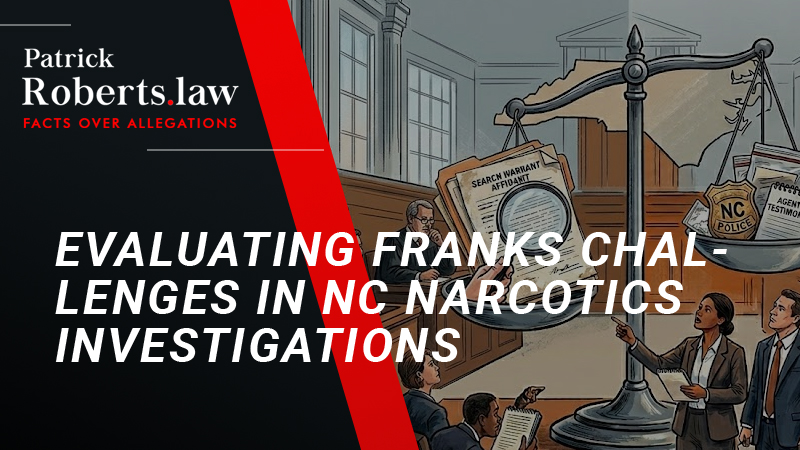
Cover Image: Evaluating Franks Challenges in NC Narcotics Investigations

Evaluating Franks Challenges in NC Narcotics Investigations

In North Carolina narcotics operations, law enforcement officers heavily rely on search warrants to seize evidence from vehicles, storage units, and private residences. These warrants are granted based on an officer’s sworn affidavit. Under the Fourth Amendment, a search warrant is valid only if it establishes probable cause within its "four corners." However, when an officer includes deliberate falsehoods or omits critical facts to secure a warrant, the defense can challenge its validity using the framework established in the landmark U.S. Supreme Court case Franks v. Delaware, 438 U.S. 154 (1778). Applying Franks to drug trafficking cases in North Carolina requires navigating complex statutory rules and distinct federal and state court precedents. This analysis details the legal standards, the evidentiary hurdles, and the strategic mechanisms used to litigate these issues. more What Is the Legal Standard for a Franks Challenge in an NC Narcotics Case? A Franks challenge is a constitutional mechanism used to attack the truthfulness of factual assertions made in a search warrant affidavit. In North Carolina, this process is governed by federal Fourth Amendment jurisprudence and state-level statutory procedures under N.C. General Statutes § 15A-978. To successfully contest a search warrant, the defense must meet specific criteria established by appellate courts. How the Fourth Circuit Court of Appeals Defines Material Omissions The Fourth Circuit Court of Appeals recognizes that a Franks violation can occur through two distinct actions in an affidavit: Commission: The inclusion of affirmative false statements. Omission: The deliberate or reckless exclusion of material facts. In drug trafficking investigations, material omissions occur when an officer leaves out information that would directly undermine a magistrate's finding of probable cause. The Fourth Circuit evaluates an omission by determining if the excluded facts were "material." To establish materiality, the defense must demonstrate that if the omitted facts had been included in the affidavit, the updated text would no longer contain sufficient information to guide a reasonable magistrate to find probable cause. Why the Defendant Bears a High Burden of Proof When Challenging Omitted Facts Appellate courts, including the Fourth Circuit and the North Carolina Court of Appeals, place a heavy burden on the defendant to secure an evidentiary hearing. There is a strong legal presumption that an officer’s search warrant affidavit is valid. Phase of Challenge Legal Threshold Required Evidentiary Showing Initial Request (Motion) Substantial Preliminary Showing Specific allegations of falsehood or reckless omission, supported by detailed offers of proof (e.g., cell logs, track records, third-party affidavits). Evidentiary Hearing ( Franks Hearing) Preponderance of the Evidence Direct or strong circumstantial proof that the affiant acted intentionally or with reckless disregard for the truth, and that the remaining content lacks probable cause. Challenging an omission is significantly more difficult than challenging an affirmative lie. The defense must prove that the investigator omitted the facts with the specific intent to mislead, or with a reckless disregard for whether the omission made the affidavit misleading. Simple inadvertence, administrative oversight, or negligent record-keeping by the officer does not satisfy this constitutional standard. How a Court Reviews an Affidavit Under the Totality of the Circumstances Framework When a North Carolina court reviews a challenged affidavit, it does not isolate individual statements. Instead, it applies the "totality of the circumstances" framework outlined in Illinois v. Gates, 462 U.S. 213 (1983) and adopted by the North Carolina Supreme Court in State v. Arrington, 311 N.C. 633 (1984). The reviewing judge must perform a specific two-step subtraction or addition test: For False Assertions: The court strikes the falsified sections from the affidavit. If the remaining text still provides a substantial basis for probable cause, the warrant remains valid, and the motion to suppress is denied. For Material Omissions: The court inserts the hidden, unstated facts back into the affidavit. If the newly revised text no longer supports a finding of probable cause to search that location for narcotics, the warrant is invalidated. How Do Omissions About Confidential Informants Invalidate a Drug Search Warrant? Narcotics investigators frequently rely on confidential informants (CIs) to establish probable cause. Affiants often present these sources as highly reliable individuals who have provided dependable tips in the past. However, when an officer conceals negative information regarding a CI's background, credibility, or motivation, the affidavit may become vulnerable to a Franks challenge. Is an Officer Required to Disclose a Confidential Informant's Criminal History to a Magistrate? As a general rule, an officer is not required to disclose every detail of an informant’s criminal past in a search warrant application. Magistrates understand that individuals operating within the drug trade often have criminal records. However, a constitutional issue arises if the officer intentionally conceals severe credibility defects that directly impact the truthfulness of the specific tip provided. For example, if a CI has an active conviction for a crime of dishonesty, such as perjury, filing a false police report, or forgery, omitting this information can be viewed as a reckless attempt to artificially inflate the informant's credibility. What Happens if Law Enforcement Conceals Financial Payments or Plea Deals Made to a Narcotics Source? Financial incentives and leniency regarding pending criminal charges are powerful motivators for informants to fabricate or exaggerate claims. If an affidavit states that a CI "honestly and reliably observed trafficking quantities of cocaine inside the target residence," but conceals that the CI was paid several thousand dollars or promised the dismissal of a pending active felony charge in exchange for the tip, the defense can argue that the magistrate was misled. Under the Franks framework, if the omission of a significant financial payment or a formal non-prosecution agreement is deemed reckless, a court must evaluate the affidavit as if those facts were fully disclosed. If the unmasked bias of the informant neutralizes the reliability of the tip, and no independent corroboration exists within the affidavit, probable cause fails. How Defense Teams Expose an Informant's Documented Track Record of Providing Unreliable Tips A common phrase found in North Carolina narcotics affidavits is: "This applicant has worked with this confidential source in the past, and this source has provided reliable information that has led to multiple arrests and seizures." To mount an effective Franks challenge, the defense must scrutinize this boilerplate assertion. Defense attorneys look for instances where: The informant previously provided false tips to the same task force. The informant failed multiple polygraph examinations. Controlled buys failed to yield the targeted substances. By cross-referencing state and federal discovery materials, a defense team can demonstrate that the officer deliberately omitted a history of unreliability to create a false impression of consistency. If the defense can show the informant’s prior tips routinely resulted in dead ends, the assertion of reliability becomes a reckless misrepresentation. Can "Boilerplate" Training and Experience Statements Meet the Probable Cause Bar? Most narcotics warrants include several paragraphs detailing the affiant’s professional background, specialized training, and years of service. Officers often use this section to justify searching a suspect’s residence, arguing that based on their "training and experience," drug traffickers routinely store drugs, financial ledgers, weapons, and currency at their homes. The Legal Definition of the Constitutional Nexus Requirement for an NC Residence Search Under the Fourth Amendment and North Carolina law, there must be a clear "nexus"—a direct, logical connection—between the illegal items sought and the specific place to be searched. Simply stating that an individual is suspected of trafficking drugs somewhere in a city is insufficient to search their private home. The affidavit must contain timely, concrete facts indicating that drugs or related contraband are currently located inside that specific structure. When Using Copied-and-Pasted Template Language Constitutes a Reckless Disregard for Facts The use of pre-drafted, boilerplate language is a common practice in law enforcement. However, when an officer relies entirely on copied-and-pasted template paragraphs while ignoring contradictory facts unique to the case, the practice can cross the line into a reckless disregard for the truth. If an investigator uses standard language claiming that "traffickers maintain records at their primary residence," while possessing explicit surveillance or GPS tracking data showing the suspect has not visited that location in months, the generalized template contradicts the known facts of the ongoing investigation. How a Defense Lawyer Can Challenge Generic Assertions That Drug Traffickers Store Records at Home North Carolina appellate courts have ruled that an officer's generic "training and experience" statement cannot serve as a substitute for specific, independent facts connecting a crime to a residence. In cases like State v. Severn, 130 N.C. App. 319 (1998), the court emphasized that an officer's background cannot bridge a complete lack of factual support within the affidavit. Defense lawyers challenge these assertions by isolating the boilerplate paragraphs during an analysis of the warrant: Isolate the Experience Claims: Identify and temporarily remove all generalized claims regarding what drug traffickers typically do as a class. Examine Case-Specific Facts: Review the remaining portions of the affidavit for actual, observed behavior connecting the home to illegal narcotics (e.g., controlled buys at the door, high volume of short-term traffic, odors, or direct observations by witnesses). Argue the Deficiency: If the case-specific section lacks substantive observations, the defense argues that the warrant relies entirely on a generic profile, which fails to establish the necessary constitutional nexus. How Is Reckless Disregard for the Truth Distinguished from Negligence in NC Drug Cases? The legal boundary between negligence and reckless disregard for the truth is the central battleground in a North Carolina narcotics Franks hearing. While an officer’s careless reporting or administrative errors will not invalidate a search warrant, a showing that the investigator intentionally ignored contradictory evidence or fabricated facts will trigger the total exclusion of the seized drugs under the Fourth Amendment. Under the standard established in Franks v. Delaware, simple negligence, typographical mistakes, or an honest misinterpretation of facts by an officer do not violate the United States Constitution. To pierce the presumption of validity that attaches to a signed search warrant, the defense must establish a higher level of culpability. The defense must prove that the affiant officer either explicitly knew a statement was false when they swore to it, or acted with reckless disregard—meaning they entertained serious doubts about the truth of the allegations but chose to present them to the magistrate anyway. In drug trafficking investigations, where officers deal with fast-moving surveillance, multiple targets, and chaotic environments, separating a bad-faith distortion from an innocent oversight requires a precise evaluation of what the officer knew versus what they wrote. What constitutes an honest or negligent mistake by an investigating officer? An honest or negligent mistake occurs when an officer makes an error due to poor record-keeping, a misunderstanding of a technical report, or an incorrect observation that was still made in good faith under the circumstances. North Carolina courts recognize that criminal investigations are frequently fluid and imperfect. Examples of negligent or innocent mistakes that generally will not result in the suppression of narcotics evidence include: Minor Typographical Errors: Writing an incorrect license plate number or misspelling a street name in one paragraph of the affidavit, provided the rest of the document clearly identifies the correct target. Good-Faith Misidentification during Surveillance: Stating that a suspect drove a black sedan to a suspected stash house when video footage later reveals the vehicle was actually dark blue, as long as the officer reasonably believed the color under prevailing lighting conditions. Passing Along an Informant’s Lie: Including false statements provided by a confidential source, provided the officer had a reasonable basis to trust the source at that time and did not know the information was fabricated. As clarified by the North Carolina Supreme Court in State v. Fernandez, 346 N.C. 1, 484 S.E.2d 350 (1997), the Franks inquiry is strictly confined to the truthfulness of the law enforcement affiant, not the truthfulness of the civilian source. If the officer was merely negligent in verifying an informant's claim, the warrant remains legally intact. How does the defense prove an officer entertained serious doubts about the truth of their surveillance assertions? To prove that an officer acted with reckless disregard, the defense must present an objective baseline of facts showing that the investigator was in possession of data that directly contradicted the claims written into the search warrant affidavit. Because it is rarely possible to get an officer to admit on the witness stand that they had internal doubts, the defense must rely on a data-driven cross-examination. This involves contrasting the polished final affidavit against the raw records generated during the active investigation: Assertion in Search Warrant Affidavit Reality Exposed by Raw Investigative Logs "The target vehicle was observed arriving at the stash house at 2:00 PM, and the suspect carried a heavy duffel bag inside." GPS Tracker Data & Radio Logs: Show the suspect's vehicle was miles away at a grocery store at 2:00 PM, and a completely different individual entered the home. "Through physical surveillance, this applicant personally verified that high-volume short-term foot traffic was occurring at the front door." Body-Worn Camera / Pole Camera Footage: Reveals the street was entirely empty during the hours the officer claimed to be conducting active surveillance. When a defense attorney exposes a clear gap between the officer’s actual observations and their sworn text, the defense establishes that the officer could not have reasonably believed the accuracy of their statements. This satisfies the reckless disregard standard. Can circumstantial evidence prove an officer deliberately closed their eyes to facts that defeated probable cause? Yes, circumstantial evidence can prove reckless disregard when the defense establishes a pattern of selective reporting where an officer systematically gathered data but purposefully excluded every fact that weakened their theory of the case. This concept, known as "deliberate ignorance" or "willful blindness," occurs when an investigator realizes that a fact completely undermines their ability to get a search warrant, so they intentionally omit it from the narrative to present a sanitized, artificial version of events to the magistrate. The North Carolina Court of Appeals addressed this type of selective filtering in State v. Severn, 130 N.C. App. 319, 502 S.E.2d 882 (1998). The court affirmed that the deliberate or reckless omission of material, exculpatory information is legally identical to making an affirmative false statement. If an officer receives an analytical laboratory report indicating that a package intercepted in the mail does not contain illegal narcotics, but they proceed to write a search warrant affidavit for the recipient's home based entirely on an earlier, unverified field-test result while concealing the formal lab denial, they have deliberately closed their eyes to the truth. Circumstantial proof of the existence of that lab report in the officer’s case file is sufficient to prove a Franks violation. Anticipatory Search Warrants & Promptness An anticipatory search warrant is valid under the Fourth Amendment if there is a fair probability that the triggering condition will occur and that evidence will be found at the targeted location once it does ( Groh v. Ramirez, 540 U.S. 551). In North Carolina, the execution of any search warrant is governed by a strict statutory timeline designed to ensure that the probable cause supporting the warrant has not grown stale before officers act. Under N.C. Gen. Stat. § 15A-248, a search warrant must be executed within 48 hours from the time it is issued. If a warrant is not served within this 48-hour window, it automatically becomes void and must be returned to the clerk of court. Key Precedents on Warrant Veracity and Timing When challenging the validity of a search warrant based on the truthfulness of the supporting affidavit or the timing of the search, North Carolina courts rely on several foundational cases: State v. Severn, 130 N.C. App. 319, 502 S.E.2d 882 (1998): This case reinforces that a factual showing sufficient to support probable cause requires a truthful showing of facts. Under the standard established in Franks v. Delaware, if a defendant makes a substantial preliminary showing that an affiant knowingly, intentionally, or with reckless disregard for the truth included a false statement in the warrant affidavit, the false information must be set aside. Severn notes that probable cause may be founded upon hearsay, provided the reporting of the circumstances is done in good faith. State v. Louchheim, 296 N.C. 314, 250 S.E.2d 630 (1979): The North Carolina Supreme Court established that if an affidavit contains exaggerated or false information, the court must examine whether the remaining, untainted content on the face of the affidavit is sufficient to establish probable cause. If the remaining facts support a finding of probable cause after the false statements are disregarded, the warrant remains valid. Additionally, Louchheim emphasizes that the facts must be closely related to the time of the issuance of the warrant to justify a finding of probable cause at that specific moment, noting that the likelihood that evidence is still in place depends heavily on the character of the crime and the nature of the items sought. Statutory Voidance Rule: A warrant that exceeds the 48-hour execution window specified in N.C. Gen. Stat. § 15A-248 is legally dead. Any evidence seized during a search conducted after this window has closed is subject to suppression as a warrantless search, regardless of whether the triggering event for an anticipatory warrant occurred. What Is the Procedural Standard for a Franks Hearing Based on Material Omissions? In North Carolina, a defendant's right to challenge the truthfulness of a search warrant affidavit is governed by the United States Supreme Court's decision in Franks v. Delaware, 438 U.S. 154 (1978), as adopted and interpreted by the North Carolina Supreme Court in cases such as State v. Fernandez, 346 N.C. 1, 484 S.E.2d 350 (1997). While Franks originally addressed affirmative misrepresentations, North Carolina courts extend this framework to material omissions. To secure an evidentiary Franks hearing based on an omission, a defendant faces a rigorous burden divided into clear procedural, state-of-mind, and materiality requirements. 1. The Pleading and Evidentiary Threshold A defendant cannot simply allege that information was left out. Under N.C.G.S. § 15A-977 and Franks, the motion to suppress must be accompanied by a detailed affidavit or specific offer of proof. Specificity Requirement: The motion must point out the exact information that was omitted from the warrant affidavit. Supporting Documentation: Allegations of omissions must be accompanied by reliable statements from witnesses, affidavits, or otherwise explained absences. Conclusory assertions or a simple "fishing expedition" will result in a summary denial of the motion without a hearing. 2. The Two-Prong Analysis for Material Omissions To overcome the presumption of validity attaching to an affidavit, the defendant’s preliminary showing must satisfy a two-pronged test demonstrating both a culpable intent by the affiant and the legal impact of the omitted information. Prong I: The Intentional or Reckless Mental State The defendant must make a substantial preliminary showing that the law enforcement affiant omitted the facts knowingly and intentionally, or with reckless disregard for the truth. Negligence Is Insufficient: Innocent omissions, oversight, or simple negligence by the officer do not satisfy this prong. Deliberate Omission: In omission cases, the defendant must show that the affiant omitted facts with the intent to make the affidavit misleading, or with reckless disregard for whether the omission made the affidavit materially misleading. Prong II: The Materiality Test (The "Insert-Back" Approach) The standard for materiality differs structurally between affirmative misstatements and omissions. For an omission, North Carolina courts apply an "insert-back" or "inclusionary" analysis rather than the "strike-out" method used for false statements. The Rewritten Affidavit: The reviewing court will mentally take the omitted exculpatory or clarifying information and insert it back into the original search warrant affidavit. The Probable Cause Assessment: The court then evaluates the newly revised affidavit under a totality-of-the-circumstances review. The Threshold for a Hearing: If the affidavit—with the omitted information included— would no longer support a finding of probable cause, the omission is deemed material, and the defendant is entitled to a Franks hearing. If probable cause still exists despite the new information, the hearing is denied. 3. Legal Consequences and the Evidentiary Hearing If the defendant successfully makes this substantial preliminary showing, the trial court will schedule an evidentiary Franks hearing. Burden of Proof at the Hearing: At the actual hearing, the burden remains on the defendant to establish the intentional or reckless omission, as well as its materiality, by a preponderance of the evidence. The Remedy: If the defendant meets this burden at the hearing, the search warrant is voided, and any evidence obtained as a direct result of the executed warrant is suppressed under the exclusionary rule as a violation of the Fourth and Fourteenth Amendments. Key Distinction: The initial showing required to secure a hearing is a substantial preliminary showing. The final standard required to win suppression at the hearing itself is a preponderance of the evidence. Substantial Preliminary Showing vs. Preponderance of the Evidence: The Two-Tiered Burden of Proof Here is the breakdown of the two standards as established by the U.S. Supreme Court: 1. The Initial Showing: Substantial Preliminary Showing To overcome the presumption of validity that attaches to a search warrant affidavit and successfully secure an evidentiary hearing, the defense must make a substantial preliminary showing. Requirements: This requires more than a simple denial or conclusory allegations. The defendant must point specifically to the parts of the affidavit alleged to be false, accompanied by a detailed offer of proof. This includes affidavits, sworn statements, or reliable witness accounts (or a reliable explanation for their absence). The Threshold: The preliminary showing must demonstrate that the affiant (the officer) included a false statement knowingly and intentionally, or with reckless disregard for the truth, and that the allegedly false statement was necessary to the finding of probable cause. 2. The Final Standard: Preponderance of the Evidence If the court grants the Franks hearing, the burden remains on the defendant to prove the allegations at the hearing itself. The legal standard required to win suppression is a preponderance of the evidence. Requirements: The defense must prove by a preponderance of the evidence (meaning it is more likely true than not) that the misstatements or material omissions were made intentionally or with reckless disregard for the truth. The Outcome: If the defendant meets this burden, the reviewing court will strip the false information from the affidavit (or insert the missing facts if it is an omission case) and re-evaluate the remainder. If the remaining content is insufficient to establish probable cause, the search warrant is voided, and the resulting evidence is suppressed under the exclusionary rule. Note on Burden Shifting: While the defendant bears the burden of proof for the Franks violation itself (the intentional or reckless falsehood), once a warrant is successfully invalidated or if a warrantless search is challenged, the procedural burden typically shifts to the prosecution to establish that the evidence is otherwise admissible. Navigating a Franks Challenge with a Skilled North Carolina Defense Attorney To navigate a high-stakes Franks challenge in North Carolina state or federal courts, a defendant requires a legal advocate with deep institutional perspective and an extensive understanding of how drug trafficking and sex crimes investigations are constructed. Attorney Patrick Roberts brings over two decades of dedicated criminal law experience to the defense of the accused. His background provides a critical advantage when auditing defective law enforcement search warrants. Mr. Roberts served as an Assistant District Attorney across three North Carolina jurisdictions, including Wake County, New Hanover County, and Johnston County. This foundational experience as a former prosecutor gives him firsthand insight into how state and federal task forces evaluate evidence, where police investigations structurally break down, and how affidavits can cross the line into material misrepresentation. Having worked with interdiction teams to build complex conspiracy cases, he understands exactly how the government constructs its evidence, allowing him to strategically dismantle the prosecution's case. His extensive trial experience includes multi-week federal conspiracy litigation across the Eastern, Middle, and Western Districts of North Carolina. Admitted to practice before the 4th Circuit Court of Appeals and the United States Supreme Court, Mr. Roberts provides a dominant defense in Wake County—including Raleigh, Cary, Apex, Holly Springs, Garner, and Fuquay-Varina—and handles "bet the house" matters in all North Carolina counties. Professional Credentials & Honors Juris Doctor (J.D.): Duke University School of Law Ranked #7 Nationally (overall) by U.S. News & World Report Ranked #9 Nationally in Criminal Law by U.S. News & World Report Bachelor of Arts (B.A.): The Johns Hopkins University (Major: Engineering) Ranked #7 Nationally among National Universities by U.S. News & World Report Professional Memberships & Distinctions: Lifetime Member of the National Association of Criminal Defense Lawyers (NACDL) Nation's Top 1 Percent, National Association of Distinguished Counsel, 2026 Trial Advocacy & Forensic Training: Alumnus of Gerry Spence’s Trial Lawyers College (2010) National Criminal Defense College (NCDC) Trial Practice Institute (2011) Advanced Cross-Examination Training at NCDC (2025) Forensic Evidence Training at NCDC (2026) Bar Admissions: Supreme Court of the United States; U.S. Court of Appeals for the Fourth Circuit; North Carolina State Bar; and the U.S. District Courts for the Eastern, Middle, and Western Districts of North Carolina Peer Ratings: Maintained an AV Preeminent® rating from Martindale-Hubbell (from 2018-present), a peer-voted recognition indicating the highest levels of legal ability and ethical standards Public Appointments: Former Commissioner on the North Carolina State Ethics Commission and past member of the North Carolina Juvenile Justice Planning Committee Features: Featured in Super Lawyers Magazine, selected for the cover of Attorney-at-Law Magazine, and has handled thousands of state and federal criminal matters across North Carolina Reviews from Clients and Peers The practical execution of a statutory defense is best demonstrated by the case resolutions and assessments provided by clients and fellow members of the North Carolina bar. Client Review “Mr. Roberts was amazing! Had a very difficult case & the outcome didn’t look bright at all. I was looking at some serious time. But he was able to get me probation (which wasn’t on the table at all before he got involved) He was honest, to the point & laid out everything that could be a possibility. Never gave false hope, just the facts & logically what we could do to possibly get this in my favor. I would recommend Mr. Roberts to anyone seeking REAL guidance, honest & qualifications to back it up.”  - Verified Client Review via Avvo.com Peer Endorsement “His experience as a former prosecutor is invaluable to any client seeking an attorney who knows the ropes. His honesty, integrity, and straightforwardness are qualities every client should seek in an attorney. I would, without hesitation, strongly recommend Mr. Roberts to anyone seeking an outstanding criminal defense lawyer.” -V erified Peer Endorsement via Avvo.com Disclaimer: Testimonials and peer reviews are for informational purposes only and do not guarantee or predict the outcome of your legal matter. Every case is unique and must be evaluated on its own merits. All endorsements featured on this site are actual comments from clients and peers. Case Review Charges: Trafficking in Opium or Heroin (N.C.G.S. § 90-95(h)(4)) Possession with Intent to Manufacture, Sell, or Deliver (PWIMSD) Heroin (N.C.G.S. § 90-95(a)(1)) Possession of Heroin (N.C.G.S. § 90-95(d)(1)) Possession of a Firearm by a Felon (N.C.G.S. § 14-415.1) Possessing a Stolen Firearm (N.C.G.S. § 14-71.1) Maintaining a Vehicle, Dwelling, or Place for Controlled Substances (N.C.G.S. § 90-108(a)(7)) Misdemeanor Possession of Marijuana up to 1/2 oz (N.C.G.S. § 90-95(d)(4)) Misdemeanor Possession of Marijuana Paraphernalia (N.C.G.S. § 90-113.22A) Facing: A mandatory active prison sentence of 70 to 93 months for the trafficking offense alone, plus up to an additional 126 months in prison for the remaining felony and misdemeanor charges. Result: All Charges Dismissed following a successful Motion to Suppress.* Case Summary The State initiated a high-stakes prosecution against a defendant represented by Attorney Patrick Roberts. The case centered on allegations of structured narcotics distribution, with law enforcement relying on information gathered from confidential informants to secure a search warrant for an alleged "stash house." Upon executing the warrant, officers seized heroin, firearms, and related contraband. After conducting a meticulous technical review of the search warrant affidavit, Mr. Roberts identified critical legal insufficiencies and filed a comprehensive motion to suppress the seized evidence. On behalf of his client, he demonstrated that the affidavit failed to establish the reliability or veracity of the confidential informants. Furthermore, Mr. Roberts argued that while the police investigation referenced a series of controlled buys, the affidavit provided insufficient summaries and lacked the temporal and factual details necessary to link those transactions to the target residence. Following arguments, the Court agreed with the defense position, ruling that the search warrant lacked the requisite probable cause under the Fourth Amendment. Because the evidence obtained during the illegal search was suppressed, the State subsequently dismissed all pending charges against Mr. Roberts' client. Disclaimer: Each case is different and must be evaluated separately. Prior results achieved do not guarantee similar results can be achieved in future cases. View more case results Defending Your Constitutional Rights Against Illegal Narcotics Searches A search warrant based on unreliable confidential informants, flawed surveillance, or reckless omissions does not have to dictate the outcome of a drug trafficking case. When state or federal task forces cross constitutional boundaries to secure a warrant, prompt and meticulous legal analysis is required to challenge the admissibility of the seized evidence. Patrick Roberts Law PLLC maintains strategically located offices across the Research Triangle to provide accessible defense advocacy throughout North Carolina. You may contact any of the offices near you, namely law offices in Raleigh, Durham, Chapel Hill, and Cary. Because dismantling complex multi-agency narcotics investigations requires deep technical review and exhaustive case auditing, the firm limits the number of active cases it accepts. This operational policy ensures that your defense receives the rigorous focus, strict quality control, and individualized strategic planning necessary to challenge high-stakes state and federal drug charges. If you are facing drug trafficking allegations and believe law enforcement relied on false pretenses or misrepresentations to search your property, contact Patrick Roberts Law PLLC to arrange a confidential case evaluation. We limit the volume of active cases to ensure that our staff can provide consistent, comprehensive attention to every matter we handle. Disclaimer: The information on this website is for general informational purposes only. Nothing herein should be taken as legal advice for any individual case or situation. Contacting us via this website, email, or contact form does not create an attorney-client relationship. Case results depend on a variety of factors unique to each case; prior results do not guarantee a similar outcome.
image

Sexting Laws in North Carolina: What You Need to Know Before It Becomes a Felony

In North Carolina, "sexting" is not a specific legal term found in the criminal code. Instead, the state relies on aggressive felony sexual exploitation of a minor statutes—the same laws used to prosecute high-level child pornography cases. This means that a single digital image involving anyone under the age of 18 can instantly transition from a "teen mistake" into a Class C, E, or H felony. Understanding this distinction is critical for parents, teenagers, and adults alike. Under N.C.G.S. § 14-190.16 and § 14-190.17, prosecutors do not distinguish between "consensual sexting" and exploitation. If a minor is depicted, the law treats the creation, possession, or distribution of that image as a serious sex offense. more What Charges Can Sexting Lead To in North Carolina? Because North Carolina has no standalone "sexting" statute, law enforcement utilizes the state's three-tiered sexual exploitation of a minor system. These charges are governed by N.C.G.S. § 14-190.16 through § 14-190.17A. All three tiers are classified as felonies, and the specific charge depends on whether the material was produced, distributed, or simply possessed. The Three-Tiered Felony System for Digital Images 1. First-Degree Sexual Exploitation (Production) Statute: N.C.G.S. § 14-190.16 Conduct: Producing or facilitating sexually explicit material involving a minor. This includes taking a photo of a minor or convincing a minor to take one. Classification: Class C or D Felony. Sentence: 38 to 182 months in state prison. 2. Second-Degree Sexual Exploitation (Distribution) Statute: N.C.G.S. § 14-190.17 Conduct: Distributing, sending, or receiving sexually explicit digital images of a minor. Classification: Class E Felony. Sentence: 15 to 63+ months in state prison. 3. Third-Degree Sexual Exploitation (Possession) Statute: N.C.G.S. § 14-190.17A Conduct: Simply possessing an image of a minor on a phone, cloud account, or device. Classification: Class H Felony. Sentence: 5 to 29 months in state prison. Critical Sentencing and Legal Facts Fact Category Data & Consequences Incarceration Rate 100% of defendants convicted of Class B1 through D felony sex offenses in FY 2024 received active prison time (per the NC Sentencing Commission). Case Duration High-level sex offense cases carry a median timeline of 30 months from charge to sentencing. "Mistake of Age" Legally not a defense. The state only needs to prove you knew the content of the image, not the age of the person in it. The "Knowing" Requirement Under North Carolina law, the "knowing" element refers to the defendant's knowledge of the character or content of the material. This creates a high burden for the defense, as prosecutors do not have to prove that the defendant intended to exploit a child—only that they knowingly possessed or sent the digital file. Can a Teenager Be Charged With a Felony for Sexting? Yes. North Carolina law permits minors to be prosecuted under these same sexual exploitation statutes — including for images they created of themselves. A 16- or 17-year-old who takes a sexually explicit selfie and sends it to a boyfriend or girlfriend can be charged with both producing and distributing sexually explicit material involving a minor. The minor in the image and the person facing charges are the same person. The recipient — even if they are the same age and in a consensual relationship — can be charged with possession. North Carolina has limited close-in-age protections for certain sexual contact offenses. For example, N.C.G.S. § 14-202.2 creates a separate Class 1 misdemeanor for indecent liberties when the defendant is under 16 and the child is at least three years younger. But no equivalent protection exists for sexting. There is no Romeo-and-Juliet exception, no diversion program written into the exploitation statutes, and no reduced charge category for consensual image-sharing between teenagers. Whether a teenager is actually charged as an adult, handled in the juvenile system, or diverted depends heavily on prosecutorial discretion. That discretion varies by county, by district attorney, and by the specific facts of the case. It is exactly why early legal intervention matters. The difference between a juvenile petition and an adult felony prosecution is not automatic. It is negotiated. What About Adults Involved in Sexting With Someone Under 18? When an adult sends or receives sexually explicit images involving a minor, the risk is greater and the charging options multiply. Beyond the sexual exploitation charges described above, an adult who uses a phone, computer, or any electronic device to solicit a minor for sexual purposes can also face charges under N.C.G.S. § 14-202.3 — solicitation of a child by computer or electronic device. This is a Class H felony, increasing to a Class G felony if either party appears at a proposed meeting location. Several features of this statute make it particularly aggressive. The offense is complete upon solicitation — no meeting has to occur, no sexual act has to take place, and there does not have to be an actual minor on the other end of the conversation. If the defendant believed the person was underage, that belief alone is enough for a conviction. NC appellate courts have applied broad interpretation to the terms "entice," "advise," "coerce," "order," and "command." Law enforcement sting operations using fictional minors are specifically allowed under the statute. The defendant must be at least 16 years old and at least five years older than the believed minor for this statute to apply. But when it does apply, it stacks on top of any exploitation charges — meaning a single sexting exchange can produce multiple felony counts. North Carolina's enforcement resources reflect how seriously the state treats these cases. The NC SBI Computer Crimes Unit coordinates a task force of more than 200 law enforcement agencies across the state. The unit has 17 full-time special agents stationed across eight field districts dedicated exclusively to investigating internet crimes against children. Nationally, the CyberTipline operated by the National Center for Missing & Exploited Children received 20.5 million reports of suspected child sexual exploitation in 2024 alone. These reports routinely generate referrals to state and local agencies, including North Carolina law enforcement. How Does North Carolina Compare to Other States? Many states have enacted laws that specifically address teen sexting — reducing charges to misdemeanors, creating diversion programs, or distinguishing consensual image-sharing between peers from exploitative conduct involving adults. North Carolina has not. The lack of a teen sexting statute means North Carolina prosecutors have only two options when a sexting case involving minors crosses their desk: charge it as a felony under the exploitation statutes or decline to prosecute entirely. There is no middle-ground charging option built into the law. This gap places enormous weight on how a case is handled before formal charges are filed. In states with dedicated sexting laws, the statute itself provides a pathway to appropriate outcomes. In North Carolina, that pathway has to be built by the defense attorney and the prosecutor on a case-by-case basis. That makes the quality of legal representation one of the most important factors in how a sexting case ends. How Can a Defense Attorney Fight Sexting Charges? Sexting cases prosecuted under North Carolina's exploitation statutes carry severe penalties. However, these cases present specific technical and procedural pressure points that a defense attorney can challenge to protect a client’s rights. 1. Challenging "Knowing" Possession The prosecution must prove you knowingly possessed the material. In the digital age, images are frequently: Automatically downloaded by messaging apps (e.g., WhatsApp or Telegram). Cached by web browsers without direct user action. Stored in cloud backups (i.e., iCloud or Google Photos) that a user may never have opened. Placed on a shared device by another individual. A forensic analysis of metadata, timestamps, and file access logs can often establish that a user never intentionally saved, viewed, or interacted with the material in question. 2. Challenging the Search of Digital Devices Law enforcement generally cannot search a cell phone incident to arrest without a warrant. Particularity: The warrant must specifically authorize a forensic examination. Scope: If police exceeded the scope of the warrant or accessed cloud data without separate authorization, the evidence may be subject to suppression (exclusion from trial). 3. Reviewing Investigative Conduct and Entrapment In digital sting operations conducted under N.C.G.S. § 14-202.3, the defense may look for evidence of entrapment. This requires showing government inducement and a lack of predisposition by the defendant. Under N.C.G.S. § 15A-905(c), written notice of an entrapment defense must be filed within 20 working days of the trial setting date, making early legal intervention vital. 4. Negotiating Charge Reductions or Diversion For cases involving teenagers or first-time offenders, counsel may negotiate for: Reduced Charges: Moving a felony down to a misdemeanor level. Juvenile Handling: Keeping the case in the juvenile system to avoid adult criminal records. Alternative Outcomes: Seeking paths that avoid mandatory Sex Offender Registration. Strategic Defense Data North Carolina Legal Reality Plea Rate 98% of felony convictions in NC result from guilty pleas. The strength of the defense determines the terms of that plea. Trial Rate The jury trial rate for serious sex offenses is 15% —the highest of any felony class, reflecting how aggressively these cases are contested. Critical Window Pre-charge negotiation options often disappear once a case is formally indicted or moved to adult court. Why Families Choose Patrick Roberts for Sex Offense Cases in North Carolina When facing charges that carry mandatory prison time and registration, the quality of legal representation is the most significant factor in the trajectory of a case. Attorney Patrick Roberts has defended clients against sex offense allegations across North Carolina for more than two decades. The Value of Prosecutorial Perspective Patrick Roberts served as an Assistant District Attorney in Wake, Johnston, and New Hanover counties. This background provides an inside look at how the state: Evaluates the credibility of digital evidence. Determines whether to elevate a charge to a higher felony tier. Approaches plea negotiations in sensitive sex offense matters. This experience allows for an informed anticipation of the prosecution's strategy throughout the investigative and trial phases. Credentials and Professional Standing Attorney Roberts’ credentials reflect a commitment to rigorous trial advocacy and ethical practice: Legal Education: Graduate of Duke University School of Law ( Top 9 best criminal law program) and The Johns Hopkins University ( Top 7 rank in National Universities). Advanced Advocacy Training: Alumnus of the Gerry Spence Trial Lawyers College and the NCDC Trial Practice Institute, including the 2025 Cross-Examination Intensive. Lifetime member of the National Association of Criminal Defense Lawyers ( NACDL) Highest Peer Ratings: Holds the AV Preeminent® rating from Martindale-Hubbell (2026)—the highest possible peer-reviewed honor for legal ability and ethics. National Recognition: The only North Carolina attorney listed on the National Child Abuse Defense & Resource Center (as of 2026). Federal Authority: Admitted to practice before the United States Supreme Court and the Fourth Circuit Court of Appeals. Recent Cases Attorney Patrick Roberts has successfully* resolved high-stakes allegations, preventing formal charges from being filed in complex criminal investigations: 2025 | Allegation of Sexual Assault: Investigated claim of molestation by a stepfather against a child under 13. Result: No Charges Filed.* 2025 | Allegation of Sexual Assault: Investigated claim of sexual touching by a 15-year-old teenager. Result: No Charges Filed.* 2026 | Allegation of Rape: Investigated claim of rape following a meeting at a bar. Result: No Charges Filed.* *Disclaimer: Each case is different and must be evaluated separately. Prior results achieved do not guarantee similar results can be achieved in future cases. Peer Endorsement "Patrick is an experienced and knowledgeable criminal attorney. I highly recommend him if you're seeking competent and professional representation in a state or federal criminal matter." — Martindale-Hubbell Verified Peer Endorsement Client Review "Patrick was professional, honest, and the best lawyer I could have asked for during a very tough situation. Throughout the process, he remained a constant calm and reassuring presence during a challenging time in my life. His guidance and dedication made a difficult experience much more manageable. " — Verified Avvo Client Review Disclaimer: The testimonials are actual comments. Every case is different and depends on its own unique facts and legal circumstances. These results are illustrative of the matters the firm handles but do not guarantee, warrant, or predict a similar outcome in your legal matter. Talk to a North Carolina Sexting Defense Attorney Now Allegations involving digital media or physical contact move rapidly through the North Carolina justice system. The strategy implemented in the first few days of an investigation often determines whether a case ends in a felony conviction or is dismissed before reaching a courtroom. Contact Patrick Roberts Law for a private case evaluation in Raleigh, Durham, Chapel Hill, or Cary. The firm limits the number of active cases it accepts. This ensures that every client receives the exhaustive forensic and procedural review necessary to challenge the state's technical proof. Disclaimer: The information on this website is for general informational purposes only and does not constitute legal advice for any individual case or situation. Contacting us via this website, email, or contact form does not create an attorney-client relationship. Each case is different and must be evaluated separately; prior results do not guarantee a similar outcome.

image

What Does Child Enticement Mean? North Carolina Criminal Defense Lawyer Explains the Law

Child enticement, under North Carolina law, refers to using a computer or electronic device to solicit a minor — or someone believed to be a minor — to commit an unlawful sex act. The charge is set out in N.C.G.S. § 14-202.3, and it carries consequences that most people do not fully understand until they or someone they care about is facing them. The legal definition is far broader than the everyday meaning of the word "enticement" suggests. The gap between what people assume and what the statute actually criminalizes is where serious mistakes happen. This article breaks down exactly what the charge means in North Carolina, what prosecutors must prove, how law enforcement sting operations factor in, and what defenses may apply. more What Elements Must the State Prove for a Child Enticement Conviction? To secure a conviction under N.C.G.S. § 14-202.3, the prosecution must establish four specific elements beyond a reasonable doubt. Failure to prove any single component typically necessitates a dismissal of the charges: Age Requirement: The defendant must be at least 16 years old and at least five years older than the individual they are alleged to have contacted. Use of Technology: The defendant must have utilized a computer or a specific electronic device (such as a phone, tablet, or gaming console) to facilitate the communication. Subjective Belief: The communication must have been directed at a person the defendant believed to be under the age of 16. Specific Intent: The purpose of the message must be to solicit, entice, advise, coerce, order, or command that person to engage in an unlawful sex act. Does the Statute Require the Involvement of an Actual Minor? No. A critical aspect of N.C.G.S. § 14-202.3 is that it focuses on the defendant’s intent and belief rather than the actual identity of the recipient. The law applies if the defendant believes the person is underage, which allows for prosecution in cases involving undercover law enforcement officers or "decoy" operations. Is a Physical Meeting Necessary for a Conviction? A physical meeting or a completed sexual act is not required for a conviction. Under North Carolina law, the offense is considered legally "complete" at the moment of solicitation. The prosecution does not need to show that the defendant was close to meeting the individual or that their efforts were successful. How Have North Carolina Courts Interpreted "Enticement"? Judicial precedent, specifically State v. Fraley, 202 N.C. App. 457 (2010), establishes a broad interpretation of what constitutes enticement. The North Carolina Court of Appeals ruled that any digital effort to arrange a sexual encounter with someone believed to be a minor falls under the scope of the statute. This broad reading means the legal line between casual online conversation and criminal conduct is defined by the underlying intent to solicit an unlawful act. Which Agencies Investigate Child Enticement in North Carolina? These cases are frequently the result of coordinated state and federal efforts. The primary investigative body is the North Carolina Internet Crimes Against Children (ICAC) Task Force. Coordination: Managed by the NC SBI Computer Crimes Unit. Scope: Includes over 200 law enforcement agencies. Resources: Employs 17 full-time SBI special agents across eight field districts who specialize in forensic digital investigations. Legal Standards Summary Table Element Requirement under N.C.G.S. § 14-202.3 Defendant Age 16+ years old Age Gap 5+ years older than the alleged victim Medium Computer or electronic device Intent Solicitation of an unlawful sex act Evidence Does not require an actual minor or physical meeting Can I Be Charged If I Was Talking to an Undercover Officer, Not a Real Child? Yes. This is the single most important thing to understand about how child enticement cases are built in North Carolina. The statute does not require that an actual child be on the other end of the conversation. N.C.G.S. § 14-202.3 applies to communications with any person you "believe to be" underage. Law enforcement sting operations — in which an officer poses as a minor online — are the primary investigative method for these cases. North Carolina courts have consistently upheld them. Many people who find themselves charged genuinely believed they were speaking with an adult or felt uncertain about what was happening in a conversation. Others were pulled into conversations they did not initiate. Regardless of how reasonable those explanations may feel, the legal question is narrow: did you believe — at the time of the solicitation — that the person was under 16? If chat logs, text messages, or other electronic evidence show you were told the person's supposed age and you continued the conversation toward a sexual purpose, prosecutors will argue that element is met. In State v. Keller, 265 N.C. App. 526, 828 S.E.2d 578 (N.C. App. 2019), the Court of Appeals examined this exact issue. The court found that the defendant's continued engagement after learning the supposed "child's" age showed predisposition, which weakened an entrapment defense. The ruling illustrates how courts evaluate what a defendant knew and when they knew it. It also shows why the content and sequence of electronic communications become the central evidence in nearly every enticement prosecution. How Can You Challenge a Child Enticement Charge in North Carolina? A charge under N.C.G.S. § 14-202.3 is significant, but several legal defenses may be applicable depending on the specific facts of the case. An effective defense strategy often involves evaluating the methods used by law enforcement and the clarity of the evidence presented. What Constitutes a Valid Entrapment Defense? Entrapment is a frequent defense in cases involving undercover "sting" operations. Under North Carolina law, establishing entrapment requires proving two specific criteria: Government Inducement: Law enforcement or their agents must have persuaded or induced the individual to commit the offense. Lack of Predisposition: The defendant must show they were not already inclined to commit the crime regardless of the government's intervention. The courts typically examine who initiated the sexual nature of the dialogue and whether law enforcement applied undue pressure or persistent persuasion. In State v. Morse, 194 N.C. App. 685 (2009), the court determined that active participation in sexual conversations and planning a meeting demonstrated a predisposition, which defeated the entrapment claim. Conversely, documented reluctance or statements declining sexual contact can strengthen this defense. Procedural Note: Under N.C.G.S. § 15A-905(c), North Carolina law requires a defendant to provide written notice of an entrapment defense within 20 working days of the trial setting date. Can the Prosecution Prove the Element of Intent? A successful conviction requires proof that the communication was made specifically for the purpose of soliciting an unlawful sex act. If the language used in digital communications is ambiguous, non-sexual, or lacks a clear objective, there may be grounds to argue that the prosecution has not met its burden of proof. While judicial interpretations of "enticement" are broad, the State must still prove this specific purpose beyond a reasonable doubt. Challenging the interpretation of digital slang, context, or intent is a standard defensive measure. Are There Constitutional Protections for Digital Evidence? The Fourth Amendment provides critical protections against unlawful searches of digital devices. Following the landmark U.S. Supreme Court decision in Riley v. California, 573 U.S. 373 (2014), law enforcement generally must obtain a warrant to search a cell phone or computer. In North Carolina, defense strategies often focus on: Warrant Scope: Warrants must be "particularized." If a forensic examination exceeds the specific scope authorized by a judge, the resulting evidence may be suppressed. Consent Issues: Granting law enforcement consent to search a residence does not automatically grant them the right to search digital devices or password-protected hardware found within that residence. Cloud Data Access: There is currently no controlling North Carolina authority regarding whether a warrant for a physical device automatically extends to connected cloud services (e.g., iCloud, Google Drive). Accessing cloud data without a specific authorization may provide grounds for a motion to suppress. Why Families Across North Carolina Trust Patrick Roberts with Child Enticement Defense Attorney Patrick Roberts is a Raleigh criminal defense attorney who has handled thousands of cases across North Carolina, with offices in Raleigh, Durham, Chapel Hill, and Cary. Education & Trial Advocacy Mr. Roberts earned his bachelor’s degree from Johns Hopkins University, which is ranked #7 among National Universities. He is a graduate of Duke University School of Law, currently ranked #7 for best law schools and #9 for its criminal law program. In addition to his academic background, he has completed several of the nation's most rigorous trial advocacy programs: Gerry Spence’s Trial Lawyers College National Criminal Defense College (NCDC) Trial Practice Institute 2025 NCDC Cross-Examination Intensive Professional Recognition & Memberships For his work in the legal field, Mr. Roberts has earned several long-standing distinctions: AV Preeminent Peer Rating (Martindale-Hubbell): Held for over 5 consecutive years. Client Champion Platinum (Martindale-Hubbell): Maintained for over 5 consecutive years. AVVO "Superb" Rating (10/10): Maintained for more than 15 years. Top 100 Trial Lawyers: Recognized by The National Trial Lawyers. He is a lifetime member of the National Association of Criminal Defense Lawyers and has co-authored two legal books, including a guide focused on defending internet sex crimes. Professional Perspective Mr. Roberts brings a dual perspective to complex legal matters. He served as an Assistant District Attorney in Wake, Johnston, and New Hanover counties, providing him with a firsthand understanding of how prosecutors build and evaluate sex crime cases. Admissions & National Listings He is admitted to practice before the U.S. Supreme Court, the Fourth Circuit Court of Appeals, and all federal district courts in North Carolina. As of 2026, he is the only North Carolina lawyer listed on the National Child Abuse Defense & Resource Center. Client Review "Our family turned to Attorney Patrick Roberts during an incredibly difficult chapter in our lives. Although our daughter lived in Raleigh, we are based in Central New Jersey, which meant countless hours on the road and a constant struggle to stay on top of the legal process from several states away. From the moment we met Mr. Roberts, he brought a sense of steadiness and reassurance that made an overwhelming situation feel manageable. He took the time to explain his credentials, his experience, and the steps he would take to defend our daughter. His confidence was never arrogant — just the calm, professional assurance of someone who knows the law, knows the system, and knows how to protect the people who depend on him. His communication was clear, timely, and compassionate, and he treated our daughter with dignity and respect throughout the entire process. He is exactly the type of attorney you want standing beside you when everything feels uncertain." — Verified client review on Avvo.com Peer Endorsement "Mr. Roberts demonstrates a high level of expertise, competence and professionalism. He is well prepared for trial and represents all clients well. Mr. Roberts is dependable and he represents the legal profession well. I am confident in his ability to represent his clients." — Martindale-Hubbell verified Peer endorsement Disclaimer: Testimonials and peer reviews are for informational purposes only and do not guarantee or predict the outcome of your legal matter. Every case is unique and must be evaluated on its own merits. All endorsements featured on this site are actual comments from clients and peers. If you or someone in your family is facing a child enticement investigation or charge in North Carolina, contact Patrick Roberts Law at https://www.patrickroberts.law/ to schedule a confidential consultation. By maintaining a strictly controlled volume of active cases, the firm ensures that staff can dedicate the thorough and consistent attention each client deserves. Disclaimer: The information on this website is for general informational purposes only and does not constitute legal advice for any individual case or situation. Contacting us via this website, email, or contact form does not create an attorney-client relationship. Each case is different and must be evaluated separately; prior results do not guarantee a similar outcome.

image

Aggravated Sexual Assault Charges in North Carolina

Aggravated sexual assault in North Carolina is a first-degree forcible sex offense — a Class B1 felony that carries a mandatory active prison sentence averaging nearly 20 years. North Carolina's criminal code does not use the exact phrase "aggravated sexual assault." That creates immediate confusion for anyone trying to understand what they or someone they care about is actually facing. The state classifies these offenses under specific statutes with precise legal elements. The distinction between a first-degree charge and a lesser offense often comes down to a single aggravating factor. This article explains what aggravated sexual assault means under North Carolina law, what penalties a conviction carries, what the prosecution must prove, and how these cases are defended. more What Does "Aggravated Sexual Assault" Mean in North Carolina? North Carolina criminalizes sexual offenses through a tiered system of statutes that distinguishes between degrees based on the presence or absence of aggravating factors. What most people call "aggravated sexual assault" corresponds to two statutes: First-degree forcible rape under N.C.G.S. § 14-27.21 requires proof of vaginal intercourse, by force and against the will of the victim, plus an aggravating factor. First-degree forcible sexual offense under N.C.G.S. § 14-27.26 covers sexual acts other than vaginal intercourse under the same force-plus-aggravation requirements. Both are Class B1 felonies — the most serious sex offense classification in the state. The aggravating factor is what elevates a second-degree charge to first-degree. Without an aggravating factor recognized under the statute, the same underlying conduct would be charged as a second-degree offense — a Class C felony. A Class C felony still carries severe consequences, but the sentencing range is meaningfully different. This distinction matters because it is not unusual for a charge to be filed at first-degree when the facts supporting the aggravating factor are contested. Whether the aggravating factor can actually be proven is one of the central battlegrounds in defending these cases. What Are the Penalties If I'm Convicted? A Class B1 felony conviction for a first-degree sex offense results in mandatory active imprisonment. There is no probation. There is no suspended sentence. According to the North Carolina Sentencing and Policy Advisory Commission, 100% of Class B1 through Class D felony sex offense convictions in FY 2024 received active prison sentences. The average sentence for a Class B1 felony conviction during that same period was 236 months minimum to 315 months maximum — roughly 20 to 26 years. North Carolina's Structured Sentencing Act calculates the exact range based on offense class and prior record level. Sex offenses receive an enhanced maximum. For Class B1 through E felonies requiring sex offender registration, the maximum sentence is calculated at 120% of the minimum plus an additional 60 months under N.C.G.S. § 15A-1340.17(f). Beyond the sentence itself, if you are convicted of a first-degree sex offense, you face 60 months of post-release supervision — five full years of monitoring after leaving prison. By comparison, most other felony offenses carry only 9 to 12 months. These numbers are not hypothetical. In FY 2024, North Carolina courts entered 431 Class B1 felony convictions. The data also shows that Class B1 cases carry the longest pretrial timeline in the system: a median of 30 months from charge filing to sentencing. Defendants spend an average of 27 months in pretrial detention. What Has to Be Proven for a Conviction? The prosecution must prove every element of the charge beyond a reasonable doubt. For a first-degree forcible rape or sexual offense conviction, that means proving three things: the sexual act itself, force and lack of consent, and at least one statutory aggravating factor. Force and lack of consent are separate elements. This is a critical distinction in North Carolina law. The North Carolina Supreme Court held in State v. Alston, 310 N.C. 399 (1984), that force must be specific to the charged act — a general atmosphere of fear or intimidation from a prior relationship is not enough. The NC Court of Appeals reinforced in State v. Henderson, 233 N.C. App. 538 (2014), that a nonconsensual act alone is insufficient to establish force. The State must independently prove both. North Carolina courts recognize two ways to prove force: actual physical force overcoming resistance, and constructive force through fear, coercion, or threats forcing submission. In State v. Etheridge, 319 N.C. 34 (1987), the court recognized constructive force in the context of a parent-child power imbalance. But the State must prove force under one of these approaches — it cannot simply rely on the absence of consent. For cases involving incapacity — where the victim was mentally incapacitated or physically helpless — the prosecution proceeds under N.C.G.S. § 14-27.22(a)(2) and must prove that the defendant knew or reasonably should have known of the victim's condition. Following 2019 amendments under the SAFE Child Act (Session Law 2019-245), voluntary intoxication that left the victim "substantially incapable" of appraising the nature of the conduct or resisting can now prove incapacity. These amendments apply only to offenses committed after December 1, 2019. The aggravating factor must also be proven independently. If the State cannot prove the statutory aggravating factor, the charge cannot stand at the first-degree level — regardless of whether the underlying sexual act is proven. Each of these elements represents a point where the State's case can fail. What Defenses Are Used in Aggravated Sexual Assault Cases? Defense strategies in these cases are built around the specific elements the prosecution must prove. No two cases present the same facts, but the legal rules that apply are well established. Challenging the Force Element Because North Carolina requires proof of force as a distinct element — separate from lack of consent — a defense attorney examines whether the State can actually meet this burden. If the prosecution's evidence establishes a nonconsensual encounter but does not independently prove force or constructive force, the evidence is legally insufficient for a forcible offense conviction. Consent Consent is a complete defense to forcible sex offenses under North Carolina law. The NC Court of Appeals affirmed in State v. Yelverton, 274 N.C. App. 348 (2020), that consent is a complete defense to forcible rape. For cases involving a prior consensual relationship, the North Carolina Supreme Court in Alston requires evidence of statements or actions clearly communicated to the defendant that clearly and unmistakably indicated withdrawal of consent. Physical resistance is not required, but the communication must be clear. Withdrawal of consent during an act became legally recognized after December 1, 2019. For those cases, the defense may challenge whether withdrawal was communicated in a manner that a reasonable person would understand. For pre-December 2019 offenses, the prior standard under State v. Way, 297 N.C. 293 (1979), which held that consent could not be withdrawn mid-act, may still apply. Challenging the Aggravating Factor Even when the underlying conduct is disputed, the aggravating factor that elevates the charge from second-degree to first-degree is a separate element the State must prove. If the evidence supporting the aggravating factor is weak or open to challenge, the defense can focus on reducing the degree of the offense — which changes the felony classification and significantly changes the sentencing range. Suppressing Improperly Obtained Evidence The U.S. Supreme Court held in Riley v. California, 573 U.S. 373 (2014), that police cannot search cell phones or digital devices incident to arrest without a warrant. In sex offense cases, phones and digital devices are often central to the State's evidence. A defense attorney examines whether the warrant authorizing a device search was sufficiently particular, whether the forensic examination went beyond what the warrant allowed, and whether any cloud data was accessed without separate authorization. North Carolina courts require particularized warrants for electronic device searches. Consent to search a home does not automatically extend to digital devices found inside. Suppressing Statements North Carolina requires mandatory recording of custodial interrogations for Class B1 felonies and Class C sex offenses under N.C.G.S. § 15A-211. If a recorded interrogation does not exist where one was required, that failure is admissible to support claims that the confession was involuntary. Beyond recording issues, a defense attorney evaluates whether Miranda warnings were properly administered before custodial interrogation and whether custody was properly established. The attorney also examines whether any police deception during questioning — while not automatically disqualifying under State v. Jackson, 308 N.C. 549 (1983) — made the overall circumstances coercive. Why Should You Consider Patrick Roberts? Patrick Roberts defends aggravated sexual assault and sex offense cases from his offices in Raleigh, Durham, Chapel Hill, and Cary, North Carolina. is a graduate of Duke University School of Law ( Top 9 best criminal law program) and Johns Hopkins University ( Top 7 rank in National Universities). He has completed rigorous trial advocacy programs, including Gerry Spence's Trial Lawyers College, the National Criminal Defense College Trial Practice Institute, and the 2025 NCDC Cross-Examination Intensive. Before founding Patrick Roberts Law PLLC, he served as an Assistant District Attorney in Wake, Johnston, and New Hanover counties — experience that gives him direct insight into how the State builds, evaluates, and prosecutes sexual assault cases. He has tried hundreds of bench and jury trials in state and federal courts since 2007 and is admitted to practice before the U.S. Supreme Court, the Fourth Circuit Court of Appeals, and all federal district courts in North Carolina. Attorney Patrick Roberts holds an AV Preeminent peer rating from Martindale-Hubbell — the highest possible rating for legal ability and ethical standards — which he has maintained for over five consecutive years. He has been recognized as a Client Champion Platinum by Martindale-Hubbell for over five consecutive years, carries a 10/10 "Superb" rating on Avvo for more than 15 years, and has been named among the Top 100 Trial Lawyers by The National Trial Lawyers. He is the only North Carolina attorney listed on the National Child Abuse Defense & Resource Center as of 2026, and is the co-author of two legal books, including one on defending internet sex crimes. Case Review Investigation Type Child Protective Services (CPS) Investigation – Alleged Felony Sexual Assault Description In this sensitive matter, Attorney Patrick Roberts’ client was accused of sexual assault by his teenage stepdaughter. Given the nature of the allegations, the client faced the potential of criminal charges carrying a mandatory minimum sentence of 12 years in prison. Recognizing the high stakes, Attorney Patrick Roberts was retained during the earliest stages of the investigation, prior to any formal arrests or indictments. Strategy Attorney Roberts focused on proactive representation during the CPS investigation phase. By engaging with investigators early, the defense was able to monitor the progression of the case and ensure the client’s rights were protected during interviews and evidence gathering. The defense centered on challenging the credibility of the allegations and providing context that investigators might otherwise have overlooked. This early intervention was designed to prevent the case from escalating to the District Attorney’s office for prosecution. Outcome* As a result of the defense’s involvement and the presentation of key facts, CPS declined to substantiate the allegations. Because the investigation was resolved at the administrative level, no criminal charges were brought against the client, successfully* avoiding the threat of a multi-year prison sentence. *Disclaimer The case reviews provided are for informational purposes only and represent actual case results handled by Attorney Patrick Roberts. However, every legal matter is unique, and these outcomes do not guarantee or predict a similar result in any future case. Client Review "When our son was arrested on sexual assault and rape charges, I was lost. I searched and found Patrick Roberts. I was impressed with his resume so we met with him and hired him. Now our son's case is over. It has taken a long time to get to the end of this experience, but I thank God for sending Patrick Roberts our way!" — Verified client review on Avvo.com Peer Endorsement "Patrick is an experienced and knowledgeable criminal attorney. I highly recommend him if you're seeking competent and professional representation in a state or federal criminal matter." — Martindale-Hubbell verified Peer Endorsement Disclaimer: The testimonials are actual comments. Every case is different and depends on its own unique facts and legal circumstances. These results are illustrative of the matters the firm handles but do not guarantee, warrant, or predict a similar outcome in your legal matter. If you are facing an aggravated sexual assault charge in North Carolina or believe you are under investigation, contact Patrick Roberts Law PLLC to speak with a defense attorney who has handled these cases at every stage — from investigation through trial. The firm accepts a limited number of engagements to allow for the rigorous, case-specific scrutiny necessary to defend high-stakes cases. Disclaimer: The information on this website is for general informational purposes only and does not constitute legal advice for any individual case or situation. Contacting us via this website, email, or contact form does not create an attorney-client relationship. Each case is different and must be evaluated separately; prior results do not guarantee a similar outcome.

image

What Is Considered Sexual Assault in North Carolina?

North Carolina law does not use the phrase "sexual assault" as a single criminal charge. Instead, what most people mean when they search this question — non-consensual sexual contact or intercourse — is prosecuted under a set of specific, graduated offenses. These range from a Class A1 misdemeanor to a Class B1 felony. Each is defined by different elements, different levels of force, and different consequences. The distinction between these charges can mean the difference between a misdemeanor conviction and decades in prison. more This article covers what conduct North Carolina criminalizes as sexual assault, how consent works under the law, and what to do if you or someone you know is facing an accusation. It draws on current North Carolina statutes and case law. What Does North Carolina Law Actually Consider "Sexual Assault"? North Carolina's criminal code splits what the public calls "sexual assault" into three categories of offenses: forcible rape, forcible sexual offense, and sexual battery. Each one is a separate charge with its own statutory elements, and the differences matter enormously. Forcible rape under N.C.G.S. § 14-27.21 and § 14-27.22 involves vaginal intercourse by force and against the will of the victim. Forcible sexual offense under N.C.G.S. § 14-27.26 and § 14-27.27 covers sexual acts other than vaginal intercourse — committed by the same means. Sexual battery under N.C.G.S. § 14-27.33 covers non-consensual sexual contact carried out for the purpose of sexual arousal, gratification, or abuse. These are not interchangeable charges. They carry different felony or misdemeanor classifications, different sentencing ranges, and different collateral consequences. Whether a particular act falls under one statute or another depends on the specific conduct alleged, the relationship between the parties, and the circumstances surrounding the encounter. One important technical point: under N.C.G.S. § 14-27.36, penetration in North Carolina requires only the slightest entry into the vulva or labia. Ejaculation is not required. What’s the Difference Between Sexual Battery, a Sexual Offense, and Rape? In North Carolina, the distinction between these offenses is determined by the type of contact, the degree of force involved, and the presence of specific aggravating factors. What is Sexual Battery? Sexual battery is a Class A1 misdemeanor. Under N.C.G.S. § 14-27.33, the state must prove that the defendant engaged in sexual contact with the victim without consent and that the contact was for the purpose of sexual arousal, gratification, or abuse. The North Carolina Supreme Court held in In re J.U., 384 N.C. 618 (2023) that nonconsensual sexual contact by its nature involves some degree of force. What are Second-Degree Forcible Rape and Sexual Offense? Second-degree forcible rape ( N.C.G.S. § 14-27.22) and second-degree forcible sexual offense ( N.C.G.S. § 14-27.27) are Class C felonies. These charges require proof that the act was committed either: By force and against the victim's will, or Against a victim who was incapable of consenting due to mental incapacity, physical helplessness, or intoxication. For incapacity-based charges, the state must also prove the defendant knew or reasonably should have known of the victim's condition. What are First-Degree Forcible Rape and Sexual Offense? First-degree forcible rape ( N.C.G.S. § 14-27.21) and first-degree forcible sexual offense ( N.C.G.S. § 14-27.26) are Class B1 felonies. These require the same elements as second-degree charges, plus an additional aggravating factor, such as: The use or display of a dangerous weapon. The infliction of serious personal injury. Acting with the aid of one or more other persons. How is "Force" Defined in These Crimes? North Carolina courts analyze force through two approaches: actual physical force overcoming resistance, or constructive force through fear, coercion, or threats forcing submission. The North Carolina Supreme Court recognized in State v. Etheridge, 319 N.C. 34 (1987) that constructive force can exist in relationships involving a significant power imbalance. However, the state must prove both force and lack of consent as separate elements for forcible offenses; a nonconsensual act alone is insufficient, as confirmed by the Court of Appeals in State v. Henderson, 233 N.C. App. 538 (2014). Charge Statute Class Key Difference Sexual Battery § 14-27.33 Class A1 Misdemeanor Sexual contact without consent. 2nd Degree Rape/Sex Offense § 14-27.22 / .27 Class C Felony Use of force or victim incapacity. 1st Degree Rape/Sex Offense § 14-27.21 / .26 Class B1 Felony Use of weapon, serious injury, or multiple participants. How Does North Carolina Define Consent — and When Does the Law Say Someone Can't Consent? Consent is the central issue in most sexual assault cases, and North Carolina law treats it with more nuance than many expect. Consent removes the "against the will" element for forcible sex offenses, and the state bears the burden of proving a lack of consent beyond a reasonable doubt. Notably, physical resistance is not required to prove a lack of consent. How Did the 2019 SAFE Child Act Change Consent Laws? In 2019, North Carolina significantly updated its consent laws through the SAFE Child Act (Session Law 2019-245). Two specific changes are critical for understanding modern sexual assault definitions: Can Consent Be Withdrawn Mid-Act? Yes. Under the amended N.C.G.S. § 14-27.20(1a), "against the will" includes situations where consent was initially given but then withdrawn in a manner that would cause a reasonable person to believe consent had been revoked. This replaced the prior rule from State v. Way (1979), which held that consent could not be withdrawn once an act began. For offenses occurring before December 1, 2019, the old standard may still apply. Does Voluntary Intoxication Impact Consent? Yes. Under the amended N.C.G.S. § 14-27.20(2), a person is considered "mentally incapacitated" if they are rendered substantially incapable of appraising the nature of their conduct or of resisting the act. Previously, State v. Haddock (2008) held that voluntary intoxication was insufficient to establish incapacity, but that is no longer the law. What Other Categories of Incapacity Exist? North Carolina recognizes additional categories where consent is legally impossible: Physically Helpless: Under N.C.G.S. § 14-27.20(3), a person who is unconscious, asleep, or otherwise physically unable to communicate unwillingness cannot consent. In State v. Moorman, 320 N.C. 387 (1987), the North Carolina Supreme Court held that both force and lack of consent are implied by law when a victim is incapacitated or sleeping. How Do Courts Handle Consent in Prior Relationships? Where a prior consensual relationship exists, courts require particularly clear evidence of a lack of consent. In State v. Alston, 310 N.C. 399 (1984), the Supreme Court held that the state must show statements or actions by the victim that expressly and unequivocally indicated a withdrawal of consent for the specific act in question. The Court also determined that general fear stemming from a prior relationship is insufficient to establish the "force" element; force must be specific to the charged act. When is Consent Never a Defense? There are several scenarios where the law dictates that consent is legally irrelevant: Statutory Age: Consent is not a defense when the victim is under the statutory age of consent. Position of Authority: It is not a defense when the defendant is a substitute parent or custodian ( N.C.G.S. § 14-27.31(c)) or school personnel where the victim is a student ( N.C.G.S. § 14-27.32(d)). Marital Status: Marriage is explicitly not a defense to any sexual offense under N.C.G.S. § 14-27.34. What Should You Do If You've Been Accused of Sexual Assault? If you are facing a sexual assault accusation in North Carolina, it is very important to speak with an experienced criminal defense attorney before you speak with anyone else — especially law enforcement. These cases are investigated aggressively. North Carolina is a one-party consent state for recordings under N.C.G.S. § 15A-287. That means pretext phone calls — where an accuser or witness records a conversation with you at law enforcement's direction — are lawful. What you say during those conversations can become evidence in your case. Anything you say to investigators before consulting with a lawyer can shape the direction of your case. As the sections above make clear, whether specific conduct qualifies as sexual assault under North Carolina law turns on the interaction between several factors. These include the type of contact alleged, how the state defines and proves force, and evolving consent standards that have changed as recently as 2019. These are fact-intensive distinctions that require experienced legal analysis. Get an Experienced Raleigh Criminal Defense Attorney Attorney Patrick Roberts has defended clients against sexual assault and sex offense allegations across North Carolina for over two decades. A former Assistant District Attorney in Wake, Johnston, and New Hanover counties, he understands how prosecutors build these cases because he once built them himself. That dual perspective — knowing what the state looks for and where its cases are vulnerable — shapes how he prepares every defense. Mr. Roberts is a graduate of Duke University School of Law ( Top 9 best criminal law program) and Johns Hopkins University ( Top 7 rank in National Universities).  He has completed rigorous trial advocacy programs, including Gerry Spence's Trial Lawyers College, the National Criminal Defense College Trial Practice Institute, and the 2025 NCDC Cross-Examination Intensive. He has tried hundreds of bench and jury trials in both state and federal courts since 2007. He is admitted to practice before the U.S. Supreme Court, the Fourth Circuit Court of Appeals, and all federal district courts in North Carolina, and is a lifetime member of the National Association of Criminal Defense Lawyers. He is the only North Carolina attorney listed on the National Child Abuse Defense & Resource Center as of 2026. Mr. Roberts served as a Commissioner of the North Carolina State Ethics Commission and as a member of the North Carolina Juvenile Justice Planning Committee. He is the co-author of two legal books and has been frequently quoted by national media outlets, including USA Today and Fox News. His professional recognition includes an AV Preeminent peer rating from Martindale-Hubbell (held for over five consecutive years), Client Champion Platinum designation from Martindale-Hubbell (over five consecutive years), and a 10/10 "Superb" AVVO rating maintained for more than 15 years. He has been featured in Super Lawyers Magazine and on the cover of Attorney at Law Magazine. Case Review In 2025, Attorney Roberts’ client faced allegations of sexual assault involving a teenage stepdaughter. Under North Carolina’s strict sentencing guidelines for offenses involving minors, a conviction would have triggered a mandatory minimum of 144 months (12 years) in prison and lifetime registration on the North Carolina Sex Offender Registry. Strategic Execution: Pre-Charge Intervention The client acted early, securing the services of Attorney Patrick Roberts at the onset of the investigation. This allowed the defense to engage during the critical "pre-charge" window, managing the parallel pressures of a criminal inquiry and a NCDHHS Child Protective Services (CPS) assessment. Administrative Advocacy: By intervening before a formal indictment, the defense maintained oversight of the CPS investigation, ensuring the client’s constitutional rights were protected during sensitive agency inquiries. Evidentiary Deconstruction: Utilizing his background as a former Assistant District Attorney, Patrick Roberts performed a technical audit of the claims. He identified significant inconsistencies and a lack of corroborating evidence, which were presented to investigators to challenge the "substantiation" of the allegations. Procedural Resolution: The defense demonstrated that the State's evidence did not meet the rigorous burden of proof required for a criminal prosecution. This proactive disclosure of evidentiary gaps influenced the State's decision-making process before charges were ever filed. The Outcome*: Case Closed Without Prosecution* As a result of this comprehensive defense presentation, CPS declined to substantiate the allegations. The State subsequently closed the file without bringing formal criminal charges. The client avoided the life-altering consequences of a felony trial and maintained a clean criminal record. Result: No Charges Filed.* *Disclaimer: Each case is different and must be evaluated separately. Prior results achieved do not guarantee similar results can be achieved in future cases. Client Review "Our teenage son was recently accused of sexual assault in a dorm on a college campus. We believed in his innocence, did our research and hired A. Patrick Roberts and we were not disappointed. We knew from the consultation that we were in good hands. Mr. Roberts wasted no time obtaining the report and jumping into action. I will never forget the joy I felt in my heart when I received the call informing me that there would be no charges made against our son. His practice is very efficient and receptive in every way. He is the REAL DEAL!" — Verified client review on Avvo.com Peer Endorsement "I have known Patrick Roberts my entire legal career. He is a great representation of how a lawyer should be an advocate for justice and truth. He has great relationships with attorneys and judges alike across countless cities and counties." — Martindale-Hubbell verified Peer Endorsement Disclaimer: The testimonials are actual comments. Every case is different and depends on its own unique facts and legal circumstances. These results are illustrative of the matters the firm handles but do not guarantee, warrant, or predict a similar outcome in your legal matter. Talk to a North Carolina Sexual Assault Defense Attorney Today If you are facing an accusation or investigation related to sexual assault in North Carolina, Patrick Roberts Law is available for a confidential consultation. With offices in Raleigh, Durham, Chapel Hill, and Cary, the firm represents clients in state and federal courts throughout North Carolina. Contact Patrick Roberts Law at https://www.patrickroberts.law/ or call the firm directly to discuss your situation. To maintain the focus necessary for complex criminal matters, the law firm is currently accepting a restricted number of new cases. Disclaimer: The information on this website is for general informational purposes only and does not constitute legal advice for any individual case or situation. Contacting us via this website, email, or contact form does not create an attorney-client relationship. Each case is different and must be evaluated separately; prior results do not guarantee a similar outcome.

image

Voyeurism Charges in North Carolina: What You Need to Know

Voyeurism charges in North Carolina fall under N.C.G.S. § 14-202, the state's "secret peeping" statute. Depending on the specific conduct alleged, a charge can range from a Class 1 misdemeanor to a Class H felony. Certain convictions can also result in court-ordered sex offender registration. This page covers what the statute actually criminalizes, how North Carolina classifies and penalizes each tier of the offense, when sex offender registration becomes a possibility, and what defenses may be available. more What Counts as Voyeurism Under North Carolina Law? North Carolina does not use the word "voyeurism" in its criminal code. The charge appears on court documents as "secretly peeping into room occupied by another person" under N.C.G.S. § 14-202. If you search your name in court records or read your charging paperwork, that is the language you will see. The statute covers a broad range of conduct built around a few key terms. "Secretly" means the person being observed did not know they were being watched or recorded. If the person was aware of the observation, the secret peeping statute does not apply — though other statutes like harassment or stalking could. "Room" is defined broadly. It includes bedrooms, bathrooms, restrooms, showers, dressing rooms, dressing stalls, cubicles, and any similar area designed to provide privacy. The statute also reaches situations outside of a traditional room. It covers any circumstances in which a reasonable person would believe they could disrobe in privacy or that a private area of their body would not be visible to the public. This applies whether the person is in a public or private place. "Photographic image" covers any photograph, video, digital image, live transmission, or motion picture of any individual person. "Private area" means the naked or genitals, pubic area, buttocks, or female breast covered by undergarments. These definitions matter because the specific facts of what allegedly happened determine whether a charge is filed as a misdemeanor or a felony. The gap between those two outcomes is significant. Is Voyeurism a Misdemeanor or a Felony in North Carolina? It can be either. N.C.G.S. § 14-202 creates a tiered system of offenses that escalates based on what the person allegedly did and whether recording technology was involved. Basic secret peeping — looking secretly into a room occupied by another person — is a Class 1 misdemeanor under subsection (a). No camera or sexual motive needs to be proven. A first offense at this level carries the lowest penalties in the statute. Upskirting or similar secret viewing — secretly peeping underneath or through another person's clothing using a mirror or device without consent — is also a Class 1 misdemeanor under subsection (a1). Peeping while possessing a camera — secretly peeping into a room while in possession of any device capable of creating a photographic image, with the intent to create an image — is a Class A1 misdemeanor under subsection (c). The state does not have to prove a photo was actually taken. Possession of the device plus intent is enough. Recording for sexual gratification — using any device to create a photographic image of another person while secretly peeping, for the purpose of arousing or gratifying the sexual desire of any person — is a Class I felony under subsection (d). This is where the statute crosses from misdemeanor to felony territory. It is also the point at which sex offender registration enters the conversation. Capturing images of private areas without consent — knowingly creating a photographic image of a private area of an individual without their consent, under circumstances where they had a reasonable expectation of privacy — is a Class I felony under subsection (e1). Installing a secret recording device — secretly or surreptitiously using or installing a device in a room that can create a photographic image, with the intent to capture someone's image without consent and for the purpose of sexual arousal or gratification — is a Class I felony under subsection (f). Possessing secretly obtained images — knowingly possessing a photographic image that the person knows or has reason to believe was obtained through secret peeping — is a Class I felony under subsection (g). Disseminating secretly obtained images — distributing or allowing the distribution of images the person knows or should have known were obtained through secret peeping, without the consent of the person depicted — is a Class H felony under subsection (h). This is the most severely classified offense in the statute. The statute also includes a repeat-offense rule under subsection (i): a second or subsequent felony conviction is punished as though it were one class higher. A second misdemeanor conviction at the Class 1 level becomes a Class A1 misdemeanor. A second Class A1 misdemeanor becomes a Class I felony. What Are the Penalties for a Voyeurism Conviction in North Carolina? North Carolina uses a Structured Sentencing system under N.C.G.S. § 15A-1340.10 that calculates punishment based on two variables: the offense classification and your prior record level. The specific sentence range for any given conviction depends on where those two variables meet on the state's sentencing grid. For the misdemeanor tiers of secret peeping, penalties increase with the classification — a Class A1 misdemeanor (peeping with a camera in possession, or a second basic peeping offense) carries a higher sentencing range than a Class 1 misdemeanor. For the felony tiers, the ranges are much higher. Class I felonies (recording for sexual gratification, capturing private images without consent, installing a device, or possessing secretly obtained images) carry sentences that depend on prior record level and can include active imprisonment. A Class H felony conviction for disseminating secretly obtained images carries a higher sentencing range still. North Carolina sentencing data provides context for how courts handle person offenses — the category that includes sex-related crimes. In fiscal year 2024, 62% of person offense convictions resulted in active imprisonment, the highest rate of any crime type. Person offenses also carried the longest average active sentences compared to property, drug, and other categories, with an average minimum of 69 months and average maximum of 100 months. Eight percent of person offense sentences fell in the aggravated range — also the highest of any crime type. If a voyeurism conviction results in probation rather than active time, the statute includes specific conditions. For a first conviction, the judge may require a psychological evaluation and following any recommended treatment. For a second or subsequent conviction, that evaluation and treatment are mandatory. Will I Have to Register as a Sex Offender for a Voyeurism Charge? Sex offender registration is not automatic for every voyeurism conviction in North Carolina, but it is a real possibility — and for many people facing these charges, it is the consequence that concerns them most. Under N.C.G.S. § 14-202(l), registration becomes a question the court must address whenever you are convicted of any felony-level secret peeping offense — subsections (d), (e1), (f), (g), or (h) — or are convicted of a second or subsequent misdemeanor-level offense under subsections (a), (a1), or (c). When that trigger is met, the sentencing court is required to consider two things. First, whether you are a danger to the community. Second, whether requiring registration would further the purposes of North Carolina's Sex Offender Registry as stated in N.C.G.S. § 14-208.5 — which are to assist law enforcement in protecting communities and to facilitate the exchange of relevant information about convicted offenders. If the court finds both, it enters an order requiring registration. The standard registration period in North Carolina is 30 years. You may petition to end the registration requirement after 10 years, provided you are not classified as a recidivist, sexually violent predator, or aggravated offender under the registry statutes. What makes this determination so serious is the weight of what follows. North Carolina currently has approximately 25,000 or more registered sex offenders. Registrants face ongoing obligations including verification requirements, location restrictions, and GPS electronic monitoring in some cases — with 581 sex offenders enrolled in GPS monitoring as of fiscal year 2022–2023. Whether registration is ordered depends heavily on the facts presented to the sentencing judge. That makes both the quality of the defense and the preparation for sentencing critical. How Can You Defend Against a Voyeurism Charge? Every voyeurism case turns on its specific facts, but the structure of N.C.G.S. § 14-202 creates several categories of defense that a criminal defense attorney will evaluate. The "secretly" element. The statute requires that the peeping was done without the knowledge or consent of the person being observed. If the person knew they were being watched or recorded — or consented to it — the secret peeping statute does not apply. Evidence of the other person's knowledge or consent directly eliminates a required element of the offense. The "room" element and reasonable expectation of privacy. The prosecution must prove that the observation occurred in a room as defined by the statute or under circumstances where the individual had a reasonable expectation of privacy. If the alleged conduct occurred in a setting where no reasonable expectation of privacy existed, that element fails. Intent and purpose. The felony tiers of the statute require proof of specific intent — either intent to create a photographic image (subsection c), purpose of sexual arousal or gratification (subsections d and f), or knowing possession or dissemination (subsections g and h). The state must prove the specific mental state required for the charged offense. For the Class A1 misdemeanor under subsection (c), for example, the prosecution must prove not just that you had a camera-capable device, but that you intended to use it to create an image. Fourth Amendment suppression. If evidence was obtained through an unlawful search — a device examined without a proper warrant, a search that exceeded the warrant's scope, or cloud data accessed without separate authorization — a motion to suppress can remove that evidence from the case entirely. In voyeurism prosecutions, where the state's case frequently depends on digital evidence, successful suppression may seriously weaken the prosecution's ability to proceed. Fifth Amendment suppression. Statements obtained during custodial interrogation without proper Miranda warnings, or through coercive circumstances, may be suppressed. If a required recording of the interrogation was not made, that failure is itself admissible evidence about whether any resulting statement was voluntary. Chain of custody and forensic methodology. Digital evidence must be collected, preserved, and analyzed under proper forensic procedures. Challenging whether material was automatically downloaded, cached by software without the user's knowledge, or accessed by someone other than you can undermine the state's proof of knowing possession or intentional creation. No defense strategy can be evaluated in the abstract. What matters is how the facts of a particular case interact with the elements the prosecution is required to prove. Why Does Your Choice of Attorney Matter in a Voyeurism Case? Voyeurism cases involve sensitive factual circumstances and high-stakes sentencing decisions. The difference between a misdemeanor and a felony — or between registration and no registration — often comes down to how the defense is prepared and presented. Attorney Patrick Roberts has defended clients facing sex offense charges from the firm's offices in Raleigh, Durham, Chapel Hill, and Cary for more than two decades. He is a graduate of Duke University School of Law (Top 7 in best law schools and Top 9 in their criminal law program) and finished his bachelor’s degree from Johns Hopkins University, top 7 in National Universities. He is a graduate of Gerry Spence's Trial Lawyers College and the National Criminal Defense College Trial Practice Institute, and completed the 2025 NCDC Cross-Examination Intensive — advanced training in high-stakes witness examination. He has been rated AV Preeminent by Martindale-Hubbell for over five consecutive years, holds a 10/10 "Superb" AVVO rating maintained for more than 15 years, and has been recognized as a Client Champion Platinum by Martindale-Hubbell for over five consecutive years. Before founding Patrick Roberts Law PLLC, Mr. Roberts served as an Assistant District Attorney in Wake, Johnston, and New Hanover counties — experience that gives him a firsthand understanding of how prosecutors build, evaluate, and prioritize sex offense cases. He is admitted to practice before the U.S. Supreme Court, the Fourth Circuit Court of Appeals, and all federal district courts in North Carolina. He is a lifetime member of the National Association of Criminal Defense Lawyers and the only North Carolina attorney listed on the National Child Abuse Defense & Resource Center as of 2026. He has co-authored two legal books, including one on defending internet sex crimes. Attorney Patrick Roberts has successfully* resolved serious sex offense allegations, including: 2025 — Closed allegation of sexual assault by a child under 13 claiming molestation by stepfather. Result: No charges filed 2025 — Closed allegation of sexual assault by a 15-year-old teenager claiming sexual touching. Result: No charges filed 2026 — Closed allegation of rape after client met a woman at a bar who claimed he raped her. Result: No charges filed Disclaimer: Each case is different and must be evaluated separately. Prior results achieved do not guarantee similar results can be achieved in future cases. Click here to see more case results. Client Review What clients consistently describe is the experience of working with someone who is prepared, direct, and present when it counts: "I was lost, frustrated, and scared after my arrest. I was falsely accused of first degree rape. After speaking with Patrick I was put at ease. He asked questions, was engaged, and very straight to the point. I was blown away and hired him. He worked long hours and weekends on my case, while running his practice. If I ever need anyone again in the area he would be the only person I would go with." — Verified client review on Avvo.com Peer Endorsement His peers in the legal profession share that assessment: "Mr. Roberts demonstrates a high level of expertise, competence and professionalism. He is well prepared for trial and represents all clients well. Mr. Roberts is dependable and he represents the legal profession well. I am confident in his ability to represent his clients." — Martindale-Hubbell verified Peer Review Disclaimer: The testimonials are actual comments. Every case is different and depends on its own unique facts and legal circumstances. These results are illustrative of the matters the firm handles but do not guarantee, warrant, or predict a similar outcome in your legal matter. If you are facing voyeurism or secret peeping charges in North Carolina, contact Patrick Roberts Law PLLC to discuss your case. The law firm is currently accepting a limited number of new consultations to ensure each potential matter receives a thorough, high-level evaluation. Disclaimer: The information on this website is for general informational purposes only and does not constitute legal advice for any individual case or situation. Contacting us via this website, email, or contact form does not create an attorney-client relationship. Each case is different and must be evaluated separately; prior results do not guarantee a similar outcome.

Courtroom scene with witness raising hand and headline about fighting statutory rape charges in North Carolina

How to Fight Statutory Rape Charges in North Carolina

Statutory rape charges in North Carolina carry some of the most severe penalties in the state's criminal code — and they are among the most difficult to defend because the law eliminates what many defendants assume is their strongest argument. Consent is not a defense. Mistake of age is not a defense. The statutory framework is built on strict liability principles that focus almost entirely on the ages of the parties involved. But that does not mean these charges are indefensible. North Carolina law still requires the prosecution to prove every element of the offense beyond a reasonable doubt, and experienced defense counsel can challenge those elements at every stage. If you are researching how to fight statutory rape charges, this article explains the legal framework and the defense strategies that apply. more What Does the Prosecution Have to Prove? North Carolina's statutory rape laws are organized in a graduated scheme where the charge classification depends on the victim's age, the defendant's age, and the age differential between them. N.C.G.S. § 14-27.23 — statutory rape of a child by an adult — applies when the defendant is 18 or older and the victim is under 13. This is a Class B1 felony. N.C.G.S. § 14-27.24 — first-degree statutory rape — applies when the defendant is at least 12 and at least four years older than a victim under 13. Also a Class B1 felony. N.C.G.S. § 14-27.25 — statutory rape of a person 15 or younger — classifies as either Class B1 or Class C felony depending on the age gap. When the defendant is at least 12 and six or more years older, it is Class B1. When the victim is 15 and the defendant is more than four but less than six years older, it is Class C. Each of these statutes requires the State to prove the specific ages and age differentials with precision. Defense counsel verifies exact birth dates through documentary evidence because charging errors in age differential calculations occur — and they can be case-dispositive. The NC Sentencing Commission reported 431 Class B1 felony convictions in FY 2024. These cases carry severe consequences: 100% of Class B1 through D sex offense convictions received active imprisonment, and enhanced sentencing provisions under N.C.G.S. § 15A-1340.17(f) apply to Class B1 through E sex offenses. Why Can't Consent or Mistake of Age Be Used as a Defense? Statutory rape is a strict liability offense in North Carolina. State v. Breathette, 202 N.C. App. 697, 690 S.E.2d 1 (2010), explicitly held that mistake of age is not a defense — even to the related charge of indecent liberties under N.C.G.S. § 14-202.1. The same principle applies to all statutory rape charges. The defendant's subjective belief about the alleged victim's age is legally irrelevant, regardless of the victim's appearance, statements, or presentation of identification. Consent is also not a defense because the law treats persons below the age of consent — 16 in North Carolina — as legally incapable of consenting to sexual activity. Whether the encounter was "consensual" in the everyday sense has no legal significance in a statutory rape prosecution. This reality is precisely why experienced defense counsel is critical. When the most intuitive defenses are foreclosed by statute, the attorney's work shifts to the remaining elements, the quality of the evidence, the reliability of the investigation, and the constitutional protections that still apply. What Defense Strategies Are Effective in Statutory Rape Cases? Age verification and differential challenges. The prosecution must prove exact ages and the precise age gap. Defense counsel obtains and cross-references birth certificates, hospital records, and identification documents. Where the age differential falls near a statutory threshold — the difference between four and six years, for example — the defense may challenge whether the correct charge was filed. Challenging the investigation. Under Riley v. California, 573 U.S. 373 (2014), digital device searches require a warrant. In statutory rape cases, text messages and social media conversations are often key evidence. Defense counsel challenges warrant particularity, scope, and execution timing under N.C.G.S. § 15A-248. Any evidence obtained in violation of these protections is subject to suppression. Interrogation challenges. North Carolina's mandatory recording requirement under N.C.G.S. § 15A-211 applies to interrogations for serious sex offenses. Failure to record is admissible as evidence of involuntariness. For juvenile defendants, J.D.B. v. North Carolina, 564 U.S. 261 (2011), requires that the defendant's age be considered in the Miranda custody analysis. Confrontation and hearsay challenges. Under Crawford v. Washington, 541 U.S. 36 (2004), testimonial statements require the declarant's availability for cross-examination. Forensic interview recordings of alleged victims are often testimonial. State v. Locklear, 363 N.C. 438, 681 S.E.2d 293 (2009), found a Confrontation Clause violation where substitute testimony was used. For child hearsay admitted under the medical diagnosis exception (N.C.G.S. § 8C-1, Rule 803(4)), State v. Hinnant, 351 N.C. 277, 523 S.E.2d 663 (2000), requires the statement to have been made for the purpose of obtaining medical treatment. Expert testimony. State v. Hall, 330 N.C. 808, 412 S.E.2d 883 (1992), permits prosecution expert testimony about victim behavior patterns but not to prove that abuse occurred. Defense counsel files Daubert motions under State v. McGrady, 368 N.C. 880, 787 S.E.2d 1 (2016), and retains defense experts on suggestibility, false memory, and forensic interview technique flaws. What Do Clients and Peers Say About Attorney Patrick Roberts? "He always took the time to explain to us what was going on which I appreciated. Patrick is able to see many different angles for a case and determine the best argument." — Review originally posted by a verified client on Avvo.com. "Awesome attorney. Great litigator." — Martindale-Hubbell Peer Review Disclaimer: The testimonials and peer reviews on this site are for informational purposes. They do not constitute a guarantee, warranty, or prediction regarding the outcome of your legal matter. Every case is different and must be evaluated on its own merits. Testimonials and peer endorsements found on this website are actual comments. Case Review Lead Attorney: Patrick Roberts Primary Charge: Statutory Rape Result: Charge Dismissed; Negotiated Plea to Misdemeanor Assault on a Female; No Sex Offender Registration Case Summary The client was accused of statutory rape after being discovered with a fifteen-year-old girl following an episode of heavy consumption of alcohol. The case was initiated when the girl’s sister discovered them together, and the State’s file included numerous eyewitnesses whose testimony supported the girl's accusations. Legal Challenge and Defense The presence of multiple eyewitnesses and the sensitive nature of the allegations created a high-risk environment for the client. A conviction for statutory rape would have carried mandatory prison time and lifelong registration as a sex offender. Attorney Patrick Roberts focused the defense on the technical requirements of the statute. While the State’s witnesses provided testimony regarding the circumstances of the encounter, Roberts focused the litigation on the specific legal element of penetration. By effectively contesting the evidence regarding this element, the defense demonstrated that the State could not meet its evidentiary burden for the felony charge. The Outcome As a result of this focused contest of the evidence, the prosecution agreed to a significant reduction in the case: The Statutory Rape charge was dismissed.* The client was permitted to plead to a misdemeanor charge of Assault on a Female. The client avoided the requirement to register as a sex offender, effectively preserving his professional future and personal liberty. *Disclaimer: Each case is different and must be evaluated separately. Prior results achieved do not guarantee similar results can be achieved in future cases What Is the Value of Getting Defense Counsel Involved Early? Having defense counsel involved early preserves options that may not be available later — from challenging the investigation in real time to identifying weaknesses in the State's theory before the case is locked in. Advanced Scholarship in Criminal Law Attorney Patrick Roberts provides a defense built on the foundations of a Duke University School of Law education, an institution currently ranked #7 in the nation for Criminal Law ( U.S. News & World Report, 2025–2026). This ranking, combined with Duke’s overall Top 6 national standing (tied with Harvard Law), positions the firm’s advocacy within the highest tier of the American legal profession. As a graduate of both The Johns Hopkins University and Duke Law, Patrick Roberts operates within the academic lineage of the Duke Center for Criminal Justice and Professional Responsibility. This background ensures that every statutory rape defense is managed with a sophisticated understanding of Constitutional law, specifically the Fourth, Fifth, and Sixth Amendment protections that often serve as the technical turning point in high-stakes criminal litigation. To provide a comprehensive defense in both state and federal jurisdictions, Patrick Roberts is admitted to practice before the nation’s highest judicial bodies: The Supreme Court of the United States The U.S. Court of Appeals for the Fourth Circuit All Federal District Courts in North Carolina ( EDNC, MDNC, WDNC) Prosecutorial Insight & Trial Advocacy Since 2007, Patrick Roberts has directed hundreds of bench and jury trials in both state and federal courts. Before transitioning to defense, he served as an Assistant District Attorney in Wake, Johnston, and New Hanover counties. Having managed the prosecution of the same categories of offenses he now defends, he possesses a technical understanding of the State’s charging priorities and evidentiary thresholds. To maintain the exacting standards required for complex sex offense litigation, Patrick Roberts has completed advanced training at the nation’s most recognized trial institutes: The NCDC Trial Practice Institute (2011) and the 2025 NCDC Cross-Examination Intensive Training Gerry Spence’s Trial Lawyers College. These programs are specifically designed to sharpen cross-examination and witness credibility analysis essential to challenging the State’s narrative in statutory allegations. Secure a Strategic Evaluation of Your Case The resolution of a high-stakes statutory allegation depends on the analytical depth applied to the State’s evidence and the constitutional precision of the defense motions. Because every case involves unique evidentiary challenges and permanent legal consequences, securing a defense grounded in high-level academic and trial standards is a necessary step in navigating the North Carolina justice system. To ensure that every client benefits from the analytical precision and dedicated oversight their defense requires, Patrick Roberts Law maintains a limited case volume. By prioritizing quality over high-volume intake, the firm preserves the capacity to conduct the deep-tier legal research and constitutional analysis essential to a sophisticated criminal defense. Contact our office to schedule a confidential evaluation of your case and to discuss your available legal options. Disclaimer: The information on this website is for general informational purposes only. Nothing herein should be taken as legal advice for any individual case or situation. Contacting us via this website, email, or contact form does not create an attorney-client relationship. Case results depend on a variety of factors unique to each case; prior results do not guarantee a similar outcome.

Dark-toned cover showing distressed man and pointing hand, introducing defense options for false rape accusations in Cary, NC.

Falsely Accused of Rape in Cary, NC? Understanding Your Defense Options

Few accusations carry the devastating weight of a rape allegation. In Cary and throughout the Research Triangle—where careers at companies like SAS Institute, Epic Games, and Lockheed Martin depend on spotless reputations—a false accusation can destroy everything you've built before you ever set foot in a courtroom. Relationships fracture. Security clearances evaporate. Professional licenses face immediate jeopardy. The court of public opinion often renders its verdict long before the legal system has its say. False rape accusations do happen. They arise from relationship conflicts, custody disputes, regret, mental health issues, and sometimes outright malice. Defending against them requires an attorney who understands both how prosecutors build these cases and how to systematically dismantle accusations that lack foundation in truth. Attorney Patrick Roberts brings unique qualifications to false accusation defense. As the only attorney in North Carolina listed on the National Child Abuse Defense and Resource Center's registry at falseallegation.org (as of December 2025), he has invested extensively in specialized training focused specifically on defending against false allegations. His background as a former prosecutor who handled sex offense cases provides critical insight into the tactics the state will employ—and the weaknesses that aggressive defense can expose. more What Must Prosecutors Prove in a North Carolina Rape Case? Understanding what the state must prove is essential to effectively challenging an accusation. Wake County prosecutors bear the burden of proving every element beyond a reasonable doubt. Mr. Roberts' years as a prosecutor provide him with a powerful perspective on the weaknesses and high standards of proof required in these cases. What Are the Elements of Forcible Rape Under North Carolina Law? North Carolina law distinguishes between degrees of forcible rape based on the circumstances involved. Under N.C. Gen. Stat. § 14-27.21, first-degree forcible rape requires proof that the defendant engaged in vaginal intercourse with another person by force and against the will of that person, plus at least one aggravating factor: The defendant used, threatened to use, or displayed a dangerous or deadly weapon The defendant inflicted serious personal injury upon the victim or another person The offense was committed with the aid of one or more accomplices Second-degree forcible rape under N.C. Gen. Stat. § 14-27.22 applies when vaginal intercourse occurs either by force and against the will of the other person, or when the alleged victim has a mental disability, is mentally incapacitated, or is physically helpless—and the defendant knows or should reasonably know of that condition. How Does the Law Define "Force and Against the Will"? The phrase "by force and against the will" is central to every forcible rape prosecution. This element requires the prosecution to prove both that force was used and that the alleged victim did not consent to the sexual activity. This dual requirement creates opportunities for defense in cases where the encounter was consensual or where the accuser's account of force does not align with the evidence. Wake County prosecutors must present evidence establishing both components. When an accusation is false, this element often becomes the prosecution's greatest vulnerability—because no genuine force occurred and no genuine resistance existed. What Is the Difference Between First-Degree and Second-Degree Charges? The distinction between degrees carries significant consequences. First-degree forcible rape is a Class B1 felony, among the most serious charges in North Carolina's criminal code. Second-degree forcible rape is classified as a Class C felony. Similar gradations exist for forcible sexual offenses under N.C. Gen. Stat. § 14-27.26 and § 14-27.27, which apply to sexual acts other than vaginal intercourse. The severity of potential consequences makes early intervention by experienced defense counsel critical. The difference between these charges can mean the difference between decades in prison and a sentence that, while still serious, allows for eventual return to normal life. Why Do False Rape Accusations Happen? Understanding the motivations behind false accusations helps build effective defense strategies. The specialized training Attorney Patrick Roberts completed through the National Child Abuse Defense and Resource Center examines the psychology and circumstances that lead to false allegations—knowledge that proves invaluable when defending Cary residents facing these devastating accusations. What Motivations Lead to False Allegations? Research and case experience reveal several common patterns that lead to false rape accusations: Relationship revenge: Accusations made after a breakup, rejection, or discovery of infidelity Custody and divorce leverage: Allegations timed to gain advantage in family court proceedings Alibi fabrication: Accusations made to explain behavior to a spouse, partner, or parent Attention-seeking: Allegations designed to garner sympathy or concern from others Financial motivation: Accusations connected to civil litigation or settlement expectations Mental health factors: Allegations arising from psychological conditions affecting perception or memory In Cary's professional community—where high-income divorces involve substantial assets and custody of children attending excellent Wake County schools—false accusations sometimes become weapons in family disputes. Recognizing these patterns early helps defense counsel focus investigation on the accuser's true motivations. How Do Relationship Dynamics Contribute to False Accusations? Many false accusations emerge from intimate relationships where consent was present but later regretted or recharacterized. The dynamics of these relationships often leave the accused genuinely bewildered—unable to understand how a consensual encounter became a criminal allegation. Dating relationships, workplace romances, and even long-term marriages can generate false accusations when relationships sour. The accuser may genuinely believe a false narrative they have constructed, or they may understand the accusation is false but use it as a tool for revenge or control. Either scenario requires careful investigation and strategic defense. Can Mistaken Identification Lead to False Accusations? While less common in acquaintance situations, mistaken identification remains a source of false accusations. Cases involving alcohol consumption, dim lighting, or brief encounters can lead to misidentification. DNA evidence has exonerated numerous individuals convicted based on eyewitness identification that later proved incorrect. Even when the accuser genuinely believes their identification is accurate, memory research demonstrates that human recall is far less reliable than most people assume—particularly for traumatic or stressful events. Cross-examination training through the National Criminal Defense College prepares Patrick Roberts to effectively challenge such identifications in Wake County courtrooms. How Does the Investigation Process Work in Wake County? When someone reports a rape allegation in Cary, a structured investigation process begins—one that Patrick Roberts understands intimately from his years prosecuting these cases. Knowing how investigations unfold helps defendants protect their rights from the earliest stages. What Happens When Someone Reports a Rape Allegation in Cary? Cary Police Department's Special Victims Unit handles rape allegations with dedicated detectives trained in these sensitive investigations. Upon receiving a complaint, SVU detectives interview the accuser, often using techniques designed to build rapport and elicit detailed accounts. They collect any available physical evidence, identify potential witnesses, and coordinate with the Wake County District Attorney's office on case development. What many accused individuals fail to realize is that investigation often continues for weeks or months before any arrest occurs. During this period, critical opportunities to preserve exculpatory evidence may be lost if defense counsel is not involved. How Do Police Interview Techniques Affect the Evidence? Law enforcement interview techniques can significantly shape the evidence that eventually reaches court. Detectives are trained to obtain detailed statements—but those techniques can also reinforce false memories or elicit details that did not actually occur. Understanding how these interviews work helps defense counsel challenge the reliability of the accuser's account. When police contact you about a rape allegation, they are not seeking your side of the story to help you—they are gathering evidence to support an arrest. Anything you say, even statements you believe are exculpatory, can be used against you. This reality makes early attorney involvement essential. What Evidence Does the Prosecution Typically Rely On? Wake County prosecutors in rape cases typically rely on the accuser's testimony, any physical or forensic evidence, witness statements, communications between the parties, and the defendant's own statements if any were made. In many false accusation cases, physical evidence is absent or inconclusive—leaving the accuser's word as the primary evidence. Attorney Patrick Roberts' prosecutorial background means he knows exactly what evidence the state will seek and how they will attempt to present it. That knowledge allows him to anticipate prosecution strategies and prepare effective responses before trial. What Defense Strategies Apply to False Rape Accusations? Defending against false rape accusations requires a comprehensive, fearless approach that scrutinizes every detail of the prosecution’s case—from the accuser’s credibility to the physical evidence and the circumstances surrounding the allegation. To provide the most robust defense possible for Cary residents, Attorney Patrick Roberts leverages two decades of criminal defense experience, having tried hundreds of bench and jury trials in state and federal courts in North Carolina. This deep courtroom history allows him to implement unique defense strategies tailored to the high stakes of these sensitive cases. A Powerful, Multi-Faceted Defense Attorney Patrick Roberts’ approach is fueled by creative defense techniques and elite training designed to dismantle the State’s arguments: Specialized Training: His specialized training through the National Association of Criminal Defense Lawyers (NACDL) in sex-crimes defense, combined with his experience in challenging false allegations, allows him to identify the subtle flaws in a case that others might miss. A Respected Advocate: As a graduate of the National Criminal Defense College and the Gerry Spence Trial Lawyers College, Attorney Patrick Roberts uses powerful courtroom skills to humanize his clients and tell their stories in a way that truly connects with a jury. Effective Results-Driven Strategy: Whether it is mastering cross-examination through his 2025 NCDC Mastery training or utilizing his strong legal standing as a former N.C. State Ethics Commissioner, Mr. Roberts builds a defense that is as ethical as it is aggressive. How Can You Challenge the Accuser's Credibility? In cases built primarily on the accuser's word, credibility becomes the central battlefield. Defense investigation focuses on the accuser's history, motivations, prior false statements, and any inconsistencies between their account and other evidence. Text messages, social media posts, and witness observations often reveal information that contradicts the accusation. The cross-examination skills Mr. Roberts developed at the National Criminal Defense College and through ongoing training prove essential when challenging an accuser's account before a Wake County jury. Effective cross-examination exposes inconsistencies without appearing to attack a witness—allowing jurors to reach their own conclusions about truthfulness. What Role Does Physical Evidence Play in Disproving False Allegations? Physical evidence—or the lack thereof—often plays a decisive role in false accusation cases. Medical examinations may reveal no injuries consistent with force. DNA evidence may be absent or inconclusive. The physical scene may show no signs of struggle. Each gap between the accuser's account and the physical evidence creates reasonable doubt. In Cary's technology-driven environment, digital evidence often proves equally important. Location data from phones, timestamps on photographs, and security camera footage can establish that events could not have occurred as alleged or that the defendant was elsewhere entirely. How Do Expert Witnesses Help in False Accusation Cases? Expert testimony can address memory reliability, the psychology of false allegations, forensic evidence interpretation, and other technical matters beyond typical juror knowledge. These experts help juries understand that false accusations occur, that memory is reconstructive rather than recorded, and that certain patterns suggest fabrication. Patrick Roberts maintains relationships with qualified experts in fields relevant to sexual assault defense—professionals familiar with Wake County courts who can present complex concepts in accessible terms for juries. What Is the Importance of Preserving Digital Evidence? Modern false accusation cases often turn on digital evidence—text messages, emails, social media communications, photographs, and location data. This evidence can establish the nature of the relationship, demonstrate consent, reveal the accuser's motivations, or contradict specific allegations. Digital evidence is fragile. Messages can be deleted. Accounts can be deactivated. Phone data can be overwritten. Preservation must begin immediately upon learning of an accusation. Experienced defense counsel can guide this process and ensure that exculpatory evidence remains available for trial. How Do You Protect Your Rights During a False Accusation Investigation? The actions you take—or fail to take—during the investigation phase can determine whether you face charges at all and how effectively those charges can be defended. NCDC training emphasizes protecting client rights from the earliest stages, and understanding the Wake County legal process helps defendants make informed decisions. Should You Speak to Police Without an Attorney? No. If police want to question you about a rape allegation, you have the constitutional right to remain silent and the right to have an attorney present. Exercise both rights. Politely decline to answer questions and request to speak with an attorney. Even if you are innocent—especially if you are innocent—speaking to police without counsel present is dangerous. Investigators are trained to elicit statements that can later be used against you. Innocent people have been convicted based on their own statements made during police interviews. Do not assume that cooperation will clear your name. How Early Should You Involve Defense Counsel? Immediately. The moment you learn you are under investigation for rape—whether through police contact, a protective order, or word from others—contact experienced defense counsel. Early involvement allows your attorney to advise you on protecting your rights, guide evidence preservation, and potentially influence whether charges are ever filed. In some cases, effective pre-charge investigation and communication with prosecutors can result in charges never being filed. Once charges are filed, the process becomes far more difficult and damaging—even if eventual acquittal occurs. What Steps Can You Take to Preserve Exculpatory Evidence? Work with your attorney to identify and preserve all evidence that might support your defense. This includes communications with the accuser, photographs and videos, location data, witness contact information, and any physical evidence. Do not communicate with the accuser—all contact should cease immediately and any necessary communication should go through attorneys. Document your own recollection of events in writing for your attorney. Identify witnesses who can corroborate your account or provide character testimony. These steps should be taken promptly, before memories fade and evidence disappears. How Can Patrick Roberts Help If You're Falsely Accused in Cary? Facing a false rape accusation requires an attorney who is not only respected in the legal community but also fearless when challenging the State's narrative. Attorney Patrick Roberts brings credentials specifically suited to false allegation defense for clients throughout Cary, Wake County, and the greater Research Triangle area. With two decades of criminal defense experience, having tried hundreds of bench and jury trials in state and federal courts in North Carolina, Mr. Roberts understands the unique challenges these cases present. He uses this deep courtroom background to craft effective and unique defense strategies that aim to dismantle accusations before they can destroy a life. Why Patrick Roberts is the Right Choice for Your Defense Attorney Patrick Roberts utilizes creative defense techniques backed by a career of proven excellence and high-level recognition: Powerful Courtroom Advocacy: As a fearless litigator, Mr. Roberts has been rated 10/10 “Superb” by AVVO for more than 15 years. This rating reflects his long-standing commitment to legal ability and professional ethics. Top-Tier Peer Recognition: He has been recognized as an AV Preeminent Peer Rated Attorney for more than 5 straight years (2026) by Martindale-Hubbell. This is the highest possible peer rating, given only to lawyers who are widely respected for their legal knowledge and ethical standards. Commitment to Client Success: Patrick is a Client Champion* Platinum 2026 award recipient, an honor he has held for more than 5 straight years. This award, given by Martindale-Hubbell, is based exclusively on the quantity and quality of stellar reviews from the people he has represented. Elite Standing: Being both an AV Preeminent Rated Attorney and a Client Platinum Champion by Martindale-Hubbell signifies a rare combination of peer respect and client satisfaction that makes him an effective choice for those facing life-altering charges. * Disclaimer: The awards and testimonials mentioned do not guarantee a similar outcome in your case. Each case is unique and must be evaluated on its own merits." Strategic Defense from Day One Whether through his specialized training in sex-crimes defense or his strong legal standing as a former N.C. State Ethics Commissioner, Mr. Roberts brings a powerful perspective to every case. He knows how to build a defense that is both strategic and aggressive, ensuring that Cary residents have a respected voice fighting for them at every stage of the process. Proven Standing in the Legal Community Attorney Patrick Roberts’ commitment to excellence is recognized at the highest levels. He is admitted to practice before the U.S. Supreme Court and all federal district courts in North Carolina, ensuring his fearless advocacy can follow a client from the local magistrate’s office to a federal appeal. "Patrick Roberts is my #1 referral... his experience in the courtroom and professionalism are the reasons he is my top recommendation. He is trustworthy, reliable, and highly esteemed by his peers." — Counsel via Martindale-Hubbell, Oct 29, 2018* Disclaimer: The testimonials and peer reviews on this site are for informational purposes. They do not constitute a guarantee, warranty, or prediction regarding the outcome of your legal matter. Every case is different and must be evaluated on its own merits. *Testimonials and peer endorsements found on this website are actual comments. What Makes Specialized False Accusation Defense Essential? Not every criminal defense attorney has training specific to false accusation cases. Attorney Patrick Roberts' status as the only North Carolina attorney listed on the National Child Abuse Defense and Resource Center's registry at falseallegation.org* reflects intensive specialized training in defending against allegations that lack foundation in truth. This training covers the psychology of false accusations, the forensic analysis of allegations, the examination of interview techniques that can produce false claims, and the cross-examination strategies that expose fabricated accounts. Combined with his NACDL sex-crimes defense training and the trial advocacy skills developed at Gerry Spence's Trial Lawyers College, this background provides the foundation for aggressive, effective defense. *as of December 2025 How Does Prosecutorial Experience Benefit Your Defense? Attorney Patrick Roberts spent years as a prosecutor handling sex offense cases. That perspective allows him to anticipate prosecution strategies and identify weaknesses. He knows how these cases are built, what evidence prosecutors prioritize, and where their cases are vulnerable. This unique insight makes him an effective advocate for those facing the most serious charges. When you face false accusations in Wake County, you are up against prosecutors who are experienced, well-resourced, and motivated to obtain convictions. To level the playing field, you need a fearless attorney who understands their playbook and knows how to counter every move. Frequently Asked Questions What should I do immediately if I'm falsely accused of rape? Stop all contact with the accuser immediately. Do not speak to police without an attorney present. Contact experienced criminal defense counsel right away—before making any statements or taking any actions that could affect your case. Begin preserving any evidence that could support your defense, including communications, photographs, and witness contact information. Can I be convicted based solely on the accuser's word? Legally, yes. North Carolina law does not require physical evidence or independent corroboration for a rape conviction. The accuser's testimony, if believed by a jury, can be sufficient. This reality makes aggressive defense essential—challenging the accuser's credibility and presenting evidence that creates reasonable doubt becomes critical when physical evidence is absent. How does consent factor into rape charges in North Carolina? Consent is central to forcible rape cases. The prosecution must prove that sexual contact occurred "by force and against the will" of the alleged victim—meaning without consent. If consent existed, the essential element of the crime is absent. However, issues of intoxication, incapacity, and the circumstances of consent can create complex factual and legal questions that require careful analysis. Where will my case be prosecuted if the alleged incident occurred in Cary? Cases arising in Cary are prosecuted through the Wake County court system. Initial appearances occur in Wake County District Court, while felony trials proceed in Wake County Superior Court at the Justice Center in Raleigh. Having defense counsel familiar with Wake County procedures, prosecutors, and judges provides a meaningful advantage. What are the penalties if convicted of rape in North Carolina? First-degree forcible rape is a Class B1 felony, carrying substantial prison terms. Second-degree forcible rape is a Class C felony. Both convictions result in sex offender registration requirements that continue for life. Beyond incarceration, convictions bring collateral consequences including loss of professional licenses, inability to obtain security clearances, immigration consequences for non-citizens, and permanent damage to personal and professional reputation. Disclaimer: Each case is different and must be evaluated separately. Prior results achieved do not guarantee similar results can be achieved in future cases. Disclaimer: The information on this website is for general information purposes only. Nothing on this site should be taken as legal advice for any individual case or situation. Case results depend upon a variety of factors unique to each case. Prior results do not guarantee a similar outcome.

Scales and gavel on desk with firm branding; headline asks if Cary, NC domestic violence charges can be dropped.

Can Domestic Violence Charges Be Dropped in Cary, NC?

Facing domestic violence charges in Cary, North Carolina creates immediate and overwhelming uncertainty. Perhaps the person who called the police now regrets it. Perhaps the allegations stem from a misunderstanding or a moment of heightened emotion during an argument. Whatever the circumstances, one question dominates your thoughts: can these charges just go away? The answer is more complicated than most Cary residents expect. In North Carolina, domestic violence charges are prosecuted by the state through the Wake County District Attorney's office—not by the person who made the allegations. This means the alleged victim cannot simply "drop charges," even if they want to. Understanding how the prosecution process actually works, what factors influence case outcomes, and what defense strategies may apply to your situation requires guidance from a defense attorney who knows how these cases are built from the inside. Attorney Patrick Roberts' background as a former prosecutor who handled domestic violence cases gives him direct insight into the strategies and priorities that shape how the Wake County DA's office approaches these matters. more What Does "Getting Charges Dropped" Actually Mean in a Domestic Violence Case? Who Decides Whether Domestic Violence Charges Move Forward? When Cary Police Department officers respond to a domestic disturbance call, their investigation can set criminal charges in motion regardless of whether anyone wants to "press charges." In North Carolina, the decision to prosecute belongs to the state. The Wake County District Attorney's office reviews the evidence, determines what charges to file, and decides whether to proceed—independent of the alleged victim's preferences. This structure exists because domestic violence is treated as an offense against the community, not just against an individual. Prosecutors in the 10th Judicial District, which includes all of Wake County and Cary, can and do move forward with cases even when the alleged victim asks them not to. Can an Alleged Victim Request That Charges Be Dismissed? An alleged victim can certainly communicate their wishes to the prosecutor. They can provide a written statement indicating they do not want the case to proceed. They can decline to participate in the prosecution. But none of these actions compels the Wake County DA to dismiss charges. Prosecutors consider victim cooperation as one factor among many. A reluctant or recanting victim may make conviction more difficult, but it does not make prosecution impossible. Wake County prosecutors are experienced in handling cases where victims become uncooperative, and they have developed methods to proceed without active victim participation when they believe the evidence supports the charges. What Happens When the Alleged Victim Refuses to Testify? When an alleged victim refuses to testify, prosecutors evaluate what other evidence exists. Cary Police Department's Special Victims Unit, which handles domestic violence investigations, typically collects multiple forms of evidence during their response: 911 call recordings, photographs of injuries or property damage, statements from neighbors or other witnesses, and the defendant's own statements made at the scene. This evidence-based prosecution approach means a case can proceed to trial even without the alleged victim's testimony. Prosecutors may use prior statements, recorded calls, or circumstantial evidence to establish their case. Defense counsel who understands this prosecutorial strategy—who has seen it from the state's side—can evaluate your specific situation and identify where the prosecution's case may have weaknesses. How Does North Carolina Define Domestic Violence Charges? What Relationships Qualify as "Personal Relationships" Under NC Law? North Carolina's domestic violence laws apply only when the parties have a specific type of relationship. Under G.S. 50B-1(b), a "personal relationship" includes: Current or former spouses Persons of opposite sex who live together or have lived together as if married Parents and children, including those acting in loco parentis, or grandparents and grandchildren Persons who have a child in common Current or former household members Persons of opposite sex who are or have been in a dating relationship The statute defines a dating relationship as one where the parties are romantically involved over time and on a continuous basis. Casual acquaintances or ordinary social interactions do not qualify. If the alleged conduct occurred between parties without one of these relationships, domestic violence charges may not be appropriate—though other criminal charges might still apply. What Conduct Can Lead to Domestic Violence Charges? Under G.S. 50B-1(a), domestic violence means committing one or more of the following acts against someone with whom you have a personal relationship: attempting to cause bodily injury or intentionally causing bodily injury; placing the person or their family member in fear of imminent serious bodily injury or continued harassment that inflicts substantial emotional distress; or committing certain sexual offenses defined elsewhere in North Carolina law. Related criminal charges often accompany or substitute for general domestic violence allegations. These include domestic criminal trespass under G.S. 14-134.3, assault by strangulation under G.S. 14-32.4(b), and stalking under G.S. 14-277.3A. For professionals living in Cary—where nearly 70% of adults hold bachelor's degrees and many work in positions requiring security clearances—any of these charges can devastate a career even before trial. Attorney Patrick Roberts' lifetime membership in the National Association of Criminal Defense Lawyers reflects his ongoing commitment to staying current on defense strategies for these complex cases. Are All Domestic Violence Offenses Charged the Same Way? Domestic violence-related charges range from misdemeanors to serious felonies. Simple assault involving a personal relationship is typically a Class A1 misdemeanor, but assault with a deadly weapon or inflicting serious injury can elevate the charge. Violations of Domestic Violence Protective Orders under G.S. 50B-4.1 start as Class A1 misdemeanors but become Class H felonies upon a third offense or when committed with a deadly weapon. Wake County operates a specialized Domestic Violence Court that coordinates case handling and applies consistent procedures. This specialized court environment means that judges and prosecutors handling your case have specific experience with these matters—making experienced defense representation essential. What Factors Influence Whether Domestic Violence Charges Might Be Reduced or Dismissed? How Does the Strength of Evidence Affect Case Outcomes? The evidence supporting the charges remains the most significant factor in case outcomes. Prosecutors assess physical evidence such as photographs of injuries, damaged property, or recovered weapons. They review digital evidence, which can include text messages, emails, and social media communications. In Cary's tech-driven community, where many residents work at companies like SAS Institute or Epic Games, work devices and corporate communication platforms sometimes become evidence sources. Key factors that influence prosecutorial decision-making include: The consistency of the alleged victim's statements across time The presence or absence of physical injuries documented at the scene Whether independent witnesses observed the incident The defendant's statements to police at the time of arrest Any prior history between the parties documented in police reports or court records The existence of prior protective orders or convictions Because these cases often turn on the credibility of a single statement or a missing piece of physical evidence, Attorney Patrick Roberts utilizes the advanced techniques honed at the National Criminal Defense College. His intensive training in cross-examination allows him to rigorously test the consistency of alleged victim statements and expose critical gaps in the State’s evidence that might otherwise go unnoticed. Does the Alleged Victim's Cooperation Matter? Victim cooperation influences but does not control case outcomes. When an alleged victim actively cooperates with prosecution—appearing for interviews, testifying at hearings, providing consistent statements—the prosecution's path becomes smoother. When cooperation disappears, prosecutors must decide whether remaining evidence justifies proceeding. Victim recantation—changing a prior statement to minimize or deny the alleged conduct—rarely results in automatic dismissal. Prosecutors and judges understand that recantation is common in domestic violence cases and may reflect pressure, reconciliation, or other factors rather than the truth of what occurred. The original statements, especially if recorded or given to responding officers, often remain admissible evidence. What Role Does the Defendant's History Play? A defendant's prior criminal history and any previous domestic violence involvement significantly affect how prosecutors approach the current case. Under G.S. 15A-534.1, the judge setting pretrial release conditions must review the defendant's criminal history report. Prior domestic violence convictions or protective order violations suggest a pattern that prosecutors weigh heavily. First-time defendants without prior history may find prosecutors more willing to consider alternative resolutions. However, this depends on the specific allegations' severity and the evidence supporting them. Even first-time defendants in Wake County face aggressive prosecution when the alleged conduct involves serious injury, weapons, or children. Can Procedural Issues Affect the Case? Constitutional violations during investigation or arrest can create opportunities to challenge the prosecution's case. Fourth Amendment issues may arise if officers conducted searches without proper consent or warrants. Fifth Amendment violations occur when police obtain statements after the defendant invoked the right to remain silent or requested an attorney. At the Wake County Justice Center in Raleigh, where all Cary criminal cases are prosecuted, experienced defense attorneys raise these issues through pretrial motions. Successful challenges can result in evidence suppression, potentially weakening the prosecution's case to the point where dismissal or significant reduction becomes appropriate. What Defense Strategies Can Lead to Favorable Outcomes in Wake County DV Cases? How Can Self-Defense Claims Affect a Domestic Violence Case? North Carolina law specifically excludes acts of self-defense from the definition of domestic violence under G.S. 50B-1(a). If you were defending yourself against the other party's aggression, this constitutes a complete defense to domestic violence charges—but establishing self-defense requires careful presentation of the evidence. Defense strategies in self-defense cases focus on demonstrating that the defendant reasonably believed force was necessary to prevent imminent harm and that the force used was proportional to the threat. Evidence supporting self-defense might include the defendant's injuries, witness observations of who initiated physical contact, or a documented history of the alleged victim's violent behavior. What If the Allegations Are False or Exaggerated? False accusations occur in domestic violence cases, often arising during contentious custody disputes or relationship breakdowns. When allegations stem from fabrication or significant exaggeration, the defense focuses on exposing inconsistencies and demonstrating the accuser's motive to lie. Attorney Patrick Roberts' training through the National Child Abuse Defense and Resource Center—an organization focused specifically on defending against false accusations—provides methods for analyzing forensic interviews and identifying unreliable allegations. As of December 2025, he is the only attorney in North Carolina listed on the NCADRC website at falseallegation.org, reflecting his commitment to this specialized defense approach. These skills apply directly to domestic violence cases where false or exaggerated allegations may have originated from custody battles or relationship retaliation. Can Constitutional Violations Lead to Dismissed Charges? When law enforcement violates constitutional rights during investigation or arrest, the resulting evidence may be suppressed. If suppression eliminates the prosecution's ability to prove the charges, dismissal becomes possible. Common constitutional issues in domestic violence cases include warrantless entries into the home without valid consent or exigent circumstances, continued questioning after a defendant requests an attorney, and coerced statements obtained through improper interrogation tactics. Identifying these issues requires detailed review of body camera footage, arrest reports, and officer testimony. When Might Negotiated Resolutions Be Appropriate? Not every domestic violence case proceeds to trial. Negotiated resolutions—including plea agreements to reduced charges, deferred prosecution agreements, or participation in court-approved programs—may serve both the defendant's interests and the court's objectives. Under G.S. 15A-1343(b)(12), defendants found responsible for domestic violence and sentenced to probation must attend and complete an abuser treatment program approved by the Domestic Violence Commission. Proactive enrollment in such programs before sentencing can demonstrate accountability and may influence case outcomes. The trial advocacy training Attorney Patrick Roberts received at Gerry Spence's Trial Lawyers College—where graduates learn methods for connecting with juries and humanizing clients—ensures he can take cases to trial when necessary. This trial readiness creates leverage in negotiations, as prosecutors know they cannot pressure a defendant into unfavorable agreements when defense counsel is prepared to fight. He doesn't settle because he has to; he negotiates from a position of strength. Attorney Patrick Roberts is not only battle-tested in local North Carolina courtrooms, but he is also admitted to practice before the U.S. Supreme Court. This prestigious credential signifies a level of legal standing recognized at the highest possible level of the American judiciary. Furthermore, his admission to the Fourth Circuit Court of Appeals and all Federal District Courts in North Carolina ensures that he can protect your rights regardless of whether your case is in state or federal jurisdiction. What Are the Immediate Concerns After a Domestic Violence Arrest in Cary? What Happens During the 48-Hour Hold Period? North Carolina's G.S. 15A-534.1 establishes special pretrial release procedures for domestic violence arrests. When Cary police arrest someone for assault, stalking, communicating a threat, or certain felonies involving a person with whom they have a personal relationship, a judge—not a magistrate—must determine pretrial release conditions. This determination must occur within 48 hours of arrest. During this period, the judge reviews the defendant's criminal history and assesses whether immediate release poses a danger to the alleged victim or others. For Cary residents accustomed to resolving problems quickly, this mandatory waiting period creates significant disruption to work, family obligations, and daily life. What Pretrial Conditions Might Be Imposed? Under G.S. 15A-534.1(a)(2), a judge may impose conditions including requirements to stay away from the alleged victim's home, school, or workplace; prohibitions on assaulting, molesting, or wounding the alleged victim; restrictions on removing or damaging property; and limitations on child visitation to court-ordered times. The judge may also require alcohol abstention verified through continuous monitoring. For Cary professionals working at companies like MetLife or Lockheed Martin—employers that require security clearances—these conditions create immediate complications. Even pretrial restrictions can trigger employment reviews and clearance investigations. How Do Protective Orders Affect the Defendant? Beyond criminal charges, alleged victims can obtain Domestic Violence Protective Orders under Chapter 50B. Emergency or ex parte orders can be issued before the defendant even knows an order has been sought. These orders may prohibit contact, exclude the defendant from a shared residence, and restrict firearm possession. Violating a protective order constitutes a separate criminal offense under G.S. 50B-4.1. A first violation is a Class A1 misdemeanor; a third violation becomes a Class H felony. Defendants must understand that protective order violations will complicate any existing criminal case and generate additional charges—even if contact with the protected person seems harmless or was initiated by them. Why Does Your Choice of Defense Attorney Matter in a Cary Domestic Violence Case? How Does Prosecutorial Experience Benefit the Defense? An attorney who has prosecuted domestic violence cases understands how the state builds its case from the inside. Attorney Patrick Roberts' background as a former prosecutor who handled domestic violence matters—including assault charges, protective orders, and violation cases—means he knows what evidence prosecutors prioritize, how they evaluate witness credibility, and where their cases typically have vulnerabilities. This prosecutorial perspective proves invaluable whether pursuing dismissal, negotiating resolution, or preparing for trial. Understanding the opposition's playbook allows defense counsel to anticipate strategies and prepare effective responses rather than reacting to prosecution moves. Why Are Trial Skills Essential Even If You Want Charges Dropped? Prosecutors negotiate differently when they face an advocate who is genuinely prepared for trial. With two decades of criminal defense experience having tried hundreds of bench and jury trials in state and federal courts in North Carolina, Attorney Patrick Roberts brings a level of seasoned authority that cannot be overlooked. The Power of Trial Readiness This respected standing is reflected in his AV Preeminent® rating from Martindale-Hubbell, the highest possible peer review rating for professional excellence and ethical standards. His reputation for being fearless and powerful in the courtroom is cemented by the feedback of his colleagues: "Thinks Outside the Box" "I have always found Patrick to be well prepared and effective. He is intelligent, proactive, and thinks outside the box. His vast experience across different legal areas enables him to be particularly effective for his clients." — Peer Review via Martindale-Hubbell, October 19, 2018 The intensive trial advocacy training he completed at Gerry Spence's Trial Lawyers College—methods focused on connecting with juries and presenting compelling narratives—ensures that his unique defense strategies are both thorough and effective. For Cary residents with professional careers, families, and community standing at stake, having an attorney who utilizes creative defense techniques to take a case to verdict provides both protection and leverage. Prosecutors recognize when they face an opponent who will not accept unfavorable outcomes simply to avoid trial. Strategic Leverage for Cary Professionals For Cary residents with professional careers, families, and community standing at stake, "business as usual" isn't enough. Having a powerful advocate who can take the case to verdict provides both protection and leverage. By employing unique defense strategies and creative defense techniques, Mr. Roberts ensures that the prosecution recognizes they are facing an opponent who will not accept unfavorable outcomes simply to avoid trial. Frequently Asked Questions Can the alleged victim drop domestic violence charges in North Carolina? No. In North Carolina, the decision to prosecute domestic violence charges belongs to the Wake County District Attorney's office, not the alleged victim. While prosecutors may consider the victim's wishes as one factor, they can and often do proceed with cases even when victims request dismissal. How long do domestic violence cases take in Wake County? Case duration varies significantly based on complexity, evidence, and court scheduling. Simple misdemeanor cases may resolve within a few months, while felony charges or cases proceeding to trial can extend for a year or longer. Cases involving protective orders often have overlapping civil and criminal proceedings. Will I have to stay away from my Cary home during the case? Possibly. Judges can order defendants to stay away from shared residences as a condition of pretrial release. Protective orders can also exclude defendants from the home. These restrictions may remain in effect throughout the case, creating significant housing disruption. Can domestic violence charges affect my professional license? Yes. Many professional licenses in North Carolina require disclosure of criminal charges and convictions. For Cary residents in regulated professions—healthcare, finance, education, law—domestic violence charges can trigger licensing board reviews regardless of case outcome. What happens if I violate a protective order while my case is pending? Protective order violations generate additional criminal charges under G.S. 50B-4.1 and significantly complicates the underlying case. Even seemingly minor contact—including responding to messages initiated by the protected person—can constitute a violation. A third violation elevates the offense to a Class H felony. Protecting Your Future After a Domestic Violence Arrest in Cary Domestic violence charges threaten your freedom, your family relationships, and the professional career you've built. The Wake County District Attorney's office approaches these cases aggressively, and the consequences of conviction extend far beyond the courtroom. Attorney Patrick Roberts understands how prosecutors build domestic violence cases because he has built them himself. His experience prosecuting these matters—combined with ongoing training through the National Criminal Defense College and the Trial Lawyers College—positions him to meticulously analyze the state’s evidence and pursue the most favorable outcome* available under the law for your situation. If you're facing domestic violence charges in Cary or elsewhere in Wake County, contact Patrick Roberts Law to discuss your case. Every situation is different, and early consultation allows for strategic planning when options remain available. Disclaimer: The information on this website is for general purposes only and does not constitute legal advice or an attorney-client relationship. *Each case is different and must be evaluated separately. Prior results achieved do not guarantee similar results can be achieved in future cases.

Gavel and scales on stacked law books beside bold “Bond Versus Bail in North Carolina” headline on dark banner.

Bond versus Bail in North Carolina

When a family member calls from jail or a loved one faces criminal charges, the immediate concern becomes getting them released. In that stressful moment, terms like "bail" and "bond" get thrown around, often interchangeably, adding confusion to an already overwhelming situation. Understanding what these terms actually mean under North Carolina law helps families make informed decisions about pretrial release and the financial obligations that come with it. North Carolina's pretrial release system operates under specific statutory frameworks that define how defendants can secure their release while awaiting trial. The terms "bail" and "bond" have distinct legal meanings, though everyday conversation often blurs the lines between them. Knowing the difference matters because the type of release ordered by a judicial official directly affects what a defendant or their family must do to secure freedom before trial and what financial consequences follow if the defendant fails to appear. Recent legislative changes have significantly altered North Carolina's pretrial release framework. Iryna's Law, enacted as Session Law 2025-93 and effective December 1, 2025, creates new restrictions on pretrial release for defendants charged with violent offenses and establishes rebuttable presumptions against release in certain cases. Understanding how bond and bail work now requires familiarity with these new statutory requirements. more What Is the Difference Between "Bail" and "Bond" in North Carolina? The confusion between these terms is understandable because they are closely related, but North Carolina law treats them as connected but separate concepts in the pretrial release process. Does North Carolina Law Define These Terms Differently? North Carolina General Statutes provide specific definitions for bond-related terminology. Under N.C. Gen. Stat. § 15A-531, a "bail bond" is defined as "an undertaking by the defendant to appear in court as required upon penalty of forfeiting bail to the State in a stated amount." The statute explains that bail bonds can take several forms, including unsecured appearance bonds, appearance bonds secured by cash deposits, appearance bonds secured by a mortgage, and appearance bonds secured by at least one solvent surety. "Bail" refers to the amount of money or security that a defendant risks forfeiting if they fail to appear in court as required. When a judge "sets bail," the judge is determining the dollar amount that will be forfeited to the State if the defendant does not comply with release conditions. The "bond" is the actual mechanism or undertaking that secures the defendant's promise to appear. Why Do People Use These Words Interchangeably? In everyday conversation, people often say "post bail" when they mean "post a bond" or ask "what is the bail amount" when they are really asking about bond conditions. This interchangeable usage occurs because the concepts work together. The bail amount determines the financial risk, and the bond is the instrument that puts that risk into effect. For practical purposes, when someone says they need to "make bail," they typically mean they need to satisfy whatever bond conditions the court has imposed. What Does It Mean When a Judge "Sets Bail"? When a judicial official sets bail, they are establishing the conditions under which a defendant may be released from custody before trial. Under N.C. Gen. Stat. § 15A-534, the judicial official must impose at least one of several possible conditions. Setting bail involves determining both the dollar amount at stake and the type of bond required. A judge might set bail at $10,000 and require a secured appearance bond, meaning the defendant must actually secure that amount through cash, property, or a surety before release occurs. What Types of Bonds Can a Judge Order in North Carolina? North Carolina law establishes specific categories of pretrial release conditions. Understanding these options helps defendants and their families know what may be required to secure release. What Is a Written Promise to Appear? The least restrictive form of pretrial release is release on a written promise to appear. Under this condition, the defendant simply signs a document promising to appear at all required court dates. No money changes hands, and no financial security is required. This option is typically reserved for defendants who present minimal flight risk and pose no danger to the community. What Is an Unsecured Appearance Bond? An unsecured appearance bond requires the defendant to sign a bond for a specified amount but does not require payment or security upfront. The defendant promises to pay the stated amount if they fail to appear, but no money or property is pledged in advance. For example, a defendant released on a $5,000 unsecured bond owes nothing unless they miss a court date, at which point they become liable for the full $5,000. How Does a Secured Appearance Bond Work? A secured appearance bond requires actual financial backing before the defendant can be released. North Carolina law provides for several ways to secure a bond. The bond can be secured by a cash deposit of the full amount, by a mortgage on real property pursuant to N.C. Gen. Stat. § 58-74-5, or by at least one solvent surety such as a bail bondsman or insurance company. When families contact a bail bondsman, they are typically seeking help with a secured appearance bond. The bondsman acts as surety, guaranteeing the defendant's appearance in exchange for a premium. Under Iryna's Law, defendants charged with violent offenses face mandatory secured bond requirements. For a first violent offense, the judicial official must impose a secured appearance bond or house arrest with electronic monitoring. For defendants charged with a second or subsequent violent offense—either after a prior conviction for a violent offense or while on pretrial release for a prior violent offense—house arrest with electronic monitoring is required if available. This represents a significant departure from prior law, which gave judicial officials broader discretion in setting release conditions. What Is House Arrest with Electronic Monitoring? North Carolina law also allows for house arrest with electronic monitoring as a condition of pretrial release. Under N.C. Gen. Stat. § 15A-531, this requires the defendant to remain at their residence unless the court authorizes them to leave for employment, counseling, education, or vocational training. The defendant must wear a device that allows a supervising agency to monitor compliance. When house arrest with electronic monitoring is imposed, the defendant must also execute a secured appearance bond. North Carolina law specifies five conditions that a judicial official may impose for pretrial release: Release on the defendant's written promise to appear without any financial obligation Release upon execution of an unsecured appearance bond in an amount specified by the judicial official Placement of the defendant in the custody of a designated person or organization agreeing to supervise them Requirement of an appearance bond secured by cash deposit, mortgage, or at least one solvent surety House arrest with electronic monitoring combined with a secured appearance bond Who Can Post a Bond on Someone's Behalf? When a secured bond is required, someone must act as surety to guarantee the defendant's appearance. North Carolina law recognizes several categories of individuals and entities who can fulfill this role. What Is an Accommodation Bondsman? An accommodation bondsman is a natural person who acts as surety out of personal relationship rather than for profit. Under N.C. Gen. Stat. § 15A-531, an accommodation bondsman is someone who "aside from love and affection and release of the person concerned, receives no consideration for action as surety." This person must provide satisfactory evidence of ownership, value, and marketability of real or personal property sufficient to cover the bond amount. Family members or close friends who pledge their own property to secure a loved one's release fall into this category. What Is a Professional Bondsman? A professional bondsman is licensed by the Commissioner of Insurance and pledges cash or approved securities with the Commissioner as security for bonds written in connection with judicial proceedings. Unlike accommodation bondsmen, professional bondsmen receive money or other things of value in exchange for writing bail bonds. They operate as a business, using their pledged assets to back multiple bonds simultaneously. What Does a Bail Agent Do? A bail agent, also called a surety bondsman, is licensed by the Commissioner of Insurance and appointed by an insurance company to execute or countersign bail bonds on the company's behalf. The bail agent works as an agent of the insurance company, which ultimately stands behind the bond. When someone contacts a "bail bonds company," they are typically working with a bail agent who represents an insurance company surety. North Carolina law recognizes three categories of sureties who can secure a defendant's appearance: The insurance company when a bail bond is executed by a bail agent on behalf of that company The professional bondsman when a bond is executed by the professional bondsman or by a runner acting on their behalf The accommodation bondsman when the bond is executed by an individual acting out of personal relationship rather than for compensation How Does a Judge Decide What Conditions to Impose? Judicial officials do not have unlimited discretion in setting bond conditions. North Carolina law establishes both the factors they must consider and a presumption favoring less restrictive release conditions—though Iryna's Law has significantly altered this framework for violent offenses. What Factors Must the Judge Consider? Under N.C. Gen. Stat. § 15A-534(c), the judicial official must consider available information when determining which conditions of release to impose. The statute requires consideration of multiple factors related to both flight risk and community safety. The statutory factors a judicial official must consider when setting bond conditions include: The nature and circumstances of the offense charged The weight of the evidence against the defendant The defendant's family ties, employment, financial resources, character, housing situation, and mental condition Whether the defendant is intoxicated to such a degree that release without supervision would be dangerous The length of the defendant's residence in the community The defendant's record of convictions The defendant's history of flight to avoid prosecution or failure to appear at court proceedings Any other evidence relevant to the issue of pretrial release Iryna's Law added a mandatory requirement that judicial officials direct law enforcement, a pretrial services program, or the district attorney to provide a criminal history report for the defendant and consider that history when setting release conditions. This applies to all defendants, not just those charged with violent offenses. When Is a Secured Bond Required Instead of Release on Promise? For defendants not charged with violent offenses, North Carolina law creates a presumption favoring the least restrictive release conditions. Under N.C. Gen. Stat. § 15A-534(b), the judicial official must impose a written promise to appear, unsecured bond, or supervised custody unless they determine that such release will not reasonably assure the defendant's appearance, will pose a danger of injury to any person, or is likely to result in destruction of evidence, subornation of perjury, or intimidation of witnesses. Only after making one of these determinations can the judicial official impose a secured bond or house arrest with electronic monitoring. When imposing these more restrictive conditions, the judicial official must record the reasons for doing so in writing. However, Iryna's Law added a mandatory secured bond requirement for any defendant who has been convicted of three or more offenses (each a Class 1 misdemeanor or higher) within the previous ten years, regardless of the current charge. How Does Iryna's Law Change Pretrial Release for Violent Offenses? Session Law 2025-93, known as Iryna's Law, fundamentally changed pretrial release for defendants charged with violent offenses effective December 1, 2025. The law creates a statutory definition of "violent offense" under N.C. Gen. Stat. § 15A-531(9), which includes Class A through G felonies involving assault, physical force, or the threat of physical force; felony sex offenses requiring registration; offenses listed in G.S. 15A-533(b) such as murder, rape, and kidnapping; and certain specific offenses including discharging a firearm into occupied property and fentanyl trafficking. For any defendant charged with a violent offense, there is now a rebuttable presumption that no condition of release will reasonably assure the defendant's appearance and the safety of the community. This shifts the burden significantly. Even if the judicial official determines that pretrial release is appropriate, the law mandates a secured appearance bond or house arrest with electronic monitoring for a first violent offense. For second or subsequent violent offenses, house arrest with electronic monitoring is required if available. The law also requires written findings of fact explaining the reasons for release conditions whenever a defendant is charged with a violent offense or has been convicted of three or more offenses (each Class 1 misdemeanor or higher) within the previous ten years. Additionally, defendants with three or more such prior convictions must be required to post a secured bond regardless of the current charge. What Happens If Someone Is Arrested While Already on Pretrial Release? When a defendant is arrested for a new offense while on pretrial release for another pending case, special rules apply. Under N.C. Gen. Stat. § 15A-534(d3), the judicial official may require execution of a secured appearance bond in an amount at least double the most recent previous bond, or at least $1,000 if no bond was previously required. For defendants charged with a felony while on probation for a prior offense, the judicial official must make a written determination about whether the defendant poses a danger to the public before setting release conditions. If the defendant is determined to pose a danger, a secured bond or house arrest with electronic monitoring is required. Iryna's Law reinforces these provisions by establishing that defendants charged with a second violent offense while on pretrial release for a prior violent offense face mandatory house arrest with electronic monitoring if released at all. The rebuttable presumption against release applies in these circumstances, making pretrial release significantly more difficult to obtain. What Happens If Someone Fails to Appear After Posting Bond? The consequences of failing to appear after posting bond extend beyond potential arrest. North Carolina has detailed statutory procedures for bond forfeiture that can result in significant financial liability. How Is a Forfeiture Entered Against the Bond? Under N.C. Gen. Stat. § 15A-544.3, when a defendant released on bail fails to appear before the court as required, the court enters a forfeiture for the amount of the bail bond in favor of the State against both the defendant and each surety on the bond. The forfeiture must contain specific information including the defendant's name and address, the file numbers of the cases, the bond amount, the date of execution, and information about all sureties. The court provides notice of the forfeiture by mailing a copy to the defendant and each surety at their address of record. This notice must be sent within 30 days after the defendant fails to appear. Can a Forfeiture Ever Be Set Aside? North Carolina law provides specific grounds for setting aside a forfeiture before it becomes a final judgment. Under N.C. Gen. Stat. § 15A-544.5, a forfeiture may be set aside if the defendant's failure to appear has been stricken and any arrest order recalled, if all charges have been finally disposed, if the defendant has been surrendered by a surety, if the defendant has been served with an order for arrest for the failure to appear, if the defendant died before or within the period between forfeiture and final judgment, or if the defendant was incarcerated in certain facilities at the time of the failure to appear. A motion to set aside a forfeiture generally must be filed within 150 days after notice is given. The defendant, any surety, a professional bondsman, runner, or bail agent may file such a motion. What Are the Consequences of a Final Judgment of Forfeiture? If a forfeiture is not set aside within the statutory period and no motion to set aside is pending, the forfeiture becomes a final judgment under N.C. Gen. Stat. § 15A-544.6. The clerk of superior court then dockets this judgment as a civil judgment against the defendant and each surety. This creates a lien on the real property of the defendant and each surety. After docketing, the clerk issues execution on the judgment against the defendant and any accommodation bondsman or professional bondsman. Additionally, no surety named in the judgment may become a surety on any bail bond in that county until the judgment is satisfied in full. For professional bondsmen, bail agents, and runners, this prohibition extends statewide. Why Does Having an Attorney Matter in Bond Hearings? The bond hearing is often the first opportunity to advocate for a defendant's release, and the outcome can determine whether someone waits for trial in jail or at home with their family. Can an Attorney Request Modified Bond Conditions? Yes. Under N.C. Gen. Stat. § 15A-534(e) and (f), bond conditions can be modified at various stages of the proceedings. A magistrate or clerk may modify pretrial release orders prior to the first appearance before a district court judge. After that appearance, a district court judge may modify orders. Once a case is before the superior court, a superior court judge may modify release conditions. An attorney can file motions requesting bond reduction or modification, presenting evidence about the defendant's ties to the community, employment, family obligations, and other factors that weigh in favor of less restrictive conditions. How Does Legal Representation Affect the Outcome? When your freedom is on the line, the quality of your legal counsel is the most critical factor. As one peer noted via Martindale-Hubbell on November 2, 2018: "Patrick is an excellent lawyer and I trust him to handle my important legal matters." This trust is built on a deep understanding of how to navigate complex North Carolina laws: Tailored Arguments: An attorney understands exactly what judicial officials must consider under state law. Mr. Roberts can present specific evidence—such as proof of employment, family ties, and community involvement—to build a strong case for your release. Countering the Prosecution: When prosecutors push for high bonds or restrictive conditions, a defense attorney can step in with specific facts to address those concerns directly. Navigating Iryna's Law: For cases involving violent offenses, North Carolina law often assumes a defendant should not be released. Rebutting this presumption requires showing that release conditions will keep the community safe and ensure the defendant appears in court. Patrick gathers and presents this evidence effectively to counter the legal arguments that would otherwise lead to detention. Facing Criminal Charges and Need Help with Bond? Understanding the difference between bond and bail is just the first step. What matters most is having someone who understands how prosecutors approach bond hearings and what arguments actually persuade judges to impose reasonable conditions—especially now that Iryna's Law has created new presumptions against release for violent offenses. A Respected and Fearless Advocate Attorney Patrick Roberts spent years as a prosecutor handling criminal cases before becoming a defense attorney. That experience means he understands how the State evaluates flight risk and danger to the community when arguing for bond conditions. His training at Gerry Spence's Trial Lawyers College—where he trained directly with and was mentored by Gerry Spence—shapes his powerful approach to persuasive advocacy in every courtroom setting. As a graduate of the National Criminal Defense College with ongoing training in cross-examination and trial techniques, he brings effective courtroom skills to every stage of a criminal case, starting with the bond hearing. If you or a family member is facing criminal charges in North Carolina and needs help navigating the bond process, contact Patrick Roberts Law to discuss your situation. Frequently Asked Questions How much does a bail bondsman charge in North Carolina? Under N.C. Gen. Stat. § 58-71-95, a bail bondsman cannot accept anything of value from a principal except the premium, which cannot exceed fifteen percent of the face amount of the bond. The bondsman may also accept collateral security or other indemnity, which must be reasonable in relation to the bond amount and must be returned within 15 days after final termination of liability on the bond. Can bond conditions be changed after they are set? Yes. North Carolina law allows judicial officials to modify pretrial release orders at various stages of the proceedings. A magistrate or clerk may modify orders before the first appearance, and judges may modify conditions thereafter. For good cause shown, any judge may revoke an order of pretrial release entirely and set new conditions. What is the difference between a secured and unsecured bond? An unsecured bond requires the defendant to sign a promise to pay a specified amount if they fail to appear, but no money or property is required upfront. A secured bond requires actual financial backing before release, either through a cash deposit of the full amount, a mortgage on property, or a surety such as a bail bondsman. Does posting bond mean the charges are dropped? No. Posting bond only secures release from custody while the case is pending. The defendant remains obligated to appear at all court dates, and the criminal charges proceed through the court system. The bond remains in effect until judgment is entered or the obligation is otherwise terminated under the statute. What happens to collateral if the defendant appears at all court dates? Under N.C. Gen. Stat. § 58-71-95, collateral security provided to a bondsman must be returned within 15 days after final termination of liability on the bond. The collateral must be returned in the same condition as it was received. Knowing and willful failure to return collateral valued at more than $1,500 is a Class I felony. What is Iryna's Law and how does it affect bond decisions? Iryna's Law (Session Law 2025-93), effective December 1, 2025, created new restrictions on pretrial release for defendants charged with violent offenses. The law establishes a rebuttable presumption against release for violent offenses, requires secured bonds or electronic monitoring for defendants who are released, mandates criminal history review for all defendants, and requires written findings of fact explaining release conditions in certain cases. Defendants with three or more prior convictions for Class 1 misdemeanors or higher offenses within the previous ten years must also post a secured bond regardless of the current charge. Disclaimer: The information on this website is for general information purposes only. Nothing on this site should be taken as legal advice for any individual case or situation. Case results depend upon a variety of factors unique to each case. Prior results do not guarantee a similar outcome.

Man texting on phone with bold headline about sexting with a minor charges in Cary, North Carolina.

Sexting With a Minor Charges in Cary, North Carolina

When Cary police or federal agents show up asking about text messages, images on your phone, or online conversations with someone who turned out to be younger than you thought, you're facing some of the most serious charges North Carolina law imposes. What many people think of as "sexting"—exchanging explicit images or messages electronically—triggers sexual exploitation statutes when a minor is involved, carrying felony classifications that can follow you for the rest of your life. For professionals working in the Research Triangle—the software engineers at SAS Institute, the defense contractors at Lockheed Martin, the financial services employees at MetLife—these accusations threaten more than freedom. They threaten the security clearances, professional licenses, and career trajectories that Cary families have spent decades building. In a community where nearly 70% of adults hold bachelor's degrees and median household incomes exceed $129,000, the stakes extend far beyond the courtroom. North Carolina doesn't use the word "sexting" in its criminal code. Instead, prosecutors charge these cases under a tiered system of sexual exploitation statutes that can mean anything from a Class 1 misdemeanor to a Class C felony—depending on exactly what you're accused of doing. more What Criminal Charges Can Result From Sexting Involving a Minor in North Carolina? The term "sexting" covers a range of conduct that North Carolina law treats very differently depending on the specific allegations. Understanding which statute applies to your situation is the first step toward building an effective defense. What Is the Difference Between Sending Sexual Content TO a Minor Versus Content Depicting a Minor? This distinction drives everything in these cases. Under N.C. Gen. Stat. § 14-190.15, an adult who sends sexual material to a minor—meaning content that is "harmful to minors" but depicts adults—faces a Class 1 misdemeanor for disseminating harmful material. This is serious, but it's fundamentally different from charges involving images of minors themselves. When the images or videos depict an actual minor engaged in sexual activity, North Carolina's sexual exploitation statutes apply. These are felonies, and the Wake County District Attorney's office prosecutes them aggressively. Having previously served as a prosecutor handling sex offense cases, Attorney Patrick Roberts understands exactly how the State approaches these charges—and where the evidence may be more vulnerable than it first appears. How Does North Carolina Classify the Different Degrees of Sexual Exploitation? North Carolina uses a three-tiered system for sexual exploitation charges, with severity based on the defendant's alleged conduct. The framework breaks down as follows: Third Degree Sexual Exploitation (N.C. Gen. Stat. § 14-190.17A): Possession of material depicting a minor engaged in sexual activity. This is a Class H felony—the lowest classification among exploitation charges, but still a felony with significant consequences. Second Degree Sexual Exploitation (N.C. Gen. Stat. § 14-190.17): Distributing, receiving, selling, purchasing, exchanging, or soliciting material depicting a minor engaged in sexual activity. This is a Class E felony, reflecting the legislature's view that distribution causes greater harm than possession alone. First Degree Sexual Exploitation (N.C. Gen. Stat. § 14-190.16): Producing, inducing, or facilitating the creation of material depicting a minor engaged in sexual activity. This is a Class C felony—one of the most serious non-homicide charges in North Carolina's criminal code. Wake County prosecutors have specialized attorneys who handle sex crime cases, and they understand how to present these tiered charges to maximize pressure on defendants. What Makes First Degree Sexual Exploitation Different From Second or Third Degree? First degree charges under § 14-190.16 target the creation of exploitative material. If prosecutors allege you used, employed, induced, coerced, or encouraged a minor to engage in sexual activity for the purpose of producing visual material, you're facing Class C felony charges. The statute also covers transporting a minor for this purpose or financing such transportation. The distinction matters enormously for sentencing. A Class C felony carries substantially greater prison exposure than the Class E or Class H felonies associated with second and third degree charges. When Cary residents contact defense counsel, understanding which tier of charges applies—and whether the prosecution's classification is legally supportable—becomes the foundation for every strategic decision that follows. How Do Cary Police Investigate Sexting Cases Involving Minors? Investigations involving sexual exploitation and digital evidence follow patterns that Cary defendants need to understand. The Cary Police Department brings specialized resources to these cases that most departments in the Triangle cannot match. What Role Does Cary's Cyber Intelligence Unit Play in These Investigations? The Cary Police Department operates the only dedicated cyber intelligence unit among the Triangle's four major police departments. While Raleigh, Durham, and Chapel Hill lack equivalent specialized capabilities, CPD's cyber unit focuses specifically on identifying and investigating online offenders, with particular emphasis on child exploitation cases. This means sexting investigations originating in Cary often involve detectives with specific training in digital forensics, online behavior analysis, and the technical aspects of tracing electronic communications. For defendants, this cuts both ways—while investigations may be more thorough, specialized units are also more likely to make technical errors that create defense opportunities for attorneys trained to identify them. Graduate training from the National Criminal Defense College gives Attorney Patrick Roberts the advanced cross-examination techniques necessary to challenge the methodologies these specialized units employ. When Do Federal Agencies Get Involved in Sexting Investigations? Cary PD's Special Victims Unit regularly coordinates with federal agencies and task forces. The Internet Crimes Against Children (ICAC) task force, the SBI Cyber Crimes Unit, and federal agencies all participate in investigations that cross jurisdictional lines—which electronic communications frequently do. If images crossed state lines electronically, if the investigation originated from a federal tip, or if prosecutors believe federal charges carry strategic advantages, your case may involve both state and federal exposure. Multi-agency investigations like Operation Southern Impact bring resources that local departments alone couldn't muster. How Does Digital Evidence From Work Devices Affect These Cases? In Cary's tech-driven environment, many investigations involve employer-provided devices, corporate networks, or cloud storage accounts subject to company policies. IT departments sometimes discover suspected contraband and report it directly to law enforcement. For employees at companies like SAS Institute, Epic Games, or defense contractors throughout Research Triangle Park, this creates immediate complications beyond criminal exposure. The company learns of the investigation simultaneously with law enforcement, employment consequences begin before charges are even filed, and security clearance review processes start immediately. Why Doesn't "I Didn't Know Their Age" Work as a Defense? One of the most common questions defendants ask—and one of the most important statutory provisions to understand—involves mistake of age. What Does the Law Say About Mistake of Age in Exploitation Cases? The North Carolina statutes are unambiguous. For first degree sexual exploitation under § 14-190.16, the law states explicitly: "Mistake of age is not a defense to a prosecution under this section." The same language appears in § 14-190.17 for second degree charges and § 14-190.17A for third degree charges. This means that even if you genuinely believed you were communicating with an adult, even if someone lied about their age, and even if their appearance suggested they were over 18, the prosecution does not have to prove you knew the person's actual age. This is a strict liability element that catches many defendants off guard. Patrick Roberts' lifetime membership in the National Association of Criminal Defense Lawyers includes completion of specialized sex-crimes defense seminars that address exactly these statutory frameworks and the defense strategies that remain available despite them. How Can Prosecutors Prove the Person in Images Was a Minor? Under each exploitation statute, the law permits an inference that makes prosecution easier. The trier of fact—judge or jury—"may infer that a participant in sexual activity whom material through its title, text, visual representations, or otherwise represents or depicts as a minor is a minor." Wake County prosecutors use this inference provision to proceed with charges even when definitive proof of age is difficult. If the material itself suggests the subject is a minor—through context, labeling, or visual appearance—that can be sufficient for the jury to find the minor element proven. What Defense Strategies Apply to Sexting Charges in North Carolina? While mistake of age isn't a defense, these cases are far from indefensible. Effective defense strategies focus on elements prosecutors must still prove and constitutional protections that apply to digital evidence collection. How Can Lack of Knowledge About Content Be Challenged? Every exploitation statute requires proof that the defendant acted "knowing the character or content of the material." This knowledge element distinguishes criminal conduct from innocent behavior. If material was downloaded automatically, stored in cached files without your awareness, or placed on your device by malware or another person, the knowledge element may be absent. Digital forensics can sometimes reveal whether files were actively accessed versus passively stored, whether they were viewed deliberately or appeared through automated processes, and whether device usage patterns support or undermine the prosecution's theory. Attorney Patrick Roberts' prosecutorial background provides insight into how the State attempts to establish knowledge—and where gaps in that proof often exist. As the only attorney in North Carolina listed on the NCADRC website at falseallegation.org as of December 2025, his training focuses specifically on cases where accusations may not match reality. What Constitutional Issues Arise in Digital Evidence Collection? Search and seizure protections under the Fourth Amendment apply fully to electronic devices. Questions about warrant validity, scope limitations, and whether evidence was obtained through unconstitutional means arise frequently in sexting prosecutions. Effective defense investigation examines how law enforcement learned of the suspected activity, whether proper authorization was obtained before accessing devices or accounts, and whether the scope of searches exceeded constitutional bounds. When Does Forensic Analysis of Devices Reveal Defense Opportunities? Independent forensic examination of devices often reveals information the prosecution's analysis missed or failed to consider. Defense-focused forensic analysis may address: Timestamp discrepancies that undermine the prosecution's timeline Evidence of device access by persons other than the defendant File metadata inconsistent with the State's theory of intentional possession or distribution Network evidence suggesting unauthorized access or hacking Deleted file recovery that provides exculpatory context For Cary defendants working in technology sectors, sophisticated understanding of digital systems can actually support defense strategies when properly analyzed by qualified forensic professionals. What Are the Long-Term Consequences of a Sexting Conviction in Cary? Even beyond imprisonment, sexual exploitation convictions carry consequences that reshape every aspect of life in a community like Cary. How Does Sex Offender Registration Affect Cary Residents? Sexual exploitation convictions trigger sex offender registration requirements in North Carolina. Registration affects where you can live, where you can work, and how you interact with your own community. In Cary's family-oriented neighborhoods—where strong public schools draw families and community events bring residents together—registration creates barriers that extend indefinitely. Attorney Patrick Roberts' training at Gerry Spence's Trial Lawyers College, where he was trained directly by one of America's most accomplished trial attorneys, emphasizes humanizing clients before juries and presenting the full picture of who they are beyond the charges they face. What Happens to Security Clearances and Professional Licenses? The professional consequences for Research Triangle employees can be career-ending. Security clearances: Defense industry employees at Lockheed Martin and throughout RTP face immediate security clearance review upon accusation—often resulting in suspension or revocation before trial. Professional licenses: Financial services professionals at MetLife, healthcare workers, attorneys, and other licensed professionals face disciplinary proceedings that operate independently of criminal court outcomes. Employment: Even positions that don't require clearances or licenses may be lost. Most employer background check policies treat sexual exploitation convictions as automatic disqualifiers. What Immigration Consequences Do Non-Citizens Face? Cary's substantial immigrant population—approximately 22% of residents are foreign-born, many working in the tech sector on employment visas—faces additional exposure. Sexual exploitation convictions are deportable offenses that can result in removal from the United States regardless of how long you've lived here, your family ties, or your employment status. For non-citizens, the intersection of criminal defense and immigration law requires attorneys who understand both systems and how decisions in one affect outcomes in the other. Why Does Experience on Both Sides Matter When Defending Sexting Charges? Defending sexual exploitation charges requires more than general criminal defense experience. These cases demand specific knowledge of how prosecutors build these cases, where evidence vulnerabilities exist, and how to present effective defense strategies in Wake County courts. How Does Prosecutorial Background Help Build a Defense Strategy? Attorney Patrick Roberts' years prosecuting sex offense cases in North Carolina provides perspective few defense attorneys can offer. Having sat at the prosecution table, he understands the evidence standards that must be met, the investigation techniques that produce—and sometimes fail to produce—reliable evidence, and the strategic decisions prosecutors make when presenting these cases. This experience translates directly to defense work. Understanding how the Wake County District Attorney's office approaches sexual exploitation cases helps anticipate prosecution tactics and identify weaknesses in the State's evidence from day one. What Training Prepares an Attorney for Sex Offense Defense? Beyond prosecutorial experience, effective sex crimes defense requires ongoing training. Attorney Patrick Roberts has invested extensively in this training through multiple pathways. Mr. Roberts’ lifetime NACDL membership includes completion of specialized sex-crimes defense seminars covering current defense strategies and evolving legal standards. His NCADRC training—which makes him the only attorney in North Carolina listed on falseallegation.org's registry—focuses specifically on defending against allegations involving children, including forensic interview analysis and challenging unreliable accusations. Advanced trial skills training at the National Criminal Defense College provides the cross-examination techniques essential for challenging investigators and expert witnesses. And training at Gerry Spence's Trial Lawyers College shapes his approach to jury selection, witness examination, and connecting with juries at a human level. Frequently Asked Questions Can I be charged if the minor initiated the sexting conversation? Yes. North Carolina's sexual exploitation statutes do not include an exception for who initiated contact. If you possessed, distributed, or produced material depicting a minor engaged in sexual activity, the charges apply regardless of how the interaction began. However, the circumstances surrounding the interaction can be relevant to defense strategy and may affect how prosecutors approach the case. What if I deleted the images before police seized my device? Deletion does not necessarily prevent prosecution. Digital forensics can often recover deleted files, and the act of deletion itself may be characterized as consciousness of guilt or obstruction. If you're aware of an investigation, speak with defense counsel before taking any action regarding electronic devices. How are sexting cases prosecuted when they cross state lines? Electronic transmissions that cross state lines can trigger federal jurisdiction in addition to state charges. Federal prosecutors may pursue these cases under separate statutes with different sentencing frameworks. Multi-agency task forces that operate in the Cary area regularly coordinate state and federal prosecution decisions. Will I have to register as a sex offender if convicted? Convictions for sexual exploitation of a minor under N.C. Gen. Stat. § 14-190.16, § 14-190.17, or § 14-190.17A trigger sex offender registration requirements. Registration duration and restrictions depend on the specific offense and classification. How long do these cases typically take in Wake County courts? Sexual exploitation cases prosecuted in Wake County Superior Court vary significantly in duration depending on the complexity of digital evidence, whether federal agencies are involved, and whether the case proceeds to trial. Cases involving extensive forensic analysis may take considerably longer than the typical felony timeline. Protecting Your Future When Everything Is at Stake Experienced Defense Representation in Cary and Wake County When you're facing sexual exploitation charges in Cary or anywhere in Wake County, you need defense counsel who understands these cases from every angle—someone who has prosecuted them, studied them through intensive training programs, and defended them in local courts. Attorney Patrick Roberts brings a combination that few attorneys can match: prosecutorial experience handling sex offense cases, lifetime NACDL membership with specialized sex-crimes defense training, and the distinction of being the only attorney in North Carolina (as of December 2025) listed on the NCADRC registry at falseallegation.org. His advanced training through the National Criminal Defense College and Gerry Spence's Trial Lawyers College provides the trial skills these serious cases demand. Professional Standing & 2026 Credentials Mr. Roberts’ effective and fearless advocacy is further distinguished by his admission to practice at the highest levels of the American judiciary: Admitted to Practice Before the U.S. Supreme Court: This prestigious credential signifies a level of legal standing recognized at the highest possible level of the American judiciary. Federal Court Advocacy: He is admitted to practice before the Fourth Circuit Court of Appeals and in all federal district courts in North Carolina, ensuring that whether your case is in state or federal court, you have a respected voice in your corner. Professional Endorsement & 2026 Credentials* “ Patrick is an extremely talented lawyer who has the highest ethical standards. He works extremely hard for his clients and is a very skilled adversary in court.”* - Verified Peer Review via Martindale-Hubbell (October 29, 2018) AV Preeminent® Peer Rated (2026): Highest level of professional excellence for more than 5 straight years. Client Champion Platinum (2026): Recognized for elite client service for more than 5 straight years. 10/10 “Superb” AVVO Rating: Maintained for over 15 years. Disclaimer: The awards and ratings mentioned above are based on third-party evaluations and peer/client reviews. They do not guarantee a similar outcome in your case. Each legal matter is unique and must be evaluated on its own merits. *Testimonials and peer endorsements found on this website are actual comments. If you're under investigation or facing charges related to sexting allegations involving a minor in Cary, Wake County, or the surrounding areas, contact Patrick Roberts Law to discuss your situation and understand your options. Disclaimer: The information on this website is for general information purposes only. Nothing on this site should be taken as legal advice for any individual case or situation. Case results depend upon a variety of factors unique to each case. Prior results do not guarantee a similar outcome. Frequently Asked Questions How much does a bail bondsman charge in North Carolina? Under N.C. Gen. Stat. § 58-71-95, a bail bondsman cannot accept anything of value from a principal except the premium, which cannot exceed fifteen percent of the face amount of the bond. The bondsman may also accept collateral security or other indemnity, which must be reasonable in relation to the bond amount and must be returned within 15 days after final termination of liability on the bond. Can bond conditions be changed after they are set? Yes. North Carolina law allows judicial officials to modify pretrial release orders at various stages of the proceedings. A magistrate or clerk may modify orders before the first appearance, and judges may modify conditions thereafter. For good cause shown, any judge may revoke an order of pretrial release entirely and set new conditions. What is the difference between a secured and unsecured bond? An unsecured bond requires the defendant to sign a promise to pay a specified amount if they fail to appear, but no money or property is required upfront. A secured bond requires actual financial backing before release, either through a cash deposit of the full amount, a mortgage on property, or a surety such as a bail bondsman. Does posting bond mean the charges are dropped? No. Posting bond only secures release from custody while the case is pending. The defendant remains obligated to appear at all court dates, and the criminal charges proceed through the court system. The bond remains in effect until judgment is entered or the obligation is otherwise terminated under the statute. What happens to collateral if the defendant appears at all court dates? Under N.C. Gen. Stat. § 58-71-95, collateral security provided to a bondsman must be returned within 15 days after final termination of liability on the bond. The collateral must be returned in the same condition as it was received. Knowing and willful failure to return collateral valued at more than $1,500 is a Class I felony. What is Iryna's Law and how does it affect bond decisions? Iryna's Law (Session Law 2025-93), effective December 1, 2025, created new restrictions on pretrial release for defendants charged with violent offenses. The law establishes a rebuttable presumption against release for violent offenses, requires secured bonds or electronic monitoring for defendants who are released, mandates criminal history review for all defendants, and requires written findings of fact explaining release conditions in certain cases. Defendants with three or more prior convictions for Class 1 misdemeanors or higher offenses within the previous ten years must also post a secured bond regardless of the current charge. Disclaimer: The information on this website is for general information purposes only. Nothing on this site should be taken as legal advice for any individual case or situation. Case results depend upon a variety of factors unique to each case. Prior results do not guarantee a similar outcome.

Contact Us

Fill out this form below and we'll contact you shortly
*Required Fields