Blog / Criminal Defense

What Is Considered Sexual Assault in North Carolina?

image

North Carolina law does not use the phrase "sexual assault" as a single criminal charge. Instead, what most people mean when they search this question — non-consensual sexual contact or intercourse — is prosecuted under a set of specific, graduated offenses. These range from a Class A1 misdemeanor to a Class B1 felony. Each is defined by different elements, different levels of force, and different consequences. The distinction between these charges can mean the difference between a misdemeanor conviction and decades in prison.

This article covers what conduct North Carolina criminalizes as sexual assault, how consent works under the law, and what to do if you or someone you know is facing an accusation. It draws on current North Carolina statutes and case law.

What Does North Carolina Law Actually Consider "Sexual Assault"?

North Carolina's criminal code splits what the public calls "sexual assault" into three categories of offenses: forcible rape, forcible sexual offense, and sexual battery. Each one is a separate charge with its own statutory elements, and the differences matter enormously.

Forcible rape under N.C.G.S. § 14-27.21 and § 14-27.22 involves vaginal intercourse by force and against the will of the victim. Forcible sexual offense under N.C.G.S. § 14-27.26 and § 14-27.27 covers sexual acts other than vaginal intercourse — committed by the same means. Sexual battery under N.C.G.S. § 14-27.33 covers non-consensual sexual contact carried out for the purpose of sexual arousal, gratification, or abuse.

These are not interchangeable charges. They carry different felony or misdemeanor classifications, different sentencing ranges, and different collateral consequences. Whether a particular act falls under one statute or another depends on the specific conduct alleged, the relationship between the parties, and the circumstances surrounding the encounter.

One important technical point: under N.C.G.S. § 14-27.36, penetration in North Carolina requires only the slightest entry into the vulva or labia. Ejaculation is not required.
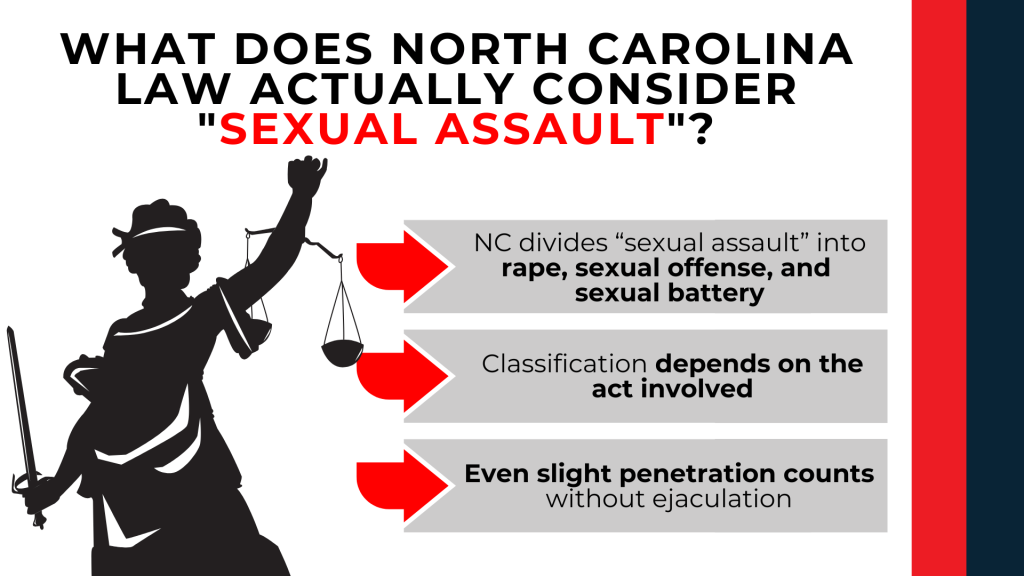
Lady justice with arrows explains categories like rape sexual offense and battery and how classification depends on conduct

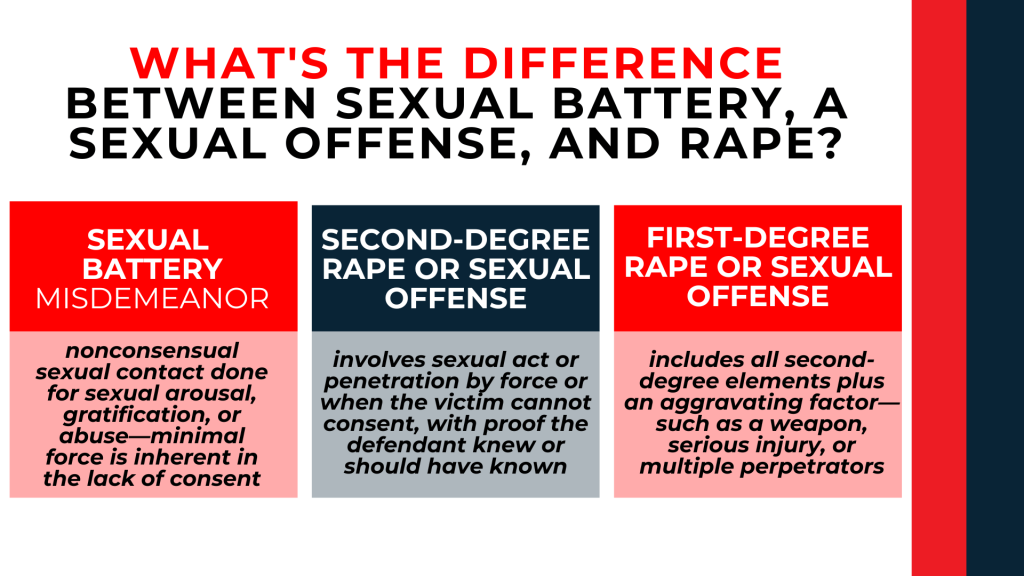
What’s the Difference Between Sexual Battery, a Sexual Offense, and Rape?

In North Carolina, the distinction between these offenses is determined by the type of contact, the degree of force involved, and the presence of specific aggravating factors.

What is Sexual Battery?

Sexual battery is a Class A1 misdemeanor. Under N.C.G.S. § 14-27.33, the state must prove that the defendant engaged in sexual contact with the victim without consent and that the contact was for the purpose of sexual arousal, gratification, or abuse. The North Carolina Supreme Court held in In re J.U., 384 N.C. 618 (2023) that nonconsensual sexual contact by its nature involves some degree of force.

What are Second-Degree Forcible Rape and Sexual Offense?

Second-degree forcible rape (N.C.G.S. § 14-27.22) and second-degree forcible sexual offense (N.C.G.S. § 14-27.27) are Class C felonies. These charges require proof that the act was committed either:

  • By force and against the victim's will, or
  • Against a victim who was incapable of consenting due to mental incapacity, physical helplessness, or intoxication.

For incapacity-based charges, the state must also prove the defendant knew or reasonably should have known of the victim's condition.

What are First-Degree Forcible Rape and Sexual Offense?

First-degree forcible rape (N.C.G.S. § 14-27.21) and first-degree forcible sexual offense (N.C.G.S. § 14-27.26) are Class B1 felonies. These require the same elements as second-degree charges, plus an additional aggravating factor, such as:

  • The use or display of a dangerous weapon.
  • The infliction of serious personal injury.
  • Acting with the aid of one or more other persons.

How is "Force" Defined in These Crimes?

North Carolina courts analyze force through two approaches: actual physical force overcoming resistance, or constructive force through fear, coercion, or threats forcing submission.

The North Carolina Supreme Court recognized in State v. Etheridge, 319 N.C. 34 (1987) that constructive force can exist in relationships involving a significant power imbalance. However, the state must prove both force and lack of consent as separate elements for forcible offenses; a nonconsensual act alone is insufficient, as confirmed by the Court of Appeals in State v. Henderson, 233 N.C. App. 538 (2014).


ChargeStatuteClassKey Difference
Sexual Battery§ 14-27.33Class A1 MisdemeanorSexual contact without consent.
2nd Degree Rape/Sex Offense§ 14-27.22 / .27Class C FelonyUse of force or victim incapacity.
1st Degree Rape/Sex Offense§ 14-27.21 / .26Class B1 FelonyUse of weapon, serious injury, or multiple participants.
Three column layout compares sexual battery second degree and first degree offenses with definitions and severity factors

How Does North Carolina Define Consent — and When Does the Law Say Someone Can't Consent?

Consent is the central issue in most sexual assault cases, and North Carolina law treats it with more nuance than many expect. Consent removes the "against the will" element for forcible sex offenses, and the state bears the burden of proving a lack of consent beyond a reasonable doubt. Notably, physical resistance is not required to prove a lack of consent.

How Did the 2019 SAFE Child Act Change Consent Laws?

In 2019, North Carolina significantly updated its consent laws through the SAFE Child Act (Session Law 2019-245). Two specific changes are critical for understanding modern sexual assault definitions:

Can Consent Be Withdrawn Mid-Act?

Yes. Under the amended N.C.G.S. § 14-27.20(1a), "against the will" includes situations where consent was initially given but then withdrawn in a manner that would cause a reasonable person to believe consent had been revoked. This replaced the prior rule from State v. Way (1979), which held that consent could not be withdrawn once an act began. For offenses occurring before December 1, 2019, the old standard may still apply.

Does Voluntary Intoxication Impact Consent?

Yes. Under the amended N.C.G.S. § 14-27.20(2), a person is considered "mentally incapacitated" if they are rendered substantially incapable of appraising the nature of their conduct or of resisting the act. Previously, State v. Haddock (2008) held that voluntary intoxication was insufficient to establish incapacity, but that is no longer the law.

What Other Categories of Incapacity Exist?

North Carolina recognizes additional categories where consent is legally impossible:

  • Physically Helpless: Under N.C.G.S. § 14-27.20(3), a person who is unconscious, asleep, or otherwise physically unable to communicate unwillingness cannot consent. In State v. Moorman, 320 N.C. 387 (1987), the North Carolina Supreme Court held that both force and lack of consent are implied by law when a victim is incapacitated or sleeping.

How Do Courts Handle Consent in Prior Relationships?

Where a prior consensual relationship exists, courts require particularly clear evidence of a lack of consent. In State v. Alston, 310 N.C. 399 (1984), the Supreme Court held that the state must show statements or actions by the victim that expressly and unequivocally indicated a withdrawal of consent for the specific act in question. The Court also determined that general fear stemming from a prior relationship is insufficient to establish the "force" element; force must be specific to the charged act.

When is Consent Never a Defense?

There are several scenarios where the law dictates that consent is legally irrelevant:

  • Statutory Age: Consent is not a defense when the victim is under the statutory age of consent.
  • Position of Authority: It is not a defense when the defendant is a substitute parent or custodian (N.C.G.S. § 14-27.31(c)) or school personnel where the victim is a student (N.C.G.S. § 14-27.32(d)).
  • Marital Status: Marriage is explicitly not a defense to any sexual offense under N.C.G.S. § 14-27.34.
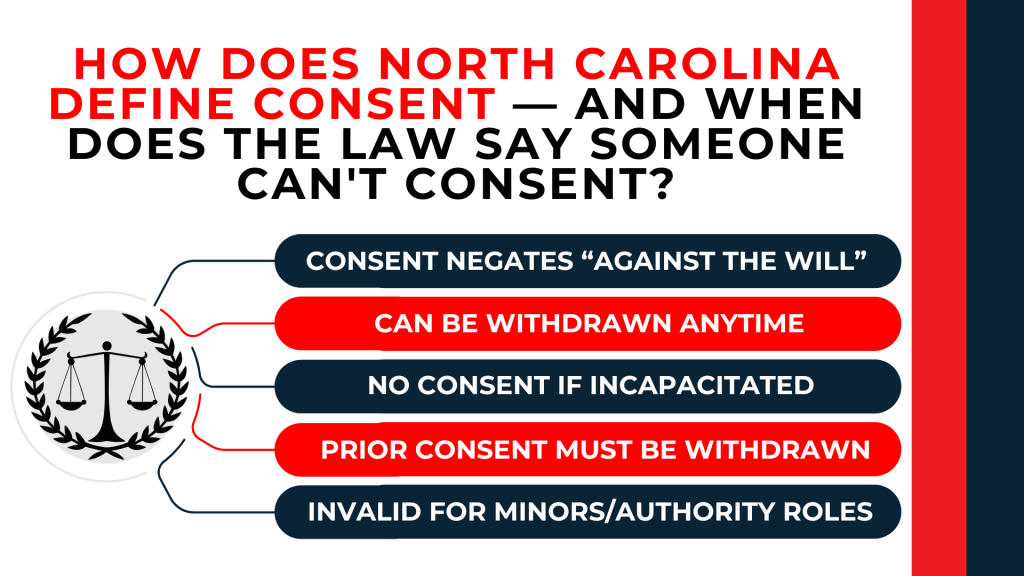
Scales of justice with labeled bars explain consent rules withdrawal incapacity and limits for minors or authority roles

What Should You Do If You've Been Accused of Sexual Assault?

If you are facing a sexual assault accusation in North Carolina, it is very important to speak with an experienced criminal defense attorney before you speak with anyone else — especially law enforcement.

These cases are investigated aggressively. North Carolina is a one-party consent state for recordings under N.C.G.S. § 15A-287. That means pretext phone calls — where an accuser or witness records a conversation with you at law enforcement's direction — are lawful. What you say during those conversations can become evidence in your case. Anything you say to investigators before consulting with a lawyer can shape the direction of your case.

As the sections above make clear, whether specific conduct qualifies as sexual assault under North Carolina law turns on the interaction between several factors. These include the type of contact alleged, how the state defines and proves force, and evolving consent standards that have changed as recently as 2019. These are fact-intensive distinctions that require experienced legal analysis.

Get an Experienced Raleigh Criminal Defense Attorney 

Attorney Patrick Roberts has defended clients against sexual assault and sex offense allegations across North Carolina for over two decades. A former Assistant District Attorney in Wake, Johnston, and New Hanover counties, he understands how prosecutors build these cases because he once built them himself. That dual perspective — knowing what the state looks for and where its cases are vulnerable — shapes how he prepares every defense.

Mr. Roberts is a graduate of Duke University School of Law (Top 9 best criminal law program) and Johns Hopkins University (Top 7 rank in National Universities).  He has completed rigorous trial advocacy programs, including Gerry Spence's Trial Lawyers College, the National Criminal Defense College Trial Practice Institute, and the 2025 NCDC Cross-Examination Intensive. He has tried hundreds of bench and jury trials in both state and federal courts since 2007. He is admitted to practice before the U.S. Supreme Court, the Fourth Circuit Court of Appeals, and all federal district courts in North Carolina, and is a lifetime member of the National Association of Criminal Defense Lawyers. He is the only North Carolina attorney listed on the National Child Abuse Defense & Resource Center as of 2026.

Mr. Roberts served as a Commissioner of the North Carolina State Ethics Commission and as a member of the North Carolina Juvenile Justice Planning Committee. He is the co-author of two legal books and has been frequently quoted by national media outlets, including USA Today and Fox News.

His professional recognition includes an AV Preeminent peer rating from Martindale-Hubbell (held for over five consecutive years), Client Champion Platinum designation from Martindale-Hubbell (over five consecutive years), and a 10/10 "Superb" AVVO rating maintained for more than 15 years. He has been featured in Super Lawyers Magazine and on the cover of Attorney at Law Magazine.

Case Review

In 2025, Attorney Roberts’ client faced allegations of sexual assault involving a teenage stepdaughter. Under North Carolina’s strict sentencing guidelines for offenses involving minors, a conviction would have triggered a mandatory minimum of 144 months (12 years) in prison and lifetime registration on the North Carolina Sex Offender Registry.

Strategic Execution: Pre-Charge Intervention

The client acted early, securing the services of Attorney Patrick Roberts at the onset of the investigation. This allowed the defense to engage during the critical "pre-charge" window, managing the parallel pressures of a criminal inquiry and a NCDHHS Child Protective Services (CPS) assessment.

  • Administrative Advocacy: By intervening before a formal indictment, the defense maintained oversight of the CPS investigation, ensuring the client’s constitutional rights were protected during sensitive agency inquiries.
  • Evidentiary Deconstruction: Utilizing his background as a former Assistant District Attorney, Patrick Roberts performed a technical audit of the claims. He identified significant inconsistencies and a lack of corroborating evidence, which were presented to investigators to challenge the "substantiation" of the allegations.
  • Procedural Resolution: The defense demonstrated that the State's evidence did not meet the rigorous burden of proof required for a criminal prosecution. This proactive disclosure of evidentiary gaps influenced the State's decision-making process before charges were ever filed.

The Outcome*: Case Closed Without Prosecution*

As a result of this comprehensive defense presentation, CPS declined to substantiate the allegations. The State subsequently closed the file without bringing formal criminal charges. The client avoided the life-altering consequences of a felony trial and maintained a clean criminal record.

Result: No Charges Filed.*

*Disclaimer: Each case is different and must be evaluated separately. Prior results achieved do not guarantee similar results can be achieved in future cases.

Client Review

"Our teenage son was recently accused of sexual assault in a dorm on a college campus. We believed in his innocence, did our research and hired A. Patrick Roberts and we were not disappointed. We knew from the consultation that we were in good hands. Mr. Roberts wasted no time obtaining the report and jumping into action. I will never forget the joy I felt in my heart when I received the call informing me that there would be no charges made against our son. His practice is very efficient and receptive in every way. He is the REAL DEAL!" — Verified client review on Avvo.com

Peer Endorsement

"I have known Patrick Roberts my entire legal career. He is a great representation of how a lawyer should be an advocate for justice and truth. He has great relationships with attorneys and judges alike across countless cities and counties." — Martindale-Hubbell verified  Peer Endorsement

Disclaimer: The testimonials are actual comments. Every case is different and depends on its own unique facts and legal circumstances. These results are illustrative of the matters the firm handles but do not guarantee, warrant, or predict a similar outcome in your legal matter. 
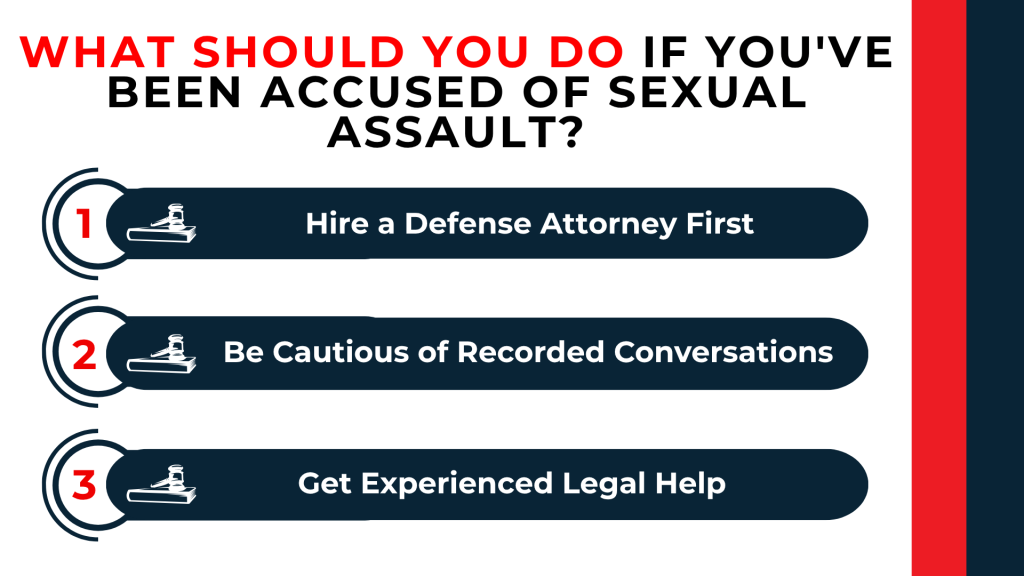
Numbered steps with gavel icons advise hiring attorney avoiding recordings and seeking experienced legal help

Talk to a North Carolina Sexual Assault Defense Attorney Today

If you are facing an accusation or investigation related to sexual assault in North Carolina, Patrick Roberts Law is available for a confidential consultation. With offices in Raleigh, Durham, Chapel Hill, and Cary, the firm represents clients in state and federal courts throughout North Carolina.

Contact Patrick Roberts Law at https://www.patrickroberts.law/ or call the firm directly to discuss your situation.

To maintain the focus necessary for complex criminal matters, the law firm is currently accepting a restricted number of new cases.
Attorney illustration with boxing gloves and skyline promotes contacting defense lawyer for sexual assault charges in NC

Disclaimer: The information on this website is for general informational purposes only and does not constitute legal advice for any individual case or situation. Contacting us via this website, email, or contact form does not create an attorney-client relationship. Each case is different and must be evaluated separately; prior results do not guarantee a similar outcome.

Posted in:

Related Posts

7 Criteria to Evaluate a Criminal Defense Firm in Wake County, NC

Choosing a criminal defense law firm in Wake County, NC requires evaluating seven key factors: trial experience, local courtroom familiarity, relevant case outcomes, peer recognition, client reviews, fee transparency, and attorney availability. This guide explains what each criterion means and how to apply it when evaluating any firm. more Facing criminal charges is one of the most consequential situations a person can encounter. The criminal defense attorney you choose will shape how your case is investigated, argued, and resolved. That decision deserves careful thought—not a quick Google search and a gut feeling. The word "best" gets used loosely in legal marketing. Rankings, badges, and bold claims are everywhere. But the firm that's right for one person may not be right for another. What matters is finding a criminal defense attorney whose background, approach, and communication style align with your specific situation. This guide outlines seven objective criteria for evaluating any criminal defense law firm serving Wake County, NC. It also explains how Patrick Roberts Law can be assessed against each one. Every criminal case is different. Nothing in this guide constitutes legal advice. Use this information to help you ask the right questions—not to predict the outcome of your case. 1. What Does Trial Experience Actually Mean for a Criminal Defense Attorney? Trial experience refers to an attorney's history of preparing and litigating cases in front of a judge or jury—not just negotiating settlements or plea agreements. This distinction matters because criminal cases sometimes proceed to trial, and an attorney who rarely steps into a courtroom may be less prepared when that happens. General legal experience is not the same as criminal defense experience. A civil litigator with 20 years of practice has a very different skill set than a criminal defense lawyer who has spent two decades in courtrooms handling felony charges, sex offenses, and violent crimes. Ask any attorney you're considering: How often do your cases go to trial? What types of criminal cases have you litigated? What does your preparation process look like? Attorney Patrick Roberts is a Duke Law graduate with over 24 years of experience in criminal law and has handled more than 1,000 cases. He previously served as a prosecutor in three counties, which means he has courtroom experience on both sides of criminal proceedings. Prospective clients can review his background and case history at patrickroberts.law. Attorney Patrick Roberts delivers high-level expertise in North Carolina Criminal Law, a distinction forged through more than 80 criminal jury trials taken to verdict, hundreds of bench trials and hundreds of motions in both state and federal courts. 2. Why Does Local Courtroom Familiarity Matter in Wake County? Criminal defense practice is local. Procedures, scheduling practices, and the general culture of a courthouse vary from county to county. A criminal defense attorney who regularly practices in Wake County courts will understand how cases move through the system there—something that can affect strategy and timing. "Local reputation" should be evaluated through verifiable professional information. Look for attorneys who openly discuss their Wake County practice, rather than relying on vague claims about "relationships" with prosecutors or judges. Patrick Roberts Law is based in Raleigh and serves clients throughout Wake County, NC. The firm's Wake County criminal defense practice page describes the range of charges it handles locally, from felony charges to drug crimes and sexual offenses. You can review the firm's stated scope of practice to assess how relevant its experience is to your situation. 3. How Should You Review a Criminal Defense Firm's Case Outcomes? Published case results can give you a sense of the types of situations a firm has handled and how those cases concluded. However, they require careful interpretation. A dismissal in one case does not mean your case will be dismissed. Outcomes depend on the specific facts, evidence, jurisdiction, and legal strategy involved. Look for results involving charges similar to yours. Ask the attorney: Have you handled cases like mine? What factors affected the outcome? What might those factors look like in my situation? Past results do not guarantee future results. Every criminal case must be evaluated individually. Patrick Roberts Law publishes case results on its website, organized by charge type. These include outcomes in cases involving first-degree murder, rape, felony burglary, statutory rape, and indecent liberties, among others. Reviewing those published results can help you assess whether the firm has handled cases with similar charges and complexities to your own. 4. What Do Peer Awards and Professional Recognition Tell You About a Criminal Defense Lawyer? Professional recognition from peer organizations can indicate that a criminal defense attorney is well-regarded within the legal community. Peer-based awards typically involve nominations from other lawyers and a vetting process based on professional standards—making them meaningfully different from advertiser-driven rankings. That said, awards should be one data point, not the deciding factor. Verify who issued the award, what criteria were used, and when it was granted. Patrick Roberts Law Based on publicly available information, Attorney Patrick Roberts has received recognition that includes the Avvo Clients' Choice Award 2026, the Martindale-Hubbell AV Preeminent rating, a Distinguished Counsel designation for 2026, and a Super Lawyers designation from 2013 to 2019. These are verifiable credentials that prospective clients can independently confirm through the issuing organizations. 5. How to Read Client Reviews of a Wake County Criminal Defense Firm Client reviews can offer insight into a firm's communication style, responsiveness, and how clients feel they were treated throughout the process. Look for patterns across multiple reviews, not just individual comments. A review that says "he fought hard for me" tells you less than one that describes specific interactions, response times, or how the attorney explained the process. Reviews that address the experience of working with the firm—not just the outcome—tend to be more informative. Keep in mind that online reviews have limits. They don't predict case outcomes, and they reflect individual perspectives. Use them as one factor among several. Patrick Roberts Law The firm has accumulated over 130 reviews on Trustindex. Published client testimonials on the firm's website describe experiences involving federal fraud cases, sex offense allegations, and other serious criminal matters. Prospective clients can read those reviews directly on the firm's site or on third-party platforms to form their own assessment. In addition to client feedback, Attorney Patrick Roberts is endorsed by fellow criminal defense attorneys who have observed his deep knowledge of North Carolina criminal law and his skill in managing complex cases. Read selected reviews from Attorney Roberts’ Avvo page below: Client Review “I highly recommend this attorney to anyone needing experienced and knowledgeable legal representation. From the beginning, he clearly explained the steps necessary to address my situation and made sure I understood the process along the way. He kept me informed as progress was being made and was always professional, responsive, and prepared. Although the legal process can move slowly at times, I always felt confident that my case was being handled properly. When my court date finally arrived, he was exceptionally well prepared and navigated the courtroom procedures with confidence and skill. His experience and attention to detail ultimately helped lead to a very positive outcome in my case. I truly appreciated his guidance and representation throughout the entire process.” — Verified Client via Avvo.com Peer Endorsement “I endorse this lawyer. Patrick is a great trial lawyer and a person who I go to for legal advice in my own practice. Patrick is dedicated to his clients and a master at criminal defense. I would not hesitate to hire him if I was in trouble and needed a lawyer.” — Review From a Criminal Defense Attorney via Avvo.com *Testimonials and peer reviews are for informational purposes only and do not guarantee or predict the outcome of your legal matter. Every case is unique and must be evaluated on its own merits. All endorsements featured on this site are actual comments from clients and peers. 6. What Should You Ask About Fees Before Hiring a Criminal Defense Law Firm? Fee structures vary among criminal defense law firms. Some charge flat fees for specific services; others bill hourly. Most require a retainer upfront. There may be additional costs for investigators, expert witnesses, filing fees, or extended litigation. The lowest fee is not necessarily the best value. A firm that charges less but lacks relevant experience may cost more in the long run—in time, outcomes, and stress. Before signing any agreement, ask: What does your fee cover? What could result in additional charges? How will I be billed if my case goes to trial? Patrick Roberts Law Specific fee information for the firm is not published on the firm's website, which is common practice in criminal defense. Prospective clients should ask directly during a consultation. Patrick Roberts Law offers free consultations, which is an appropriate opportunity to raise questions about billing structure, what services are included, and what additional costs might arise. 7. How Should You Evaluate Attorney Availability and Communication? Criminal cases can move quickly. Hearings get scheduled. Evidence needs to be reviewed. Decisions have to be made under pressure. An attorney who is difficult to reach—or who hands off your case without telling you—can leave you feeling uninformed at critical moments. Before hiring anyone, clarify: Who will handle my case day to day? How do I reach the attorney directly? What is the typical response time for questions or updates? Patrick Roberts Law Patrick Roberts Law's main contact number is 919-746-7206. You may also send inquiries through the firm's email address info@patrickroberts.law. Prospective clients should confirm during a consultation how communication is handled, who their primary point of contact will be, and what to expect during different stages of their case. Questions to Ask Before Hiring a Wake County Criminal Defense Attorney Use this checklist when meeting with any criminal defense attorney in Wake County, NC: How much experience do you have with cases like mine? How often do your criminal cases go to trial? How familiar are you with the Wake County courts? Can you explain your approach to my type of charge? What outcomes have you achieved in similar cases? What will my legal fees include? Who will handle my case? How will we communicate, and how quickly should I expect responses? What should I expect during the next stage of my case? These questions apply to every firm you consider—including Patrick Roberts Law. How Patrick Roberts Law Fits These Evaluation Criteria When you apply the seven criteria above to Patrick Roberts Law, here is what the verifiable record shows: Patrick Roberts is a Duke Law graduate and former prosecutor with over 24 years of experience in North Carolina criminal law. The firm has handled more than 1,000 cases and has published detailed case results covering a wide range of serious charges. Mr. Roberts has received peer recognition including Super Lawyers (2013–2019), an AV Preeminent Martindale-Hubbell rating, a Distinguished Counsel designation, and an Avvo Clients' Choice Award. The firm has over 220 client reviews and offers free consultations with a 24/7 phone line. That does not make Patrick Roberts Law the right choice for every person facing criminal charges in Wake County. The right firm depends on the nature of your charges, your priorities, and how you want to communicate with your attorney. Use the same criteria to compare Patrick Roberts Law with any other qualified options you are considering. You can review the firm's Wake County criminal defense services to assess how its practice areas align with your situation. Speak With Patrick Roberts Law About Your Criminal Defense Case If you are facing criminal charges in Wake County, NC, the most important step you can take right now is to speak with a qualified criminal defense attorney. The earlier you get legal guidance, the more options you may have. Patrick Roberts Law offers free consultations and serves clients throughout Wake County and the surrounding areas. While representing clients in critical legal matters across all North Carolina counties, his practice maintains a strong presence in Wake County, specifically serving Raleigh, Cary, Apex, Holly Springs, Garner, and Fuquay-Varina. To discuss your situation and learn about your legal options, contact Patrick Roberts Law today. Choose Your Criminal Defense Attorney Based on What Matters Most The seven criteria in this guide—trial experience, local courtroom familiarity, case outcomes, peer recognition, client reviews, fee transparency, and attorney availability—give you a practical framework for comparing criminal defense law firms in Wake County, NC. No ranking, badge, or advertisement replaces this kind of objective evaluation. The "best" criminal defense attorney is the one whose background, communication style, and approach match your specific case and circumstances. Patrick Roberts Law is one firm worth evaluating using these criteria. There are others. Take the time to compare your options carefully, ask direct questions, and make a decision based on what the evidence actually shows—not what a firm says about itself. Frequently Asked Questions How do I find a qualified criminal defense law firm in Wake County, NC? Start by identifying attorneys who focus on criminal defense and regularly practice in Wake County courts. From there, evaluate each firm using objective criteria: trial experience, published case results, peer recognition, client reviews, fee transparency, and attorney availability. Free consultations—offered by firms like Patrick Roberts Law—are a practical way to assess fit before making a commitment. Does hiring a former prosecutor as a criminal defense attorney make a difference? It can. A criminal defense attorney who previously worked as a prosecutor understands how the government builds its cases, what evidence it tends to rely on, and where weaknesses may exist. Patrick Roberts Law's lead attorney served as an assistant district attorney in three counties before moving to criminal defense, which provides a dual perspective on case strategy. What is the difference between a criminal defense lawyer and a criminal defense law firm? A solo criminal defense lawyer and a law firm both provide legal representation, but they differ in staffing, capacity, and support resources. A firm may have multiple attorneys and support staff, which can affect how cases are managed and communicated. Before hiring, ask who specifically will handle your case and what role each team member plays. How do I know if a criminal defense attorney's awards are meaningful? Look for recognition issued by established legal organizations with clear selection criteria. For example, Martindale-Hubbell's AV Preeminent rating is based on peer review by other attorneys. The Super Lawyers designation involves peer nominations and independent research. Awards that require payment or have no vetting process carry less weight. Always verify the source and criteria independently. Disclaimer: The information on this website is for general informational purposes only. Nothing herein should be taken as legal advice for any individual case or situation. Contacting us via this website, email, or contact form does not create an attorney-client relationship. Case results depend on a variety of factors unique to each case; prior results do not guarantee a similar outcome.
Digital Forensics in NC Rideshare Crimes: How GPS Telemetry & Cell Phone Evidence Impact Criminal Defense

A $50 million civil lawsuit recently filed in Durham County Superior Court against Lyft has placed ridesharing  safety standards and vetting protocols under intense public scrutiny. Filed on behalf of a victim alleging sexual assault during a rideshare trip, the civil complaint targets platform background check policies—specifically highlighting that the driver's prior driving while impaired (DWI) conviction fell outside North Carolina’s statutory 7-year lookback window. While civil proceedings evaluate corporate liability, the parallel criminal prosecution focuses on an entirely different evidentiary threshold: digital forensics, GPS telemetry, and the digital chain of custody. more The Evidentiary Core: Digital Forensics in Platform Offenses In complex felony prosecutions involving rideshare platforms, verbal testimony rarely forms the sole basis of the state's case. Prosecution and defense teams analyze four primary electronic data streams to establish location, intent, and timing: Server-Side Telemetry & GPS Logs: Geolocation data maintained on TNC servers, documenting latitude, longitude, velocity spikes, and route deviations. On-Device Cellular Telemetry: Hardware extraction logs retrieved directly from mobile devices using specialized forensic software. In-Cabin Media: Audio and video recordings captured by dual-facing dashcams, personal mobile devices, or in-app emergency features. Application Transaction Logs: Timestamped electronic records tracking ride requests, driver acceptance, cancellation attempts, and status changes. Because electronic records are subject to sampling rates, time-synchronization variances, and network latency, validating their technical reliability is critical to trial preparation. Authentication Standards Under N.C.G.S. § 8C-1, Rule 901 Before electronic telemetry can be admitted as substantive evidence in a North Carolina courtroom, the state must establish its authenticity under Rule 901 of the North Carolina Rules of Evidence. Satisfying Rule 901 requires a foundational showing of reliability: N.C.G.S. § 8C-901(b)(1) – Witness with Knowledge: The prosecution often introduces device extractions through an investigating officer. Cross-examination evaluates whether the witness possesses formal digital forensics expertise or relied entirely on automated extraction tools. N.C.G.S. § 8C-901(b)(9) – System or Process: Introducing server-side GPS exports requires proving that the platform’s tracking systems yield accurate results, typically supported by testimony or affidavits from the TNC’s official Custodian of Records. Digital Chain of Custody Protocol Digital evidence requires strict handling protocols to demonstrate that raw data extracted from servers or mobile hardware remains uncorrupted throughout the proceedings: Faraday Shielding: Securing mobile hardware inside signal-blocking enclosures prevents remote data wiping commands or incoming cellular overwrites immediately upon seizure. Cryptographic Hash Verification: Forensic examiners generate a unique cryptographic hash value (such as SHA-256) at the initial extraction. Any discrepancy between the working file's hash and the original acquisition hash indicates file alteration or data corruption. Hardware Write-Blockers: Analysts utilize write-blocking hardware during examination to ensure the host operating system does not alter underlying file metadata. Primary Technical Vulnerabilities in Telemetry Evidence Auditing electronic discovery in platform-based cases involves evaluating four common technical vulnerabilities: Vulnerability Technical Mechanism Strategic Defense Impact Clock-Drift & UTC Offsets Discrepancies between local device clocks, cell tower logs, and server Universal Time Coordinated (UTC) stamps. Reconciles timeline gaps that might otherwise misrepresent routine traffic stops as unlawful restraint. GPS Polling & "Jitter" Periodic logging intervals combined with satellite signal interference near structures or heavy foliage. Demonstrates that apparent route deviations on digital maps can be artifacts of algorithmic estimation. API vs. Raw Exports Summarized PDF exports provided by platforms compared to underlying raw data files. Uncovers critical missing metadata, confidence radiuses, and system error codes omitted from summary reports. Data Volatility & Spoliation Automated operating system purges that overwrite volatile device memory over time. Highlights potential losses of ambient sensor logs or messaging records due to delayed preservation requests. Defense Counsel Action Items When handling criminal cases involving mobile telemetry and location data in North Carolina courts, defense strategy centers on thorough technical verification: Issue 18 U.S.C. § 2703(f) Preservation Demands: Serve formal preservation notices on TNC platforms, cellular carriers, and third-party data providers immediately to prevent automated deletion routines. Request Raw Bit-Stream Extractions: File discovery motions for full raw images (.E01 or .raw formats), system audit logs, and verified hash values rather than relying solely on high-level extraction summaries. Audit Metadata Integrity: Evaluate foundational witness testimony under Rule 901 to determine whether the state can verify the underlying technical process of data acquisition. Retain Independent Forensic Experts: Engage certified digital forensic analysts to independently re-verify cryptographic hashes, assess GPS confidence intervals, and review extraction logs for chain-of-custody errors. Legal Representation for Complex Digital Evidence Cases When facing felony charges involving digital telemetry, forensic app extractions, or TNC data in North Carolina, technical evidence demands experienced analysis. Former prosecutor Patrick Roberts brings over two decades of trial experience to evaluate electronic evidence, review forensic extraction protocols, and structure comprehensive defense strategies. Education & Advanced Trial Advocacy Duke University School of Law: Juris Doctor (Ranked #7 National Law School & #9 Criminal Law Program by U.S. News & World Report) The Johns Hopkins University: Bachelor’s Degree (Ranked #7 National University by U.S. News & World Report) Gerry Spence’s Trial Lawyers College: Graduate National Criminal Defense College (NCDC): Trial Practice Institute Graduate (Including the 2025 Cross-Examination Intensive) Peer Recognition & Legal Accolades Martindale-Hubbell AV Preeminent® Rating: Peer-rated for the highest level of professional excellence (8 Consecutive Years) Martindale-Hubbell Client Champion Platinum: Recognized for exceptional client service (5+ Consecutive Years) Avvo 10.0/10 “Superb” Rating: Highest legal rating for experience, outcome history, and professional conduct (15+ Consecutive Years) The National Trial Lawyers: Top 100 Trial Lawyers Peer Endorsement “Patrick is a thoughtful and experienced attorney. When I have a client needing representation in the Raleigh area in his areas of practice, he would be my referral of choice.” -Verified Peer Endorsement via Avvo.com Client Review “Throughout the process, he remained a constant calm and reassuring presence during a challenging time in my life. His guidance and dedication made a difficult experience much more manageable. ” - Verified Client Review via Avvo.com Disclaimer: Testimonials and peer reviews are actual comments from clients and peers. They are for informational purposes only and do not guarantee or predict the outcome of your legal matter. Every case is unique and must be evaluated on its own merits. To stay current with evolving legal and technical standards, he attended the Defending Digital Sex Crimes Bootcamp in Orlando, Florida, in July 2026—a two-day intensive program focused on defending possession and distribution cases involving digital evidence. For individuals navigating state charges, felony classifications, or registry exposure, he provides the interactive North Carolina Sex-Offense Search Tool to help evaluate charge severity and statutory penalties. For confidential legal consultations regarding criminal matters in Raleigh, Durham, Chapel Hill, or throughout North Carolina, contact Patrick Roberts Law at ( 919) 746-7206 or visit patrickroberts.law. Legal Disclaimer This content is provided for educational and informational purposes only and does not constitute formal legal advice. Reading this information or contacting the firm does not create an attorney-client relationship.

Gloved hand holding a bag of meth introduces North Carolina meth intent-to-distribute charges.

Possession of Meth With Intent to Distribute in North Carolina: What the Charge Really Means

In North Carolina, what people call "possession of meth with intent to distribute" is charged as possession with intent to sell or deliver methamphetamine — PWISD for short. It falls under N.C. Gen. Stat. § 90-95(a)(1), and it's a Class H felony. But the single fact that changes everything is weight. At 28 grams, the same meth stops being a PWISD case and becomes trafficking. Trafficking carries mandatory prison time, no matter who you are. more This article breaks down what the state actually has to prove, how "intent" gets established when nothing was ever sold, the line between simple possession, intent to sell, and trafficking, how much prison time is really on the table, and the specific ways these cases get dismissed, suppressed, or knocked down to something smaller. Is "possession of meth with intent to distribute" the same as what I'm charged with in North Carolina? Almost certainly, yes — "intent to distribute" is federal and everyday language for what North Carolina calls possession with intent to sell or deliver a controlled substance. The charge lives in § 90-95(a)(1), and under § 90-95(b)(1), PWISD meth is a Class H felony. Here's the first thing worth holding onto: a charge is an accusation, not a conviction. The label on the paperwork is the prosecutor's opening position, not the final answer. Drug cases are also not rare or exotic in this state. Non-trafficking drug offenses were the single largest category of felony convictions in North Carolina in FY2024, about 30% of all of them. Prosecutors handle these constantly, which means there are well-worn paths to reducing and beating them, too. What decides your outcome is the machinery underneath the charge — the proof, the weight, and the search — not the scary phrase at the top of the page. How do  prosecutors establish "Intent to Sell or Deliver" without a completed sale Under North Carolina law (N.C. Gen. Stat. § 90-95(a)(1)), a person can be charged with Possession with Intent to Sell or Deliver (PWISD) even if no actual transaction occurred. Because direct evidence of intent is rarely available, prosecutors rely on circumstantial evidence to convince a jury that the drugs were meant for distribution rather than personal use. Circumstantial Factors Used to Infer Intent Prosecutors typically present a combination of surrounding facts to infer distribution intent, including: Quantity: Possessing an amount exceeding what a typical user retains for personal consumption. Packaging: Drugs divided into multiple individual baggies or uniform units rather than kept in a single bulk container. Paraphernalia Associated with Distribution: The presence of digital scales, measuring spoons, cutting agents, or unused packaging materials. Currency: Carrying large amounts of cash, particularly in small, organized denominations. Electronic Communications: Text messages, call logs, or social media records that reference prices, meeting locations, or transaction terms. Absence of Personal-Use Paraphernalia: The lack of pipes, syringes, or other consumption items, which prosecutors argue indicates the substance was not intended for personal consumption. Challenging Circumstantial Evidence of Intent Because an intent charge relies on inferences rather than direct proof, every piece of circumstantial evidence can be challenged, reinterpreted, or subjected to evidentiary objections. Common defense strategies include establishing alternative, non-distribution explanations for the state's evidence: Cash: Demonstrating that currency originated from legitimate sources, such as employment wages, bank withdrawals, or rental payments. Packaging: Showing that drugs were purchased in pre-packaged quantities from a seller rather than packaged by the defendant for resale. Quantity: Presenting evidence consistent with bulk purchasing for personal use to reduce costs or minimize trips. Dismantling even one or two of the state's primary circumstantial factors can significantly weaken a PWISD charge, creating leverage to seek a charge reduction to simple possession or a dismissal of the intent element prior to trial. What's the difference between simple possession, intent to sell, and trafficking meth? These are three separate charges with three very different consequences. Which one you actually face turns on the evidence and the weight — not just on what the officer wrote down. Getting moved from one tier to the next is often the whole ballgame. Simple possession of meth — having it for personal use, with no evidence of intent to sell. Under § 90-95(d)(2), possession of methamphetamine is a Class I felony. Possession with intent to sell or deliver (PWISD) — possession plus the circumstantial intent evidence described above. Under § 90-95(b)(1), this is a Class H felony — one step up. Trafficking meth — triggered purely by weight, 28 grams or more, regardless of whether you ever intended to sell anything. This is where the penalties jump dramatically. Notice the fork. The gap between simple possession (Class I) and PWISD (Class H) is fought over intent — the softer, more contestable evidence. The gap between PWISD and trafficking is fought over weight — a number on a lab report. That difference in what has to be proven is exactly what a defense strategy is organized around. At what point does a meth charge become "trafficking" — and why does that change everything? The moment the alleged amount hits 28 grams, meth becomes trafficking under § 90-95(h)(3b). At that point intent stops mattering, because trafficking is measured by weight alone. This is the most important threshold in the entire statute. It's why the number on the state's scale can matter more than anything you said or did. The meth trafficking tiers run like this: 28 grams to under 200 grams — Class F felony, mandatory 70 to 93 months and a fine of at least $50,000 200 grams to under 400 grams — Class E felony, mandatory 90 to 120 months and a fine of at least $100,000 400 grams or more — Class C felony, mandatory 225 to 282 months and a fine of at least $250,000 What makes trafficking far worse than PWISD is the word mandatory. North Carolina's trafficking tiers are fixed by drug weight and apply regardless of your prior record level. A first-time offender and someone with a long history draw the same minimum. There's generally no probation and no suspended sentence at these levels. Trafficking is also common enough in this state to be taken seriously: North Carolina courts recorded 638 drug-trafficking convictions in FY2024. All of which is why fighting the weight — the reliability of the measurement, what got included in it, the lab's methods — is often the single highest-value thing a defense can do. How much prison time am I actually facing? It depends entirely on which of the three charges sticks and, for the non-trafficking charges, on your prior record. So the honest answer is that the range is wide and heavily influenceable. That's good news, because it means the sentence is not fixed the day you're charged. For PWISD meth as a Class H felony and simple possession as a Class I felony, North Carolina uses structured sentencing. That system sets the punishment according to the offense class and your prior record level. Someone with no record is in a very different position from someone with a long one. These classes also carry real room for outcomes short of lengthy active prison time. Because prior record drives the number, mitigating and negotiating around it is a core part of the work. For trafficking, the math flips. The mandatory minimums above are locked to weight and ignore your record entirely. That's exactly why keeping a case below the trafficking line, or below a higher trafficking tier, can be worth years of someone's life. The difference between 27 grams and 28 grams is the difference between a contestable Class H felony and a mandatory 70-month sentence. Can a meth intent-to-sell charge be beaten or reduced? Yes — these cases are dismissed, suppressed, and reduced regularly. They depend on evidence that is often gathered in legally vulnerable ways, or built on inferences that don't hold up. No lawyer can promise a result, but there are real, recurring levers. The stop or search was illegal Most drug evidence comes from a traffic stop, a search of a car, a home, or a person. If the stop wasn't lawful, the search exceeded its bounds, or the warrant was defective, your attorney may move to suppress that evidence. If the drugs are kept out, the case can collapse with them. This is often the highest-impact challenge in a meth case. What if the intent evidence is weak? Because intent is circumstantial, it's contestable. If the state's "dealer" story rests on ambiguous packaging, a debatable quantity, or cash with an innocent explanation, that supports knocking PWISD down to simple possession. That drops the charge from a Class H to a Class I felony. Can the weight or lab work be challenged? The 28-gram trafficking line makes measurement everything. The composition of what was weighed, the accuracy and calibration of the testing, and the State Crime Laboratory's chain of custody and analysis can all be contested. Pulling a case below a weight threshold can move it out of trafficking entirely. The drugs weren't really "yours" Sometimes meth is found in a shared car, a shared home, or a space others had access to — rather than physically on you. In those situations, whether the drugs were really yours to control can be genuinely contested. Being near drugs that others could access is not the same as possessing them, and these cases can turn on that distinction. One piece of realism to plan around: the overwhelming majority of felony convictions in North Carolina — about 98% — come from guilty pleas, not trials. That's not a reason to give up; it's the reason skilled negotiation matters so much. Suppression motions, weaknesses in intent, and weight challenges are the leverage that turns a bad plea into a good one — or into a dismissal. What should I do in the next few days — and how does a former prosecutor help? The early days shape the case, so the priorities are simple: Stop talking about the case — not to police, not over jail phones, not on social media. The state builds intent out of statements, and silence protects you. Get counsel involved immediately — early enough to preserve evidence, address custody and release, and open negotiations before an indictment locks the case in. Write down everything you remember about the stop, the search, and who had access to the location. The details that fuel suppression and possession defenses fade fast. Moving quickly also matters because the process is long and often carries pretrial custody. Here's the reality: in FY2019, superior court felonies took a median of about 259 days — roughly eight and a half months — to resolve. And as of 2015, 82% of the people in North Carolina jails were awaiting trial rather than serving a sentence. That's a long time to be fighting from behind, and a reason to have an advocate working on release and strategy from day one. Review Your Legal Options with Attorney Patrick Roberts Patrick Roberts is a former Assistant District Attorney who prosecuted cases in Wake, Johnston, and New Hanover counties and has more than 24 years of experience in criminal law. That matters here specifically: he has built the exact intent-and-weight cases the state is now trying to build against you, so he knows how prosecutors decide a case is "dealing" rather than personal use, where their circumstantial theories are thinnest, and how lab weight and chain-of-custody get challenged from the inside. With offices in Raleigh, Durham, Chapel Hill, and Cary, the firm handles meth PWISD and trafficking cases across the Triangle and North Carolina. Attorney Patrick Roberts delivers high-level expertise in North Carolina criminal law, offering strategic defense built on a foundation of more than 80 criminal jury trials taken to verdict and hundreds of bench trials. Client Review “I endorse this lawyer. Patrick is a great trial lawyer and a person who I go to for legal advice in my own practice. Patrick is dedicated to his clients and a master at criminal defense. I would not hesitate to hire him if I was in trouble and needed a lawyer.” - Verified Client Review via Avvo.com Peer Endorsement “I attended the Trial Lawyers College with Patrick. If I was facing serious criminal charges anywhere in North Carolina, he would be my first call.” - Verified Peer Endorsement via Avvo.com Disclaimer: The client reviews and peer endorsements featured on this website reflect actual comments provided by clients and legal professionals. This information is intended for general informational purposes only and does not constitute a guarantee, warranty, or prediction regarding the outcome of any future legal matter. Every legal case presents unique facts and circumstances that must be evaluated independently on its own merits. The testimonials displayed here do not represent all reviews or endorsements received by the firm. Evaluate Your State or Federal Meth Defense Facing a PWISD or methamphetamine trafficking charge in North Carolina involves strict statutory penalties, but an arrest is not a final conviction. Defense outcomes depend heavily on identifying constitutional and procedural vulnerabilities early in the judicial process. Whether through challenging the legality of the initial traffic stop or search warrant, disputing circumstantial evidence of intent, or contesting crime lab weight measurements, the State bears the burden of proving every legal element beyond a reasonable doubt. Because critical procedural deadlines—such as statutory windows to object to State Crime Laboratory reports—begin running shortly after formal charges are filed, early legal evaluation is essential to preserving your available defenses. Consult with Criminal Defense Attorney Patrick Roberts If you or a family member are facing methamphetamine charges in North Carolina, obtaining a direct, objective evaluation of your case facts is a critical first step. Patrick Roberts Law PLLC provides legal defense for high-exposure drug prosecutions across state and federal courts in North Carolina. Schedule a confidential consultation with Attorney Patrick Roberts to review the evidence, evaluate constitutional search-and-seizure issues, and discuss your legal options. Based in Wake County, Mr. Roberts serves clients in Raleigh, Cary, Apex, Holly Springs, Garner, and Fuquay-Varina, while also managing complex legal matters in every county across North Carolina. To maintain the quality of its defense and provide each client with individualized attention, the firm limits the number of cases it accepts at any given time. This article is general legal information about North Carolina law, not legal advice, and reading it does not create an attorney-client relationship. Every case turns on its own facts; for advice about your specific situation, consult a licensed North Carolina criminal defense attorney.