Blog / Criminal Defense

Blog

All Criminal Defense Criminal Defense Lawyer Sex Defense Felony Charges Lawyer Drug Charges Sex Defense Lawyer Murder Charges Rape Case Statutory Rape Charges Drug Crimes & Violations Drug Trafficking Violent Crime Domestic Violence Child Exploitation Charges Indecent Liberties North Carolina Criminal Law Sexual Assault North Carolina Law Fentanyl Crimes indecent liberties with a minor Sex Crimes Sex Crimes Defense Sex Offender Registry Sexual exploitantion of minors Meth Trafficking Age of Consent Aggravated Sexual Assault Artificial Intelligence Child Enticement Charges child grooming Child Rape Constitutional Rights & Warrants Criminal Defense & Travel Law Criminal Justice Criminal Law Cybercrime Defense Data Privacy Digital Evidence Entrapment defense False Accusations Family Law Federal Offenses Indecent Exposure Legal Defense Strategies Legal Resources Legal Updates Possession with intent to sell Sex Crimes & Registry Sex Crimes Defense Strategies Sex Offender Registration Requirements Sex Offender Registry Compliance Sex Offense Defense Sexting Laws solicitation of a child by computer Solicitation of a Minor Charge State vs. Federal Laws Statute of Limitations Statutory Sex Offense
Jail scene behind bars with headline “How to Bail Someone Out of Jail in NC” and PatrickRoberts.law branding.

How to Bail Someone Out of Jail in North Carolina

Getting a phone call from a loved one who has been arrested is one of the most stressful experiences a family can face. The immediate priority becomes getting them released as quickly as possible, but the bail process can feel confusing and overwhelming—especially if you have never navigated it before. Understanding how pretrial release works in North Carolina helps families make informed decisions and take the right steps to bring their loved one home. North Carolina law establishes a framework for pretrial release that balances the defendant's right to freedom before trial against the need to ensure they appear in court and do not pose a danger to the community. The type of release ordered by a judicial official determines what steps you must take to secure someone's release. Some defendants are released on a simple written promise, while others must post significant financial security before they can leave custody. Recent legislative changes, particularly Iryna's Law effective December 1, 2025, have added new requirements for defendants charged with violent offenses that make understanding the current legal landscape even more important. more How Does the Bail Process Work in North Carolina? Before you can take steps to get someone released, it helps to understand how the process unfolds from arrest through the setting of release conditions. What Happens After Someone Is Arrested? After an arrest, the defendant is taken to a local detention facility for booking. This process includes fingerprinting, photographing, and creating an official record of the arrest. Following booking, the defendant appears before a judicial official—typically a magistrate—who reviews the charges and determines conditions for pretrial release. The judicial official considers information about the charges, the defendant's background, and factors related to flight risk and community safety before deciding what conditions, if any, will allow the defendant to be released while the case is pending. Who Decides the Conditions of Release? Under N.C. Gen. Stat. § 15A-532, judicial officials have authority to determine conditions for release. In most cases, a magistrate sets initial release conditions shortly after booking. However, certain situations require a judge rather than a magistrate to make this determination. For example, when a defendant is arrested for a new offense while already on pretrial release for another pending case, a judge must set the conditions for the new charge. Similarly, for certain domestic violence offenses, only a judge can determine release conditions during the first 48 hours after arrest. Under Iryna's Law, defendants charged with violent offenses face additional requirements that may involve judicial review. How Long Does the Process Take? The timeline for setting release conditions and processing release varies based on the circumstances of the arrest, the charges involved, and the procedures of the specific detention facility. Procedures differ by county, so families should contact the detention facility directly to understand what to expect and how to proceed once conditions are set. What Types of Release Conditions Can a Judge Set? North Carolina law provides judicial officials with several options for pretrial release, ranging from release without any financial obligation to secured bonds requiring significant collateral. What Is a Written Promise to Appear? The least restrictive form of release is a written promise to appear. Under this condition, the defendant simply signs a document promising to attend all required court dates. No money or property is required. This option is typically available only for lower-level offenses where the defendant presents minimal flight risk and no danger to the community. What Is the Difference Between a Secured and Unsecured Bond? An unsecured bond sets a dollar amount that the defendant promises to pay if they fail to appear, but no money or property must be provided upfront for release. The defendant signs an agreement and is released, but becomes liable for the full amount if they miss court. A secured bond requires actual financial backing before release. The defendant or someone acting on their behalf must provide cash, property, or a surety (such as a bail bondsman) to guarantee the bond amount. The defendant cannot be released until this security is in place. What Is House Arrest with Electronic Monitoring? North Carolina law allows house arrest with electronic monitoring as a condition of pretrial release. Under N.C. Gen. Stat. § 15A-531, this requires the defendant to remain at their residence except when authorized to leave for employment, counseling, education, or vocational training. The defendant wears a monitoring device that tracks compliance. When house arrest is imposed, the defendant must also execute a secured appearance bond. Under N.C. Gen. Stat. § 15A-534(a), judicial officials may impose one or more of the following conditions for pretrial release: Release on the defendant's written promise to appear Release upon execution of an unsecured appearance bond in an amount specified by the judicial official Placement of the defendant in the custody of a designated person or organization agreeing to supervise them Requirement of an appearance bond secured by a cash deposit of the full amount, by a mortgage on real property, or by at least one solvent surety House arrest with electronic monitoring, which must be combined with a secured appearance bond What Are the Different Ways to Post a Secured Bond? When a judicial official requires a secured bond, you have several options for providing the required security. The right choice depends on your financial situation and the bond amount. Can You Pay the Full Amount in Cash? Yes. If you have access to sufficient funds, you can post the full bond amount in cash directly. This is sometimes called a "cash bond." The procedures for posting a cash bond vary by county—contact the detention facility or clerk's office to learn where payments are accepted and what forms of payment the specific facility allows. If the defendant appears at all required court dates and no forfeiture is ordered, the cash is returned after the case concludes. The clerk's office processes refunds and mails a check to the person who posted the bond. Court costs and fees may be deducted from the refund. Can You Use Property to Secure a Bond? Under N.C. Gen. Stat. § 58-74-5, a defendant may execute a mortgage on real or personal property to secure a bond. The mortgage is payable to the State of North Carolina and includes a power of sale that allows the clerk to sell the property if the defendant breaches the conditions of release. Using property to secure a bond requires recording a deed of trust with the Register of Deeds in the county where the property is located. This process typically requires the assistance of an attorney to prepare the necessary documents. The clerk's office must approve property bonds, and specific requirements vary by judicial district. Contact the clerk's office in the county where the defendant is held to learn about local requirements for property bonds. How Does Using a Bail Bondsman Work? Most people who need to post a secured bond work with a bail bondsman. A bail bondsman is licensed by the North Carolina Department of Insurance to post bonds in exchange for compensation. The bondsman acts as surety, guaranteeing the defendant's appearance and taking responsibility for the full bond amount if the defendant fails to appear. When you contact a bail bondsman, you provide information about the defendant, including their name, date of birth, the charges, and the bond amount. The bondsman charges a premium—a fee for their service—and may require collateral depending on the bond amount and risk factors. Once the premium is paid and any required paperwork is completed, the bondsman posts the bond with the court, and the defendant can be released. There are three primary ways to satisfy a secured bond requirement in North Carolina: Pay the full bond amount in cash directly to the court, which is refundable if the defendant appears at all court dates Provide a mortgage or deed of trust on real property with sufficient equity to cover the bond amount Work with a licensed bail bondsman who posts the bond in exchange for a non-refundable premium What Should You Know About Working with a Bail Bondsman? If you decide to work with a bail bondsman, understanding the financial obligations and legal requirements helps you avoid surprises and protect your interests. How Much Does a Bail Bondsman Charge? Under N.C. Gen. Stat. § 58-71-95, a bail bondsman cannot charge a premium exceeding fifteen percent of the face amount of the bond. For example, on a $10,000 bond, the maximum premium would be $1,500. This premium is the bondsman's fee for providing the service and is not refundable, regardless of the outcome of the case. The bondsman may also require collateral—property or other assets pledged as additional security. Collateral requirements must be reasonable in relation to the bond amount. What Happens to Collateral After the Case Ends? North Carolina law protects people who provide collateral to bail bondsmen. Under N.C. Gen. Stat. § 58-71-95, collateral must be returned within 15 days after final termination of liability on the bond. The collateral must be returned in the same condition as when it was received. Knowing and willfully failing to return collateral valued at more than $1,500 is a Class I felony under North Carolina law. If a bondsman fails to return your collateral after the case concludes, you have legal recourse. How Do You Find a Licensed Bail Bondsman? All bail bondsmen in North Carolina must be licensed by the Department of Insurance. The North Carolina Judicial Branch maintains a list of bondsmen authorized to write bonds in each county, available at nccourts.gov. A bondsman authorized in one county may not be authorized in another, so verify that any bondsman you contact is approved to write bonds in the county where the defendant is held. When working with a bail bondsman, keep these key points in mind: The premium (up to 15% of the bond amount) is non-refundable and is the bondsman's fee for service Collateral must be returned within 15 days after the bond obligation terminates All bondsmen must be licensed by the NC Department of Insurance A bondsman's authorization to write bonds may be limited to specific counties You can verify a bondsman's license status through the NC Department of Insurance or the NC Judicial Branch website How Has Iryna's Law Changed the Bail Process for Violent Offenses? Session Law 2025-93, known as Iryna's Law, took effect December 1, 2025, and significantly changed pretrial release procedures for defendants charged with violent offenses. Families trying to bail someone out on violent charges need to understand these new requirements. What Qualifies as a "Violent Offense" Under the New Law? Iryna's Law created a statutory definition of "violent offense" under N.C. Gen. Stat. § 15A-531(9). This includes Class A through G felonies that involve assault, physical force, or the threat of physical force as an essential element. It also includes felony sex offenses requiring registration, offenses listed in G.S. 15A-533(b) such as murder, rape, kidnapping, and armed robbery, and certain specific offenses including discharging a firearm into occupied property and fentanyl trafficking. What Does the Rebuttable Presumption Against Release Mean? For any defendant charged with a violent offense, there is now a rebuttable presumption that no condition of release will reasonably assure the defendant's appearance and the safety of the community. This means the burden effectively shifts—rather than presuming release is appropriate, the law presumes detention unless the defendant can overcome that presumption. The law also requires judicial officials to obtain and consider a criminal history report for all defendants when setting bond conditions. What Release Conditions Apply If the Judge Grants Release? Even when a judicial official determines that release is appropriate for a defendant charged with a violent offense, Iryna's Law mandates specific conditions. For a first violent offense, the judicial official must impose a secured appearance bond or house arrest with electronic monitoring—less restrictive options like written promises or unsecured bonds are not available. For defendants charged with a second or subsequent violent offense—either after a prior conviction or while on pretrial release for a prior violent offense—house arrest with electronic monitoring is required if available. This makes securing release significantly more difficult and more restrictive for repeat violent offense charges. What Happens If the Defendant Fails to Appear in Court? Understanding the consequences of failing to appear helps families appreciate the seriousness of the defendant's obligations after release and the potential financial exposure for anyone who posted bond. How Is a Bond Forfeiture Entered? Under N.C. Gen. Stat. § 15A-544.3, when a defendant released on bail fails to appear as required, the court enters a forfeiture for the amount of the bail bond against both the defendant and each surety on the bond. The court sends notice of the forfeiture to the defendant and each surety at their address of record. If a cash bond was posted, the State keeps the cash to satisfy the forfeiture. If property was used as security, the State may foreclose on the property. If a bail bondsman posted the bond, the bondsman becomes liable for the full amount and may pursue the defendant or any indemnitors (co-signers) for reimbursement. Can a Forfeiture Be Set Aside? North Carolina law provides specific grounds for setting aside a forfeiture before it becomes a final judgment. Under N.C. Gen. Stat. § 15A-544.5, a forfeiture may be set aside if the defendant's failure to appear has been stricken and any arrest order recalled, if all charges have been finally disposed, if the defendant has been surrendered by a surety, if the defendant has been served with an order for arrest, if the defendant died, or if the defendant was incarcerated in certain facilities at the time of the failure to appear. A motion to set aside must generally be filed within 150 days after notice of forfeiture is given. If no motion is filed and the forfeiture is not set aside, it becomes a final judgment that can be enforced like any civil judgment, including through liens on real property and execution against assets. Why Does Having an Attorney Help with the Bail Process? While families can navigate much of the bail process on their own, having an attorney involved can make a significant difference in the conditions imposed and the speed of release. Can an Attorney Request Lower Bond or Different Conditions? Yes. Under N.C. Gen. Stat. § 15A-534(e) and (f), bond conditions can be modified at various stages of the proceedings. A magistrate or clerk may modify orders before the first appearance before a district court judge. After that, judges may modify conditions at appropriate stages of the case. An attorney can file motions requesting bond reduction or modification of conditions. How Does Legal Representation Affect Bond Hearings? An attorney understands the specific factors judicial officials must consider under N.C. Gen. Stat. § 15A-534(c) and can present evidence addressing those factors—community ties, employment, family obligations, lack of prior failures to appear, and other considerations that support release or less restrictive conditions. Under Iryna's Law, rebutting the presumption against release for violent offenses requires presenting persuasive evidence that release conditions can reasonably assure appearance and community safety. An attorney experienced in bond hearings knows what evidence to gather and how to present arguments that address the court's concerns. Facing Criminal Charges and Need Help with the Bail Process? Getting someone released from jail is often just the first step in a criminal case. However, in 2026, the stakes have never been higher. Under Iryna’s Law (N.C. Gen. Stat. § 15A-534), North Carolina has shifted toward a "rebuttable presumption" against release for certain offenses. This means the court may lean toward detention unless an attorney can effectively present evidence to the contrary. The Roberts Advantage: From Prosecutor to Defense Attorney Patrick Roberts spent years as a prosecutor in three different North Carolina counties. This background provides a distinct advantage: he doesn't just guess what the State will say; he knows exactly how they evaluate flight risk and community danger. Attorney Patrick Roberts uses his training and strong legal standing to combat new challenges to your freedom. He is a respected voice in the courtroom who knows that a powerful defense starts with being effective and strategic from day one. Admitted to Practice Before the U.S. Supreme Court: This prestigious credential signifies a level of legal standing recognized at the highest possible level of the American judiciary. Admitted to practice in all federal district courts in NC and the Fourth Circuit: If a case moves from a state investigation into a federal indictment (which often happens in drug or white-collar cases), he doesn't have to hand the case off to another lawyer. He can stay with the client from the local magistrate's office all the way to a federal appeal. Former N.C. State Ethics Commissioner: Appointed by the Governor to oversee the integrity of state officials, this role underscores Patrick’s deep commitment to ethical standards and his high standing within the North Carolina legal community. 2025 NCDC Cross-Examination Mastery: Recently sharpened his skills at the National Criminal Defense College, mastering the techniques needed to dismantle the State’s arguments for high bond or detention. Gerry Spence Trial Lawyers College Graduate: Trained directly by legendary advocate Gerry Spence, focusing on humanizing defendants and persuasive storytelling. Elite Peer & Client Recognition: Rated 10/10 "Superb" by AVVO for over 15 years and recognized as an AV Preeminent® Peer Rated Attorney (2026) by Martindale-Hubbell—the highest rating given by fellow lawyers for legal ability and ethics. What Peers Say About Patrick Roberts: "I have known him as both an Assistant District-Attorney and a private attorney. He’s one of the best I know—a great litigator and an awesome attorney." – Fellow Attorney via Martindale-Hubbell, Oct 22, 2018 “Mr. Roberts demonstrates a high level of expertise, competence and professionalism. He is well prepared for trial and represents all clients well. Mr. Roberts is dependable and he represents the legal profession well. I am confident in his ability to represent his clients.” – Peer review via Martindale-Hubbell, Oct. 30. 2018 Frequently Asked Questions How much does it cost to bail someone out of jail in North Carolina? The cost depends on the type of bond set by the judicial official. If an unsecured bond or written promise to appear is ordered, no upfront payment is required. For a secured bond, you can pay the full amount in cash (which is refundable if the defendant appears at all court dates) or work with a bail bondsman who charges a non-refundable premium of up to 15% of the bond amount. Do you get bail money back in North Carolina? If you posted a cash bond directly with the court, the money is returned after the case concludes, provided the defendant appeared at all required court dates and no forfeiture was ordered. Court costs and fees may be deducted. If you paid a premium to a bail bondsman, that fee is not refundable—it is the bondsman's compensation for posting the bond. Can bail be denied in North Carolina? Yes, in certain circumstances. Capital offenses are within the judge's discretion to deny bail entirely. Under Iryna's Law, defendants charged with violent offenses face a rebuttable presumption against release, meaning the judge may deny release if the presumption is not overcome. Defendants charged with offenses listed in G.S. 15A-533(b), such as murder, rape, and kidnapping, also face discretionary denial of release. Can bond conditions be changed after they are set? Yes. Bond conditions can be modified at various stages of the case. An attorney can file a motion requesting reduction of the bond amount or modification of other conditions. However, the judge also has authority to increase the bond, so filing a motion carries some risk if the circumstances do not clearly support a reduction. What is the difference between bail and bond? "Bail" refers to the amount of money or security that a defendant risks forfeiting if they fail to appear in court. "Bond" is the instrument or undertaking that secures the defendant's promise to appear. When a judge "sets bail," they establish both the dollar amount at stake and the type of bond required. In everyday conversation, these terms are often used interchangeably. Disclaimer: The information on this website is for general purposes only and does not constitute legal advice or an attorney-client relationship. Every case is unique and past results do not guarantee future outcomes

Law books and scales beside headline introducing North Carolina’s new habitual domestic violence felony law.

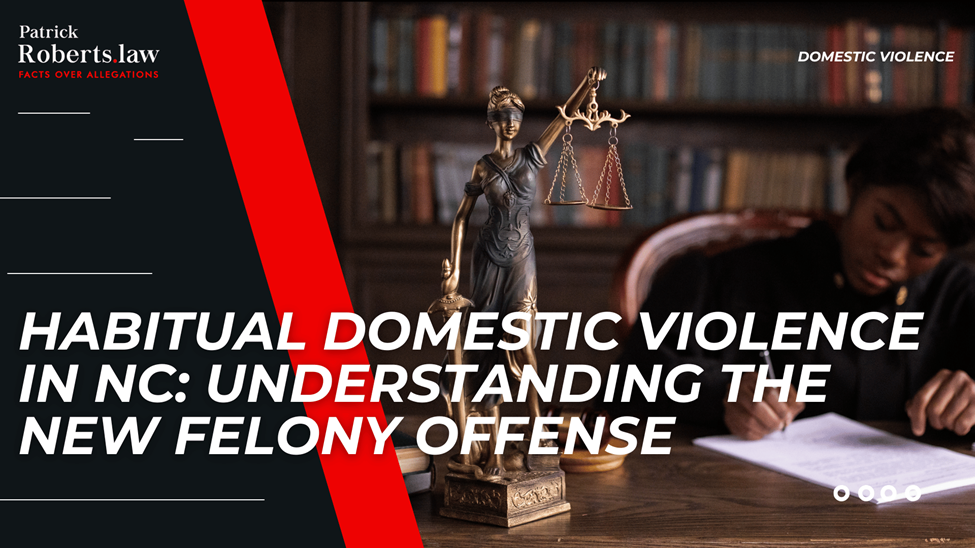
Habitual Domestic Violence in North Carolina: Understanding the New Felony Offense

A domestic violence arrest in North Carolina has always carried serious consequences. But as of December 1, 2025, certain defendants now face something far more significant: a felony charge that can escalate with each subsequent conviction. North Carolina's new habitual domestic violence statute transforms what would otherwise be misdemeanor charges into felony prosecutions for individuals with qualifying prior convictions. This law creates a standalone enhancement mechanism that prosecutors can use to pursue felony charges against defendants whose records show a pattern of domestic violence offenses. Understanding how this new offense works—what the prosecution must prove, how prior convictions factor into the analysis, and what punishment exposure exists—is essential for anyone facing these charges or concerned about how past convictions might affect their future. What Is the New Habitual Domestic Violence Offense in North Carolina? How Does This Charge Differ from Misdemeanor Domestic Violence? Traditional domestic violence charges in North Carolina are typically prosecuted as misdemeanors. The habitual domestic violence offense changes that framework entirely. When prosecutors can establish that a defendant has the required pattern of prior domestic violence convictions, they can pursue felony charges for conduct that would otherwise remain at the misdemeanor level. This elevation from misdemeanor to felony status represents a fundamental shift in how repeat domestic violence offenders are prosecuted. Rather than facing the relatively limited consequences associated with misdemeanor convictions, defendants charged under this statute confront felony punishment classifications that carry substantially more severe consequences. What Statute Governs This New Felony? The habitual domestic violence offense is codified at N.C. Gen. Stat. § 14-32.6. This statute establishes the elements the prosecution must prove, defines which prior convictions qualify for enhancement purposes, and sets forth the punishment structure that applies to convictions under this section. When Did This Law Take Effect? The habitual domestic violence statute took effect on December 1, 2025. This effective date is critically important because the law applies only to offenses committed on or after that date. Conduct occurring before December 1, 2025, cannot form the basis of a habitual domestic violence charge, even if the defendant has the qualifying prior convictions. However, prior convictions from before the effective date can still count toward establishing habitual status for offenses committed after the law took effect. What Must the Prosecution Prove to Convict Someone of Habitual Domestic Violence? To secure a conviction under N.C. Gen. Stat. § 14-32.6, the prosecution must prove three distinct components: qualifying current conduct, the required prior conviction record, and compliance with the statutory lookback period. What Current Conduct Qualifies Under This Statute? The prosecution must first establish that the defendant committed either misdemeanor domestic violence under the existing statute or committed an assault against someone with whom they share a qualifying domestic relationship. This current offense forms the foundation of the habitual charge—without it, the enhancement cannot apply regardless of how many prior convictions exist. How Many Prior Convictions Are Required? Beyond the current conduct, the prosecution must prove that the defendant has at least two prior convictions that qualify under the statute. The law establishes two pathways to meet this requirement: Pathway 1: Two or more convictions under North Carolina's misdemeanor domestic violence statute (G.S. 14-32.5) or substantially similar offenses from other states. Pathway 2: One conviction under G.S. 14-32.5 (or a substantially similar out-of-state offense) plus at least one conviction for an assault involving a victim with whom the defendant shared a qualifying domestic relationship. The critical distinction is that at least one prior must be an actual domestic violence statute conviction—two generic assault convictions involving domestic relationships are not sufficient on their own, even if both victims were intimate partners or family members. What Is the 15-Year Lookback Period? Not every prior conviction counts toward habitual status. The statute imposes a 15-year lookback period that limits which convictions the prosecution can use. Specifically, the earlier of the two required prior convictions must have occurred within 15 years of the current offense. Convictions that fall outside this window—meaning they occurred more than 15 years before the earliest qualifying prior—cannot be counted toward establishing habitual status. This lookback calculation can become complex when a defendant has multiple prior convictions spanning many years. The timing of each conviction relative to both the current offense and the other priors matters significantly. Do Out-of-State Convictions Count Toward Habitual Status? Yes. The statute explicitly allows the prosecution to use "substantially similar convictions from other states" as qualifying priors. This means defendants who have domestic violence convictions from other jurisdictions remain exposed to felony enhancement in North Carolina, provided those out-of-state offenses are substantially similar to North Carolina's domestic violence statutes. Determining whether an out-of-state conviction is "substantially similar" often requires careful legal analysis of the elements of the foreign offense compared to North Carolina law. What Are the Potential Punishments for a Habitual Domestic Violence Conviction? The punishment structure for habitual domestic violence is designed to escalate with each subsequent conviction, reflecting the legislature's intent to impose increasingly severe consequences for repeat offenders. What Felony Class Applies to a First Habitual DV Conviction? A first conviction under the habitual domestic violence statute is classified as a Class H felony. This represents a significant elevation from the misdemeanor classification that would otherwise apply to domestic violence charges without the habitual enhancement. How Does Punishment Escalate with Subsequent Convictions? The statute creates an escalating punishment framework where each subsequent conviction under this section is punished one felony class higher than the defendant's most recent habitual domestic violence conviction. The escalation structure works as follows: First habitual DV conviction: Class H felony Second habitual DV conviction: Class G felony Third habitual DV conviction: Class F felony Continued escalation with each subsequent conviction This escalating structure means that defendants who continue to accumulate convictions under this statute face progressively more serious felony classifications. What Is the Maximum Felony Classification? The escalation caps at Class C felony status. Once a defendant reaches Class C classification, subsequent convictions remain at the Class C level rather than continuing to escalate. Class C felonies represent one of the more serious felony classifications in North Carolina's structured sentencing system, carrying substantial prison exposure depending on the defendant's prior record level. How Does This Offense Interact with Other Domestic Violence Laws? The habitual domestic violence statute functions as part of a broader package of changes affecting how domestic violence cases are handled in North Carolina. Can a Habitual DV Conviction Be Used to Enhance Other Charges? No. The statute specifically provides that a conviction under the habitual domestic violence section cannot be used as a prior conviction to enhance punishment under other habitual offense laws. This makes the habitual domestic violence enhancement a standalone mechanism—it elevates the current offense to felony status but does not feed into other habitual offender statutes. What Arrest Powers Do Police Have Under the New Law? Related legislative changes have expanded police authority in domestic violence cases. Officers can now arrest without a warrant for misdemeanor domestic violence offenses, extending their powers beyond traditional assault charges. This means law enforcement has greater flexibility to make immediate arrests in domestic violence situations without first obtaining judicial authorization. The following changes affect how domestic violence arrests and pretrial proceedings work: Police may now make warrantless arrests for misdemeanor domestic violence Defendants charged with misdemeanor domestic violence must have pretrial release conditions set by a judge rather than a magistrate Judges must review the defendant's criminal history before setting pretrial release conditions How Have Pretrial Release Procedures Changed for DV Cases? Defendants charged with misdemeanor domestic violence now face modified pretrial release procedures. Instead of having a magistrate set conditions of release, these defendants must appear before a judge who will review their criminal history before establishing appropriate conditions. This change ensures that judicial officers making pretrial release decisions have access to information about the defendant's prior record, which may be particularly relevant given the new habitual enhancement statute. What Defense Strategies Apply to Habitual Domestic Violence Charges? Defending against habitual domestic violence charges requires attention to both the current conduct allegations and the prior conviction record the prosecution intends to use for enhancement purposes. Can the Validity of Prior Convictions Be Challenged? The prosecution's ability to prove habitual status depends entirely on establishing that the defendant has qualifying prior convictions. Defense strategies may focus on whether prior convictions were constitutionally obtained, whether proper procedures were followed in earlier cases, and whether documentation adequately establishes the convictions the prosecution claims. If the validity of prior convictions can be successfully challenged, the enhancement may fail even if the current conduct is proven. What If Prior Convictions Fall Outside the Lookback Period? The 15-year lookback requirement creates a potential defense avenue when prior convictions are aged. If the earlier of the two required priors occurred more than 15 years before the current offense, it cannot count toward habitual status. Careful analysis of conviction dates relative to the current offense date can reveal whether the prosecution's theory of habitual status actually satisfies the statutory timing requirements. This calculation becomes particularly important when defendants have multiple prior convictions from different time periods. Identifying which convictions fall within and outside the lookback window may determine whether felony enhancement applies. How Does the Qualifying Relationship Requirement Affect the Case? Both the current conduct and the prior convictions must involve victims with whom the defendant shared a qualifying domestic relationship. If the prosecution cannot establish the required relationship element—either for the current offense or for the priors being used for enhancement—the habitual charge may not stand. Defense strategies may focus on whether the relationships at issue actually qualify under the statutory definitions. Why Does Legal Representation Matter When Facing This Felony Charge? What's at Stake with a Felony Domestic Violence Conviction? A habitual domestic violence conviction creates a felony record with all the collateral consequences that follow. Employment opportunities, housing options, professional licensing, and firearm rights can all be affected by felony convictions. The escalating punishment structure means that defendants who face multiple prosecutions under this statute confront increasingly serious felony classifications, potentially reaching Class C status with its substantial prison exposure. The complexity of the habitual enhancement analysis—including prior conviction validity, lookback period calculations, and relationship requirement issues—demands careful legal attention to every element the prosecution must prove. How Can an Attorney with Prosecutorial Experience Help? Facing charges under a new statute requires understanding how prosecutors will interpret and apply the law in its early implementation. The habitual domestic violence offense creates multiple points of potential challenge, from the validity of prior convictions to the timing requirements of the lookback period. Attorney Patrick Roberts brings the perspective of a former prosecutor who handled domestic violence cases, meaning he understands how the State approaches these matters from investigation through trial. His training at the National Criminal Defense College, including ongoing participation in advanced cross-examination programs, provides the technical courtroom skills these cases demand. As a graduate of Gerry Spence's Trial Lawyers College—where he trained directly with one of the most accomplished trial lawyers in the country—he brings a methodology focused on connecting with juries and humanizing clients facing serious allegations. Contact Patrick Roberts Law to discuss your case and understand your options under this new law. Frequently Asked Questions When did habitual domestic violence become a crime in North Carolina? The habitual domestic violence statute took effect on December 1, 2025. Only offenses committed on or after that date can be charged under this law, though prior convictions from before the effective date can still count toward establishing habitual status. Can I be charged with habitual domestic violence if my prior convictions are from another state? Yes. The statute allows the prosecution to count "substantially similar convictions from other states" toward the required two prior convictions. Whether an out-of-state conviction qualifies requires analysis of whether that offense is substantially similar to North Carolina's domestic violence laws. What happens if I'm convicted of habitual domestic violence more than once? Each subsequent conviction is punished one felony class higher than your most recent habitual domestic violence conviction, starting at Class H and escalating up to a maximum of Class C. Does the new law apply to conduct that occurred before December 1, 2025? No. Conduct occurring before the effective date cannot form the basis of a habitual domestic violence charge. However, prior convictions from before December 1, 2025, can still count toward establishing habitual status for offenses committed after the law took effect. Who sets my bond conditions if I'm arrested for a domestic violence offense? Under related changes to domestic violence procedures, defendants charged with misdemeanor domestic violence must have pretrial release conditions set by a judge who reviews the defendant's criminal history, rather than a magistrate. Yoast SEO Disclaimer: The information on this website is for general information purposes only. Nothing on this site should be taken as legal advice for any individual case or situation. Case results depend upon a variety of factors unique to each case. Prior results do not guarantee a similar outcome.
Justice scales beside bold headline introducing statutory sex offense charges in Cary, NC, with law firm branding and dark red accents.

Understanding Statutory Sex Offense Charges in Cary, North Carolina

A statutory sexual offense charge in North Carolina represents one of the most serious accusations a person can face. For Cary residents—many of whom hold advanced degrees and work in Research Triangle Park's demanding professional environment—these allegations threaten to unravel careers, families, and futures built over decades. The consequences extend far beyond potential prison time to include mandatory sex offender registration, satellite-based monitoring, and the permanent destruction of professional credentials. North Carolina law defines multiple forms of statutory sexual offense, each carrying different elements and penalties depending on the ages of the individuals involved. Understanding these distinctions matters because Wake County prosecutors make strategic charging decisions that can dramatically affect your case outcome. Attorney Patrick Roberts brings a perspective few defense attorneys can offer: years of prosecutorial experience handling sex crimes cases in North Carolina. That background means he understands not just the law, but how prosecutors build these cases and where weaknesses in the evidence may exist. What Exactly Is a Statutory Sexual Offense Under North Carolina Law? How Does North Carolina Define "Sexual Act" in These Cases? Statutory sexual offense charges in North Carolina involve what the law terms a "sexual act"—which is distinct from sexual intercourse. While the statutes reference sexual acts, the precise legal definition encompasses specific conduct beyond intercourse. Wake County prosecutors pursuing these charges must prove the occurrence of a qualifying sexual act as an element of the offense. What Age Requirements Trigger These Charges? North Carolina's statutory sexual offense laws focus primarily on the ages of both the defendant and the alleged victim. The age combinations determine which specific statute applies and, consequently, the severity of the charges. For Cary residents facing accusations, understanding these age thresholds is essential because they dictate whether a charge is even legally valid. How Do the Three Different Statutory Sexual Offense Laws Differ? North Carolina has three distinct statutory sexual offense statutes, each addressing different circumstances. When Wake County prosecutors review a case originating from Cary, they select the appropriate charge based on these criteria: N.C. Gen. Stat. § 14-27.28 (Statutory Sexual Offense with a Child by an Adult): Applies when the defendant is at least 18 years old and the victim is under 13 years of age. This is a Class B1 felony carrying a mandatory minimum of 300 months (25 years) of active punishment. N.C. Gen. Stat. § 14-27.29 (First-Degree Statutory Sexual Offense): Applies when the defendant is at least 12 years old, at least four years older than the victim, and the victim is under 13 years of age. This is a Class B1 felony. Notably, this offense is a lesser included offense of § 14-27.28. N.C. Gen. Stat. § 14-27.30 (Statutory Sexual Offense with a Person 15 or Younger): Applies when the defendant is at least 12 years old and the victim is 15 or younger. If the defendant is at least six years older, it is a Class B1 felony. If the defendant is more than four but less than six years older, it is a Class C felony. A marriage exception exists under this statute. Attorney Patrick Roberts' experience prosecuting sex crimes cases means he understands how district attorneys evaluate evidence and select charges. That insight proves invaluable when developing defense strategy. What Are the Felony Classifications and Potential Consequences? What Makes a Class B1 Felony So Serious? Class B1 felonies represent the second-most-serious felony classification in North Carolina's structured sentencing system. For professionals working at companies like SAS Institute or defense contractors such as Lockheed Martin—employers prevalent throughout the Research Triangle—a Class B1 felony conviction destroys careers instantly. Security clearances are revoked. Professional licenses are suspended or permanently lost. The median household income of $129,399 that supports a Cary family disappears. When Does the Mandatory 300-Month Minimum Apply? Under N.C. Gen. Stat. § 14-27.28, when an adult defendant (18 or older) is convicted of statutory sexual offense with a child under 13, the court must impose a minimum of 300 months—25 years—of active punishment. This mandatory minimum exists regardless of a defendant's prior record or other mitigating circumstances. The statute further authorizes enhanced sentencing up to and including life imprisonment without parole when the court finds the offense involved extraordinary brutality, duration, severity, or scope. What Is Satellite-Based Monitoring and When Is It Required? Following the termination of active punishment for a conviction under § 14-27.28, defendants are subject to enrollment in satellite-based monitoring as provided under Part 5 of Article 27A of Chapter 14 of the General Statutes. This GPS tracking requirement extends supervision well beyond prison release. For Cary's substantial immigrant population—approximately 22% of residents are foreign-born, many working in the tech sector on employment visas—conviction also triggers deportation consequences that compound these penalties. Patrick Roberts' ongoing sex-crimes defense training through NACDL, where he holds lifetime membership, ensures he stays current on the evolving legal landscape surrounding these serious charges. How Do Cary Police and Wake County Prosecutors Handle These Investigations? What Role Does Cary PD's Special Victims Unit Play? When allegations of statutory sexual offense arise in Cary, the Cary Police Department's Special Victims Unit typically handles the investigation. This dedicated unit within CPD's Investigations Division focuses specifically on sexual assault, child exploitation, and related sensitive crimes. SVU detectives receive specialized training in interviewing alleged victims and gathering evidence in these cases. For allegations involving digital evidence, CPD's Cyber Intelligence Unit—the only dedicated unit of its kind among the Triangle's four major police departments—may also become involved. How Does the Wake County District Attorney's Office Approach These Cases? All Cary criminal cases are prosecuted through the Wake County District Attorney's office, which maintains specialized prosecutors who focus specifically on sex crime cases. These prosecutors coordinate closely with Cary PD throughout case development, from investigation through trial. Having handled these cases as a prosecutor, Patrick Roberts understands how the Wake County DA's office evaluates evidence, makes charging decisions, and prepares for trial. What Evidence Do Investigators Typically Gather? Investigations into statutory sexual offense allegations are thorough and multifaceted. Cary's high-tech community environment means digital evidence often plays a central role. Investigators commonly pursue several categories of evidence: Forensic interviews with the alleged victim, often conducted by trained child forensic interviewers Digital evidence from phones, computers, and cloud storage accounts Physical evidence and forensic examinations Witness statements from family members, teachers, or other individuals Communication records including text messages, social media, and email Any available surveillance footage or photographic evidence Understanding what evidence exists—and what evidence may be missing or unreliable—is central to building an effective defense. What Defense Strategies Apply to Statutory Sexual Offense Charges? Can Age Mistake Ever Be a Defense in North Carolina? In statutory sexual offense cases, the defendant's knowledge of or mistake about the alleged victim's age is generally not a defense under North Carolina law. These are strict liability offenses with respect to age. However, the prosecution must still prove the alleged victim's actual age beyond a reasonable doubt as an element of the offense. Cases sometimes involve disputes about age documentation or evidence. How Can False Allegations Be Challenged? False allegations occur in sex offense cases for various reasons: custody disputes, family conflicts, misunderstandings, or suggestive interviewing techniques. In a family-oriented community like Cary, where accusations carry enormous social weight even before any conviction, wrongful allegations can devastate innocent people. Patrick Roberts holds specialized training from the National Child Abuse Defense and Resource Center (NCADRC) focused specifically on defending against false accusations. He is the only attorney in North Carolina listed on the NCADRC website at falseallegation.org—a distinction reflecting his commitment to this specialized area. Effective defense strategies for challenging questionable allegations include: Analyzing forensic interview recordings for suggestive or leading questioning techniques Examining the alleged victim's memory and any factors affecting reliability Investigating potential motives for false reporting Consulting with experts on child suggestibility and memory Challenging inconsistencies in the allegation over time The trial advocacy methods Patrick Roberts learned at Gerry Spence's Trial Lawyers College—where he trained directly with the legendary attorney who never lost a criminal trial—emphasize connecting with juries and humanizing clients facing serious accusations. What Happens After an Arrest for Statutory Sexual Offense in Wake County? What Should You Expect at the Initial Court Appearance? Following an arrest for statutory sexual offense, defendants appear before a magistrate and then in Wake County District Court for initial proceedings. Cases are processed through the Wake County Justice Center in Raleigh. Bond is typically set, though prosecutors often request substantial bonds or pretrial detention in these cases. Having defense counsel present as early as possible helps protect your rights during these critical initial stages. How Long Does the Court Process Typically Take? Felony cases in Wake County's 10th Judicial District, particularly Class B1 felonies like statutory sexual offense, often take many months or longer to resolve. The timeline depends on factors including the complexity of the evidence, whether forensic testing is required, and whether the case proceeds to trial or resolves through negotiation. Defense counsel who understands Wake County procedures can navigate the system efficiently while protecting the client's interests throughout. What Pretrial Conditions Might Be Imposed? Courts commonly impose restrictive pretrial conditions in statutory sexual offense cases. These may include GPS monitoring, no-contact orders with the alleged victim, residence restrictions, employment limitations, and internet usage prohibitions. For Cary professionals whose work requires technology access or security clearances, these conditions can be professionally devastating even before any conviction. The cross-examination and trial preparation techniques Patrick Roberts developed through the National Criminal Defense College help ensure clients are prepared to challenge the prosecution's case. Why Does Your Choice of Defense Attorney Matter in These Cases? What Advantages Does Former Prosecution Experience Provide? Statutory sexual offense cases require defense counsel who understands both sides of the courtroom. Patrick Roberts' years as a prosecutor handling sex crimes cases provide insight that defense-only attorneys simply cannot match. He knows how Wake County prosecutors evaluate evidence, make charging decisions, and prepare for trial. He understands the investigation techniques law enforcement uses and where weaknesses in the State's case may exist. That prosecutorial perspective shapes every aspect of defense strategy. Why Is Specialized Sex-Crimes Training Important? Beyond courtroom experience, defending against sex offense charges requires specialized knowledge that general criminal defense attorneys may lack. Patrick Roberts has invested heavily in ongoing professional development focused specifically on these cases. His credentials include lifetime NACDL membership with extensive sex-crimes defense training at recent national seminars. His NCADRC training addresses the specific challenges of false allegation defense—and his listing as the only North Carolina attorney on falseallegation.org reflects that commitment. The advanced cross-examination techniques he continues to develop through NCDC training, combined with the jury connection methods from the Gerry Spence Trial Lawyers College, provide a comprehensive skill set tailored to these complex cases Frequently Asked Questions Where will my statutory sexual offense case be heard? Cases arising from Cary are prosecuted in Wake County Superior Court, located at the Wake County Justice Center in Raleigh. Having defense counsel familiar with Wake County procedures and prosecutors provides a meaningful advantage. What is the difference between statutory sexual offense and statutory rape? Statutory rape involves sexual intercourse, while statutory sexual offense involves other sexual acts as defined by North Carolina law. Both carry severe penalties, and the specific charge depends on the conduct alleged. Can these charges be reduced or dismissed? Every case is different, and outcomes depend on the specific facts and evidence. Potential strategies include challenging the sufficiency of evidence, exposing problems with the investigation, demonstrating false allegations, or negotiating with prosecutors. An attorney who understands how the Wake County District Attorney's office approaches these cases can evaluate the options realistically. Will I have to register as a sex offender if convicted? Yes. Conviction for statutory sexual offense requires sex offender registration in North Carolina. For convictions under § 14-27.28 specifically, satellite-based monitoring is also mandated following release from active punishment. Protecting Your Future Starts Now Facing statutory sexual offense charges in Cary threatens everything you have built—your career in the Research Triangle's competitive professional environment, your family relationships, and your freedom. These allegations demand defense counsel who combines prosecutorial insight with specialized training in sex-crimes defense. Mr. Patrick Roberts brings experience that few North Carolina attorneys can match. His background prosecuting these cases means he understands how the Wake County District Attorney's office builds its case against you. His distinction as the only North Carolina attorney listed on the National Child Abuse Defense and Resource Center's falseallegation.org registry as of December 2025 reflects his commitment to defending the wrongly accused. If you or someone you love faces statutory sexual offense charges in Cary, Wake County, or anywhere in the Research Triangle area, contact Patrick Roberts Law to discuss your case and your defense options. Disclaimer: The information on this website is for general information purposes only. Nothing on this site should be taken as legal advice for any individual case or situation. Case results depend upon a variety of factors unique to each case. Prior results do not guarantee a similar outcome.
Courtroom scene with judge and defendant highlighting second-degree sexual exploitation charges in North Carolina.

What Are Second-Degree Sexual Exploitation of a Minor Charges in North Carolina?

Being accused of second-degree sexual exploitation of a minor in Cary, North Carolina puts everything at risk—your career in the Research Triangle, your professional licenses, your family's stability, and your future. This is a Class E felony under North Carolina law, and Wake County prosecutors take these cases seriously. Understanding exactly what you face is the first step toward building an effective defense. North Carolina's exploitation statutes target the creation, distribution, and possession of visual material depicting minors engaged in sexual activity. Second-degree sexual exploitation occupies the middle tier of these offenses, focusing primarily on distribution, receipt, and non-commercial recording of such material. For Cary residents—many of whom work in technology, defense, or other fields requiring security clearances—the consequences extend far beyond the courtroom. What Is Second-Degree Sexual Exploitation of a Minor Under North Carolina Law? What Specific Conduct Does This Statute Prohibit? N.C. Gen. Stat. § 14-190.17 defines second-degree sexual exploitation of a minor. The statute prohibits several distinct types of conduct when a person knows the character or content of the material involved. Prohibited conduct under this statute includes: Recording, photographing, filming, developing, or duplicating material containing a visual representation of a minor engaged in sexual activity Distributing or transporting such material Exhibiting such material Receiving such material Selling, purchasing, or exchanging such material Soliciting such material Distributing, transporting, exhibiting, receiving, selling, purchasing, exchanging, or soliciting a child sex doll Each of these acts constitutes a separate violation. In Cary's digital environment—where cloud storage, work devices, and electronic communications are ubiquitous—investigators often examine multiple platforms and accounts when building these cases. How Does Second-Degree Differ From First-Degree and Third-Degree Charges? North Carolina divides sexual exploitation offenses into three degrees based on the nature of the conduct involved. First-degree sexual exploitation under N.C. Gen. Stat. § 14-190.16 is a Class C felony that targets those who use, employ, or coerce minors to engage in sexual activity for live performances or material production—or who produce such material for sale or pecuniary gain. This is the production-focused offense. Third-degree sexual exploitation under N.C. Gen. Stat. § 14-190.17A is a Class H felony that covers knowing possession of such material without the distribution or commercial elements. Second-degree falls between these extremes. It addresses the distribution chain—those who spread, receive, or solicit the material—without requiring proof of commercial motive or direct involvement in production. Wake County prosecutors frequently charge second-degree offenses when digital evidence shows material was shared, downloaded, or requested. Why Does North Carolina Treat These Offenses So Seriously? North Carolina's General Assembly has classified these offenses as serious felonies because of the ongoing harm to the minors depicted in such material. Every time material is distributed or received, it perpetuates the exploitation of the child involved. This policy rationale shapes how aggressively these cases are investigated and prosecuted throughout the state, including in Wake County. What Must the Prosecution Prove to Convict You? The Wake County District Attorney's office must prove every element of second-degree sexual exploitation beyond a reasonable doubt. Understanding these elements is essential for identifying where the prosecution's case may be vulnerable. Attorney Patrick Roberts handled sex crimes cases as a prosecutor earlier in his career, giving him direct insight into how the state constructs these cases and what evidence they prioritize. That dual-perspective now fundamentally informs his defense strategy: he knows precisely where to look for procedural errors and evidentiary weaknesses because he once had the burden of proving those very elements himself. What Does "Knowing the Character or Content" Mean? The statute requires that the defendant acted "knowing the character or content of the material." This knowledge element is critical. The prosecution must prove you actually knew what the material depicted—not merely that you should have known or were negligent in failing to discover it. The elements the prosecution must establish include: The defendant engaged in one of the prohibited acts (distributing, receiving, soliciting, recording, etc.) The material contained a visual representation of a minor engaged in sexual activity The defendant knew the character or content of the material This knowledge requirement creates important defense opportunities. Malware, unauthorized access to devices, file-sharing programs that download content automatically, and shared network environments can all complicate the prosecution's ability to prove knowing conduct. What Qualifies as "Material Containing a Visual Representation"? Under North Carolina law, the material must contain a "visual representation" of a minor engaged in "sexual activity." The statute also covers material that has been "created, adapted, or modified to appear that an identifiable minor is engaged in sexual activity." Sexual activity, as defined in the broader sex offense statutes, includes various forms of sexual conduct. The visual representation can be photographs, videos, digital images, or other visual media. In Wake County prosecutions, digital files—recovered from computers, phones, cloud storage, and external drives—constitute the most common form of evidence. Can Mistake of Age Be Raised as a Defense? No. The statute explicitly states that "mistake of age is not a defense to a prosecution under this section." Even if you genuinely believed the person depicted was an adult, this belief provides no legal defense. However, the prosecution still bears the burden of proving the person depicted was actually a minor. The statute allows the trier of fact to "infer" that a participant is a minor based on how the material represents or depicts them—but this inference can be challenged. Defense strategies may focus on the actual age of the person depicted or the reliability of age determinations based on visual assessment alone. How Do Cary Police and Federal Agencies Investigate These Cases? Sexual exploitation investigations in Cary involve specialized law enforcement units with significant resources and technical capabilities. Understanding how these investigations unfold helps defendants recognize both the evidence they may face and the potential vulnerabilities in the investigation process. Attorney Patrick Roberts has completed rigorous training through the National Child Abuse Defense and Resource Center. As of December 2025, he is the only attorney in North Carolina listed on the NCADRC's website at falseallegation.org —a reflection of his focused preparation for defending these sensitive cases. This specialized training emphasizes understanding investigation methods and identifying where procedures may have compromised evidence reliability. What Role Does Cary's Cyber Intelligence Unit Play? Cary Police Department operates the only dedicated cyber intelligence unit among the Triangle's four major police departments. Unlike Raleigh, Durham, or Chapel Hill, Cary maintains specialized personnel focused specifically on identifying online offenders and investigating digital exploitation cases. This unit employs proactive identification techniques—they don't simply wait for reports. They actively monitor for potential offenders, coordinate with internet service providers, and participate in multi-jurisdictional operations. For defendants, this means investigations may have begun long before any arrest or search warrant. How Do Multi-Agency Task Forces Coordinate These Investigations? Exploitation investigations in Wake County rarely involve just one agency. Cary's Special Victims Unit and Cyber Intelligence Unit frequently coordinate with the North Carolina State Bureau of Investigation's Cyber Crimes Unit, federal agencies including the FBI and Homeland Security Investigations, and the Internet Crimes Against Children (ICAC) task force. This multi-agency approach means investigations often have federal involvement from the outset. Task force participation—including operations like Operation Southern Impact and the Invictus Project—brings additional resources and investigative techniques to bear. Defendants may face evidence gathered through multiple agencies with different procedures and oversight requirements. What Types of Digital Evidence Will Investigators Examine? In Cary's technology-driven community, digital evidence plays a central role in these prosecutions. Investigators typically examine computers, laptops, tablets, and smartphones; cloud storage accounts; email and messaging applications; file-sharing program logs and histories; internet browsing history and cached files; external storage devices; and work computers and employer-provided devices. For professionals working at companies like SAS Institute, Epic Games, or other Research Triangle employers, work devices present particular concerns. IT departments sometimes discover and report suspected material, triggering investigations that extend into personal devices and accounts. The interconnected nature of modern digital life means a search warrant for one device often leads to examination of linked accounts and cloud-synced content. If you're under investigation for second-degree exploitation charges in Wake County, the decisions you make now will shape your defense options going forward. Contact Patrick Roberts Law to discuss your situation before speaking with investigators. What Consequences Could a Conviction Bring? A conviction for second-degree sexual exploitation of a minor carries consequences that extend far beyond the criminal sentence itself. For Cary residents—with careers built in the Research Triangle's professional economy—these collateral consequences can be devastating. What Is the Felony Classification for This Offense? Second-degree sexual exploitation of a minor is a Class E felony under North Carolina law. The specific sentence in any case depends on factors including prior record level and the circumstances of the offense. What matters for most defendants is understanding that this is a serious felony conviction that will follow them permanently. Will You Be Required to Register as a Sex Offender? Convictions for sexual exploitation of a minor trigger sex offender registration requirements under North Carolina law. Registration creates a public record that affects where you can live, where you can work, and how your community perceives you. In a community like Cary—where 68% of adults hold bachelor's degrees and professional reputation matters enormously—registration creates social consequences that compound the legal ones. How Could a Conviction Affect Your Career in the Research Triangle? For professionals working in Research Triangle Park and the surrounding area, a sexual exploitation conviction effectively ends careers that took decades to build. The collateral consequences for Cary residents are particularly severe. Employment and professional consequences include: Immediate termination from most professional positions Revocation of security clearances required for defense contractors like Lockheed Martin Loss of professional licenses in fields including law, medicine, education, and finance Disqualification from positions involving minors or vulnerable populations Background check failures blocking future employment in most professional fields Exclusion from employer-provided housing, relocation assistance, and other benefits For Cary's substantial immigrant population—many working in the technology sector on employment visas or holding green cards—a conviction triggers immigration consequences including potential deportation. With 22% of Cary residents born outside the United States, this consequence affects a significant portion of those who may face these charges. The $129,000 median household income that supports a Cary family depends on continued professional employment. A conviction doesn't just threaten freedom—it threatens the entire financial foundation of a defendant's family. What Defense Strategies Apply to These Charges? Effective defense in second-degree exploitation cases requires understanding both the technical complexity of digital evidence and the specific elements the prosecution must prove. Through ongoing training with the National Association of Criminal Defense Lawyers—including sex-crimes defense seminars held as recently as late 2025—Mr. Roberts stays current on evolving defense strategies and forensic interview analysis techniques. How Can the "Knowledge" Requirement Be Challenged? The prosecution must prove the defendant knew the character or content of the material. This knowledge element creates significant defense opportunities in certain cases. Potential defense approaches include: Challenging whether the defendant actually accessed or viewed the material Demonstrating that malware, viruses, or unauthorized access placed material on the device Showing that automatic download features in file-sharing programs operated without user knowledge Establishing that multiple users had access to the device or account Questioning the reliability of forensic analysis methods or conclusions Challenging chain of custody for digital evidence Identifying constitutional violations in how evidence was obtained Every case presents different facts, and not every defense applies in every situation. An attorney who understands how Wake County prosecutors approach these cases can evaluate which strategies offer the best path forward. What Constitutional Issues Might Apply to Your Case? The Fourth Amendment protects against unreasonable searches and seizures. In digital exploitation cases, constitutional challenges may arise regarding the validity of search warrants, the scope of searches conducted, and whether law enforcement exceeded the authority granted by warrants. Challenges to how internet service provider data was obtained, whether consent to search was truly voluntary, and whether search warrant applications contained material misrepresentations can all affect the admissibility of evidence. Suppressing key evidence may fundamentally change the prosecution's ability to proceed. When Might Negotiation Be the Right Approach? Not every case should go to trial. When the evidence is strong, skilled negotiation may achieve outcomes—including reduced charges or alternative sentencing—that serve the defendant's interests better than trial would. Understanding the Wake County District Attorney's approach to these cases matters enormously in negotiation. Prosecutors have discretion in how they charge cases and what resolutions they'll accept. An attorney who has worked with these prosecutors, who understands their priorities, and who can present mitigating factors effectively positions clients for the best possible outcomes when negotiation is appropriate. The stakes in second-degree exploitation cases demand experienced representation from the earliest stages. Contact Patrick Roberts Law to discuss defense strategies specific to your situation. Why Does Your Choice of Defense Attorney Matter in These Cases? Sexual exploitation charges combine legal complexity, technical evidence challenges, and life-altering consequences. The attorney you choose shapes how your case unfolds from investigation through resolution. What Should You Look for in a Defense Attorney for Exploitation Charges? These cases demand specific knowledge and preparation. Understanding digital forensics, knowing how to challenge technical evidence, and having relationships with expert witnesses who can evaluate prosecution claims all matter. Familiarity with Wake County courts—knowing how local judges handle these matters and how prosecutors in this jurisdiction approach case evaluation—provides advantages that general criminal defense experience cannot match. As a graduate of the National Criminal Defense College, with recent participation in their advanced cross-examination program, Patrick Roberts brings intensive trial preparation skills to every case. That training translates directly to the courtroom—knowing how to examine forensic analysts, challenge investigation methods, and present technical defenses clearly to judges and juries. How Does Prosecutorial Experience Benefit Your Defense? An attorney who has prosecuted these cases understands how the state thinks. He knows what evidence prosecutors consider essential, where they expect defense challenges, and how they evaluate case strength. That perspective—seeing the case from the prosecution's viewpoint—reveals opportunities that might otherwise remain hidden. Attorney Patrick Roberts brings that dual perspective to every exploitation case. His years handling these matters as a prosecutor inform his defense strategy at every stage. Frequently Asked Questions What is the difference between second-degree and third-degree sexual exploitation? Second-degree sexual exploitation under N.C. Gen. Stat. § 14-190.17 focuses on distribution, receipt, and solicitation of material depicting minors engaged in sexual activity—the spreading of such material. Third-degree exploitation under § 14-190.17A covers knowing possession without the distribution element. Second-degree is a Class E felony while third-degree is a Class H felony, reflecting the more serious nature of distribution conduct. Can I be charged if I didn't know the person in the images was a minor? Mistake of age is explicitly not a defense under this statute. However, the prosecution still must prove the person depicted was actually a minor. The statute allows juries to infer someone is a minor based on how the material depicts them, but this inference can be challenged through defense evidence and expert testimony regarding age determination. Where will my case be prosecuted if I'm arrested in Cary? Cary is located in Wake County, which is part of North Carolina's 10th Judicial District. Your case will be prosecuted by the Wake County District Attorney's office and tried in Wake County Superior Court at the Justice Center in Raleigh. Having defense counsel familiar with Wake County procedures and prosecutors provides important advantages in these proceedings. Will I have to register as a sex offender if convicted? Yes. A conviction for second-degree sexual exploitation of a minor requires sex offender registration under North Carolina law. Registration creates ongoing obligations and restrictions that affect housing, employment, and community presence for years after the criminal case concludes. How do police typically discover these cases in the Cary area? Investigations may begin through multiple channels. Cary Police Department's Cyber Intelligence Unit—the only dedicated unit of its kind among the Triangle's four major police departments—conducts proactive investigations. Cases also originate from reports by internet service providers, tips to the National Center for Missing and Exploited Children's CyberTipline, multi-agency task force operations, and sometimes through discoveries by employers or family members who encounter material on shared devices. Should I talk to investigators before hiring an attorney? No. You have an absolute right to remain silent and to have an attorney present during questioning. Statements made to investigators—even statements you believe are exculpatory—can be used against you and may limit defense options later. Contact an attorney before speaking with law enforcement about any aspect of an exploitation investigation. Protect Your Future A second-degree sexual exploitation charge in Wake County threatens everything you've built—your career in the Research Triangle, your professional standing, your family's security. These cases are complex, the consequences are severe, and the prosecution has significant resources. Patrick Roberts is a graduate of the Gerry Spence Trial Lawyers College, where he trained directly with one of America's most accomplished trial attorneys. That training emphasized a client-centered philosophy that treats every case as the most important one. Combined with his prosecutorial background, sex-crimes defense training, and familiarity with Wake County courts, he brings the preparation these serious charges demand. If you face second-degree exploitation charges in Cary or anywhere in Wake County, contact Patrick Roberts Law to discuss your defense. Disclaimer: The information on this website is for general information purposes only. Nothing on this site should be taken as legal advice for any individual case or situation. Case results depend upon a variety of factors unique to each case. Prior results do not guarantee a similar outcome.

Judge’s gavel and scales beside bold headline explaining how Iryna’s Law changes bail rules for violent charges in NC.

Iryna's Law: What Do North Carolina's New Bail Rules Mean for Violent Offense Charges?

Being arrested on a violent offense charge in North Carolina has always been serious. But as of December 1, 2025, defendants facing these charges encounter a fundamentally different pretrial landscape. New legislation—commonly referred to as Iryna's Law—has restructured how courts approach bail determinations for violent offenses, creating a legal presumption that defendants charged with these crimes should remain in custody while their cases are pending. Understanding these changes is essential for anyone facing violent offense charges or their families trying to navigate the path toward pretrial release. What Is Iryna's Law and When Did These Changes Take Effect? Why Did North Carolina Enact Stricter Pretrial Release Rules? Iryna's Law represents a significant shift in North Carolina's approach to pretrial detention for defendants charged with violent crimes. The legislation creates new presumptions and procedural requirements designed to address concerns about community safety and court appearance rates among defendants facing serious charges. The law fundamentally changes the starting point for bail hearings—rather than beginning with an assumption that release conditions can be set, courts now begin with a presumption against release for qualifying offenses. When Do These New Rules Apply to Pending Cases? The new rules took effect on December 1, 2025. They apply to anyone who appears before a judicial official for a pretrial release determination on or after that date. This means the timing of your court appearance—not the date of your alleged offense or arrest—determines whether these rules govern your bail hearing. Do These Rules Apply Retroactively to Existing Release Conditions? If your pretrial release conditions were established before December 1, 2025, these new rules do not automatically change your situation. The law applies prospectively to bail determinations made on or after the effective date. However, if your release conditions come up for review or modification after the effective date, the new framework may apply to that subsequent determination. Which Criminal Charges Qualify as "Violent Offenses" Under the New Law? What Felony Classifications Trigger the New Bail Rules? The statute defines "violent offense" broadly. Any Class A through Class G felony qualifies if assault, physical force, or the threat of physical force is a required element of the crime. This classification-based approach captures a wide range of serious felonies without requiring the legislature to name each offense individually. Which Specific Crimes Are Named in the Statute? Beyond the classification-based definition, the law specifically identifies certain offenses that trigger the new bail rules regardless of their felony class. The qualifying offenses include: First-degree and second-degree murder Any felony requiring sex offender registration, regardless of whether the defendant is currently registered Shooting into occupied property First-degree burglary Certain sexual offenses involving minors Stalking Possession of a firearm by a felon Fentanyl trafficking Do Attempt Charges Also Fall Under These Rules? Yes. The statute explicitly includes attempts to commit any qualifying violent offense. This means defendants charged with attempted murder, attempted first-degree burglary, or attempts to commit other qualifying crimes face the same presumption against release as those charged with completed offenses. How Does the New Presumption Against Release Work? What Does "Rebuttable Presumption" Mean in This Context? Under the new law, there is a "rebuttable presumption" that no release conditions can adequately ensure both the defendant's appearance at court and the safety of the community. A rebuttable presumption is a legal assumption that stands unless challenged with sufficient evidence. The court starts from the position that pretrial detention is appropriate, and the defendant must present reasons why release should be granted despite that presumption. Who Bears the Burden of Proof at a Bail Hearing? This represents perhaps the most significant practical change under Iryna's Law. Previously, defendants facing violent charges could often expect courts to set bail conditions that would allow release. Now, the burden has shifted. The defendant—typically through defense counsel—must affirmatively convince the judge that release is appropriate despite the presumption favoring detention. What Must a Judge Find Before Granting Release? To grant pretrial release for a violent offense charge, a judge must affirmatively decide that release is appropriate despite the statutory presumption. This requires more than a finding that standard release conditions would be adequate. The judge must determine that circumstances justify overcoming the presumption, and then must impose strict conditions as required by the statute. What Release Conditions Apply If a Judge Grants Pretrial Release? What Conditions Are Required for a First Violent Offense Charge? If a judge grants release on a first violent offense charge, the law mandates specific conditions. The court cannot simply release the defendant on their written promise to appear. Instead, the judge must require one of the following: A secured bond, meaning cash or a surety bond through a bail bondsman House arrest with electronic monitoring These are the only permissible options for a first violent offense charge. The choice between them rests with the judge based on the circumstances of the case. How Do the Rules Change for Second or Subsequent Violent Offense Charges? The conditions become more restrictive for defendants facing a second or subsequent violent offense charge. If the judge grants release in these cases, the court must impose house arrest with electronic monitoring, provided that electronic monitoring is available in that jurisdiction. A secured bond alone is not sufficient for repeat violent offense charges—the monitoring requirement is mandatory. Are Unsecured Bonds Still an Option for Violent Offenses? No. Under Iryna's Law, unsecured bonds and release on a written promise to appear are no longer available for defendants charged with violent offenses. This eliminates options that previously allowed some defendants to secure release without posting cash or obtaining a surety bond. What Procedural Changes Should Defendants Expect? Why Must a Judge—Rather Than a Magistrate—Set Bail Conditions? One significant procedural change involves who makes bail determinations for certain charges. Under the new law, a judge—not a magistrate—must determine whether to grant pretrial release for the most serious offenses, including: Murder Forcible rape Forcible sexual offense Sexual offenses involving children Armed robbery First-degree burglary Assault with a deadly weapon with intent to kill inflicting serious injury Kidnapping, human trafficking First-degree arson Additionally, if you are arrested for any new offense while already out on pretrial release for another case, a judge must set your bail conditions on the new charge. For other violent offenses covered by the new presumption, a magistrate may still conduct the initial bail determination—but must apply the rebuttable presumption against release and impose the required conditions (secured bond or electronic monitoring) if release is granted. What Information Will Law Enforcement Report to the Court? The law requires law enforcement officers to provide the judicial official with information about any concerning behavior they observed before, during, or after the arrest. This reporting requirement means judges will have more information about the circumstances of the arrest when making release decisions. The following information may be presented to the court: Statements made by the defendant before, during, or after arrest Observations about the defendant's behavior or demeanor Circumstances of the alleged offense as observed by officers Any other conduct law enforcement deems relevant to the bail determination Why Are Written Findings Now Required? Judges must now document in writing why they chose specific release conditions. These written findings must address the statutory factors regarding flight risk and danger to the community. This requirement creates a record that can be reviewed and ensures judges are applying the statutory framework in each case. What Happens If You're Arrested for a New Offense While Out on Bond? How Does a Pending Case Affect Bail on a New Charge? If you are arrested for any new offense while already released on bond for another case, the bail determination process changes. A judge—not a magistrate—must set your bail conditions on the new charge. The judge will review your criminal history and any risk assessment information. The fact that you were already on pretrial release when the new alleged offense occurred will be a factor in the court's analysis. What Is the 48-Hour Rule for Judicial Review? When someone is arrested on a new charge while out on bond, they may be held for up to 48 hours while waiting for a judge to conduct the bail determination. This holding period allows time for a judge to review the case rather than having a magistrate set immediate conditions. If no judge acts within the 48-hour window, a magistrate may then set conditions. This rule balances the requirement for judicial review against constitutional limits on pretrial detention without judicial involvement. How Can Experienced Defense Representation Help Under These New Rules? Why Does Understanding the Prosecution's Perspective Matter? Navigating Iryna's Law effectively requires understanding how prosecutors approach violent offense cases. A defense attorney who has seen these matters from the prosecution's side understands what arguments are likely to be persuasive to a judge and what factors prosecutors will emphasize when opposing release. This perspective helps in preparing for bail hearings and anticipating the State's position. What Should You Look for in a Defense Attorney for Violent Offense Charges? Violent offense charges under the new bail rules require an attorney prepared to advocate aggressively at the pretrial stage. The shift in burden means defense counsel must be ready to present compelling reasons for release from the outset. Look for an attorney with experience handling serious felony matters and the trial skills to advocate effectively in contested hearings. Frequently Asked Questions Does Iryna's Law affect charges that were filed before December 1, 2025? The law applies based on when you appear before a judicial official for a pretrial release determination, not when charges were filed. If your bail hearing occurs on or after December 1, 2025, the new rules govern that determination. Can I still be released on bond for a violent offense charge? Yes, release is still possible, but the path is more difficult. A judge must affirmatively find that release is appropriate despite the presumption against it, and then must impose either a secured bond or house arrest with electronic monitoring. What if electronic monitoring isn't available in my county? For first violent offense charges, the judge can require a secured bond as an alternative. For second or subsequent charges, the statute requires electronic monitoring "if available" in the jurisdiction. If unavailable, the court must determine appropriate conditions consistent with the law. Does a prior violent offense from years ago count as a "prior" under these rules? The statute addresses "second or subsequent" violent offense charges but does not specify a time limitation. The application to specific prior records should be discussed with a defense attorney familiar with the jurisdiction's interpretation of the law. Protect Your Rights Under North Carolina's New Bail Rules Facing violent offense charges under Iryna's Law means confronting a system that now presumes you should remain in custody. Overcoming that presumption requires presenting a compelling case to a judge—and that requires an attorney who understands how prosecutors think about these cases. Attorney Patrick Roberts spent years as a prosecutor handling domestic violence cases and other serious felonies before becoming a defense attorney. That prosecutorial background means he knows how the State builds these cases and where the opportunities for effective advocacy exist. His trial skills training through the National Criminal Defense College, including advanced cross-examination techniques, and his graduation from Gerry Spence's Trial Lawyers College—where he trained directly with Gerry Spence—shape his approach to contested hearings. For defendants facing sex offense charges affected by these new rules, his specialized training through the National Association of Criminal Defense Lawyers' sex-crimes defense program and the National Child Abuse Defense and Resource Center provides additional depth. Contact Patrick Roberts Law to discuss your case and explore your options for pretrial release under North Carolina's new bail rules. Disclaimer: The information on this website is for general information purposes only. Nothing on this site should be taken as legal advice for any individual case or situation. Case results depend upon a variety of factors unique to each case. Prior results do not guarantee a similar outcome.

Attorney signing paperwork beside gavel introduces how bail bonds function under North Carolina law.

How Do Bail Bonds Work in North Carolina?

When someone you care about is arrested, the hours that follow often feel chaotic and overwhelming. You're fielding phone calls, trying to understand what happened, and hearing unfamiliar terms like "secured bond" and "surety" thrown around by officials who seem to assume you already know what they mean. The immediate question on everyone's mind is straightforward: how do we get them out? Understanding how bail bonds work in North Carolina is the first step toward navigating this process effectively. North Carolina law establishes specific procedures for pretrial release, defines what types of bonds courts can require, and sets clear obligations for defendants once they're released. Recent legislative changes—including Iryna's Law (Session Law 2025-93), effective December 1, 2025—have significantly tightened pretrial release standards for certain offenses, making it more important than ever to understand how the system works. This guide explains the North Carolina bail bond system from start to finish—what bail actually is, how judges decide whether and how much to require, what happens after bail is set, and what obligations come with being released on bond. What Exactly Is a Bail Bond in North Carolina? What Is the Purpose of Bail in the Criminal Justice System? Bail exists to balance two competing interests: the defendant's right to liberty before trial and the State's interest in ensuring the defendant appears for court proceedings. A bail bond is essentially a promise—backed by financial consequences—that the defendant will show up when required. Under N.C. Gen. Stat. § 15A-531, a bail bond is defined as "an undertaking by the defendant to appear in court as required upon penalty of forfeiting bail to the State in a stated amount." The bond remains in effect throughout all stages of the proceeding until judgment is entered, unless terminated earlier under specific circumstances outlined in the statute. What Types of Bail Bonds Does North Carolina Recognize? North Carolina law recognizes several distinct types of bail bonds, each with different requirements and financial implications. Understanding these options helps defendants and their families make informed decisions about how to secure release. The primary types of bail bonds under North Carolina law include: Written promise to appear: The defendant signs a document promising to appear without any financial security required. Unsecured appearance bond: The defendant signs a bond for a specified amount but pays nothing upfront; the amount becomes due only if the defendant fails to appear. Secured appearance bond with cash deposit: The defendant or someone on their behalf deposits the full bond amount in cash with the court. Secured appearance bond with surety: A bail bondsman or insurance company guarantees the bond amount, typically in exchange for a non-refundable premium. Secured appearance bond with property mortgage: Real property is pledged as security under N.C. Gen. Stat. § 58-74-5. House arrest with electronic monitoring: The defendant is confined to their residence with exceptions for employment, counseling, or court-approved activities, monitored electronically. The type of bond a court requires depends heavily on the nature of the charges, the defendant's history, and—under recent changes to North Carolina law—whether the offense qualifies as a "violent offense." Who Are the Different Parties Involved in a Bail Bond? The bail bond system involves several distinct roles. The "principal" is the defendant—the person obligated to appear in court. A "surety" is anyone who guarantees the defendant's appearance, and North Carolina law recognizes three categories of sureties. An "accommodation bondsman" is typically a friend or family member who pledges their own property as security without receiving any payment beyond the legal rights against the defendant if the bond is forfeited. A "professional bondsman" is licensed by the Commissioner of Insurance and pledges cash or approved securities as collateral for the bonds they write. A "bail agent" (sometimes called a surety bondsman) works on behalf of an insurance company, executing bonds under a power of attorney from the insurer. How Does a Judge Decide Whether to Grant Bail? What Factors Does the Court Consider When Setting Bail? When determining conditions of pretrial release, judicial officials don't simply pick a number. N.C. Gen. Stat. § 15A-534(c) requires them to consider specific factors based on available information, and under amendments effective December 1, 2025, judicial officials must now direct law enforcement, a pretrial services program, or the district attorney to provide a criminal history report for consideration. Courts must evaluate the following when setting bail conditions: The nature and circumstances of the offense charged The weight of the evidence against the defendant The defendant's family ties and employment status The defendant's financial resources The defendant's character, housing situation, and mental condition Whether the defendant is intoxicated to a degree that would make unsupervised release dangerous The length of the defendant's residence in the community The defendant's record of prior convictions The defendant's history of failing to appear for court proceedings or fleeing to avoid prosecution Any other evidence relevant to pretrial release For most non-violent offenses, the statute still requires judges to impose the least restrictive conditions that will reasonably assure the defendant's appearance and protect public safety. However, Iryna's Law has fundamentally changed this calculus for offenses classified as "violent." Are There Charges Where Bail Can Be Denied in North Carolina? North Carolina law gives judges discretion to deny bail entirely for certain serious offenses. Under N.C. Gen. Stat. § 15A-533(b), a judge determines in their discretion whether to grant pretrial release for charges including first or second degree murder, various degrees of rape and sexual offense, assault with a deadly weapon with intent to kill inflicting serious injury, first or second degree kidnapping, human trafficking, armed robbery, first degree burglary, and first degree arson. Important change under Iryna's Law: For defendants charged with any offense listed in G.S. 15A-533(b), there is now a rebuttable presumption that no condition of release will reasonably assure the defendant's appearance and community safety. This shifts the burden—rather than the State arguing for detention, the defendant must overcome the presumption that release is inappropriate. For capital offenses, judges have complete discretion under N.C. Gen. Stat. § 15A-533(c) to determine whether any release is appropriate. The statute also creates rebuttable presumptions against release in specific circumstances, including when a defendant allegedly committed a drug trafficking offense while already on pretrial release for another offense, or when the offense involved illegal use of a firearm while the defendant was on pretrial release for another firearm-related offense. What Role Does a Defendant's Criminal History Play? Criminal history significantly influences bail decisions—and recent legislative changes have made prior convictions even more consequential. Under Iryna's Law, if a defendant has been convicted of three or more offenses (each a Class 1 misdemeanor or higher) within the previous ten years, the judicial official must impose a secured appearance bond or house arrest with electronic monitoring. The less restrictive options—written promise to appear, unsecured bond, or supervised release—are no longer available for these defendants. Additionally, for defendants charged with violent offenses or those with three or more qualifying prior convictions, the judicial official must now make written findings of fact explaining why the release conditions are appropriate based on the statutory factors. This documentation requirement adds accountability to bail decisions. A history of failing to appear for court dates continues to weigh heavily against release on less restrictive terms. Under N.C. Gen. Stat. § 15A-534(d1), when a defendant has already failed to appear on one or more occasions for the charges at issue, the judicial official must impose at least the conditions recommended in any outstanding arrest order, or require a secured bond at least double the previous amount (with a minimum of $1,000). What Happens After Bail Is Set? How Do You Actually Post a Bail Bond? Once a judicial official sets bail conditions, the defendant or someone acting on their behalf must satisfy those conditions to secure release. For a cash bond, this means depositing the full amount with the court—funds that will be returned (minus any court costs or fees) when the case concludes, assuming all court appearances are made. For a secured bond with a surety, the process typically involves contacting a licensed bail bondsman. The bondsman assesses the risk, collects a premium, may require collateral, and then posts the bond on the defendant's behalf. What Does a Bail Bondsman Do? A bail bondsman essentially guarantees to the court that the defendant will appear as required. If the defendant fails to appear and the bond is forfeited, the bondsman becomes liable for the full bond amount. To manage this risk, bondsmen are permitted under N.C. Gen. Stat. § 58-71-95 to require collateral security or other indemnity from the defendant or their family. This collateral must be "reasonable in relation to the amount of the bond" and must be returned within 15 days after the bond obligation terminates. Failure to return collateral valued over $1,500 is a Class I felony. Bondsmen are also authorized under N.C. Gen. Stat. § 15A-540 to surrender a defendant to the sheriff and be relieved of their obligation—a power that incentivizes defendants to maintain contact with their bondsman and comply with all court requirements. How Much Does a Bail Bond Cost in North Carolina? North Carolina law caps the premium a bail bondsman can charge at fifteen percent of the face amount of the bond. This premium is non-refundable—it's the bondsman's fee for taking on the risk of guaranteeing the defendant's appearance. For example, on a $10,000 bond, the maximum premium would be $1,500. If the defendant makes all court appearances, the bondsman keeps this fee regardless of case outcome. If the defendant pays a cash bond directly to the court, however, they receive the full amount back (less any applicable fees) when the case concludes. The financial strain bail creates for families is significant, which is why effective advocacy at the bail stage—arguing for the lowest appropriate bond amount and least restrictive conditions—can make a meaningful difference in a defendant's ability to maintain employment and support their family while their case proceeds. What Are Your Obligations Once You're Released on Bond? What Conditions Might the Court Impose on Your Release? Release on bond isn't unconditional. N.C. Gen. Stat. § 15A-534(a) authorizes judicial officials to place restrictions on travel, associations, conduct, or place of residence. Additional conditions may include electronic monitoring with house arrest, abstaining from alcohol consumption verified by continuous monitoring, or supervision by a designated person or organization. Common conditions imposed on pretrial release include: Remaining within the jurisdiction or obtaining permission before traveling Maintaining employment or actively seeking employment Avoiding contact with alleged victims or witnesses Abstaining from alcohol or controlled substances Submitting to drug testing Surrendering firearms Obeying all laws Note on Iryna's Law and "violent offenses": Under the new statutory framework effective December 1, 2025, defendants charged with "violent offenses"—a newly defined category under N.C. Gen. Stat. § 15A-531(9)—face a rebuttable presumption against release and mandatory minimum bond conditions. A "violent offense" now includes any Class A through G felony involving assault, physical force, or threat of force; any felony sex offense requiring registration; offenses like discharging a firearm into occupied property, first-degree burglary, indecent liberties with a child, stalking, and possession of a firearm by a felon; as well as fentanyl trafficking and attempts to commit any of these offenses. For a first violent offense, if release is granted, the court must impose either a secured bond or house arrest with electronic monitoring. For a second or subsequent violent offense—whether following a prior conviction or while on pretrial release for a prior violent offense—the court must impose house arrest with electronic monitoring if available. What Happens If You Miss a Court Date? Missing a court date triggers serious consequences. Under N.C. Gen. Stat. § 15A-544.3, when a defendant fails to appear as required, the court enters a forfeiture for the full bond amount against both the defendant and any surety. Notice of this forfeiture is mailed to all parties, and the forfeiture becomes a final judgment—enforceable like any civil judgment—after 150 days unless set aside. An order for arrest is typically issued, and when the defendant is eventually located, they'll face not only the original charges but also the consequences of the failure to appear, including significantly higher bond requirements. Can Your Bond Be Revoked? Yes. Under N.C. Gen. Stat. § 15A-534(f), any judge may revoke an order of pretrial release for good cause shown. Violations of bond conditions, new criminal charges, or evidence suggesting the defendant poses a danger or flight risk can all justify revocation. If bond is revoked, the defendant is taken back into custody. They may apply to have new conditions set, but the judge will consider the circumstances that led to revocation when determining whether and under what conditions to allow release. Can Bail Be Reduced or Modified After It's Set? When Can You Request a Bond Reduction? Bond conditions aren't necessarily permanent. Under N.C. Gen. Stat. § 15A-534(e), different judicial officials can modify pretrial release orders at different stages of the case. A magistrate or clerk can modify their own order before the first district court appearance. After that appearance, a district court judge can modify earlier orders until the case moves to superior court or an appeal is noted. Once the case is in superior court, a superior court judge has modification authority. What Evidence Helps Support a Bond Modification Request? Successful bond modification requests typically present new information or changed circumstances that address the court's original concerns. Evidence of strong community ties, stable employment, family responsibilities, and lack of criminal history all support arguments for reduced bond or less restrictive conditions. When the underlying charges may be contested or the State's evidence is weak, highlighting these issues can affect how courts weigh flight risk and danger to the community. The strength of the State's case is a legitimate factor in bail determinations. How Does Having an Attorney Affect Bond Hearings? Having experienced defense counsel at bond hearings substantially affects outcomes. An attorney can present mitigating information effectively, challenge the State's characterization of the evidence, and argue for specific conditions that address the court's concerns while minimizing disruption to the defendant's life. Defense counsel can also identify when the State is seeking excessive restrictions and advocate for alternatives. The difference between a $50,000 secured bond and a $10,000 secured bond—or between secured and unsecured conditions—can determine whether a defendant waits months in jail or returns home to their family while their case proceeds. This advocacy is particularly critical under Iryna's Law, where the presumption has shifted against release for violent offenses and defendants must affirmatively demonstrate that release conditions can adequately protect the community and ensure appearance. What Happens If a Bail Bond Is Forfeited? How Does the Forfeiture Process Work? When a defendant fails to appear, the court enters a forfeiture under N.C. Gen. Stat. § 15A-544.3. This forfeiture must contain specific information including the defendant's name and address, the bond amount, the names of all sureties, and the date on which the forfeiture will become final if not set aside. Notice is mailed to the defendant and each surety, and it becomes effective when mailed regardless of whether actually received. The notice includes detailed information about how the forfeiture can be set aside and warns that sureties will be prohibited from executing new bonds in that county until any final judgment is satisfied. Can a Forfeiture Be Set Aside? Yes, but only for specific reasons enumerated in N.C. Gen. Stat. § 15A-544.5. A forfeiture may be set aside if the failure to appear is stricken and any arrest order recalled, if all charges are finally disposed, if the defendant is surrendered by a surety, if the defendant is served with an order for arrest, if the defendant died before final judgment, or if the defendant was incarcerated at the time of the missed court date. The motion to set aside must be filed within 150 days of the forfeiture notice and must include evidence supporting one of the permitted reasons. Courts have no discretion to set aside forfeitures for other reasons, no matter how sympathetic the circumstances. Why Does Having an Experienced Defense Attorney Matter for Bail? How Can a Defense Lawyer Help at the Bail Stage? The bail stage is often underestimated, but decisions made here ripple throughout the entire case. A defendant who remains in custody has less ability to assist with their defense, maintain employment, or care for family. Studies consistently show that pretrial detention correlates with worse case outcomes, including higher conviction rates and longer sentences. An experienced defense attorney can advocate for appropriate bond conditions at the initial hearing, prepare modification motions when circumstances warrant, ensure clients understand and comply with all conditions, and respond quickly if issues arise. What Should You Look for in a Criminal Defense Attorney? The bail system sits at the intersection of criminal procedure, client advocacy, and practical problem-solving. Effective representation requires understanding both the legal framework and the human stakes involved—particularly now, when recent legislative changes have made pretrial release significantly more difficult for certain categories of defendants. Frequently Asked Questions About Bail Bonds in North Carolina How long do you stay in jail if you can't make bail in North Carolina? If you cannot satisfy the bail conditions, you remain in custody until your case is resolved—which could mean weeks or months depending on court schedules and case complexity. This is why pursuing bond modification through an attorney is often worthwhile when initial conditions are unaffordable. Can you bail yourself out of jail in North Carolina? Yes, if you have access to funds. You can post a cash bond for the full amount, or a family member or friend can contact a bail bondsman on your behalf. The challenge is often practical: accessing funds and making arrangements while in custody. What happens to bail money when the case is over? If you posted a cash bond directly with the court, the money is returned after the case concludes and all required appearances are made, minus any applicable court costs or fees. If you paid a premium to a bail bondsman, that fee is non-refundable regardless of the case outcome. Can bail be denied in North Carolina? Yes. Judges have discretion to deny bail for serious violent offenses including murder, rape, kidnapping, and armed robbery. Under Iryna's Law (effective December 1, 2025), there is now a rebuttable presumption against release for these offenses—meaning defendants must overcome the assumption that no release conditions are adequate. What's the difference between bond and bail? The terms are often used interchangeably in everyday conversation. Technically, "bail" refers to the security given to ensure a defendant's appearance, while a "bond" is the written agreement documenting that undertaking. In practice, when someone asks about "bail," they're usually asking about the bond conditions and how to satisfy them. Protect Your Rights from the Start The hours after an arrest are critical. Bail decisions affect not just immediate freedom but the entire trajectory of a case. Understanding your options—and having an advocate who can present your circumstances effectively—makes a meaningful difference. With recent changes under Iryna's Law tightening pretrial release standards for violent offenses and repeat offenders, effective advocacy at the bail stage has never been more important. Attorney Patrick Roberts brings a unique combination of experience and training to criminal defense in North Carolina. As a former prosecutor, he handled drug crimes, sex offenses, and domestic violence cases—experience that provides critical insight into how the State builds cases and evaluates bail risk. He is a lifetime member of the National Association of Criminal Defense Lawyers (NACDL) and has completed extensive sex-crimes defense training through that organization. His training through the National Child Abuse Defense and Resource Center (NCADRC) focuses specifically on defending against false accusations, and he is the only North Carolina attorney listed on NCADRC's registry at falseallegation.org. As a graduate of the National Criminal Defense College (NCDC), he continues pursuing advanced training in cross-examination and trial skills. He also trained directly with Gerry Spence at the renowned Trial Lawyers College, learning methods that emphasize connecting with juries and humanizing clients. If you or someone you care about is facing criminal charges in North Carolina, contact Patrick Roberts Law to discuss your situation. Disclaimer: The information on this website is for general information purposes only. Nothing on this site should be taken as legal advice for any individual case or situation. Case results depend upon a variety of factors unique to each case. Prior results do not guarantee a similar outcome.

A defense attorney in a suit reviews case files inside a Cary, NC courtroom, representing Patrick Roberts Law. The image emphasizes strong legal defense, justice, and professionalism in sexual assault defense cases.

Sexual Assault Defense Attorney in Cary, NC

If you're facing sexual assault charges in Cary, NC, your freedom, reputation, and future are on the line. These are serious allegations that demand immediate action and skilled representation from a criminal defense attorney. Patrick Roberts understands the complexities of North Carolina's sexual offense laws. He provides aggressive defense strategies for individuals accused of sexual assault throughout Wake County and the greater Triangle area. Call or contact Patrick Roberts Law online now. Time is not on your side, but we are. more What You Need To Know: Sexual Assault Charges in North Carolina Sexual assault encompasses a broad range of unwanted sexual conduct under North Carolina law. These charges can include forced or coerced sexual acts, unwanted touching, and situations involving threats or physical force. The severity of charges depends on specific circumstances, including the use of force, the age of the alleged victim, and the relationship between the parties involved. North Carolina categorizes sexual offenses into different degrees, with first-degree charges carrying the most severe penalties. These cases often involve allegations of force, weapons, or victims under certain ages. The prosecution must prove every element of the alleged crime beyond a reasonable doubt, creating opportunities for strategic defense. What Are The Most Common Sexual Assault Charges in Wake County? First-Degree Forcible Rape (N.C.G.S. § 14-27.21) Involves vaginal intercourse by force and against the victim's will Class B1 felony carrying potential life imprisonment Mandatory minimum sentences apply in certain circumstances Second-Degree Forcible Sexual Offense (N.C.G.S. § 14-27.27) Sexual acts committed by force and against the victim's will Class C felony with significant prison exposure Registration requirements upon conviction Sexual Battery (N.C.G.S. § 14-27.33) Unwanted sexual touching for arousal or gratification Class A1 misdemeanor requiring sex offender registration Often charged alongside more serious offenses How Patrick Roberts Defends Sexual Assault Cases in Cary As a former assistant district attorney with over 22 years of experience, Attorney Patrick Roberts understands both sides of the criminal justice system. This dual perspective allows him to anticipate prosecution strategies and identify weaknesses in their case from the earliest stages of investigation. Immediate Case Protection Time is critical when facing sexual assault allegations. Law enforcement may attempt to conduct interviews, seek search warrants, or gather additional evidence that could strengthen the prosecution's case. Early legal intervention protects your constitutional rights and prevents potentially damaging mistakes. Clients are advised to exercise their right to remain silent and request legal representation immediately upon arrest or contact by law enforcement. The law firm can quickly mobilize resources to protect your interests, preserve favorable evidence, and begin building a strong defense before the prosecution solidifies their case. Strategic Defense Approaches Every sexual assault case presents unique challenges and opportunities for defense. Mr. Roberts thoroughly investigates each case to identify the strongest defense strategies, which may include: Constitutional Challenges Challenging unlawful searches and seizures Questioning the validity of police interrogations Filing motions to suppress improperly obtained evidence Factual Defenses Establishing consent where applicable Demonstrating inconsistencies in witness testimony Presenting alibi evidence and alternative explanations Professional Witness Testimony Utilizing forensic professionals to challenge physical evidence Employing psychologists to explain behavior patterns Consulting medical professionals when injuries are alleged The Stakes: Consequences of Sexual Assault Convictions Sexual assault convictions carry life-altering consequences that extend far beyond prison time: Prison Sentences Felony sexual assault convictions can result in decades of imprisonment Mandatory minimum sentences apply to certain offenses Habitual offender status can lead to life imprisonment Sex Offender Registration Lifetime registration requirements for many convictions Severe restrictions on where you can live and work Public notification requirements affecting family and employment Collateral Consequences Permanent criminal record affecting employment opportunities Loss of professional licenses and certifications Immigration consequences for non-citizens Restrictions on child custody and visitation rights Local Court Experience in Wake County Wake County courts processes thousands of criminal matters annually, with sexual assault allegations among the most rigorously prosecuted. Patrick Roberts Law leverages extensive experience within the Wake County Superior and District Court systems to provide strategic, detail-oriented representation. This deep familiarity with local courtroom procedures and protocols ensures that every client receives a defense tailored to the specific standards of the Wake County legal community. Patrick Roberts Law maintains a local office at 543 Keisler Dr, Suite 202, in Cary, providing accessible legal support for clients throughout Wake County and the Triangle. Protecting Your Rights from Day One If you're under investigation or have been charged with sexual assault in Cary or anywhere in Wake County, taking immediate protective steps is crucial: Critical First Steps Exercise Your Right to Remain Silent Do not speak to law enforcement without an attorney present Avoid discussing the case with family, friends, or anyone else Remember that anything you say can be used against you in court Contact a Criminal Defense Attorney Immediately Early legal intervention can significantly impact case outcomes An attorney can protect your rights during police questioning Legal counsel can begin investigating the case and preserving favorable evidence Preserve Evidence Do not delete text messages, emails, or social media communications Maintain records of your whereabouts during the alleged time period Identify potential witnesses who can support your defense Avoid Contact with the Alleged Victim Any contact, direct or indirect, can be misinterpreted as intimidation Follow any no-contact orders issued by the court Inform family members about restrictions to prevent accidental violations Why Choose Patrick Roberts Law Representative Case Results* The case results at Patrick Roberts Law reflect the firm's history of defending clients against the most serious sexual assault charges in North Carolina, including matters where individuals faced potential life imprisonment. Recent achievements include the dismissal* of first-degree rape charges carrying potential sentences of 60 to 87 years and the negotiation of resolutions that successfully* avoided sex offender registration requirements for the firm's clients. *Each case is different and must be evaluated separately. Prior results achieved do not guarantee similar results can be achieved in future cases. Prosecutorial Insight Having served as an Assistant District Attorney across three North Carolina counties, Attorney Patrick Roberts provides the firm's clients with a sophisticated prosecutorial perspective on criminal defense. This professional background allows the legal team to: Anticipate prosecution strategies and weaknesses Navigate Local Courtroom Procedures Identify the specific points where investigations often fail to meet the State's high burden of proof Leverage a high-level understanding of prosecutorial tactics to build proactive and effective defense strategies Comprehensive Investigation Mr. Roberts conducts thorough investigations designed to identify evidence and witnesses that may have been overlooked during the initial law enforcement inquiry. This includes collaborating with forensic experts and conducting independent witness interviews to ensure every possible avenue for the defense is explored. Understanding the Difference: Sexual Battery vs. Sexual Assault It's important to understand the distinction between sexual battery and sexual assault under North Carolina law. Sexual battery involves unwanted sexual touching without penetration and is typically charged as a misdemeanor. Sexual assault, particularly when involving penetration, is usually charged as a felony with much more severe penalties. Both charges carry serious consequences, including mandatory sex offender registration, but the penalties and long-term impacts differ significantly. Understanding these distinctions is crucial for developing an effective defense strategy. Frequently Asked Questions What should I do if I'm arrested for sexual assault in Cary? Immediately request an attorney and exercise your right to remain silent. Contact Patrick Roberts Law at 919-746-7206 for emergency legal representation. Can sexual assault charges be reduced or dismissed? Yes, with proper legal representation, charges can sometimes be reduced or dismissed based on insufficient evidence, procedural violations, or successful plea negotiations. How long do sexual assault investigations typically take in Wake County? Investigations can last weeks to months depending on the complexity of the case and the evidence involved. Having an attorney involved early can help protect your rights throughout the process. Can I be charged with sexual assault based solely on accusations? While charges can be filed based on accusations alone, the prosecution bears the burden of proving guilt beyond a reasonable doubt at trial. Contact Patrick Roberts for a Free Case Evaluation Contact Patrick Roberts for a free case evaluation today. Call 919-746-7206 to schedule your consultation and take the first step toward protecting your future. Don't let these charges define your life, get the aggressive defense you deserve. Disclaimer: The information on this website is for general information purposes only. Nothing on this site should be taken as legal advice for any individual case or situation. Case results depend upon a variety of factors unique to each case. Prior results do not guarantee a similar outcome.

Courtroom with defendant in handcuffs before judge; title asks about first-degree sexual exploitation charges in Cary.

What Are First-Degree Sexual Exploitation Charges in Cary, North Carolina?

Being accused of first-degree sexual exploitation of a minor in Cary is among the most serious allegations anyone can face. This charge—prosecuted as a Class C or D felony in Wake County Superior Court—carries consequences that extend far beyond potential incarceration. For residents of Cary's highly educated, professionally accomplished community, an accusation threatens careers built over decades, security clearances that enable work at Research Triangle Park employers, and standing in a family-oriented community known for its safety and quality of life. Cary Police Department maintains the only dedicated Cyber Intelligence Unit among the Triangle's four major police departments, giving these investigations specialized attention from the outset. Understanding what prosecutors must prove, how investigations unfold, and what defense options exist is essential for anyone facing these allegations or who has learned they are under investigation. more What Is First-Degree Sexual Exploitation of a Minor Under North Carolina Law? North Carolina law treats first-degree sexual exploitation of a minor as one of the most serious offenses in the state's criminal code. Patrick Roberts prosecuted sex crime cases earlier in his career, giving him direct insight into how the Wake County District Attorney's office constructs these complex prosecutions—and where potential weaknesses may exist. What Specific Conduct Does This Statute Prohibit? Under N.C. Gen. Stat. § 14-190.16, a person commits first-degree sexual exploitation if, knowing the character or content of the material or performance, they engage in any of the following conduct: Using, employing, inducing, coercing, encouraging, or facilitating a minor to engage in sexual activity for a live performance or to produce visual material depicting such activity Permitting a minor under their custody or control to engage in such activity for a live performance or material production Transporting or financing the transportation of a minor through North Carolina with intent that the minor engage in sexual activity for a performance or material production Recording, photographing, filming, developing, or duplicating for sale or pecuniary gain material depicting a minor engaged in sexual activity Creating for sale or pecuniary gain material adapted or modified to appear that an identifiable minor is engaged in sexual activity Creating for sale or pecuniary gain a child sex doll of an identifiable minor Wake County prosecutors must prove that the defendant acted "knowing the character or content" of the material or performance. This knowledge requirement is a critical element that distinguishes criminal conduct from innocent behavior—and represents a potential avenue for defense. How Does First-Degree Differ from Second or Third-Degree Charges? North Carolina's sexual exploitation statutes create a hierarchy based on the defendant's role and conduct. First-degree charges target those who produce, facilitate, or profit from creating exploitative material. Second-degree charges under N.C. Gen. Stat. § 14-190.17 address distribution, receipt, and non-profit recording. Third-degree charges under N.C. Gen. Stat. § 14-190.17A covers simple possession. This distinction matters significantly. First-degree sexual exploitation is a Class C felony for most violations, while second-degree is a Class E felony and third-degree is a Class H felony. The penalties, collateral consequences, and prosecution approach differ substantially across these categories. Is Mistake of Age a Valid Defense in These Cases? No. North Carolina law explicitly states that mistake of age is not a defense to first-degree sexual exploitation charges. Under N.C. Gen. Stat. § 14-190.16(c), a defendant cannot claim they believed the minor was actually an adult. This strict liability approach regarding the victim's age means defense strategies must focus on other elements of the offense—particularly the knowledge requirement and identification of the defendant. How Do Cary Police and Federal Agencies Investigate These Allegations? Sexual exploitation investigations in Cary involve specialized law enforcement units with significant resources devoted to these cases. Understanding how these investigations work helps defendants and their families prepare for what lies ahead. What Role Does Cary's Cyber Intelligence Unit Play? Cary Police Department operates the only dedicated Cyber Intelligence Unit among the Triangle's four major police departments—Raleigh, Durham, and Chapel Hill do not maintain equivalent specialized units. This team focuses specifically on identifying online offenders and investigating child exploitation cases, including child sexual abuse material (CSAM) offenses. Unlike purely reactive investigation, Cary's Cyber Intelligence Unit engages in proactive identification of potential offenders. This means investigations may begin before any complaint is filed and before the target knows they are under scrutiny. The unit's particular expertise in digital forensics and online investigation techniques makes these cases highly technical from the outset. Which State and Federal Agencies Might Be Involved? Investigations in Cary may involve coordination among multiple agencies with overlapping jurisdiction: Cary Police Department's Special Victims Unit and Cyber Intelligence Unit North Carolina State Bureau of Investigation (SBI) Cyber Crimes Unit Internet Crimes Against Children (ICAC) task force Federal agencies for cross-jurisdictional matters Task force operations including Operation Southern Impact and the Invictus Project This multi-agency coordination means defendants may face investigation by entities with vast resources and technical capabilities. The involvement of federal agencies can also raise the specter of federal charges, which carry different penalties and procedures than state prosecutions. What Digital Evidence Do Investigators Typically Pursue? In Cary's technology-driven community, digital evidence forms the backbone of most exploitation cases. Investigators typically pursue computers, smartphones, tablets, and any other devices capable of storing or transmitting images. Cloud storage accounts receive particular scrutiny, as do network logs that may establish IP addresses and access patterns. Work computers and employer-provided devices frequently become relevant in these investigations. IT departments at Cary's major employers—including SAS Institute, Epic Games, and defense contractors—sometimes discover and report suspected contraband, triggering investigations that can upend careers and lives before any charges are filed. If you are under investigation or have been contacted by law enforcement regarding sexual exploitation allegations, contact Patrick Roberts Law immediately. Early intervention can significantly impact how your case develops. What Must the Prosecution Prove to Convict in Wake County? Every criminal conviction requires proof beyond a reasonable doubt. In first-degree sexual exploitation cases prosecuted in Wake County Superior Court, the District Attorney's office must establish each element of the offense through admissible evidence. Through a lifetime membership in the National Association of Criminal Defense Lawyers and the completion of rigorous advanced seminars in sex-crimes defense—including training as recently as late 2025—Mr. Roberts stays current on evolving defense strategies and the latest approaches to challenging prosecution evidence. How Does the "Knowledge" Element Work? The prosecution must prove the defendant knew the character or content of the material or performance. This is not strict liability—the state must establish actual awareness, not merely that the defendant should have known. In cases involving shared devices, compromised networks, or complex digital environments, this element may be genuinely contested. Wake County prosecutors typically attempt to establish knowledge through circumstantial evidence: file organization, search history, communication records, and the volume and nature of discovered material. Each of these approaches has potential weaknesses that experienced defense counsel can identify and challenge. Can the Prosecution Use Inferences About the Victim's Age? Yes. Under N.C. Gen. Stat. § 14-190.16(b), the trier of fact—whether judge or jury—may infer that a participant in sexual activity is a minor if the material through its title, text, visual representations, or otherwise represents or depicts that person as a minor. This statutory inference can work against defendants even when the actual age of depicted individuals cannot be conclusively established. Defense counsel may challenge these inferences through expert testimony regarding the difficulty of age determination from images, the reliability of the prosecution's analysis, and the specific characteristics of the material at issue. What Are the Consequences of a Conviction for Cary Professionals? The consequences of a first-degree sexual exploitation conviction reach into virtually every aspect of a defendant's life. For Cary residents—where nearly 70% of adults hold bachelor's degrees and median household income exceeds $129,000—the professional and social devastation compounds already severe criminal penalties. Attorney Patrick Roberts has completed extensive training through the National Child Abuse Defense and Resource Center (NCADRC), which focuses on defending against allegations involving children and understanding the full scope of collateral consequences. As of December 2025, he is the only attorney in North Carolina listed on the NCADRC website at falseallegation.org. What Criminal Penalties Apply to First-Degree Charges? Most violations of N.C. Gen. Stat. § 14-190.16 constitute Class C felonies—among the most serious felony classifications in North Carolina. Violations involving the creation of digitally altered images or child sex dolls of identifiable minors (subsections (a)(5) and (a)(6)) are Class D felonies. Beyond incarceration, convicted individuals face mandatory sex offender registration, which creates ongoing obligations that affect where you can live, work, and travel for years after completing any sentence. How Would a Conviction Affect Your Career in Research Triangle Park? While every employer maintains distinct internal policies, a conviction in the Research Triangle area often triggers the following professional challenges: Security clearances required for defense contractors like Lockheed Martin are immediately jeopardized and typically revoked upon conviction Professional licenses in healthcare, finance, law, education, and other regulated fields face suspension or revocation proceedings Employment at major Cary employers—including SAS Institute, Epic Games, MetLife, and government positions with the Town of Cary—becomes effectively impossible Background check failures foreclose future employment opportunities across most professional sectors Reputational damage in Cary's close-knit professional community extends beyond the individual defendant to affect family members For engineers, software developers, financial professionals, and others whose careers depend on trust and credentialing, a conviction represents not just the loss of a current job but the permanent destruction of professional identity. What Immigration Consequences Could Apply? Cary's substantial immigrant population—approximately 22% of residents are foreign-born, many working in the tech sector on employment visas or holding green cards—faces additional devastating consequences. Sex offenses involving minors typically qualify as aggravated felonies under federal immigration law, triggering deportation proceedings regardless of how long someone has lived in the United States or their ties to the community. For non-citizens, a conviction can mean permanent separation from family, career, and community—consequences that often exceed even the criminal penalties imposed by Wake County courts. The stakes in a first-degree sexual exploitation case demand immediate action. Contact Patrick Roberts Law to discuss your situation and begin building your defense. What Defense Strategies Apply to First-Degree Exploitation Cases? Effective defense in exploitation cases requires both legal acumen and technical sophistication. As a graduate of the National Criminal Defense College with ongoing participation in advanced cross-examination programs, Mr. Roberts brings rigorous preparation to challenging the prosecution's evidence in Wake County Superior Court. How Can the Knowledge Requirement Be Challenged? Because the prosecution must prove the defendant knew the character or content of the material, defense strategies often focus on establishing reasonable doubt about awareness. In cases involving shared computers, family devices, or work networks, determining who actually accessed or downloaded material can be genuinely unclear. Malware, unauthorized remote access, and compromised networks can place material on devices without the owner's knowledge. Expert forensic analysis may reveal that someone other than the defendant was responsible for the presence of contraband material. What Constitutional Issues Might Arise in These Cases? Fourth Amendment protections against unreasonable search and seizure apply with full force to digital evidence. Law enforcement must typically obtain warrants to search computers, phones, and cloud storage accounts. Challenges to the scope of warrants, the execution of searches, and the handling of evidence can potentially exclude critical prosecution evidence. Wake County courts apply well-established constitutional standards, but the application of these principles to rapidly evolving digital technologies creates opportunities for defense challenges that experienced counsel can identify and pursue. When Are Expert Witnesses Critical to the Defense? Digital forensics experts play essential roles in exploitation defense. These specialists can analyze metadata, access logs, and device histories to establish timelines that may contradict prosecution theories. They can identify signs of unauthorized access, evaluate whether material could have been placed without the defendant's knowledge, and challenge the prosecution's technical conclusions. In Wake County Superior Court, expert testimony that creates reasonable doubt about any element of the offense can make the difference between conviction and acquittal. Why Does Your Choice of Defense Attorney Matter in These Cases? First-degree sexual exploitation cases demand defense counsel with specific experience, training, and trial readiness. The combination of technical complexity, severe consequences, and multi-agency prosecution makes attorney selection among the most important decisions a defendant will make. What Experience Should You Look for in Defense Counsel? Defending exploitation cases requires understanding both sides of the courtroom. An attorney who has prosecuted these cases understands how investigations develop, what evidence prosecutors prioritize, and where weaknesses in the state's case may exist. Training in sex-crimes defense ensures counsel knows current strategies, evolving legal standards, and best practices for challenging these allegations. Trial experience matters because prosecutors know which defense attorneys will actually take cases to verdict if necessary. An attorney who prepares every case as though it will go to trial—and has the skills to try it effectively—operates from a position of strength in every negotiation. How Does Patrick Roberts' Background Apply to These Cases? Attorney Patrick Roberts trained directly with legendary trial attorney Gerry Spence at the Trial Lawyers College, learning a client-centered philosophy that treats every case as though it were going to trial. This approach—combined with his prosecutorial background, NACDL and NCADRC specialized training, and ongoing National Criminal Defense College education—positions him to effectively handle the most serious sexual exploitation allegations in Wake County. Mr. Roberts’ experience on both sides of sex crime prosecutions provides a tactical perspective few defense attorneys can offer. He understands how the Wake County District Attorney's office approaches these cases, what evidence they consider essential, and where their legal theories may be challenged effectively. Frequently Asked Questions How is first-degree sexual exploitation different from possession charges? First-degree involves producing, facilitating, or profiting from the creation of material depicting minors. Third-degree covers simple possession. The distinction significantly affects both the charges and potential penalties, with first-degree carrying more severe consequences as a Class C felony. Wake County prosecutors make charging decisions based on the specific conduct alleged, and understanding these distinctions helps defendants and their families grasp what they are actually facing. Will I be held in custody if arrested for this charge in Wake County? These charges typically involve significant bond amounts, and prosecutors may argue for pretrial detention given the seriousness of the allegations. An experienced defense attorney can advocate for reasonable bond conditions at your initial appearance in Wake County court, presenting factors that support release while your case proceeds. Can charges be filed even if no actual minor was involved? Yes. Under N.C. Gen. Stat. § 14-190.16(a)(5), creating material that has been adapted or modified to appear that an identifiable minor is engaged in sexual activity is a Class D felony—even if the images do not depict an actual minor. This provision addresses digitally altered or artificially generated images that use the likeness of real children. How do Cary police typically become aware of these allegations? Cary Police Department's Cyber Intelligence Unit—the only dedicated unit of its kind among the Triangle's four major police departments—proactively investigates these cases. Investigations may also begin through tips from the National Center for Missing and Exploited Children, IT departments at local employers like SAS or Epic Games, federal task force referrals, or reports from internet service providers. What happens to my professional licenses if I'm convicted? Professional licensing boards in North Carolina typically have provisions for revocation or suspension following felony convictions, particularly for offenses involving minors. For Cary residents working in regulated professions—including healthcare, finance, law, and education—a conviction can permanently end your career and foreclose opportunities across the entire field. Take Action to Protect Your Future First-degree sexual exploitation of a minor is among the most aggressively prosecuted offenses in Wake County. The investigation and prosecution resources devoted to these cases, combined with the severe criminal penalties and life-altering collateral consequences, make experienced defense representation essential from the earliest possible moment. If you or someone you know faces first-degree sexual exploitation charges in Cary or anywhere in Wake County, call Patrick Roberts Law today for a confidential consultation about your defense options. Disclaimer: Each case is different and must be evaluated separately. Prior results achieved do not guarantee similar results can be achieved in future cases. Disclaimer: The information on this website is for general information purposes only. Nothing on this site should be taken as legal advice for any individual case or situation. Case results depend upon a variety of factors unique to each case. Prior results do not guarantee a similar outcome.
Judge with gavel in courtroom beside title asking about sexual exploitation of a minor charges in Cary, NC

What Are the Charges for Sexual Exploitation of a Minor in Cary, North Carolina?

Sexual exploitation of a minor is among the most aggressively prosecuted offenses in North Carolina. For Cary residents facing these allegations, the consequences extend far beyond the courtroom—threatening careers at Research Triangle Park companies, security clearances, professional licenses, and standing in a community where reputation matters deeply. Understanding exactly what North Carolina law prohibits, how Cary Police Department and federal task forces investigate these cases, and what defense options exist is essential for anyone confronting these charges. North Carolina divides sexual exploitation into three degrees, each targeting different conduct related to material depicting minors engaged in sexual activity. Whether the allegation involves production, distribution, or possession, the State treats these as serious felonies with lasting consequences. This article explains what each charge means, how Wake County prosecutors approach these cases, and why experienced defense representation matters. more What Is Sexual Exploitation of a Minor Under North Carolina Law? How Does North Carolina Define "Sexual Exploitation"? Sexual exploitation of a minor refers to offenses involving material that contains visual representations of minors engaged in sexual activity. Unlike hands-on offenses such as statutory rape or indecent liberties, exploitation charges focus on the creation, distribution, or possession of such material. North Carolina law addresses these offenses through three distinct statutes, each covering different levels of involvement. The Cary Police Department's Special Victims Unit actively investigates exploitation allegations, often working alongside state and federal task forces that target these offenses across jurisdictional lines. Wake County sees regular prosecution of exploitation cases, reflecting both proactive law enforcement efforts and the digital nature of modern investigations. What Types of Conduct Fall Under These Charges? North Carolina's exploitation statutes cover a range of conduct related to material depicting minors. The prohibited activities include: Using, inducing, or coercing a minor to engage in sexual activity for the purpose of producing visual material Permitting a minor under one's custody to be depicted in such material Recording, photographing, or filming a minor engaged in sexual activity Distributing, transporting, selling, purchasing, or exchanging material depicting minors Possessing material that contains visual representations of minors in sexual activity Each category carries different charges and classifications depending on the defendant's level of involvement and whether commercial gain was involved. How Do Exploitation Charges Differ from Other Sex Offenses? Exploitation charges are distinct from contact offenses. While statutory rape and indecent liberties involve physical conduct with a minor, exploitation focuses on visual material—its creation, movement, or possession. A person can face exploitation charges without ever having physical contact with any minor depicted in the material. This distinction matters because exploitation cases typically center on digital evidence: files found on devices, cloud storage accounts, download histories, and metadata. The investigation and defense of these cases require technical sophistication that differs significantly from other sex offense prosecutions. What Are the Three Degrees of Sexual Exploitation Charges? North Carolina separates exploitation offenses into three degrees based on the defendant's role and the nature of the conduct. Having prosecuted sex crimes cases earlier in his career, Patrick Roberts understands how prosecutors categorize these charges and what evidence they prioritize at each level. What Constitutes First-Degree Sexual Exploitation? First-degree sexual exploitation under N.C. Gen. Stat. § 14-190.16 targets those involved in producing material or facilitating a minor's involvement in its creation. This is the most serious exploitation charge. A person commits first-degree exploitation if, knowing the character or content of the material, the person: Uses, employs, induces, coerces, or facilitates a minor to engage in sexual activity for producing visual material Permits a minor under their custody to engage in such activity for production purposes Transports a minor across North Carolina with intent that the minor engage in sexual activity for material production Records, photographs, films, or duplicates such material for sale or pecuniary gain First-degree sexual exploitation is generally a Class C felony. When the offense involves creating material for sale or commercial gain, the classification may be a Class D felony for certain specific conduct. What Actions Lead to Second-Degree Charges? Second-degree sexual exploitation under N.C. Gen. Stat. § 14-190.17 addresses the distribution and receipt of exploitative material. A person commits this offense if, knowing the character or content of the material, the person: Records, photographs, films, or duplicates material depicting a minor in sexual activity (without the commercial element) Distributes, transports, exhibits, receives, sells, purchases, exchanges, or solicits such material Second-degree exploitation is a Class E felony. This charge commonly applies to those who share material through online platforms or who actively seek and receive such material from others. When Is Possession Charged as Third-Degree Exploitation? Third-degree sexual exploitation under N.C. Gen. Stat. § 14-190.17A is the possession offense. A person commits this crime if, knowing the character or content of the material, they possess material containing visual representations of a minor engaged in sexual activity. Third-degree exploitation is a Class H felony. While it carries the lowest classification among exploitation offenses, it remains a felony conviction with serious consequences. For professionals working in the Research Triangle—including those holding security clearances at companies like Lockheed Martin or building careers at SAS, Epic Games, or other major employers—even a third-degree charge threatens everything they have built. Can Mistake of Age Be Raised as a Defense? No. North Carolina law explicitly states that mistake of age is not a defense to any degree of sexual exploitation. This applies to all three levels of the offense. Even if a defendant genuinely believed the individuals depicted were adults, this belief provides no legal defense under the statute. How Does Cary Police Department Investigate Exploitation Allegations? What Role Does the Special Victims Unit and Cyber Intelligence Unit? Cary Police Department's Special Victims Unit handles follow-up investigations for exploitation allegations, working in close coordination with the department’s cyber intelligence team when digital evidence or online conduct is involved. SVU detectives specialize in sensitive cases involving children, bringing focused training and dedicated resources to these investigations while cyber intelligence personnel assist with forensic review of devices, online accounts, and network activity. When an exploitation case originates in Cary—whether through a tip, proactive online operation, or report from an employer's IT department—SVU typically takes the lead on the local investigation, with cyber intelligence supporting the technical aspects needed to identify offenders and secure digital evidence. Patrick Roberts is the only North Carolina attorney listed on the National Child Abuse Defense and Resource Center's website (falseallegation.org/north-carolina-members), reflecting specialized training in defending cases involving allegations against children. This training provides insight into how investigations unfold and where procedural or evidentiary weaknesses may exist. How Do Multi-Agency Task Forces Operate in Wake County? Exploitation investigations frequently involve multiple agencies working together. Cary Police Department participates in coordinated efforts including Operation Southern Impact and the Invictus Project—multi-agency operations targeting those who exploit children. The Internet Crimes Against Children (ICAC) task force also operates in this region, bringing federal resources and expertise to local investigations. These task forces conduct proactive operations, including online investigations designed to identify individuals seeking exploitative material. When federal agencies become involved, defendants may face the possibility of federal charges in addition to or instead of state prosecution—significantly raising the stakes. What Digital Evidence Do Investigators Typically Pursue? In Cary's high-tech environment, digital forensics plays a central role in exploitation cases. Investigators typically seek: Device analyses including computers, phones, tablets, and external storage media. Cloud storage accounts and their contents. Internet service provider records and download histories. Chat logs, messaging app data, and email communications. File metadata showing creation dates, access patterns, and modification histories. Given the technical sophistication of both the local workforce and law enforcement capabilities, these investigations often produce substantial digital evidence. Effective defense requires equally sophisticated analysis of how evidence was obtained, preserved, and interpreted. If you're facing sexual exploitation allegations in Cary or Wake County, contact Patrick Roberts Law to discuss how an experienced defense can protect your future. What Happens After an Arrest for Sexual Exploitation in Wake County? Where Will Your Case Be Heard? Cary falls primarily within Wake County's jurisdiction, meaning exploitation cases proceed through the Wake County court system. Initial appearances occur in Wake County District Court, while felony matters ultimately move to Wake County Superior Court. The Wake County District Attorney's Office, part of the 10th Prosecutorial District, handles prosecution. Wake County prosecutors maintain specialized units that focus on sex offenses, bringing concentrated experience to these cases. The DA's office coordinates closely with Cary PD and task force investigators throughout the prosecution. What Pretrial Conditions Might the Court Impose? Defendants in exploitation cases often face significant pretrial restrictions. Courts may impose conditions including surrender of electronic devices, restrictions on internet access, limitations on contact with minors, and GPS monitoring. Bond amounts in these cases tend to be substantial given the serious nature of the charges. These restrictions can immediately impact employment—particularly for those in technology fields where internet access is essential to their work. Understanding what conditions to expect and how to address them requires familiarity with how Wake County judges typically handle these matters. What Are the Consequences of a Conviction in the Research Triangle? How Do Felony Classifications Affect Sentencing? North Carolina classifies exploitation offenses as follows: first-degree is typically a Class C felony (or Class D for certain conduct), second-degree is a Class E felony, and third-degree is a Class H felony. These classifications determine sentencing ranges under North Carolina's structured sentencing guidelines, with prior record level also affecting potential punishment. Through ongoing sex-crimes defense training with the National Association of Criminal Defense Lawyers, Patrick Roberts understands the full scope of consequences these charges carry—both the direct penalties and the collateral effects that often prove more devastating to clients' lives. Will You Be Required to Register as a Sex Offender? Conviction for any degree of sexual exploitation of a minor triggers sex offender registration requirements in North Carolina. Registration brings ongoing obligations including address verification, restrictions on where registrants may live and work, and public listing on the sex offender registry. In a community where 68.4% of adults hold bachelor's degrees and median household income exceeds $113,000, the social consequences of registration are profound. Neighbors, employers, and professional licensing boards can all access registry information. How Could a Conviction Affect Your Career in the Research Triangle? For Cary residents, collateral consequences often matter as much as direct penalties. A conviction can result in: Loss of security clearances required for defense contractor positions at companies like Lockheed Martin Termination from technology employers including SAS, Epic Games, and others with strict background check policies Revocation of professional licenses in fields including healthcare, education, law, and finance Immigration consequences for the 22% of Cary residents who are foreign-born, potentially including deportation Loss of custody or visitation rights with one's own children Permanent barriers to future employment in any position involving children or vulnerable populations These consequences follow a conviction indefinitely, making the stakes of an exploitation case extend far beyond any sentence imposed. Don't face exploitation charges without understanding your options. Schedule a confidential consultation to discuss your case. What Defense Strategies Apply to Exploitation Charges? How Can the "Knowledge" Element Be Challenged? Each exploitation statute requires that the defendant acted "knowing the character or content of the material." This knowledge element is essential to the State's case. Defense strategies may focus on whether the defendant actually knew what the material contained—particularly relevant when material is found in shared accounts, on devices accessible to multiple users, or in locations where it could have been placed without the defendant's awareness. What Role Does Digital Forensics Play in the Defense? As a National Criminal Defense College graduate currently participating in advanced cross-examination training, Patrick Roberts brings technical rigor to challenging digital evidence. Defense-side forensic analysis can examine: Whether files were actively downloaded or passively cached by web browsers. Whether timestamps and metadata are consistent with the State's theory. Whether devices were accessed by unauthorized users or compromised by malware. Whether proper forensic protocols were followed during evidence collection. Whether chain of custody was maintained from seizure through analysis. In a community as technologically sophisticated as Cary, juries often include professionals capable of understanding technical defense arguments. Presenting a credible challenge to digital evidence requires both forensic knowledge and the ability to communicate complex concepts clearly. When Can Evidence Be Suppressed? Constitutional protections apply to exploitation investigations just as they do to any criminal case. If law enforcement obtained evidence through an unlawful search—whether of a home, vehicle, or electronic device—that evidence may be subject to suppression. Challenges may also arise regarding the validity of warrants, the scope of consent given, or the methods used to identify and locate a defendant. Suppression of key evidence can fundamentally change a case, potentially leading to reduced charges or dismissal. Why Does Experience Matter When Facing These Charges in Cary? What Should You Look for in a Defense Attorney? Exploitation cases require an attorney who understands both the technical aspects of digital evidence and the specific dynamics of Wake County prosecution. Familiarity with how local investigators build cases, how the DA's office evaluates evidence, and how Wake County judges handle pretrial matters all contribute to effective defense. Attorney Patrick Roberts’s training at the Gerry Spence Trial Lawyers College instilled a philosophy that every client deserves a defense that treats their case as the most important one. That client-centered approach, combined with technical preparation and local experience, defines effective representation in these serious matters. How Does Prosecutorial Experience Benefit the Defense? An attorney who has prosecuted sex crimes understands the case from the State's perspective—what evidence prosecutors find most compelling, what weaknesses they try to minimize, and how they present these sensitive cases to juries. That insight allows defense counsel to anticipate prosecution strategy and prepare accordingly. Patrick Roberts' background on both sides of these cases provides a perspective few defense attorneys can offer. Combined with specialized training in sex-crimes defense and false-allegation cases, this experience positions him to identify the strongest available defense for each client's circumstances. Frequently Asked Questions Can I be charged with exploitation if someone else used my device? The State must prove you knowingly possessed or distributed the material. If someone else had access to your device and you were unaware of the material's presence, this may form the basis of a defense. However, these cases require careful forensic analysis to establish who actually accessed or downloaded specific files. What is the difference between state and federal exploitation charges? North Carolina prosecutes exploitation under state statutes in state court, while federal charges proceed under different statutes in federal court with different sentencing structures. Federal involvement often occurs when material crossed state lines or when federal task forces initiated the investigation. Federal convictions typically carry more severe penalties. Will I have to register as a sex offender in Wake County? Yes. Conviction for any degree of sexual exploitation of a minor requires sex offender registration in North Carolina. Wake County maintains registration through the Sheriff's Office, and registrants appear on the publicly accessible state registry. How long do exploitation investigations typically take in Cary? Investigation length varies significantly. Some cases proceed quickly from search warrant to arrest, while others—particularly those involving task force operations or complex digital forensics—may take months or longer. During this time, individuals may be unaware they are under investigation until law enforcement executes a search warrant. Can exploitation charges be reduced or dismissed? Outcomes depend on the specific facts and evidence in each case. Challenges to how evidence was obtained, questions about the knowledge element, or problems with the State's forensic analysis may affect how a case resolves. While these are serious charges that prosecutors pursue aggressively, every case has its own circumstances that must be evaluated individually. Should I talk to investigators if Cary police contact me? You have the right to remain silent and the right to have an attorney present during questioning. Before answering questions from Cary PD, Wake County investigators, or federal agents, consult with a defense attorney who can advise you on how to protect your rights while the investigation proceeds. Protect Your Future Sexual exploitation charges in Cary demand a defense built on specialized training, prosecutorial insight, and technical sophistication. Patrick Roberts Law provides the experienced representation these serious cases require. Contact the firm to schedule a confidential consultation about your situation. Disclaimer: The information on this website is for general information purposes only. Nothing on this site should be taken as legal advice for any individual case or situation. Case results depend upon a variety of factors unique to each case. Prior results do not guarantee a similar outcome.
Online Solicitation Defense Attorney in Cary, NC

Patrick Roberts Law provides aggressive defense representation for individuals charged with internet-based solicitation offenses in Cary, NC and throughout Wake County. An online solicitation conviction can result in prison time, substantial fines, sex offender registration, and a permanent criminal record that follows you for years. Don't face these serious charges alone. Patrick Roberts offers free consultations and has earned excellent reviews from past clients for providing dedicated legal representation to Cary residents facing internet crime allegations. more Why Choose Patrick Roberts Law? Proven Track Record* in Digital Crime Defense Patrick Roberts Law has built a reputation as skilled trial lawyers who aren't afraid to take online solicitation cases to court when necessary. Attorney Patrick Roberts' background as a former assistant district attorney provides unique insights into how the prosecution builds internet crime cases and the weaknesses that can be challenged in court. *Each case is different and must be evaluated separately. Prior results achieved do not guarantee similar results can be achieved in future cases. Comprehensive Understanding of North Carolina Online Solicitation Laws With extensive experience handling internet-based criminal cases throughout Wake County, Patrick Roberts Law understands the nuances of North Carolina's online solicitation laws. This includes knowledge of digital evidence collection procedures, entrapment defenses, and proper law enforcement protocols that must be followed during online investigations. Free Consultations and Personalized Attention Every online solicitation case is unique, and Patrick Roberts Law provides free consultations to evaluate your specific situation. During your consultation, attorney Patrick Roberts will review the circumstances of your case, examine the digital evidence against you, and explain your legal options moving forward. How an Online Solicitation Defense Attorney Can Protect Your Rights Challenging Digital Evidence Collection One of the first things a skilled online solicitation attorney will examine is whether law enforcement properly collected and preserved digital evidence. If evidence was obtained without proper warrants or through illegal searches, it may be suppressed, potentially leading to dismissal of charges. Examining Entrapment Claims Many online solicitation cases involve undercover officers or informants who may have induced criminal behavior that wouldn't have occurred otherwise. An experienced defense attorney knows how to challenge these tactics and present entrapment defenses when appropriate. Questioning Chat Log Authenticity Digital communications can be manipulated, taken out of context, or misinterpreted. Patrick Roberts Law thoroughly investigates the authenticity and accuracy of chat logs, emails, and other digital evidence used by prosecutors. Protecting Your Constitutional Rights Online investigations must comply with constitutional protections against unreasonable searches and seizures. Attorney Patrick Roberts scrutinizes every aspect of the investigation to ensure your rights were protected throughout the process. Understanding Online Solicitation Laws in North Carolina What Constitutes Online Solicitation in Cary? North Carolina law prohibits using electronic communication to solicit minors for sexual purposes. This includes text messages, social media platforms, dating apps, chat rooms, and any other digital communication method. The prosecution must prove intent to engage in sexual activity with someone they believed to be under 16 years old. Penalties for Online Solicitation Convictions Online solicitation charges in Wake County can result in: Prison sentences ranging from several months to multiple years Substantial fines and court costs Mandatory sex offender registration with lifetime monitoring requirements Probation with strict supervision and internet restrictions Loss of professional licenses and career opportunities Restrictions on housing and proximity to schools and parks How Online Solicitation Charges Can Impact Your Life in Cary Employment Consequences Many Cary employers conduct background checks and may be reluctant to hire individuals with online solicitation convictions. This is particularly true for positions involving computer access, working with vulnerable populations, or requiring professional licenses. Professional License Issues Healthcare professionals, teachers, attorneys, and other licensed professionals may face disciplinary action from their licensing boards following online solicitation arrests or convictions. Some professions require immediate disclosure of criminal charges, even before conviction. Impact on Family Relationships Online solicitation charges can devastate family relationships and may affect child custody arrangements. The stigma associated with these charges can strain marriages and impact your relationship with children and extended family members. Housing and Community Restrictions Conviction may result in restrictions on where you can live and work, particularly near schools, playgrounds, or other areas where children congregate. These restrictions can significantly limit housing options in Cary and surrounding Wake County communities. How Do Skilled Lawyers Defend Against Online Solicitation Charges? Common Defense Strategies Patrick Roberts Law uses various defense strategies depending on the specific circumstances of your case: Challenging Intent: Prosecutors must prove you intended to engage in sexual activity with a minor. Innocent conversations or misunderstandings can be mischaracterized as criminal solicitation. Age Verification Issues: If you reasonably believed the person was an adult based on their representations or appearance, this may impact the prosecution's case. Entrapment Defense: When law enforcement induces criminal behavior that wouldn't have occurred otherwise, entrapment defenses may apply. Digital Evidence Challenges: Questioning the authenticity, chain of custody, and interpretation of digital communications and evidence. Working with Wake County's Court System Most online solicitation cases in Cary are initially heard in the Wake County Superior Court system. Patrick Roberts Law is familiar with the procedures and personnel at local courthouses, which can be advantageous when negotiating with prosecutors or presenting your case to judges. Frequently Asked Questions About Online Solicitation Defense What should I do if I'm contacted by law enforcement about online solicitation allegations? Exercise your right to remain silent and contact an attorney immediately. Do not provide statements or consent to searches of your electronic devices without legal representation present. Can online solicitation charges be reduced or dismissed in Wake County? Yes, with skilled legal representation, charges can sometimes be reduced to lesser offenses or dismissed entirely based on insufficient evidence, constitutional violations, or successful entrapment defenses. How long do online solicitation cases typically take to resolve? Case duration varies significantly based on complexity, evidence volume, and court schedules. Simple cases may resolve in months, while complex cases involving extensive digital evidence can take a year or more. What happens to my electronic devices if I'm arrested for online solicitation? Law enforcement typically seizes computers, phones, and other devices for forensic examination. An experienced attorney can challenge improper searches and work to limit the scope of digital evidence collection. How does sex offender registration work in North Carolina? Online solicitation convictions typically require registration as a sex offender, which involves regular reporting to law enforcement, address restrictions, and public notification requirements that can last for decades. Read more by visiting our blog. Contact Patrick Roberts Law Today Time is critical in online solicitation cases. The sooner you contact our office, the sooner we can begin protecting your rights and building your defense. Contact us for a free consultation by calling 919-746-7206 or visiting our contact page. Our Cary office is conveniently located at 543 Keisler Dr, Suite 202, serving clients throughout Wake County and the greater Triangle area. Don't let online solicitation charges define your life. Don't wait, contact us today. Disclaimer: The information on this website is for general information purposes only. Nothing on this site should be taken as legal advice for any individual case or situation. Case results depend upon a variety of factors unique to each case. Prior results do not guarantee a similar outcome.

Aggravated Assault Defense Attorney in Cary, NC

Serving Cary and the greater Wake County area, Patrick Roberts Law offers dedicated legal representation for those accused of aggravated assault. An aggravated assault conviction comes with serious consequences, including lengthy prison sentences, steep fines, and a permanent criminal record that can affect your life for years. Don’t face these charges alone. Attorney Patrick Roberts provides free consultations and has earned hundreds of client reviews for his dedicated defense and case results. more What Is Aggravated Assault? Aggravated assault in North Carolina is a serious crime that typically involves: Intentional harm: Attempting or threatening to cause serious bodily injury. Use of a weapon: Using a deadly weapon like a firearm, knife, or blunt object. Severe injury: Causing significant physical harm or disfigurement. Certain factors, like injuries to minors or assaulting a law enforcement officer, can escalate charges and penalties. What Penalties Are Possible for Aggravated Assault Charges in North Carolina? A conviction for aggravated assault may lead to: Prison time: Sentences ranging from months to decades, depending on the offense. High fines: Including court costs and victim restitution. Permanent criminal record: Affecting job prospects, housing opportunities, and reputation. Loss of civil rights: Including restrictions on firearm ownership and voting. Life Impact of Aggravated Assault Charges Career Challenges A criminal record for aggravated assault can make it difficult to find or maintain employment, especially in positions requiring trust or public interaction. Professional Licenses Certain licenses, such as those for medical, teaching, or legal professions, may be suspended or revoked due to a conviction. Personal Strain Violent crime charges can strain personal relationships and complicate matters like friendship, family dynamics, and child custody. Social Stigma Convictions for violent crimes often carry a lasting stigma, making it harder to regain community trust and rebuild your reputation. Why Choose Patrick Roberts Law? Extensive Experience in Violent Crime Defense Patrick Roberts Law has a proven track record* of defending clients charged with violent crimes like aggravated assault. As a former assistant district attorney, Patrick Roberts knows how prosecutors build their cases and how to effectively counter their strategies. *Each case is different and must be evaluated separately. Prior results achieved do not guarantee similar results can be achieved in future cases. Deep Knowledge of North Carolina Assault Laws With years of experience handling assault cases in Wake County, Patrick Roberts Law understands the complexities of North Carolina’s assault statutes. Whether your case involves a deadly weapon, serious bodily harm, or allegations of intent to cause injury, our team knows how to craft a strong defense. Individualized Case Evaluations and Free Consultation Recognizing that every aggravated assault allegation involves a unique set of circumstances, Patrick Roberts Law provides confidential, no-cost consultations to meticulously evaluate the merits of each case. At this meeting, Mr. Roberts will examine the charges, analyze the evidence, and explain your legal options. How Patrick Roberts Law Can Protect Your Rights Thorough Evidence Review A skilled defense attorney will carefully analyze all evidence, including witness testimony, medical records, and surveillance footage. Any inconsistencies or weaknesses in the prosecution’s case will be identified and challenged. Assessing Self-Defense Claims Many aggravated assault charges stem from incidents where self-defense may apply. Patrick Roberts Law evaluates whether your actions were justified under North Carolina’s self-defense laws and presents this argument if appropriate. Contesting Intent to Harm Prosecutors must prove intent to cause serious injury. Your attorney will work to demonstrate that your actions were accidental, unintentional, or misunderstood, potentially leading to reduced or dismissed charges. Ensuring Constitutional Protections If your rights were violated during your arrest or investigation—such as through illegal searches, coerced statements, or mishandled evidence—this can form the basis for a strong defense. Defense Strategies for Aggravated Assault Cases Common Legal Defenses Patrick Roberts Law employs several strategies to defend against aggravated assault charges, including: Self-Defense: Arguing that your actions were necessary to protect yourself or others from harm. Lack of Intent: Showing that your actions were accidental or lacked the intent to cause harm. False Accusations: Uncovering evidence of mistaken identity, miscommunication, or malicious allegations. Challenging Evidence: Questioning witness credibility, inconsistencies, and the reliability of physical evidence. Negotiating Reduced Charges: Working with prosecutors to reduce charges to less severe offenses, lowering penalties. Frequently Asked Questions About Aggravated Assault Defense What should I do if I’m arrested for aggravated assault? Stay calm, exercise your right to remain silent, and contact an attorney immediately. Avoid discussing the case with law enforcement without legal representation. Can aggravated assault charges be reduced or dismissed? Yes, with skilled legal representation, charges can often be reduced or dismissed, depending on the strength of the evidence and circumstances of your case. How long does it take to resolve an aggravated assault case? Timelines vary based on case complexity and court schedules. Some cases resolve in a few months, while others may take over a year. Will I face jail time if convicted of aggravated assault? Prison is a possible penalty, but an experienced attorney can explore alternatives and work to minimize penalties. Contact Patrick Roberts Law Today Facing aggravated assault charges? You don’t have to navigate this alone. Contact Patrick Roberts Law for a free consultation at 919-746-7206 or visit our Cary office at 543 Keisler Dr, Suite 202. Serving clients across Wake County and the Triangle area, Patrick Roberts Law is committed to protecting your rights and building a robust defense. Reach out today! Disclaimer: The information on this website is for general information purposes only. Nothing on this site should be taken as legal advice for any individual case or situation. Case results depend upon a variety of factors unique to each case. Prior results do not guarantee a similar outcome.

Image of a distraught woman in need of help

Forcible Rape Defense Attorney in Cary, NC

When facing forcible rape charges in Cary, North Carolina, your freedom, reputation, and entire future hang in the balance. These are among the most serious criminal allegations in the North Carolina legal system, carrying severe penalties including lengthy prison sentences and mandatory sex offender registration. Patrick Roberts Law provides aggressive, strategic defense representation for individuals confronting these life-altering accusations in Wake County and throughout the Triangle area. If you or a loved one has been charged with or is under investigation for forcible rape in Cary, immediate legal intervention is critical. Contact 919-746-7206 today or visit our contact page to schedule a free consultation with an experienced criminal defense attorney who understands the gravity of these charges. more Understanding Forcible Rape Charges in North Carolina What Constitutes Forcible Rape Under North Carolina Law? North Carolina law defines forcible rape as engaging in sexual intercourse with another person by force and against their will. Unlike statutory rape cases that focus solely on age, forcible rape charges center on the alleged use of force, threats, or coercion to compel sexual activity. These charges fall under North Carolina General Statute § 14-27.21 and are classified as Class B1 felonies, among the most serious criminal offenses in the state. The prosecution must prove several key elements beyond a reasonable doubt to secure a conviction: Force or Threat of Force: The state must demonstrate that physical force, threats of bodily harm, or other forms of coercion were used. Lack of Consent: Prosecutors must establish that the alleged victim did not consent to the sexual activity. Sexual Intercourse: The charge requires proof that sexual intercourse occurred. Intent: The defendant must have acted with the specific intent to engage in non-consensual sexual activity. Penalties for Forcible Rape Convictions in Cary A forcible rape conviction in North Carolina carries devastating consequences that extend far beyond prison time: Prison Sentences: Class B1 felony convictions can result in 12 years to life imprisonment, with aggravating factors potentially leading to life without parole. Sex Offender Registration: Lifetime registration as a sex offender, severely restricting where you can live, work, and travel. Permanent Criminal Record: A felony conviction that appears on background checks, affecting employment, housing, and educational opportunities. Professional License Loss: Many professional licenses are automatically revoked upon felony sex crime convictions. Civil Consequences: Potential civil lawsuits and financial judgments from alleged victims. How Patrick Roberts Defends Forcible Rape Cases Prosecutorial Background Advantage As a former assistant district attorney in three North Carolina counties, Patrick Roberts brings unique insights into how prosecutors build forcible rape cases. This dual perspective allows him to anticipate prosecution strategies, identify weaknesses in the state's evidence, and develop more effective defense approaches. His prosecutorial experience provides invaluable knowledge of how these cases are investigated, charged, and tried in Wake County courts. Comprehensive Case Investigation Every forcible rape case requires thorough investigation to uncover evidence that supports the defense. Patrick Roberts Law conducts extensive investigations that may include: Evidence Analysis: Scrutinizing physical evidence, DNA analysis, and forensic reports for inconsistencies or procedural errors. Witness Interviews: Identifying and interviewing witnesses who may provide testimony favorable to the defense. Digital Evidence Review: Examining text messages, social media communications, and other electronic evidence that may support consent or contradict allegations. Timeline Reconstruction: Carefully reconstructing events leading up to and following the alleged incident to identify inconsistencies in the prosecution's narrative. Strategic Defense Approaches Defending forcible rape charges requires sophisticated legal strategies tailored to the specific facts of each case. Common defense approaches include: Consent Defense: When appropriate, demonstrating that the alleged victim consented to sexual activity through evidence of prior communications, behavior, or other relevant factors. False Allegation Defense: Investigating potential motives for false accusations, including relationship disputes, custody battles, or other personal conflicts. Identity Challenges: Questioning whether the defendant was correctly identified as the perpetrator, particularly in cases involving strangers or limited lighting conditions. Constitutional Violations: Challenging improperly obtained evidence, including violations of Fourth Amendment search and seizure protections or Fifth Amendment rights against self-incrimination. The Critical Importance of Early Legal Intervention Protecting Your Rights During Investigation Forcible rape investigations often begin long before formal charges are filed. Law enforcement may attempt to interview suspects, conduct searches, or gather evidence that could be used against you. Having experienced legal representation from the earliest stages of an investigation is crucial for protecting your constitutional rights. Exercise Your Right to Remain Silent: Never speak to law enforcement about rape allegations without an attorney present. Even statements intended to explain or clarify can be misinterpreted and used against you. Prevent Unlawful Searches: Police may attempt to search your home, vehicle, or electronic devices without proper warrants. An experienced rape defense lawyer can challenge improper searches and suppress illegally obtained evidence. Preserve Favorable Evidence: Time-sensitive evidence that supports your defense may be lost or destroyed without immediate action. Your attorney can work to preserve text messages, social media posts, surveillance footage, and other evidence that may be crucial to your case. Understanding Carnal Knowledge Laws In some forcible rape cases, prosecutors may also pursue charges related to carnal knowledge, which refers to sexual intercourse or penetration. Understanding the carnal knowledge meaning in legal contexts is important because these charges often accompany rape allegations and carry their own severe penalties. Additionally, cases involving carnal knowledge of a juvenile present unique challenges and require attorneys who understand both adult rape defense and juvenile law complexities. Local Court Experience in Wake County Cary and Wake County Court System Cary residents facing forcible rape charges will typically appear in Wake County Superior Court, located in Raleigh. These cases are among the most seriously prosecuted criminal matters in the county, often receiving significant attention from both prosecutors and the media. Patrick Roberts' extensive experience in Wake County courts provides a deep understanding of local court procedures which is vital for clients facing these charges. Judicial Knowledge: Understanding how different judges handle sex crime cases and what arguments are most effective in specific courtrooms. Professional Reputation: Attorney Patrick Roberts maintains a respected presence in the Wake County legal community. This professional standing ensures open channels of communication with the prosecution, helping to ensure your side of the story is heard and considered. Local Resources: Access to local forensic professionals, investigators, and other resources that may be crucial to building an effective defense. Cary Office Convenience Patrick Roberts Law maintains an office at 543 Keisler Dr, Suite 202, Cary, NC 27518, providing convenient access for clients in the Cary area. This local presence allows for more personal attention and easier coordination of defense strategies with clients and their families during this challenging time. Frequently Asked Questions About Forcible Rape Defense What should I do if I'm arrested for forcible rape in Cary? Immediately invoke your right to remain silent and request an attorney. Contact Patrick Roberts Law at 919-746-7206 for emergency legal representation. Do not make any statements to police without your attorney present. Can forcible rape charges be reduced or dismissed? Yes, with skilled legal representation, charges can sometimes be reduced to lesser offenses or dismissed entirely based on insufficient evidence, constitutional violations, or successful plea negotiations. Each case depends on its specific facts and circumstances. How long do forcible rape cases take to resolve in Wake County? Complex felony cases can take 12-18 months or longer to resolve, depending on the evidence involved, pretrial motions, and court schedules. Early legal intervention can sometimes expedite favorable resolutions. What is the difference between forcible rape and other sex crimes? Forcible rape specifically involves the use of force or threats to compel sexual intercourse. Other sex crimes may involve different types of sexual contact, age-based offenses, or circumstances that don't involve force. Can I be convicted based solely on the alleged victim's testimony? While convictions can occur based primarily on victim testimony, the prosecution must still prove guilt beyond a reasonable doubt. Skilled defense attorneys can challenge credibility, identify inconsistencies, and present alternative explanations for the allegations. Will I have to register as a sex offender if convicted? Yes, forcible rape convictions in North Carolina require lifetime sex offender registration. This makes fighting the charges aggressively from the beginning crucial to avoiding these long-term consequences. How Much Does Forcible Rape Defense Cost in Cary? Legal fees vary based on case complexity and other factors. Patrick Roberts Law offers free consultations to discuss your case and explain fee structures. The cost of quality legal representation is often far less than the long-term consequences of a conviction. Can these charges affect my immigration status? Yes, felony sex crime convictions can have severe immigration consequences, including deportation for non-citizens. It's crucial to work with an attorney who understands both criminal and immigration law implications. Why Choose Patrick Roberts Law for Your Defense Proven Track Record* in Serious Cases Patrick Roberts has successfully defended* clients against the most serious criminal charges in North Carolina, including cases where clients faced potential life sentences. His case results demonstrate the importance of skilled legal representation in achieving favorable outcomes even in seemingly impossible situations. *Each case is different and must be evaluated separately. Prior results achieved do not guarantee similar results can be achieved in future cases. Comprehensive Defense Strategy From the initial investigation through trial if necessary, Patrick Roberts Law provides a multi-phased defense strategy from the initial investigation through trial. This includes working with forensic professionals, conducting independent investigations, and developing a strategic defense designed to expose weaknesses in the State's evidence. Personalized Attention Every client receives direct access to Patrick Roberts and personalized attention throughout their case. We understand the stress and uncertainty you're facing and provide clear communication about your options and case progress. Elite Professional Recognition Patrick Roberts' credentials include graduation from Duke Law School, AV Preeminent peer review rating,* Super Lawyers recognition, and the Platinum Client Champion award. These accolades reflect his commitment to high quality legal representation and client service. *For more information on the selection criteria for Super Lawyers, AV Preeminent, and other awards listed, please see the Accolades section of the website or visit the respective awarding organization’s website. Speak to a Statutory Rape Attorney Today Don't let forcible rape charges define your future. The sooner you contact Patrick Roberts Law, the sooner we can begin protecting your rights and building your defense. Our combination of prosecutorial insight, defense experience, and local knowledge provides a comprehensive foundation for pursuing the most favorable outcome possible in your case.* *Each case is different and must be evaluated separately. Prior results achieved do not guarantee similar results can be achieved in future cases. Contact 919-746-7206 now or visit our contact page to schedule your free consultation. For additional information about our practice areas, visit our comprehensive legal services page. Patrick Roberts Law is ready to fight for your rights, your freedom, and your future. Disclaimer: The information on this website is for general information purposes only. Nothing on this site should be taken as legal advice for any individual case or situation. Case results depend upon a variety of factors unique to each case. Prior results do not guarantee a similar outcome.
Contact Us

Fill out this form below and we'll contact you shortly
*Required Fields