Blog / Fentanyl Crimes

Blog

All Fentanyl Crimes Criminal Defense Criminal Defense Lawyer Sex Defense Felony Charges Lawyer Drug Charges Sex Defense Lawyer Murder Charges Rape Case Statutory Rape Charges Drug Crimes & Violations Drug Trafficking Violent Crime Domestic Violence Child Exploitation Charges Indecent Liberties North Carolina Criminal Law Sexual Assault North Carolina Law indecent liberties with a minor Sex Crimes Sex Crimes Defense Sex Offender Registry Sexual exploitantion of minors Meth Trafficking Age of Consent Aggravated Sexual Assault Artificial Intelligence Child Enticement Charges child grooming Child Rape Constitutional Rights & Warrants Criminal Defense & Travel Law Criminal Justice Criminal Law Cybercrime Defense Data Privacy Digital Evidence Entrapment defense False Accusations Family Law Federal Offenses Indecent Exposure Legal Defense Strategies Legal Resources Legal Updates Possession with intent to sell Sex Crimes & Registry Sex Crimes Defense Strategies Sex Offender Registration Requirements Sex Offender Registry Compliance Sex Offense Defense Sexting Laws solicitation of a child by computer Solicitation of a Minor Charge State vs. Federal Laws Statute of Limitations Statutory Sex Offense
Courtroom scene with a judge in robes reading documents, accompanied by bold title text introducing a guide on fentanyl charges in North Carolina.

Understanding Fentanyl Charges in North Carolina

Fentanyl charges in North Carolina carry some of the most severe consequences in drug law. Whether you face charges for possession, sale, trafficking, or manufacturing, the stakes are extremely high. North Carolina lawmakers have repeatedly increased penalties for fentanyl offenses, reflecting the state's aggressive stance on opioid-related crimes. If you or someone you know has been arrested on fentanyl charges, understanding what you're facing is the first step toward protecting your rights and your future. more What Makes Fentanyl Different from Other Drugs in North Carolina? North Carolina law treats fentanyl and carfentanil as Schedule II controlled substances under N.C. Gen. Stat. § 90-90. This classification places them among the most tightly regulated drugs in the state—substances recognized as having high potential for abuse but some accepted medical use. What sets fentanyl apart from many other controlled substances is the severity of punishment. North Carolina has created enhanced penalties specifically for fentanyl offenses, distinguishing them from other Schedule II drugs. Recent legislative changes effective December 1, 2025, further increased these penalties, making fentanyl charges even more serious than they were before. Key characteristics that make fentanyl charges particularly severe include: Enhanced felony classifications compared to other Schedule II substances Mandatory minimum prison sentences for trafficking offenses Substantial monetary fines that can reach into the hundreds of thousands of dollars Special trafficking thresholds that are lower than those for many other drugs The state's focus on fentanyl reflects ongoing concerns about overdose deaths and the drug's extreme potency. Even small quantities can trigger serious criminal charges. What Are the Different Types of Fentanyl Charges in North Carolina? North Carolina law creates several distinct criminal offenses involving fentanyl. The specific charge you face depends on the alleged conduct and the amount of the substance involved. Possession of Fentanyl Under N.C. Gen. Stat. § 90-95(a)(3), it is unlawful to possess a controlled substance. When the substance is fentanyl or carfentanil, possession is treated as a felony offense. As of December 1, 2025, possession of fentanyl is classified as a Class H felony—an increase in severity from previous law. This charge applies when law enforcement alleges that you knowingly had fentanyl in your custody or control. The state must prove that you knew the substance was present and that you had the ability to control it. If prosecutors cannot establish that you knew about the fentanyl or that you had the power to control it, the possession charge may not be sustainable. Possession with Intent to Sell or Deliver (PWISD) When the state believes that you possessed fentanyl not for personal use but to distribute it to others, you may face charges under N.C. Gen. Stat. § 90-95(a)(1). This offense—possession with intent to sell or deliver—is significantly more serious than simple possession. Under changes taking effect December 1, 2025, PWISD involving fentanyl or carfentanil becomes a Class F felony. The state must prove not only that you possessed the substance but also that you intended to transfer it to another person. Evidence supporting this intent might include: The quantity of fentanyl found Packaging materials such as small baggies or scales Large amounts of cash Text messages or other communications suggesting drug transactions Testimony from confidential informants or undercover officers If the evidence does not clearly establish your intent to distribute the fentanyl—for instance, if the amount found could reasonably be for personal use and no other indicators of distribution exist—the PWISD charge may not hold. Sale or Delivery of Fentanyl The actual sale or delivery of fentanyl is prohibited under N.C. Gen. Stat. § 90-95(a)(1). Beginning December 1, 2025, selling or delivering fentanyl or carfentanil is classified as a Class F felony. "Delivery" includes any transfer of the substance from one person to another, whether or not money changes hands. The state must prove that you knowingly transferred fentanyl to someone else. If you were unaware that the substance you transferred was fentanyl—perhaps because you believed it was a different drug or no drug at all—this lack of knowledge could undermine the charge. Manufacturing Fentanyl Manufacturing fentanyl is also prohibited under N.C. Gen. Stat. § 90-95(a)(1). This charge applies not only to large-scale production but also to activities such as mixing, preparing, or compounding the drug. As of December 1, 2025, manufacturing fentanyl is a Class F felony. The state must prove that you engaged in the process of creating, preparing, or producing fentanyl. If the evidence shows only possession—not active involvement in making or altering the substance—a manufacturing charge may be inappropriate. Trafficking in Fentanyl Trafficking charges arise when the amount of fentanyl allegedly possessed, sold, manufactured, delivered, or transported exceeds certain weight thresholds. Unlike other charges that focus primarily on conduct, trafficking focuses on quantity. Under N.C. Gen. Stat. § 90-95(h)(4) and the new subsection (h)(4c) effective December 1, 2025, trafficking in fentanyl or carfentanil is established when the amount involved is four grams or more. The law creates escalating levels of trafficking based on weight: Four grams or more, but less than 14 grams: Beginning December 1, 2025, this becomes a Class E felony with mandatory prison time. Fourteen grams or more, but less than 28 grams: This becomes a Class D felony with mandatory prison time. Twenty-eight grams or more: This remains a Class C felony with mandatory prison time. Trafficking charges carry mandatory minimum prison sentences, meaning that even first-time offenders may face substantial incarceration. The law also imposes significant financial penalties. Because trafficking is defined by weight, even someone who possessed fentanyl solely for personal use can face trafficking charges if the amount exceeds four grams. The state need not prove that you intended to sell or distribute the substance—possession of the threshold amount alone is sufficient. However, if the substance was improperly weighed, if the alleged fentanyl was actually a different substance or a mixture containing only trace amounts of fentanyl, or if law enforcement lacked probable cause to search and seize the drugs, these issues could form the basis for challenging a trafficking charge. How Does North Carolina Prove Fentanyl Charges? To convict you of any fentanyl-related offense, the state must prove each element of the crime beyond a reasonable doubt. The specific elements vary depending on the charge, but common requirements include: Identity of the substance: The state must establish that the substance in question was actually fentanyl or carfentanil. This typically requires laboratory testing by a certified analyst. If the lab report is flawed, if the chain of custody was broken, or if the substance was not properly preserved, the identity element may be in question. Knowledge: For possession-based offenses, the state must show that you knew the substance was present and knew (or reasonably should have known) that it was an illegal drug. If you were unaware of the fentanyl's presence—for example, if it was hidden in your vehicle without your knowledge—this lack of awareness could negate the knowledge element. Possession or control: The state must prove that you possessed the fentanyl, either actually (on your person) or constructively (in a place you control). Constructive possession requires showing that you had the power and intent to control the substance. If fentanyl was found in a shared space where multiple people had access, proving your exclusive control becomes more difficult. Intent (for certain charges): For PWISD, sale, delivery, and manufacturing charges, the state must prove your specific intent to engage in that conduct. Evidence of intent is often circumstantial. If the evidence is weak or ambiguous, the intent element may not be satisfied. Quantity (for trafficking): Trafficking charges hinge on the weight of the substance. The state must accurately measure the amount of fentanyl involved. Challenges to the weight calculation—such as arguments that the total weight included non-drug materials or that the scale was inaccurate—can be critical. What About Fentanyl Found in a Shared Space or Vehicle? A common scenario involves fentanyl discovered in a car, home, or other location accessible to multiple people. In these cases, the state may attempt to charge everyone present with constructive possession. Constructive possession exists when you do not have physical custody of the fentanyl but have the power and intent to control it. North Carolina courts have held that mere presence in a place where drugs are found is not enough to establish possession. The state must show additional facts connecting you to the substance, such as: Your ownership or control of the location Statements you made about the drugs Your proximity to the fentanyl Evidence that you used or benefited from the substance If the evidence shows only that you were in a vehicle or home where fentanyl was present, without more, constructive possession may not be proven. This is especially true when another person had greater access or control over the area where the drugs were found. Can You Be Charged if You Didn't Know It Was Fentanyl? A critical question arises when someone possesses a substance believing it to be a different drug, only to learn later that it contained fentanyl. Under North Carolina law, the state must prove that you knowingly possessed a controlled substance, but it generally does not have to prove that you knew the specific identity of the drug. If you believed you were possessing heroin or cocaine, for instance, but the substance turned out to be fentanyl, you may still face fentanyl-related charges. However, if you had no knowledge that the substance was any kind of illegal drug—perhaps you believed it was an over-the-counter medication or a legal substance—this lack of knowledge could undermine the charge. Additionally, if fentanyl was mixed with another substance and you were unaware of its presence, the circumstances may raise questions about whether you knowingly possessed fentanyl specifically. These fact-intensive inquiries often require careful legal analysis. What Happens If Fentanyl Is Found During an Illegal Search? The Fourth Amendment to the U.S. Constitution and Article I, Section 20 of the North Carolina Constitution protect you from unreasonable searches and seizures. If law enforcement discovered fentanyl during a search that violated your constitutional rights, the evidence may be suppressed—meaning it cannot be used against you at trial. Common situations that raise search and seizure issues include: Traffic stops without reasonable suspicion: Officers must have a lawful reason to pull you over. If the stop was pretextual or unsupported, any evidence found afterward may be inadmissible. Searches without consent or a warrant: Police generally need your consent, a warrant, or an applicable exception (such as probable cause coupled with exigent circumstances) to search your person, vehicle, or home. If none of these applied, the search may have been illegal. Prolonged detention: Even if a traffic stop begins lawfully, officers cannot extend the stop beyond the time reasonably necessary to address the original reason for the stop unless they develop reasonable suspicion of additional criminal activity. Lack of probable cause for arrest: If you were arrested without probable cause and fentanyl was found during a search incident to that arrest, both the arrest and the search may be invalid. If a motion to suppress evidence succeeds, the prosecution may be unable to proceed with the charges, as the primary evidence against you would be excluded. What Are the Consequences of a Fentanyl Conviction? A conviction for a fentanyl-related offense can have life-altering consequences. While this article does not detail specific sentence lengths or fine amounts, it is important to understand that fentanyl charges generally result in: Prison or jail time: Felony convictions often lead to active incarceration. Trafficking offenses carry mandatory minimum prison sentences, meaning judges have limited discretion to impose lighter penalties. Substantial fines: Convictions can result in significant financial penalties, particularly for trafficking offenses. Permanent criminal record: A felony conviction remains on your record and can affect employment, housing, professional licensing, firearm ownership, and voting rights. Collateral consequences: Beyond the direct penalties, a drug conviction can impact child custody, immigration status, eligibility for federal benefits, and more. The severity of these consequences underscores the importance of mounting a strong defense. Are There Differences Between Federal and State Fentanyl Charges? Fentanyl offenses can be prosecuted under either federal or North Carolina state law, depending on the circumstances. Federal charges often arise when: The alleged conduct involved interstate or international drug trafficking The quantity of fentanyl was particularly large The case involved organized criminal activity Federal agencies such as the DEA were involved in the investigation Federal fentanyl charges are governed by the Controlled Substances Act and typically carry even harsher penalties than state charges, including longer mandatory minimum sentences. Federal courts also follow different sentencing guidelines. If you face federal charges, the legal strategies and procedural rules differ significantly from those in state court. Understanding which jurisdiction is prosecuting your case is essential. What Should You Do If You're Facing Fentanyl Charges? If you have been arrested or charged with a fentanyl offense in North Carolina, taking immediate action is important. The decisions you make in the early stages of your case can significantly impact the outcome. Do not speak to law enforcement without an attorney present. Anything you say can be used against you. Even seemingly innocent statements can be twisted or taken out of context. Politely decline to answer questions and invoke your right to counsel. Preserve evidence and document the circumstances. If you believe the search was unlawful, the substance was misidentified, or other factors could support your defense, make note of these details as soon as possible. Witness statements, video footage, and other evidence can fade or disappear over time. Contact an experienced criminal defense attorney immediately. Fentanyl charges are among the most serious drug offenses in North Carolina. You need a lawyer who understands the nuances of state drug laws, the science of substance identification, search and seizure law, and trial advocacy. Attorney Patrick Roberts has extensive experience handling drug cases in North Carolina. He understands what is at stake and works diligently to protect his clients' rights at every stage of the criminal process—from the initial investigation through trial if necessary. Why Early Legal Representation Matters Engaging a defense attorney early in your case provides several advantages: Protecting your rights during questioning: Your attorney can be present during any police interviews, ensuring that you do not inadvertently harm your case. Investigating the facts: Your lawyer can conduct an independent investigation, interview witnesses, review evidence, and identify weaknesses in the state's case. Challenging illegal searches: If your rights were violated, your attorney can file motions to suppress evidence before trial. Negotiating with prosecutors: In some cases, early intervention can lead to reduced charges, alternative sentencing options, or even dismissal. Preparing for trial: If your case goes to trial, thorough preparation is essential. Building a strong defense takes time. Contact Patrick Roberts Law Today Fentanyl charges in North Carolina are serious, but a charge is not a conviction. You have rights, and there may be defenses available in your case.* Whether the issue involves an illegal search, insufficient evidence, mistaken identity of the substance, or lack of knowledge or intent, a skilled attorney can evaluate the facts and develop a strategy tailored to your situation. Attorney Patrick Roberts is committed to providing aggressive, knowledgeable representation to individuals facing drug charges* in North Carolina. He takes the time to understand each client's unique circumstances and fights to protect their future. If you or someone you care about is facing fentanyl charges, do not wait. Contact Patrick Roberts Law to schedule a consultation and discuss your case. *Disclaimer: Each case is different and must be evaluated separately. Prior results achieved do not guarantee similar results can be achieved in future cases.

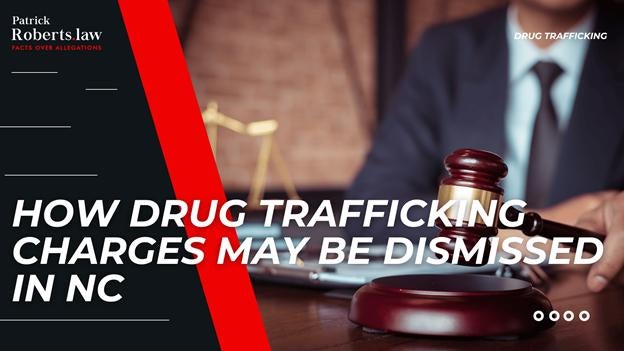
Close-up of gavel in front of suited attorney with gold scales and bold title: How to Get a Drug Trafficking Charge Dismissed in NC.

How Drug Trafficking Charges May Be Dismissed in NC

Drug trafficking charges in North Carolina can turn your life upside down in an instant. These charges carry severe penalties. However, dismissal is possible through several legal pathways. Understanding these options and acting quickly can make the difference between a conviction and walking free. This comprehensive guide explores the specific grounds, procedures, and strategies under North Carolina law that could lead to getting your trafficking charges dismissed. more What Makes a Drug Charge "Trafficking" in North Carolina? Under N.C. Gen. Stat. § 90-95(h), drug trafficking isn't about selling drugs on street corners. It's purely about quantity. The law automatically assumes that possessing certain amounts of controlled substances means you're trafficking. This applies regardless of your actual intentions. You could face trafficking charges even if the drugs were only for personal use. The threshold amounts vary significantly by substance: Marijuana trafficking begins at 10 pounds under N.C. Gen. Stat. § 90-95(h)(1) Cocaine trafficking starts at just 28 grams under N.C. Gen. Stat. § 90-95(h)(3) Methamphetamine trafficking also begins at 28 grams under N.C. Gen. Stat. § 90-95(h)(3b) Heroin and other opiates trigger trafficking at only 4 grams under N.C. Gen. Stat. § 90-95(h)(4) These weight thresholds include the entire mixture containing the controlled substance. They don't just count the pure drug. This means cutting agents, packaging materials with drug residue, and other substances mixed with the drug all count toward the total weight. Understanding this distinction is crucial. It affects whether you face trafficking charges or lesser possession charges. Can Constitutional Violations Lead to Potential Dismissal of Trafficking Charges? Absolutely. N.C. Gen. Stat. § 15A-954(a) provides multiple constitutional grounds that require courts to dismiss charges. This powerful statute serves as a shield against government overreach. It protects your fundamental rights throughout the criminal process. The most common constitutional violations in trafficking cases include: Fourth Amendment violations: Illegal searches and seizures remain the primary way to challenge drug cases. Police need proper justification to search your home, vehicle, or person. If they didn't have it, any evidence they found may be thrown out. Fifth Amendment violations: Police must respect your right to remain silent. Coerced confessions don't count. Neither do statements made after police failed to read Miranda warnings. The same goes for any interrogation that continued after you asked for silence. Sixth Amendment violations: You have the right to an attorney and a speedy trial. Denial of counsel counts as a violation. So do unreasonable delays in prosecution. Any interference with your ability to prepare a defense also provides grounds for potential dismissal. Sometimes constitutional violations are "flagrant" and cause "irreparable prejudice" to your case preparation. When this happens, N.C. Gen. Stat. § 15A-954(a)(4) mandates dismissal as the only remedy. This might occur in extreme situations. For example, when police destroy evidence that could prove your innocence. Or when they intimidate your key witnesses. It also applies when their conduct is so outrageous that a fair trial becomes impossible. How Does Suppression of Evidence Work in Trafficking Cases? Evidence suppression often serves as the key to dismissal in trafficking prosecutions. N.C. Gen. Stat. § 15A-974 establishes two distinct paths for excluding illegally obtained evidence. The first covers constitutional violations. The second addresses substantial statutory violations. Judges must consider several factors when evaluating whether to suppress evidence: The importance of the violated interest: Violations of core privacy rights carry more weight than minor procedural errors The extent of deviation from lawful conduct: How far did officers stray from proper procedures? Whether the violation was willful: Intentional misconduct weighs heavily toward suppression Deterrent effect: Will suppression discourage future police misconduct? The statute includes an important exception. Evidence won't be suppressed if officers acted under an "objectively reasonable, good faith belief that the actions were lawful." However, this good faith exception has limits. Officers cannot rely on clearly invalid warrants. They can't use false information. They also can't claim good faith for obvious constitutional violations. In trafficking cases, suppression of the drugs themselves typically destroys the prosecution's case. Why? Because prosecutors need physical evidence of the controlled substance and its weight. Without it, they cannot prove the essential elements of trafficking under N.C. Gen. Stat. § 90-95(h). When Can Prosecutors Voluntarily Dismiss Trafficking Charges? N.C. Gen. Stat. § 15A-931 grants prosecutors broad discretion to dismiss charges. They can do this at any point before or during trial. This authority extends beyond mere weakness in the evidence. Prosecutors consider numerous factors when deciding whether to pursue or dismiss trafficking charges. Common scenarios leading to voluntary dismissal include: Evidentiary problems discovered after charging: Sometimes lab tests reveal substances aren't illegal drugs. Weight measurements might fall below trafficking thresholds. Chain of custody gaps can create reasonable doubt. Witness issues: Key witnesses may become unavailable. They might recant their statements. Or they could prove unreliable under scrutiny. Legal defenses: Investigation sometimes reveals strong defenses. These include lack of knowledge, entrapment, or constitutional violations. Resource considerations: Prosecutors manage heavy caseloads. They may dismiss weaker trafficking cases to focus on stronger prosecutions. Cooperation agreements: N.C. Gen. Stat. § 90-95(h)(5) specifically allows sentence reductions. This applies when defendants provide "substantial assistance in the identification, arrest, or conviction of any accomplices, accessories, co-conspirators, or principals." The dismissal process itself is straightforward. Prosecutors can announce dismissal orally in court. They can also file written notice with the clerk under N.C. Gen. Stat. § 15A-931(a). Once dismissed, the statute of limitations isn't tolled. This means prosecutors must refile charges within the original time limits if they change their minds. What If the State Cannot Prove All Elements of Trafficking? Every criminal charge contains specific elements. Prosecutors must prove each one beyond a reasonable doubt. For trafficking under N.C. Gen. Stat. § 90-95(h), these elements include: The substance was actually a controlled substance covered by the statute You possessed, manufactured, sold, delivered, or transported it The quantity met or exceeded the statutory threshold You acted knowingly If prosecutors fail to prove any single element, the entire charge fails. N.C. Gen. Stat. § 15A-1227 gives defense attorneys multiple opportunities to challenge the evidence. They can file motions to dismiss at several stages: After the State's case: Once prosecutors rest, defense counsel can argue insufficient evidence After all evidence: Another opportunity exists after the defense presents its case Post-verdict: Dismissal remains possible even after a guilty verdict, before the judge enters judgment After a hung jury: If jurors cannot reach a verdict, dismissal motions may succeed before retrial These motions require judges to view evidence favorably toward the State. The judge must then determine whether any rational juror could find guilt beyond a reasonable doubt. Trafficking cases often hinge on proving the "knowing" element. This becomes especially important when drugs are found in shared spaces. The same applies to vehicles where multiple people had access. How Do Chain of Custody Issues Affect Trafficking Cases? Scientific evidence forms the backbone of most trafficking prosecutions. This makes chain of custody critical. N.C. Gen. Stat. § 90-95(g) and (g1) establish specific procedures for introducing lab reports. They also set requirements for maintaining evidence integrity. The State must demonstrate an unbroken chain showing: Collection: Who seized the suspected drugs, when, where, and how Storage: How evidence was packaged, labeled, and secured Transfer: Each person who handled the evidence and when Testing: How the lab received, tested, and stored samples Court presentation: That the evidence presented matches what was originally seized Any missing link in this chain creates doubt. Specifically, it raises questions about whether the tested substances are the same ones allegedly possessed by the defendant. Weight measurements prove especially crucial in trafficking cases. The State must establish accurate weights through proper procedures. If they cannot, they may fail to prove the threshold amounts required under N.C. Gen. Stat. § 90-95(h). Modern practice under N.C. Gen. Stat. § 90-95(g1) allows written documentation to establish chain of custody. This means the State doesn't need to call every person who handled evidence. However, defendants can object and force live testimony. They must file written objections at least five days before trial. This tactical decision often depends on identifying specific weaknesses in the chain documentation. Can Lack of Knowledge Be a Defense Leading to Dismissal? Knowledge remains an essential element of trafficking charges. Prosecutors must prove it. The State cannot simply show drugs were near you. They must establish you knew about their presence and nature. This requirement creates opportunities for dismissal when circumstances suggest innocent explanations. Consider these scenarios where lack of knowledge might negate trafficking charges: Borrowed vehicles: You borrowed a friend's car. You had no idea drugs were hidden in a compartment. Shared living spaces: Roommates or family members possessed drugs without your knowledge. Hidden compartments: Drugs were concealed in areas you couldn't reasonably know about. Mistaken substances: You believed you possessed legal substances, not controlled drugs. Courts examine all circumstances when evaluating knowledge claims. Several factors suggest knowledge. These include drugs in plain view, evidence of drug use, large amounts of cash, drug paraphernalia, or surveillance showing drug activity. Other factors support lack of knowledge. These include no fingerprints on drug packaging, no drug residue on your person, credible explanations for your presence, and witness testimony supporting your innocence. The burden always remains on prosecutors to prove knowledge. Defendants need not prove ignorance. When reasonable doubt exists about whether you knew about the drugs, dismissal or acquittal should follow. What Procedural Defects Can Result in Dismissal? Beyond substantive defenses, procedural violations provide additional paths to dismissal. N.C. Gen. Stat. § 15A-954(a) lists these grounds. These technical requirements exist to ensure fair proceedings. They protect defendants' rights throughout the criminal process. Key procedural grounds for dismissal include: Defective charging documents: Under N.C. Gen. Stat. § 15A-954(a)(10), indictments must properly allege all elements of trafficking. Missing elements can void charges. So can wrong statute citations or unclear allegations. Statute of limitations: N.C. Gen. Stat. § 15A-954(a)(2) requires dismissal when too much time passes before charging. Most drug crimes have lengthy limitation periods, though. Double jeopardy: You cannot be prosecuted twice for the same conduct. Prior prosecution bars subsequent charges under N.C. Gen. Stat. § 15A-954(a)(5). This applies whether the first case ended in acquittal or conviction. Lack of jurisdiction: Courts must have authority over both the crime and the defendant. Trafficking charges require a proper venue where the crime allegedly occurred. Prior adjudication: Courts may have previously ruled on the same legal or factual issues in your favor. If so, N.C. Gen. Stat. § 15A-954(a)(7) may bar re-litigation. Immunity agreements: Prosecutors must honor immunity deals. N.C. Gen. Stat. § 15A-954(a)(9) requires this, whether the agreements were formal or informal. These procedural protections work alongside substantive defenses. Together, they ensure fair treatment throughout the criminal process. Experienced attorneys know to examine every aspect of a case. They look for potential procedural violations that could lead to dismissal. How Important Is Legal Representation for Getting Charges Dismissed? The difference between conviction and dismissal often comes down to skilled legal representation. You need it from the start. Trafficking cases involve complex statutory schemes. They include scientific evidence, constitutional protections, and procedural requirements. Most defendants cannot navigate these alone. An experienced attorney provides crucial advantages: Early intervention: Your attorney can preserve evidence, interview witnesses, and file necessary motions. These opportunities disappear quickly without prompt action. Investigation resources: Attorneys can hire experts to retest substances. These professionals can also investigate police procedures or reconstruct events. Motion practice: Proper legal representation ensures constitutional violations get raised correctly. This includes motions under N.C. Gen. Stat. § 15A-954 and § 15A-974. Negotiation leverage: Experienced attorneys understand when prosecutors face evidentiary weaknesses. They use that knowledge to secure dismissals. Trial preparation: Being ready for trial often leads prosecutors to dismiss questionable charges. Protecting your record: Attorneys ensure dismissals are properly entered. They also make sure records get cleared to minimize long-term consequences. Many dismissals result from issues prosecutors would never discover on their own. Defense counsel must push for discovery, file motions, and conduct independent investigations. The earlier you secure representation, the more options remain available. Protect Your Rights with Experienced Legal Help Drug trafficking charges in North Carolina threaten your freedom, finances, and future. But these charges can be beaten. Success requires careful analysis, strategic motion practice, and aggressive defense of your constitutional rights. Attorney Patrick Roberts brings extensive experience handling criminal cases throughout North Carolina courts. He understands the complexities of trafficking statutes. He also knows the practical realities of defending against these serious charges. Time is your enemy when facing trafficking accusations. Evidence disappears quickly. Witnesses forget important details. Legal deadlines pass before you know it. The sooner you have qualified representation examining your case, the better your chances become. Your attorney can identify grounds for dismissal that you might miss on your own. Contact Patrick Roberts Law immediately to discuss your situation. Begin building your defense today. Your future depends on the decisions you make right now. Make the right choice by securing experienced legal counsel who will fight for dismissal of your charges.* *Disclaimer: Each case is different and must be evaluated separately. Prior results achieved do not guarantee similar results can be achieved in future cases.
Lawyer-themed banner showing a gloved hand holding a vial of fentanyl with overlay text asking how many grams qualify as trafficking in North Carolina.

How Many Grams of Fentanyl Is Considered Trafficking in North Carolina?

If you're facing drug charges in North Carolina involving fentanyl, you need to understand when possession becomes trafficking. Under North Carolina law, having just 4 grams or more of fentanyl can lead to trafficking charges—a serious felony with severe penalties. more What Amount of Fentanyl Is Considered Trafficking in North Carolina? According to N.C. Gen. Stat. § 90-95(h)(4), anyone who sells, manufactures, delivers, transports, or possesses 4 grams or more of fentanyl faces trafficking charges. This threshold is surprisingly low compared to other drugs. The low amount reflects how dangerous fentanyl is and shows how seriously North Carolina treats this powerful opioid. The law creates three levels of charges based on how much fentanyl is involved: 4 to 14 grams: Class F felony 14 to 28 grams: Class E felony 28 grams or more: Class C felony These weight limits include pure fentanyl and any mixture containing it. This means if fentanyl is mixed with other substances, the total weight of everything counts toward the trafficking amount. How Does North Carolina Define Fentanyl Trafficking? North Carolina's trafficking law, found in N.C. Gen. Stat. § 90-95(h)(4), places fentanyl in the same category as other opioids like heroin. The law defines trafficking broadly to cover many activities beyond just having the drug: Manufacturing Selling Delivering Transporting Possessing with intent to manufacture, sell, or deliver The law specifically names "heroin, fentanyl, or carfentanil, or any salt, compound, derivative, or preparation thereof, or any mixture containing any of these substances" as drugs subject to the harshest penalties. This broad definition ensures that all forms of fentanyl—whether pharmaceutical or street versions—fall under the trafficking law. What Are the Penalties for Fentanyl Trafficking in North Carolina? While exact sentences depend on factors like criminal history, N.C. Gen. Stat. § 90-95(h)(4) makes clear that fentanyl trafficking is always a felony. The law requires much higher fines for fentanyl trafficking than for other opioids: Class F felony (4-14 grams): Mandatory fine required Class E felony (14-28 grams): Higher mandatory fine required Class C felony (28+ grams): Highest mandatory fine required These severe penalties show how the legislature views fentanyl's deadly nature. The law singles out fentanyl, heroin, and carfentanil for the highest financial penalties among all opioid trafficking crimes. Can You Be Charged with Trafficking for Possessing Fentanyl? Yes, simply having 4 grams or more of fentanyl counts as trafficking under N.C. Gen. Stat. § 90-95(h)(4). Unlike simple possession charges, the state doesn't need to prove you planned to sell or distribute the drug. The law assumes that having this much indicates trafficking activity. This creates serious risks for people who might have fentanyl for personal use. The law doesn't distinguish between having drugs for yourself and having them to sell when the amount is 4 grams or more. Once you cross that 4-gram line, the charge automatically jumps from simple possession to trafficking. What Defenses Exist for Fentanyl Trafficking Charges? Several defenses might apply to fentanyl trafficking charges, depending on your specific situation: Challenging the Weight: Since trafficking charges depend on having 4 grams or more, the exact weight matters greatly. If police weighed the drugs incorrectly or included packaging materials, this might bring the amount below the trafficking threshold. Questioning Possession: The state must prove you knowingly had the fentanyl. If police found the drugs in a shared space or someone else's car, proving you possessed them becomes harder. Under N.C. Gen. Stat. § 90-95(a)(3), prosecutors must show you knew about the drugs and could control them. Substantial Assistance: N.C. Gen. Stat. § 90-95(h)(5) allows judges to reduce penalties when defendants provide "substantial assistance in the identification, arrest, or conviction of any accomplices, accessories, co-conspirators, or principals." The judge must note this cooperation in the court record. Alternative Sentencing: Under N.C. Gen. Stat. § 90-95(h)(5a), judges can impose lighter sentences if you meet specific requirements, including: Taking responsibility for your actions Having no prior felony drug convictions under N.C. Gen. Stat. § 90-95 Not using violence or weapons Completing approved drug treatment Being charged only for possession-based trafficking How Does Conspiracy to Traffic Fentanyl Work? N.C. Gen. Stat. § 90-95(i) states that conspiracy to traffic fentanyl carries the same penalties as actually trafficking it. This means if you agree with others to traffic fentanyl, you can face trafficking charges even if you never touch or see any drugs. Conspiracy charges often come from: Text messages or recorded conversations about drug deals Being present when drugs are sold Providing rides or money for drug purchases Storing or hiding drugs for someone else The conspiracy law greatly expands what police can charge as trafficking, since they don't need to prove you actually had or sold any drugs. What Should You Do If You're Under Investigation? If you think you're being investigated for fentanyl trafficking, you need to act quickly to protect yourself: Stay silent: Don't talk to police without a lawyer present Save evidence: Keep any documents, texts, or other items that might help your defense Don't discuss your case: Only talk about the charges with your attorney Write everything down: Record all details about any police encounters while they're fresh in your memory Because trafficking laws are complex and penalties are severe, getting an experienced lawyer early in the process is crucial. When Should You Contact a Criminal Defense Attorney? Since having just 4 grams of fentanyl triggers trafficking charges in North Carolina, you need legal help immediately if you're facing any fentanyl charges. The difference between simple possession and trafficking can mean the difference between a misdemeanor and a serious felony. Trafficking charges carry mandatory penalties that limit what judges can do to help. Attorney Patrick Roberts has handled many drug trafficking cases throughout North Carolina.* With deep knowledge of N.C. Gen. Stat. § 90-95 and how courts apply it across the state, Patrick Roberts Law fights to protect clients' rights and explore every possible defense. Don't wait to get help—the sooner you have a lawyer, the more options you may have for your defense. Contact Patrick Roberts Law today to discuss your case and learn about your rights under North Carolina law. *Disclaimer: Each case is different and must be evaluated separately. Prior results achieved do not guarantee similar results can be achieved in future cases.

Contact Us

Fill out this form below and we'll contact you shortly
*Required Fields