Blog / Criminal Defense

Blog

All Criminal Defense Criminal Defense Lawyer Sex Defense Felony Charges Lawyer Drug Charges Sex Defense Lawyer Murder Charges Rape Case Statutory Rape Charges Drug Crimes & Violations Drug Trafficking Violent Crime Domestic Violence Child Exploitation Charges Indecent Liberties North Carolina Criminal Law Sexual Assault North Carolina Law Fentanyl Crimes indecent liberties with a minor Sex Crimes Sex Crimes Defense Sex Offender Registry Sexual exploitantion of minors Meth Trafficking Age of Consent Aggravated Sexual Assault Artificial Intelligence Child Enticement Charges child grooming Child Rape Constitutional Rights & Warrants Criminal Defense & Travel Law Criminal Justice Criminal Law Cybercrime Defense Data Privacy Digital Evidence Entrapment defense False Accusations Family Law Federal Offenses Indecent Exposure Legal Defense Strategies Legal Resources Legal Updates Possession with intent to sell Sex Crimes & Registry Sex Crimes Defense Strategies Sex Offender Registration Requirements Sex Offender Registry Compliance Sex Offense Defense Sexting Laws solicitation of a child by computer Solicitation of a Minor Charge State vs. Federal Laws Statute of Limitations Statutory Sex Offense
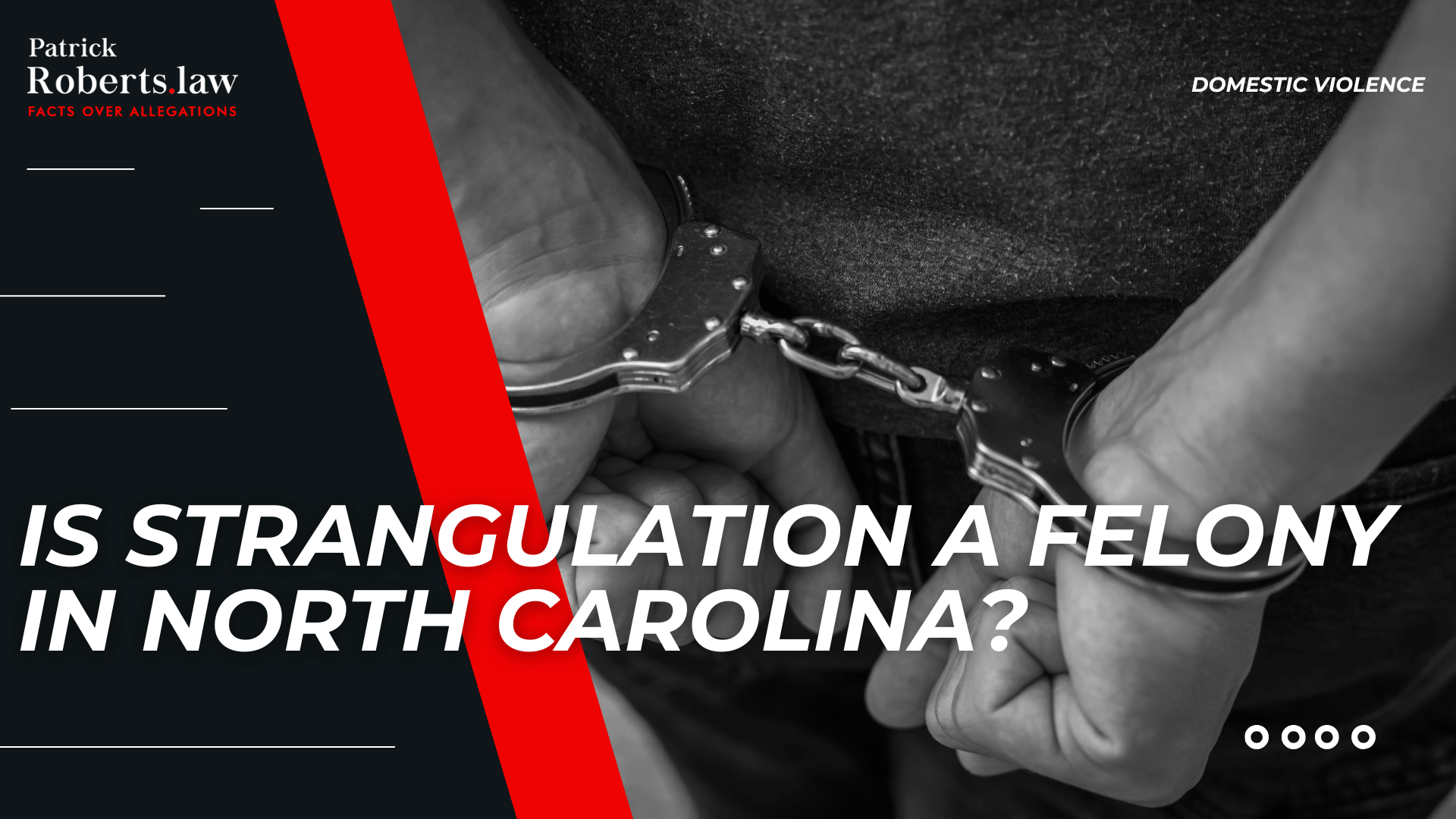
Handcuffed wrists introduce felony strangulation charges and penalties under North Carolina law.

Is Strangulation a Felony in North Carolina?

Yes. In North Carolina, assault by strangulation is a Class H felony under N.C.G.S. § 14-32.4(b). It is not a misdemeanor, not a lesser assault charge, and not something that can be informally resolved. A strangulation charge carries potential prison time, a permanent felony record, and consequences that reach into nearly every corner of your life. Those consequences affect your right to own a firearm, your ability to hold a professional license, and — for noncitizens — your right to remain in the United States. more This page explains what North Carolina law actually considers strangulation, how little injury the prosecution needs to prove, what the penalties look like, and what a felony conviction means for your future. If you or someone close to you is facing this charge, the information below covers what you need to understand right now. What Does North Carolina Law Consider "Strangulation"? Most people hear the word "strangulation" and picture someone being choked unconscious. North Carolina law sets the bar far lower than that. The statute itself — N.C.G.S. § 14-32.4(b) — does not define the term. The definition comes from North Carolina's pattern jury instruction, N.C.P.I.—Crim. 208.61. It describes strangulation as a form of suffocation caused by closure of the blood vessels or air passages of the neck from external pressure on the neck — whether from hanging, a cord or similar object, or manual pressure. The instruction does not require proof that the airway was completely closed or that the person was unable to breathe at all. Evidence that enough pressure was applied to the throat to cause difficulty breathing is enough. This means that what many people would describe as "grabbing someone by the neck" or "putting a hand on their throat" during an argument can meet the legal definition of strangulation. That is true even if the other person never lost consciousness, never stopped breathing entirely, and walked away from the encounter. How Much Injury Does the Prosecution Actually Need to Prove? This is where the charge becomes more serious than most people expect. The statute requires "physical injury," but that phrase is not defined in § 14-32.4(b) itself. Courts look to the related definition in G.S. § 14-34.7(c), which defines physical injury as cuts, scrapes, bruises, or other physical injury that does not count as serious injury. That threshold is deliberately low. According to analysis from the UNC School of Government, North Carolina courts have found sufficient physical injury from cuts and bruises, petechiae (small broken blood vessels in the eyes or skin), redness on the neck, soreness, blurred vision, and difficulty swallowing. Courts have also recognized that physical injury can exist even where no injuries are externally visible. The legislature designed it this way. The statute requires only "physical injury" — not "serious injury" and not "serious bodily injury," which are the standards for higher assault charges. The act of strangulation itself, combined with even minimal evidence of injury, is what North Carolina treats as grounds for felony prosecution. Why Is Strangulation Charged as a Felony Instead of a Misdemeanor? North Carolina has a layered system of assault charges, and strangulation sits well above where most people assume their situation falls. Simple assault and simple battery are Class 2 misdemeanors under G.S. § 14-33(a). Assault inflicting serious injury — which requires a higher level of harm including hospitalization, significant pain, or blood loss — is a Class A1 misdemeanor under G.S. § 14-33(c)(1). Assault on a female, one of the most commonly charged domestic violence offenses, is also a Class A1 misdemeanor. Assault by strangulation under G.S. § 14-32.4(b) bypasses the misdemeanor tier entirely and goes straight to a Class H felony — even when the physical injury is minor. And it can go higher. If the same conduct causes serious bodily injury, the charge escalates to a Class F felony under G.S. § 14-32.4(a). Serious bodily injury means injury that creates a substantial risk of death, serious permanent disfigurement, coma, a long-lasting condition that causes extreme pain, permanent or long-lasting loss or impairment of the function of a bodily member or organ, or prolonged hospitalization. If a deadly weapon is involved and serious injury results, it can reach a Class E felony under G.S. § 14-32(b). The practical takeaway is that a strangulation charge is not treated like a fight that got out of hand. North Carolina law treats the act of applying pressure to someone's neck as far more dangerous than other forms of assault, and the charges reflect that. What Are the Penalties for a Strangulation Conviction in North Carolina? North Carolina sentences felonies using a grid that combines the offense class with your prior record level. That level is calculated on a point system under G.S. § 15A-1340.14. Each prior Class H or I felony adds two points, and each prior Class A1 or Class 1 misdemeanor adds one point. For a Class H felony with no significant criminal history — Prior Record Level I — the presumptive sentencing range is a 5 to 6 month minimum, with a mitigated range starting at 4 months. The statutory maximum for any Class H felony, even at the highest prior record level with aggravating factors, is 39 months under G.S. § 15A-1340.17. At lower prior record levels, the court can impose community punishment (probation) or intermediate punishment (probation with additional conditions like electronic monitoring, confinement, or treatment programs). At higher record levels, active prison time becomes mandatory. Common probation conditions in domestic violence-related strangulation cases include supervised probation, substance abuse treatment, completion of an abuser treatment program under G.S. § 15A-1343(b)(12), and restitution. Two statistics from the NC Sentencing and Policy Advisory Commission's FY2024 report put these numbers in context. Across all North Carolina felonies in FY2024, roughly 40% of sentences were active prison time, 36% were intermediate punishment, and 24% were community punishment. And approximately 98% of all felony convictions that year resulted from guilty pleas — only 498 out of 26,577 felony convictions came from jury trials. For Class G, H, and I felonies specifically, the jury trial rate drops to approximately 1%. That does not mean trial is never the right path. But the overwhelming majority of these cases are resolved through negotiation, which makes the quality of that negotiation critical. What Does a Felony Strangulation Conviction Do to Your Future? The sentence is only part of the picture. A conviction for assault by strangulation under G.S. § 14-32.4(b) triggers consequences that last far longer than any period of prison time or probation. The most immediate is the loss of firearm rights. A felony conviction triggers the federal firearms prohibition under 18 U.S.C. § 922(g)(1), which bars possession of any firearm or ammunition. North Carolina state law under G.S. § 14-415.1 separately bars a convicted felon from possessing, purchasing, owning, or controlling a firearm. In domestic violence cases, additional federal prohibitions under the Lautenberg Amendment, 18 U.S.C. § 922(g)(9), and under § 922(g)(8) for persons subject to qualifying protective orders, impose their own lifetime bans. For noncitizens, the consequences can be even more severe. The Fourth Circuit held in U.S. v. Rice, 36 F.4th 578 (4th Cir. 2022), that North Carolina assault by strangulation is categorically a "crime of violence" because it can only be committed with an intentional, knowing, or purposeful state of mind. That holding was confirmed as binding in United States v. Robinson, 92 F.4th 531 (4th Cir. 2024). A crime-of-violence classification can trigger treatment as an aggravated felony under federal immigration law when a sentence of one year or more is imposed — including suspended sentences. That carries mandatory detention and near-automatic removal. When the offense involves a victim in a qualifying domestic relationship, it is separately deportable as a crime of domestic violence under 8 U.S.C. § 1227(a)(2)(E), with no one-year sentence requirement. Professional licensing is also at risk. Under G.S. § 93B-8.1, North Carolina licensing boards may deny a license based on a criminal conviction when the crime is violent or sexual in nature. A conviction that federal courts have classified as a crime of violence falls clearly within that standard. Some professions face additional risk. The Nursing Practice Act under G.S. § 90-171.48, for example, expressly lists Article 8 assaults (which includes § 14-32.4) among offenses affecting fitness to practice. Finally, a conviction for assault by strangulation is generally not eligible for expungement under current North Carolina law. It also makes you ineligible for expungement of other offenses on your record. This is a permanent mark. Why Do You Need a Defense Attorney Now — Not Later? A strangulation charge is a felony that carries prison time, lifetime firearms prohibitions, potential deportation for noncitizens, professional licensing consequences, and a conviction that cannot be expunged. Those consequences begin adding up the moment the charge is filed — and the earlier a defense attorney is involved, the more options remain available. The sentencing data makes one thing clear: in a system where approximately 98% of felony cases resolve by plea, the quality of your attorney's negotiation matters enormously. An attorney who understands how the prosecution builds and evaluates these cases is often a decisive factor in the outcome. Patrick Roberts is a Raleigh criminal defense attorney and former Assistant District Attorney who has handled thousands of criminal cases across North Carolina over more than 24 years of practice. That prosecutorial background means he understands how strangulation cases are charged, what evidence the state relies on, and where the weaknesses in that evidence tend to be. He is a graduate of the Trial Lawyers College, the National Criminal Defense College, and Duke University School of Law, and his offices in Raleigh, Durham, Chapel Hill, and Cary serve clients across North Carolina. He handles high-stakes legal matters throughout North Carolina, with a primary focus on Wake County municipalities including Raleigh, Cary, Apex, Holly Springs, Garner, and Fuquay-Varina. Client Review “When our son was arrested on sexual assault and rape charges, I was lost. I searched and found Patrick Roberts. I was impressed with his resume so we met with him and hired him. Now our son's case is over. It has taken a long time to get to the end of this experience, but I thank God for sending Patrick Roberts our way!” - verified client review via Avvo.com Peer Endorsement “I attended the Trial Lawyers College with Patrick. If I was facing serious criminal charges anywhere in North Carolina, he would be my first call.” - Verified peer endorsement via Avvo.com Disclaimer: Testimonials and peer reviews are actual comments from clients and peers. They are for informational purposes only and do not guarantee or predict the outcome of your legal matter. Every case is unique and must be evaluated on its own merits. If you or someone you care about is facing a strangulation charge, the time to act is now. Contact Patrick Roberts Law to discuss your case. The firm maintains a selective intake process to ensure that each client receives the focused professional attention their case requires. Disclaimer: The information on this website is for general informational purposes only. Nothing herein should be taken as legal advice for any individual case or situation. Contacting us via this website, email, or contact form does not create an attorney-client relationship. Case results depend on a variety of factors unique to each case; prior results do not guarantee a similar outcome.


Police handcuff a person beside title introducing assault by strangulation charges in North Carolina.

Assault by Strangulation in North Carolina — What You're Actually Facing

Assault by strangulation is a Class H felony in North Carolina under N.C.G.S. § 14-32.4(b). It is not a misdemeanor, not a lesser assault charge, and not something the court system treats as a routine domestic dispute. It is a standalone felony offense. A conviction carries up to 39 months in prison, a permanent criminal record, and collateral consequences that follow you for life. more Many people searching for information about this charge don't yet realize how broadly North Carolina defines strangulation, how little injury the prosecution actually needs to prove, or how far the consequences extend beyond the sentence itself. This page covers what the statute requires, what the prosecution has to show, what the sentencing exposure looks like, what a felony conviction means for your future, and how these charges can be challenged. What Is Assault by Strangulation Under North Carolina Law? Under N.C.G.S. § 14-32.4(b), a person who assaults another person and inflicts physical injury by strangulation is guilty of a Class H felony, unless the conduct falls under another statute that provides greater punishment. The legislature created this offense as a distinct category because it treats strangulation as inherently dangerous conduct — dangerous enough to warrant felony treatment even when the physical injuries are relatively minor. This is a critical distinction. If you are charged under this statute, you are not facing an elevated misdemeanor or a simple assault with added facts. You are facing a felony — with everything that comes with a felony conviction in North Carolina. The charge applies regardless of the relationship between the parties. N.C.G.S. § 14-32.4(b) does not vary the offense class based on whether the accused and the alleged victim are in a domestic relationship, are strangers, or fall anywhere in between. While many strangulation charges arise in a domestic context, the statute itself is relationship-neutral. What Does the Prosecution Have to Prove? A conviction under N.C.G.S. § 14-32.4(b) requires the State to prove four elements: that there was an assault, that the assault was on another person, that the assault inflicted physical injury, and that the physical injury was caused by strangulation. Two of those elements — "strangulation" and "physical injury" — are not defined anywhere in the statute itself. How North Carolina courts have interpreted them is where most people's understanding falls short. The North Carolina Pattern Jury Instruction (N.C.P.I.—Crim. 208.61) defines strangulation as a form of suffocation characterized by closure of the blood vessels and/or air passages of the neck as a result of external pressure on the neck, whether brought about by hanging, a cord or similar object, or the manual assertion of pressure. What the instruction does not require is proof of complete airway closure or a complete inability to breathe. Evidence that sufficient pressure was applied to the throat to cause difficulty breathing is enough. That means the State does not need to prove that anyone lost consciousness, that the airway was fully blocked, or that the situation reached the level of severity many people associate with the word "strangulation." Pressure on the neck that restricts breathing, even partially, can satisfy the element. The physical injury threshold is equally low. The statute requires only "physical injury," which North Carolina courts and the UNC School of Government have interpreted using the related definition in G.S. § 14-34.7(c): cuts, scrapes, bruises, or other physical injury that does not constitute serious injury. Courts have found sufficient physical injury based on bruising, redness, petechiae (small broken blood vessels in the eyes or skin), soreness, blurred vision, and difficulty swallowing. Critically, courts have also recognized that physical injury may exist even where no injuries are externally visible. The complainant's testimony about pain, difficulty breathing, or other symptoms can be enough on its own. This is the knowledge gap that catches most people off guard. The prosecution does not need dramatic injuries. The bar is deliberately set low because the legislature intended the act of strangulation itself, paired with any physical consequence, to carry felony weight. This is also a general-intent crime. In U.S. v. Rice, 36 F.4th 578 (4th Cir. 2022), the court held that assault by strangulation under this statute can only be committed with an intentional, knowing, or purposeful state of mind. The court reasoned that a person cannot strangle someone without knowing or intending it. The prosecution does not need to prove you intended a specific injury. It only needs to prove the conduct was deliberate rather than accidental. What Are the Penalties for a Conviction? Assault by strangulation is sentenced under North Carolina's Structured Sentencing Act. The sentence is determined by two factors: the offense class (Class H) and your prior record level. Prior record level ranges from Level I to Level VI based on a point system that assigns points for prior convictions. Each prior Class H or I felony adds two points, and each prior Class A1 or Class 1 misdemeanor adds one point. At Prior Record Level I — a person with minimal or no criminal history — the presumptive sentencing range is a minimum of 5 to 6 months, with the mitigated range starting at 4 months. The absolute statutory maximum for any Class H felony is 39 months, which is a Level VI aggravated sentence. At lower prior record levels, community punishment (probation) and intermediate punishment (probation with additional conditions like electronic monitoring or short-term confinement) are available sentencing options. Active prison time becomes mandatory at Prior Record Level VI. Probation conditions in cases involving domestic circumstances can include supervised probation, electronic monitoring, substance-abuse treatment, completion of an abuser-treatment program under G.S. § 15A-1343(b)(12), restitution, and a fine at the court's discretion. If you are facing this charge in a domestic context, there is an immediate procedural reality you need to understand. Under N.C.G.S. § 15A-534.1, if you are arrested for a crime of domestic violence, you can be held for up to 48 hours before a judge sets pretrial release conditions. Unlike most arrests where a magistrate can set bond quickly, this statute sends pretrial release decisions to a judge. That judge may set conditions including a secured appearance bond, no-contact provisions, and orders to stay away from the alleged victim's home, school, and workplace. Roughly 98 percent of North Carolina felony convictions result from guilty pleas rather than jury trials. The jury trial rate for Class H felonies sits around one percent. That means the decisions made early in a case, including at the pretrial stage, carry enormous weight in shaping how the case turns out. What Happens to Your Record and Your Life After a Felony Conviction? The sentence is only part of what a conviction means. A Class H felony conviction for assault by strangulation triggers consequences that extend well beyond the courtroom and, in many cases, last permanently. A felony conviction imposes a federal firearms ban under 18 U.S.C. § 922(g)(1) and a state ban under G.S. § 14-415.1, preventing you from possessing, purchasing, or owning firearms. In cases involving a domestic relationship, the Lautenberg Amendment under 18 U.S.C. § 922(g)(9) can independently impose a lifetime ban on firearms and ammunition. A qualifying domestic violence protective order triggers its own separate federal firearms ban under § 922(g)(8). For noncitizens, the consequences can be even more severe. The Fourth Circuit held in U.S. v. Rice, 36 F.4th 578 (4th Cir. 2022), that North Carolina's assault by strangulation is categorically a "crime of violence." United States v. Robinson, 92 F.4th 531 (4th Cir. 2024), confirmed that holding still applies. That classification means a conviction can be treated as an aggravated felony under federal immigration law when a sentence of one year or more is imposed. For immigration purposes, a suspended sentence counts. The result can be mandatory detention and near-automatic deportation. When the offense involves a victim in a qualifying domestic relationship, it separately qualifies as a deportable crime of domestic violence under 8 U.S.C. § 1227(a)(2)(E), which carries no minimum sentence requirement at all. A conviction also creates professional licensing risks. Under G.S. § 93B-8.1, North Carolina licensing boards can deny a license when a conviction is directly related to the occupation or involves a crime that is violent or sexual in nature. A crime of violence categorization clearly fits within that standard. Finally, an assault by strangulation conviction is generally not eligible for expungement under current North Carolina law. It also makes you ineligible for expungement of other offenses. The record is, for practical purposes, permanent. Can Assault by Strangulation Charges Be Fought? Yes — but the path depends entirely on the facts, and the facts need to be examined early. The most common areas of real dispute in strangulation cases involve challenging the two elements the statute leaves undefined. The first is whether what happened actually constituted strangulation. The question is whether sufficient pressure was applied to the neck to meet the legal definition, as opposed to accidental contact, grabbing, or a struggle that involved the neck area without the kind of sustained external pressure the pattern jury instruction describes. The second is whether any physical injury actually resulted, particularly in cases where there are no visible marks, no medical treatment, and the State's evidence consists primarily of the complainant's testimony. Both of these questions are heavily fact- and evidence-driven. Photographs taken at the scene or shortly after, medical records, the presence or absence of petechiae, the complainant's statements to law enforcement versus later testimony, and any conflicting accounts from witnesses all directly affect whether the prosecution can prove these elements beyond a reasonable doubt. Self-defense is the primary affirmative defense available under N.C.G.S. § 14-51.3. North Carolina law authorizes a person to use non-deadly force when and to the extent the person reasonably believes it is necessary to defend against another person's imminent use of unlawful force. There is no duty to retreat — a person who is lawfully present in any location may stand their ground. The same standards apply to the defense of another person under the same statute. The limits are imminence and proportionality. The threat being defended against must be imminent, not speculative, not future, and not already concluded. The force used must be proportionate to the threat as it existed at the moment force was applied. Grossly disproportionate force can defeat the claim even where the initial threat was real. In a strangulation prosecution, the practical question is whether the physical contact with the neck was a proportionate, necessary response to an imminent threat you reasonably perceived. The evidence must support that account. One defense that is generally not available is voluntary intoxication. Because assault by strangulation is a general-intent crime, North Carolina law does not permit voluntary intoxication as a defense. The court in State v. Tadlock, 299 N.C. App. 754 (2025), affirmed that even evidence of heavy drinking does not entitle a defendant to a voluntary intoxication instruction. The court found that the defendant's purposeful conduct showed he was not "utterly incapable" of forming intent. For a general-intent offense like strangulation, this defense is effectively unavailable. Why Do You Need a Defense Attorney Now? Everything about this charge rewards early action and penalizes delay. The 48-hour pretrial hold means bond and release conditions can be set before you have had any meaningful opportunity to consult with a lawyer. The evidence that will make or break the case — photographs of the alleged victim's neck and eyes, medical records, the complainant's initial statements, 911 recordings, body camera footage — begins to take shape in the first days after an arrest. Once the State's narrative is locked in, challenging it becomes significantly harder. The collateral consequences outlined above also mean that the difference between a conviction and another outcome is not just a matter of months served. It is the difference between a permanent felony record with firearms prohibitions, potential immigration consequences, and licensing barriers — and the possibility of a reduced charge, a dismissal, or an acquittal that avoids those outcomes entirely. Patrick Roberts is a Raleigh criminal defense attorney and former Assistant District Attorney in Wake, Johnston, and New Hanover counties. That prosecutorial background matters in strangulation cases specifically because he understands how the State builds these cases from the inside — what evidence prosecutors rely on, where the weaknesses tend to be, and how charging decisions get made. He is a graduate of Gerry Spence's Trial Lawyers College and the National Criminal Defense College Trial Practice Institute, with more than 24 years of experience and thousands of criminal cases handled across North Carolina. Patrick Roberts Law PLLC serves clients from offices in Raleigh, Durham, Chapel Hill, and Cary. His legal practice spans all North Carolina counties for high-stakes litigation, with a concentrated defense practice in Wake County—including Raleigh, Cary, Apex, Holly Springs, Garner, and Fuquay-Varina. Client Review “Patrick Roberts represented my son and we were blessed to meet such a God send. From the first meeting until present, Mr. Roberts has been transparent and thorough about every possible outcome. With his confidence and experience in criminal law, Mr. Roberts is able to give you the best outcome possible. I highly recommend Mr. Roberts he’s outstanding.” - Verified client review via Avvo.com Peer Endorsement “Patrick is a thoughtful and experienced attorney. When I have a client needing representation in the Raleigh area in his areas of practice, he would be my referral of choice ” - Verified peer endorsement via Avvo.com Disclaimer: Testimonials and peer reviews are actual comments from clients and peers. They are for informational purposes only and do not guarantee or predict the outcome of your legal matter. Every case is unique and must be evaluated on its own merits. If you are facing an assault by strangulation charge in North Carolina, or if someone close to you has been arrested, contact Patrick Roberts Law to discuss the case. To preserve high standards of diligence and thorough management, the firm strictly regulates its active case volume. Disclaimer: The information on this website is for general informational purposes only. Nothing herein should be taken as legal advice for any individual case or situation. Contacting us via this website, email, or contact form does not create an attorney-client relationship. Case results depend on a variety of factors unique to each case; prior results do not guarantee a similar outcome.
Judge's gavel introduces consequences of a Class H felony in North Carolina with law firm branding.

What Are the Consequences of a Class H Felony in North Carolina?

A Class H felony in North Carolina carries a potential sentence ranging from 4 to 39 months depending on the circumstances. Beyond the sentence itself, a conviction can affect firearm rights, employment, professional licensing, and immigration status long after any sentence is served. The range is wide because North Carolina uses a structured sentencing system. The actual punishment depends not just on the offense class but on the defendant's prior record. Two people charged with the same Class H felony can face very different outcomes. more This page walks through the specific sentencing ranges at each prior record level, whether probation is available, and the consequences that extend beyond the courtroom. How Much Prison Time Does a Class H Felony Carry? The sentencing range for a Class H felony spans from a mitigated minimum of 4 months at the lowest prior record level to a statutory maximum of 39 months at the highest. The felony punishment chart in N.C. Gen. Stat. § 15A-1340.17 sets three ranges at each prior record level — mitigated, presumptive, and aggravated. Each range specifies a minimum sentence. The maximum sentence is then calculated from the minimum using a statutory formula. At Prior Record Level I, the presumptive minimum is 5 to 6 months. At Prior Record Level VI, the most severe, the aggravated minimum can reach 25 months, with a maximum of 39 months. The presumptive range is the default. A judge can sentence in the mitigated range if mitigating factors outweigh aggravating factors, or in the aggravated range if aggravating factors outweigh mitigating ones. Neither departure happens automatically — both depend on the facts presented at sentencing and, in many cases, on what is negotiated before sentencing ever occurs. The numbers matter, but so does the context around them. According to the North Carolina Sentencing and Policy Advisory Commission's FY2024 Statistical Report, approximately 98% of all felony convictions in North Carolina resulted from guilty pleas rather than jury trials. For Class G, H, and I felonies specifically, the jury trial rate was roughly 1%. That means the outcome of nearly every Class H felony case is shaped by what happens during negotiation, not at trial. The sentencing range is what drives that negotiation. How Does My Prior Record Change My Sentence? The prior record level is calculated under N.C. Gen. Stat. § 15A-1340.14 by assigning points to prior convictions. Each prior Class H or Class I felony conviction adds 2 points. Each prior Class A1 or Class 1 misdemeanor conviction adds 1 point. Higher-class felony convictions carry more points, and the total determines the prior record level, which ranges from Level I to Level VI. This is the factor that produces the widest swing in the potential sentence. If you are at Prior Record Level I, you are looking at a presumptive minimum of 5 to 6 months. At Level VI, you could be looking at more than triple that. In domestic violence cases, this calculation often matters because prior assault-related misdemeanors — including prior convictions for assault on a female under N.C. Gen. Stat. § 14-33(c)(2), which is a Class A1 misdemeanor — each add a point to the total. The prior record level also determines what type of sentence is available, which leads directly to the question most people facing a Class H felony are asking next. Could I Get Probation Instead of Prison? Yes, depending on the prior record level. North Carolina's structured sentencing system assigns one of three disposition types to each cell on the felony punishment chart: community (C), intermediate (I), or active (A). Community punishment is probation-based and does not require any period of incarceration. Intermediate punishment is also probation-based but may include conditions like supervised probation, short-term confinement, or electronic monitoring. Active punishment means a sentence served in custody. At lower prior record levels, the sentencing chart for a Class H felony includes community and intermediate options. Active time becomes mandatory at Prior Record Level VI. This is not a formality. Statewide, the felony punishment distribution in FY2024 was 40% active sentences, 36% intermediate, and 24% community. That means the majority of felony defendants in North Carolina received a probation-based sentence rather than incarceration. In domestic violence cases, probation conditions carry their own weight. Under N.C. Gen. Stat. § 15A-1343(b)(12), a defendant found responsible for acts of domestic violence must attend an approved abuser-treatment program as a condition of probation unless the court finds it is not in the interests of justice. These programs require 39 hours of group treatment completed over 26 to 30 weeks, with groups of no more than 16 participants. Not every North Carolina county has an approved program. As of 2026, 34 programs operate across 65 of the state's 100 counties, leaving 35 counties without one. It is also worth noting that many Class H and I felonies resolve through plea in district court rather than superior court. In FY2024, 5,072 Class H and I felony pleas — 31% of all convictions at that level — were handled in district court. The median time from charge to sentencing in district court was 4 months, compared to 11 months in superior court. What Happens to My Right to Own a Firearm? A Class H felony conviction triggers a firearms ban at both the state and federal level. Under N.C. Gen. Stat. § 14-415.1, it is unlawful for any person convicted of a felony to possess, purchase, or own a firearm in North Carolina. At the federal level, the felon-in-possession statute, 18 U.S.C. § 922(g)(1), bars firearm and ammunition possession by convicted felons. In domestic violence cases, additional federal firearms bans may apply separately from the felony conviction itself. Under 18 U.S.C. § 922(g)(8), a person subject to a qualifying Domestic Violence Protective Order that includes a credible-threat finding is barred from possessing firearms while the order is in effect. Under 18 U.S.C. § 922(g)(9), the Lautenberg Amendment, a person convicted of a misdemeanor crime of domestic violence faces a generally permanent ban on firearm and ammunition possession. Depending on how a case is resolved, the § 922(g)(9) ban may be relevant even where the original charge was a felony — for example, if a plea to a qualifying misdemeanor offense is part of the resolution. For many people, the loss of firearm rights is the single most consequential long-term outcome of a Class H felony conviction, particularly when employment, hunting, or personal protection depends on the ability to legally possess a firearm. Will a Class H Felony Affect My Job or Professional License? A felony conviction appears on criminal background checks. It can disqualify you from employment in a range of fields, both by employer policy and by regulatory requirement. Under N.C. Gen. Stat. § 93B-8.1, North Carolina licensing boards may deny a professional license based on a criminal conviction if the criminal history is "directly related" to the duties of the occupation or the crime is "violent or sexual in nature." An assault-by-strangulation conviction — which the Fourth Circuit has held is categorically a crime of violence — falls within that second category. Certain professions face additional scrutiny. The North Carolina Nursing Practice Act, N.C. Gen. Stat. § 90-171.48, expressly lists Article 8 assaults (which includes § 14-32.4) among offenses that affect fitness to practice. The NC Board of Nursing also requires self-reporting of felony or certain misdemeanor charges, typically within 30 days. Other licensed professions — teaching, law enforcement, real estate, and others regulated by state boards — apply their own standards. But the underlying conviction is reportable across the board. Beyond licensed professions, the practical reality is that a felony conviction narrows the field. Many employers in North Carolina conduct background checks. While the law limits when and how that information can be used in some contexts, the conviction itself does not disappear from the record. Can a Class H Felony Be Expunged in North Carolina? Under current North Carolina law, a Class H felony conviction is generally not eligible for expunction. The expungement statutes impose strict limitations on which convictions qualify, and a violent felony conviction typically falls outside those boundaries. Beyond the conviction itself, having a Class H felony on your record can disqualify you from expunging other, lesser offenses that might otherwise be eligible. This is one of the reasons the outcome of the case — not just the sentence imposed — carries so much long-term weight. A conviction that results in probation rather than prison may feel like a favorable resolution at the time. But the felony record it leaves behind follows you into employment, housing, licensing, and firearm eligibility for years or decades afterward. In many cases, the most consequential work a defense attorney does is not reducing the sentence but shaping the outcome in a way that avoids or limits the conviction record itself. What Are the Immigration Consequences of a Class H Felony? If you are not a United States citizen, a Class H felony conviction in a domestic violence case can carry immigration consequences that are more severe than the criminal sentence. In United States v. Rice, 36 F.4th 578 (4th Cir. 2022), the Fourth Circuit held that North Carolina's assault by strangulation offense is categorically a "crime of violence" because it can only be committed with an intentional, knowing, or purposeful state of mind. That holding was confirmed in United States v. Robinson, 92 F.4th 531 (4th Cir. 2024). Because the offense qualifies as a crime of violence, it is treated as an aggravated felony under 8 U.S.C. § 1101(a)(43)(F) when a sentence of one year or more is imposed. For immigration purposes, a suspended sentence counts. An aggravated felony classification carries mandatory detention and near-automatic removal. Separately, under 8 U.S.C. § 1227(a)(2)(E), a noncitizen convicted of a crime of domestic violence against a person in a qualifying domestic relationship is deportable regardless of the sentence length. This sharply distinguishes a Class H felony strangulation conviction from North Carolina's lower-level assault charges. The Fourth Circuit held in United States v. Vinson, 805 F.3d 120 (4th Cir. 2015), that ordinary North Carolina assault convictions are not categorically crimes of violence because they can be committed through culpable negligence rather than intentional force. A strangulation conviction does not benefit from that distinction. If you are facing this charge and are not a U.S. citizen, you should understand that the immigration consequences may be irreversible. They should be evaluated by someone qualified to assess them before any plea is entered. Why Does the Defense Strategy Matter More Than the Charge? The structured sentencing system in North Carolina does something that is easy to miss when reading a statute for the first time: it creates a range of outcomes, not a fixed one. A Class H felony can result in 39 months in custody or supervised probation served in the community. It can end with a conviction that permanently alters your record or, in some cases, with a resolution that avoids the felony conviction entirely. Where you land within that range depends on the prior record, the facts, the evidence, and the quality of the defense. At Patrick Roberts Law in Raleigh, North Carolina, criminal defense attorney Patrick Roberts brings more than 24 years of experience and a perspective shaped by his prior service as an Assistant District Attorney in Wake, Johnston, and New Hanover counties. That background means an understanding of how the state builds and evaluates cases from the inside — and where the pressure points are that create room for a different outcome. Attorney Patrick Roberts offers comprehensive legal representation across every county in North Carolina for high-stakes cases, maintaining a core geographic focus on Wake County communities like Raleigh, Cary, Apex, Holly Springs, Garner, and Fuquay-Varina. Client Review “Mr. Roberts was amazing! Had a very difficult case & the outcome didn’t look bright at all. I was looking at some serious time. But he was able to get me probation (which wasn’t on the table at all before he got involved) He was honest, to the point & laid out everything that could be a possibility. Never gave false hope, just the facts & logically what we could do to possibly get this in my favor. I would recommend Mr. Roberts to anyone seeking REAL guidance, honest & qualifications to back it up.” - Verified client review via Avvo.com Peer Endorsement “I retained and worked with Patrick and his team for four years and my primary expectations were without a doubt satisfied. Patrick will always be my first choice for legal defense for myself or my family. Standout Points: Patrick's clients receive bond reductions that other attorneys are unable to secure. Patrick and his team double check their own knowledge of the law so that their courtroom presentation is well organized and flawless. Patrick knows how important it is to present your particular case in the right environment to receive the most positive reception.” - Verified peer endorsement via Avvo.com Disclaimer: Testimonials and peer reviews are actual comments from clients and peers. They are for informational purposes only and do not guarantee or predict the outcome of your legal matter. Every case is unique and must be evaluated on its own merits. If you or someone close to you is facing a Class H felony charge in North Carolina, the gap between the worst-case scenario and a manageable resolution is not determined by the charge alone. It is a matter of preparation, strategy, and knowing how the system actually works. Contact Patrick Roberts Law to discuss your case. Through a selective intake process, the firm caps its active case volume to protect the quality and pace of its legal oversight. Disclaimer: The information on this website is for general informational purposes only. Nothing herein should be taken as legal advice for any individual case or situation. Contacting us via this website, email, or contact form does not create an attorney-client relationship. Case results depend on a variety of factors unique to each case; prior results do not guarantee a similar outcome.
Attorney consultation introduces assault on a female charges in North Carolina with law firm branding.

Assault on a Female in North Carolina: What You're Actually Facing

Assault on a female in North Carolina is a Class A1 misdemeanor under N.C. Gen. Stat. § 14-33(c)(2) — the most serious misdemeanor classification the state has. It carries up to 150 days in jail, but the jail time is not the part of this charge that changes lives. The collateral consequences — what happens to your record, your firearms rights, your custody situation, and your employment — are what most people never see coming until it's too late to get ahead of them. more This page covers what the charge actually means under NC law and what the realistic penalties and long-term consequences look like. It also explains what a criminal defense attorney can do to affect the direction of a case. What Is "Assault on a Female" Under North Carolina Law? North Carolina does not have a single "domestic violence" crime on the books. Instead, prosecutors charge domestic-violence-related conduct through a patchwork of general assault statutes. Assault on a female is the one they reach for most often. In 2015 alone, North Carolina district courts reported 29,483 assault-on-a-female and assault-by-strangulation charges filed statewide. The statute is narrow in who it covers and broad in what conduct qualifies. Under § 14-33(c)(2), the charge requires three things: the defendant is male, the defendant is 18 years of age or older, and the alleged victim is female. That's it. There is no requirement that the parties have a romantic or domestic relationship. There is no requirement that the alleged victim suffered an injury. NC assault is a common-law offense that can be committed without the use of physical force — including through culpable negligence. Because of that, the range of conduct that can support a charge is broader than most people expect. This is not a simple assault charge with a different label. Simple assault under § 14-33(a) is a Class 2 misdemeanor. Assault on a female is a Class A1 misdemeanor. That single classification difference has serious effects on sentencing exposure, the permanent record it creates, and the federal consequences it can trigger. How Is This Charge Different From Simple Assault? The difference between simple assault and assault on a female is not about what happened. It is about the statutory classification that attaches based on who the parties are, and that classification determines everything downstream. Simple assault is a Class 2 misdemeanor. The maximum sentence is 60 days. Assault on a female is a Class A1 misdemeanor — two full classification levels higher — with a maximum sentence of 150 days. Under North Carolina's structured sentencing system, the gap between these two classifications is not just a matter of days in jail. It changes the type of punishment a judge can impose and the prior-record points the conviction adds to any future charges. It also changes how the conviction interacts with federal law. A Class A1 misdemeanor is the only misdemeanor class in North Carolina for which a judge can impose an active jail sentence regardless of whether you have any prior criminal record. For a Class 2 simple assault, if you're a first-time offender, you're generally looking at community punishment — supervised or unsupervised probation. For a Class A1 assault on a female, active time is on the table from the start. What Kind of Sentence Could I Get? North Carolina uses a structured sentencing system. That means punishment for any offense is determined by the combination of the offense class and your prior criminal record. For a Class A1 misdemeanor, the sentencing grid works across three prior-conviction levels. If you have no prior convictions, you face a sentencing range of 1 to 60 days. If you have five or more prior convictions, you face a range of 1 to 150 days. The middle tier falls between those two endpoints. Within each range, the judge chooses between community punishment (probation), intermediate punishment (probation with more restrictive conditions like supervised probation or electronic monitoring), or active punishment (jail time). The data shows that most misdemeanor defendants in North Carolina do not go to jail. According to the NC Sentencing and Policy Advisory Commission, 68% of misdemeanor sentences statewide in FY2024 were community punishment, meaning probation rather than active jail time. Only 29% received active jail time. For those who did receive active time on a Class A1 misdemeanor, the average sentence was 66 days. But probation in a domestic violence case is not the same as probation for a shoplifting charge. Under N.C. Gen. Stat. § 15A-1343(b)(12), if you are found responsible for acts of domestic violence, you must attend and complete an approved abuser-treatment program as a condition of probation. The only exception is if the court specifically finds it is not in the interests of justice. These are not anger management classes. Approved programs require 39 hours of group treatment, completed over 26 to 30 weeks, in groups of no more than 16 participants. As of 2026, only 34 programs operate across 65 North Carolina counties. That means 35 counties have no program at all, which can create practical burdens that follow you for months. What Are the Consequences Beyond the Sentence? The sentence a judge hands down is only one layer of what an assault on a female conviction does to your life. The collateral consequences — the ones that operate outside the courtroom — are often more severe and longer-lasting than any jail time. Firearms. This is the area where North Carolina's assault statutes interact with federal law in ways that are both serious and legally complex. Under 18 U.S.C. § 922(g)(9), a person convicted of a "misdemeanor crime of domestic violence" as defined by federal law faces a generally permanent ban on possessing firearms or ammunition. However, the Fourth Circuit held in United States v. Vinson, 805 F.3d 120 (4th Cir. 2015), that ordinary North Carolina assault — including assault on a female under § 14-33(c)(2) — does not categorically qualify as a federal misdemeanor crime of domestic violence. The reason is that NC assault can be committed through culpable negligence rather than the intentional use of physical force that the federal definition requires. That does not mean firearms consequences disappear. A Domestic Violence Protective Order is often issued alongside the case, since the DVPO runs on a separate civil track from the criminal charge. If one is issued, 18 U.S.C. § 922(g)(8) bars firearm possession for as long as the qualifying order remains in effect. North Carolina law under § 50B-3.1 separately requires you to surrender firearms, ammunition, and permits to the sheriff when the court makes certain findings in the DVPO, such as a finding that you used or threatened to use a deadly weapon. Possessing a firearm in violation of the order is a Class H felony under § 14-269.8. It is also worth noting that the General Assembly passed N.C. Gen. Stat. § 14-32.5 — the misdemeanor crime of domestic violence statute, effective December 1, 2023 — specifically to close the gap that Vinson created. Convictions under that newer statute are designed to categorically trigger the federal firearms ban. How the charging decision is made between § 14-33(c)(2) and § 14-32.5 can have lasting consequences for firearms rights. That is one reason the early involvement of a defense attorney matters. Child custody. Under N.C. Gen. Stat. § 50-13.2, courts are required to consider acts of domestic violence between the parties when making custody decisions. The court must also issue written findings on this factor. A conviction for assault on a female does not automatically result in a loss of custody. But it gives the other parent a powerful piece of evidence in any current or future custody proceeding, and courts take it seriously. The North Carolina Court of Appeals confirmed in Jordao v. Jordao, 273 N.C. App. 543 (2020), that trial courts must evaluate all relevant factors, including domestic violence, with written findings supporting the best-interest-of-the-child decision. Immigration. For anyone who is not a U.S. citizen, the immigration consequences of a domestic-violence-related conviction can be more severe than the criminal sentence itself. Under INA § 237(a)(2)(E), a noncitizen is deportable for a conviction of a crime of domestic violence, stalking, or child abuse. Separately, a judicial finding of a protective-order violation can trigger deportability even without a criminal conviction at all. Immigration courts use categorical and circumstance-specific approaches to evaluate these convictions, and those approaches involve their own body of case law. A criminal defense strategy that ignores immigration consequences can produce a result that technically resolves the state charge but devastates your ability to remain in the country. Employment. A Class A1 misdemeanor conviction appears on criminal background checks. If you work in a regulated profession, the impact of a visible conviction on your professional standing can be serious. This is something to evaluate with an attorney before any plea is entered. Can a Lawyer Actually Change the Outcome?* A criminal defense attorney does not make a charge disappear by showing up. What an attorney does is identify the specific weaknesses in the state's case and develop a strategy that accounts for the full range of consequences — criminal, civil, and collateral. The goal is to make sure you are not making decisions in the dark. In assault on a female cases, the state's evidence often hinges on the testimony of a single witness — the alleged victim. There may be no independent witnesses, no physical evidence of injury, and no video. The circumstances leading to the arrest may involve a mutual argument where the question of who was the aggressor is genuinely in dispute. North Carolina law recognizes self-defense as a justification for the use of force, and where the facts support it, that defense can be raised. Beyond the facts of the incident itself, a defense attorney evaluates whether the elements of the charge are actually met and whether the arrest and charging decisions were handled properly. The attorney also looks at whether there is room to negotiate a resolution that avoids the most damaging consequences. Assault on a female is a misdemeanor that moves on a faster timeline than felony cases. The median time to sentencing for felonies in superior court was 11 months in FY2024, while district court cases resolve much sooner. That shorter window means the opportunity for early intervention is limited. But it also means that an attorney who gets involved early can influence the case before it picks up momentum. The distinction between a conviction and a dismissal, or between a plea to the original charge and a negotiated reduction, is not academic. It determines whether the firearms consequences attach, whether a custody court sees a domestic violence conviction in the record, and whether an immigration court treats the disposition as a deportable offense. How Quickly Do I Need to Act? The consequences described on this page — a permanent criminal record, potential firearms restrictions, custody implications, immigration exposure — do not wait for a trial date to start taking shape. They are determined by decisions made early: how the charge is challenged, whether a plea is entered and to what, and whether the collateral consequences are accounted for before a disposition goes on the record. Patrick Roberts is a Raleigh criminal defense attorney and former Assistant District Attorney who has handled thousands of criminal cases across North Carolina. His practice at Patrick Roberts Law is based in Raleigh, with additional offices in Durham, Chapel Hill, and Cary. He offers comprehensive legal representation across every county in North Carolina for high-stakes cases, maintaining a core geographic focus on Wake County communities like Raleigh, Cary, Apex, Holly Springs, Garner, and Fuquay-Varina. If you are facing this charge, the consultation is where the defense begins. Client Review “Mr. Roberts was amazing! Had a very difficult case & the outcome didn’t look bright at all. I was looking at some serious time. But he was able to get me probation (which wasn’t on the table at all before he got involved) He was honest, to the point & laid out everything that could be a possibility. Never gave false hope, just the facts & logically what we could do to possibly get this in my favor. I would recommend Mr. Roberts to anyone seeking REAL guidance, honesty & qualifications to back it up.” - Verified client review via Avvo.com Peer Endorsement “I have known Patrick for years and have always been struck by his knowledge and dedication. I endorse him without hesitation or qualification.” - Verified peer endorsement via Avvo.com Disclaimer: Testimonials and peer reviews are actual comments from clients and peers. They are for informational purposes only and do not guarantee or predict the outcome of your legal matter. Every case is unique and must be evaluated on its own merits. Through a selective intake process, the firm caps its active case volume to protect the quality and pace of its legal oversight. Disclaimer: The information on this website is for general informational purposes only. Nothing herein should be taken as legal advice for any individual case or situation. Contacting us via this website, email, or contact form does not create an attorney-client relationship. Case results depend on a variety of factors unique to each case; prior results do not guarantee a similar outcome.
Person covering face during accusation introduces guidance for false domestic violence allegations in North Carolina.

Falsely Accused of Domestic Violence in North Carolina — What to Do Right Now

A false domestic violence accusation can lead to an arrest, a protective order, and criminal charges before you ever get to tell your side of the story. In North Carolina, the legal system is built to move quickly once an accusation is made. It often moves before any independent investigation takes place — and before you have any meaningful opportunity to respond. more That speed is exactly why the decisions you make in the first days after an accusation matter so much. This page covers the mistakes that turn a defensible case into a disaster, why false accusations happen and how a defense attorney fights them, and what's at stake if you don't act. Can I Really Be Arrested Based on Nothing but Their Word? The short answer is that the system is designed to act first and sort out the truth later. North Carolina's domestic violence procedures — the 48-hour pretrial hold, the ex parte protective order process, the special release conditions — all operate up front, before you have any meaningful opportunity to respond. The question of whether the accusation is true gets resolved in court, with evidence, in front of a judge or jury. But the arrest, the booking, and the initial restrictions on your freedom happen first. That reality is difficult to accept, especially when you know the accusation is false. But understanding it is the first step toward responding effectively rather than reactively. What Should I Do (and Not Do) If I've Been Falsely Accused? The gap between people who successfully defend against false accusations and people who don't is almost always about what they did in the first days after the accusation — before the legal process had a chance to work. Get an attorney immediately. Not after you've talked to the police. Not after you've tried to sort things out with the accuser. Before either of those things. A defense attorney can intervene at the pretrial stage, advise you on protective order hearings, and begin building your defense while the evidence is fresh. Preserve everything. Text messages, voicemails, emails, social media messages, call logs, photographs, receipts, GPS data, security camera footage — anything that documents your whereabouts, the accuser's statements or behavior, or the timeline of events. Digital evidence disappears. Preserve it now, before it's deleted or overwritten. Comply with every court order completely. If a no-contact order or protective order has been issued, follow it to the letter. Even if you believe the order is unjust. Compliance is not an admission that the accusation is true. It is what keeps you from catching a second criminal charge while you fight the first one. Do not contact the accuser. Not to explain. Not to apologize. Not to ask them to drop the charges. Any contact can be used against you. And if a no-contact order is in place, any contact is a separate crime under N.C. Gen. Stat. § 50B-4.1. Do not talk to law enforcement without your attorney present. You will not talk your way out of this at the police station. Anything you say — including statements you believe are helpful to your defense — becomes evidence the prosecution controls. Do not post about the situation on social media. Not vaguely. Not specifically. Not to your close friends list. Prosecutors and opposing counsel check social media. Posts made in frustration have a way of being turned into evidence of anger, instability, or consciousness of guilt. Why Would Someone Make a False Domestic Violence Accusation? Defense attorneys who handle these cases see the same patterns repeatedly, and understanding those patterns is part of how a defense is built. What if the accusation is really about custody or divorce? A domestic violence accusation — and especially a protective order — can shift the balance in a custody dispute overnight. Under N.C. Gen. Stat. § 50-13.2(a), courts are required to consider acts of domestic violence as a factor in the best-interest determination for child custody. An accusation, even an unproven one, introduces that consideration into the case and can restrict your access to your children while the matter is pending. Retaliation after a breakup. When a relationship ends badly, a false accusation can serve as a way to maintain control. It can remove you from a shared home, trigger a no-contact order that cuts off communication, and create legal consequences that put you on the defensive. Gaining sole possession of a shared residence. An ex parte protective order can require you to leave a shared home immediately — before any hearing on the merits. For someone who wants the other person out, an accusation is the fastest route. What if the accuser was actually the aggressor? In some cases, the accuser is the person who was actually aggressive. They file first to control the story before you have a chance to report what really happened. None of this means every domestic violence accusation is false. It means these motives exist, defense attorneys know how to identify them, and evidence of motive is relevant to your defense. How Does a Defense Attorney Actually Fight a False DV Charge? The prosecution bears the burden of proving every element of the charge beyond a reasonable doubt. "Their word against yours" is not a legal standard — it is a starting point that thorough defense work can dismantle. Here's what that work looks like. Inconsistencies in the accuser's account. A false accusation has to be fabricated, and fabricated stories change. The initial 911 call, the statement to responding officers, the written statement at the magistrate's office, the testimony at the protective order hearing, and the testimony at trial are all separate opportunities for the accuser's story to shift. A defense attorney obtains and compares each version, identifying contradictions in the sequence of events, the description of the alleged assault, the location of alleged injuries, and the timeline. Absence of physical evidence. If the accusation describes an assault that should have produced injuries, marks, or damage to the scene — and none exists — that gap is evidence. Photographs taken at the time of the arrest, body camera footage from responding officers, and medical records (or the absence of medical treatment) all help show whether the alleged assault actually occurred. Digital evidence. Text messages and social media communications from the accuser — before and after the alleged incident — are often the most powerful evidence in false accusation cases. Messages that are friendly, romantic, or routine in tone minutes or hours after the alleged assault undermine the accusation. Messages that reveal a motive — threats to "ruin" you, discussions of custody strategy, statements to friends about the plan — can be devastating to the prosecution's case. What if the timeline proves I wasn't there? Cell phone location data, GPS records, security camera footage, credit card transactions, and witness testimony can establish where both parties were at the time of the alleged offense. When the timeline doesn't support the accusation, the case weakens significantly. Witness testimony. A defense attorney will identify and interview several types of witnesses. That includes people who were present during or immediately after the alleged incident, people who observed the accuser's demeanor or heard the accuser's statements, and people who can speak to the accuser's motive or pattern of behavior. 911 call analysis. The 911 recording — tone, specific language, what the caller does and does not say, background noise — is often the first and least rehearsed version of the accusation. It can reveal whether the call sounds like a genuine report of violence or a performance designed to create a record. The point is not that any single piece of evidence wins the case. It's that false accusations, by definition, are not supported by reality — and a thorough investigation can expose the gaps between the accusation and what actually happened. What's at Stake If I Don't Fight This? A Class A1 misdemeanor is the most common DV charge class. The direct sentencing range for a conviction is 1 to 60 days with no prior convictions, up to 1 to 150 days with five or more priors. Most misdemeanor DV defendants in North Carolina receive community punishment rather than active jail time. Statewide, 68% of misdemeanor sentences in FY2024 resulted in community (probation) punishment. But the jail time is not the real threat. The collateral consequences of a domestic violence conviction extend far beyond the sentence and, in some cases, are permanent. Federal firearms ban. A conviction under N.C. Gen. Stat. § 14-32.5 — the misdemeanor crime of domestic violence statute — triggers a generally permanent ban on possessing firearms or ammunition under 18 U.S.C. § 922(g)(9). Separately, being subject to a qualifying DVPO that includes a credible-threat finding triggers a firearms ban under 18 U.S.C. § 922(g)(8) for as long as the order remains in effect. If you own firearms, hunt, or work in any field that requires you to carry a weapon, this consequence alone can reshape your life. Custody. Under N.C. Gen. Stat. § 50-13.2(a), courts must consider acts of domestic violence and the safety of the child and parties as factors in the best-interest determination for custody. The court must support this determination with written findings of fact. A DV conviction — or even a DVPO — introduces this factor into any current or future custody proceeding and can be used to justify restricted visitation or supervised contact. Immigration consequences. For non-citizens, a domestic violence conviction can trigger deportability under INA § 237(a)(2)(E). The protective-order-violation ground under that same section requires no conviction at all. A judicial finding of a protective order violation is enough to make a non-citizen removable. Will I have to complete an abuser-treatment program? Under N.C. Gen. Stat. § 15A-1343(b)(12), a defendant found responsible for acts of domestic violence must complete an approved abuser-treatment program as a condition of probation. The only exception is if the court specifically finds it not in the interests of justice. These are not anger management classes — approved programs require 39 hours of group treatment completed over 26 to 30 weeks. A criminal record. A domestic violence conviction creates a criminal record that appears on background checks. An attorney can explain how this may affect your specific situation. Every one of these consequences attaches to a conviction. Some attach to a protective order alone, without any conviction at all. Fighting the charge is not optional when these are the stakes. Why Does the Attorney You Choose for This Matter? False domestic violence accusations require a specific kind of defense. The attorney needs to understand how prosecutors evaluate and build DV cases — what evidence they rely on, what weaknesses they overlook, and what leverage exists at each stage of the process. The attorney also needs to be willing to investigate the accuser's credibility and motive aggressively. That means not defaulting to plea negotiation simply because these cases are treated as routine by the system. North Carolina resolved roughly 98% of felony convictions through guilty pleas in FY2024 — only 498 of 26,577 went to a jury. That statistic reflects a system where most cases are resolved through negotiation. The threat of a real trial — prepared by an attorney who actually tries cases — is one of the most powerful tools in your defense. Patrick Roberts is a Raleigh criminal defense attorney and former Assistant District Attorney in Wake, Johnston, and New Hanover counties. That prosecutorial background means he understands how the state builds domestic violence cases from the inside — what they look for, what they assume, and where the case is vulnerable. Attorney Patrick Roberts is a graduate of Gerry Spence's Trial Lawyers College and the National Criminal Defense College Trial Practice Institute, has handled thousands of criminal cases across North Carolina, and has been named among the Top 100 Trial Lawyers by The National Trial Lawyers. Client Review “Have you ever found yourself in a situation and didn’t know who to turn to? That was us when our young adult got into legal trouble for the first time in his life. As parents, we were overwhelmed and scared. We prayed for an experienced criminal defense attorney who would be honest, direct, yet compassionate — and God led us to Patrick Roberts, Esquire. We couldn’t have asked for better representation! Attorney Roberts is well-versed in the law and the Wake County Court System. He’s candid and doesn’t sugarcoat things — which was exactly what we needed. His years of experience exuded a strong sense of confidence. From day one, it was clear that he’s deeply committed to advocating for his clients, no matter how tough the situation. He’s a man of his word and asked us to trust his process.” - Verified client review via Avvo.com Peer Endorsement “His experience as a former prosecutor is invaluable to any client seeking an attorney who knows the ropes. His honesty, integrity, and straightforwardness are qualities every client should seek in an attorney. I would, without hesitation, strongly recommend Mr. Roberts to anyone seeking an outstanding criminal defense lawyer.” - Verified peer endorsement via Avvo.com Disclaimer: Testimonials and peer reviews are actual comments from clients and peers. They are for informational purposes only and do not guarantee or predict the outcome of your legal matter. Every case is unique and must be evaluated on its own merits. Case Review Attorney Roberts’ client was placed under active law enforcement investigation following severe domestic violence allegations made by his spouse. The specific accusation involved non-consensual sexual assault, an offense that carries significant felony penalties and long-term legal consequences in North Carolina. Defense Strategy & Evidentiary Discovery Attorney Patrick Roberts and the defense team initiated an independent investigation to assess the credibility and context of the allegations. During this phase, the defense gathered evidence establishing a clear alternative motive for the accuser's report. Specifically, documentation and contextual facts revealed that the spouse was facing potential deportation and sought to leverage the allegations to alter her immigration status (potentially via legal avenues reserved for victims of crimes, such as a U-visa or VAWA petition). Resolution By presenting this evidence of an ulterior motive directly to the prosecution prior to formal indictments, Attorney Roberts demonstrated substantial credibility issues regarding the state's complaining witness. Following a single strategic meeting with the prosecuting agency, the defense successfully* convinced the State to decline the formal filing of all criminal charges against K.M., terminating the investigation without an arrest or trial. Result: No charges filed* View other case results here. * Disclaimer: Each case is different and must be evaluated separately. Prior results achieved do not guarantee similar results can be achieved in future cases. Patrick Roberts serves clients from offices in Raleigh, Durham, Chapel Hill, and Cary. If you've been falsely accused of domestic violence, the time to act is now — before the system moves further without your side of the story. He offers comprehensive legal representation across every county in North Carolina for high-stakes cases, maintaining a core geographic focus on Wake County communities like Raleigh, Cary, Apex, Holly Springs, Garner, and Fuquay-Varina. Contact Patrick Roberts Law to schedule a consultation. By managing a restricted number of active cases, the firm ensures comprehensive time and resources are dedicated to every matter. Disclaimer: The information on this website is for general informational purposes only. Nothing herein should be taken as legal advice for any individual case or situation. Contacting us via this website, email, or contact form does not create an attorney-client relationship. Case results depend on a variety of factors unique to each case; prior results do not guarantee a similar outcome.
Handcuffs on wrists introduce what to expect after a domestic violence arrest in North Carolina.

What Happens After a Domestic Violence Arrest in North Carolina?

After a domestic violence arrest in North Carolina, you can be held in jail for up to 48 hours before a judge sets the conditions of your release. That hold is longer than what applies to most other criminal charges, and it is usually the first thing that catches people off guard. It is also only the beginning of a process that moves through pretrial conditions, possible protective orders, and eventual case resolution. more This page walks through that process in order, from the jail cell to the courtroom. Whether you are facing a DV arrest in North Carolina or standing beside someone who is, it will help you understand what comes next and where the key decisions fall. Why Am I Still in Jail? — North Carolina's 48-Hour Hold Rule Most criminal charges in North Carolina allow a magistrate to set bond and release conditions shortly after booking. Domestic violence cases work differently. Under N.C. Gen. Stat. § 15A-534.1, when someone is charged with a crime of domestic violence, only a judge — not a magistrate — can decide the conditions of pretrial release. That judge has up to 48 hours from the time of arrest to act. If no judge sets conditions within that window, a magistrate must then set them. In practice, this means that if you are arrested on a Friday evening for a domestic violence offense, you may not see a judge until Sunday or even Monday. The hold is not a punishment and does not mean a finding of guilt. It exists because lawmakers decided that DV cases require a judge's review before the accused returns to the community. But if you are sitting in a holding cell with no information, it can feel no different from punishment. That is one reason having an attorney involved early matters. What Conditions Will a Judge Set for My Release? Release after a domestic violence arrest is rarely unconditional. Under § 15A-534.1(a)(2), a judge can set conditions that include staying away from the alleged victim's home, school, and workplace, not assaulting or harassing the alleged victim, and posting a secured appearance bond. These conditions take effect immediately. Violating them — even unintentionally, even by sending a single text message — can lead to a new criminal charge and send you back to jail. The most disruptive condition for many people is the stay-away order. If you and the alleged victim live in the same home, you may be not allowed to return. That means finding somewhere else to stay, often on short notice and with limited access to your belongings. This is not a permanent arrangement, but it controls daily life until the case is resolved or the conditions are changed. Any attempt to work around it creates serious legal risk. Will There Be a Protective Order Against Me? Separately from the criminal case, the alleged victim can seek a Domestic Violence Protective Order — commonly called a DVPO or "50B order" — through the civil courts under N.C. Gen. Stat. Chapter 50B. Pursuing both a criminal prosecution and a civil protective order for the same actions is permitted and does not count as double jeopardy. Under § 50B-2, a court can issue an emergency ex parte DVPO without advance notice to you if the alleged victim shows a danger of further acts of domestic violence. A final DVPO can then be entered after notice and a hearing, lasting up to one year under § 50B-3. It is renewable for periods of up to two years. The DVPO can require you to stay away from the alleged victim, move out of a shared home, surrender firearms, and follow other conditions the court finds necessary. This is important to understand early: a knowing violation of a DVPO is itself a Class A1 misdemeanor under § 50B-4.1. It can escalate to a Class H felony if the violation involves a deadly weapon, follows two prior Chapter 50B convictions, or involves entering a domestic violence safe house. You can find yourself bound by both criminal pretrial conditions and a civil protective order at the same time. Each carries its own restrictions and its own penalties for violation. Keeping track of what each order requires is not optional. How Long Will This Case Take? The timeline depends on the seriousness of the charge and the court where the case is resolved. According to data from the NC Sentencing and Policy Advisory Commission's FY2024 Statistical Report, the median time from charge to sentencing for felonies resolved in district court was about 4 months, compared to roughly 11 months for felonies resolved in Superior Court. Misdemeanor cases generally move faster than felonies, though court backlogs can stretch any timeline. Most cases do not go to trial. In FY2024, only about 2% of all NC felony convictions resulted from a jury trial — 498 out of 26,577. The remaining convictions were almost always the result of negotiated plea agreements. For Class H and Class I felonies, the category that includes assault by strangulation, the jury trial rate drops to roughly 1%. None of this means a trial is impossible or a bad idea in a given case. It means that for the vast majority of people moving through this system, the outcome will be shaped by what happens in negotiations between the defense attorney and the prosecutor. That makes the quality of your representation the most important thing you can control. What Should I Do Right Now? Two things matter more than anything else in the hours and days after a domestic violence arrest. First, do not make statements — to law enforcement, to the alleged victim, or to anyone whose account could later become evidence. North Carolina law does not require you to explain your side of the story at the scene or at the jail. What you say during and after an arrest becomes part of the record. In DV cases, where the facts are often disputed and the context is deeply personal, prosecutors routinely use early statements to build their case. Second, get a criminal defense attorney involved before the first court appearance. The bond hearing, the response to a protective order petition, and the earliest conversations with the prosecutor are not just formalities. They are the moments where the direction of your case is set — and they happen fast. Patrick Roberts is a former Assistant District Attorney who spent years prosecuting cases in Wake, Johnston, and New Hanover counties before shifting to criminal defense. That background means he understands how the state builds and evaluates cases from the inside — how charging decisions are made, what prosecutors look for in the evidence, and where the weaknesses in a case are most likely to exist. With offices in Raleigh, Durham, Chapel Hill, and Cary, and more than two decades of experience handling criminal matters across North Carolina, his practice is built around the kind of case where the consequences extend far beyond the courtroom. He provides legal representation for high-stakes cases across North Carolina, focusing locally on Wake County areas such as Raleigh, Cary, Apex, Holly Springs, Garner, and Fuquay-Varina. Client Review “Mr. Roberts was a great attorney to work with. From the start he was confident and transparent with us. He told us he had other strategies as back up in case his main one didn't go as planned. That showed us that he was prepared for any obstacle that was coming his way. We went to the first court hearing and waited, we then saw Mr. Roberts walk in with confidence and his head up high. He looked fearless and ready. That day we were the first ones out, we were in there for probably 10 minutes. The one thing that stuck with me that he said was "don't be scared because I'm not scared." He was good at communicating with us and keeping us informed with what was going on and when the next court dates would be. Overall he was a good attorney to work with, he dedicates and puts his time into your case and will work on it for however long he will need to whether it's lengthy or not.” - Verified client review via Avvo.com Peer Endorsement I knew Patrick when he was an assistant District Attorney, and was also impressed with his high ethical standards, and his reasoned and experienced approach in handling his cases. He is an exemplary attorney and I highly recommend him." - Verified peer endorsement via Avvo.com Disclaimer: Testimonials and peer reviews are actual comments from clients and peers. They are for informational purposes only and do not guarantee or predict the outcome of your legal matter. Every case is unique and must be evaluated on its own merits. If you or someone you know is facing a domestic violence charge in North Carolina, securing qualified legal counsel early in the process is critical. Taking immediate, informed steps—such as exercising the right to remain silent before giving a statement and preparing thoroughly for the initial hearing—can significantly impact the trajectory and outcome of a legal case. Contact Patrick Roberts Law to discuss your legal options. The firm maintains a selective intake process to ensure that each client receives the focused professional attention their case requires. Disclaimer: The information on this website is for general informational purposes only. Nothing herein should be taken as legal advice for any individual case or situation. Contacting us via this website, email, or contact form does not create an attorney-client relationship. Case results depend on a variety of factors unique to each case; prior results do not guarantee a similar outcome.

Judge listens as attorneys present arguments introducing self-defense in North Carolina domestic violence cases.

Can You Claim Self-Defense Against a Domestic Violence Charge in North Carolina?

Self-defense is a legally recognized defense to domestic violence charges in North Carolina. When it's proven, it results in a complete acquittal. In fact, North Carolina law explicitly excludes acts of self-defense from the definition of domestic violence under N.C. Gen. Stat. § 50B-1. The legislature didn't leave that to interpretation. It wrote self-defense out of the definition on purpose. more But there's a gap between what actually happened in a confrontation and what a courtroom will accept as legal self-defense. That gap is where cases are won or lost. North Carolina law imposes specific requirements — imminent threat, reasonable belief, proportional force — that don't always line up with how a real person experiences a real moment of danger. Roughly 81% of domestic violence incidents in North Carolina occur inside a home. That means the person facing charges and the person who called 911 often share a living space, a history, and a version of events that law enforcement has to sort through in minutes. The person who was defending themselves doesn't always end up on the right side of that initial call. This page covers what North Carolina law actually requires to prove self-defense in a domestic violence case. It explains how the state's stand-your-ground and castle doctrine laws apply, what happens when the force used wasn't perfectly proportional, and where the line falls between losing your right to this defense and preserving it. Is self-defense a real defense to domestic violence charges in North Carolina? Yes. North Carolina courts recognize what's called "perfect self-defense" — a complete legal justification that, if proven, means you are not guilty. It isn't a technicality, and it isn't a sentencing argument. It is a defense to the charge itself. The legal foundation is straightforward. Under N.C. Gen. Stat. § 14-51.3, a person is justified in using force when and to the extent they reasonably believe that force is necessary to defend themselves against another person's imminent use of unlawful force. When the threat involves death or serious bodily harm, deadly force is permitted. North Carolina imposes no duty to retreat before using it. What matters for someone searching this topic is that self-defense doesn't activate automatically just because the facts support it. It has to be raised by the defense, supported with evidence, and argued under standards that North Carolina courts have spent decades refining. The distinction between "I had no choice" and a courtroom finding that the legal standard was met is not something that resolves itself. What does North Carolina require you to prove? Perfect self-defense in North Carolina requires you to have held a reasonable belief that force was necessary to prevent imminent death or great bodily harm. Every word in that standard carries weight, and courts examine each one independently. Reasonable means your belief is measured against what a reasonable person in your position would have perceived — not just what you personally felt. Your own fear, however genuine, has to be the kind of fear that an ordinary person facing the same circumstances would also have experienced. Evidence of prior abuse, prior threats, and the history of the relationship is admissible and relevant to this question. North Carolina courts have held that evidence of battered-spouse syndrome can be considered when evaluating whether your belief was reasonable. But that evidence supports the reasonableness question — it doesn't replace it. Necessary means there was no adequate alternative to the use of force at that moment. This doesn't mean you had to exhaust every conceivable option. It means force couldn't have been clearly avoided under the circumstances as they existed in real time. Imminent is the element that gets scrutinized most heavily in domestic violence cases. The North Carolina Supreme Court drew the hardest line on it in State v. Norman, 324 N.C. 253, 378 S.E.2d 8 (1989). In that case, a battered wife shot her sleeping husband. The Supreme Court held she was not entitled to self-defense instructions because there was no evidence of imminent fear of death at the time of the killing. The abuse was real. The fear was real. But the legal definition of imminence required a threat that was happening right then — not one that had happened before or would happen again later. Norman does not mean self-defense is unavailable in domestic violence cases. It means the timing of the threat matters as much as its severity. Building the defense requires showing what was happening at the specific moment force was used. Do you have to prove you tried to leave or retreat first? No. North Carolina is a stand-your-ground state, and this is one of the most significant protections available to someone raising self-defense in a domestic violence case. Under N.C. Gen. Stat. § 14-51.3, enacted in 2011, a person has no duty to retreat from any place where they have a lawful right to be before using defensive force. That includes a shared apartment, a home they own, a vehicle, or any other location where their presence is legal. The prosecution cannot argue that you should have left the room, gone outside, or driven away. The law eliminated that requirement entirely. This matters in domestic violence cases specifically because the confrontation almost always happens in a place both people have a right to occupy. The old question of "why didn't you just leave?" has no legal relevance to a self-defense claim in North Carolina. The only questions are whether the threat was imminent, the belief was reasonable, and the force was necessary. What if it happened in your own home? When a confrontation occurs inside a home, North Carolina's castle doctrine under N.C. Gen. Stat. § 14-51.2 can add a separate layer of legal protection beyond the general self-defense statute. The castle doctrine creates a presumption — meaning the court starts with the assumption — that you had a reasonable fear of imminent death or serious bodily harm when you used defensive force against someone who unlawfully and forcibly entered your home, vehicle, or workplace. Under normal self-defense, you carry the burden of proving that reasonable belief. Under the castle doctrine, the presumption flips the question: the State has to overcome it. The North Carolina Supreme Court has reinforced this presumption in recent years. In State v. Phillips, 386 N.C. 513, 905 S.E.2d 23 (2024), the court held that the castle doctrine presumption can only be overcome by five specific circumstances listed in § 14-51.2(c). The State cannot pursue an excessive-force theory unless it first overcomes the presumption through one of those exceptions. In State v. Allison, 388 N.C. 664, 923 S.E.2d 485 (2025), the court reversed a second-degree murder conviction because the jury had not been instructed that curtilage is part of the "home" under the statute. As the court's plain-language reading confirmed, the castle doctrine's protections extend beyond a home's four walls. There is a critical limitation in domestic violence cases. The castle doctrine applies to someone who unlawfully enters the home. When the other person is a lawful occupant — a spouse, a partner, a roommate — the presumption may not apply in the same way. But when a domestic violence protective order or a pretrial no-contact order has been entered against the other person, and that person enters the home in violation of the order, the situation can change. Whether the entry was unlawful and forcible is one of the first things a defense attorney evaluates. So is whether the castle doctrine presumption applies in your specific situation. What if you used more force than you needed to? Proportionality is a requirement of self-defense in North Carolina. The force used has to be proportionate to the threat — responding to a shove with a weapon, for example, creates a serious problem for a perfect self-defense claim. Even under the stand-your-ground statute, force far out of proportion can defeat the claim. But North Carolina law doesn't treat this as all-or-nothing. Sometimes you believed you were in danger and used force to defend yourself, but the belief was unreasonable or the force was excessive. In those situations, the court can recognize what's called imperfect self-defense. Imperfect self-defense doesn't result in an acquittal. What it does is reduce the seriousness of the charge and the potential sentence. The difference between a conviction on the original charge and a conviction on a reduced charge can be the difference between years in prison and a much different outcome. This is why the proportionality question is not a reason to abandon a self-defense argument. It's a reason to have the argument built carefully, by someone who understands how North Carolina courts evaluate what was proportionate under the specific circumstances of the confrontation. Can you still claim self-defense if you started the argument? This is one of the most common concerns, and the answer depends on the specific facts of the incident. Under N.C. Gen. Stat. § 14-51.4, the right to use defensive force is generally unavailable to someone who was the initial aggressor or who was committing or fleeing from a felony at the time. Whether you qualify as the initial aggressor in a domestic violence case is a question that depends on the specific facts. Arguments escalate, and the line between verbal conflict and physical confrontation is often blurry looking back. A defense attorney investigates who first used or threatened unlawful physical force in a specific incident. That investigation looks at 911 recordings, witness accounts, the sequence of injuries, and your own account of what happened. It is one of the first steps in evaluating whether self-defense is realistic. Why do you need a lawyer — not just an explanation? The most common mistake people make when they've been charged with domestic violence after defending themselves is assuming that telling the truth will be enough. It usually isn't — not because the truth doesn't matter, but because the legal system doesn't process truth the way a conversation does. It processes evidence, standards, and procedure. Building a self-defense case in a domestic violence prosecution requires assembling specific types of evidence the court will accept. That includes 911 call recordings that capture what was happening before officers arrived, photographs documenting injuries on you as well as the complainant, medical records, witness statements, prior police reports involving the complainant's behavior, and sometimes expert testimony on the patterns in the relationship. It also requires understanding what to protect. Statements you make to police at the scene — before anyone has explained your rights, before the adrenaline has worn off — are frequently used by the prosecution to undercut the self-defense claim later. What you say in the first ten minutes can define what your attorney has to work around for the next ten months. Patrick Roberts, a Raleigh criminal defense attorney and former assistant district attorney in Wake, Johnston, and New Hanover counties, has handled thousands of criminal cases across North Carolina. That prosecutorial background means he understands how the State builds domestic violence cases from the inside — how they evaluate evidence, where they see weakness in a self-defense claim, and where their own case is vulnerable to challenge. His approach at Patrick Roberts Law is built on that dual perspective: meticulous preparation paired with aggressive trial advocacy when the case demands it. Client Review “I recently hired A. Patrick Roberts as my lawyer, and I couldn't be more pleased with the outcome of my case. He represented me in a domestic violence accusation, and thanks to his exceptional skills, my case was dismissed. From our first meeting, Patrick impressed me with his thorough understanding of the law and his strategic approach to my case. He not only provided clear and practical legal advice but also employed smart strategies that were beyond my expectations. His attention to detail and dedication to my defense made all the difference. If you're looking for a lawyer who truly cares about his clients and knows how to navigate complex legal situations, I highly recommend A. Patrick Roberts. He is an outstanding lawyer, and I am incredibly grateful for his support.” - Verified client review via Avvo.com Peer Endorsement "Patrick Roberts is undoubtedly one of the best attorney advocates in the Triangle area. His experience as a former prosecutor is invaluable to any client seeking an attorney who knows the ropes. His honesty, integrity, and straightforwardness are qualities every client should seek in an attorney. I would, without hesitation, strongly recommend Mr. Roberts to anyone seeking an outstanding criminal defense lawyer." - Verified peer endorsement via Avvo.com Disclaimer: Testimonials and peer reviews are actual comments from clients and peers. They are for informational purposes only and do not guarantee or predict the outcome of your legal matter. Every case is unique and must be evaluated on its own merits. Talk to a Defense Attorney Evidence in domestic violence cases deteriorates quickly. Bruises fade. Recordings get overwritten. Witnesses' memories shift. And statements made to police in the hours after an arrest become permanent parts of the record. If self-defense is the truth of what happened, the time to start building that defense is now — before the case takes shape around the prosecution's version of events. Patrick Roberts Law represents clients facing domestic violence charges throughout the Triangle from offices in Raleigh, Durham, Chapel Hill, and Cary. He offers comprehensive legal representation across every county in North Carolina for high-stakes cases, maintaining a core geographic focus on Wake County communities like Raleigh, Cary, Apex, Holly Springs, Garner, and Fuquay-Varina. To discuss your case, contact the firm at patrickroberts.law. To ensure consistent and comprehensive attention, the firm limits the volume of active cases its staff handles. Disclaimer: The information on this website is for general informational purposes only. Nothing herein should be taken as legal advice for any individual case or situation. Contacting us via this website, email, or contact form does not create an attorney-client relationship. Case results depend on a variety of factors unique to each case; prior results do not guarantee a similar outcome.
Judge at the bench introduces when domestic violence charges may be dismissed in North Carolina.

Can Domestic Violence Charges Be Dropped in North Carolina?

Domestic violence charges can be dropped in North Carolina, but not the way most people expect. The person who files the complaint — the alleged victim — does not have the power to make the charges go away. Once the State brings charges, the decision to dismiss, reduce, or prosecute belongs to the district attorney's office. That decision turns on the strength of the evidence, not on whether the other party wants to move forward. more That distinction is the most important thing to understand about this process. It reshapes everything else: what your realistic options are, what a defense attorney can actually do for you, and why the steps you take in the first days after an arrest matter more than most people realize. North Carolina does not have a single statute called "domestic violence." Instead, the State prosecutes conduct between people in qualifying personal relationships through a set of general assault statutes. The most commonly charged offense in domestic violence cases is assault on a female by a male eighteen or older under N.C. Gen. Stat. § 14-33(c)(2), a Class A1 misdemeanor. More serious allegations can lead to felony charges like assault by strangulation under § 14-32.4(b), a Class H felony with a deliberately low injury threshold. As of December 1, 2023, North Carolina also has a dedicated misdemeanor crime of domestic violence under § 14-32.5, a Class A1 offense written to track the federal definition. The specific charge you are facing shapes what "dropped" realistically looks like — outright dismissal, reduction to a lesser offense, or a negotiated resolution that avoids the worst consequences. Why Can't the Alleged Victim Just Drop the Charges? This is the question behind the question for most people searching this topic. The short answer is that the alleged victim never owned the charges to begin with. In North Carolina's criminal justice system, a domestic violence case is formally titled the State of North Carolina versus the defendant — not the complainant versus the defendant. When law enforcement responds to a domestic call, officers make their own observations, collect evidence, and often make an arrest based on what they see at the scene. Once the case is in the hands of the district attorney, it belongs to the State. The alleged victim is a witness, not a party who controls the case. The alleged victim may contact the DA's office and ask for the charges to be dismissed. They may recant their original statement, say the situation was exaggerated, or explain that the two of them have reconciled. None of that requires the prosecutor to dismiss the charges. Many prosecutors will note the victim's wishes and factor them into their decision. But they are not required to follow them, and they are aware that victims in domestic violence cases may recant for a variety of reasons. The State can and sometimes does proceed with a case even when the alleged victim is uncooperative, relying on other evidence gathered during the investigation to build its case. Understanding this reality is the first step toward building an actual strategy rather than waiting for the case to resolve itself. What Makes a Prosecutor Decide to Drop or Pursue Domestic Violence Charges? If the alleged victim's wishes don't control the outcome, the next question is what does. Prosecutors evaluate domestic violence cases the same way they evaluate any criminal case — by asking whether they can prove each element of the offense beyond a reasonable doubt. The factors that typically matter include the strength of the physical evidence, the consistency and availability of witness testimony, whether the incident was captured on any recording, your criminal history, and the seriousness of the alleged conduct. A case with limited supporting evidence and an alleged victim who is no longer cooperating presents different challenges for the State than one supported by extensive independent evidence. Prosecutors may be more willing to dismiss or reduce charges when the evidence raises genuine doubt about whether they can prove the case beyond a reasonable doubt. This is where the work of a defense attorney matters most. The question is not whether the alleged victim wants to drop the case. The question is whether the State's evidence is strong enough to prove the case — and whether a skilled attorney can expose the weaknesses in that evidence before it ever reaches a courtroom. How Does a Defense Attorney Get Domestic Violence Charges Dismissed? A dismissal does not happen by accident, and it rarely happens because you simply show up to court and hope for the best. Getting domestic violence charges dismissed in North Carolina requires a defense attorney to build a case for dismissal. That case must give the prosecutor a reason to conclude that taking it to trial is not worth the risk. That process starts with an independent investigation of the facts. What the police report says happened and what actually happened are not always the same thing. A defense attorney reviews the officer's report, any recorded statements, photographs, and medical records, and interviews witnesses the State may not have spoken to. The goal is to identify what the State's case is missing and what it gets wrong. Constitutional challenges are another avenue. If evidence was obtained through a search that violated your Fourth Amendment rights, it could be thrown out of the case. In State v. Elder, 368 N.C. 70 (2015), the North Carolina Supreme Court held that officers serving a DVPO could not search a residence, person, or vehicle for firearms based solely on the protective order's terms. Other problems in how evidence was gathered can create similar issues for the State's case. In many situations, the most effective path to dismissal is presenting the results of this investigation directly to the prosecutor before trial. When a defense attorney can demonstrate specific, documented weaknesses in the State's case, prosecutors will sometimes agree to dismiss rather than risk losing at trial. Those weaknesses might include a recanting witness with no supporting physical evidence, an inconsistent timeline, or evidence in your favor that the State did not have. This is an area where Patrick Roberts's background as a former assistant district attorney in Wake, Johnston, and New Hanover counties gives his clients an informed perspective. He spent years on the other side of the courtroom — building DV cases, evaluating witness credibility, and deciding which cases to take to trial. That experience gives him a firsthand understanding of the decision-making prosecutors use when deciding whether a case is worth pursuing. That perspective informs every conversation with a DA's office about why a particular case should not move forward. What Happens If the Charges Can't Be Fully Dismissed? Not every domestic violence case ends in a full dismissal, and anyone telling you otherwise is not being honest. But "not dismissed" does not mean "worst-case scenario." Between outright dismissal and a conviction at trial, there is a wide range of negotiated outcomes. The difference between a good one and a devastating one often comes down to the quality of your defense. Charge reductions are one of the most common resolutions. A felony assault by strangulation charge under § 14-32.4(b) may be reduced to a misdemeanor assault. A Class A1 misdemeanor like assault on a female may be resolved through a plea to a lesser offense that carries fewer collateral consequences. The specific charge on your record matters enormously — not just for sentencing, but for everything that follows. In North Carolina, the vast majority of criminal cases are resolved through negotiation rather than trial. According to the NC Sentencing and Policy Advisory Commission's FY2024 report, only 498 out of 26,577 felony convictions — roughly two percent — resulted from jury trials. For Class H felonies like assault by strangulation, the jury trial rate drops to approximately one percent. This does not mean the system is broken. It means that plea negotiation is where most outcomes are determined. Your attorney's ability to negotiate effectively is one of the most important factors in your case. For misdemeanor DV offenses, the sentencing data provides additional context. In FY2024, 68 percent of misdemeanor sentences resulted in community punishment — meaning probation rather than active jail time. The average active sentence for a Class A1 misdemeanor, the class that covers assault on a female and DVPO violations, was 66 days. These numbers mean that even where a conviction occurs, the outcome often involves probation, court-ordered treatment, and conditions of supervision rather than extended jail time — particularly if you have no prior record. If you are found responsible for acts of domestic violence, North Carolina law requires you to attend an approved abuser-treatment program as a condition of probation under § 15A-1343(b)(12), unless the court finds it is not in the interests of justice. These programs require 39 hours of group treatment completed over 26 to 30 weeks. Your good-faith inability to pay for a required program cannot be treated as a willful probation violation, a protection established in State v. Floyd, 213 N.C. App. 611 (2011). What Should You Do Right Now? The earlier a defense attorney gets involved in a domestic violence case, the more options are available. Evidence can be preserved or lost. Witnesses' memories fade. The prosecutor's evaluation of the case hardens over time. The window to present a compelling reason for dismissal or reduction is widest at the beginning. Patrick Roberts is a North Carolina criminal defense attorney and former assistant district attorney who has handled thousands of criminal cases across the state. He is a graduate of Gerry Spence's Trial Lawyers College and the National Criminal Defense College Trial Practice Institute, rated AV Preeminent by Martindale-Hubbell, and named among the Top 100 Trial Lawyers by The National Trial Lawyers. His offices in Raleigh, Durham, Chapel Hill, and Cary serve clients throughout the Triangle and surrounding counties.  His legal practice spans all North Carolina counties for high-stakes litigation, with a concentrated defense practice in Wake County—including Raleigh, Cary, Apex, Holly Springs, Garner, and Fuquay-Varina. Client Review “I recently hired A. Patrick Roberts as my lawyer, and I couldn't be more pleased with the outcome of my case. He represented me in a domestic violence accusation, and thanks to his exceptional skills, my case was dismissed. From our first meeting, Patrick impressed me with his thorough understanding of the law and his strategic approach to my case. He not only provided clear and practical legal advice but also employed smart strategies that were beyond my expectations. His attention to detail and dedication to my defense made all the difference. If you're looking for a lawyer who truly cares about his clients and knows how to navigate complex legal situations, I highly recommend A. Patrick Roberts. He is an outstanding lawyer, and I am incredibly grateful for his support.”- Verified client review via Avvo.com Peer Endorsement “I endorse this lawyer's work. I have known A. Patrick Roberts for 5 years. He has always been very professional and very highly regarded in the criminal defense community. I have gotten to know Patrick over the years and come to highly respect him as a friend and an attorney."-Verified peer endorsement via Avvo.com Disclaimer: Testimonials and peer reviews are actual comments from clients and peers. They are for informational purposes only and do not guarantee or predict the outcome of your legal matter. Every case is unique and must be evaluated on its own merits. If you or someone close to you is facing domestic violence charges in North Carolina, contact Patrick Roberts Law to discuss your case. The firm manages a restricted caseload to maintain a high standard of service and thorough oversight for each client. Disclaimer: The information on this website is for general informational purposes only. Nothing herein should be taken as legal advice for any individual case or situation. Contacting us via this website, email, or contact form does not create an attorney-client relationship. Case results depend on a variety of factors unique to each case; prior results do not guarantee a similar outcome.
Pointing finger and distressed person highlight false rape accusation concerns and defense information in North Carolina.

False Rape Accusations in North Carolina: What You Need to Know

A false rape accusation can lead to a conviction in North Carolina even without physical evidence, forensic proof, or a single witness beyond the accuser. That is not an exaggeration. North Carolina law does not require supporting evidence for sex offense convictions. A jury can convict based on one person's testimony alone if they find it credible. Research consistently places the rate of false reports for sexual assault between 2% and 8%. Sexual assault accounts for roughly 10% of all exonerations nationally — the fourth most common category of wrongful convictions. False accusations happen, courts have recognized that reality, and North Carolina law provides specific tools to fight them. But those tools only work if you understand what you are facing and act early. more This page covers how a jury can convict on an accusation alone. It explains the specific legal tools a defense attorney uses to fight a false accusation in North Carolina. And it lays out what you should do right now to protect yourself. Can You Be Convicted Based on One Person's Word? Yes. In North Carolina, the testimony of the accuser alone — if believed by the jury — is legally sufficient to support a conviction. There is no statutory requirement that the State produce DNA evidence, medical records, eyewitnesses, or any other supporting evidence to support a rape charge. This rule comes from the common law and has been affirmed repeatedly by North Carolina appellate courts. In State v. Parker, the North Carolina Supreme Court addressed the role of supporting evidence. The Court held that while corroborative evidence may be used to establish a confession's trustworthiness, the absence of supporting evidence does not make a case legally insufficient. The practical consequence is straightforward: if the accuser takes the stand, tells a consistent story, and the jury believes it, that is enough. The one exception works in the defendant's favor. Under the corpus delicti rule, if the State's case depends on the defendant's own confession rather than the accuser's testimony, North Carolina courts require substantial independent supporting evidence. This is especially true where the alleged victim denies the offense occurred. The North Carolina Supreme Court emphasized in State v. Smith that where proof of injury or loss is otherwise lacking, strong corroboration of an out-of-court confession is "essential." But in the typical false accusation scenario — where the accuser is the one driving the case — the legal system places enormous weight on credibility. That makes how you challenge credibility the central question of your defense. How Does a Defense Attorney Fight a False Rape Accusation? A false accusation defense in North Carolina is not a single argument. It is a combination of legal tools applied to the specific weaknesses in the prosecution's case. Here is how those tools work under current North Carolina law. How Can You Challenge the Accuser's Credibility and Motive? North Carolina's Rape Shield law — Rule 412 of the North Carolina Rules of Evidence — generally bars evidence of a complainant's prior sexual behavior. But the law contains exceptions that are directly relevant in false accusation cases, and North Carolina courts have recognized additional grounds beyond the statute itself. Rule 412(b) permits evidence of the complainant's sexual behavior with the defendant, evidence of an alternative source of physical injury, evidence of a distinctive pattern tending to prove consent, and evidence forming the basis for an expert opinion that the complainant fantasized about the sexual act. Each of these can apply in cases where the accusation is fabricated. Beyond the statutory exceptions, North Carolina appellate courts have held that evidence of bias or motive to fabricate is admissible even when it falls outside Rule 412's categories. In State v. Martin, the Court of Appeals recognized that motive and bias evidence is admissible outside the Rape Shield framework. In State v. Goins, the Court held that bias evidence is admissible where the State's case depends on the complainant's credibility. These rulings mean that if the accuser has a reason to lie — a custody dispute, a relationship conflict, financial motivation, revenge — evidence of that motive can be presented to the jury. Prior inconsistent statements by the accuser are also admissible for impeachment purposes. If the accuser told a different version of events to friends, family, or police before trial, those inconsistencies can be used to undermine their testimony. What If There Is No Evidence of Force? North Carolina law requires the State to prove both force and lack of consent as separate elements — each beyond a reasonable doubt. That means a defense attorney can challenge each independently. The North Carolina Supreme Court held in State v. Alston that force must be proven specific to the act, not inferred from the general nature of a relationship. The Court of Appeals reinforced this in State v. Henderson, confirming that a nonconsensual act alone, without proof of the distinct element of force, is insufficient to support a forcible rape conviction. In a false accusation case, this separation creates two separate ways the prosecution's case can fail instead of one. The absence of physical or forensic supporting evidence, while not legally required, is a factual argument that goes directly to reasonable doubt. When there are no injuries, no DNA evidence inconsistent with your account, and no independent witnesses, defense counsel argues that gap to the jury. It gives the jury a concrete reason to question whether the State has met its burden. Can You Challenge the State's Expert Witnesses? The State frequently calls expert witnesses in sex offense cases to explain what it describes as unexpected victim behavior — delayed reporting, inconsistent accounts, continued contact with the defendant after the alleged assault. This testimony often relies on frameworks like Rape Trauma Syndrome or Child Sexual Abuse Accommodation Syndrome. North Carolina law places real limits on this testimony. In 2011, the legislature adopted the federal Daubert reliability standard for expert testimony under N.C.G.S. § 8C-1, Rule 702(a). The Supreme Court confirmed in State v. McGrady that North Carolina "unequivocally" adopted Daubert. This means prosecution experts must demonstrate that their testimony is based on sufficient facts, reliable principles, and methods reliably applied to the case. More specifically, the Supreme Court held in State v. Hammett that an expert may express an opinion on whether abuse occurred only if the opinion is based on sufficient physical evidence. An expert opinion based solely on the accuser's statements or history — without independent physical evidence — is improper. In State v. Hall, the Court held that syndrome testimony may be admitted to explain behavior. But it cannot be used as substantive evidence to prove that a sexual assault actually occurred. A defense attorney can file a Daubert motion to challenge prosecution experts before they ever testify. Defense experts on false memory, witness suggestibility, and flawed forensic interview techniques can present the jury with another way of evaluating the accuser's account. What If Evidence Was Obtained Through an Improper Search? Digital evidence — text messages, photos, social media activity, call logs — plays an increasingly central role in sex offense cases. The Fourth Amendment and its North Carolina counterpart, N.C. Const. art. I, § 20, require a warrant for the search of cell phones and digital devices, as the U.S. Supreme Court held in Riley v. California. A defense attorney can challenge whether the warrant was specific enough, whether the forensic examination exceeded the warrant's scope, and whether cloud data was accessed without separate authorization. Consent to search a home does not automatically extend to digital devices found inside it. If law enforcement obtained evidence through an improper search, a motion to suppress can remove that evidence from the case entirely. North Carolina courts require warrants to be executed within 48 hours of issuance under N.C.G.S. § 15A-248. Forensic examination procedures present additional grounds for challenge, including chain of custody and the qualifications of the examiner. Protecting Your Own Statements One of the most dangerous aspects of a false accusation is the risk of making statements that damage your own defense before you even know you need one. Miranda warnings are required before custodial interrogation. North Carolina also mandates electronic recording of custodial interrogations for Class C sex offenses and above under N.C.G.S. § 15A-211. If law enforcement failed to record the interrogation, that failure is admissible to support a claim that any resulting confession was involuntary. North Carolina is a one-party consent state under N.C.G.S. § 15A-287. This means law enforcement can legally arrange for the accuser — or another person — to call you and record the conversation without your knowledge. These pretext calls are designed to draw out admissions or apologies that can be used at trial. Anything you say in what you believe is a private conversation with the accuser may already be on tape. Polygraph evidence is inadmissible in North Carolina under State v. Grier, so agreeing to take a polygraph will not help your case at trial and may generate statements that can be used against you. What Should You Do Right Now? If you are facing a false rape accusation — whether charges have been filed or you have reason to believe an accusation is coming — the steps you take immediately will shape everything that follows. Do not speak to law enforcement without an attorney. You have the right to remain silent, and exercising that right cannot be used against you. Anything you say in an interrogation, a phone call, or even a casual conversation with an officer can become evidence. The mandatory recording requirement under § 15A-211 only applies to formal custodial interrogations of certain felonies. Informal conversations, voluntary interviews, and pretext calls are not covered by the same protections. Do not contact the accuser. Any communication — a phone call, a text message, a message through a friend — can be recorded under North Carolina's one-party consent law and used against you. Even an attempt to "clear things up" or ask why they made the accusation can be reframed as consciousness of guilt or an attempt to intimidate a witness. Preserve everything. Text messages, emails, social media posts, photographs with timestamps, location data, and any communications with the accuser before and after the alleged incident may be critical evidence. Do not delete anything. Do not alter anything. Instruct anyone who might have relevant communications to preserve them as well. Contact a criminal defense attorney before charges are filed. What happens in the first days and weeks — whether evidence is preserved, whether statements are made, whether a defense investigation begins — determines the options available at every stage that follows. Early intervention is not a luxury. It is the difference between a defense that is built ahead of time and one that is playing catch-up from the start. Talk to a North Carolina Criminal Defense Attorney Patrick Roberts Patrick Roberts is a Raleigh criminal defense attorney and former prosecutor who has handled thousands of criminal cases across North Carolina, including sex offense charges. His background as a former Assistant District Attorney in Wake, Johnston, and New Hanover counties provides him with direct insight into the methods used to build a prosecution, the specific types of evidence relied upon, and the legal vulnerabilities within a state's case. Education & Advanced Training An alumnus of Johns Hopkins University ( #7 National University) and Duke University School of Law (#7 National Law School; #9 Criminal Law Program), Mr. Roberts has dedicated his career to honing his trial craft. He is a graduate of the prestigious Gerry Spence’s Trial Lawyers College and the National Criminal Defense College (NCDC) Trial Practice Institute, including the 2025 Cross-Examination Intensive. He holds advanced procedural training as a graduate of the Trial Lawyers College, and the National Criminal Defense College. His professional standing is recognized within the legal community. He is a Client Champion (Awarded by Martindale-Hubbell) since 2017 up to the present year 2026. He holds an AV Preeminent peer-review rating from Martindale-Hubbell and is listed among the Top 100 Trial Lawyers by The National Trial Lawyers. He has been selected as a member of the Nation's Top One Percent by the National Association of Distinguished Counsel. Case Review Charge: First-Degree Sexual Offense (N.C.G.S. § 14-27.4) Defense Counsel: Patrick Roberts Result: No Charges Filed (Investigation Closed) Fact Summary and Allegations The matter originated from an allegation made by a female complainant whom the client met at a bar. The complainant alleged that the client committed an act of non-consensual sexual assault (rape). Following the report, law enforcement initiated an active investigation to determine if probable cause existed to issue formal criminal charges. Legal Framework In North Carolina, a charge under N.C.G.S. § 14-27.4 (First-Degree Sexual Offense) is a Class B1 felony, which carries a mandatory minimum active prison sentence if convicted. Because the client was under active investigation but not yet formally arrested or indicted, defense counsel had a narrow window to intervene before the state committed to prosecution. Defense Strategy and Action Plan 1. Pre-Arrest Intervention Rather than waiting for an arrest warrant to be issued, Attorney Patrick Roberts engaged with the investigating detective during the initial inquiry stage. This phase is critical because the standard of proof required for law enforcement to secure an arrest warrant (probable cause) is significantly lower than the standard required to secure a conviction at trial (beyond a reasonable doubt). 2. Independent Defense Investigation Counsel conducted an independent investigation parallel to the police inquiry. In cases involving acquaintances meeting in public venues, defense investigations typically focus on establishing a timeline, locating objective evidence, and identifying witness statements that may contradict the complainant's narrative. This can include: Securing electronic evidence (text messages, social media interactions, or location data). Retrieving surveillance footage from the establishment or surrounding areas. Interviewing third-party witnesses regarding the demeanor and interactions of both parties. 3. Presentation of Exculpatory Evidence Upon compiling the investigative findings, defense counsel presented the evidence directly to the lead detective. The objective was to demonstrate material inconsistencies, factual inaccuracies, or a lack of corroborating evidence within the complainant's allegations, thereby undermining the legal basis for probable cause. Disposition and Legal Analysis The presentation of the defense's investigative findings successfully demonstrated to law enforcement that the allegations lacked a credible foundation. When a defense attorney provides objective, exculpatory evidence during the pre-charge phase, it allows law enforcement to re-evaluate the viability of the case. If the detective determines that the evidence fails to meet the threshold of probable cause—or that the state would be unable to sustain its burden of proof at trial—the police can exercise investigative discretion to close the file without making an arrest. As a direct result of this intervention, the investigative authority declined to file formal charges, and the matter was resolved without criminal registration, arrest, or prosecution. Disclaimer: Each case is different and must be evaluated separately. Prior results achieved do not guarantee similar results can be achieved in future cases. View more case results Client Review “I highly recommend this attorney to anyone needing experienced and knowledgeable legal representation. From the beginning, he clearly explained the steps necessary to address my situation and made sure I understood the process along the way. He kept me informed as progress was being made and was always professional, responsive, and prepared. Although the legal process can move slowly at times, I always felt confident that my case was being handled properly. When my court date finally arrived, he was exceptionally well prepared and navigated the courtroom procedures with confidence and skill. His experience and attention to detail ultimately helped lead to a very positive outcome in my case. I truly appreciated his guidance and representation throughout the entire process.” - Verified Client Review via Avvo.com Peer Endorsement “I endorse this lawyer. Patrick is a fantastic attorney who is dedicated to his clients' interests and truly cares for his clients. He has the experience and trial skills necessary to achieve the results his clients need. I recommend anybody in need of a criminal defense attorney use him.” - Verified Peer Endorsement via Avvo.com Patrick Roberts Law has offices in Raleigh, Durham, Chapel Hill, and Cary. If you are facing a false rape accusation in North Carolina, contact the firm for a confidential case evaluation. Disclaimer: Testimonials and peer reviews are for informational purposes only and do not guarantee or predict the outcome of your legal matter. Every case is unique and must be evaluated on its own merits. All endorsements featured on this site are actual comments from clients and peers. The information on this website is for general informational purposes only. Nothing herein should be taken as legal advice for any individual case or situation. Contacting us via this website, email, or contact form does not create an attorney-client relationship. Prior results do not guarantee a similar outcome.

Hand typing on laptop keyboard introduces child pornography charges and legal consequences in North Carolina.

What Happens If You're Charged with Child Pornography in North Carolina?

Child pornography charges in North Carolina are prosecuted under a three-tiered felony structure that distinguishes between production, distribution, and possession. The penalties, consequences, and long-term effects differ substantially depending on which tier applies. Whether you are facing charges, expect to be charged, or are trying to understand what someone close to you is up against, this page covers how North Carolina defines and classifies these offenses. It explains what you are facing at each sentencing level and what a conviction means for registration, immigration, employment, and daily life going forward. more What Do Child Pornography Charges Actually Mean in North Carolina? North Carolina prosecutes child pornography offenses under the label "sexual exploitation of a minor," and the law divides these charges into three degrees based on the nature of the alleged conduct. First-degree sexual exploitation of a minor under N.C.G.S. § 14-190.16 covers production and facilitation — using, employing, inducing, or coercing a minor to engage in sexual activity for the purpose of producing material, or producing, directing, or financing such material. This is a Class C or Class D felony, carrying a sentencing range of 44 to 182 months for Class C and 38 to 160 months for Class D. Second-degree sexual exploitation under N.C.G.S. § 14-190.17 covers distribution and receipt — recording, photographing, reproducing, or sharing material depicting a minor engaged in sexual activity. This is a Class E felony with a sentencing range of 15 to 63 or more months. Third-degree sexual exploitation under N.C.G.S. § 14-190.17A covers possession — knowingly possessing material depicting a minor engaged in sexual activity. This is a Class H felony, with sentences ranging from 5 to 29 months depending on prior record level. Two things about these statutes catch people off guard. First, mistake of age is explicitly not a defense at any level. The prosecution does not need to prove that you knew the person depicted was a minor. Courts allow the jury or judge to infer that a person depicted as a minor is in fact a minor based on the title, text, or visual representation of the material. Second, North Carolina has no teen-specific sexting statute. That means minors — beginning at age 16, when they can be tried as adults — can technically be prosecuted for sexually exploiting themselves through consensual sexting. This creates significant prosecutorial discretion issues that a defense attorney needs to navigate carefully. These cases can also be prosecuted federally, particularly when the material crossed state lines, involved the internet, or was identified through a federal investigation. The distinction between state and federal prosecution matters enormously for sentencing, as discussed below. What Penalties Am I Facing? Your potential sentences depend on the degree of the charge, your prior record, and whether the case is prosecuted in state or federal court. North Carolina uses a Structured Sentencing system that calculates punishment ranges based on the offense class and your prior record level. For sexual exploitation charges specifically, the law imposes an enhanced maximum sentence: for Class B1 through Class E felonies requiring sex offender registration, the maximum sentence is calculated at 120% of the minimum plus an additional 60 months, under N.C.G.S. § 15A-1340.17(f). At the state level, all Class B1 through D felony sex offense convictions result in mandatory active imprisonment — 100% of convictions in those classes received active prison time in FY 2024. For Class E and H felonies, the court has more discretion, and intermediate or community punishments are possible depending on the circumstances and prior record. Federal prosecution changes the picture dramatically. The average federal sentence for child pornography production is 273 months — nearly 23 years. Federal sexual abuse offenses carry a 99.2% imprisonment rate, and many of these offenses carry mandatory minimum sentences. These cases also move slowly. The median time from charge filing to sentencing for Class B1 felonies in North Carolina is 30 months — two and a half years — which is three times the overall felony median. Defendants convicted of serious sex offenses spent an average of 27 months in pretrial detention. The weight of the process itself is part of what makes early legal representation critical. Will I Have to Register as a Sex Offender? Yes. All three degrees of sexual exploitation of a minor require mandatory sex offender registration in North Carolina. There is no exception, no judicial discretion on this point, and no version of a conviction at any tier that avoids the registry. The standard registration period under North Carolina's Sex Offender Registry (N.C.G.S. § 14-208 et seq.) is 30 years. After 10 years, if you are not classified as a repeat offender, sexually violent predator, or aggravated offender, you may ask the court to end the registration requirement under N.C.G.S. § 14-208.12A. But that request is discretionary — it is not guaranteed to be granted. North Carolina currently has approximately 25,000 or more registered sex offenders, and the registry carries real daily consequences. If you are registered, you face residential restrictions, periodic in-person verification requirements, and potential GPS electronic monitoring. 581 sex offenders were enrolled in active GPS monitoring during FY 2022–2023. Registration status is publicly searchable, which affects housing, employment, and community life in ways that persist long after any sentence is served. What Are the Consequences Beyond Prison and the Registry? The consequences beyond your sentence extend into areas that many people do not consider until it is too late to address them. For non-citizens, the consequences can be immediate and permanent. Sexual abuse of a minor is classified as an aggravated felony under federal immigration law, which triggers mandatory deportation. Most sex offenses also qualify as crimes involving moral turpitude. Under Padilla v. Kentucky, 559 U.S. 356 (2010), defense counsel has a constitutional obligation to advise you of the immigration consequences of a guilty plea. That means any plea negotiation must account for these effects from the start. Beyond immigration, a conviction creates barriers to employment and professional licensing. Many licensing boards treat sex offense convictions as disqualifying under "good moral character" requirements. Housing options narrow significantly due to both registry restrictions and landlord screening practices. Military service and law enforcement careers are no longer an option. These consequences matter for defense strategy because they affect how a case should be negotiated. An outcome that looks acceptable when measured only in months of prison time may be devastating when its full long-term consequences are understood. This is one of the reasons that working with an attorney who regularly handles these cases — and who understands the full picture, not just the sentencing grid — matters. Talk to a North Carolina Criminal Defense Attorney Who Handles These Cases Patrick Roberts is a Raleigh criminal defense attorney who has handled sex crime cases across North Carolina for more than 24 years, including internet-based exploitation offenses. He is a former assistant district attorney in Wake, Johnston, and New Hanover counties, which means he understands how prosecutors classify and pursue these charges. He has co-authored a legal book on defending internet sex crimes and is admitted to practice before all three U.S. District Courts in North Carolina, the Fourth Circuit Court of Appeals, and the United States Supreme Court. Education & Advanced Training An alumnus of Johns Hopkins University (#7 National University) and Duke University School of Law (#7 National Law School; #9 Criminal Law Program), Mr. Roberts has dedicated his career to honing his trial craft. He is a graduate of the Gerry Spence’s Trial Lawyers College and the National Criminal Defense College (NCDC) Trial Practice Institute, including the 2025 Cross-Examination Intensive. Accolades & Peer Review • Martindale-Hubbell AV Preeminent Rating: 5+ Consecutive Years • Martindale-Hubbell Client Champion Platinum: 5+ Consecutive Years • AVVO 10/10 “Superb” Rating: 15+ Consecutive Years • The National Trial Lawyers: Top 100 Trial Lawyers Mr. Roberts is a published author of two legal books and a lifetime member of the National Association of Criminal Defense Lawyers. Client Review “Patrick was professional, honest, and the best lawyer I could have asked for during a very tough situation. Throughout the process, he remained a constant calm and reassuring presence during a challenging time in my life. His guidance and dedication made a difficult experience much more manageable.” - verified Client Review via Avvo.com Peer Endorsement " I endorse this lawyer. Patrick is a great trial lawyer and a person who I go to for legal advice in my own practice. Patrick is dedicated to his clients and a master at criminal defense. I would not hesitate to hire him if I was in trouble and needed a lawyer." - verified Peer Review via Avvo.com DISCLAIMER: Testimonials and peer reviews are for informational purposes only and do not guarantee or predict the outcome of your legal matter. Every case is unique and must be evaluated on its own merits. All endorsements featured on this site are actual comments from clients and peers. Case Review Case Summary: The State Bureau of Investigation (SBI) and local law enforcement traced illegal online activity to the client's IP address, leading to accusations of downloading child pornography. Following the execution of a search warrant at the residence, authorities seized multiple items suspected of containing illicit material, and the client provided a confession. Attorney Patrick Roberts intervened to present mitigating factors directly to the district attorney's office, countering the evidence gathered by law enforcement. Result: The state offered a favorable resolution, resulting in a strictly probationary sentence with no jail or prison time imposed. *Disclaimer: Each case is different and must be evaluated separately. Prior results achieved do not guarantee similar results can be achieved in future cases. View more case results Patrick Roberts Law serves clients from offices in Raleigh, Durham, Chapel Hill, and Cary. If you are facing child pornography charges or expect to be charged, contact the firm to discuss your case. The law firm limits the volume of active cases to ensure that their staff can provide consistent, comprehensive attention to every matter they handle. Disclaimer: The information on this website is for general informational purposes only. Nothing herein should be taken as legal advice for any individual case or situation. Contacting us via this website, email, or contact form does not create an attorney-client relationship. Case results depend on a variety of factors unique to each case; prior results do not guarantee a similar outcome.

Hand holding a U.S. passport introduces passport eligibility questions for registered sex offenders.

Can a Sex Offender Get a Passport?

A sex offense conviction does not automatically prevent you from obtaining a U.S. passport. In most cases, a registered sex offender can apply for and receive one. But whether you can get a passport and what that passport will look like when it arrives are two different questions. The distinction matters more than most people realize. Under the International Megan's Law, signed into law in 2016, the U.S. State Department is required to print a unique identifier inside the passports of certain registered sex offenders. That identifier and the immigration policies of your destination country create layers of restriction that go well beyond the passport application itself. Below is what you need to know about each of those layers if you are on the sex offender registry in North Carolina or anywhere else in the United States. more Does a Sex Offense Conviction Prevent You From Getting a Passport? No. Being a registered sex offender does not automatically prevent the issuing of a U.S. passport. The State Department follows its standard application procedures, and there is no blanket federal law that bars registered sex offenders from holding a passport. What changes is how the passport is issued and what it contains. If you are a covered sex offender, you may apply for a U.S. passport as long as you meet the conditions of International Megan's Law. The passport will be valid. It will allow you to leave the United States. But if your conviction involved a minor, the passport will carry a marking that has real consequences at foreign borders. You will also not be eligible for the smaller, less expensive passport card. What Is the International Megan's Law Passport Identifier? The International Megan's Law to Prevent Child Exploitation and Other Sexual Crimes Through Advanced Notification of Traveling Sex Offenders is a federal law that Congress passed in 2016. It requires a visual "unique identifier" to be placed on the passports of people convicted of sex offenses involving a minor. It also requires covered offenders to notify law enforcement 21 days before traveling abroad. The identifier is a statement printed inside the passport book which reads: "The bearer was convicted of a sex offense against a minor and is a covered sex offender pursuant to 22 USC 212b(c)(1)." This is not a subtle notation. It is a full printed statement inside your passport. The identifier immediately alerts foreign immigration officials upon scanning, though it does not automatically deny entry. It does, however, trigger additional screening that can result in being turned away at the border, detained, or deported. The message is too long to fit on the smaller passport card. As a result, covered sex offenders can only apply for and carry the more detailed, and more expensive, passport book. The State Department can revoke passports issued to covered sex offenders that do not contain the identifier. Which Offenses Trigger the Passport Identifier? Not every sex offense conviction triggers the identifier. International Megan's Law applies to anyone who is required to register under the sex offender registration program of any jurisdiction for a sex offense against a child. The key factor is whether the original offense involved a minor. The Angel Watch Center in the U.S. Department of Homeland Security determines whether a person qualifies as a covered sex offender under the law. This determination drives whether the State Department prints the identifier. In North Carolina, offenses that require sex offender registration and involve a minor include statutory rape under N.C.G.S. § 14-27.23 through § 14-27.25, indecent liberties with children under N.C.G.S. § 14-202.1, sexual exploitation of a minor under N.C.G.S. § 14-190.16, § 14-190.17, and § 14-190.17A, and solicitation of a child by computer under N.C.G.S. § 14-202.3. Convictions for offenses against adults — such as second-degree forcible rape under N.C.G.S. § 14-27.22 or sexual battery under N.C.G.S. § 14-27.33 — generally would not trigger the passport identifier. However, they still carry registration obligations under the NC Sex Offender Registry (N.C.G.S. § 14-208 et seq.). If your conviction involved an adult victim, you may be able to obtain a passport without the identifier. But you would still be subject to other travel requirements depending on your registration status and the terms of your supervision. If you believe you received an identifier in your passport by mistake, you can contact DHS at dhsintermeganslaw@ice.dhs.gov. Can You Travel Internationally With a Marked Passport? Having the identifier in your passport does not make the passport itself invalid. You can still board a flight out of the United States. The problem arises on the other end. Individual countries have their own policies on allowing registered sex offenders into their borders. Some enforce near-total bans. Countries such as Canada and New Zealand deny entry to most people with criminal convictions, while others, such as Costa Rica, deny entry to all registered sex offenders. Some countries review applicants with a criminal background on a case-by-case basis. Those subject to sex offender registration are frequently denied. There is no single, reliable list of countries that will or will not admit you. Immigration policies change frequently, and enforcement varies between different ports of entry within the same country. What worked for one traveler last year may not apply to your situation today. The only way to get a current, accurate answer for a specific destination is to contact that country's consulate or embassy directly, or to work with an attorney who can help you assess the risk before you book a flight. Beyond the destination country's policies, the United States itself operates a notification system. Under the International Megan's Law, when a covered sex offender provides the required advance travel notice, the Angel Watch Center can send that information to the destination country's government. That notification may prompt the foreign country to deny entry before you even arrive. Can You Get a Passport Without the Identifier? If the identifier was placed in your passport because you were on the sex offender registry for a qualifying offense against a minor, the identifier will remain as long as you are required to register. In North Carolina, the standard sex offender registration period is 30 years. But under N.C.G.S. § 14-208.12A, you may petition the superior court to end your registration requirement after 10 years from the date of initial county registration. To be eligible, you must not have been convicted of a later offense requiring registration. The court may grant relief if you show three things: you have not been arrested for any offense requiring registration since completing your sentence, the requested relief complies with the federal Jacob Wetterling Act and other applicable federal standards, and the court is satisfied that you do not pose a current or potential threat to public safety. If the court grants the petition, the clerk forwards a certified copy of the order to the Department of Public Safety. Your name is then removed from the registry. If the court denies the petition, you may petition again one year later. Removal from the registry could change your passport status because the International Megan's Law identifier is tied to being required to register. If you are no longer required to register for a qualifying offense, the reason for the identifier may no longer apply. However, this is not automatic — you would need to go through the passport reissue process with the State Department after successfully ending your registration. This is one of the areas where working with an experienced criminal defense attorney is important. The petition process under § 14-208.12A involves a hearing in superior court, and the district attorney has the right to present evidence against it. The victim of the original offense also has the right to appear and be heard by the court. A successful petition requires preparation and a clear record of evidence. How Can a Criminal Defense Attorney Help? Passport eligibility, the identifier, destination country policies, and the possibility of petitioning for registry removal — these are all separate legal questions with separate answers. They also interact with each other in ways that depend on your conviction, your registration status, and your individual circumstances. A criminal defense attorney can help you in several ways. They can assess whether your offense triggers the International Megan's Law identifier. They can petition the court under N.C.G.S. § 14-208.12A to end your registration requirement if you are eligible. And they can challenge the underlying conviction through post-conviction relief if grounds exist. Patrick Roberts is a Raleigh criminal defense attorney who handles sex offense cases across North Carolina, with additional offices in Durham, Chapel Hill, and Cary. He has handled thousands of criminal cases and has over two decades of experience. Education & Advanced Training An alumnus of Johns Hopkins University (#7 National University) and Duke University School of Law (#7 National Law School; #9 Criminal Law Program), Mr. Roberts has dedicated his career to honing his trial craft. He is a graduate of the prestigious Gerry Spence’s Trial Lawyers College and the National Criminal Defense College (NCDC) Trial Practice Institute, including the 2025 Cross-Examination Intensive. Accolades & Peer Review • Martindale-Hubbell AV Preeminent Rating: 5+ Consecutive Years • Martindale-Hubbell Client Champion Platinum: 5+ Consecutive Years • AVVO 10/10 “Superb” Rating: 15+ Consecutive Years • The National Trial Lawyers: Top 100 Trial Lawyers Mr. Roberts is a published author of two legal books and a lifetime member of the National Association of Criminal Defense Lawyers. A Former Prosecutor’s Insight Mr. Roberts’ defense strategy is informed by his tenure as an Assistant District Attorney in the Wake, Johnston, and New Hanover offices. This experience allows him to anticipate the tactics used by the state in complex sex crime litigation. Jurisdictional Admissions Qualified to handle cases at the highest levels, he is admitted to the U.S. Supreme Court, the Fourth Circuit Court of Appeals, and all North Carolina federal districts. He remains the sole North Carolina representative listed by the National Child Abuse Defense & Resource Center as of 2026. Client Review “Mr. Roberts was a great attorney to work with. From the start he was confident and transparent with us. He told us he had other strategies as back up in case his main one didn't go as planned. That showed us that he was prepared for any obstacle that was coming his way. We went to the first court hearing and waited, we then saw Mr. Roberts walk in with confidence and his head up high. He looked fearless and ready. That day we were the first ones out, we were in there for probably 10 minutes. The one thing that stuck with me that he said was "don't be scared because I'm not scared." He was good at communicating with us and keeping us informed with what was going on and when the next court dates would be. Overall he was a good attorney to work with, he dedicates and puts his time into your case and will work on it for however long he will need to whether it's lengthy or not. “ - Verified Client Review via Avvo.com * Peer Endorsement “I knew Patrick when he was an assistant District Attorney, and was also impressed with his high ethical standards, and his reasoned and experienced approach in handling his cases. He is an exemplary attorney and I highly recommend him.” - Verified Peer Endorsement via Avvo.com* If you have questions about how your conviction affects your ability to travel, contact Patrick Roberts Law to discuss your situation. To maintain a high standard of service and thorough oversight for each client, the firm manages a restricted caseload. *Disclaimer: Testimonials and peer reviews are for informational purposes only and do not guarantee or predict the outcome of your legal matter. Every case is unique and must be evaluated on its own merits. All endorsements featured on this site are actual comments from clients and peers. The information on this website is for general informational purposes only. Nothing herein should be taken as legal advice for any individual case or situation. Contacting us via this website, email, or contact form does not create an attorney-client relationship. Case results depend on a variety of factors unique to each case; prior results do not guarantee a similar outcome.
Attorney reviewing documents beside courtroom scene introduces North Carolina sex offender registration penalties.

What Happens If You Don't Register as a Sex Offender in North Carolina?

Failure to register as a sex offender in North Carolina is a criminal offense under the state's Sex Offender Registry statute (Article 27A, N.C.G.S. § 14-208 et seq.). It carries the possibility of active prison time, and it is prosecuted regardless of whether the underlying conviction was years or even decades ago. This page covers what the state considers a registration violation, what the sentencing range looks like, what defenses may apply, and what to do if you are facing this charge in Wake County or anywhere in North Carolina. more What Counts as a "Failure to Register" Under North Carolina Law? North Carolina's sex offender registration system imposes several ongoing obligations, and a violation of any one of them can result in a separate criminal charge. The registration system under N.C.G.S. § 14-208 et seq. requires compliance across multiple categories — not just the initial registration after conviction or release. The obligations that most commonly lead to charges include failing to complete initial registration with the county sheriff's office. You can also be charged for failing to report an address change within the required timeframe, failing to appear for mandatory in-person verification, or failing to notify authorities of changes to employment or enrollment status. North Carolina requires registration for 30 years under the standard period. Lifetime registration applies if you are classified as a recidivist, aggravated offender, or sexually violent predator. Location restrictions under N.C.G.S. § 14-208.18 create additional compliance requirements that, if violated, can generate separate charges. With approximately 25,000 registered sex offenders in North Carolina — including 839 in Wake County alone — the registry system leads to a large number of charges. Many of the people charged with a registration violation did not commit a new sex offense. They missed a deadline, moved without updating paperwork, or misunderstood what their specific obligations required. What Are the Penalties for Failing to Register as a Sex Offender in NC? North Carolina sentences felony offenses under the Structured Sentencing Act (N.C.G.S. § 15A-1340.10 et seq.). The Act calculates a sentencing range based on two variables: the offense class and your prior record level. That means the penalty for a registration violation is not a single fixed number — it shifts depending on your criminal history. The sentencing grid determines whether a judge can impose active imprisonment, intermediate punishment (such as supervised probation with conditions), or community punishment. If you have minimal prior criminal history, you may fall in a range where intermediate or community punishment is available. If you have a longer record, you may face a presumptive range that requires active time. The punishment for a failure to register charge can range from structured probation to years in prison. The difference often comes down to prior record level, the circumstances of the violation, and the quality of the defense presented. Can You Be Charged If You Didn't Know You Had to Register? This is the question at the center of most failure-to-register defenses. The registration obligations under Article 27A are complex. They vary by classification and depend on information the state is supposed to provide to you. That complexity creates room for a criminal defense attorney to examine how the charge was built. When defending registration cases under § 14-208 et seq., attorneys focus on the following areas: Challenging the accuracy of the initial classification. You may not have been correctly classified when you were placed on the registry. If your underlying conviction did not legally require registration, or if you were assigned a more restrictive tier than the offense warranted, the classification itself can be challenged. A charge built on obligations that should never have applied is a charge with a built-in problem. Challenging location restriction and verification requirements. The registration system imposes location restrictions under N.C.G.S. § 14-208.18 and periodic verification obligations that vary depending on your classification. An experienced defense attorney will examine whether the specific requirements the state claims were violated actually applied to your situation. The attorney will also examine whether those requirements were communicated to you accurately. Petition for termination of registration. Under N.C.G.S. § 14-208.12A, a person who is not classified as a recidivist, sexually violent predator, or aggravated offender may petition for removal from the registry after 10 years. If you have been charged with a registration violation, you may also have grounds to argue that you are eligible for removal. That fact can change your defense strategy and plea negotiations. None of these defenses are automatic. They require investigation, documentation, and an attorney who understands how the registration system works from the inside — including how classification and enforcement decisions are made in practice. What Should You Do If You've Been Charged With Failure to Register? If you are facing a failure to register charge in North Carolina, two things are true at the same time: the charge is serious, and defenses may be available. Prosecutors do not treat these cases casually. But a registration violation is not the same as being charged with a new sex offense, and the defenses available are specific, practical, and based on how the registration system actually functions. What matters now is how quickly the defense gets started. The circumstances of the alleged violation need to be documented while records are fresh — what your understanding was, whether the classification was correct, and whether the specific obligations the state says were violated actually applied. The structured sentencing calculation needs to be run accurately so the actual sentencing range is clear, not assumed. Hire an Experienced Sex Crime Lawyer Attorney Patrick Roberts in Raleigh has handled criminal defense cases across Wake, Durham, and the surrounding North Carolina counties for over two decades. Patrick Roberts is a former assistant district attorney in Wake, Johnston, and New Hanover counties — experience that means he understands how the state builds and evaluates cases from the inside, including how registration enforcement decisions are made at the prosecutorial level. He has co-authored a book on defending internet sex crimes and has handled thousands of criminal cases across the state. Education & Trial Advocacy Mr. Roberts holds a bachelor’s degree from Johns Hopkins University ( ranked #7 nationally) and a Juris Doctor from Duke University School of Law, which ranks #7 overall and #9 for its criminal law program. His commitment to courtroom excellence is evidenced by his completion of the industry's rigorous trial programs, including Gerry Spence’s Trial Lawyers College, the National Criminal Defense College (NCDC) Trial Practice Institute, and the 2025 NCDC Cross-Examination Intensive. Professional Recognition & Memberships With a career spanning decades, Mr. Roberts has maintained the highest possible peer and client ratings. He has held an AV Preeminent Peer Rating and the Client Champion Platinum award from Martindale-Hubbell for over five consecutive years. Additionally, he has sustained a perfect 10/10 "Superb" rating on AVVO for more than 15 years and is recognized as a Top 100 Trial Lawyer by The National Trial Lawyers. A lifetime member of the National Association of Criminal Defense Lawyers, he has also co-authored two legal texts, including a specialized guide on defending internet sex crimes. Admissions & National Listings He is admitted to practice before the U.S. Supreme Court, the Fourth Circuit Court of Appeals, and every federal district court in North Carolina. Furthermore, he is currently the only North Carolina attorney listed on the National Child Abuse Defense & Resource Center for 2026. Client Review “I highly recommend this attorney to anyone needing experienced and knowledgeable legal representation. From the beginning, he clearly explained the steps necessary to address my situation and made sure I understood the process along the way. He kept me informed as progress was being made and was always professional, responsive, and prepared. Although the legal process can move slowly at times, I always felt confident that my case was being handled properly. When my court date finally arrived, he was exceptionally well prepared and navigated the courtroom procedures with confidence and skill. His experience and attention to detail ultimately helped lead to a very positive outcome in my case. I truly appreciated his guidance and representation throughout the entire process.” - Verified client review via Avvo.com Peer Endorsement “I have known Patrick for years and have always been struck by his knowledge and dedication. I endorse him without hesitation or qualification.” - Verified peer endorsement via Avvo.com Disclaimer: Testimonials and peer reviews are for informational purposes only and do not guarantee or predict the outcome of your legal matter. Every case is unique and must be evaluated on its own merits. All endorsements featured on this site are actual comments from clients and peers. If you have been charged with failing to register or believe a charge may be coming, contact Patrick Roberts Law for a case evaluation. The earlier the defense investigation begins, the more options remain available. The firm maintains a selective intake process to ensure that each client receives the focused professional attention their case requires. Disclaimer: The information on this website is for general informational purposes only. Nothing herein should be taken as legal advice for any individual case or situation. Contacting us via this website, email, or contact form does not create an attorney-client relationship. Case results depend on a variety of factors unique to each case; prior results do not guarantee a similar outcome.
Contact Us

Fill out this form below and we'll contact you shortly
*Required Fields