Blog / Criminal Defense

What Happens If You're Charged with Child Pornography in North Carolina?

Hand typing on laptop keyboard introduces child pornography charges and legal consequences in North Carolina.

Child pornography charges in North Carolina are prosecuted under a three-tiered felony structure that distinguishes between production, distribution, and possession. The penalties, consequences, and long-term effects differ substantially depending on which tier applies. Whether you are facing charges, expect to be charged, or are trying to understand what someone close to you is up against, this page covers how North Carolina defines and classifies these offenses. It explains what you are facing at each sentencing level and what a conviction means for registration, immigration, employment, and daily life going forward.

What Do Child Pornography Charges Actually Mean in North Carolina?

North Carolina prosecutes child pornography offenses under the label "sexual exploitation of a minor," and the law divides these charges into three degrees based on the nature of the alleged conduct.

First-degree sexual exploitation of a minor under N.C.G.S. § 14-190.16 covers production and facilitation — using, employing, inducing, or coercing a minor to engage in sexual activity for the purpose of producing material, or producing, directing, or financing such material. This is a Class C or Class D felony, carrying a sentencing range of 44 to 182 months for Class C and 38 to 160 months for Class D.

Second-degree sexual exploitation under N.C.G.S. § 14-190.17 covers distribution and receipt — recording, photographing, reproducing, or sharing material depicting a minor engaged in sexual activity. This is a Class E felony with a sentencing range of 15 to 63 or more months.

Third-degree sexual exploitation under N.C.G.S. § 14-190.17A covers possession — knowingly possessing material depicting a minor engaged in sexual activity. This is a Class H felony, with sentences ranging from 5 to 29 months depending on prior record level.

Two things about these statutes catch people off guard. First, mistake of age is explicitly not a defense at any level. The prosecution does not need to prove that you knew the person depicted was a minor. Courts allow the jury or judge to infer that a person depicted as a minor is in fact a minor based on the title, text, or visual representation of the material. Second, North Carolina has no teen-specific sexting statute. That means minors — beginning at age 16, when they can be tried as adults — can technically be prosecuted for sexually exploiting themselves through consensual sexting. This creates significant prosecutorial discretion issues that a defense attorney needs to navigate carefully.

These cases can also be prosecuted federally, particularly when the material crossed state lines, involved the internet, or was identified through a federal investigation. The distinction between state and federal prosecution matters enormously for sentencing, as discussed below.
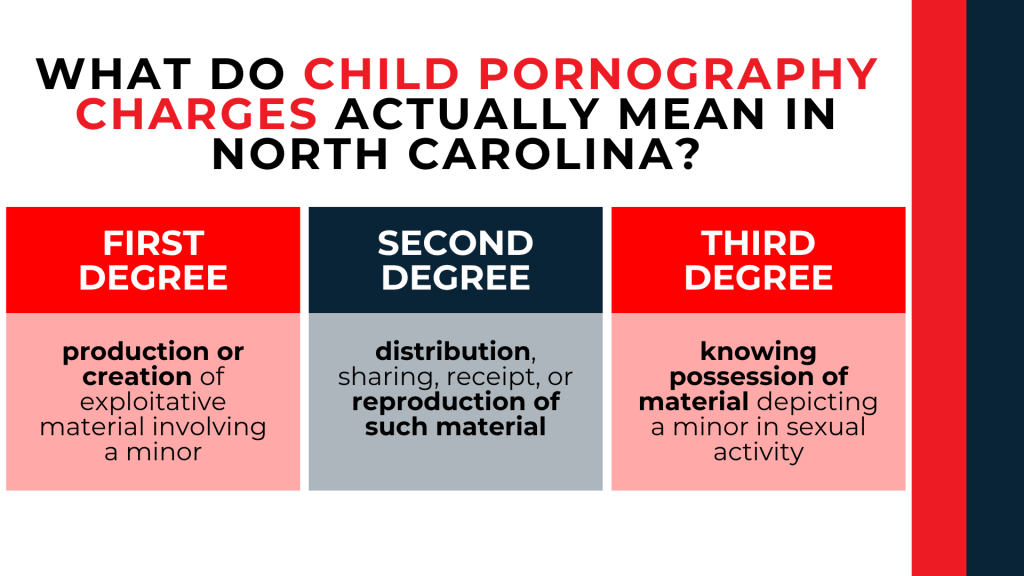
Three-column layout explains first-degree production, second-degree distribution, and third-degree possession offenses.

What Penalties Am I Facing?

Your potential sentences depend on the degree of the charge, your prior record, and whether the case is prosecuted in state or federal court.

North Carolina uses a Structured Sentencing system that calculates punishment ranges based on the offense class and your prior record level. For sexual exploitation charges specifically, the law imposes an enhanced maximum sentence: for Class B1 through Class E felonies requiring sex offender registration, the maximum sentence is calculated at 120% of the minimum plus an additional 60 months, under N.C.G.S. § 15A-1340.17(f).

At the state level, all Class B1 through D felony sex offense convictions result in mandatory active imprisonment — 100% of convictions in those classes received active prison time in FY 2024. For Class E and H felonies, the court has more discretion, and intermediate or community punishments are possible depending on the circumstances and prior record.

Federal prosecution changes the picture dramatically. The average federal sentence for child pornography production is 273 months — nearly 23 years. Federal sexual abuse offenses carry a 99.2% imprisonment rate, and many of these offenses carry mandatory minimum sentences.

These cases also move slowly. The median time from charge filing to sentencing for Class B1 felonies in North Carolina is 30 months — two and a half years — which is three times the overall felony median. Defendants convicted of serious sex offenses spent an average of 27 months in pretrial detention. The weight of the process itself is part of what makes early legal representation critical.
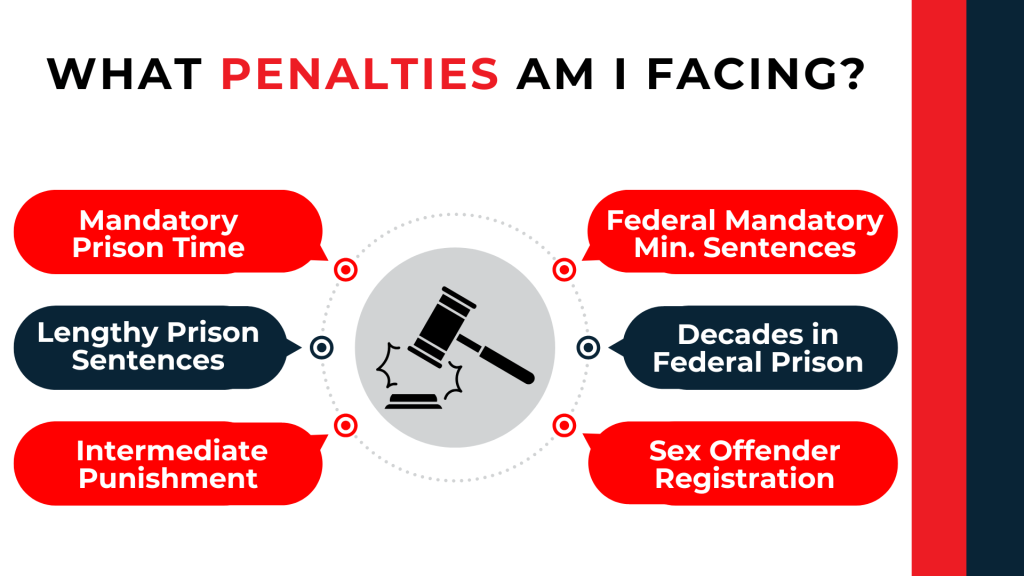
Judge's gavel surrounded by callouts outlining prison terms, mandatory minimums, and registration consequences.

Will I Have to Register as a Sex Offender?

Yes. All three degrees of sexual exploitation of a minor require mandatory sex offender registration in North Carolina. There is no exception, no judicial discretion on this point, and no version of a conviction at any tier that avoids the registry.

The standard registration period under North Carolina's Sex Offender Registry (N.C.G.S. § 14-208 et seq.) is 30 years. After 10 years, if you are not classified as a repeat offender, sexually violent predator, or aggravated offender, you may ask the court to end the registration requirement under N.C.G.S. § 14-208.12A. But that request is discretionary — it is not guaranteed to be granted.

North Carolina currently has approximately 25,000 or more registered sex offenders, and the registry carries real daily consequences. If you are registered, you face residential restrictions, periodic in-person verification requirements, and potential GPS electronic monitoring. 581 sex offenders were enrolled in active GPS monitoring during FY 2022–2023. Registration status is publicly searchable, which affects housing, employment, and community life in ways that persist long after any sentence is served.
Gavel icon highlights mandatory sex offender registration and long-term impacts on housing and employment.

What Are the Consequences Beyond Prison and the Registry?

The consequences beyond your sentence extend into areas that many people do not consider until it is too late to address them.

For non-citizens, the consequences can be immediate and permanent. Sexual abuse of a minor is classified as an aggravated felony under federal immigration law, which triggers mandatory deportation. Most sex offenses also qualify as crimes involving moral turpitude. Under Padilla v. Kentucky, 559 U.S. 356 (2010), defense counsel has a constitutional obligation to advise you of the immigration consequences of a guilty plea. That means any plea negotiation must account for these effects from the start.

Beyond immigration, a conviction creates barriers to employment and professional licensing. Many licensing boards treat sex offense convictions as disqualifying under "good moral character" requirements. Housing options narrow significantly due to both registry restrictions and landlord screening practices. Military service and law enforcement careers are no longer an option.

These consequences matter for defense strategy because they affect how a case should be negotiated. An outcome that looks acceptable when measured only in months of prison time may be devastating when its full long-term consequences are understood. This is one of the reasons that working with an attorney who regularly handles these cases — and who understands the full picture, not just the sentencing grid — matters.
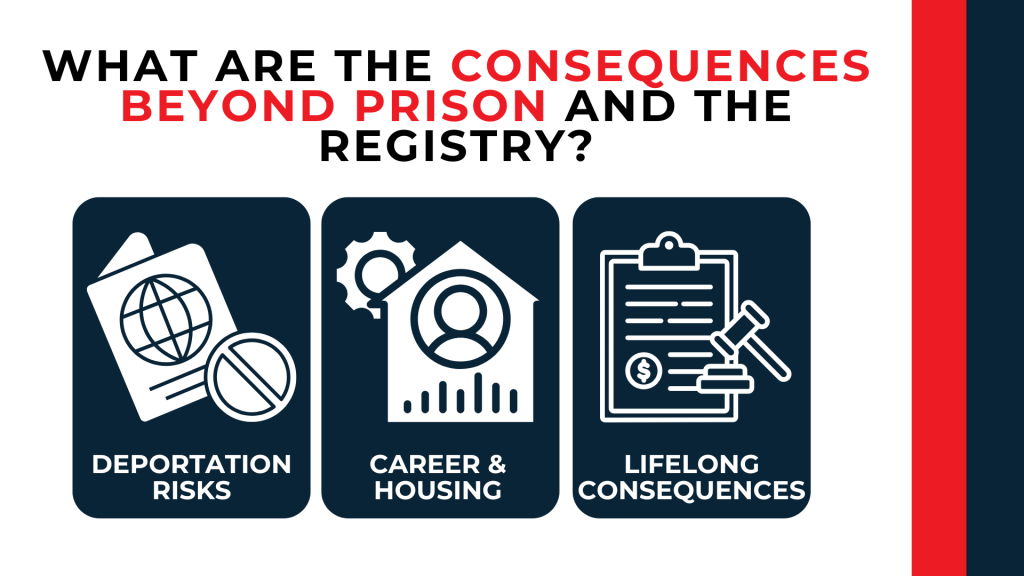
Passport, housing, and legal document icons summarize deportation risks, housing barriers, and lifelong effects.

Talk to a North Carolina Criminal Defense Attorney Who Handles These Cases

Patrick Roberts is a Raleigh criminal defense attorney who has handled sex crime cases across North Carolina for more than 24 years, including internet-based exploitation offenses. He is a former assistant district attorney in Wake, Johnston, and New Hanover counties, which means he understands how prosecutors classify and pursue these charges. He has co-authored a legal book on defending internet sex crimes and is admitted to practice before all three U.S. District Courts in North Carolina, the Fourth Circuit Court of Appeals, and the United States Supreme Court.

Education & Advanced Training

An alumnus of Johns Hopkins University (#7 National University) and Duke University School of Law (#7 National Law School; #9 Criminal Law Program), Mr. Roberts has dedicated his career to honing his trial craft. He is a graduate of the Gerry Spence’s Trial Lawyers College and the National Criminal Defense College (NCDC) Trial Practice Institute, including the 2025 Cross-Examination Intensive.

Accolades & Peer Review

• Martindale-Hubbell AV Preeminent Rating: 5+ Consecutive Years

• Martindale-Hubbell Client Champion Platinum: 5+ Consecutive Years

• AVVO 10/10 “Superb” Rating: 15+ Consecutive Years

• The National Trial Lawyers: Top 100 Trial Lawyers

Mr. Roberts is a published author of two legal books and a lifetime member of the National Association of Criminal Defense Lawyers.

Client Review

“Patrick was professional, honest, and the best lawyer I could have asked for during a very tough situation. Throughout the process, he remained a constant calm and reassuring presence during a challenging time in my life. His guidance and dedication made a difficult experience much more manageable.” - verified Client Review via Avvo.com

Peer Endorsement

"I endorse this lawyer. Patrick is a great trial lawyer and a person who I go to for legal advice in my own practice. Patrick is dedicated to his clients and a master at criminal defense. I would not hesitate to hire him if I was in trouble and needed a lawyer." - verified Peer Review via Avvo.com

DISCLAIMER: Testimonials and peer reviews are for informational purposes only and do not guarantee or predict the outcome of your legal matter. Every case is unique and must be evaluated on its own merits. All endorsements featured on this site are actual comments from clients and peers.

Case Review

Case Summary: The State Bureau of Investigation (SBI) and local law enforcement traced illegal online activity to the client's IP address, leading to accusations of downloading child pornography. Following the execution of a search warrant at the residence, authorities seized multiple items suspected of containing illicit material, and the client provided a confession. Attorney Patrick Roberts intervened to present mitigating factors directly to the district attorney's office, countering the evidence gathered by law enforcement.

Result: The state offered a favorable resolution, resulting in a strictly probationary sentence with no jail or prison time imposed.

*Disclaimer: Each case is different and must be evaluated separately. Prior results achieved do not guarantee similar results can be achieved in future cases.

View more case results

Patrick Roberts Law serves clients from offices in Raleigh, Durham, Chapel Hill, and Cary. If you are facing child pornography charges or expect to be charged, contact the firm to discuss your case.

The law firm limits the volume of active cases to ensure that their staff can provide consistent, comprehensive attention to every matter they handle.

Disclaimer: The information on this website is for general informational purposes only. Nothing herein should be taken as legal advice for any individual case or situation. Contacting us via this website, email, or contact form does not create an attorney-client relationship. Case results depend on a variety of factors unique to each case; prior results do not guarantee a similar outcome.

Attorney illustration promotes experienced legal defense for sex crime and internet offense cases in North Carolina.
Posted in:

Related Posts

Can North Carolina Ban Images of People Who Don't Exist?

The AI Image Loophole: Can North Carolina Ban Images of People Who Don't Exist?

Why State Banning of Purely Synthetic Media Faces First Amendment Challenges Under Federal Law Generative artificial intelligence can now synthesize hyper-realistic images in seconds without using a real photograph or a live human subject. This rapid technological advancement has created a major legal dilemma for state legislatures across the United States. In North Carolina, lawmakers responded by passing Session Law 2024-37 (effective December 1, 2024), updating statutes like N.C. Gen. Stat. § 14-190.17C to criminalize the creation, distribution, and possession of explicit visual media generated or altered by technological means, including artificial intelligence. While the policy goal of protecting youth from exploitation is undeniable, the state's broad law updates face a major First Amendment challenge in federal court—one that provides critical defense opportunities for individuals charged under these modern statutes. Understanding North Carolina’s Synthetic Media Statutes North Carolina’s legal updates under Session Law 2024-37 categorize digital media offenses into distinct statutory tiers: Statute Offense Level Target & Standard Key Forensic / Legal Issue N.C.G.S. § 14-190.16 First degree sexual exploitation of a minor Class C / D Felony Creation for sale involving an identifiable minor (e.g., deepfakes of real people). Proving authorship vs. automated software generation. N.C.G.S. § 14-190.17 Second degree sexual exploitation of a minor Class E Felony Distribution or receipt of altered media depicting real/identifiable minors. Active transmission vs. automated cloud synchronization. N.C.G.S. § 14-190.17C Obscene visual representation of sexual exploitation of a minor Class E / H Felony Simple possession of explicit, "obscene" AI representations (No real minor required). First Amendment overreach; Failure to meet Miller obscenity standards. The Federal Conflict: Why Purely AI-Generated Images Conflict with Precedent To evaluate why state laws banning purely synthetic media face constitutional hurdles, it is necessary to examine how the U.S. Supreme Court treats non-obscene explicit content under the First Amendment. 1. The Physical Harm Rule (New York v. Ferber) In New York v. Ferber, 458 U.S. 747 (1982), the U.S. Supreme Court created an exception to First Amendment protection for child sexual abuse material (CSAM). The ruling was explicitly grounded in a compelling state interest: preventing the physical and psychological abuse of an actual, live child during production. Under Ferber, the image itself acts as a record of a physical crime. 2. Banning Virtual Media Is Unconstitutional (Ashcroft v. Free Speech Coalition) When Congress attempted to ban computer-generated imagery that "appeared to be" a minor under the Child Pornography Prevention Act of 1996, the Supreme Court struck down the statute in Ashcroft v. Free Speech Coalition, 535 U.S. 234 (2002). Justice Anthony Kennedy, writing for the majority, emphasized that: • Virtual depictions do not involve the abuse, coercion, or exploitation of a real physical child. • Speech depicting non-existent minors cannot be banned under Ferber because no live minor was harmed in its creation. • Unless the material independently satisfies the strict legal standard for obscenity under Miller v. California, 413 U.S. 15 (1973), virtual expression remains protected by the First Amendment. 3. Private Possession Rights (Stanley v. Georgia) Under Stanley v. Georgia, 394 U.S. 557 (1969), the First Amendment protects an individual’s right to privately possess non-obscene material inside their home. While Osborne v. Ohio, 495 U.S. 103 (1990) allowed states to criminalize the private possession of traditional CSAM to destroy the commercial market that incentivizes physical child abuse, purely AI-generated images created locally on a machine carry no market connection to real-world harm. Core Legal Defenses in AI Image Cases State prosecutors bringing charges under N.C.G.S. § 14-190.17C for fully synthetic media must navigate complex federal hurdles: 1. Failure to Prove Obscenity ( Miller v. California): For synthetic imagery without a real subject, North Carolina must satisfy all three prongs of the Miller obscenity test—proving the work appeals to prurient interest, is patently offensive, and lacks serious literary, artistic, political, or scientific value. If the state fails to prove obscenity beyond a reasonable doubt, simple private possession remains protected speech. 2. Statutory Overbreadth: Broad definitions that criminalize code or algorithms because they "appear to depict" a minor risk penalizing constitutionally protected artistic expression, technological research, or non-obscene digital media. 3. Forensic Distinction (Synthetic vs. Deepfake): Digital forensics must distinguish between a "deepfake" modified from a real photograph of an actual person (under N.C.G.S. § 14-190.16) and a 100% synthetic image generated entirely from a text prompt. The experts and digital forensic teams Mr. Roberts works with on sex crimes cases are led by previous law-enforcement officers with decades of experience. Demonstrating that an image is fully synthetic eliminates the element of a real victim. To stay updated on these evolving technical defenses, Attorney Patrick Roberts attended the Defending Digital Sex Crimes Bootcamp in Orlando, Florida, in July 2026—a two-day intensive program focused specifically on the defense of possession and distribution cases involving complex digital evidence. Frequently Asked Questions for Families Facing AI & Digital Media Charges Navigating a high-stakes criminal investigation can feel overwhelming for a family. Below are answers to critical legal and practical questions families frequently ask when facing complex digital media allegations in North Carolina. Q: Can a person be charged in North Carolina if no actual minor was used to create the image? A: Yes. Under N.C.G.S. § 14-190.17C, state law permits prosecution for explicit synthetic media even if no live child was involved. However, because no physical victim exists, these charges are vulnerable to First Amendment challenges under federal law. Q: What is the difference between an "AI Deepfake" and a "Purely Synthetic Image"? A: A deepfake uses an existing photograph or video of a real, identifiable person and alters it using AI tools (charged under N.C.G.S. § 14-190.16). A purely synthetic image is generated entirely from scratch by an algorithm without referencing or utilizing an actual person's likeness. Q: What should our family do if law enforcement executes a search warrant for computers or phones? A: If police arrive with a search warrant, remain calm, do not resist, but do not consent to any searches beyond what is explicitly written in the warrant. Most importantly, every family member should exercise their constitutional right to remain silent. Do not attempt to explain device contents, provide passwords, or answer questions without a defense attorney present. Q: Could these charges end up in federal court instead of state court? A: Yes. If law enforcement alleges that images crossed state lines (via the internet, cloud storage, or peer-to-peer networks), federal prosecutors can bring charges in federal district court. Defense attorney Patrick Roberts maintains a robust federal defense practice across all three North Carolina federal districts (Eastern, Middle, and Western Districts), handling complex federal felony indictments involving digital evidence. Q: How does a defense lawyer handle cases where digital evidence overlaps with other serious allegations? A: Digital cybercrime investigations frequently intersect with broader, high-stakes felony investigations. Attorney Patrick Roberts handles complex felony defense, including sensitive sex offenses (such as statutory rape or indecent liberties allegations), as well as serious white-collar and drug trafficking investigations. Having a defense team capable of handling multi-layered, complex felony charges ensures every constitutional defense—from search warrant execution to digital forensic analysis—is aggressively pursued. Q: Will an arrest automatically lead to sex offender registration for synthetic media? A: A conviction for felony sexual exploitation or obscene representation statutes can carry mandatory sex offender registration requirements in North Carolina. You can research state registration requirements and legal classifications directly using our interactive Sex Offense Search Tool. An arrest is not a conviction—early intervention by experienced counsel can challenge the legality of the state's evidence, push to reduce felony charges, or seek a full dismissal based on constitutional overreach before a trial occurs. Experienced Legal Advocacy for Complex Digital Media Defense As North Carolina’s Session Law 2024-37 introduces new, untested boundaries regarding the possession of synthetic media, the complexity of digital forensic evidence requires specialized legal advocacy. Patrick Roberts, Managing Partner of Patrick Roberts Law PLLC, brings over two decades of courtroom experience, including extensive work specifically addressing digital forensics and Internet Crimes Against Children (ICAC) investigations. Having handled more than 250 felony sex crime cases and routinely collaborating with independent digital forensic experts to audit government data, Mr. Roberts possesses the technical expertise to challenge the scientific and legal sufficiency of AI-related allegations. A former Assistant District Attorney who transitioned to a dedicated career in defense, he provides rigorous representation for clients facing evolving digital charges, ensuring that constitutional protections—particularly those concerning First Amendment scrutiny and the "Miller" obscenity standard—remain at the forefront of the defense strategy. • AV Preeminent Rating (Martindale-Hubbell): Recognized for eight consecutive years (2018–2026) through a rigorous, peer-reviewed national vetting process confirming the highest level of professional excellence and ethical standards. • Duke University School of Law Alumnus: Earned a Juris Doctor (J.D.) from Duke University School of Law, providing a strong academic foundation for complex litigation. • National Association of Distinguished Counsel Selection: Selected as part of the "Nation's Top 1 Percent" of attorneys for multiple years, including 2025 and 2026, based on demonstrated legal merit. • Former Prosecutor Perspective: Leveraging four years of experience as an Assistant District Attorney (2003–2007) across three North Carolina districts, specifically managing dockets for juvenile sex crimes and digital forensic evidence. • Advanced Digital Sex Crimes Training: Completed the "Defending Digital Sex Crimes Bootcamp" (2026) and coursework on child abuse allegations, focusing specifically on the defense of cases involving digital and synthetic evidence. • Expert in Sex Crime Defense: Experience rooted in the defense and prosecution of more than 250 felony sex offense cases across North Carolina. Co-authored the professional legal text *Strategies for Defending Internet Pornography Cases* (Aspatore Books, 2008), which details the analysis of electronic documents and the utilization of technology experts in criminal defense. Client Review "Mr. Roberts is the best lawyer he handled my son’s case with such care and concern for my son's future and the outcome was great for all the hard work he did thanks so much Mr. Roberts, if you need a criminal lawyer please get him you won’t be disappointed." — Review by a verified client via Avvo (read more on our Client Reviews page) Peer Endorsement "I endorse this lawyer. Patrick is a great trial lawyer and a person who I go to for legal advice in my own practice. Patrick is dedicated to his client's and a master at criminal defense. I would not hesitate to hire him if I was in trouble and needed a lawyer." — Peer endorsement by a fellow North Carolina trial attorney via Avvo Disclaimer: The client reviews and peer endorsements displayed are authentic testimonials and comments provided by clients and fellow attorneys. Every case is unique and must be evaluated individually; past client experiences and case results do not guarantee, promise, or predict similar outcomes in any future matter. Case Results When choosing legal representation, you have every right to look closely at what an attorney has actually accomplished for past clients. Here is a look at real case results handled by Attorney Patrick Roberts: • Child Sexual Abuse Material Possession Allegation: The client was under investigation for downloading illicit digital materials, with law enforcement seizing evidence and obtaining a confession at the client's home. Mr. Roberts effectively advocated for the client, providing mitigating evidence that convinced the District Attorney's office to offer a probationary sentence, avoiding incarceration and allowing for interstate probation transfer. ○ Outcome: Probation and successful transfer of supervision. • Second-Degree Exploitation of a Child Charges: The client faced two felony counts involving online communications and photo exchanges with a minor. Mr. Roberts conducted a thorough investigation into the client’s psychological history and presented expert mental health evaluations to prosecutors, leading to a negotiated plea agreement. ○ Outcome: Two misdemeanors with probation; avoided prison, felony conviction, and sex offender registration. • Child Pornography Investigation and Misdemeanor Charges: The client faced a federal investigation for child pornography alongside state charges for larceny and resisting a public officer. An independent defense investigation by Attorney Patrick Roberts uncovered contradictory evidence, which prevented federal charges from being filed and led to the dismissal of all state-level charges. ○ Outcome: No federal charges filed and dismissal of all state charges. Disclaimer: Case outcomes depend upon a variety of factors unique to each case. Prior results do not guarantee or predict a similar outcome in any future legal matter. Click here for more case results. Protect Your Rights Against AI-Related Criminal Charges As Session Law 2024-37 introduces complex new challenges regarding the possession and distribution of synthetic imagery, individuals facing investigation require a defense rooted in both constitutional law and advanced forensic understanding. If you are navigating an inquiry involving AI-generated media, immediate and experienced legal counsel is essential to address the constitutional questions surrounding these new statutes and to ensure your rights are rigorously protected against potential overreach. Patrick Roberts Law PLLC provides experienced advocacy for clients facing these complex digital charges, with a comprehensive practice that serves individuals state-wide across North Carolina. Whether you are seeking Wake County sex crimes defense —including Raleigh, Cary, Apex, Holly Springs, Garner, or Fuquay-Varina—or representation in any other jurisdiction in the state, our firm is prepared to offer the focused, authoritative defense necessary for this evolving legal landscape. Please contact us at www.patrickroberts.law to discuss your legal options. Patrick Roberts Law PLLC utilizes a selective intake process to ensure full commitment of necessary time and resources to complex legal challenges. Disclaimer: This article is general legal information, not legal advice. Reading it does not create an attorney-client relationship. North Carolina criminal law governing digital and synthetic media is rapidly evolving and subject to statutory interpretation. How these rules apply depends on the specific facts of your case. For guidance on your situation, consult a licensed North Carolina attorney.

Can North Carolina Ban Images of People Who Don't Exist?

Is North Carolina’s Iryna’s Law Unconstitutional? Inside the Jail Overcrowding Crisis

By Patrick Roberts Law, PLLC What Is Happening with North Carolina's Pretrial System? A sweeping pretrial release reform statute ( House Bill 307 / Iryna’s Law) has caused severe overcrowding across North Carolina detention facilities, pushing the Wake County Detention Center system far past its physical capacity. By replacing traditional judicial discretion with mandatory secured bonds and rebuttable presumptions against release for broad charge categories, hundreds of legally innocent defendants remain detained pretrial. Legal scholars and defense attorneys argue that these overcrowded, unsanitary conditions raise serious Eighth Amendment challenges regarding cruel and unusual punishment and excessive bail. Why Is the Wake County Detention System at a Breaking Point? The Wake County Detention Center system is severely overcrowded because Iryna’s Law drastically restricts pretrial release options, holding hundreds of legally innocent defendants in custody before trial. In August 2026, the Wake County Detention Center system reported housing over 1,800 detainees (peaking above 1,900) in facilities designed for a maximum operational capacity of 1,574 beds. Investigative reporting from WRAL News and official records from the Wake County Sheriff’s Office confirm that this surge forced detention staff to convert multipurpose rooms into housing and set up temporary sleeping arrangements in common floor areas to accommodate the overflow. This operational strain stems directly from House Bill 307, officially known as Iryna’s Law, enacted as Session Law 2025-93, which took effect across North Carolina on December 1, 2025. By establishing mandatory restrictions and rebuttable presumptions against pretrial release for broad categories of criminal charges, the statute has led to a historic spike in the number of individuals held without bond or under unattainable secured bonds while awaiting trial. For defendants, families, and criminal defense practitioners in Raleigh and across North Carolina, this systemic bottleneck raises a critical constitutional question: Does prolonged pretrial detention in severely overcrowded, understaffed facilities violate the Eighth Amendment? What Is Iryna’s Law, and How Does It Change Pretrial Release? Iryna’s Law (HB 307) is a North Carolina pretrial release statute that restricts judicial discretion by creating a legal presumption against release and requiring mandatory secured bonds or detention holds for broad charge categories. What Was the Intent Behind the Legislation? North Carolina lawmakers drafted Iryna’s Law following the high-profile August 2025 homicide of Iryna Zarutska on a Charlotte light rail train. The primary statutory goal was to enhance public safety by tightening bail eligibility for individuals accused of violent offenses or those identified as repeat violent offenders. How Does HB 307 Mandate Detention under N.C.G.S. § 15A-534 and § 15A-531? Under N.C. Gen. Stat. § 15A-534, as amended by House Bill 307 (Session Law 2025-93), written promises to appear were repealed statewide as a permissible release condition for any offense. In addition, under § 15A-534(b1) and the expanded "violent offense" definition in N.C.G.S. § 15A-531(9), judicial officials (magistrates and judges) face a statutory presumption that no condition of release will reasonably assure appearance or public safety, barring unsecured bonds and custody releases for: • Any felony offense requiring registration on the North Carolina Sex Offender Registry. • Offenses involving Possession of a Firearm by a Felon ( N.C.G.S. § 14-415.1). • Designated repeat violent felony offenses. Under this strict framework, the burden shifts to the defense to produce competent evidence overcoming the statutory presumption of detention, and judges must issue written findings of fact under § 15A-534(d) explaining why any authorized release conditions adequately assure court appearance and public safety. Pre-Iryna's Law (Prior Framework) Post-Iryna's Law (HB 307 / S.L. 2025-93) Presumption of release on least restrictive conditions Rebuttable presumption of detention (§ 15A-534(b1)) Written promise to appear & unsecured bonds allowed Written promises repealed; secured bond or electronic monitoring mandatory for qualifying offenses Informal bond modification hearings Evidentiary burden on defense How Severe Is Jail Overcrowding Across North Carolina? Jail overcrowding under Iryna’s Law is a statewide crisis affecting urban centers, coastal counties, and rural communities throughout North Carolina. While the Wake County Detention Center in Raleigh faces a severe urban bottleneck, operational crises are reported across the state: • Wake County (Raleigh): Wake County Sheriff's Office census data indicates that the number of individuals held without bail surged from 140 in November 2025 to over 530 by late August 2026, driving total detention counts between 1,778 and 1,931 against a rated capacity of 1,574 beds. • Mecklenburg County (Charlotte): Records analyzed by WCNC Charlotte show Mecklenburg County Detention Center held nearly 2,200 individuals in space rated for 1,907, generating multimillion-dollar budget overruns in food, overtime, and medical services. • Non-Triangle Counties (Robeson, Carteret, Scotland): According to NCDHHS jail inspection data and NC Health News, more than one-third of North Carolina county detention facilities exceeded capacity in 2026, including Robeson County (over 500 inmates in a 410-bed jail) and Carteret County (146 inmates in a 117-bed facility). Does Jail Overcrowding Violate the Eighth Amendment? Overcrowded jail conditions may violate the Eighth and Fourteenth Amendments when severe space shortages, lack of sanitation, and inadequate medical care turn pretrial detention into unconstitutional punishment for individuals legally presumed innocent. The Eighth Amendment to the United States Constitution provides that: "Excessive bail shall not be required, nor excessive fines imposed, nor cruel and unusual punishments inflicted." Legal scholars and constitutional defense attorneys evaluate the impact of Iryna's Law under two primary legal doctrines: 1. When Does Bail Become Unconstitutional Pretrial Punishment? In United States v. Salerno, 481 U.S. 739 (1987), the U.S. Supreme Court held that pretrial detention is constitutional only when it serves a regulatory purpose (such as community safety or ensuring court appearance) rather than a punitive one. When statutory presumptions lead to the categorical detention of individuals charged with non-violent underlying facts—or who lack the financial means to pay high secured bonds—defense attorneys argue that the bail structure functions as unconstitutional pretrial punishment. 2. How Do Conditions of Confinement Apply Under Bell v. Wolfish? Pretrial detainees are protected by the Due Process Clause of the Fourteenth Amendment and the Eighth Amendment's protections against cruel and unusual punishment. In Bell v. Wolfish (1979), the Supreme Court ruled that conditions of pretrial confinement must not amount to punishment. Within the U.S. Court of Appeals for the Fourth Circuit (which exercises jurisdiction over federal appeals from North Carolina), courts analyze whether severe overcrowding, lack of sanitation, restricted access to medical care, or sleeping on floors violates constitutional standards. How Can an Experienced Criminal Defense Lawyer Help You Get Released? An experienced criminal defense attorney can overcome the statutory presumption against release by presenting clear evidence of community ties, offering enforceable release plans, and filing constitutional bond modification motions. Under HB 307, magistrate decisions are no longer routine administrative hurdles; overcoming a statutory presumption against release requires an immediate, strategic legal response. 1. How Do You Overcome the Rebuttable Presumption Against Release? Because Iryna’s Law shifts the burden of proof onto the defense, an attorney works rapidly to assemble a persuasive evidentiary portfolio before the first formal bond motion. This includes gathering verified employment records, character affidavits, proof of local residency, and clean histories of past court compliance to demonstrate that the defendant poses neither a flight risk nor a danger to the community. 2. What Structured Alternatives to Detention Can a Defense Attorney Present? Judges are often hesitant to grant release under Iryna’s Law without concrete safeguards. An attorney presents tailored, enforceable release plans—such as Continuous Alcohol Monitoring (CAM), GPS electronic monitoring, supervised third-party custody, or residential treatment placement—addressing specific judicial safety concerns while securing the individual’s release. 3. How Can Lawyers Challenge Unconstitutional Confinement Conditions? Where severe overcrowding, unsanitary quarters, or lack of medical care are present in local facilities like the Wake County Detention Center, defense counsel can file formal motions for bond modification based on Eighth Amendment and Fourteenth Amendment Due Process grounds. Documenting these harmful conditions gives the court strong legal justification to reduce bond or order release on conditions. 4. How Does an Attorney Prevent Your Case from Getting Stuck in the System? With overcrowded dockets and backlogged jails, unrepresented individuals risk languishing in detention for months waiting for a court date. A dedicated criminal defense lawyer files emergency motions for bond modification, requests expedited hearings, and ensures the case moves forward quickly through the 10th Judicial District court system. What Are the Most Effective Defense Strategies Under Iryna's Law? The most effective defense strategies involve early evidence gathering, offering actionable monitoring alternatives, and filing constitutional motions challenging detention conditions. 1. Overcoming the Statutory Presumption: Compile documentary evidence prior to the bond hearing, including verified employment records, proof of local residency, character affidavits, and clean compliance records for past court appearances. 2. Proposing Structured Release Conditions: Offer actionable alternatives—such as electronic monitoring (CAM/GPS), third-party custody arrangements, or specialized treatment programs—to address judicial safety concerns directly. 3. Filing Motions Based on Confinement Conditions: Where severe overcrowding or medical neglect is documented, file formal motions for bond modification citing Eighth Amendment and Due Process concerns regarding the conditions of pretrial holding. Frequently Asked Questions About Iryna’s Law & Wake County Pretrial Release What is Iryna’s Law (HB 307) in North Carolina? Iryna’s Law (House Bill 307 / Session Law 2025-93) is a North Carolina pretrial release reform statute that took effect on December 1, 2025. It restricts the options judicial officials (magistrates and judges) have for granting bail. The law repealed written promises to appear across the board for all criminal offenses, barred unsecured bonds for qualifying violent and repeat offenses, and created a statutory rebuttable presumption against pretrial release requiring secured bonds or electronic house arrest if release is granted. Why are Wake County jails so overcrowded right now? Wake County Detention Centers are severely overcrowded because Iryna’s Law drastically limits pretrial release options. As a result, hundreds of individuals charged with offenses like firearm possession or registrable sex offenses are held without bond or with high secured bonds while awaiting trial, causing the local jail population to exceed physical capacity. Does Iryna’s Law apply to non-violent charges or firearm offenses? Yes. Although designed to target violent crime, Iryna’s Law broadly defines "violent offenses" to include charges such as Possession of a Firearm by a Felon ( N.C.G.S. § 14-415.1) and any felony requiring registration on the NC Sex Offender Registry, forcing individuals facing these charges to meet strict legal burdens to obtain bond. How does jail overcrowding violate the Eighth Amendment? Under the Eighth Amendment and Fourteenth Amendment Due Process principles ( Bell v. Wolfish), pretrial detainees who are legally presumed innocent cannot be subjected to conditions that amount to punishment. When severe overcrowding forces detainees to sleep on floors in unsanitary quarters with compromised medical access, defense attorneys can argue the confinement violates constitutional protections against excessive bail and cruel and unusual punishment. Can you still get a bond if you are held under Iryna’s Law in Wake County? Yes, but the burden of proof is on the defendant. Instead of an informal bail setting, a defense attorney must present formal evidence—such as verified employment, community ties, lack of flight risk, and structured release plans (e.g., GPS electronic monitoring)—to overcome the statutory presumption against release during a bond modification hearing in Wake County District Court. Strategic Legal Advocacy for Overcoming Iryna’s Law Detention Mandates As North Carolina’s courts grapple with the systemic pressures introduced by "Iryna’s Law," securing pretrial release has become a complex legal challenge requiring aggressive advocacy and strategic preparation. Attorney Patrick Roberts provides the depth of experience necessary to challenge restrictive detention mandates. With a career spanning over two decades, Mr. Roberts leverages his background as a former Assistant District Attorney and his extensive record handling hundreds of complex felony cases to dismantle the state’s justifications for continued incarceration. His practice emphasizes the development of robust, evidence-based release plans that effectively demonstrate community ties and mitigate the risks cited by the prosecution. Recognized by his peers with an AV Preeminent rating from Martindale-Hubbell and frequently consulted for his expertise in navigating North Carolina’s evolving criminal procedure and constitutional law, Mr. Roberts offers the focused representation required to advocate for clients impacted by the current jail overcrowding crisis. • AV Preeminent Rating (2018–2026): Consistently awarded the highest peer-review rating for professional excellence and ethical standards by Martindale-Hubbell. • National Association of Distinguished Counsel (NADC) Selection: Recognized among the "Nation's Top 1 Percent" of attorneys in 2015, 2016, 2017, 2018, 2025, and 2026. • Attorney-At-Law Magazine "Attorney of the Month": Featured as the 2022 cover story subject for professional distinction and leadership in the field of criminal defense. • Former Prosecutor Perspective (2003–2007): Brings critical insight into state sentencing and detention policies from four years of service as an Assistant District Attorney across three North Carolina prosecutorial districts. • Legislative Planning Experience: Served as a committee member on the North Carolina Juvenile Justice Planning Committee under the Governor's Crime Commission, providing experience with the regulatory and planning bodies that shape state criminal justice frameworks. Client Review "I recently hired A. Patrick Roberts as my lawyer, and I couldn't be more pleased with the outcome of my case. He represented me in a domestic violence accusation, and thanks to his exceptional skills, my case was dismissed. From our first meeting, Patrick impressed me with his thorough understanding of the law and his strategic approach to my case. He not only provided clear and practical legal advice but also employed smart strategies that were beyond my expectations. His attention to detail and dedication to my defense made all the difference. If you're looking for a lawyer who truly cares about his clients and knows how to navigate complex legal situations, I highly recommend A. Patrick Roberts. He is an outstanding lawyer, and I am incredibly grateful for his support." — Review by a verified client via Avvo Peer Endorsement "I endorse Andy. He is a highly skilled attorney that is well respected in the legal community." — Peer endorsement by a fellow North Carolina trial attorney via Avvo Disclaimer: The client reviews and peer endorsements displayed are authentic testimonials and comments provided by clients and fellow attorneys. Every case is unique and must be evaluated individually; past client experiences and case results do not guarantee, promise, or predict similar outcomes in any future matter. Case Results Understanding the specific outcomes a lawyer has delivered helps you feel confident in your decision. Below are examples of past cases resolved by Attorney Patrick Roberts: • Out-of-State Probation Violation Allegations: The client faced probation violation charges while residing out-of-state. Mr. Roberts demonstrated to the court that the violations were due to miscommunication between the client and probation officers, leading the court to dismiss the violation and terminate the client's probation. ○ Outcome: Dismissed • Felony Probation Violation Linked to Armed Robbery: The client was accused of a felony probation violation related to prior charges of Robbery with a Dangerous Weapon. Defense counsel persuaded the court to maintain probation rather than impose an active sentence, resulting in an extension of probation with mandatory drug treatment. ○ Outcome: Probation extended with drug treatment • Common Law Robbery Charge: The client faced accusations of common law robbery involving a BB pistol and a potential prison sentence of 31 to 47 months. Defense counsel presented psychiatric records detailing severe mental health disorders, which persuaded the prosecution to dismiss the felony charge. The client subsequently pleaded to a reduced charge of larceny. ○ Outcome: Common Law Robbery charge dismissed; pleaded to reduced charge of larceny, received 24 months of probation and seven days in jail Disclaimer: Case outcomes depend upon a variety of factors unique to each case. Prior results do not guarantee or predict a similar outcome in any future legal matter. Protecting Your Rights Amidst North Carolina’s Pretrial Detention Crisis The implementation of House Bill 307 has fundamentally altered the landscape of pretrial release in North Carolina, often resulting in prolonged detention for those accused of felonies. Successfully challenging these new, restrictive bond mandates requires a sophisticated legal strategy that proactively addresses the court’s presumption against release. At Patrick Roberts Law PLLC, we build comprehensive, evidence-based release plans designed to overcome these systemic obstacles. Whether you are facing charges within our primary practice areas of Wake County—including Raleigh, Cary, Apex, Holly Springs, Garner, and Fuquay-Varina—or require representation for high-stakes litigation in any county across North Carolina, our firm provides the focused defense necessary to advocate for your liberty. If you or a loved one are affected by these shifting pretrial standards, contact us to discuss your options. Visit www.patrickroberts.law to learn more about our approach to complex criminal defense and to schedule a consultation. Disclaimer: This article is provided for informational and educational purposes only and does not constitute formal legal advice, nor does it establish an attorney-client relationship. Pretrial release laws and detention conditions vary based on individual case facts. If you or a family member are facing criminal charges in North Carolina, consult a qualified criminal defense attorney licensed in the State of North Carolina.

Can You Still Get Bond After an Arrest Under Iryna’s Law in North Carolina?

Can You Still Get Bond After an Arrest Under Iryna’s Law in North Carolina?

By Patrick Roberts Law PLLC Obtaining pretrial release after an arrest for a qualifying offense under Iryna’s Law is possible, but it requires overcoming a strong statutory presumption against release. Rather than receiving a routine bond at the initial magistrate appearance, defendants charged with qualifying offenses face mandatory secured bonds, electronic monitoring holds, or complete no-bond orders. Securing release requires hiring an experienced criminal defense lawyer to file an expedited Motion for Bond Modification in Wake County District or Superior Court and presenting concrete, verified evidence that the defendant is neither a flight risk nor a danger to the public. What Is Causing the Current Jail Overcrowding Crisis in North Carolina? Overcrowded detention facilities across North Carolina are at a breaking point, driven by a sharp rise in defendants held without bond or on unreachable secured bonds following the passage of Iryna’s Law. Investigative reporting from WCNC and local news outlets highlights how detention centers across the state are seeing inmate populations outpace available bed capacity. When detention centers exceed roughly 80% capacity, facilities are considered effectively full due to necessary classification rules that separate inmates based on security risk, gender, and mental health needs. Statistical Surge: How HB 307 Has Strained Wake County and Regional Detention Facilities The systemic impact of Iryna’s Law ( HB 307), which took effect on December 1, 2025, is a primary catalyst behind these rising numbers: • Spike in Detainees Held Without Bond: In Wake County alone, official records show that 198 individuals were held without bond when Iryna’s Law took effect. By August 2026, that number surged to 533 detainees held without bond. • Exceeding Bed Capacities: Wake County’s two detention facilities have a design capacity of 1,574 beds. The county’s average monthly population skyrocketed from 1,198 in 2021 to an average of 1,778 in July 2026. • Overflow Measures & Out-of-County Transfers: To manage severe space shortages, Wake County has been forced to transfer overflow inmates to facilities in Caswell and Northampton counties. • Statewide Facility Strains: Other counties face identical operational bottlenecks. Union County's facility exceeded its 264-bed capacity (reaching 280), Lincoln County is building an expansion to hit 300 beds, and Cabarrus County uses temporary floor sleeping arrangements ("boats") due to bed and staffing limits. • Cancellation of Rehabilitation Programs: Overcrowding and safety concerns have forced facilities like Union County to cancel inmate educational programs, including GED classes, due to classroom space being repurposed for extra beds. This severe operational congestion means unrepresented defendants risk languishing in overcrowded, highly stressed facilities for weeks or months while waiting for their cases to move through backlogged court dockets. What Happens at Your First Appearance Hearing Under Iryna’s Law? During the initial 48-hour first appearance hearing under Iryna’s Law, magistrates and judges routinely issue high secured bonds or temporary no-bond orders because the statute restricts their authority to grant unsecured release. Under North Carolina General Statutes §§ 15A-533 and 15A-534, as amended by Session Law 2025-93 (House Bill 307), judicial officials are strictly barred from issuing written promises to appear or unsecured bonds for offenses classified as "violent" under N.C.G.S. § 15A-531(9) or qualifying repeat allegations. If you or a family member are arrested in Wake County, the pretrial process follows a strict statutory framework: • Initial Appearance (Promptly After Arrest / 48-Hour Domestic Rule): Under N.C.G.S. § 15A-511, an arrested individual is brought before a magistrate. For qualifying violent offenses, including Possession of a Firearm by a Felon, domestic violence charges (governed by N.C.G.S. § 15A-534.1’s 48-hour judicial hold), or felony sex crimes, the court must apply a rebuttable presumption against release, routinely setting substantial secured bonds or entering no-bond holds pending formal hearing. • First Appearance Hearing (Within 96 Hours): Under N.C.G.S. § 15A-601(c), felony defendants remaining in custody must receive a first appearance before a District Court Judge within 96 hours of arrest (or at the first open session of District Court). This provides counsel the initial forum to address counsel appointment, review the state’s statutory triggers, and calendar a full bond modification hearing. What Types of Pretrial Release Are Still Allowed Under HB 307? Iryna’s Law eliminates unsecured bonds and written promises to appear for qualifying charges, limiting legal pretrial release options to secured monetary bonds, house arrest with electronic monitoring, or supervised custody. If a judge determines that pretrial release is appropriate after hearing evidence, North Carolina law limits the court to specific statutory release conditions: Release Mechanism Statutory Requirement Under Iryna's Law Unsecured Bond / Written Promise Prohibited for all qualifying charges. Secured Appearance Bond Allowed; requires full cash, real property collateral, or a licensed bail bondsman. House Arrest with Electronic Monitoring Allowed; mandatory for second-offense violent allegations; defendant covers vendor fees. Monitored Pretrial Services Custody Allowed in select jurisdictions when paired with continuous location tracking. How Does Defense Counsel Overcome the Presumption Against Release? An experienced defense attorney overcomes the rebuttable presumption by presenting concrete, documentary evidence of community stability, employment, clean court compliance history, and structured supervision plans. Because Iryna’s Law shifts the burden of proof onto the defense, simply arguing that a defendant is "innocent until proven guilty" is legally insufficient to secure bond. A skilled legal team will prepare and submit an organized evidentiary packet at the bond modification hearing: 1. Proving Lack of Flight Risk Defense counsel provides verified documentation to prove strong roots in Wake County or North Carolina, including: • Current residential leases or property ownership deeds. • Verified proof of steady local employment or school enrollment. • Affidavits from family members, employers, or community leaders. • Official certified court records demonstrating 100% compliance with past court dates. 2. Addressing Community Safety Concerns To convince a judge that release will not jeopardize public safety, your attorney structures enforceable risk-mitigation measures: • Private Electronic Monitoring (GPS): Securing a pre-approved contract with an authorized electronic monitoring provider prior to the hearing. • Continuous Alcohol / Drug Monitoring (CAM): Agreeing to voluntary, daily substance monitoring transponders. • No-Contact Orders & Restrictive Curfews: Establishing strict geographical boundaries and stay-away orders regarding alleged victims or co-defendants. What Steps Should Families Take Immediately After an Arrest in Wake County? Families should refrain from discussing case details over jail phones, retain qualified legal representation immediately, and gather employment and residency documentation for the bond hearing. If a relative is currently held at the Wake County Detention Center in Raleigh, follow these critical steps: 1. Do Not Discuss Case Details on Jail Phone Calls: All inmate telephone calls and video visits at Wake County facilities are recorded by law enforcement and prosecutors. Never discuss the facts of the alleged crime on the phone. 2. Gather Proof of Community Ties: Collect recent pay stubs, lease agreements, utility bills, and character references immediately so your criminal defense lawyer can prepare the bond packet. 3. Contact a Dedicated Defense Attorney: Bond hearings under Iryna’s Law require formal written motions. Retaining qualified legal counsel early ensures a motion is placed on the court docket without unnecessary delays. Frequently Asked Questions About Bond Modification in North Carolina Can a magistrate set a bond under Iryna’s Law, or do you have to see a judge? Magistrates can set secured bonds for certain first-time qualifying offenses under Iryna's Law, but they cannot grant unsecured release. For repeat violent allegations or cases requiring mandatory house arrest with electronic monitoring, only a District or Superior Court Judge can determine bond conditions. How long does it take to get a bond modification hearing in Wake County? Once your attorney files a formal Motion for Bond Modification in Wake County District Court, a hearing is typically scheduled within 3 to 7 business days, depending on court docket availability and whether emergency calendar priority is granted. Who pays for electronic monitoring if house arrest is granted? Under North Carolina law, the defendant is financially responsible for the daily monitoring fees charged by state-approved electronic monitoring vendors. Demonstrating the financial ability to pay for monitoring vendor services is often required before a judge signs the release order. What happens if you violate electronic house arrest while on pretrial release? Violating electronic monitoring conditions—such as breaching a designated curfew or entering restricted zones—results in an immediate order for arrest (OFA), revocation of bond, and continuous detention until trial without eligibility for re-release under HB 307. Why Experienced Legal Representation Matters for Bond Modification When facing the restrictive mandates of Iryna’s Law, securing pretrial release requires a high level of advocacy and a precise, evidentiary-based approach to bond hearings. Attorney Patrick Roberts, an AV Preeminent-rated defense attorney with over two decades of courtroom experience, leverages his extensive background in both prosecution and criminal defense to challenge the statutory presumption of detention. Mr. Roberts has successfully litigated complex bond and custody issues across North Carolina, drawing on his deep understanding of how judicial officers weigh flight risk and public safety to craft compelling arguments for release. By utilizing his experience in managing high-stakes litigation—including felony sex crime defense and violent crime cases—he works to develop the structured release plans and documented community evidence necessary to satisfy the court’s burden of proof and restore his clients' liberty while their cases proceed. • AV Preeminent and Client Champion Platinum Ratings: Recognized by Martindale-Hubbell for eight consecutive years (2018–2026) based on peer review and verified client satisfaction benchmarks. • Juris Doctor from Duke University School of Law: Graduated from the prestigious law school, establishing a foundational academic background in legal theory and procedure. • National Association of Distinguished Counsel (NADC): Selected as a member of the "Nation’s Top 1 Percent" on six separate occasions spanning 2015 to 2026. • Former Prosecutor Perspective: Assistant District Attorney Experience: Served four years managing dockets in three North Carolina districts, providing critical insight into the state’s tactical approaches during detention and bond hearing procedures. • NCDC Trial Practice Institute Graduate: Completed an intensive, two-week training program at the National Criminal Defense College focused on advanced litigation and evidence management strategies essential for challenging pretrial restrictions. • Gerry Spence's Trial Lawyers College Graduate: Successfully completed a three-week residential trial advocacy program accredited for 143.25 CLE hours, providing specialized training in high-stakes courtroom argumentation and evidentiary presentation. Client Review With the sensitive nature of my case, every step of this process was frightening. Patrick and the wonderful people he works with were kind, caring, and nonjudgmental. He made his role very clear to me from the beginning and promised to do everything he could to help clear my name. And he did! They answered every question I had to the best of their ability. Patrick connected me directly with the people and services outside of his office to help me get my life back. I can honestly say I am better off now than I ever was before. If you are feeling as lost and confused as I was, do not look any further. Patrick Roberts is the man you need to represent you. His experience and knowledge of the legal system gave me a second chance in life. If you are reading this, you have found the right attorney. — Review by a verified client via Avvo Peer Endorsement "Patrick Roberts is undoubtedly one of the best attorney advocates in the Triangle area. His experience as a former prosecutor is invaluable to any client seeking an attorney who knows the ropes. His honesty, integrity, and straightforwardness are qualities every client should seek in an attorney. I would, without hesitation, strongly recommend Mr. Roberts to anyone seeking an outstanding criminal defense lawyer." — Peer endorsement by a fellow North Carolina trial attorney via Avvo Disclaimer: The client reviews and peer endorsements displayed are authentic testimonials and comments provided by clients and fellow attorneys. Every case is unique and must be evaluated individually; past client experiences and case results do not guarantee, promise, or predict similar outcomes in any future matter. Case Results You deserve to see the tangible results an attorney has achieved before deciding who represents you. Below, you can explore some of the specific cases and outcomes Attorney Patrick Roberts has achieved for his clients: • Robbery with a Dangerous Weapon: The defendant was accused of robbery with a dangerous weapon involving the alleged theft of more than $70,000 in cash and $15,000 in jewelry with a semi-automatic weapon. Despite the defendant's prior criminal history, criminal defense attorney Patrick Roberts successfully obtained a dismissal of the charges. ○ Outcome: Dismissal of all charges • Felony Probation Violation Hearing: The client faced a potential 16 to 20-month active prison sentence due to a probation violation stemming from prior robbery charges. Mr. Roberts successfully* argued against incarceration, persuading the judge to extend the client's probation and mandate drug treatment instead of imposing jail time. ○ Outcome: Probation extended with mandatory drug treatment • First-Degree Murder and Armed Robbery Charges: The client was charged with First-Degree Murder and Robbery with a Dangerous Weapon after a fatal drug transaction. Attorney Patrick Roberts successfully* negotiated a plea agreement to reduce the charge to a Class B2 Second-Degree Murder, thereby avoiding a mandatory life sentence and securing a prison term of 144 to 185 months. ○ Outcome: Negotiated plea to Second-Degree Murder; sentenced to 144 to 185 months *Disclaimer: Case outcomes depend upon a variety of factors unique to each case. Prior results do not guarantee or predict a similar outcome in any future legal matter. How to Seek Legal Representation for Bond Modification If you or a loved one is facing detention under Iryna’s Law, proactive legal intervention is critical. Because the statute establishes a presumption against release, successfully navigating the bond process requires immediate, strategic preparation and a compelling presentation of evidence to the court. Patrick Roberts Law PLLC provides experienced, rigorous representation for clients facing complex criminal charges across North Carolina, with a specialized focus on Wake County communities, including Raleigh, Cary, Apex, Holly Springs, Garner, and Fuquay-Varina. We understand the urgency of these matters and work diligently to build a robust defense aimed at securing pretrial release. To discuss the specific details of your case and begin preparing a formal Motion for Bond Modification, please book a confidential consultation or contact our office today at www.patrickroberts.law. The law firm maintains a selective intake process to ensure that each client receives the focused professional attention their case requires. Disclaimer: This article is general legal information, not legal advice. Reading it does not create an attorney-client relationship. North Carolina criminal procedure and pretrial release laws under Iryna’s Law (S.L. 2025-93) are strictly statutory and subject to judicial interpretation, and how these rules apply depends on the specific facts of your case. For guidance on your situation, consult a licensed North Carolina criminal defense attorney.