Obtaining pretrial release after an arrest for a qualifying offense under Iryna’s Law is possible, but it requires overcoming a strong statutory presumption against release. Rather than receiving a routine bond at the initial magistrate appearance, defendants charged with qualifying offenses face mandatory secured bonds, electronic monitoring holds, or complete no-bond orders. Securing release requires hiring an experienced criminal defense lawyer to file an expedited Motion for Bond Modification in Wake County District or Superior Court and presenting concrete, verified evidence that the defendant is neither a flight risk nor a danger to the public.
What Is Causing the Current Jail Overcrowding Crisis in North Carolina?
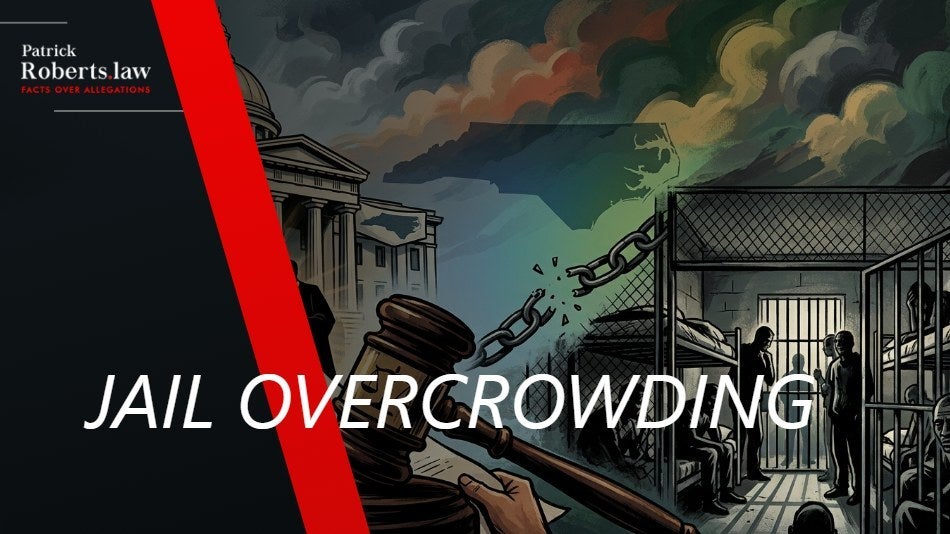
Overcrowded detention facilities across North Carolina are at a breaking point, driven by a sharp rise in defendants held without bond or on unreachable secured bonds following the passage of Iryna’s Law.
Investigative reporting from WCNC and local news outlets highlights how detention centers across the state are seeing inmate populations outpace available bed capacity. When detention centers exceed roughly 80% capacity, facilities are considered effectively full due to necessary classification rules that separate inmates based on security risk, gender, and mental health needs.
Statistical Surge: How HB 307 Has Strained Wake County and Regional Detention Facilities
The systemic impact of Iryna’s Law (HB 307), which took effect on December 1, 2025, is a primary catalyst behind these rising numbers:
• Spike in Detainees Held Without Bond: In Wake County alone, official records show that 198 individuals were held without bond when Iryna’s Law took effect. By August 2026, that number surged to 533 detainees held without bond.
• Exceeding Bed Capacities: Wake County’s two detention facilities have a design capacity of 1,574 beds. The county’s average monthly population skyrocketed from 1,198 in 2021 to an average of 1,778 in July 2026.
• Overflow Measures & Out-of-County Transfers: To manage severe space shortages, Wake County has been forced to transfer overflow inmates to facilities in Caswell and Northampton counties.
• Statewide Facility Strains: Other counties face identical operational bottlenecks. Union County's facility exceeded its 264-bed capacity (reaching 280), Lincoln County is building an expansion to hit 300 beds, and Cabarrus County uses temporary floor sleeping arrangements ("boats") due to bed and staffing limits.
• Cancellation of Rehabilitation Programs: Overcrowding and safety concerns have forced facilities like Union County to cancel inmate educational programs, including GED classes, due to classroom space being repurposed for extra beds.
This severe operational congestion means unrepresented defendants risk languishing in overcrowded, highly stressed facilities for weeks or months while waiting for their cases to move through backlogged court dockets.
What Happens at Your First Appearance Hearing Under Iryna’s Law?
During the initial 48-hour first appearance hearing under Iryna’s Law, magistrates and judges routinely issue high secured bonds or temporary no-bond orders because the statute restricts their authority to grant unsecured release.
Under North Carolina General Statutes §§ 15A-533 and 15A-534, as amended by Session Law 2025-93 (House Bill 307), judicial officials are strictly barred from issuing written promises to appear or unsecured bonds for offenses classified as "violent" under N.C.G.S. § 15A-531(9) or qualifying repeat allegations.
If you or a family member are arrested in Wake County, the pretrial process follows a strict statutory framework:
• Initial Appearance (Promptly After Arrest / 48-Hour Domestic Rule): Under N.C.G.S. § 15A-511, an arrested individual is brought before a magistrate. For qualifying violent offenses, including Possession of a Firearm by a Felon, domestic violence charges (governed by N.C.G.S. § 15A-534.1’s 48-hour judicial hold), or felony sex crimes, the court must apply a rebuttable presumption against release, routinely setting substantial secured bonds or entering no-bond holds pending formal hearing.
• First Appearance Hearing (Within 96 Hours): Under N.C.G.S. § 15A-601(c), felony defendants remaining in custody must receive a first appearance before a District Court Judge within 96 hours of arrest (or at the first open session of District Court). This provides counsel the initial forum to address counsel appointment, review the state’s statutory triggers, and calendar a full bond modification hearing.
What Types of Pretrial Release Are Still Allowed Under HB 307?
Iryna’s Law eliminates unsecured bonds and written promises to appear for qualifying charges, limiting legal pretrial release options to secured monetary bonds, house arrest with electronic monitoring, or supervised custody.
If a judge determines that pretrial release is appropriate after hearing evidence, North Carolina law limits the court to specific statutory release conditions:
Release Mechanism | Statutory Requirement Under Iryna's Law |
Unsecured Bond / Written Promise | Prohibited for all qualifying charges. |
Secured Appearance Bond | Allowed; requires full cash, real property collateral, or a licensed bail bondsman. |
House Arrest with Electronic Monitoring | Allowed; mandatory for second-offense violent allegations; defendant covers vendor fees. |
Monitored Pretrial Services Custody | Allowed in select jurisdictions when paired with continuous location tracking. |
How Does Defense Counsel Overcome the Presumption Against Release?
An experienced defense attorney overcomes the rebuttable presumption by presenting concrete, documentary evidence of community stability, employment, clean court compliance history, and structured supervision plans.
Because Iryna’s Law shifts the burden of proof onto the defense, simply arguing that a defendant is "innocent until proven guilty" is legally insufficient to secure bond. A skilled legal team will prepare and submit an organized evidentiary packet at the bond modification hearing:
1. Proving Lack of Flight Risk
Defense counsel provides verified documentation to prove strong roots in Wake County or North Carolina, including:
• Current residential leases or property ownership deeds.
• Verified proof of steady local employment or school enrollment.
• Affidavits from family members, employers, or community leaders.
• Official certified court records demonstrating 100% compliance with past court dates.
2. Addressing Community Safety Concerns
To convince a judge that release will not jeopardize public safety, your attorney structures enforceable risk-mitigation measures:
• Private Electronic Monitoring (GPS): Securing a pre-approved contract with an authorized electronic monitoring provider prior to the hearing.
• Continuous Alcohol / Drug Monitoring (CAM): Agreeing to voluntary, daily substance monitoring transponders.
• No-Contact Orders & Restrictive Curfews: Establishing strict geographical boundaries and stay-away orders regarding alleged victims or co-defendants.
What Steps Should Families Take Immediately After an Arrest in Wake County?
Families should refrain from discussing case details over jail phones, retain qualified legal representation immediately, and gather employment and residency documentation for the bond hearing.
If a relative is currently held at the Wake County Detention Center in Raleigh, follow these critical steps:
1. Do Not Discuss Case Details on Jail Phone Calls: All inmate telephone calls and video visits at Wake County facilities are recorded by law enforcement and prosecutors. Never discuss the facts of the alleged crime on the phone.
2. Gather Proof of Community Ties: Collect recent pay stubs, lease agreements, utility bills, and character references immediately so your criminal defense lawyer can prepare the bond packet.
3. Contact a Dedicated Defense Attorney: Bond hearings under Iryna’s Law require formal written motions. Retaining qualified legal counsel early ensures a motion is placed on the court docket without unnecessary delays.
Frequently Asked Questions About Bond Modification in North Carolina
Can a magistrate set a bond under Iryna’s Law, or do you have to see a judge?
Magistrates can set secured bonds for certain first-time qualifying offenses under Iryna's Law, but they cannot grant unsecured release. For repeat violent allegations or cases requiring mandatory house arrest with electronic monitoring, only a District or Superior Court Judge can determine bond conditions.
How long does it take to get a bond modification hearing in Wake County?
Once your attorney files a formal Motion for Bond Modification in Wake County District Court, a hearing is typically scheduled within 3 to 7 business days, depending on court docket availability and whether emergency calendar priority is granted.
Who pays for electronic monitoring if house arrest is granted?
Under North Carolina law, the defendant is financially responsible for the daily monitoring fees charged by state-approved electronic monitoring vendors. Demonstrating the financial ability to pay for monitoring vendor services is often required before a judge signs the release order.
What happens if you violate electronic house arrest while on pretrial release?
Violating electronic monitoring conditions—such as breaching a designated curfew or entering restricted zones—results in an immediate order for arrest (OFA), revocation of bond, and continuous detention until trial without eligibility for re-release under HB 307.
Why Experienced Legal Representation Matters for Bond Modification
When facing the restrictive mandates of Iryna’s Law, securing pretrial release requires a high level of advocacy and a precise, evidentiary-based approach to bond hearings. Attorney Patrick Roberts, an AV Preeminent-rated defense attorney with over two decades of courtroom experience, leverages his extensive background in both prosecution and criminal defense to challenge the statutory presumption of detention. Mr. Roberts has successfully litigated complex bond and custody issues across North Carolina, drawing on his deep understanding of how judicial officers weigh flight risk and public safety to craft compelling arguments for release. By utilizing his experience in managing high-stakes litigation—including felony sex crime defense and violent crime cases—he works to develop the structured release plans and documented community evidence necessary to satisfy the court’s burden of proof and restore his clients' liberty while their cases proceed.
• AV Preeminent and Client Champion Platinum Ratings: Recognized by Martindale-Hubbell for eight consecutive years (2018–2026) based on peer review and verified client satisfaction benchmarks.
• Juris Doctor from Duke University School of Law: Graduated from the prestigious law school, establishing a foundational academic background in legal theory and procedure.
• National Association of Distinguished Counsel (NADC): Selected as a member of the "Nation’s Top 1 Percent" on six separate occasions spanning 2015 to 2026.
• Former Prosecutor Perspective: Assistant District Attorney Experience: Served four years managing dockets in three North Carolina districts, providing critical insight into the state’s tactical approaches during detention and bond hearing procedures.
• NCDC Trial Practice Institute Graduate: Completed an intensive, two-week training program at the National Criminal Defense College focused on advanced litigation and evidence management strategies essential for challenging pretrial restrictions.
• Gerry Spence's Trial Lawyers College Graduate: Successfully completed a three-week residential trial advocacy program accredited for 143.25 CLE hours, providing specialized training in high-stakes courtroom argumentation and evidentiary presentation.
Client Review
With the sensitive nature of my case, every step of this process was frightening. Patrick and the wonderful people he works with were kind, caring, and nonjudgmental. He made his role very clear to me from the beginning and promised to do everything he could to help clear my name. And he did! They answered every question I had to the best of their ability. Patrick connected me directly with the people and services outside of his office to help me get my life back. I can honestly say I am better off now than I ever was before. If you are feeling as lost and confused as I was, do not look any further. Patrick Roberts is the man you need to represent you. His experience and knowledge of the legal system gave me a second chance in life. If you are reading this, you have found the right attorney.
— Review by a verified client via Avvo
Peer Endorsement
"Patrick Roberts is undoubtedly one of the best attorney advocates in the Triangle area. His experience as a former prosecutor is invaluable to any client seeking an attorney who knows the ropes. His honesty, integrity, and straightforwardness are qualities every client should seek in an attorney. I would, without hesitation, strongly recommend Mr. Roberts to anyone seeking an outstanding criminal defense lawyer."
— Peer endorsement by a fellow North Carolina trial attorney via Avvo
Disclaimer: The client reviews and peer endorsements displayed are authentic testimonials and comments provided by clients and fellow attorneys. Every case is unique and must be evaluated individually; past client experiences and case results do not guarantee, promise, or predict similar outcomes in any future matter.
Case Results
You deserve to see the tangible results an attorney has achieved before deciding who represents you. Below, you can explore some of the specific cases and outcomes Attorney Patrick Roberts has achieved for his clients:
• Robbery with a Dangerous Weapon: The defendant was accused of robbery with a dangerous weapon involving the alleged theft of more than $70,000 in cash and $15,000 in jewelry with a semi-automatic weapon. Despite the defendant's prior criminal history, criminal defense attorney Patrick Roberts successfully obtained a dismissal of the charges.
○ Outcome: Dismissal of all charges
• Felony Probation Violation Hearing: The client faced a potential 16 to 20-month active prison sentence due to a probation violation stemming from prior robbery charges. Mr. Roberts successfully* argued against incarceration, persuading the judge to extend the client's probation and mandate drug treatment instead of imposing jail time.
○ Outcome: Probation extended with mandatory drug treatment
• First-Degree Murder and Armed Robbery Charges: The client was charged with First-Degree Murder and Robbery with a Dangerous Weapon after a fatal drug transaction. Attorney Patrick Roberts successfully* negotiated a plea agreement to reduce the charge to a Class B2 Second-Degree Murder, thereby avoiding a mandatory life sentence and securing a prison term of 144 to 185 months.
○ Outcome: Negotiated plea to Second-Degree Murder; sentenced to 144 to 185 months
*Disclaimer: Case outcomes depend upon a variety of factors unique to each case. Prior results do not guarantee or predict a similar outcome in any future legal matter.
How to Seek Legal Representation for Bond Modification
If you or a loved one is facing detention under Iryna’s Law, proactive legal intervention is critical. Because the statute establishes a presumption against release, successfully navigating the bond process requires immediate, strategic preparation and a compelling presentation of evidence to the court. Patrick Roberts Law PLLC provides experienced, rigorous representation for clients facing complex criminal charges across North Carolina, with a specialized focus on Wake County communities, including Raleigh, Cary, Apex, Holly Springs, Garner, and Fuquay-Varina. We understand the urgency of these matters and work diligently to build a robust defense aimed at securing pretrial release. To discuss the specific details of your case and begin preparing a formal Motion for Bond Modification, please book a confidential consultation or contact our office today at www.patrickroberts.law.
The law firm maintains a selective intake process to ensure that each client receives the focused professional attention their case requires.
Disclaimer: This article is general legal information, not legal advice. Reading it does not create an attorney-client relationship. North Carolina criminal procedure and pretrial release laws under Iryna’s Law (S.L. 2025-93) are strictly statutory and subject to judicial interpretation, and how these rules apply depends on the specific facts of your case. For guidance on your situation, consult a licensed North Carolina criminal defense attorney.