\If you have a dismissed charge, an acquittal, or an older conviction on your North Carolina record, you may be able to have it erased through a court process called expunction. That's the state's word for what most people call expungement. Whether you qualify depends almost entirely on two things: what kind of outcome your case had, and how much time has passed since it ended.
This is not a rare or exotic remedy. North Carolina courts issued more than 1.4 million expunctions in the 2024-2025 fiscal year alone. Below, we'll walk through what expunction actually means here, how to figure out which category you fall into, the waiting periods that apply, what can't be cleared, the step-by-step filing process, the cost and timeline, and what an expunction does (and doesn't do) once it's granted.
What does it mean to clear a record in North Carolina?
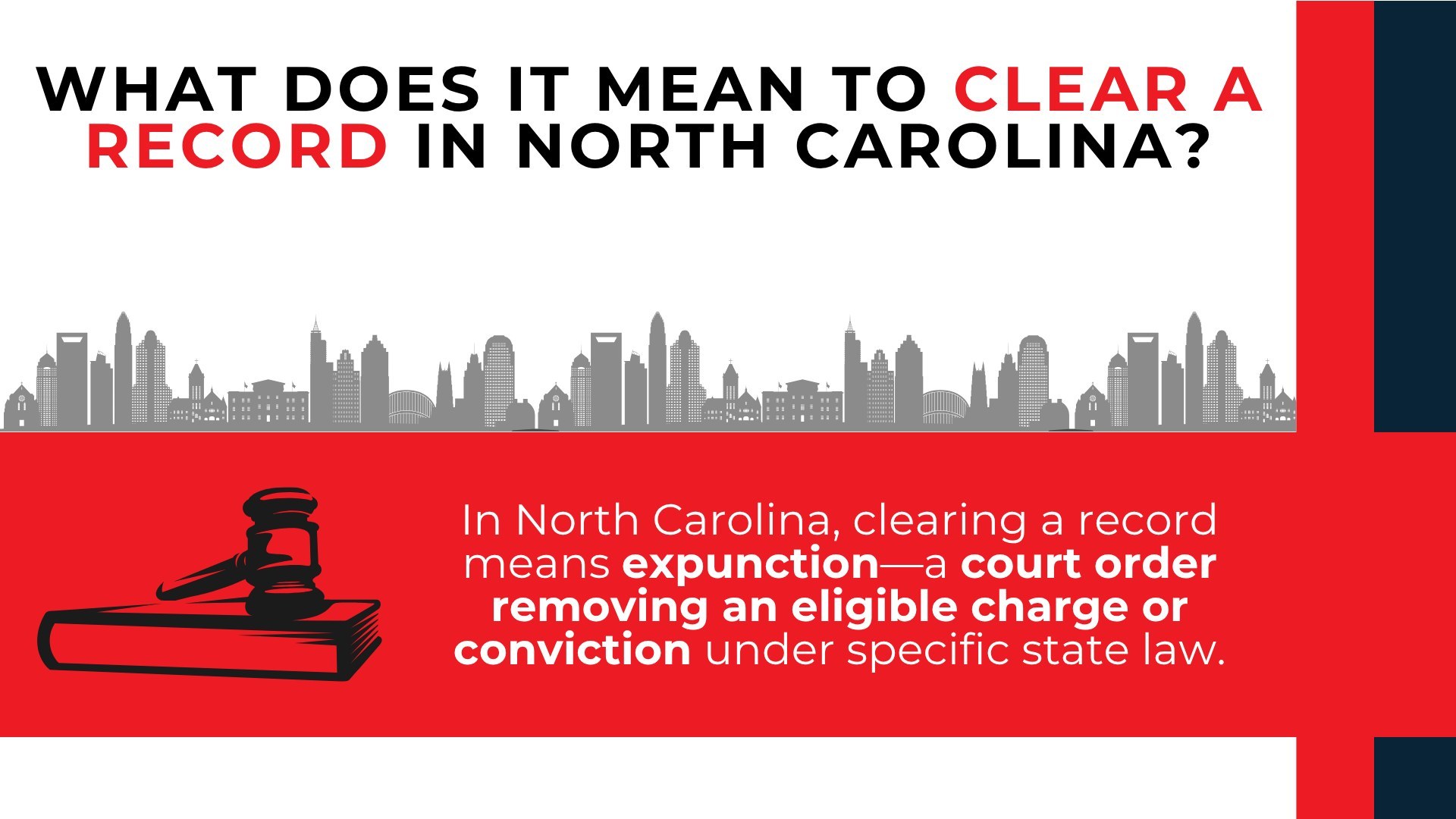
Expunction is a court order that removes a charge or conviction from your record. In the eyes of the law, it restores you to the position you were in before it ever happened. North Carolina has no general "sealing" law. Every form of relief comes from a specific statute in Chapter 15A, Article 5 of the General Statutes (§§ 15A-145 through 15A-160). If a statute grants relief for your situation, you're eligible. If none does, you're not. There's no general "the judge felt bad for me" pathway.
That's actually good news for you. Eligibility is written into the text of the law rather than left to a judge's mood. So you can find out fairly precisely where you stand before you spend a dollar or a day on it. The rest of this article is about locating yourself in that text.
Was your case dismissed, or were you actually convicted?
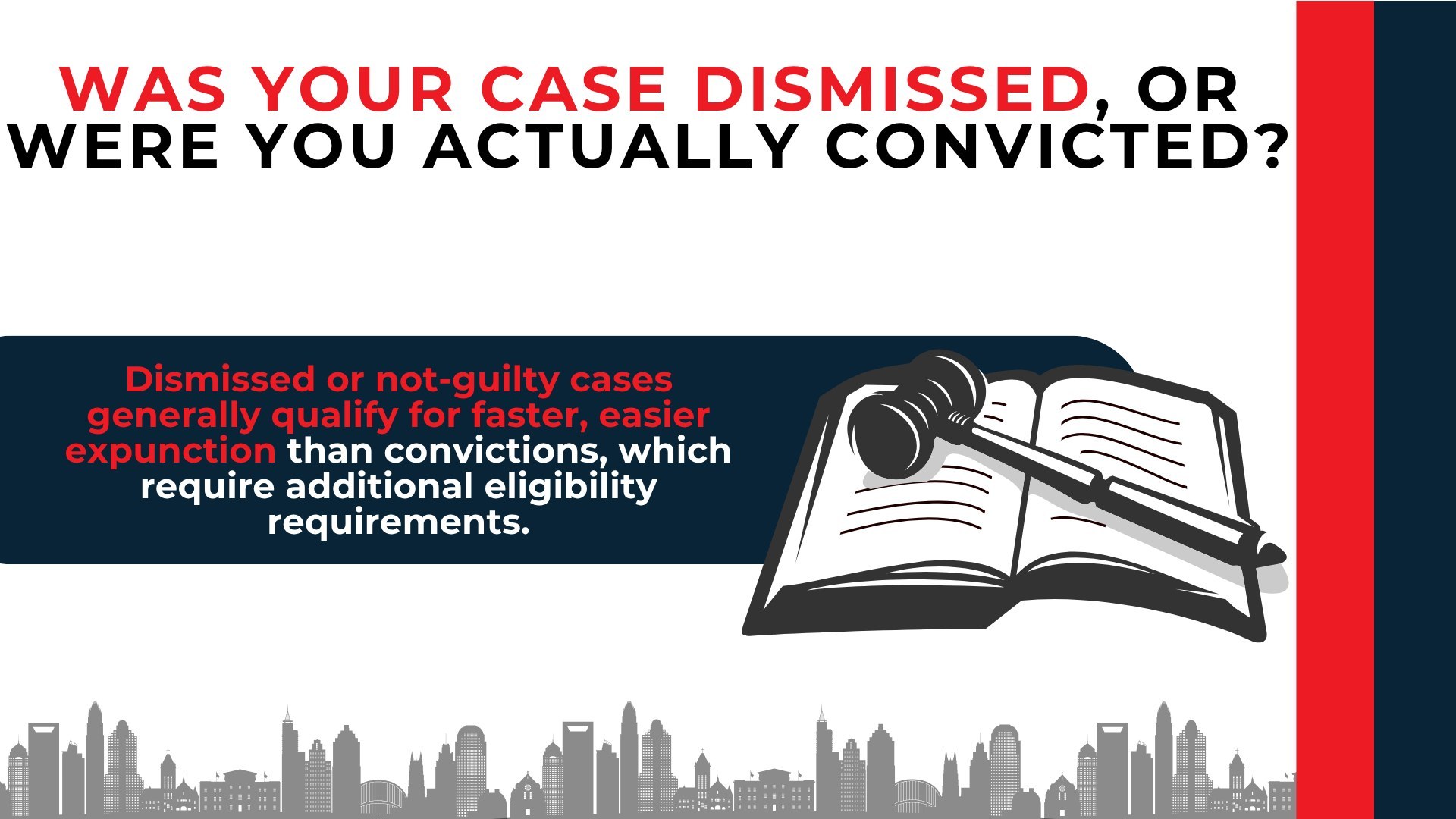
This is the single most important question, because it splits everything that follows into two very different tracks. North Carolina divides record relief into two tracks. The first is expunction of non-convictions: charges that were dismissed or ended in a not-guilty verdict (§ 15A-146). The second is expunction of convictions, where you were actually found or pleaded guilty (§§ 15A-145 to 15A-145.9).
The difference matters enormously. Non-conviction relief has no waiting period, generally no fee, and often happens automatically. Conviction relief requires you to wait years, pay a fee, and prove you deserve it. So before anything else, pin down which one you're dealing with. If the charge was dropped or you won at trial, read the next section. If you were convicted, skip ahead to the one after it.
What if your charge was dismissed or you were found not guilty?
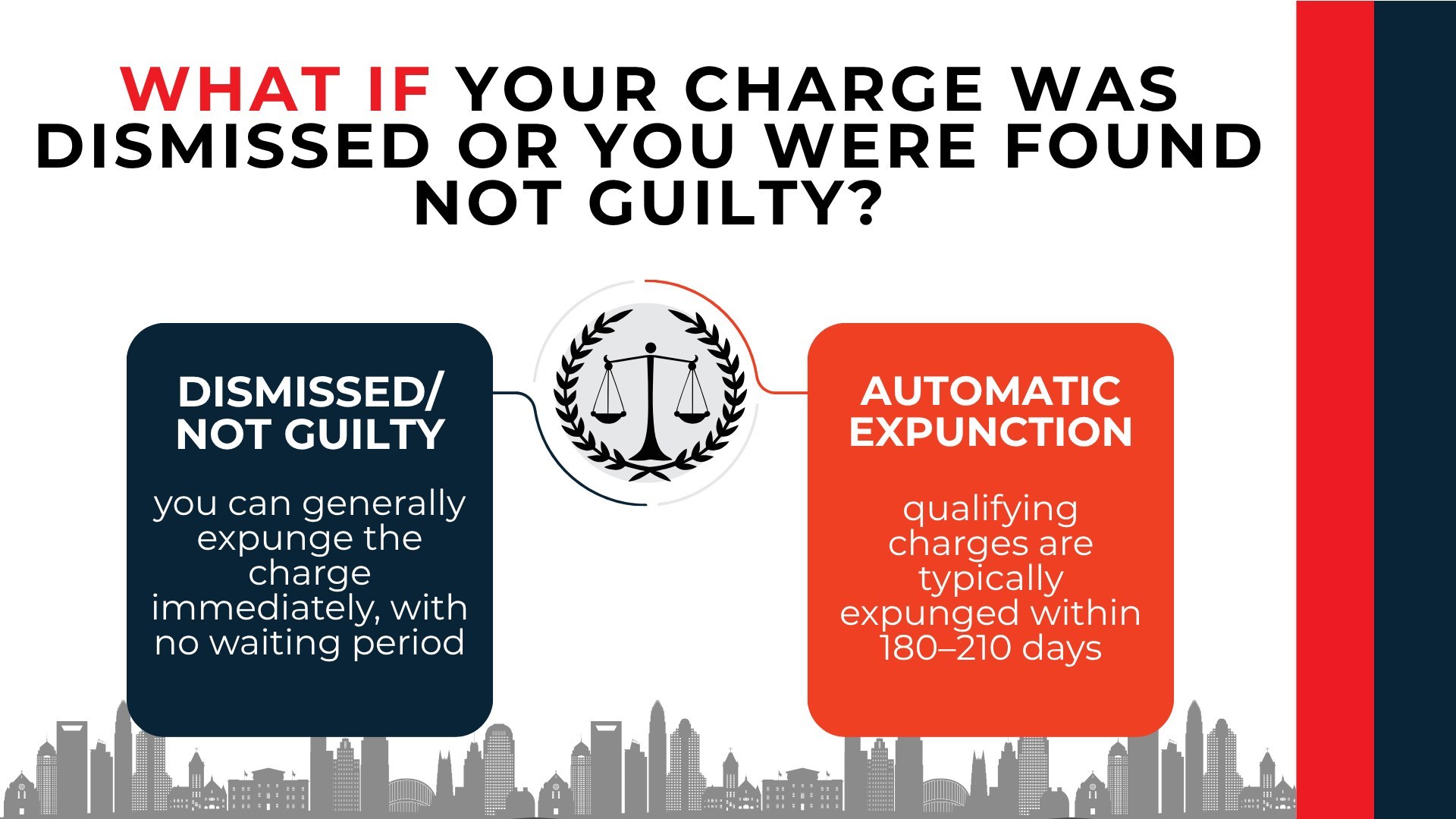
If your case ended in a dismissal or a not-guilty finding, you're in the easiest category. There's no waiting period, generally no filing fee, and you may not have to file anything at all. This is also the most common outcome in North Carolina. Across roughly 15 million charges disposed between 2014 and 2023, 80.6% ended with no finding of guilt, the large majority of them dismissed.
Under § 15A-146, if a single charge against you was dismissed, or you were acquitted on all related charges, you have the right to petition to have that record expunged. That right isn't blocked by a prior conviction or a prior expunction. That's a key feature that makes non-conviction relief far more forgiving than the conviction track.
Here's the part many people don't know: a lot of these clear on their own. North Carolina now runs an automatic expunction system. It erases qualifying dismissed and acquitted charges roughly 180 to 210 days after final disposition, with no petition from you at all (§ 15A-146(a4)). That process accounted for 1,381,128 automatic expunctions in 2024–2025, by far the largest category of record clearing in the state.
Two things to watch, though:
• A felony dismissed as part of a plea deal is not automatic. If you pleaded guilty to one charge and had another dismissed in exchange, that dismissed felony requires a petition; it won't clear itself.
• Automatic expunctions can leave records out of sync. The automatic process skips the clerk's usual duty to notify every agency. So a background check may still show the charge even after it's technically expunged. A petition, by contrast, triggers formal notice to all record-holding agencies.
If your dismissal hasn't cleared on its own and it's been more than seven months, or if a plea agreement was involved, filing a petition is the reliable route.
If you were convicted, how long before you can file?
If you were actually convicted, you can still petition to expunge a nonviolent misdemeanor or nonviolent felony. But you can only do so after a waiting period, measured from the later of your conviction date or the day you finished your sentence, including probation. This is North Carolina's main "second chance" pathway, found in § 15A-145.5, and unlike the age-based options below, it has no age limit.
The waiting periods are the heart of the answer:
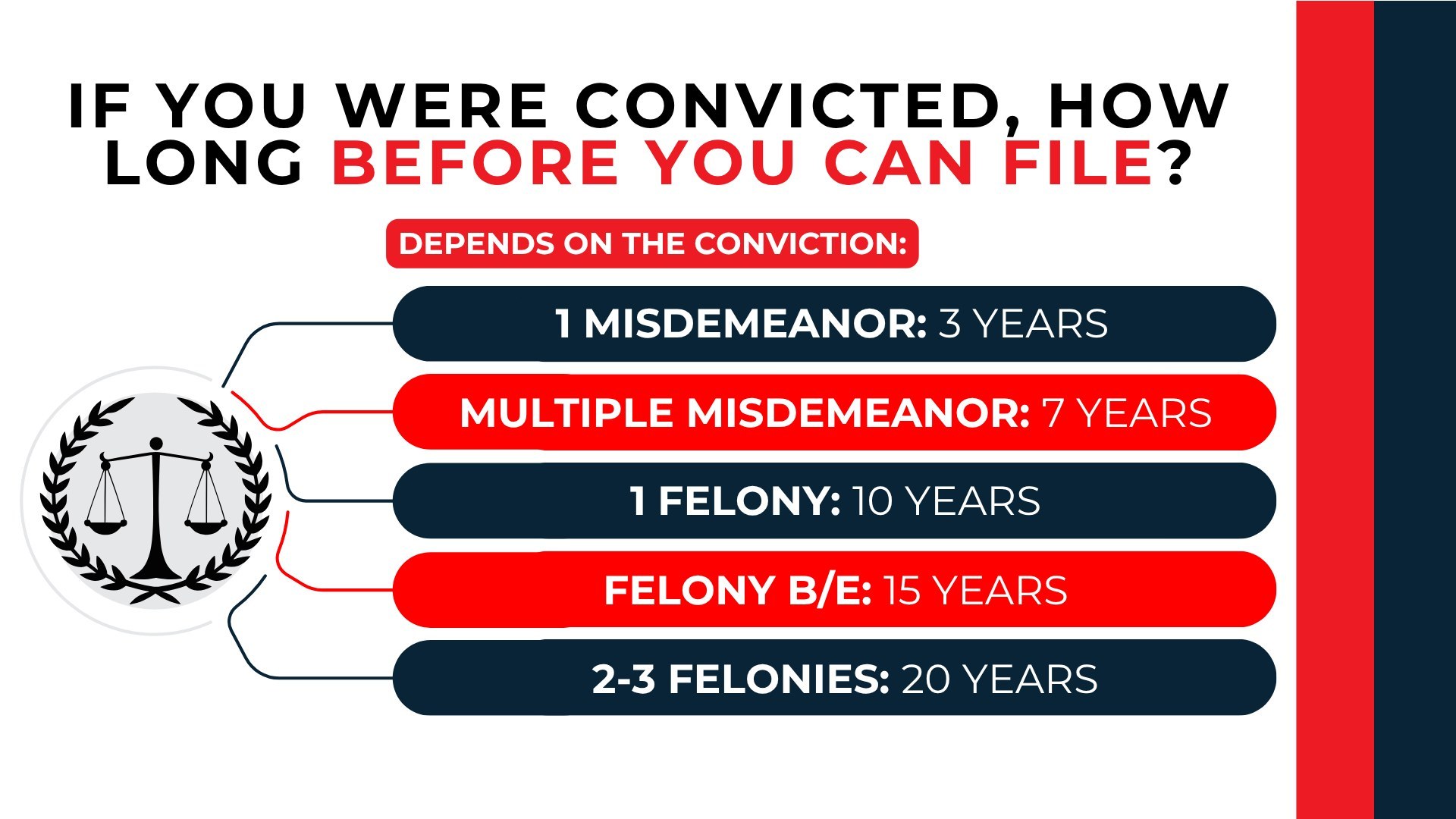
• One nonviolent misdemeanor: 3 years after conviction or completion of your sentence, whichever is later. (This was cut down from five years by a 2025 change in the law.)
• Multiple nonviolent misdemeanors: 7 years after your last conviction or the end of any active sentence, probation, or post-release supervision.
• One nonviolent felony: 10 years after conviction or completion of sentence.
• A felony breaking-or-entering conviction under G.S. 14-54(a): 15 years.
• Two or three nonviolent felonies: 20 years after the most recent one.
Two conditions ride along with these timelines. First, you have to show good moral character during the waiting period: no picking up new trouble. Second, this relief is essentially once in a lifetime. With narrow multi-county exceptions, a prior § 15A-145.5 expunction disqualifies you from getting another. That's part of why getting the petition right the first time matters so much.
For perspective on how selective this path is: North Carolina courts granted only 3,599 nonviolent-conviction expunctions under this statute in all of 2024–2025. That's a tiny fraction of the automatic dismissal stream. Convictions are harder to clear than dismissals, but far from impossible.
What if you were under 18 or in your teens or early 20s when it happened?
If you were young when the offense occurred, you may qualify much sooner than the adult waiting periods suggest. That's often one to four years instead of ten. North Carolina has several first-offender pathways with shorter clocks for people who made a mistake early and stayed clean afterward.
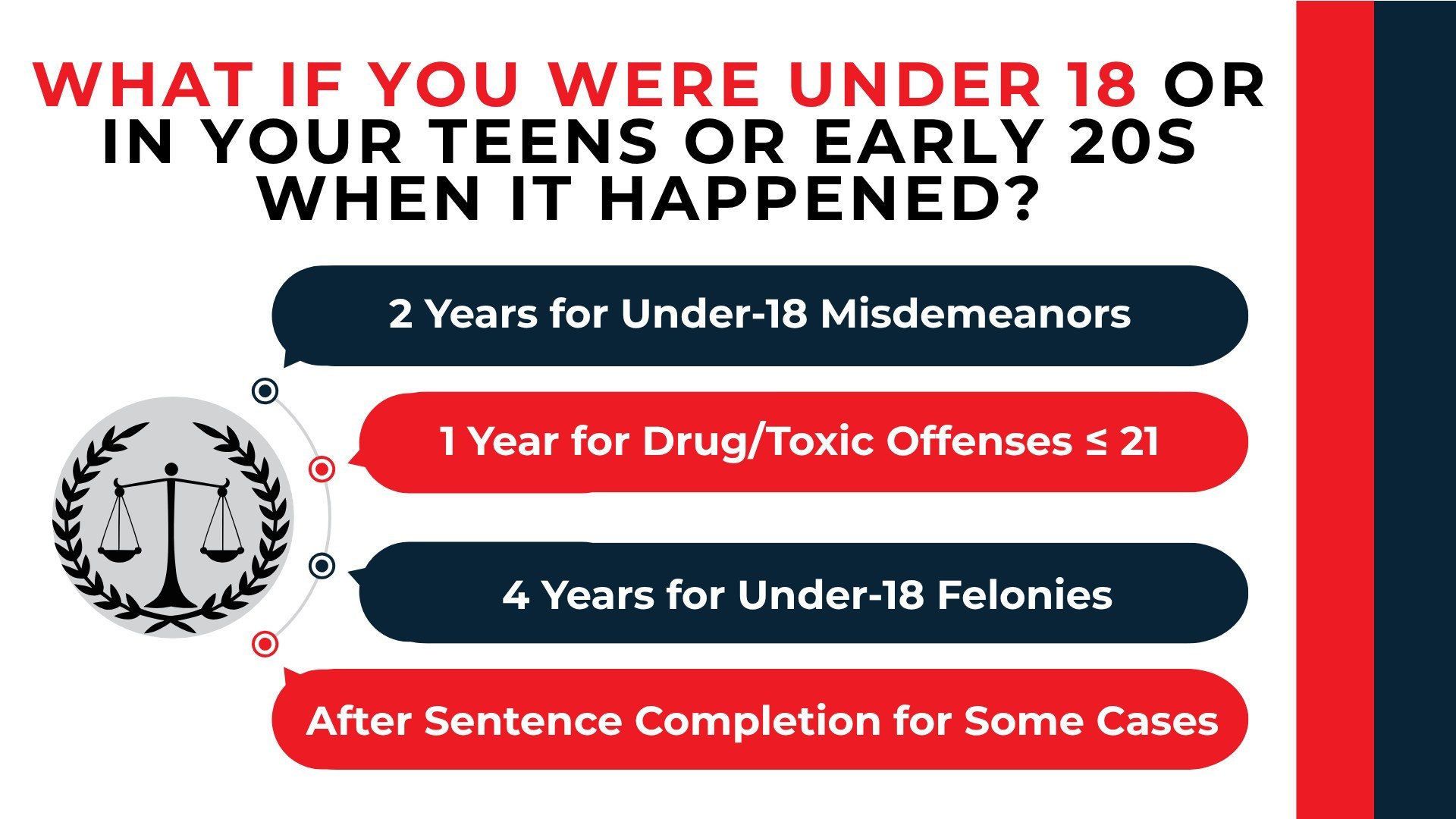
• Under-18 misdemeanor or underage-alcohol offense (§ 15A-145): 2-year wait.
• Drug first offenders not over 21 (§ 15A-145.2) and toxic-vapor first offenders (§ 15A-145.3): 12-month wait, plus completion of any court-ordered program.
• Under-18 nonviolent felony (§ 15A-145.4): 4-year wait.
• "Raise the Age" relief (§ 15A-145.8A) for 16- and 17-year-olds convicted before December 1, 2019: relief available on completion of the sentence.
All of these require that you had no prior conviction and picked up no new one during the waiting period. If your record traces back to something that happened when you were a teenager or in college, don't assume the ten-year felony clock applies to you. One of these shorter tracks may fit.
What can't be expunged?
Some records can't be cleared no matter how much time passes, and some situations block you even when the offense itself would otherwise qualify. Knowing this before you file saves you money and disappointment.
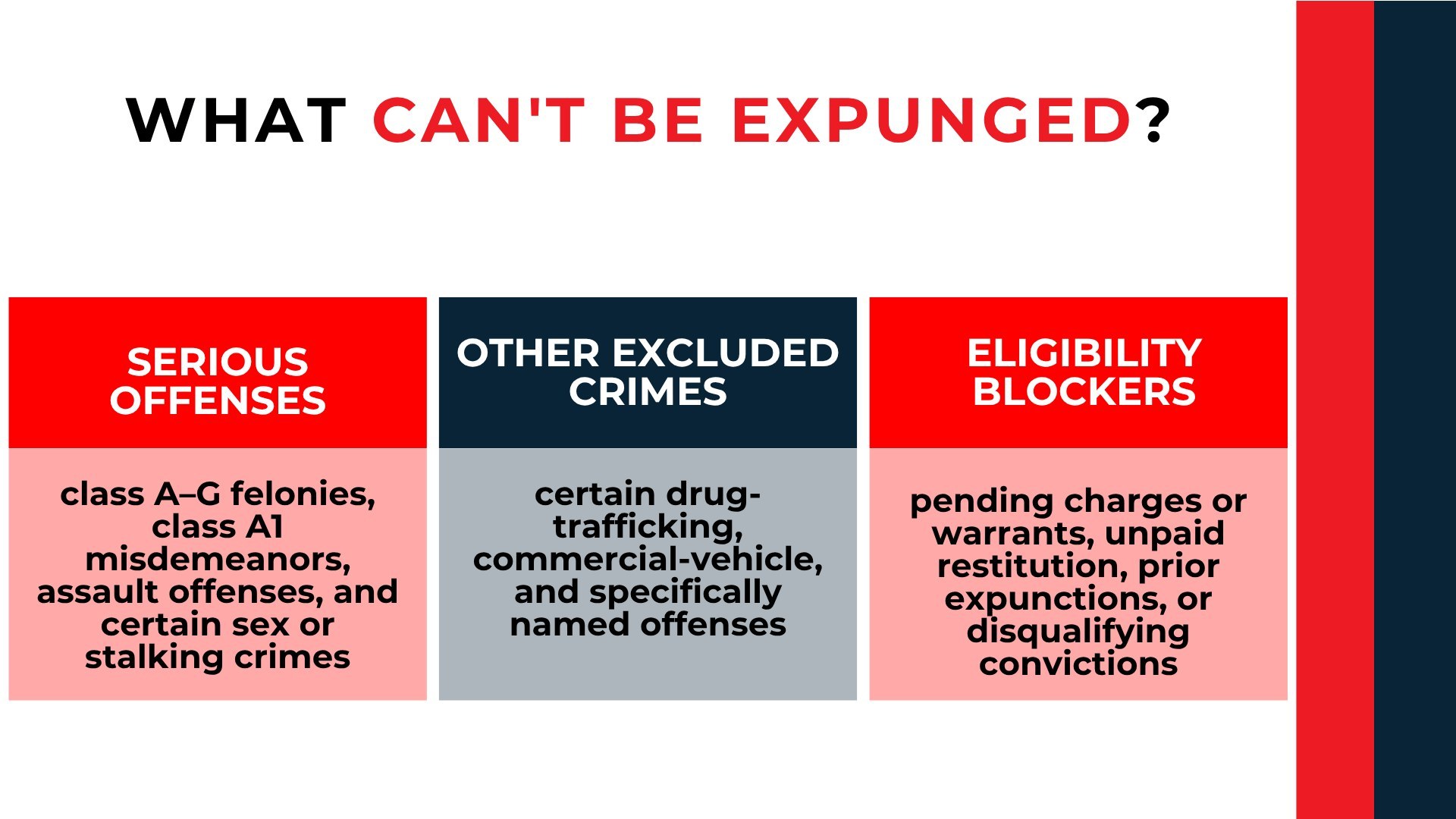
The offense-based exclusions built into the definition of "nonviolent" under § 15A-145.5(a) include:
• Class A through G felonies (the most serious felony classes)
• Class A1 misdemeanors
• Offenses with an assault element
• Certain sex-related and stalking offenses
• Specific drug-trafficking felonies (methamphetamine, heroin, and certain cocaine offenses)
• Commercial-vehicle felonies and a handful of other named crimes
Then there are the practical blockers, problems that stop an otherwise-eligible petition cold:
• An outstanding warrant or a pending criminal charge
• Unpaid restitution from the case
• A prior § 15A-145.5 expunction already used (outside narrow exceptions)
• A disqualifying prior conviction
If you fall into an offense exclusion, expunction under this pathway isn't available. If you're tripped up by a practical blocker, an unpaid balance or a pending matter, that's often something that can be cleared up first. Then you file. It's worth having the exact situation reviewed before you conclude you're stuck.
How do you actually file - step by step?
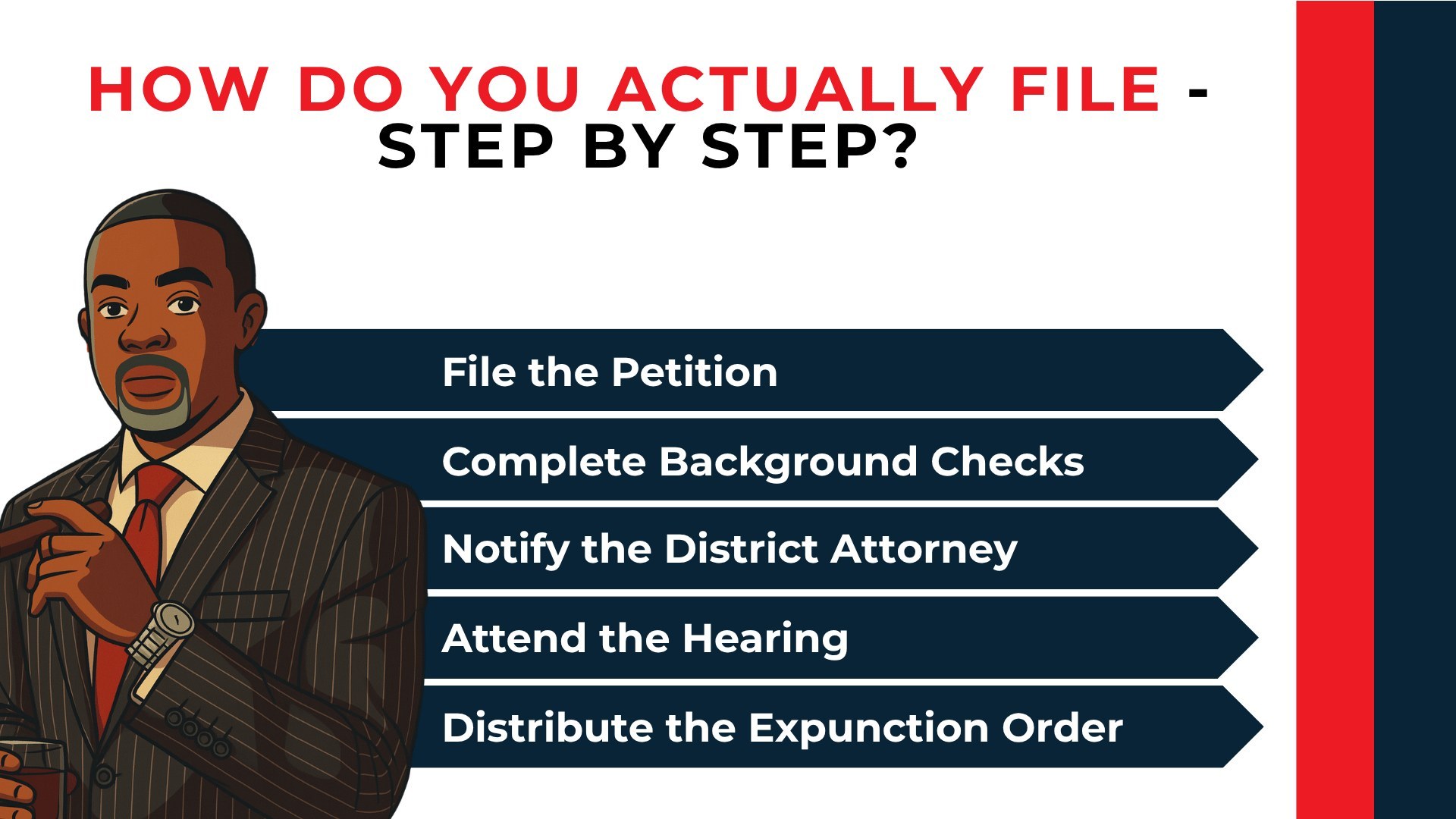
You expunge a record by filing a verified petition, a written request signed under oath. You file it on the correct state court form, in the county where the charge or conviction happened, and then attend a hearing. Here's the sequence:
• File the petition on the applicable AOC (Administrative Office of the Courts) form, in the trial division of the county where the case arose.
• The background checks run. Most petitions require an AOC check for any prior expunction and an SBI (State Bureau of Investigation) check of your criminal history to confirm eligibility.
• The district attorney gets notice. The prosecutor's office is notified and can weigh in, which is exactly why the way your petition is framed and supported matters.
• A judge holds a hearing and rules on the petition.
• If granted, the clerk sends the order out. The clerk sends the granted expunction to the AOC, the arresting agency (sheriff or police), the DMV where relevant, the Department of Adult Correction, the SBI, and, through the SBI, the FBI. That pulls the record across the system.
That notification step in item 5 is the reason a petition-based expunction often produces cleaner results than an automatic one. It forces every agency holding the record to update it.
How long does it take and what does it cost?
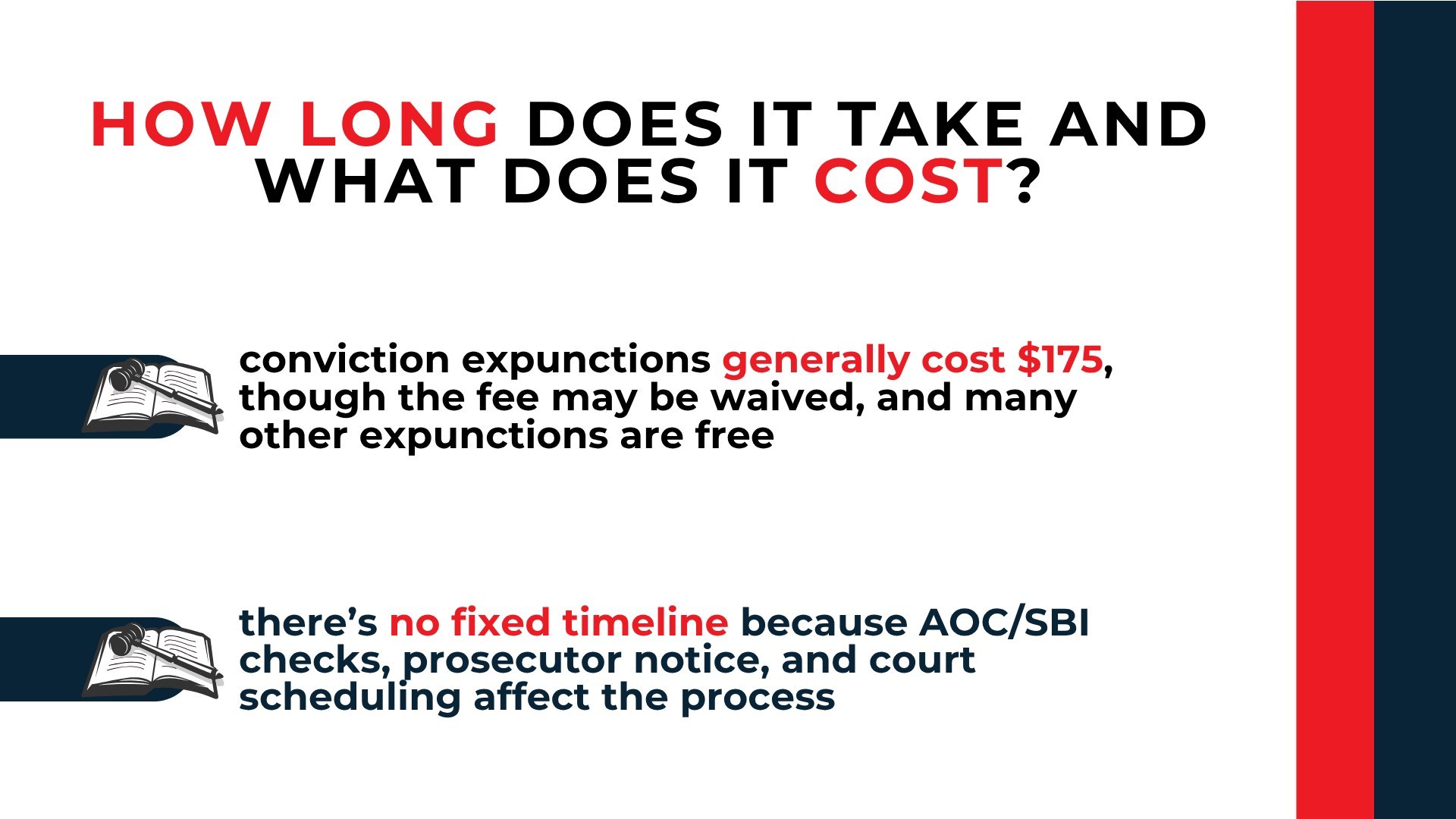
The filing fee for a conviction expunction is $175, and it's waived if you can't afford it (indigency). Several categories carry no fee, identity-theft and mistaken-identity expunctions among them, and dismissal and not-guilty expunctions are generally free to file as well.
Timing depends on the checks and the hearing rather than a fixed clock. Every petition runs through AOC and SBI verification and then waits for a court hearing, with notice to the prosecutor. Statewide, expunction filing fees brought in about $248,000 in 2024-2025. That's a reminder that the fee-bearing petitions are a modest, deliberate slice of the system, and that yours will get individual handling.
Once it's granted, what does expungement do for you, and what doesn't it do?
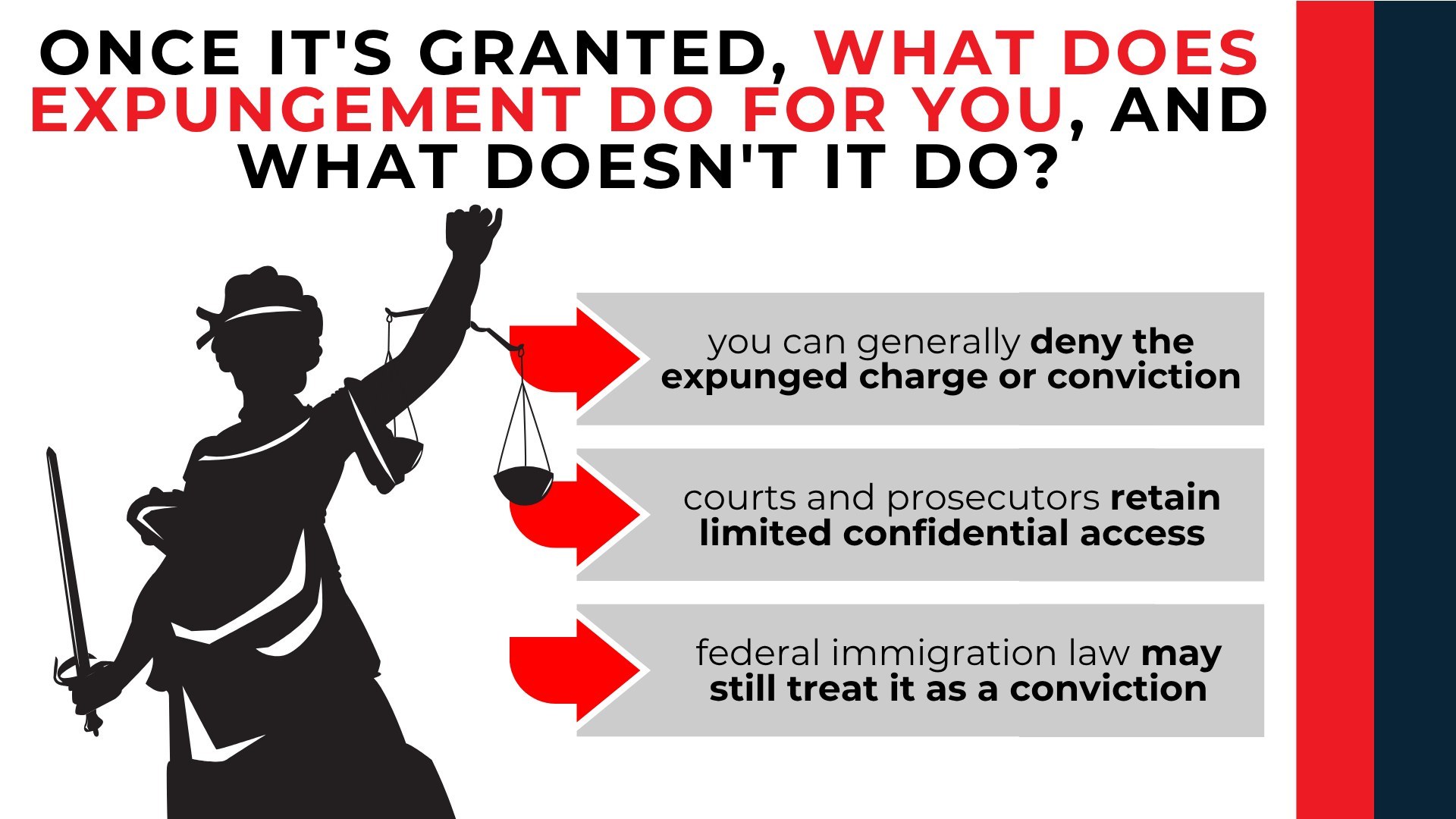
A granted expunction restores you, in law, to the status you held before the charge or conviction. In most situations, you can lawfully deny that the matter ever happened. Under § 15A-153, employers and schools cannot require you to disclose an expunged arrest, charge, or conviction. That's the practical payoff: applications you couldn't get past before open back up. The research bears out why this matters. One leading national study found that within a year of clearing their records, recipients' wages rose by more than 22%.
But be clear-eyed about the limits:
• Prosecutors and courts keep limited access. Expunged convictions stay in a confidential file that district attorneys can use for specific justice-system purposes. Those include calculating prior-record level, habitual-offender charging, and certain sentencing enhancements (§§ 15A-151, 15A-151.5). It's gone from public and employer view, not from the system entirely.
• It doesn't erase federal immigration consequences. Immigration law uses its own federal definition of "conviction," and a North Carolina expunction doesn't undo it. If you're not a citizen, treat this as its own separate question to run down before you rely on an expunction.
Within those boundaries, an expunction is powerful. It's just not a magic eraser, and any lawyer worth hiring will tell you that upfront.
Should you do this yourself, or talk to a lawyer?
You can file some expunctions on your own, but the ones that matter most are technical, unforgiving, and often one shot. The conviction pathway under § 15A-145.5 is generally available only once in your life. Eligibility turns on precise definitions and dates. And the district attorney gets notice and a chance to object. A petition that's filed in the wrong track, a year too early, or with an unresolved blocker doesn't just fail. It can burn an opportunity you don't get back.
Three steps to take now:
• Pin down your outcome and your dates: dismissal or conviction, offense class, and the date your sentence (including probation) ended. That determines which track and which clock apply.
• Check for blockers: any pending charge, outstanding warrant, or unpaid restitution that would need to be cleared first.
• Have your eligibility reviewed before you file, so your one petition is the right one, filed at the right time, in the right county.

Criminal Defense and Expungement in North Carolina
Patrick Roberts has practiced criminal defense in North Carolina since 2002. His background as an Assistant District Attorney across three prosecutorial districts, combined with more than two decades in private practice, gives him extensive insight into state legal procedures and criminal records law. Mr. Roberts applies this practical expertise to direct clients through the statutory requirements for expunction in North Carolina, including eligibility assessments and procedural filings. Holding an AV Preeminent rating and Client Champion Platinum recognition from Martindale-Hubbell, he provides thorough representation to resolve pending charges and clear eligible records.
• Martindale-Hubbell AV Preeminent & Client Champion Platinum: Holds dual professional ratings, maintained consecutively for eight years, signifying high peer-reviewed standing and verified client satisfaction.
• National Association of Distinguished Counsel (NADC): Selected to the "Nation's Top 1 Percent" of attorneys in 2015, 2016, 2017, 2018, 2025, and 2026.
• Graduate of Duke University School of Law (ranked Number 7 in Best Law Schools and Number 9 in Criminal Law for the 2026-2027 period) and Johns Hopkins (ranked No. #7 in National Universities).
• Former Prosecutor Perspective: Leveraging four years of experience as an Assistant District Attorney across three North Carolina counties, providing insight into the state’s procedural requirements for petitioning court records.
• Sex Offender Registry Removal: Possesses extensive experience navigating complex North Carolina legal requirements for the successful petitioning and removal of individuals from the state’s Sex Offender Registry.
• White Collar Criminal Defense College Graduate: Completed specialized training at Stetson University College of Law, offering advanced proficiency in analyzing the criminal history points, offense levels, and financial criteria often relevant to conviction-based record assessments.
• Trial Experience: Over 75 jury trials completed.
Client Review
We hired Patrick Roberts when our son was accused of a crime. Patrick knew exactly what to do and what the possible outcomes were. We did everything he said and to our relief charges were eventually dropped... He knew the long term implications of the charges and did everything, everything he could to give us the best possible outcome. It is a stressful time, the courts move painfully slow. Trust him. Patrick knows what he is doing..
— Review by a verified client via Avvo
Peer Endorsement
I endorse this lawyer. Patrick is a great trial lawyer and a person who I go to for legal advice in my own practice. Patrick is dedicated to his client's and a master at criminal defense. I would not hesitate to hire him if I was in trouble and needed a lawyer.
— Peer endorsement by a fellow North Carolina trial attorney via Avvo
Disclaimer: The client reviews and peer endorsements displayed are authentic testimonials and comments provided by clients and fellow attorneys. Every case is unique and must be evaluated individually; past client experiences and case results do not guarantee, promise, or predict similar outcomes in any future matter.
Case Results
Seeing how a lawyer has handled real cases gives you a clearer idea of what to expect for your own. Below are examples of cases Attorney Roberts has resolved:
• Second Degree Sexual Offense Allegation: The client was accused of a second-degree sexual offense. Mr. Roberts conducted a thorough investigation, including witness interviews and background research on the accuser, which revealed substance abuse issues and potential motives. Upon presentation of this evidence, the Assistant District Attorney agreed to drop the charges.
○ Outcome: Dismissal
• First Degree Burglary and Felony Larceny Charges: The client faced multiple charges of first-degree burglary and felony larceny following an eyewitness identification. Defense counsel analyzed cellular phone records, which contradicted the eyewitness account and proved the identification was mistaken. The Assistant District Attorney accepted the evidence and dismissed all charges.
○ Outcome: Dismissed
• Sex Offender Registry Removal: The client sought legal assistance to resolve their status on the sex offender registry. Counsel successfully petitioned to have the client’s name removed after they completed the required statutory registration period.
○ Outcome: Client's name expunged from the sex offender registry after the period ended.
• Statutory Sex Offense Allegations: The client was originally charged with multiple felony statutory sex offenses. Counsel negotiated a plea agreement reducing the charges to a single count of misdemeanor sexual battery. Following the completion of a ten-year registration period, counsel successfully petitioned for the client’s removal from the sex offender registry on the first attempt.
○ Outcome: Plea negotiated to misdemeanor sexual battery with 10-year registration, followed by successful removal from the sex offender registry on the first petition.
Disclaimer: Case outcomes depend upon a variety of factors unique to each case. Prior results do not guarantee or predict a similar outcome in any future legal matter.
See more case results.
Navigating North Carolina Expunction Laws
Expunging a criminal record requires precise execution and strict compliance with North Carolina statutory requirements. Successfully navigating the petition process demands an in-depth understanding of state-specific procedural rules and eligibility thresholds. Patrick Roberts Law PLLC delivers focused legal representation in expunction proceedings throughout all 100 North Carolina counties, with a targeted practice across Wake County, including Raleigh, Cary, Apex, Holly Springs, Garner, and Fuquay-Varina. To evaluate statutory eligibility and ensure petitions meet all legal standards, professional legal guidance is essential. Initiate the review process by scheduling a consultation with Patrick Roberts Law PLLC at www.patrickroberts.law.
We maintain a selective intake process to ensure that each client receives the focused professional attention their case requires.
Disclaimer: This article is general legal information, not legal advice. Reading it does not create an attorney-client relationship. North Carolina expunction law is almost entirely statutory and subject to legislative change, and how these rules apply depends on the specific facts of your case. For guidance on your situation, consult a licensed North Carolina attorney.