Blog / Criminal Defense

If Your Charges Are Dropped, Is It Still on Your Record in North Carolina?

Man and woman stand before a judge as a dismissed case file highlights whether dropped NC charges remain on record.

In most cases, yes — a dropped charge stays on your record until someone takes a specific legal step to remove it. Having a charge dismissed ends the prosecution against you, but it does not automatically wipe the arrest, the charge, or the court file out of the records that background checks pull from.

That gap between "the case is over" and "the record is clean" is where people get blindsided — at a job application, an apartment screening, or a license review. This article explains why a dropped charge lingers, what a background check actually shows, what it can cost you, how North Carolina now clears many dismissals automatically, and why yours might still be visible.

Doesn't "dropped" mean the charge is gone?

No. When a charge is dropped — the everyday word for dismissed — it means the State stopped pursuing the case. It does not mean the event was erased.

Think of it as two separate things. One is the outcome of your case: dismissed, or found not guilty. The other is the record of it: the arrest entry, the charge that was filed, and the court's file showing how it all ended. Dropping the charge settles the outcome. It leaves the record sitting exactly where it was.

North Carolina actually has no general "sealing" statute — there's no automatic vault that swallows a case the moment it's dismissed. Every form of record relief in this state flows from a specific law in Chapter 15A, Article 5 of the General Statutes (the expunction laws — "expunction" and "expungement" mean the same thing: legally destroying the record). Until one of those mechanisms actually runs on your case, the charge remains.

If it's any reassurance about how common this is: of roughly 15 million criminal charges disposed of statewide from 2014 to 2023, 80.6% ended with no finding of guilt — the large majority of them dismissed. Dismissal is the norm in North Carolina courts, not the exception. But a dismissal that's never cleared still shows up.
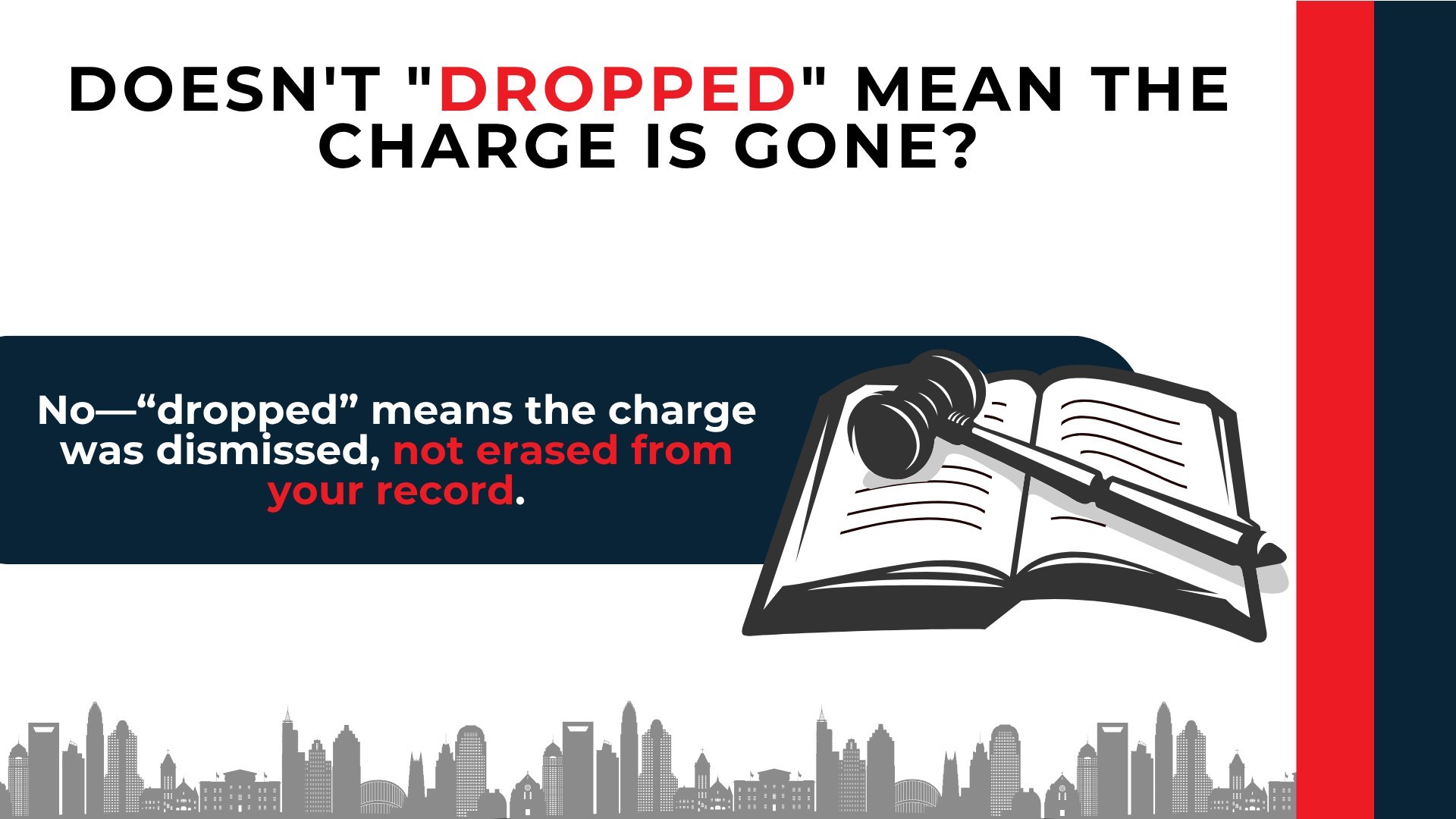
Gavel and law book explain that a dropped charge means dismissal, not automatic removal from your criminal record.


What actually shows up on a background check after a dismissal?

A background check shows your history, not just your verdict. So even after a dismissal, a check can display the arrest, the charge that was filed, and a disposition line — the entry describing how the case ended — reading "dismissed" or "not guilty."

To you, "dismissed" reads as vindication. To an employer or landlord skimming a report, it reads as there was a criminal charge here. Many people never get to explain the context. The charge simply appears, and a decision gets made before you're ever in the room.

Downstream agency records can compound the problem. Even after a record is cleared in the court's official system, those records can lag behind and keep reporting a charge that's already been removed — a synchronization gap that can leave downstream agency records out of step with the court.
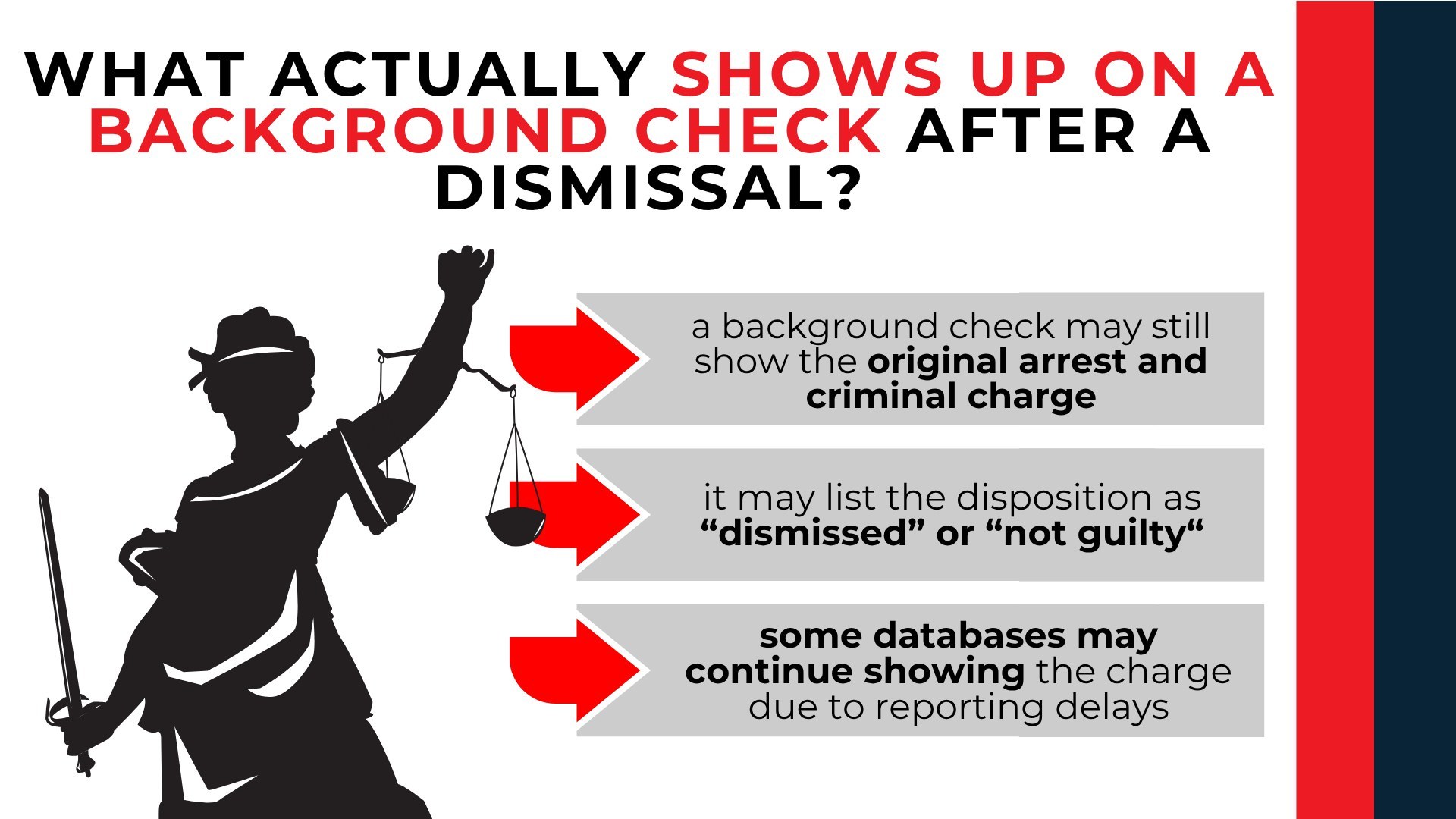
Lady Justice and arrows show that background checks may list the arrest, charge, dismissal, or outdated records.

Can a dropped charge still cost me a job, housing, or a license?

Yes — until it's expunged, a dropped charge can surface in any decision that runs a background check. North Carolina law only shields you after the record is cleared, not before.

The contexts where this bites hardest:

• Employment — hiring screens routinely flag arrests and charges regardless of outcome.

• Housing — landlords and property managers pull the same reports.

• Professional licensing — boards and certification bodies examine criminal history closely.

The protection kicks in only once the record is expunged. Under N.C. Gen. Stat. § 15A-153, after expunction, employers and educational institutions may not require you to disclose an expunged arrest, charge, or conviction — and in most contexts you may lawfully deny it happened. Before expunction, that shield doesn't exist. This is the practical reason a dismissal isn't the finish line: the relief that actually protects you is a separate step from the dismissal itself.
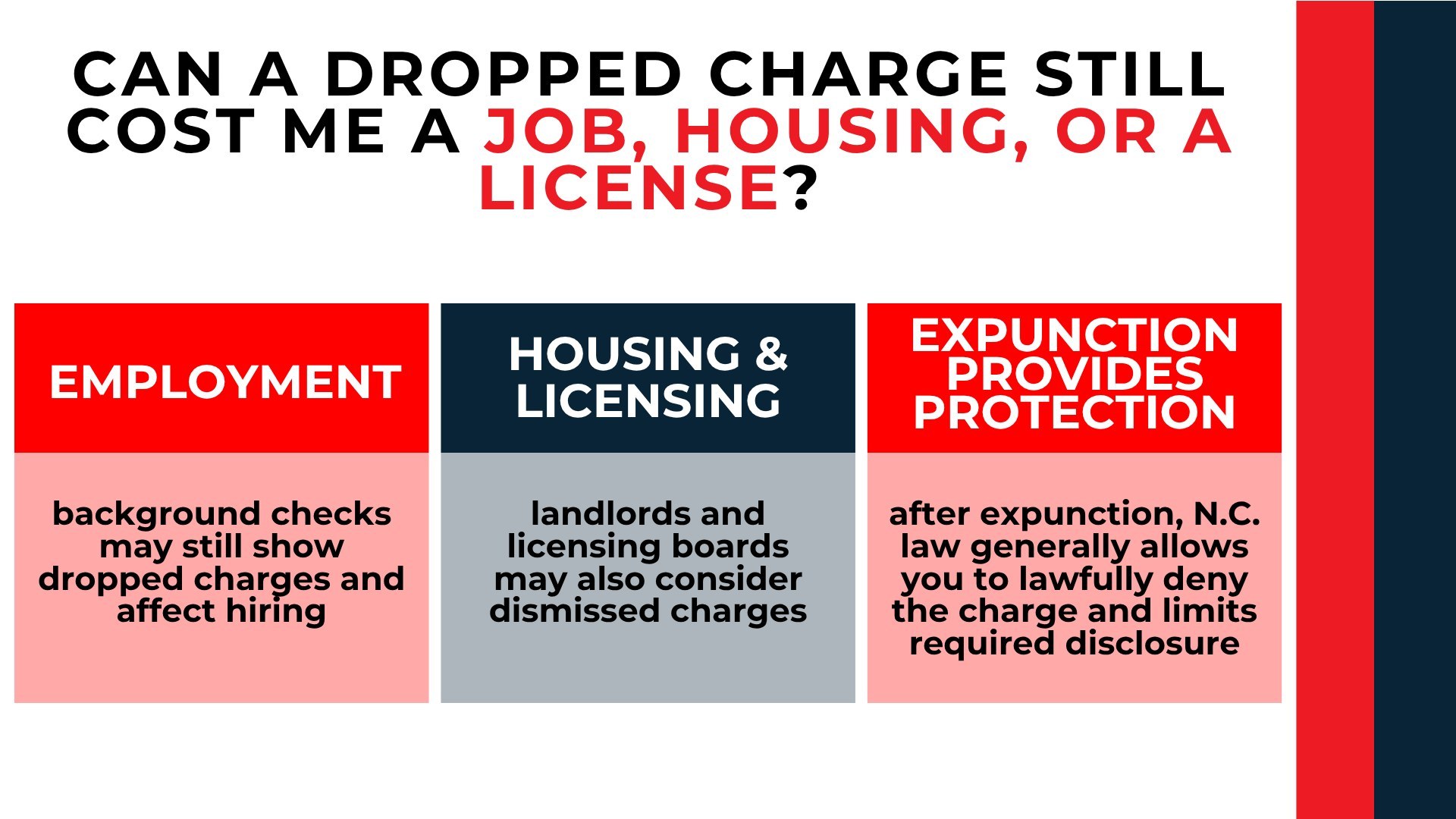
Three panels explain how dropped charges may affect employment, housing, licensing, and how expunction offers protection.

Doesn't North Carolina clear dismissed charges automatically now?

For many dismissed and not-guilty charges, yes — North Carolina now expunges them automatically, without you filing anything. But "automatic" comes with a lag and a list of exceptions, so it isn't something to simply assume happened.

This is the Second Chance Act mechanism, under N.C. Gen. Stat. § 15A-146(a4), most recently restructured by Session Law 2024-35. Under the current framework, the courts are directed to expunge eligible non-conviction dispositions automatically — generally within about 180 to 210 days after your case reaches final disposition.

The scale is real. In fiscal year 2024–25, North Carolina courts issued 1,381,128 automatic expunctions of dismissed and not-guilty charges — by far the largest category of record clearing in the state. So for a routine dismissal, there's a genuine chance the system will clear it on its own.

The word to sit with, though, is eligible. Not every dropped charge qualifies, and the timeline assumes the machinery is working smoothly. Often it hasn't been.
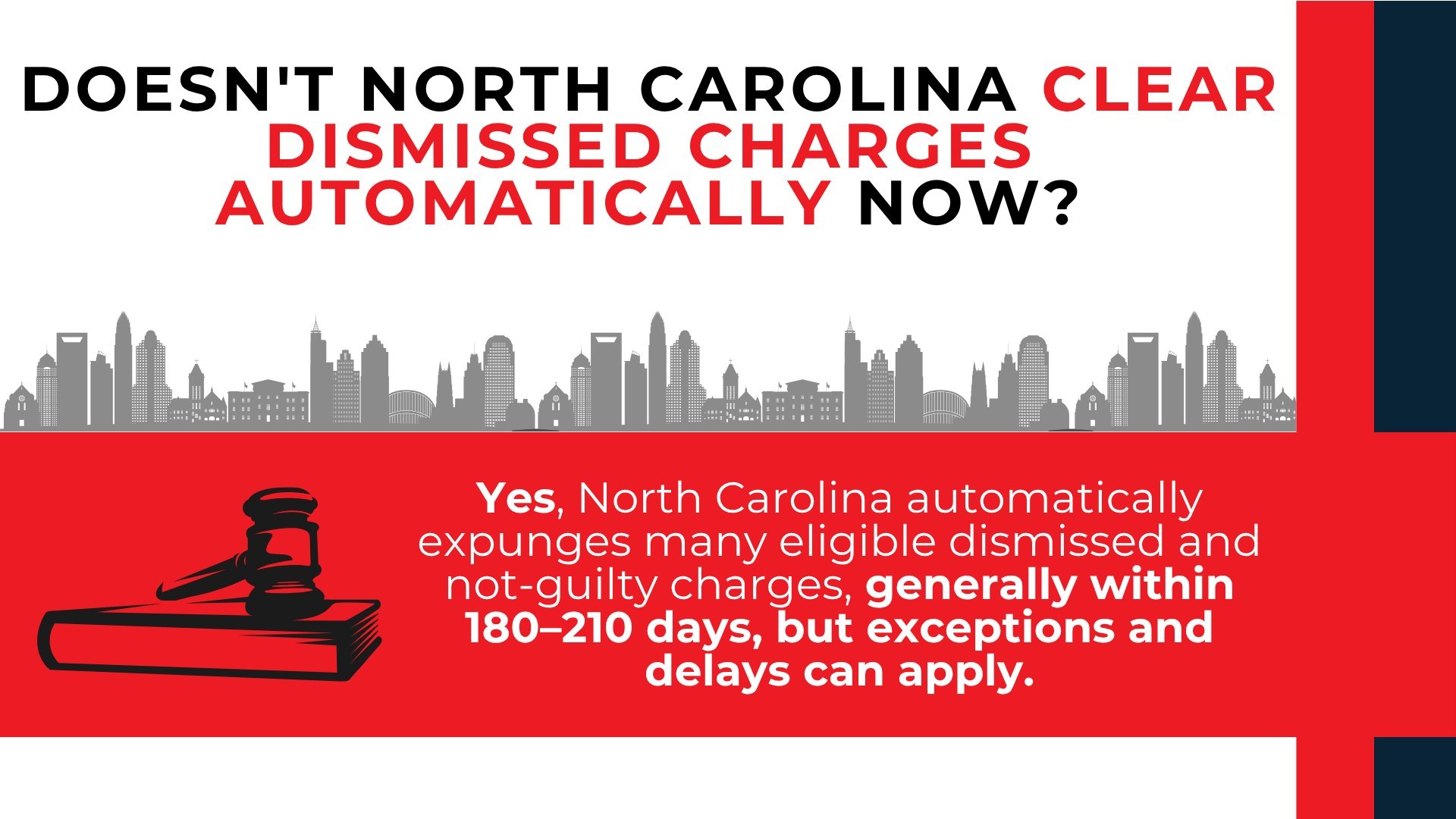
Gavel and NC skyline explain automatic expunction of eligible dismissed charges, typically within 180–210 days.

Then why is my dropped charge still showing up?

Because "automatic" has failed plenty of people — through timing, backlog, and specific carve-outs that quietly exclude certain dismissals. If yours is still visible, one of these is usually why:

1. The clock hasn't run yet. Automatic expunction happens months after final disposition, not the day of your court date. In that window, the charge stays fully visible.

2. The backlog. Automatic expunction was created effective December 2020, then paused by Session Law 2022-47 starting August 2022, and only restored under the 2024 law. That two-year freeze created an enormous backlog. Once processing resumed on July 1, 2024, automatic expunctions climbed to over 1.38 million in FY2024–25, up from 395,055 in FY2021–22 as the state worked through the pile. If your dismissal landed in that paused stretch, it may have waited far longer than the normal window.

3. A felony dismissed as part of a plea deal doesn't auto-clear. If a felony charge was dismissed pursuant to a plea agreement, it is not subject to automatic expunction. Many people assume the whole case vanished when part of a plea resolved it. It didn't.

4. A recent carve-out for incapacity dismissals. Effective December 1, 2025, dismissals entered because a defendant was found incapable to proceed are excluded from expunction under § 15A-146 (Session Law 2025-93). That's a narrow category, but a real one.

5. The downstream databases never got the memo. Automatic expunctions bypass the clerk-notification duties that normally push a cleared order out to the sheriff, the SBI, the FBI, and other agencies. That leaves records unsynchronized — the court may have cleared it while other databases still report it.

The takeaway: don't assume "automatic" worked. Confirm it did.
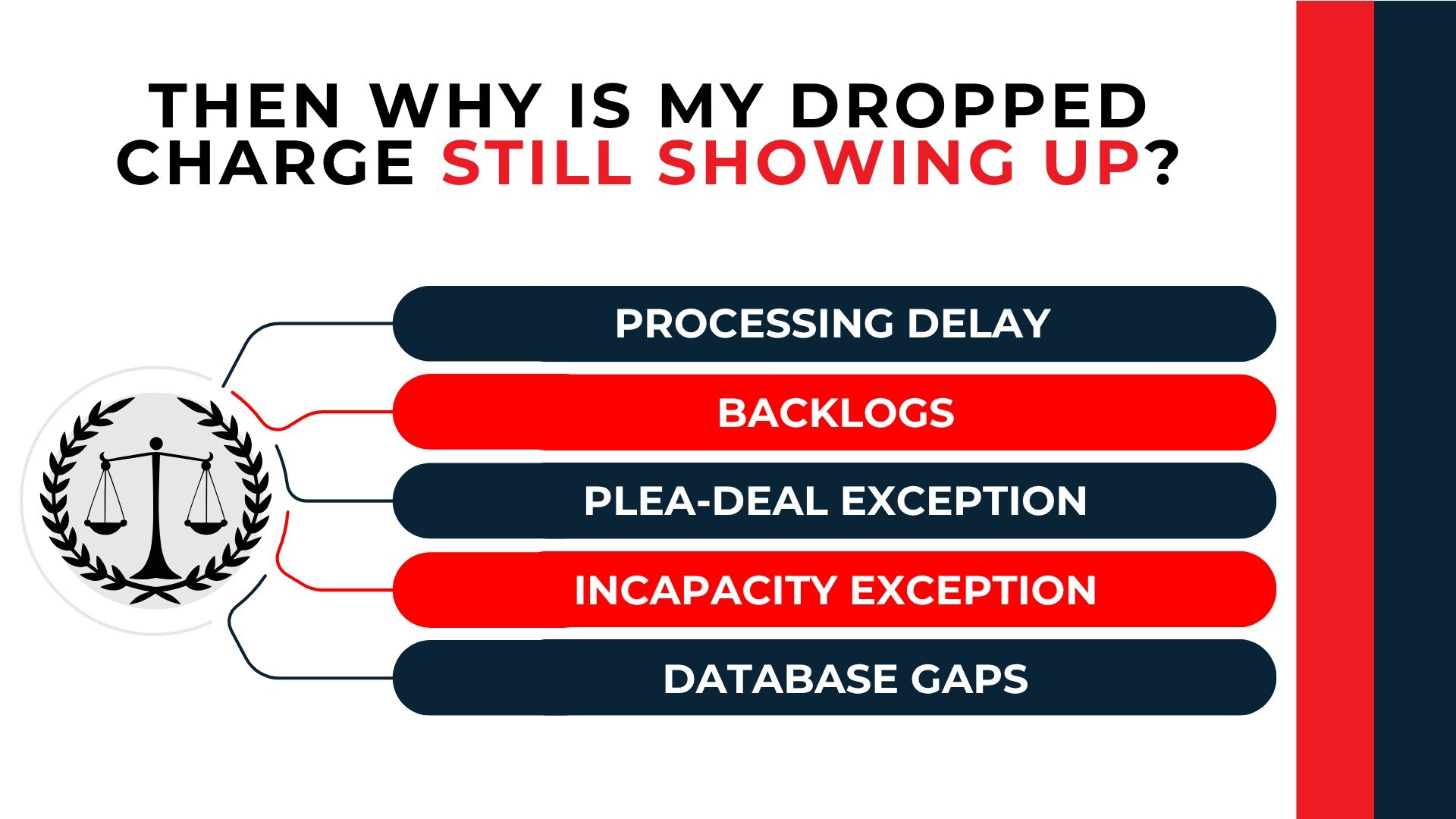
Scales connect five reasons a dropped charge may remain, including delays, backlogs, exceptions, and database gaps.

What to do now

1. Don't assume it's cleared — confirm it. Pull your own background check or have your record checked. If a dismissed charge is still visible, the automatic clearing either hasn't run yet or didn't cover your case.

2. Figure out why it's still there. The timing window, the backlog, a felony dismissed in a plea deal, or an out-of-sync database can each leave a dropped charge showing long after the case ended.

3. Get advice before you rely on it being gone. If the charge is still on your record, don't assume it will disappear on its own — find out where it actually stands.
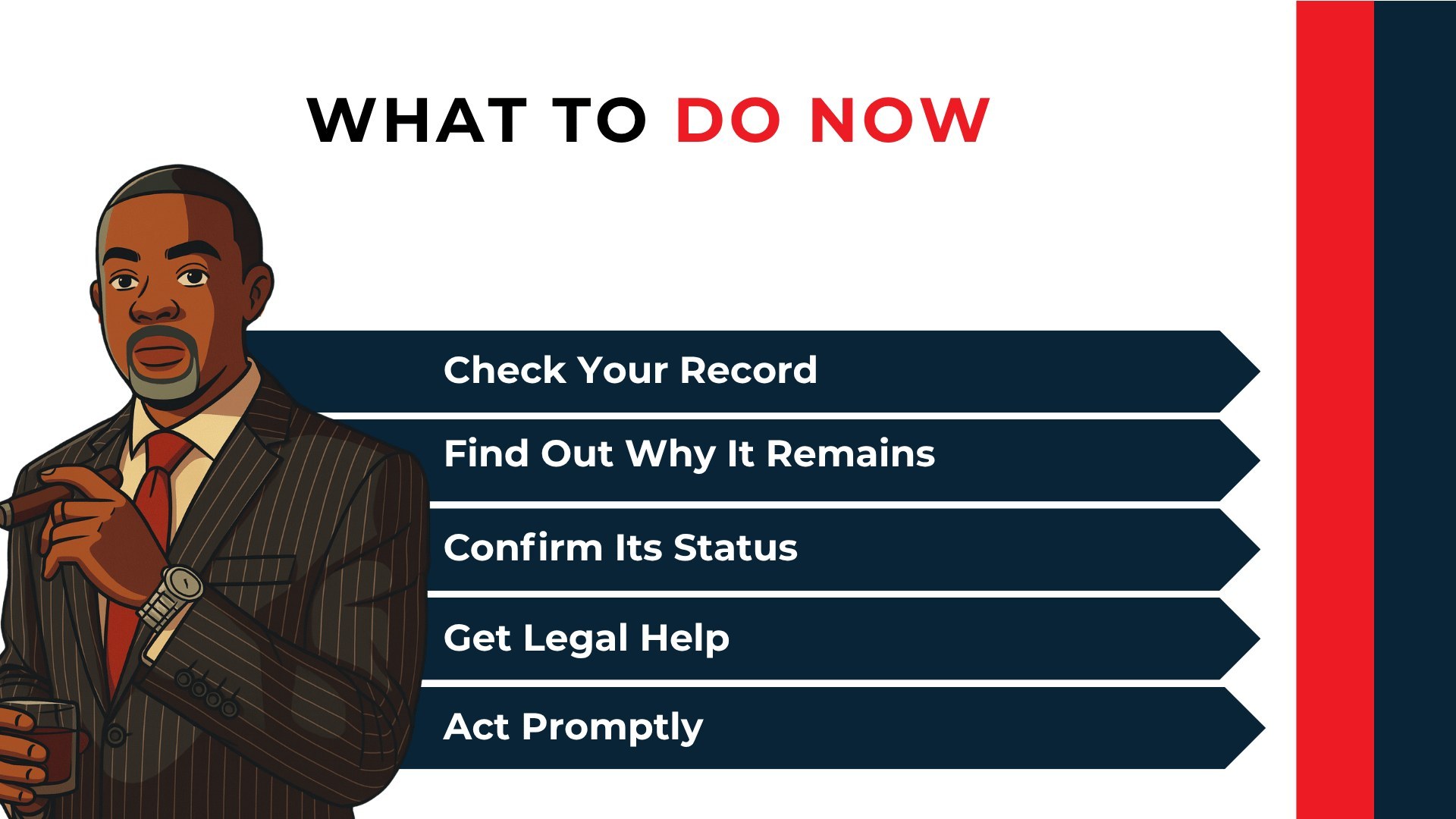
Attorney beside five action steps advises checking your record, confirming its status, and seeking legal help.

Securing Your Future: Navigating Record Expunction and Criminal Defense

When a criminal charge is dismissed, the legal process does not always conclude with the automatic removal of your record. For individuals facing the complexities of North Carolina’s expunction statutes, Attorney Patrick Roberts offers seasoned legal guidance grounded in over two decades of courtroom experience, including over 75 completed jury trials across state and federal jurisdictions. As a former Assistant District Attorney and a career defense practitioner, Mr. Roberts possesses expertise in the nuances of North Carolina’s criminal justice system, including the specific statutory requirements for expunging non-conviction records and managing the lingering impacts of dismissed charges. Throughout his career, Mr. Roberts has handled complex litigation ranging from high-level felonies to regulatory compliance, and he routinely advises clients on the proactive steps necessary to secure their reputation and ensure their criminal history accurately reflects their true standing. Whether addressing immediate defense needs or navigating the technicalities of post-disposition record relief, Patrick Roberts Law PLLC provides the strategic advocacy required to protect your future.

• AV Preeminent Rating (Martindale-Hubbell): Held this peer-nominated distinction for eight consecutive years (2018–2026), reflecting the highest level of professional excellence and ethical standards.

• Top 1 Percent (NADC): Selected to the National Association of Distinguished Counsel’s list of the nation's top 1 percent of attorneys for six years, including 2025 and 2026.

• Duke Law School: Earned a J.D. from Duke University School of Law, providing a foundational education in complex legal analysis and procedural law.

• Former Prosecutor Perspective: Leveraging four years of experience as an Assistant District Attorney across three North Carolina prosecutorial districts, offering strategic insight into how plea deals and dismissals are processed within the state’s criminal justice system.

• Sex Offender Registry Removal Experience: Holds specific practice experience in successfully petitioning courts for the legal removal of individuals from the North Carolina Sex Offender Registry, demonstrating a command of complex post-conviction and record-clearing procedures.

• White Paper Author (Federal Sentencing Guidelines): Authored the 2014 publication "The Numbers Count: Fraud and the Federal Sentencing Guidelines," which provides deep technical analysis on how offense levels and historical criminal data influence final case outcomes and sentencing.

Client Review

We hired Patrick to defend our son against very serious felony charges that we knew to be false. It was the scariest thing to put our trust in someone to help us, especially living out of state, but we were so fortunate that we found Patrick. He showed a tremendous attention to detail, hired experts to examine and refute the evidence, and used brilliant strategies to poke holes in the case. After four long years, and many highs and lows, Patrick did what he promised: he took care of our son. Felony charges were reduced* to a misdemeanor with no jail time. We will always be grateful to Patrick and his firm for giving our son his life back.

— Review by a verified client via Avvo

Peer Endorsement

I have known Patrick for years and have always been struck by his knowledge and dedication. I endorse him without hesitation or qualification.

— Peer endorsement by a fellow North Carolina trial attorney via Avvo

*Disclaimer: The client reviews and peer endorsements displayed are authentic testimonials and comments provided by clients and fellow attorneys. Every case is unique and must be evaluated individually; past client experiences and case results do not guarantee, promise, or predict similar outcomes in any future matter.

Case Results

Understanding the specific outcomes a lawyer has delivered helps you feel confident in your decision. Below are examples of case results Attorney Patrick Roberts has achieved for his clients:

• Second Degree Sexual Offense Allegation: Attorney Roberts investigated the incident and the accuser's history, highlighting substance abuse and ulterior motives. After presenting these findings to the prosecution, the Assistant District Attorney dismissed the charge.

â—‹ Outcome: Dismissal

• First Degree Burglary and Felony Larceny Charges: Facing multiple burglary and larceny counts following an eyewitness identification, the defense utilized phone records to prove the identification was mistaken. The prosecutor agreed with the evidence and dismissed all charges.

â—‹ Outcome: Dismissed

• First Degree Murder Charges (N.C.G.S. § 14-17): Facing life in prison without parole after being accused as the driver in a drive-by shooting, the client was represented at trial by Attorney Patrick Roberts. Despite the State presenting surveillance video footage and multiple prosecution witnesses, Attorney Roberts methodically challenged the state's case and highlighted key inconsistencies across witness testimonies, resulting in a complete acquittal.*

â—‹ Outcome: Not Guilty

*Disclaimer: Case outcomes depend upon a variety of factors unique to each case. Prior results do not guarantee or predict a similar outcome in any future legal matter.

See more case results.

Ensure Your Criminal Record Reflects the Truth

Dismissed charges do not always disappear automatically, and relying on state-run systems often leaves individuals vulnerable to lingering inaccuracies on their background reports. If you need to confirm that your record has been properly cleared, or if you require assistance navigating the expunction process, legal advocacy is essential to protecting your professional and personal future.

Patrick Roberts Law PLLC provides experienced legal representation for clients throughout North Carolina, with a primary focus on complex matters in Wake County—including Raleigh, Cary, Apex, Holly Springs, Garner, and Fuquay-Varina. To review your specific situation and ensure your record is accurately shielded from public view, please visit www.patrickroberts.law to schedule a consultation.

The firm maintains a selective caseload to protect the integrity of its defense strategies and the thoroughness of its trial preparation.

Disclaimer: This article is general legal information, not legal advice. Reading it does not create an attorney-client relationship. North Carolina expunction law is almost entirely statutory and subject to legislative change, and how these rules apply depends on the specific facts of your case. For guidance on your situation, consult a licensed North Carolina attorney.


Posted in:

Related Posts

Attorney reviews a criminal record with a client, introducing how to expunge your record in North Carolina.

How to Expunge Your Record in North Carolina

\If you have a dismissed charge, an acquittal, or an older conviction on your North Carolina record, you may be able to have it erased through a court process called expunction. That's the state's word for what most people call expungement. Whether you qualify depends almost entirely on two things: what kind of outcome your case had, and how much time has passed since it ended. This is not a rare or exotic remedy. North Carolina courts issued more than 1.4 million expunctions in the 2024-2025 fiscal year alone. Below, we'll walk through what expunction actually means here, how to figure out which category you fall into, the waiting periods that apply, what can't be cleared, the step-by-step filing process, the cost and timeline, and what an expunction does (and doesn't do) once it's granted. What does it mean to clear a record in North Carolina? Expunction is a court order that removes a charge or conviction from your record. In the eyes of the law, it restores you to the position you were in before it ever happened. North Carolina has no general "sealing" law. Every form of relief comes from a specific statute in Chapter 15A, Article 5 of the General Statutes (§§ 15A-145 through 15A-160). If a statute grants relief for your situation, you're eligible. If none does, you're not. There's no general "the judge felt bad for me" pathway. That's actually good news for you. Eligibility is written into the text of the law rather than left to a judge's mood. So you can find out fairly precisely where you stand before you spend a dollar or a day on it. The rest of this article is about locating yourself in that text. Was your case dismissed, or were you actually convicted? This is the single most important question, because it splits everything that follows into two very different tracks. North Carolina divides record relief into two tracks. The first is expunction of non-convictions: charges that were dismissed or ended in a not-guilty verdict (§ 15A-146). The second is expunction of convictions, where you were actually found or pleaded guilty (§§ 15A-145 to 15A-145.9). The difference matters enormously. Non-conviction relief has no waiting period, generally no fee, and often happens automatically. Conviction relief requires you to wait years, pay a fee, and prove you deserve it. So before anything else, pin down which one you're dealing with. If the charge was dropped or you won at trial, read the next section. If you were convicted, skip ahead to the one after it. What if your charge was dismissed or you were found not guilty? If your case ended in a dismissal or a not-guilty finding, you're in the easiest category. There's no waiting period, generally no filing fee, and you may not have to file anything at all. This is also the most common outcome in North Carolina. Across roughly 15 million charges disposed between 2014 and 2023, 80.6% ended with no finding of guilt, the large majority of them dismissed. Under § 15A-146, if a single charge against you was dismissed, or you were acquitted on all related charges, you have the right to petition to have that record expunged. That right isn't blocked by a prior conviction or a prior expunction. That's a key feature that makes non-conviction relief far more forgiving than the conviction track. Here's the part many people don't know: a lot of these clear on their own. North Carolina now runs an automatic expunction system. It erases qualifying dismissed and acquitted charges roughly 180 to 210 days after final disposition, with no petition from you at all (§ 15A-146(a4)). That process accounted for 1,381,128 automatic expunctions in 2024–2025, by far the largest category of record clearing in the state. Two things to watch, though: • A felony dismissed as part of a plea deal is not automatic. If you pleaded guilty to one charge and had another dismissed in exchange, that dismissed felony requires a petition; it won't clear itself. • Automatic expunctions can leave records out of sync. The automatic process skips the clerk's usual duty to notify every agency. So a background check may still show the charge even after it's technically expunged. A petition, by contrast, triggers formal notice to all record-holding agencies. If your dismissal hasn't cleared on its own and it's been more than seven months, or if a plea agreement was involved, filing a petition is the reliable route. If you were convicted, how long before you can file? If you were actually convicted, you can still petition to expunge a nonviolent misdemeanor or nonviolent felony. But you can only do so after a waiting period, measured from the later of your conviction date or the day you finished your sentence, including probation. This is North Carolina's main "second chance" pathway, found in § 15A-145.5, and unlike the age-based options below, it has no age limit. The waiting periods are the heart of the answer: • One nonviolent misdemeanor: 3 years after conviction or completion of your sentence, whichever is later. (This was cut down from five years by a 2025 change in the law.) • Multiple nonviolent misdemeanors: 7 years after your last conviction or the end of any active sentence, probation, or post-release supervision. • One nonviolent felony: 10 years after conviction or completion of sentence. • A felony breaking-or-entering conviction under G.S. 14-54(a): 15 years. • Two or three nonviolent felonies: 20 years after the most recent one. Two conditions ride along with these timelines. First, you have to show good moral character during the waiting period: no picking up new trouble. Second, this relief is essentially once in a lifetime. With narrow multi-county exceptions, a prior § 15A-145.5 expunction disqualifies you from getting another. That's part of why getting the petition right the first time matters so much. For perspective on how selective this path is: North Carolina courts granted only 3,599 nonviolent-conviction expunctions under this statute in all of 2024–2025. That's a tiny fraction of the automatic dismissal stream. Convictions are harder to clear than dismissals, but far from impossible. What if you were under 18 or in your teens or early 20s when it happened? If you were young when the offense occurred, you may qualify much sooner than the adult waiting periods suggest. That's often one to four years instead of ten. North Carolina has several first-offender pathways with shorter clocks for people who made a mistake early and stayed clean afterward. • Under-18 misdemeanor or underage-alcohol offense (§ 15A-145): 2-year wait. • Drug first offenders not over 21 (§ 15A-145.2) and toxic-vapor first offenders (§ 15A-145.3): 12-month wait, plus completion of any court-ordered program. • Under-18 nonviolent felony (§ 15A-145.4): 4-year wait. • "Raise the Age" relief (§ 15A-145.8A) for 16- and 17-year-olds convicted before December 1, 2019: relief available on completion of the sentence. All of these require that you had no prior conviction and picked up no new one during the waiting period. If your record traces back to something that happened when you were a teenager or in college, don't assume the ten-year felony clock applies to you. One of these shorter tracks may fit. What can't be expunged? Some records can't be cleared no matter how much time passes, and some situations block you even when the offense itself would otherwise qualify. Knowing this before you file saves you money and disappointment. The offense-based exclusions built into the definition of "nonviolent" under § 15A-145.5(a) include: • Class A through G felonies (the most serious felony classes) • Class A1 misdemeanors • Offenses with an assault element • Certain sex-related and stalking offenses • Specific drug-trafficking felonies (methamphetamine, heroin, and certain cocaine offenses) • Commercial-vehicle felonies and a handful of other named crimes Then there are the practical blockers, problems that stop an otherwise-eligible petition cold: • An outstanding warrant or a pending criminal charge • Unpaid restitution from the case • A prior § 15A-145.5 expunction already used (outside narrow exceptions) • A disqualifying prior conviction If you fall into an offense exclusion, expunction under this pathway isn't available. If you're tripped up by a practical blocker, an unpaid balance or a pending matter, that's often something that can be cleared up first. Then you file. It's worth having the exact situation reviewed before you conclude you're stuck. How do you actually file - step by step? You expunge a record by filing a verified petition, a written request signed under oath. You file it on the correct state court form, in the county where the charge or conviction happened, and then attend a hearing. Here's the sequence: • File the petition on the applicable AOC (Administrative Office of the Courts) form, in the trial division of the county where the case arose. • The background checks run. Most petitions require an AOC check for any prior expunction and an SBI (State Bureau of Investigation) check of your criminal history to confirm eligibility. • The district attorney gets notice. The prosecutor's office is notified and can weigh in, which is exactly why the way your petition is framed and supported matters. • A judge holds a hearing and rules on the petition. • If granted, the clerk sends the order out. The clerk sends the granted expunction to the AOC, the arresting agency (sheriff or police), the DMV where relevant, the Department of Adult Correction, the SBI, and, through the SBI, the FBI. That pulls the record across the system. That notification step in item 5 is the reason a petition-based expunction often produces cleaner results than an automatic one. It forces every agency holding the record to update it. How long does it take and what does it cost? The filing fee for a conviction expunction is $175, and it's waived if you can't afford it (indigency). Several categories carry no fee, identity-theft and mistaken-identity expunctions among them, and dismissal and not-guilty expunctions are generally free to file as well. Timing depends on the checks and the hearing rather than a fixed clock. Every petition runs through AOC and SBI verification and then waits for a court hearing, with notice to the prosecutor. Statewide, expunction filing fees brought in about $248,000 in 2024-2025. That's a reminder that the fee-bearing petitions are a modest, deliberate slice of the system, and that yours will get individual handling. Once it's granted, what does expungement do for you, and what doesn't it do? A granted expunction restores you, in law, to the status you held before the charge or conviction. In most situations, you can lawfully deny that the matter ever happened. Under § 15A-153, employers and schools cannot require you to disclose an expunged arrest, charge, or conviction. That's the practical payoff: applications you couldn't get past before open back up. The research bears out why this matters. One leading national study found that within a year of clearing their records, recipients' wages rose by more than 22%. But be clear-eyed about the limits: • Prosecutors and courts keep limited access. Expunged convictions stay in a confidential file that district attorneys can use for specific justice-system purposes. Those include calculating prior-record level, habitual-offender charging, and certain sentencing enhancements (§§ 15A-151, 15A-151.5). It's gone from public and employer view, not from the system entirely. • It doesn't erase federal immigration consequences. Immigration law uses its own federal definition of "conviction," and a North Carolina expunction doesn't undo it. If you're not a citizen, treat this as its own separate question to run down before you rely on an expunction. Within those boundaries, an expunction is powerful. It's just not a magic eraser, and any lawyer worth hiring will tell you that upfront. Should you do this yourself, or talk to a lawyer? You can file some expunctions on your own, but the ones that matter most are technical, unforgiving, and often one shot. The conviction pathway under § 15A-145.5 is generally available only once in your life. Eligibility turns on precise definitions and dates. And the district attorney gets notice and a chance to object. A petition that's filed in the wrong track, a year too early, or with an unresolved blocker doesn't just fail. It can burn an opportunity you don't get back. Three steps to take now: • Pin down your outcome and your dates: dismissal or conviction, offense class, and the date your sentence (including probation) ended. That determines which track and which clock apply. • Check for blockers: any pending charge, outstanding warrant, or unpaid restitution that would need to be cleared first. • Have your eligibility reviewed before you file, so your one petition is the right one, filed at the right time, in the right county. Criminal Defense and Expungement in North Carolina Patrick Roberts has practiced criminal defense in North Carolina since 2002. His background as an Assistant District Attorney across three prosecutorial districts, combined with more than two decades in private practice, gives him extensive insight into state legal procedures and criminal records law. Mr. Roberts applies this practical expertise to direct clients through the statutory requirements for expunction in North Carolina, including eligibility assessments and procedural filings. Holding an AV Preeminent rating and Client Champion Platinum recognition from Martindale-Hubbell, he provides thorough representation to resolve pending charges and clear eligible records. • Martindale-Hubbell AV Preeminent & Client Champion Platinum: Holds dual professional ratings, maintained consecutively for eight years, signifying high peer-reviewed standing and verified client satisfaction. • National Association of Distinguished Counsel (NADC): Selected to the "Nation's Top 1 Percent" of attorneys in 2015, 2016, 2017, 2018, 2025, and 2026. • Graduate of Duke University School of Law ( ranked Number 7 in Best Law Schools and Number 9 in Criminal Law for the 2026-2027 period) and Johns Hopkins (ranked No. #7 in National Universities). • Former Prosecutor Perspective: Leveraging four years of experience as an Assistant District Attorney across three North Carolina counties, providing insight into the state’s procedural requirements for petitioning court records. • Sex Offender Registry Removal: Possesses extensive experience navigating complex North Carolina legal requirements for the successful petitioning and removal of individuals from the state’s Sex Offender Registry. • White Collar Criminal Defense College Graduate: Completed specialized training at Stetson University College of Law, offering advanced proficiency in analyzing the criminal history points, offense levels, and financial criteria often relevant to conviction-based record assessments. • Trial Experience: Over 75 jury trials completed. Client Review We hired Patrick Roberts when our son was accused of a crime. Patrick knew exactly what to do and what the possible outcomes were. We did everything he said and to our relief charges were eventually dropped... He knew the long term implications of the charges and did everything, everything he could to give us the best possible outcome. It is a stressful time, the courts move painfully slow. Trust him. Patrick knows what he is doing.. — Review by a verified client via Avvo Peer Endorsement I endorse this lawyer. Patrick is a great trial lawyer and a person who I go to for legal advice in my own practice. Patrick is dedicated to his client's and a master at criminal defense. I would not hesitate to hire him if I was in trouble and needed a lawyer. — Peer endorsement by a fellow North Carolina trial attorney via Avvo Disclaimer: The client reviews and peer endorsements displayed are authentic testimonials and comments provided by clients and fellow attorneys. Every case is unique and must be evaluated individually; past client experiences and case results do not guarantee, promise, or predict similar outcomes in any future matter. Case Results Seeing how a lawyer has handled real cases gives you a clearer idea of what to expect for your own. Below are examples of cases Attorney Roberts has resolved: • Second Degree Sexual Offense Allegation: The client was accused of a second-degree sexual offense. Mr. Roberts conducted a thorough investigation, including witness interviews and background research on the accuser, which revealed substance abuse issues and potential motives. Upon presentation of this evidence, the Assistant District Attorney agreed to drop the charges. ○ Outcome: Dismissal • First Degree Burglary and Felony Larceny Charges: The client faced multiple charges of first-degree burglary and felony larceny following an eyewitness identification. Defense counsel analyzed cellular phone records, which contradicted the eyewitness account and proved the identification was mistaken. The Assistant District Attorney accepted the evidence and dismissed all charges. ○ Outcome: Dismissed • Sex Offender Registry Removal: The client sought legal assistance to resolve their status on the sex offender registry. Counsel successfully petitioned to have the client’s name removed after they completed the required statutory registration period. ○ Outcome: Client's name expunged from the sex offender registry after the period ended. • Statutory Sex Offense Allegations: The client was originally charged with multiple felony statutory sex offenses. Counsel negotiated a plea agreement reducing the charges to a single count of misdemeanor sexual battery. Following the completion of a ten-year registration period, counsel successfully petitioned for the client’s removal from the sex offender registry on the first attempt. ○ Outcome: Plea negotiated to misdemeanor sexual battery with 10-year registration, followed by successful removal from the sex offender registry on the first petition. Disclaimer: Case outcomes depend upon a variety of factors unique to each case. Prior results do not guarantee or predict a similar outcome in any future legal matter. See more case results. Navigating North Carolina Expunction Laws Expunging a criminal record requires precise execution and strict compliance with North Carolina statutory requirements. Successfully navigating the petition process demands an in-depth understanding of state-specific procedural rules and eligibility thresholds. Patrick Roberts Law PLLC delivers focused legal representation in expunction proceedings throughout all 100 North Carolina counties, with a targeted practice across Wake County, including Raleigh, Cary, Apex, Holly Springs, Garner, and Fuquay-Varina. To evaluate statutory eligibility and ensure petitions meet all legal standards, professional legal guidance is essential. Initiate the review process by scheduling a consultation with Patrick Roberts Law PLLC at www.patrickroberts.law. We maintain a selective intake process to ensure that each client receives the focused professional attention their case requires. Disclaimer: This article is general legal information, not legal advice. Reading it does not create an attorney-client relationship. North Carolina expunction law is almost entirely statutory and subject to legislative change, and how these rules apply depends on the specific facts of your case. For guidance on your situation, consult a licensed North Carolina attorney.

Judge at a courtroom desk introduces North Carolina's Second Chance Act and whether it can clear a criminal record.

North Carolina's Second Chance Act: Can It Clear Your Record?

North Carolina's Second Chance Act is a 2020 law (S.L. 2020-35) that makes it easier to clear an old criminal record. It automatically wipes many dismissed and not-guilty charges without you filing anything. And it lets people petition to erase older nonviolent convictions that used to stay on your record for life. Whether it reaches your record comes down to one question above all: are you dealing with a charge that was dropped, or a charge you were actually convicted of? The answer puts you on one of two very different tracks. This article walks through both. It covers how automatic clearing works for dismissed charges, how the petition process works for old convictions, which convictions qualify as "nonviolent" and which are shut out, how long you have to wait, how many offenses you can clear, what can disqualify you, and how to start. One note before we go: this is North Carolina's state law, not the federal reentry program that shares the same name. What is North Carolina's Second Chance Act? The Second Chance Act expanded who can clear a North Carolina criminal record. For the first time, it also made a lot of that clearing happen automatically. It did two main things. First, it set up automatic expunction (erasure of your record) for many dismissed and not-guilty charges. Second, it broadened the path to petition (formally ask a court) to expunge older nonviolent convictions under N.C. Gen. Stat. § 15A-145.5. North Carolina has no general "sealing" law that hides a record from view. Every bit of record relief comes from specific permissions written into Chapter 15A, Article 5 of the state statutes. The Second Chance Act is the centerpiece of that system today, and its two tracks (dismissals versus convictions) work by completely different rules. Everything below follows that split. By the numbers, the automatic side dwarfs everything else. In fiscal year 2024–25, North Carolina courts issued 1,381,128 automatic expunctions of dismissed and not-guilty charges, compared with just 3,599 petition-based expunctions of nonviolent convictions. If your charges were dropped, the law is doing a lot of the work for you. If you were convicted, the work is yours to start, but it's doable. My charges were dismissed or I was found not guilty: is my record already cleared automatically? Probably, yes, with one important exception. Under § 15A-146(a4), as restructured by S.L. 2024-35, qualifying dismissals and not-guilty findings are now expunged automatically, roughly 180 to 210 days after the case is finally resolved. There's no petition, no fee, and nothing for you to file. The exception catches people who assume they're covered. A felony charge that was dismissed as part of a plea agreement (meaning you pleaded to something else and this charge got dropped in the deal) is not cleared automatically. That one requires a petition. So if your felony went away because of a plea, don't assume it's gone. There's also a practical wrinkle worth knowing. Automatic expunctions skip the clerk-notification steps that § 15A-150 requires for petition-based ones. In plain terms, the court clears the record, but the notice that tells outside agencies to update their copies doesn't always go out. That can leave a stale entry floating around on a background check even after your record is officially clean. If you're seeing something you thought was expunged, that gap is often why, and it's fixable. Can the Second Chance Act actually clear a conviction, not just a dismissal? Yes. This is the part that changed the most. Under § 15A-145.5, you can petition a court to expunge nonviolent misdemeanor and nonviolent felony convictions. That's not just charges that were dropped, but ones you were found or pleaded guilty to. Two things make this track different from the automatic one. First, nothing happens on its own; you have to file. Second, the court has discretion and the eligibility rules are strict. There's a definition of "nonviolent" you have to fit inside, waiting periods you have to clear, and disqualifiers that can stop you even when your charge itself qualifies. The next four sections are how you figure out whether you're actually eligible. This is also the pathway most people never use. The relief exists; the bottleneck is getting through the door. Which convictions count as "nonviolent," and which are shut out? "Nonviolent" is the gatekeeper, and it's defined by exclusion in § 15A-145.5(a): a conviction qualifies only if it isn't on the excluded list. If your offense is on that list, this pathway is closed no matter how long ago it happened. The definition specifically excludes: • Class A through G felonies: the more serious felony classes • Class A1 misdemeanors: the highest misdemeanor class • Offenses with assault as an element: where causing or threatening physical harm is part of the charge itself • Certain sex-related and stalking offenses • Specific drug-trafficking felonies: including methamphetamine and heroin trafficking, and possession with intent to sell or deliver cocaine • A handful of other exclusions: food contamination under G.S. 14-401.16, offenses under G.S. 14-54(a1), commercial-vehicle felonies, offenses under G.S. 14-12.12(b), 14-12.13, or 14-12.14, and any offense for which G.S. 14-3(c) was applied If none of that describes your conviction, you're likely inside the "nonviolent" box and the waiting periods come next. If you're not sure how your old charge was classified (and a lot of people genuinely aren't), that's worth pinning down before anything else. Everything downstream depends on it. How long do I have to wait before I can file? The waiting period depends on what you're clearing. The clock runs from the later of two dates: your conviction, or the day you finished the whole sentence, including any probation or post-release supervision. Whichever comes last is where the count starts. Here are the current waiting periods under § 15A-145.5: • One nonviolent misdemeanor: 3 years. This dropped from 5 years under S.L. 2025-71, effective July 9, 2025. • Multiple nonviolent misdemeanors: 7 years from your last conviction (or from finishing that sentence, whichever is later). • One nonviolent felony: 10 years. • One felony breaking or entering under G.S. 14-54(a): 15 years. • Two or three nonviolent felonies: 20 years from the most recent conviction listed in your petition. That the misdemeanor wait just got cut from five years to three is a good illustration of why these numbers are worth checking against the current statute rather than what you were told years ago. The legislature has been actively moving them. How many old convictions can I get expunged? More than one, which is the other big shift the Second Chance Act made. The old rule was essentially one-and-done. Now the statute allows expunging multiple nonviolent offenses under the tiered timelines above. That's what the "multiple misdemeanors" and "two or three felonies" categories are for. There's a catch that trips people up, though. A prior expunction under § 15A-145.5 generally bars you from getting another one, with only narrow multi-county exceptions. So the smart move is to clear everything eligible in a single, well-planned petition rather than burning your one shot on a single charge and getting locked out of the rest. If you have several things on your record, sequencing matters, and it's easy to get wrong on your own. What could disqualify me even if my charge itself qualifies? Plenty, and these are the traps that surface late, sometimes at the courthouse. Even a perfectly "nonviolent" conviction that's cleared its waiting period can be denied if you trip one of the disqualifiers in § 15A-145.5. The disqualifiers to check before you file: • A pending charge or an outstanding warrant: anything unresolved hanging over you • A disqualifying prior conviction: certain other convictions on your record block relief • Unpaid restitution: money still owed to a victim • A prior § 15A-145.5 expunction: as covered above, with narrow exceptions • Failure to show "good moral character" during the waiting period: the court has to be satisfied you've stayed on the right side of the line since the conviction That last one isn't a formality. The judge has discretion here, and how your petition is presented affects whether they're persuaded. The rest are yes-or-no facts you can verify in advance, which is exactly why pulling your actual record before filing beats going on memory. How do I start, and do I need a lawyer? You start by filing a verified petition (a sworn request) on the correct Administrative Office of the Courts (AOC) form, in the county where the charge or conviction happened. The court generally decides it after a hearing. There's a $175 filing fee under §§ 15A-145(e) and 15A-145.5(g), waivable if you can't afford it. Most petitions also require record checks from both the AOC (to confirm you haven't used up a prior expunction) and the SBI (your full criminal history). You're not legally required to have a lawyer. But look back at what this article covered: figuring out whether your conviction is truly "nonviolent," which class it was, when the clock actually started, whether a disqualifier is lurking, and how to clear everything in one petition without wasting your one shot. Those are the exact places do-it-yourself petitions fail: not on the paperwork, on the eligibility judgment underneath it. A denied or bungled petition can cost you the relief entirely. Three steps to take now: • Figure out which track you're on. Dismissed or not-guilty charges are likely clearing automatically (watch the felony-plea exception); actual convictions require a petition. • Pull your real record from the SBI and AOC so you're working from facts, not memory, and check it against the disqualifiers above. • Talk to a North Carolina criminal defense attorney before you file, especially if you have more than one offense or any uncertainty about how a charge was classified. Navigating Record Expungement and Legal Relief in North Carolina For individuals seeking to clear their criminal records under North Carolina’s Second Chance Act, engaging with counsel who understands both the procedural technicalities and the long-term impact of these petitions is critical. Attorney Patrick Roberts, brings over two decades of legal experience to this complex area of law. A former Assistant District Attorney who served in three North Carolina prosecutorial districts, Mr. Roberts possesses a dual-perspective expertise that informs his approach to navigating statutory requirements, waiting periods, and the nuances of nonviolent conviction eligibility. Admitted to practice before the U.S. Supreme Court and holding an AV Preeminent rating from Martindale-Hubbell, he has built a practice dedicated to zealous criminal defense and the strategic resolution of complex legal matters. Mr. Roberts’ extensive background—ranging from handling high-level felony litigation to assisting clients with registry matters and technical compliance—provides a foundation of insight for those looking to resolve past charges and secure their future through the expungement process. • National Legal Recognition: Selected by the National Association of Distinguished Counsel to the "Nation’s Top 1 Percent" on six separate occasions between 2015 and 2026. • Martindale-Hubbell Rating: Maintains the AV Preeminent peer-review rating and the Client Champion Platinum designation, both held consecutively from 2018 through 2026. • Academic and Trial Training: Graduate of the National Criminal Defense College's Trial Practice Institute and Gerry Spence’s Trial Lawyers College • Former Prosecutor Perspective: Served as an Assistant District Attorney across three North Carolina districts, providing direct insight into how the state processes dismissals, plea deals, and record-related procedural filings. • Digital Evidence Expertise: Completed the "Defending Digital Sex Crimes Bootcamp" in 2026 and regularly collaborates with independent forensic analysts to audit government data, essential for managing complex records and technical eligibility requirements. • Regulatory Experience: Appointed by the Governor to the North Carolina Juvenile Justice Planning Committee under the Governor's Crime Commission, demonstrating a high-level understanding of state legislative frameworks and system policy. • Trial Experience: Over 75 completed jury trials across state and federal jurisdictions. Client Review...I was being questioned by authorities on a case involving a sex crime... I went into the Raleigh office, and after talking with Mr. Roberts I knew I was in the right place... The staff responded very quickly, kept me informed, and in the end, case dismissed. Do NOT wait until you are formally charged; if you think there's even a chance, go see this firm. — Review by a verified client via Avvo Peer Endorsement I knew Patrick when he was an Assistant District Attorney, and was always impressed with his high ethical standards and his reasoned, experienced approach in handling cases. He is an exemplary attorney and I highly recommend him. — Peer endorsement by a fellow North Carolina trial attorney via Avvo Disclaimer: The client reviews and peer endorsements displayed are authentic testimonials and comments provided by clients and fellow attorneys. Every case is unique and must be evaluated individually; past client experiences and case results do not guarantee, promise, or predict similar outcomes in any future matter. Case Results Understanding the specific outcomes a lawyer has delivered helps you feel confident in your decision. Here are some case results by Attorney Patrick Roberts: • Sexual Offense Allegation: Mr. Roberts challenged the validity of a Second Degree Sexual Offense charge by investigating the accuser’s background, including substance abuse history and potential biases. Following the presentation of this evidence, the prosecution dismissed the case. ○ Outcome: Dismissed • Armed Robbery and Conspiracy Allegation: Representing an individual charged with robbery with a deadly weapon and conspiracy, Mr. Roberts successfully argued that the accused lacked motive and had been falsely implicated by a co-defendant. All felony charges were subsequently dropped. ○ Outcome: Dismissed • First Degree Burglary and Larceny Allegation: Attorney Roberts utilized phone records to prove that an eyewitness misidentified the accused in a photo lineup regarding charges of First Degree Burglary and Felony Larceny. The prosecution accepted the findings and dismissed all counts. ○ Outcome: Dismissed • Obtaining Property by False Pretenses Allegation: An individual facing eight counts of obtaining property by false pretenses was cleared of all charges after Attorney Roberts provided proof that the accused was misidentified due to sharing a name with the actual offender. ○ Outcome: Dismissed Disclaimer: Case outcomes depend upon a variety of factors unique to each case. Prior results do not guarantee or predict a similar outcome in any future legal matter. Understanding Your Eligibility Under the Second Chance Act Navigating the expungement process under North Carolina’s Second Chance Act requires a precise understanding of statutory requirements, waiting periods, and eligibility criteria. Whether you are seeking to clear dismissed charges or petition for the expungement of a nonviolent conviction, professional legal guidance is essential to ensure your petition is prepared correctly and to avoid procedural errors that could jeopardize your eligibility for relief. Patrick Roberts Law PLLC provides dedicated representation for clients seeking to clear their criminal records. Based in Wake County, our firm serves clients throughout Raleigh, Cary, Apex, Holly Springs, Garner, and Fuquay-Varina, while also managing complex expungement matters in every county across North Carolina. To determine your eligibility and discuss your path forward, please visit www.patrickroberts.law to schedule a consultation. To maintain a high standard of service and thorough oversight for each client, we manage a restricted caseload. Disclaimer: This article is general legal information, not legal advice. Reading it does not create an attorney-client relationship. North Carolina expunction law is almost entirely statutory and subject to legislative change, and how these rules apply depends on the specific facts of your case. For guidance on your situation, consult a licensed North Carolina attorney.
Woman reviews paperwork beside Patrick Roberts Law branding about who can still access an expunged North Carolina record.

If Your Record Is Expunged in North Carolina, Who Can Still See It?

Once your record is expunged in North Carolina, the general public, employers, landlords, and schools can no longer see it. By law, most of them can't even ask you about it. A narrow group of government actors, mainly prosecutors and the courts, keeps limited access to a confidential file, but only for specific justice-system purposes, not for anyone to browse. That's the short answer. The rest of this article walks through exactly who falls into each bucket: who is permanently locked out of your record, who still retains access and why, how a federal or immigration context changes the picture, why an expunged record sometimes still surfaces on a background check anyway, whether you can legally deny the expunged matter when asked, and what recourse you have if someone shares it who shouldn't have. Who can't see my expunged record anymore? After expunction, the people most likely to look you up (the general public, private employers, and educational institutions) can no longer see the expunged arrest, charge, or conviction. This is the largest and most important bucket, and it's where most of the reassurance lives. North Carolina goes a step further than just blocking access. Under § 15A-153, employers and schools are prohibited from requiring you to disclose an expunged arrest, charge, or conviction. They can't lawfully make you volunteer it. That's the practical payoff of expungement. A background check run by a prospective employer or landlord should come back clean. And the application question asking whether you've been arrested or convicted no longer has to capture the expunged matter. So for the ordinary situations that drive most of the anxiety here (a job application, an apartment, a professional program, a new relationship doing its own digging), the answer is that the expunged record is off-limits to them. Then who can still see it? A confidential statewide file of the expunged record is retained. A defined set of justice-system officials (prosecutors, district attorneys, and the courts) keep limited access to it. This is the honest core of the question, and it's narrower than most people fear. Two statutes govern this. Section 15A-151 directs that expunged records be kept in a confidential file rather than destroyed. Under § 15A-151.5, district attorneys and prosecutors are granted defined access to that file. The key word is defined: this is not open access, and it is not access for anyone outside the justice system. A prosecutor can reach the file for the specific statutory purposes described in the next section. A curious neighbor, a private investigator, or a hiring manager cannot. Think of it this way: the courts keep a sealed copy so the justice system can do its job in a future case. But that copy is walled off from the world you actually live and work in. If I'm ever charged again, can my expunged record be used against me? For everyday life, no. Inside a future criminal prosecution, an expunged conviction can resurface in specific, listed ways, but only there, and only for the purposes the statute names. This is where the difference between an expunged dismissal and an expunged conviction matters. Under § 15A-151, expunged convictions remain available to district attorneys in the confidential file for a defined list of uses: • Prior-record-level calculation: how your criminal history is scored if you're convicted of a new offense. • Habitual-offender indictment: charging you as a repeat offender based on qualifying prior convictions. • Offense-level enhancement: increasing the severity level of a new charge because of your history. • G.S. 90-96 eligibility: determining eligibility under that statute. • Rule 404(b) and Rule 609 purposes: using prior conduct or convictions as evidence in a later case, in the limited ways those evidence rules allow. The takeaway: an expunged conviction is invisible to your employer and landlord. But it is not invisible to a prosecutor building a case against you down the road. If you have a conviction expunged and later face a new charge, that history can come back into play in the courtroom. Does a North Carolina expungement erase it at the federal level too? No. A North Carolina expunction does not undo federal immigration consequences, because federal law uses its own definition of "conviction," one your state expunction doesn't reach. This is a category of access many people never think to ask about. State expungement is governed by state statute; federal immigration authorities apply federal standards. Under those federal definitions, a matter you've cleared in North Carolina can still count as a conviction for immigration purposes. If you are not a U.S. citizen, this is not a detail to gloss over. An expunction that fully protects you in the employment and housing context may do nothing for you in an immigration proceeding. This is precisely the kind of situation where you want a lawyer looking at your specific record before you rely on the expunction. A general reassurance here would be irresponsible. Why did my expunged record still show up on a background check? Usually because of a lag between the court order and the private databases, not because the expungement failed. This is one of the most common reasons people go looking for this answer after they've already gotten relief. And the fix is generally administrative, not legal. Here's how it works. When an expunction is granted through the normal petition process, § 15A-150 requires the clerk of court to send the order out to the agencies that hold the record: the Administrative Office of the Courts, the sheriff or arresting agency, the DMV where relevant, the State Bureau of Investigation, and, through the SBI, the FBI. That notification is what pushes the "this is expunged" signal through the system. The gap appears with automatic expunctions. Those bypass the § 15A-150 clerk-notification duties, which can leave downstream agency records out of sync. And automatic expunctions are not a small side channel. They are by far the largest category of record clearing in the state, with 1,381,128 processed automatically in fiscal year 2024–25 alone. Private background-check companies buy and store data from these sources. When they're working from an older copy, an expunged record can still appear on their report even though it's legally gone. If that happens to you, it typically means a specific database is out of date, not that your expunction is invalid. It's fixable, often by supplying the expunction order to the reporting company or pushing to have the record corrected at the source. Can I legally say "no" if someone asks whether I've been arrested or convicted? In most contexts, yes: once a matter is expunged, you may lawfully deny that it ever happened. Section 15A-153 restores your pre-offense legal status, and that includes the right to answer as though the expunged arrest, charge, or conviction never occurred. For the standard job application, rental application, or school form, you can answer "no" to a question about the expunged matter without lying in the eyes of the law. That's the entire point of the relief. The honest edges are the ones already covered above. One is the justice-system uses that a prosecutor retains in a future case. The other is the federal and immigration context, where state expunction doesn't control. Outside of those specific situations, the expunged matter is yours to leave off. For most people, that's exactly the freedom they were hoping expungement would give them. What can I do if someone shares my expunged record when they shouldn't have? You may have a civil claim against them. North Carolina imposes civil liability for the unlawful disclosure of expunged criminal-history information under § 15A-152. That means if someone releases or shares your expunged record in violation of the law, you can potentially sue them for it. This won't cover the routine database-lag situation described earlier, which is a correction problem rather than a wrongful-disclosure one. But it does give you real leverage where an entity that knew or should have known a record was expunged went ahead and disclosed it anyway. If you believe that's happened, keep a copy of the report or communication showing the disclosure. It's the evidence a lawyer will want to see first. What to do next If you've had a record expunged and something about it is still nagging at you, three steps are worth taking now: • Pin down what type of relief you have: an expunged dismissal and an expunged conviction don't carry the same exposure in a future case. Knowing which you have tells you what a prosecutor could still reach. • If a record surfaced on a background check, get the report in hand and identify which database it came from, so it can be corrected at the source. • If you're a non-citizen, or if a specific application or proceeding has real stakes, talk to a North Carolina criminal defense attorney before you rely on the expunction. The federal and immigration exceptions are exactly where general reassurance breaks down. Strategic Legal Counsel for North Carolina Criminal Record Relief Navigating the limitations of an expungement requires a precise understanding of how state and federal criminal records interact with the justice system. Attorney Patrick Roberts leverages over 24 years of legal experience, including a significant role as an Assistant District Attorney, to provide clients with the necessary expertise regarding record management and criminal defense. His background allows him to anticipate how courts, law enforcement, and background check agencies interpret criminal history, ensuring clients receive informed counsel on the long-term visibility and impact of their records. Mr. Roberts holds an AV Preeminent rating from Martindale-Hubbell and maintains a practice focused on complex criminal litigation, including sex offender registry compliance and removal matters, providing a diligent approach to navigating the legal consequences of one’s criminal past. • Martindale-Hubbell AV Preeminent Rating: Maintains this peer-nominated credential based on national vetting processes consistently from 2018 through 2026. • National Association of Distinguished Counsel (NADC): Repeatedly selected for inclusion in the "Nation's Top 1 Percent" (2015–2018, 2025–2026). • Duke University School of Law: Earned a Juris Doctor (J.D.) degree (1997–2000), providing a foundational background in legal doctrine and procedural practice. • Former Prosecutor Perspective: Served as an Assistant District Attorney (2003–2007) in New Hanover, Johnston, and Wake counties, providing technical insight into how prosecutors access and interpret criminal record data. • Sex Offender Registry Removal: Regularly petitions courts for the legal removal of individuals from the North Carolina Sex Offender Registry, demonstrating practical knowledge of registry compliance and record clearing. • Federal Sentencing Guidelines Publication: Authored "The Numbers Count: Fraud and the Federal Sentencing Guidelines" (2014), a white paper analyzing how criminal history points and offense levels affect sentencing outcomes. • Trial Experience: Over 75 completed jury trials across state and federal jurisdictions. Client Review I highly recommend Patrick Roberts not only because he is a brilliant attorney that won dismissal* of all charges against me, but also because he is a genuinely nice man with a kind demeanor and very easy to talk with. From the first phone call and meeting I had with Mr. Roberts I immediately felt at ease with him, and knew that I had someone in my corner that would fight hard for me. — Review by a verified client via Avvo Peer Endorsement I knew Patrick when he was an Assistant District Attorney, and was always impressed with his high ethical standards and his reasoned, experienced approach in handling cases. He is an exemplary attorney and I highly recommend him. — Peer endorsement by a fellow North Carolina trial attorney via Avvo *Disclaimer: The client reviews and peer endorsements displayed are authentic testimonials and comments provided by clients and fellow attorneys. Every case is unique and must be evaluated individually; past client experiences and case results do not guarantee, promise, or predict similar outcomes in any future matter. Case Results You deserve to see the tangible results an attorney has achieved before deciding who represents you. Here are some cases he has resolved: • Felony Sex Offense Defense: After facing multiple felony statutory sex offense charges, Attorney Patrick Roberts negotiated a plea deal reducing the offense to a single misdemeanor sexual battery charge. Following the completion of a ten-year registration period, the attorney successfully petitioned for the client's removal from the registry. ○ Outcome: Plea negotiated to misdemeanor sexual battery and subsequent registry removal in 2026. • Probation Violation Defense: The client faced charges for alleged probation violations while living out-of-state. Mr. Roberts presented evidence to the court demonstrating that these violations resulted from administrative miscommunication, resulting in the dismissal of the violation charges and the termination of probation. ○ Outcome: Probation violation dismissed and probation terminated. • First-Degree Murder Defense ( N.C.G.S. § 14-17): Facing a potential sentence of life without parole, the client was accused of being the driver in a drive-by shooting. Despite the State's presentation of video footage and multiple witnesses, Attorney Patrick Roberts skillfully discredited the prosecution's witnesses by highlighting inconsistencies in their testimonies, securing an acquittal* at trial. ○ Outcome: Not Guilty verdict. *Disclaimer: Case outcomes depend upon a variety of factors unique to each case. Prior results do not guarantee or predict a similar outcome in any future legal matter. Click here for more case results Protecting Your Future Through Expungement Navigating the complexities of expungement requires precise legal counsel to ensure your record is handled correctly and your privacy is effectively protected. Whether you are addressing concerns regarding public access to your record or navigating specific legal exceptions, securing experienced representation is a critical step in moving forward. Patrick Roberts Law PLLC offers comprehensive guidance for individuals seeking to clear their records, ensuring you understand the limitations and potential outcomes of the expungement process under North Carolina law. Based in Wake County, we provide dedicated legal support to clients throughout Raleigh, Cary, Apex, Holly Springs, Garner, and Fuquay-Varina, while also managing complex legal matters in every county across North Carolina. If you are ready to take the necessary steps toward a fresh start, please contact us at www.patrickroberts.law to schedule a consultation regarding your case. To maintain the quality of its defense and provide each client with individualized attention, the firm limits the number of cases it accepts at any given time. Disclaimer: This article is general legal information, not legal advice. Reading it does not create an attorney-client relationship. North Carolina expunction law is almost entirely statutory and subject to legislative change, and how these rules apply depends on the specific facts of your case. For guidance on your situation, consult a licensed North Carolina attorney.