
North Carolina law does not specifically prohibit registered sex offenders from attending church. The state statute that restricts where registrants can go — N.C.G.S. § 14-208.18 — lists specific categories of locations. Houses of worship are not among them. But that one-line answer is incomplete, and acting on it without understanding the details could lead to a felony charge. Whether church attendance is actually safe in your situation depends on the type of offense on your record, the physical layout of the church, and the conditions of any sentence or supervision you may be under.
This page breaks down what the statute actually says, where the gray areas are, and what practical steps can reduce the risk of an unintentional violation.
What Places Are Sex Offenders Not Allowed to Go in NC?
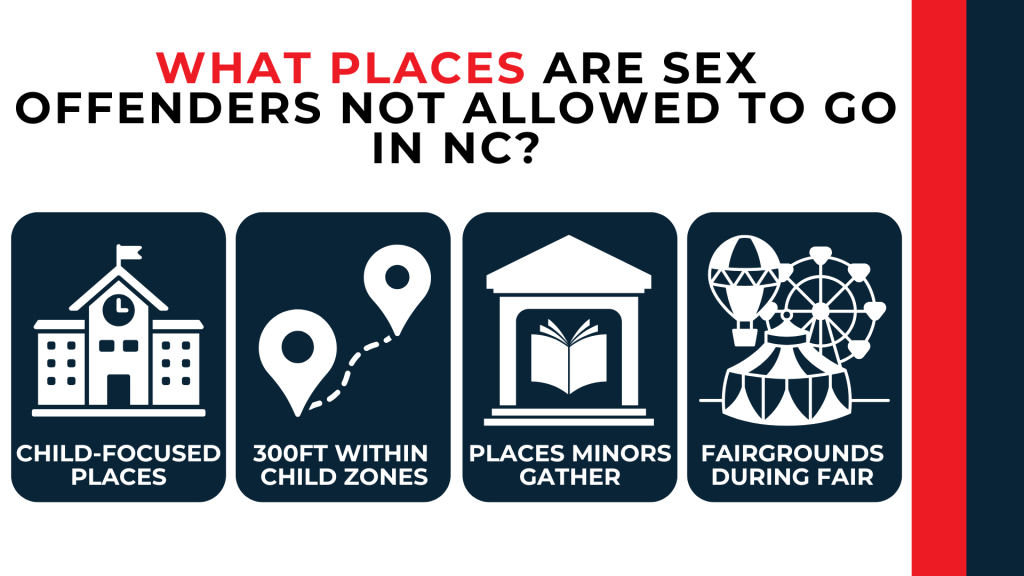
N.C.G.S. § 14-208.18 is the statute that covers location restrictions for registered sex offenders in North Carolina. It does not impose a blanket ban on all public places. Instead, it identifies specific categories of locations that are off-limits.
Under subsection (a), if you are a covered registrant, you cannot knowingly be at any of the following:
- Premises intended primarily for the use, care, or supervision of minors, including schools, children’s museums, child care centers, nurseries, and playgrounds.
- Within 300 feet of any location intended primarily for minors when that location sits on a larger property not primarily intended for minors.
- Any place where minors frequently congregate — the statute names libraries, arcades, amusement parks, recreation parks, and swimming pools as examples — when minors are present.
- On fairgrounds during the State Fair, the Mountain State Fair, or any agricultural fair.
Not every person on the registry faces these restrictions. Under subsection (c), the premises limitations apply to you if you committed an offense under Article 7B of Chapter 14 (North Carolina’s sexual offense statutes), any offense where the victim was under 18, or an offense involving sexual exploitation of a minor under G.S. §§ 14-190.16, 14-190.17, 14-190.17A, or 14-190.17C.
The 300-foot buffer rule in subsection (a)(2) has an additional requirement. It applies only when a court has found in a criminal or civil proceeding that you present or may present a danger to minors. It also applies when the original offense involved a victim under 18 or a sexual exploitation charge.
The distinction matters. The restrictions you face depend on the specific offense that triggered your registration, not simply the fact that you are on the registry.
Could a Church Count as a Place Where Minors Congregate?
This is where the answer gets complicated, and it is the reason a general “churches aren’t listed” response can be misleading.
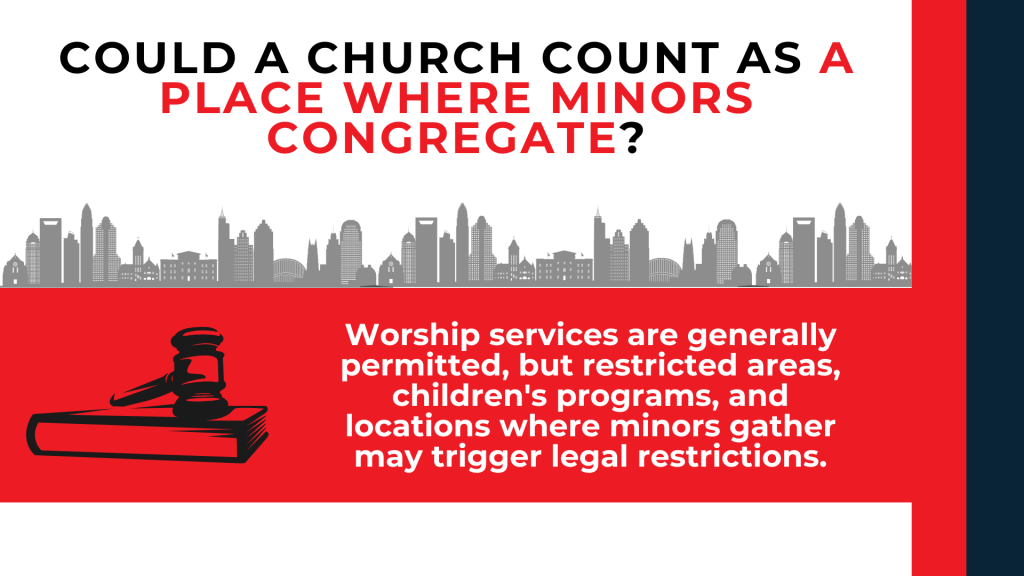
A church sanctuary used for a regular Sunday worship service is not a place “intended primarily for the use, care, or supervision of minors” under § 14-208.18(a)(1). Adults make up the majority of the congregation, and the primary purpose of the space is worship for people of all ages.
But many churches contain spaces that could fall within the statute’s reach. A dedicated nursery room, a children’s Sunday school wing, a youth ministry area, or a vacation Bible school program may qualify as a location intended primarily for minors. If those spaces exist within the church building, the 300-foot buffer in subsection (a)(2) could also come into play. This is especially true on larger church campuses where children’s programming happens in a separate building or wing.
The statute also restricts you from being at places “where minors frequently congregate” when minors are present. A church fellowship hall hosting a youth group meeting, a gymnasium used for children’s basketball, or a Wednesday-night kids’ program could potentially meet that description depending on the specific facts.
None of this means that attending a worship service is automatically a violation. It means that the physical layout of the church, the timing of your visit, and the specific areas you enter all matter in determining whether you are following the law.
Could Conditions of My Sentence Add Restrictions Beyond the Statute?
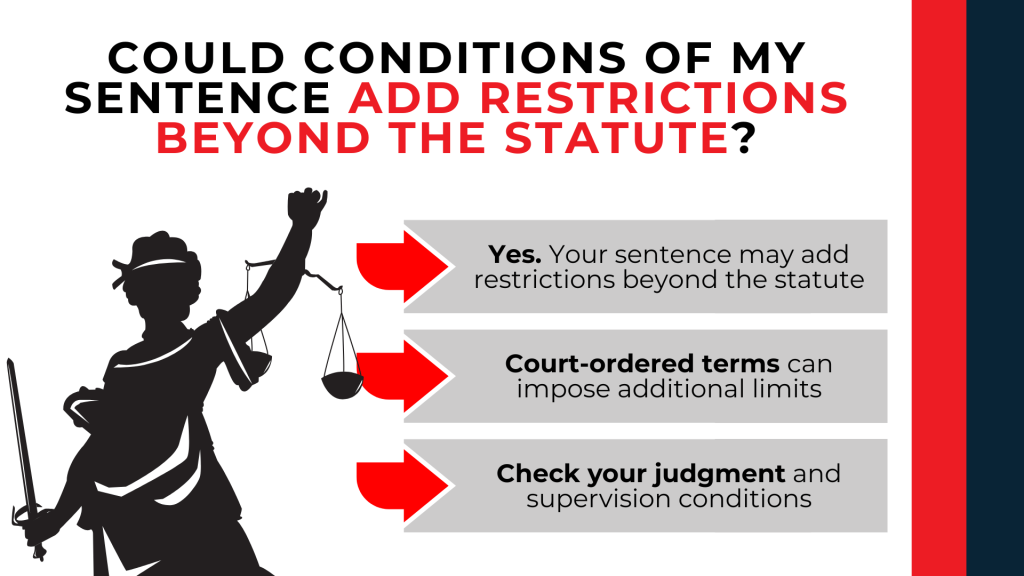
Sex offense convictions in North Carolina carry additional consequences beyond the registry itself. Defense attorneys should advise clients on location restrictions tied to their specific case. Section 14-208.18 defines the statutory restrictions, but it may not be the only source of limitations on where you can go.
If your sentence included probation, post-release supervision, or other court-ordered conditions, those terms may impose additional restrictions. These restrictions are specific to your case and may go further than what the statute requires. What those conditions cover depends on the language of your judgment and the terms set by the court. The restrictions that apply to you may come from more than one source — the registry statute, your judgment, and any supervision conditions. It is important to review all of them together rather than relying on the statute alone.
An attorney familiar with sex offense cases in North Carolina can review the specific documents that apply to your situation. They can tell you whether church attendance is allowed under every restriction that applies to you, not just the ones in § 14-208.18.
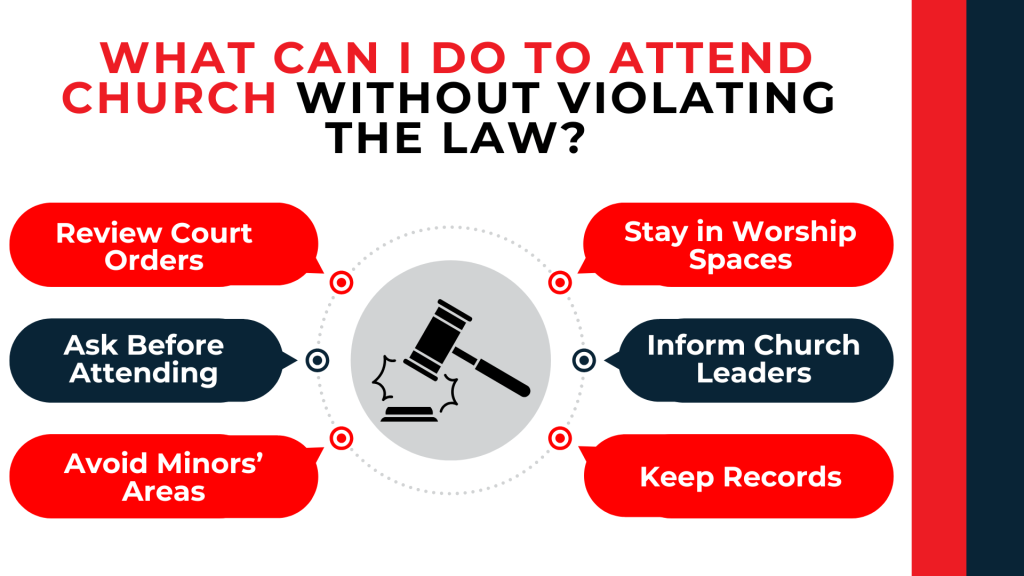
What Can I Do to Attend Church Without Violating the Law?
The following are general considerations — not legal standards — that may help reduce the risk of an unintentional violation. They are not a substitute for reviewing your specific case with an attorney.
Start by reviewing your judgment and commitment order and any other court orders that govern your supervision. These documents define what you are and are not permitted to do. If you are unsure how to read them, a criminal defense attorney can walk you through the specific language.
If you are on active supervision, consider discussing church attendance with your supervising officer before attending rather than assuming it is permitted. A clear answer in advance is better than an unclear situation after the fact.
If you do attend, staying in the main worship area and avoiding spaces designated for minors — nurseries, children’s classrooms, youth group rooms — may help you stay on the right side of the statutory restrictions in § 14-208.18. Arriving close to the start of the service and leaving promptly when it ends limits time spent in common areas where children may gather.
Communicating with church leadership about your situation in advance may also be worthwhile. Some churches have existing policies that address this, and being upfront can prevent misunderstandings.
Keeping a record of the steps you take — conversations with a supervising officer, communications with church staff, and the specific services you attend — may be useful if a question ever arises about your actions.
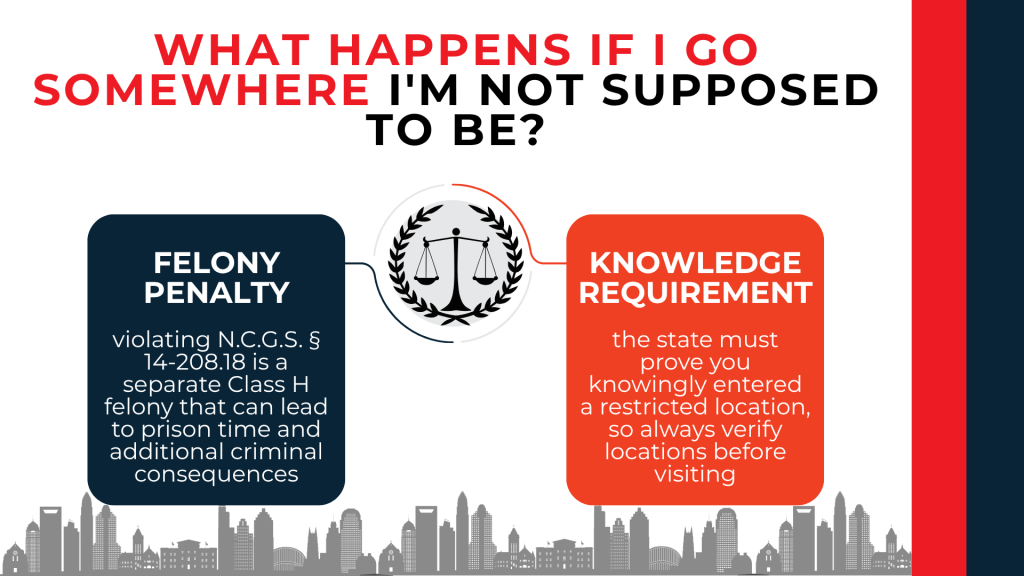
What Happens If I Go Somewhere I’m Not Supposed to Be?
A violation of N.C.G.S. § 14-208.18 is a Class H felony under subsection (h). That is a separate criminal charge on top of whatever consequences may follow from other aspects of your case. A Class H felony in North Carolina carries a potential prison sentence that varies based on your prior record level. A conviction also adds another offense to a record that already carries significant additional consequences.
The statute requires that you “knowingly” be at a restricted location, which means the state must prove awareness. But “I didn’t realize there was a daycare in the building” is a difficult argument to make when the information was available in advance. The safest approach is to know the layout of any location before you go.
Talk to a North Carolina Sex Crimes Defense Attorney
The answer to whether you can attend church depends on your specific offense, your specific court orders, and any conditions tied to your sentence or supervision. A general overview of the statute can tell you what the law says in broad terms, but it cannot tell you where you personally stand.
Patrick Roberts is a Raleigh-based attorney who handles sex offenses statewide, with regional offices in Cary, Durham, and Chapel Hill. Over a 20-year career, he has managed thousands of cases, supported by an academic foundation from Johns Hopkins and Duke Law. His commitment to trial advocacy is evidenced by his graduation from Gerry Spence’s Trial Lawyers College and the NCDC. An AV Preeminent rated lawyer and published author, Mr. Roberts utilizes his past experience as an Assistant District Attorney to counter the prosecution’s strategies.
Education & Advanced Training
An alumnus of Johns Hopkins University (#7 National University) and Duke University School of Law (#7 National Law School; #9 Criminal Law Program), Mr. Roberts has dedicated his career to honing his trial craft. He is a graduate of the prestigious Gerry Spence’s Trial Lawyers College and the National Criminal Defense College (NCDC) Trial Practice Institute, including the 2025 Cross-Examination Intensive.
Accolades & Peer Review
• Martindale-Hubbell AV Preeminent Rating: 5+ Consecutive Years
• Martindale-Hubbell Client Champion Platinum: 5+ Consecutive Years
• AVVO 10/10 “Superb” Rating: 15+ Consecutive Years
• The National Trial Lawyers: Top 100 Trial Lawyers
Mr. Roberts is a published author of two legal books and a lifetime member of the National Association of Criminal Defense Lawyers.
A Former Prosecutor’s Insight
Mr. Roberts’ defense strategy is informed by his tenure as an Assistant District Attorney in the Wake, Johnston, and New Hanover offices. This experience allows him to anticipate the methods used by the state in complex sex crime litigation.
Jurisdictional Admissions
Qualified to handle cases at the highest levels, he is admitted to the U.S. Supreme Court, the Fourth Circuit Court of Appeals, and all North Carolina federal districts. He remains the sole North Carolina representative listed by the National Child Abuse Defense & Resource Center as of 2026.
Client Review
“Have you ever found yourself in a situation and didn’t know who to turn to? That was us when our young adult got into legal trouble for the first time in his life. As parents, we were overwhelmed and scared. We prayed for an experienced criminal defense attorney who would be honest, direct, yet compassionate — and God led us to Patrick Roberts, Esquire. We couldn’t have asked for better representation! Attorney Roberts is well-versed in the law and the Wake County Court System. He’s candid and doesn’t sugarcoat things — which was exactly what we needed. His years of experience exuded a strong sense of confidence. From day one, it was clear that he’s deeply committed to advocating for his clients, no matter how tough the situation. He’s a man of his word and asked us to trust his process. We did and it worked! Using a serious yet compassionate tone, Attorney Roberts made time to provide the hard facts about the consequences of breaking the law and concluded his talk with words of encouragement and optimism, not false hope. If you have a type A personality like we do, take our advice, relax. We eventually accepted that this busy attorney would not always be immediately available to answer questions, because his priority was advocating for his clients behind the scenes. His dedication became clear when it mattered most — and that’s exactly the kind of attorney you want on your side! We are forever thankful for Attorney Patrick Roberts’ professional work. Due to his strong advocacy, our child now has a second chance to pursue their endless dreams and future aspirations. If you need help with a criminal defense case in the Raleigh area of North Carolina, we highly recommend Patrick Roberts Law, PLLC.” – Verified Client Review via Avvo.com
Peer Endorsement
“I endorse this lawyer without reservation. Patrick is plain outstanding. The highest remark I can give a lawyer is that I would ask him to represent me were I charged with a crime. I would ask Patrick and know that I would be in the very best of hands.” – Verified peer endorsement via Avvo.com
Disclaimer: Testimonials and peer reviews are for informational purposes only and do not guarantee or predict the outcome of your legal matter. Every case is unique and must be evaluated on its own merits. All endorsements featured on this site are actual comments from clients and peers.
Seeking Clarity on North Carolina Registry Compliance?
Statutory boundaries regarding property lines, church activities, and childcare facilities require careful, case-by-case legal analysis. If you or a family member need guidance navigating North Carolina’s complex registry rules, our legal team can review your specific situation to ensure you are fully informed and compliant.
[Request a Confidential Consultation with Patrick Roberts Law, PLLC]
The firm maintains a selective intake process to ensure that each client receives the focused professional attention their case requires.
Disclaimer: The information on this website is for general informational purposes only. Nothing herein should be taken as legal advice for any individual case or situation. Contacting us via this website, email, or contact form does not create an attorney-client relationship. Case results depend on a variety of factors unique to each case; prior results do not guarantee a similar outcome.
Former assistant district attorney
Contact Patrick Roberts
Facing criminal charges in North Carolina demands seasoned representation. Trust in the experience and dual perspective of Patrick Roberts. Reach out today for a confidential consultation.
-
Call Our Team
Calls answered 24/7






For more information on the selection criteria, go to www.martindale.com
*Each case is different and must be evaluated separately. Prior results achieved do not guarantee similar results can be achieved in future cases.