

There is no single national answer. How long you can visit another state without triggering a registration requirement depends on the laws of the destination state. Those laws vary widely — from as few as a couple of days to 30 days or more. Some states count consecutive days; others count total days over the course of a year. Getting this wrong does not result in a warning. It results in criminal charges.
If you are registered in North Carolina and planning to travel — or if someone you care about is — this page covers how destination states set their own timelines, what North Carolina requires before you leave, and what happens if you miss a step.
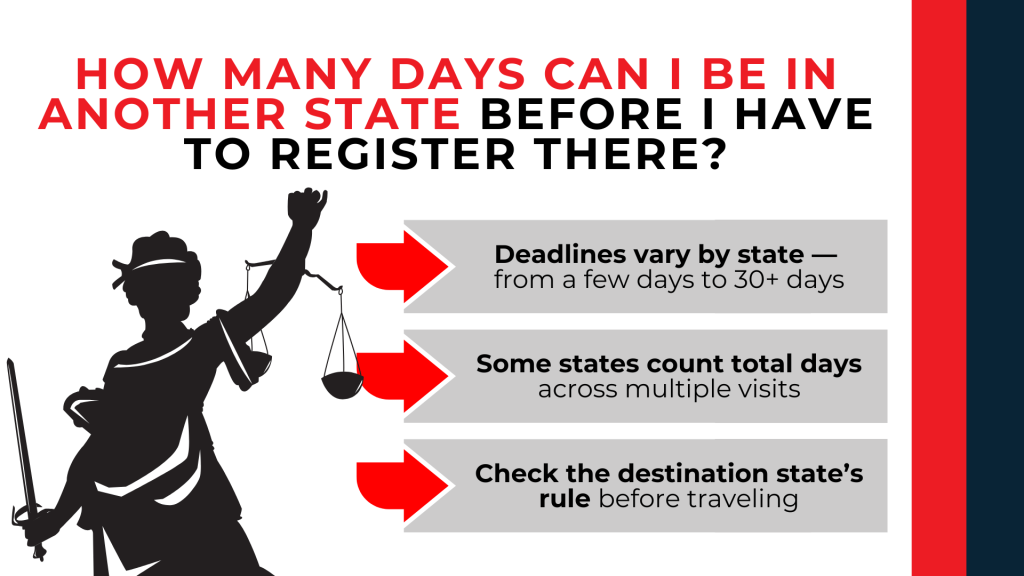
How Many Days Can I Be in Another State Before I Have to Register There?
The time limit for registering as a sex offender when visiting another state varies significantly by jurisdiction. Because individual states retain independent authority to regulate their registries, deadlines are highly variable and strictly enforced. A visiting individual may have anywhere from 24 hours to 30 days to register with local law enforcement, depending on the destination state’s statutes.
State-Level Registration Deadlines
Registration requirements are generally triggered by either consecutive days of presence or an aggregate number of days within a calendar or 12-month period. Failing to register within the designated window can result in state-level failure-to-register charges and potentially trigger federal prosecution.
The table below outlines the visiting registration requirements for several states, illustrating the lack of uniformity across jurisdictions:
| Jurisdiction | Registration Deadline / Presence Trigger | Definition of Presence / Tracking Period |
| California | Within 5 working days | Upon entering the jurisdiction |
| Florida | Within 3 days | Total days within a calendar year |
| Texas | Within 7 days | Upon arriving or establishing temporary residence |
| Virginia | Within 3 days | If stay exceeds 30 days total |
| Washington | Within 3 business days | If present for 10 days or more |
Federal Framework and SORNA Requirements
The federal Sex Offender Registration and Notification Act (SORNA) establishes the baseline standards for the tracking and tiering of registrants nationwide. SORNA categorizes offenses into three distinct tiers, which dictate the duration of the registration obligation:
- Tier I: 15-year registration period (reducible to 10 years upon meeting compliance criteria).
- Tier II: 25-year registration period.
- Tier III: Lifetime registration period.
While SORNA outlines these federal baselines, it functions as a statutory floor rather than a ceiling. States frequently implement shorter registration windows for visiting individuals, stricter tracking mechanisms, and alternate verification schedules. Furthermore, under federal guidelines, a registrant must report any change in temporary lodging, employment, or school enrollment to their home jurisdiction within three business days. For international travel, federal law mandates notification to the home registry at least 21 days prior to departure.
Compliance and Verification
Because rules are subject to legislative updates and localized interpretation, cross-state travelers cannot rely on the statutes of their home jurisdiction to estimate compliance windows elsewhere. Verifying the exact requirements of the destination state prior to travel is necessary to maintain compliance. Authoritative verification channels include:
- The county sheriff’s department or local law enforcement agency in the destination jurisdiction.
- The official state police or department of public safety sex offender registry portal for the target state.
- A qualified criminal defense attorney admitted to practice in the destination jurisdiction.
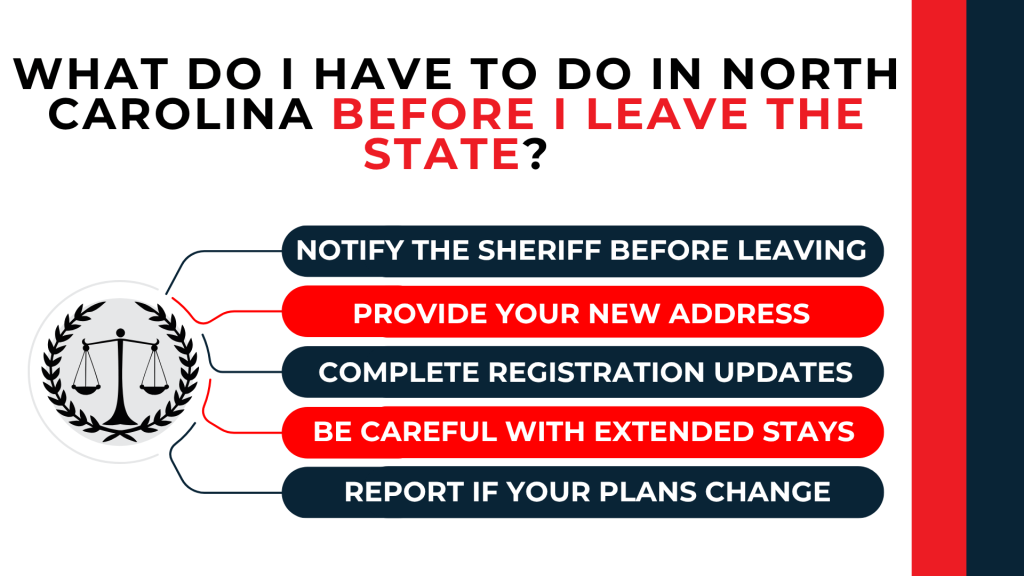
What Do I Have to Do in North Carolina Before I Leave the State?
North Carolina’s requirements are specific and time-sensitive. Under N.C.G.S. § 14-208.9(b), if you intend to move to another state, you must report in person to the sheriff of your current county of residence at least three business days before the date you plan to leave. You must provide written notification that includes the address, municipality, county, and state of your intended new residence.
At that visit, the sheriff will assess whether your current registry photograph still provides a true and accurate likeness and may take a new one. The sheriff is also required to inform you that you must comply with the registration requirements in your new state of residence. The sheriff then forwards your information to the NC Department of Public Safety, which notifies the appropriate officials in the state you are moving to.
Now, here is where it gets particularly important if you are planning a visit rather than a permanent move. North Carolina’s statute is written around establishing residence in another state. But the notification and registration requirements still matter for extended visits. Overstaying a destination state’s visitor time limit without having registered can trigger charges in that state. And failing to notify North Carolina about your whereabouts can create problems here as well.
There is also a rule that catches people who change their minds. Under § 14-208.9(b1), if you report your intent to move to another state and then decide to stay in North Carolina, you must report back in person to the same sheriff’s office within three business days of the date you originally said you would leave. The sheriff then notifies the Department of Public Safety that you are remaining in the state. Failing to close that loop is not a technicality — it is a criminal offense.
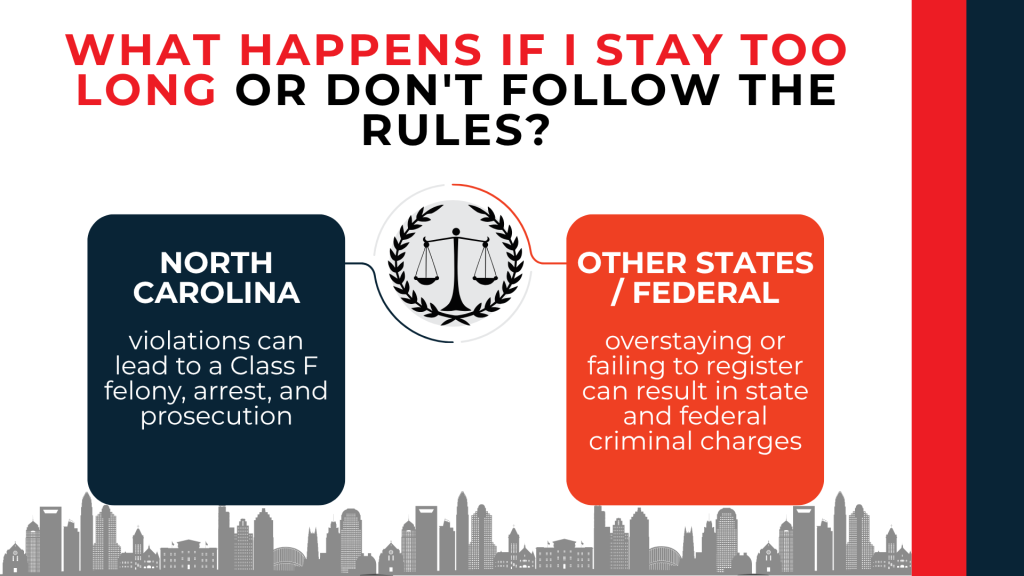
What Happens If I Stay Too Long or Don’t Follow the Rules?
The consequences operate on two fronts, and they are serious on both.
On the North Carolina side, N.C.G.S. § 14-208.11 makes it a Class F felony to willfully fail to comply with the state’s registration requirements. That includes failing to notify the sheriff of an address change, failing to return a verification form, and submitting false information. It also covers the situation directly relevant here — reporting your intent to reside in another state but then remaining in North Carolina without reporting back to the sheriff as required under § 14-208.9. If a probation officer, parole officer, or law enforcement officer becomes aware of a violation, the statute authorizes immediate arrest. You can be arrested and transferred to the county where the registration failure occurred for prosecution there.
On the destination state’s side, overstaying the visitor time limit without registering can result in state-level felony charges for failure to register as a sex offender. Federal law may create an additional layer of risk as well. SORNA establishes federal registration and notification requirements that apply across state lines. A registrant who fails to meet those requirements when traveling between states could face federal prosecution on top of any state charges. Federal sexual abuse offenses carry a 99.2% imprisonment rate, with an average sentence of 221 months.
The overlap matters. A single trip where you miss a deadline or skip a notification can leave you facing charges in your home state, your destination state, and the federal system.
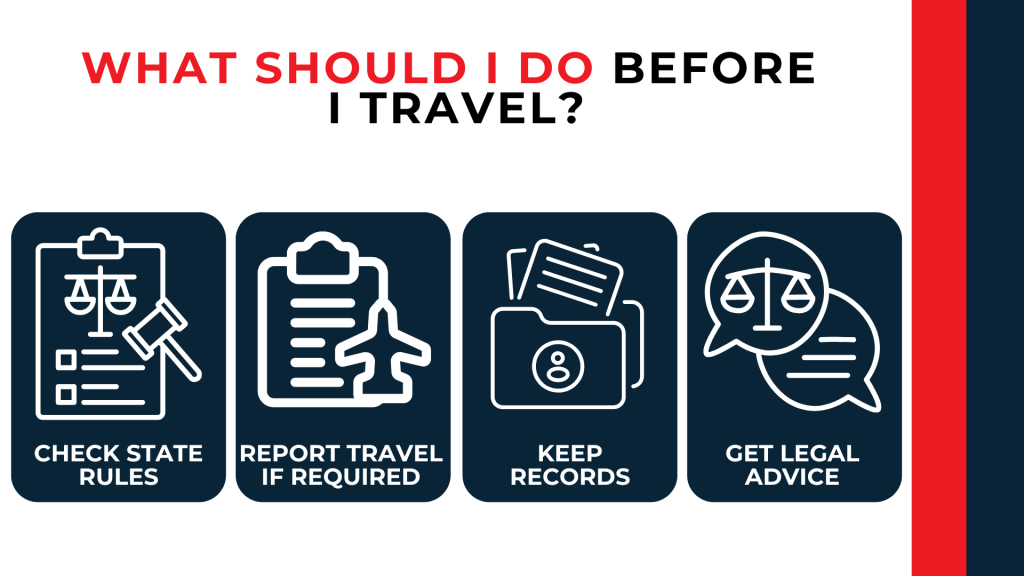
What Should I Do Before I Travel?
The legal consequences of crossing state lines while on a sex offender registry leave no room for assumptions. To maintain compliance and protect your liberty, execute these four defensive steps prior to travel:
1. Verify Destination Statutes
Identify the exact rules governing out-of-state visitors in your destination jurisdiction. Do not assume their timeline matches North Carolina’s. You must look for three specific data points:
- The exact registration window (e.g., some jurisdictions like Florida or Nevada require registration within 48 hours of arrival).
- Whether the presence trigger is calculated in consecutive days or aggregate days over a 12-month period.
- The specific law enforcement agency responsible for receiving visitor registrations.
This information is typically hosted by the destination state’s bureau of investigation, state police registry portal, or the local county sheriff’s department where you intend to stay.
2. Determine if North Carolina Reporting Requirements Apply
North Carolina law does not provide a standard mechanism to report brief, temporary out-of-state vacations to your local sheriff. However, you are legally required to report travel under G.S. § 14-208.9 and G.S. § 14-208.8A if your trip crosses into these specific thresholds:
- Intent to Relocate: If you are moving out of state permanently, you must report in person to your current registering sheriff at least three business days before departing.
- Employment and Temporary Lodging: If you are traveling for work and will maintain a temporary residence (such as a hotel or transient lodging) out of your county for more than 10 days within a 30-day period, or more than 30 days in the aggregate during a calendar year, you must formally notify the sheriff.
3. Maintain an Absolute Paper Trail
If an administrative question or an investigation ever arises regarding your travel timelines, documentation is your primary defense against a failure-to-register allegation. Retain physical and digital copies of:
- Dated round-trip travel arrangements, flight itineraries, or train tickets.
- Hotel, Airbnb, or lodging receipts showing explicit check-in and check-out dates.
- Fuel, toll, and dining receipts generated during the trip to establish your precise timeline.
- Written confirmation or names/badge numbers of any registry officials you spoke with in the destination state.
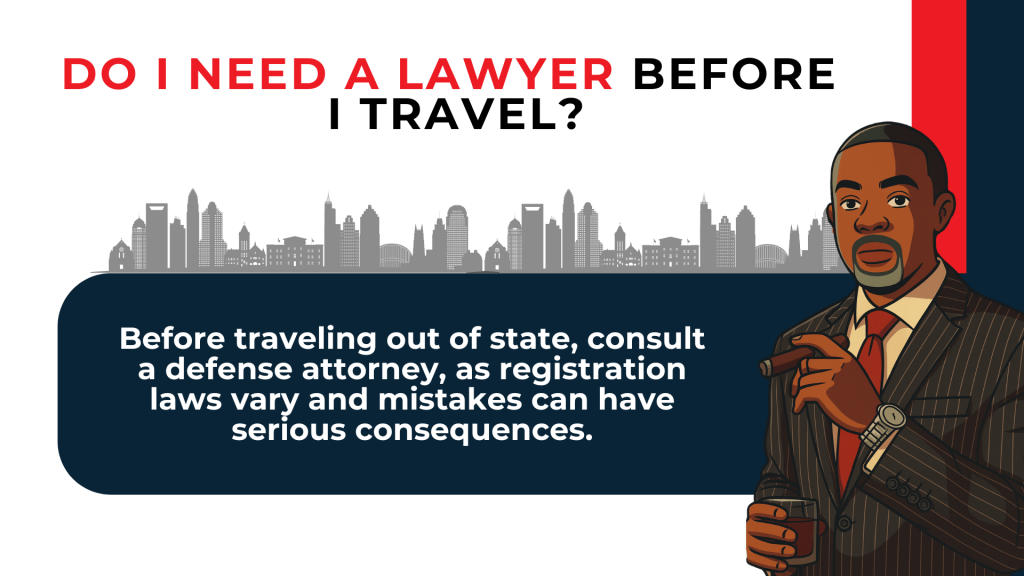
Do I Need a Lawyer Before I Travel?
If you are on the North Carolina sex offender registry and you need to travel to another state — whether for a family obligation, a work opportunity, or any other reason —it is important to get legal guidance before you go. The registration system across states can be quite confusing that even well-intentioned people make mistakes. The law does not distinguish between intentional evasion and honest confusion.
Consult a Local Defense Attorney
If your travel plans fall into a grey area—such as multi-week split custody visits, extended work assignments, or frequent border crossings—consult a criminal defense attorney in the destination state before you leave.
Because failure-to-register is a strict liability or willful omission felony depending on the exact charge, relying on an unverified interpretation of a statute is a severe risk. Mistake of law (“I didn’t know the rule”) is rarely a viable defense in a courtroom. Securing legal clarity beforehand ensures you do not inadvertently trigger a felony charge.
Verifying Cross-State Registration Compliance
Travelers must ensure their itineraries comply with both North Carolina statutes and the laws of their destination state, because sex offender registration laws vary significantly by jurisdiction. A qualified criminal defense attorney can review specific travel plans, evaluate temporary residency thresholds, and provide clear guidance on out-of-state reporting requirements.
Legal Counsel in the Research Triangle Area
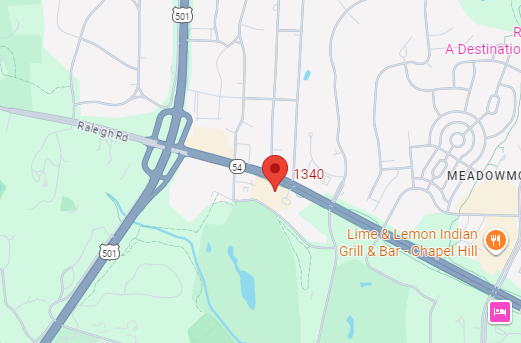
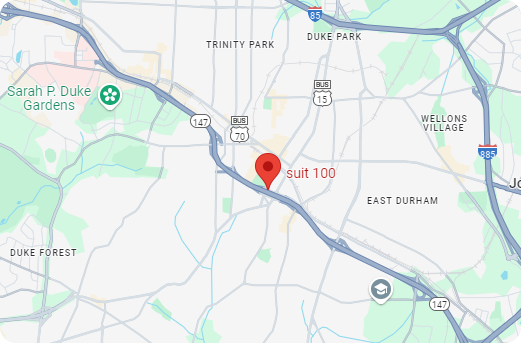
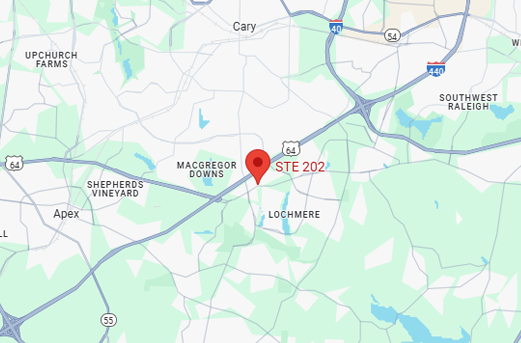
Patrick Roberts is a Raleigh criminal defense attorney with over 24 years of experience. He handles sex offense registration cases across North Carolina, with additional offices in Durham, Chapel Hill, and Cary.
Mr. Roberts offers legal consultation for individuals navigating the complexities of the North Carolina registry and interstate travel requirements. Drawing on experience within the state’s criminal justice system, the legal team at Patrick Roberts Law PLLC assists clients in reviewing statutory obligations to maintain regulatory compliance.
Consultations can be arranged at any of our four Research Triangle office locations: Raleigh, Durham, Cary, Chapel Hill.
Schedule a Consultation: To discuss your specific travel timeline and verify your out-of-state compliance requirements, contact Patrick Roberts Law PLLC at 919-746-7206 or through the website’s contact form to schedule a confidential appointment.
Education & Advanced Training
An alumnus of Johns Hopkins University (#7 National University) and Duke University School of Law (#7 National Law School; #9 Criminal Law Program), Mr. Roberts has dedicated his career to honing his trial craft. He is a graduate of the prestigious Gerry Spence’s Trial Lawyers College and the National Criminal Defense College (NCDC) Trial Practice Institute, including the 2025 Cross-Examination Intensive.
Accolades & Peer Review
• Martindale-Hubbell AV Preeminent Rating: 5+ Consecutive Years
• Martindale-Hubbell Client Champion Platinum: 5+ Consecutive Years
• AVVO 10/10 “Superb” Rating: 15+ Consecutive Years
• The National Trial Lawyers: Top 100 Trial Lawyers
Mr. Roberts is a published author of two legal books and a lifetime member of the National Association of Criminal Defense Lawyers.
A Former Prosecutor’s Insight
Mr. Roberts’ defense strategy is informed by his tenure as an Assistant District Attorney in the Wake, Johnston, and New Hanover offices. This experience allows him to anticipate the strategies used by the state in complex sex crime litigation.
Jurisdictional Admissions
Qualified to handle cases at the highest levels, he is admitted to the U.S. Supreme Court, the Fourth Circuit Court of Appeals, and all North Carolina federal districts. He remains the sole North Carolina representative listed by the National Child Abuse Defense & Resource Center as of 2026.
Client Review
“I highly recommend this attorney to anyone needing experienced and knowledgeable legal representation. From the beginning, he clearly explained the steps necessary to address my situation and made sure I understood the process along the way. He kept me informed as progress was being made and was always professional, responsive, and prepared. Although the legal process can move slowly at times, I always felt confident that my case was being handled properly. When my court date finally arrived, he was exceptionally well prepared and navigated the courtroom procedures with confidence and skill. His experience and attention to detail ultimately helped lead to a very positive outcome in my case. I truly appreciated his guidance and representation throughout the entire process.” – Verified client review via Avvo.com
Peer Endorsement
“I endorse this lawyer. Patrick is a great trial lawyer and a person who I go to for legal advice in my own practice. Patrick is dedicated to his clients. I would not hesitate to hire him if I was in trouble and needed a lawyer.”- Verified peer endorsement via Avvo.com
Disclaimer: Testimonials and peer reviews are for informational purposes only and do not guarantee or predict the outcome of your legal matter. Every case is unique and must be evaluated on its own merits. All endorsements featured on this site are actual comments from clients and peers.
If you need to know where you stand before you travel, contact Patrick Roberts Law to discuss your situation.
Disclaimer: The information on this website is for general informational purposes only. Nothing herein should be taken as legal advice for any individual case or situation. Contacting us via this website, email, or contact form does not create an attorney-client relationship. Case results depend on a variety of factors unique to each case; prior results do not guarantee a similar outcome.
Former assistant district attorney
Contact Patrick Roberts
Facing criminal charges in North Carolina demands seasoned representation. Trust in the experience and dual perspective of Patrick Roberts. Reach out today for a confidential consultation.
-
Call Our Team
Calls answered 24/7






For more information on the selection criteria, go to www.martindale.com
*Each case is different and must be evaluated separately. Prior results achieved do not guarantee similar results can be achieved in future cases.