
If you’re facing misdemeanor charges in North Carolina, you need to know how these charges might affect your gun rights. While most people know felonies can take away your right to own guns, certain misdemeanors can also make it illegal for you to own or possess firearms under both federal and North Carolina laws.
What Federal Laws Block Gun Ownership After Misdemeanors?
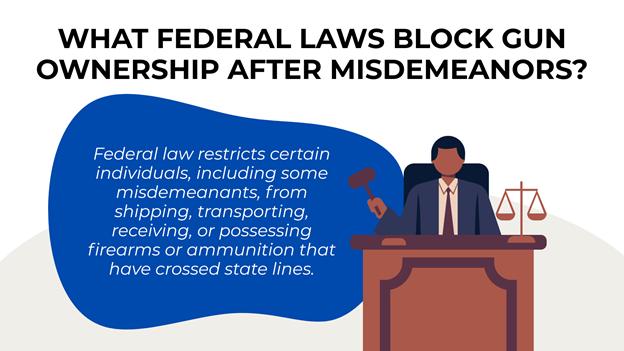
Federal law (18 U.S.C. § 922(g)) lists several types of people who cannot ship, transport, receive, or possess firearms or ammunition that have crossed state lines. While many of these rules target felons, some misdemeanors can also cost you your gun rights.
Domestic Violence Misdemeanors
The biggest federal gun ban for misdemeanors comes from 18 U.S.C. § 922(g)(9), which clearly states that anyone “convicted of a misdemeanor crime of domestic violence” cannot own guns. This rule, often called the “Lautenberg Amendment,” was created to close a gap in gun laws.
Under federal law, a domestic violence misdemeanor means an offense that:
- Involved using or trying to use physical force, or threatening to use a deadly weapon
- Was committed against a current or former spouse, parent, or guardian
- Was committed against someone you have a child with
- Was committed against someone you live with or used to live with as a couple
- Was committed against someone in a similar relationship
This covers many common charges when they happen in a domestic setting, such as:
- Simple assault against a spouse or partner
- Domestic battery
- Domestic violence
- Threatening a family member with a weapon
It’s important to know that the charge doesn’t have to include the words “domestic violence” in its name. What matters is your relationship to the victim, not what the offense is called.
Is the Federal Ban Permanent?
Unlike some state restrictions that expire after a certain time, the federal ban under 18 U.S.C. § 922(g)(9) lasts forever unless:
- Your conviction is expunged or set aside
- You receive a pardon
- Your civil rights are restored (if you lost them due to the conviction)
What Other Federal Restrictions Might Apply?
Other federal rules that might apply to misdemeanors include:
- People under certain domestic violence restraining orders (18 U.S.C. § 922(g)(8))
- People who use illegal drugs or are addicted to them (18 U.S.C. § 922(g)(3)), which might include some drug misdemeanors
How Do North Carolina Laws Restrict Gun Rights After Misdemeanors?
North Carolina has its own rules about guns, especially for concealed carry permits. Under North Carolina General Statutes (N.C.G.S.) § 14-415.12, the sheriff must deny a concealed carry permit to people with certain misdemeanor convictions.
Which Violent Misdemeanors Create a Three-Year Ban?
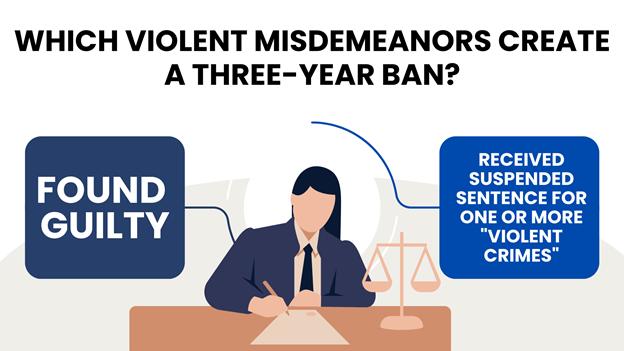
Under N.C.G.S. § 14-415.12(b)(8), you can’t get a concealed carry permit if, within the last three years, you were:
- Found guilty of, or
- Received a prayer for judgment continued or suspended sentence for
one or more “violent crimes” that are misdemeanors, including:
- Assault charges (except simple assault under G.S. § 14-33(a))
- Making threats (G.S. § 14-277.1)
- Stalking (former G.S. § 14-277.3)
- Taking weapons to schools (G.S. § 14-269.2)
- Carrying weapons at parades (G.S. § 14-277.2)
- Carrying hidden weapons (G.S. § 14-269.3)
- Taking weapons into places serving alcohol (G.S. § 14-269.3)
- Bringing weapons into government buildings or courts (G.S. § 14-269.4)
- Having guns at parades (G.S. § 14-269.6)
- Disorderly conduct (G.S. § 14-288.4(a)(1))
- Riot-related charges (G.S. § 14-288.2, 14-288.6, 14-288.9)
- Breaking emergency rules (former G.S. § 14-288.12-14)
- Breaking concealed carry permit rules (G.S. § 14-415.21(b))
- Carrying weapons in restricted areas with a permit (G.S. § 14-415.26(d))
What Misdemeanors Create a Permanent Ban in North Carolina?
North Carolina law permanently blocks people from getting concealed carry permits if they have certain misdemeanor convictions, no matter when they happened.
Domestic Violence and Related Charges
Under N.C.G.S. § 14-415.12(b)(8a), you can never get a permit if you were convicted of or received a prayer for judgment continued for:
- Assault with a deadly weapon (G.S. § 14-32.5)
- Assault on a female (G.S. § 14-33(c)(2))
- Assault on a child under 12 (G.S. § 14-33(c)(3))
- Assault causing serious injury (G.S. § 14-33(c)(1))
- Assault on a person with a disability (G.S. § 14-33(d))
- Stalking (G.S. § 14-277.3A)
- Child abuse (G.S. § 14-318.2)
- Trespassing after domestic violence (G.S. § 14-134.3)
- Breaking a protective order while having a deadly weapon (G.S. § 50B-4.1)
Federal Domestic Violence Ban
North Carolina directly includes the federal ban in N.C.G.S. § 14-415.12(b)(8b), saying a permit will be denied to anyone who “cannot possess a firearm under 18 U.S.C. § 922(g) because of a domestic violence misdemeanor.”
How Do Assaults on Officials Impact Gun Rights?
Under N.C.G.S. § 14-415.12(b)(8c), you can never get a permit if you were convicted of or received a prayer for judgment continued for crimes involving:
- Assault or threats against police officers
- Assault on probation or parole officers
- Assault on jail or prison staff
- Assault on firefighters
- Assault on EMTs
- Assault on medical responders
- Assault on emergency room staff

What About DWI Convictions–How Do They Impact Gun Rights?
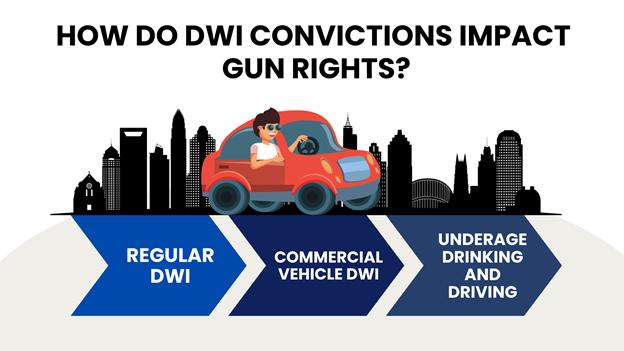
North Carolina specifically addresses drunk driving in N.C.G.S. § 14-415.12(b)(11). If you were convicted of drunk driving under:
- G.S. § 20-138.1 (Regular DWI)
- G.S. § 20-138.2 (Commercial vehicle DWI)
- G.S. § 20-138.3 (Underage drinking and driving)
within the last three years, you cannot get a concealed carry permit.
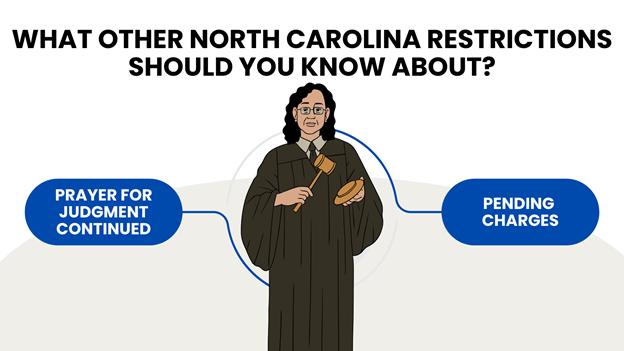
What Other North Carolina Restrictions Should You Know About?
North Carolina has more rules that might affect your gun rights:
- Prayer for Judgment Continued: Under N.C.G.S. § 14-415.12(b)(9), if you received a prayer for judgment continued for any offense that would block you from getting a permit, you can’t get one.
- Pending Charges: Under N.C.G.S. § 14-415.12(b)(10), if you’re out on bail or awaiting trial, appeal, or sentencing for a crime that would stop you from getting a permit, you can’t get one.
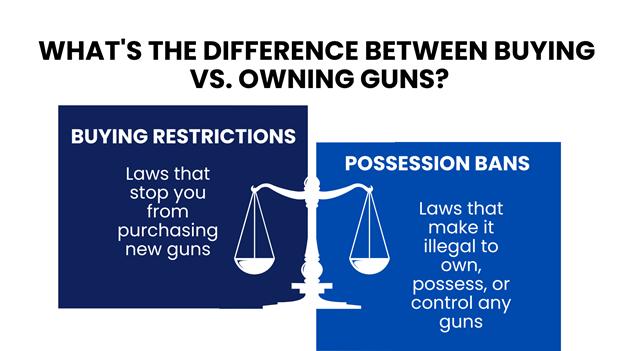
What’s the Difference Between Buying vs. Owning Guns?
When dealing with gun restrictions, it helps to understand two different concepts:
- Buying restrictions: Laws that stop you from purchasing new guns
- Possession bans: Laws that make it illegal to own, possess, or control any guns, even ones you bought before your conviction
Federal bans under 18 U.S.C. § 922(g) generally restrict both buying and owning. They make it illegal to “ship or transport across state lines, or possess in or affecting commerce, any firearm or ammunition” or to “receive any firearm or ammunition that has been shipped or transported across state lines.”
North Carolina’s rules about concealed carry permits (N.C.G.S. § 14-415.12) specifically affect your ability to get a permit to carry a hidden handgun, but other North Carolina laws may separately ban possession.
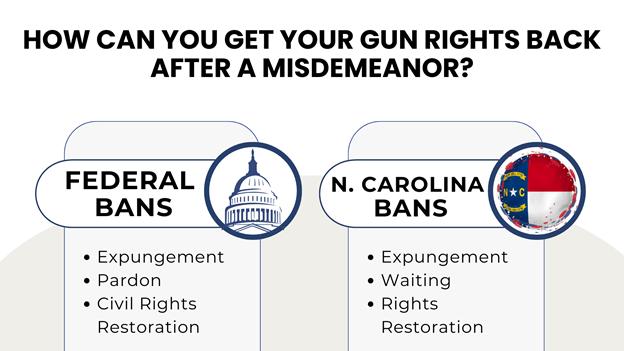
How Can You Get Your Gun Rights Back After a Misdemeanor?
If you’ve lost your gun rights because of a misdemeanor conviction, you might have options:
For Federal Bans:
- Expungement: If your conviction is erased under state law, the federal ban might no longer apply
- Pardon: A pardon that specifically gives back gun rights might remove the federal ban
- Civil Rights Restoration: In some places, there’s a process to restore your civil rights, which might lift the federal ban
For North Carolina Bans:
- Waiting: For certain misdemeanors with three-year bans, simply waiting until that time is up might restore your eligibility
- Expungement: North Carolina has processes to expunge certain misdemeanors under various laws
- Rights Restoration: Under N.C.G.S. § 14-415.4, there are ways to get your gun rights back in certain cases
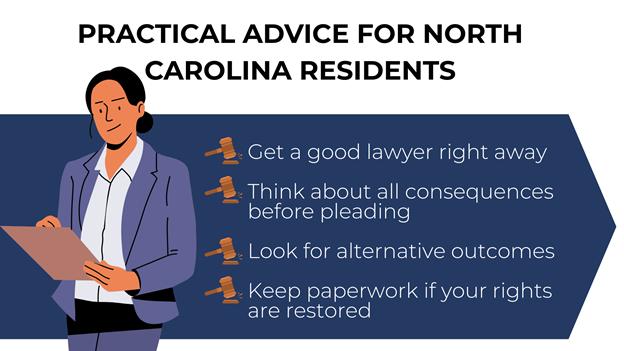
Practical Advice for North Carolina Residents
If you’re facing misdemeanor charges in North Carolina and worry about your gun rights:
- Get a good lawyer right away: An experienced North Carolina criminal defense attorney can look at your specific situation and help protect your Second Amendment rights
- Think about all consequences before pleading: Many people accept plea deals without understanding how they’ll affect their constitutional rights
- Look for alternative outcomes: In some cases, your lawyer might negotiate for solutions that don’t affect your gun rights
- Keep paperwork if your rights are restored: If you get your rights back through any legal process, keep all documentation
Conclusion
North Carolina residents face a complex mix of federal and state restrictions that can affect gun rights after misdemeanor convictions. The most severe restrictions apply to domestic violence offenses under both federal law (18 U.S.C. § 922(g)(9)) and North Carolina law (N.C.G.S. § 14-415.12(b)(8a) and (8b)), which can permanently revoke your right to own firearms unless your conviction is expunged, set aside, or pardoned.
At Patrick Roberts Law Firm, we understand how high the stakes are. Patrick and his team have deep experience helping clients navigate these overlapping laws—whether you’re currently facing charges or dealing with the long-term consequences of a past conviction.
Don’t wait to understand your rights or pursue relief. Contact Patrick Roberts Law Firm today to protect your future and preserve your Second Amendment rights.
Former assistant district attorney
Contact Patrick Roberts
Facing criminal charges in North Carolina demands seasoned representation. Trust in the experience and dual perspective of Patrick Roberts. Reach out today for a confidential consultation.
-
Call Our Team
Calls answered 24/7






For more information on the selection criteria, go to www.martindale.com
*Each case is different and must be evaluated separately. Prior results achieved do not guarantee similar results can be achieved in future cases.