

If you or someone you care about has been arrested for a serious criminal offense in North Carolina, the rules governing whether you can be released before trial have changed significantly. North Carolina Session Law 2025-93, commonly known as Iryna’s Law, took effect on December 1, 2025, and it fundamentally alters how courts approach pretrial release for defendants charged with violent offenses.
Under this new framework, defendants facing certain serious charges no longer start from a neutral position when seeking release. Instead, the law creates a presumption that no release conditions can adequately protect the public or ensure the defendant will appear for court. This shift places the burden squarely on the defendant to prove otherwise—a meaningful change from how bail determinations previously worked in North Carolina.
Understanding what Iryna’s Law does, which charges it covers, and how it affects your options is essential for anyone navigating the criminal justice system after December 1, 2025. This article breaks down the key provisions of the law, explains who it affects, and addresses common questions about how these new rules work in practice.
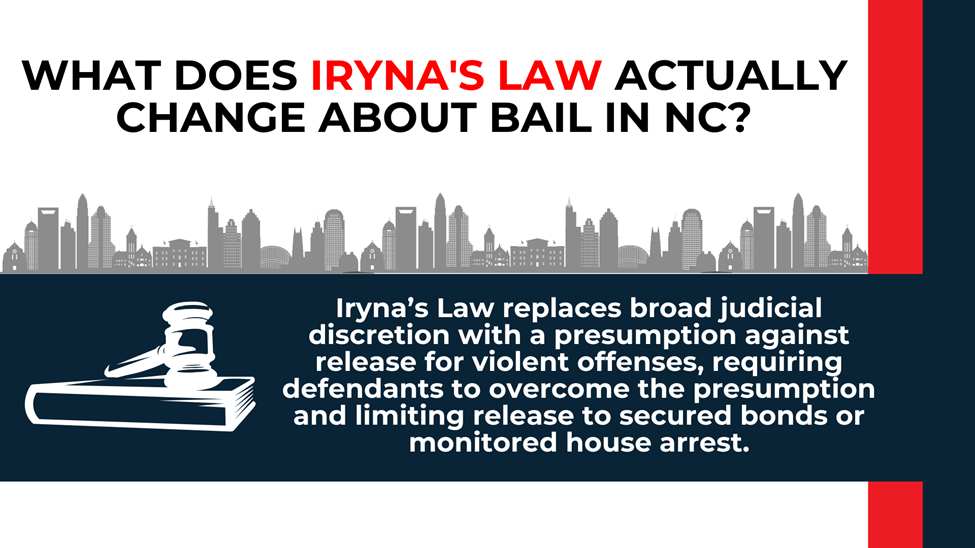
What Does Iryna’s Law Actually Change About Bail in North Carolina?
What Was Pretrial Release Like Before This Law?
Before Iryna’s Law took effect, judicial officials in North Carolina had considerable discretion when setting conditions for pretrial release. While judges and magistrates always considered factors like the seriousness of the charge, the defendant’s ties to the community, and any prior criminal history, the system did not impose a blanket presumption against release for any particular category of offenses. Defendants charged with serious crimes could still potentially secure release through various mechanisms, including unsecured bonds in some circumstances.
What Is a “Rebuttable Presumption” Against Release?
Iryna’s Law creates what legal professionals call a “rebuttable presumption” against pretrial release for defendants charged with violent offenses. In practical terms, this means the law assumes from the start that no conditions of release can adequately ensure public safety or guarantee that the defendant will appear for future court dates. The defendant must actively overcome this presumption by presenting evidence or arguments that convince the court otherwise.
This represents a significant procedural shift. Rather than the State bearing the burden of explaining why a defendant should remain in custody, the defendant now carries the burden of demonstrating why release is appropriate. The presumption does not make release impossible, but it creates a substantial hurdle that must be cleared.
What Types of Release Are Still Available Under This Law?
For defendants charged with violent offenses under Iryna’s Law, judicial officials must require one of two forms of release if they determine release is appropriate:
- A secured appearance bond, which requires the defendant or a bondsman to post money or property as a guarantee of appearance
- House arrest with electronic monitoring, which confines the defendant to their residence and tracks their location
The law eliminates unsecured release options for violent offense charges. Previously, some defendants could secure release by simply promising to pay a specified amount if they failed to appear—without putting up any money or collateral in advance. That option is no longer available when Iryna’s Law applies.
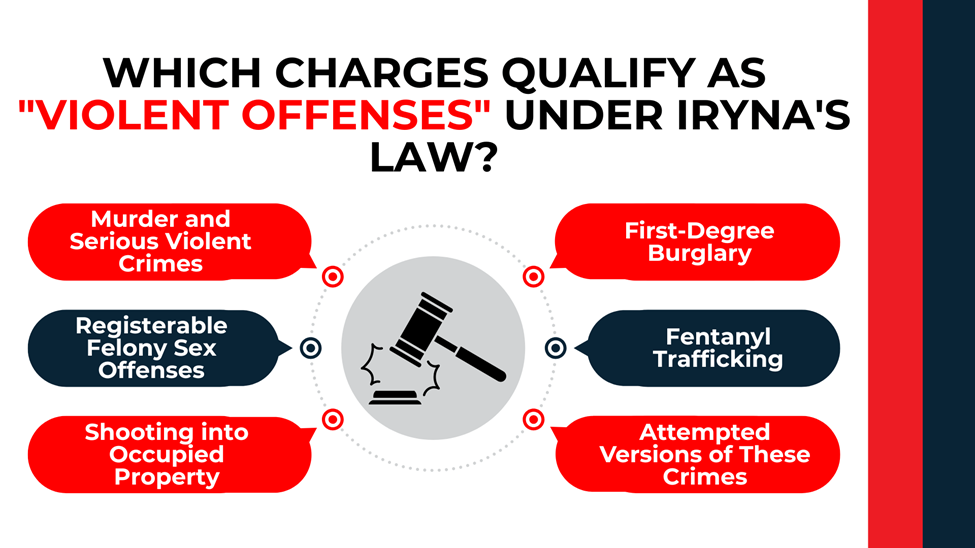
Which Charges Qualify as “Violent Offenses” Under Iryna’s Law?
What Felony Classes Are Included?
Iryna’s Law does not apply to all criminal charges or even all felony charges. The law specifically defines “violent offense” to include Class A through Class G felonies that involve assault, physical force, or threats of force. North Carolina’s felony classification system ranks offenses from Class A (the most serious) through Class I (the least serious), so this law targets the upper half of the felony spectrum—but only when the offense involves violence or the threat of violence.
What Specific Crimes Does the Law Cover?
The statutory definition of “violent offense” encompasses several specific categories of criminal conduct:
- Murder and related serious crimes
- Felony sex offenses that require registration on the North Carolina Sex Offender Registry
- Discharging a firearm into occupied property
- First-degree burglary
- Fentanyl trafficking offenses
- Attempts to commit any of the above crimes
This list captures a broad range of serious criminal conduct, from violent crimes against persons to drug trafficking offenses involving fentanyl. The inclusion of attempted charges means that even incomplete crimes can trigger the law’s provisions if they would have constituted a violent offense if completed. This list is not exhaustive—the statute includes additional specific offenses
Does This Apply to All Felony Charges?
No. Iryna’s Law applies only to charges that meet the specific “violent offense” definition. A defendant charged with a Class H or Class I felony would not face the rebuttable presumption against release, nor would a defendant charged with a higher-class felony that does not involve assault, physical force, or threats of force. Similarly, misdemeanor charges fall outside the scope of this law regardless of the underlying conduct.
The distinction matters because it determines whether the defendant starts from a presumption of detention or proceeds under the traditional pretrial release framework. Identifying whether a specific charge qualifies as a “violent offense” under this statute is one of the first questions that must be answered when someone is arrested.
What Happens If Someone Is Already on Pretrial Release When Charged?
What Is the “Second Violent Offense” Rule?
Iryna’s Law includes special provisions for defendants who have prior involvement with violent offense charges. If a defendant is charged with a violent offense and either has a prior conviction for a violent offense or is currently on pretrial release for a prior violent offense charge, the law imposes an additional requirement: the defendant must be placed on house arrest with electronic monitoring if that option is available in the jurisdiction.
This provision targets repeat situations involving violent conduct. The law treats defendants with prior violent convictions—or those who allegedly committed a new violent offense while already awaiting trial on another—as presenting heightened concerns that warrant the most restrictive form of release available short of detention.
What If Someone Is Arrested for Any New Offense While on Release?
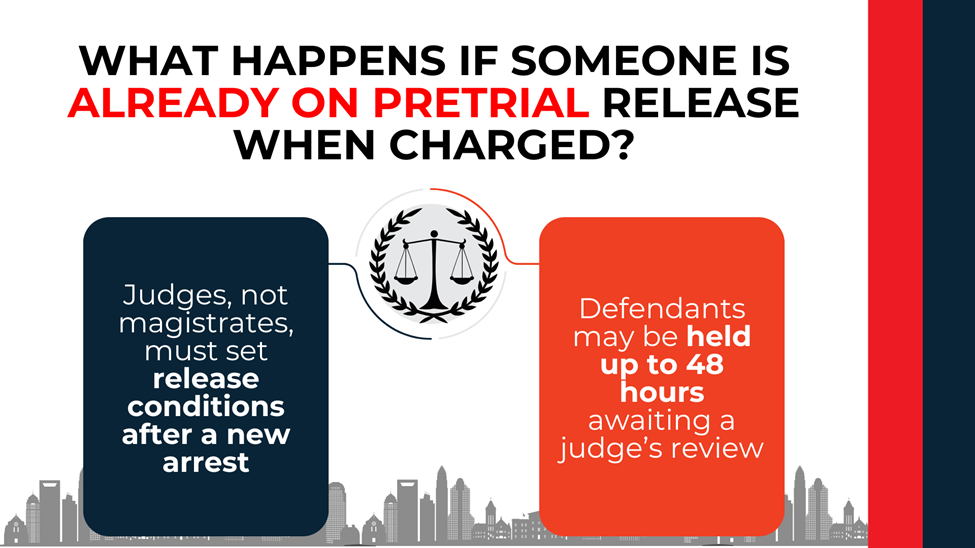
The law also addresses what happens when any defendant on pretrial release is arrested for a new offense, regardless of whether the new charge qualifies as a violent offense. In these situations, a judge—not a magistrate—must set the conditions of release. This requirement elevates the decision-making authority to a higher judicial officer.
Additionally, the defendant can be held for up to 48 hours awaiting this judicial determination. This holding period ensures that a judge has the opportunity to review the situation before the defendant is released, rather than allowing immediate release through a magistrate’s determination.
How Does Iryna’s Law Address Mental Health Evaluations?
When Is a Mental Health Evaluation Required?
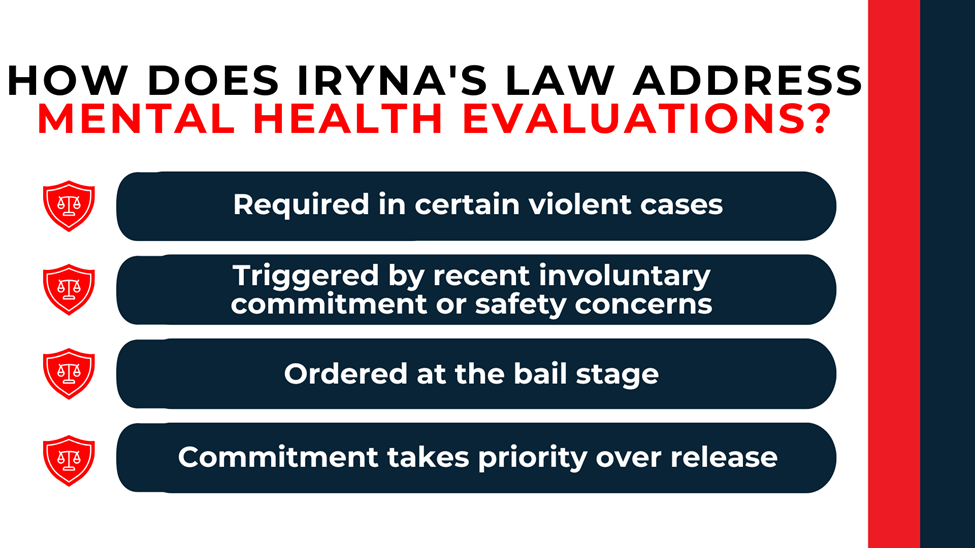
Iryna’s Law incorporates a mental health component that can affect the pretrial release process. The law mandates a mental health evaluation at the bail stage when either of two circumstances exists:
- The defendant is charged with a violent offense and has been involuntarily committed within the past three years
- The judicial official has reasonable grounds to believe the defendant poses a danger to themselves or others
These triggers focus on situations where mental health concerns intersect with violent offense allegations. The first criterion is objective—either the defendant has a documented involuntary commitment within the specified timeframe or they do not. The second criterion involves judicial discretion based on the information available at the time of the bail determination.
What Happens During the Evaluation Process?
When a mental health evaluation is triggered under Iryna’s Law, the arresting officers must transport the defendant to a hospital emergency department or crisis facility. There, a commitment examiner conducts an examination to assess whether grounds for involuntary commitment exist.
This process occurs at the bail stage, meaning it happens early in the case—typically within hours of arrest. The evaluation is not optional when the triggering circumstances are present; the law mandates that it occur.
How Does This Affect the Pretrial Release Timeline?
If the commitment examiner determines that grounds for involuntary commitment exist, that process takes priority over standard pretrial release procedures. In other words, the mental health commitment process supersedes the normal bail determination. The defendant may be committed for treatment rather than proceeding through the typical pretrial release framework.
This integration of mental health evaluation into the bail process reflects an approach that attempts to identify defendants who may need mental health intervention rather than simply pretrial supervision. For defendants and their families, understanding that this evaluation may occur—and that it can redirect the process toward commitment rather than release—is important.
When Did Iryna’s Law Take Effect and Who Does It Apply To?
What Is the Effective Date?
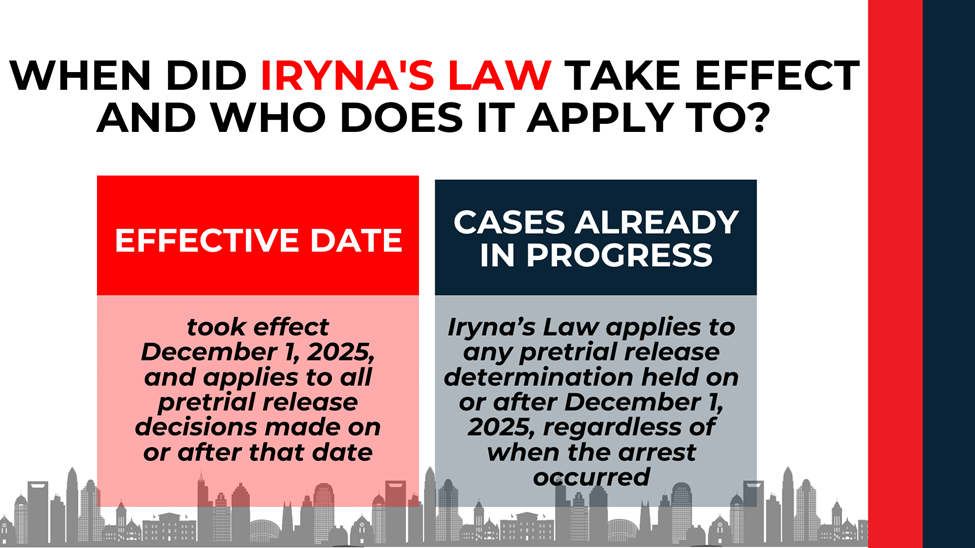
Iryna’s Law became effective on December 1, 2025. Governor Josh Stein signed the legislation—formally designated as House Bill 307—on October 3, 2025, and the law applies to all pretrial release determinations occurring on or after the effective date.
Does This Law Apply to Cases Already in Progress?
The law applies to all persons appearing for pretrial release determinations on or after December 1, 2025. This means that even if an arrest occurred before the effective date, if the pretrial release determination happens on or after December 1, 2025, the new provisions apply.
For defendants whose cases were already in the system before the effective date, the timing of their pretrial release hearing—not the timing of their arrest—determines whether Iryna’s Law governs their situation.
Why Does Legal Representation Matter More Under These New Rules?
What Must Defendants Prove to Overcome the Presumption?
Because Iryna’s Law creates a presumption against release, defendants charged with violent offenses must affirmatively demonstrate that conditions exist which can adequately ensure public safety and their appearance at future court dates. This is not simply a matter of arguing that detention is unnecessary; the defendant must present a compelling case for why release is appropriate despite the statutory presumption.
The types of evidence and arguments that may help overcome the presumption can include stable employment, strong community ties, lack of prior failures to appear, the specific circumstances of the alleged offense, and proposed release conditions that address any identified concerns. Marshaling this evidence effectively requires preparation and knowledge of what courts consider persuasive.
How Can an Attorney Help at the Bail Stage?
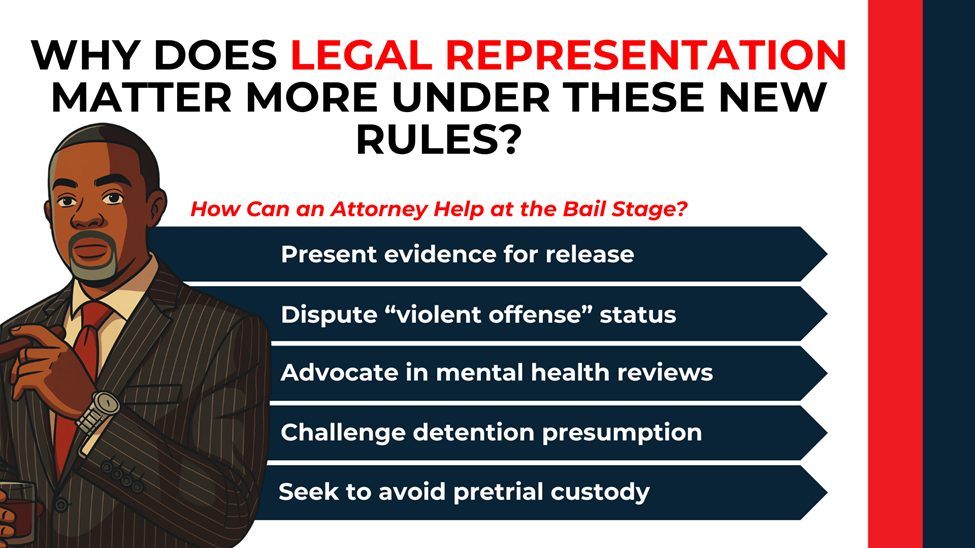
Legal representation at the initial bail determination has always mattered, but Iryna’s Law raises the stakes considerably. An attorney can help in several critical ways. First, counsel can gather and present evidence supporting release before the hearing occurs, rather than leaving the defendant to address these issues without preparation. Second, an attorney can make legal arguments about whether the charge actually qualifies as a “violent offense” under the statute’s definition—a determination that affects whether the presumption applies at all. Third, if the mental health evaluation provisions are triggered, an attorney can help navigate that process and advocate for the defendant’s interests.
The early stages of a case often set the trajectory for everything that follows. A defendant who remains in custody faces practical challenges in assisting with their defense, maintaining employment, and supporting their family. Under Iryna’s Law, securing release when facing violent offense charges requires overcoming a significant legal presumption—making skilled advocacy at the bail stage more important than ever.
Frequently Asked Questions About Iryna’s Law
Does Iryna’s Law apply to misdemeanor charges?
No. The law’s definition of “violent offense” is limited to Class A through Class G felonies involving assault, physical force, or threats of force, along with specific enumerated offenses. Misdemeanor charges do not trigger the rebuttable presumption against release created by this law.
Can a defendant be released on their own recognizance under this law?
For charges that qualify as violent offenses under Iryna’s Law, release on an unsecured basis is not available. The law requires either a secured appearance bond or house arrest with electronic monitoring. A written promise to appear without posting any money or collateral does not satisfy these requirements.
What if electronic monitoring isn’t available in my county?
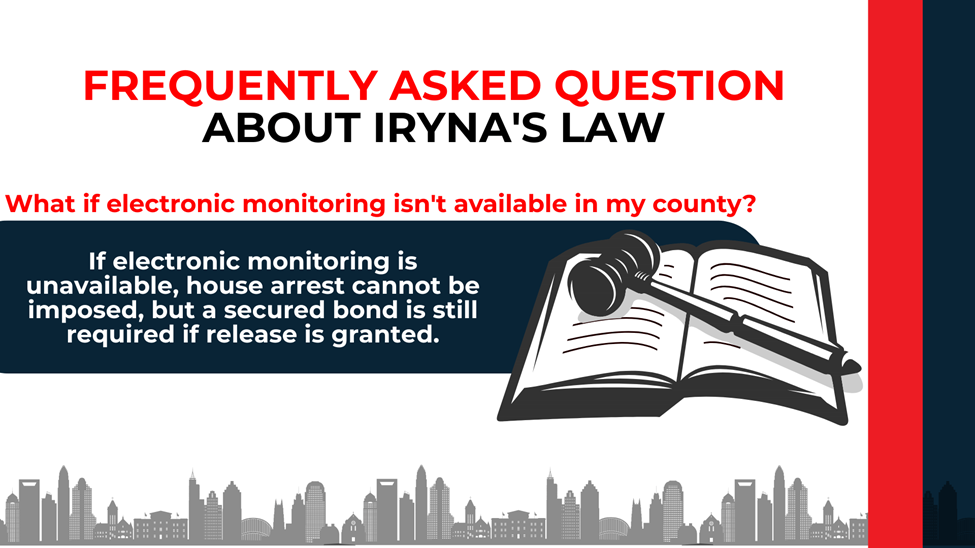
The law’s provisions regarding house arrest with electronic monitoring apply “if available.” If electronic monitoring is not available in a particular jurisdiction, that option cannot be imposed. However, the unavailability of electronic monitoring does not eliminate the requirement for secured bond if release is granted.
How long can someone be held before seeing a judge under the new rules?
When a defendant who is already on pretrial release is arrested for a new offense, they can be held for up to 48 hours awaiting a judicial determination on release conditions. For initial arrests, the timeline depends on various factors, but the mental health evaluation provisions can affect how quickly the standard pretrial release process proceeds.
Discuss Your Case With an Experienced North Carolina Criminal Defense Attorney
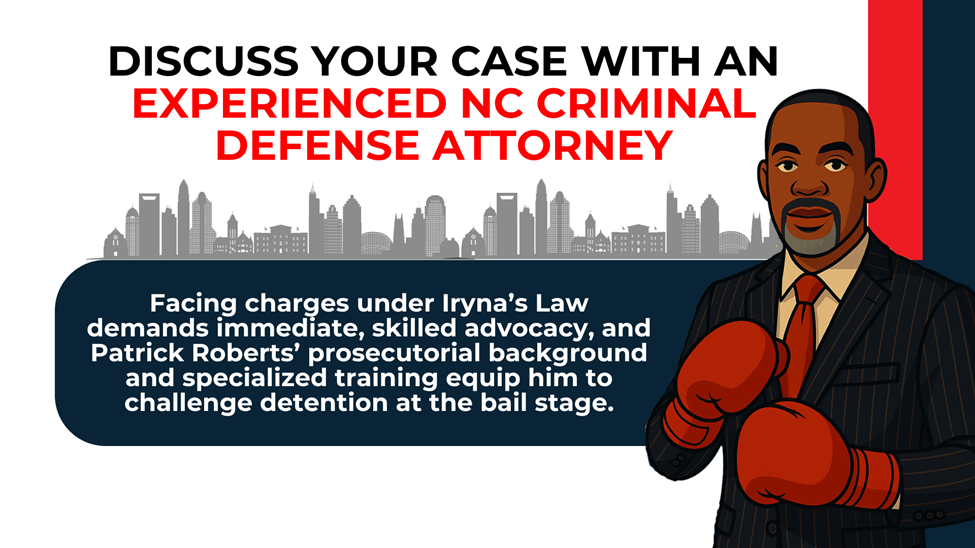
Facing charges that fall under Iryna’s Law means confronting a legal system that now presumes you should not be released before trial. Overcoming that presumption requires immediate, focused effort—and an attorney who understands how prosecutors approach violent offense cases from the inside.
Attorney Patrick Roberts served as a prosecutor handling serious criminal matters, including violent offenses, before becoming a criminal defense attorney. That prosecutorial background provides insight into how the State evaluates these cases and what arguments carry weight with judges at the bail stage. His training at Gerry Spence’s Trial Lawyers College—where he trained directly with Gerry Spence, one of the most accomplished trial lawyers in the country—shapes his approach to presenting compelling narratives on behalf of clients. The advanced cross-examination and trial skills developed through his graduate work at the National Criminal Defense College prepare him to advocate effectively at every stage of a case, including the critical early hearings where pretrial release is determined.
For defendants facing charges involving sex offenses that trigger Iryna’s Law, Attorney Patrick Roberts brings additional specialized preparation: extensive training through the National Association of Criminal Defense Lawyers’ sex-crimes defense seminars as a lifetime NACDL member, and certification through the National Child Abuse Defense and Resource Center. He is the only attorney in North Carolina as of December 2025 who is listed on the NCADRC website at falseallegation.org.
If you or someone you care about is facing violent offense charges in North Carolina under these new rules, contact Patrick Roberts Law to discuss your situation and explore your options for seeking pretrial release.
Disclaimer: The information on this website is for general information purposes only. Nothing on this site should be taken as legal advice for any individual case or situation. Case results depend upon a variety of factors unique to each case. Prior results do not guarantee a similar outcome.
Former assistant district attorney
Contact Patrick Roberts
Facing criminal charges in North Carolina demands seasoned representation. Trust in the experience and dual perspective of Patrick Roberts. Reach out today for a confidential consultation.
-
Call Our Team
Calls answered 24/7












For more information on the selection criteria, go to www.martindale.com
*Each case is different and must be evaluated separately. Prior results achieved do not guarantee similar results can be achieved in future cases.