

Failure to register as a sex offender in North Carolina is a criminal offense under the state’s Sex Offender Registry statute (Article 27A, N.C.G.S. § 14-208 et seq.). It carries the possibility of active prison time, and it is prosecuted regardless of whether the underlying conviction was years or even decades ago. This page covers what the state considers a registration violation, what the sentencing range looks like, what defenses may apply, and what to do if you are facing this charge in Wake County or anywhere in North Carolina.
What Counts as a “Failure to Register” Under North Carolina Law?
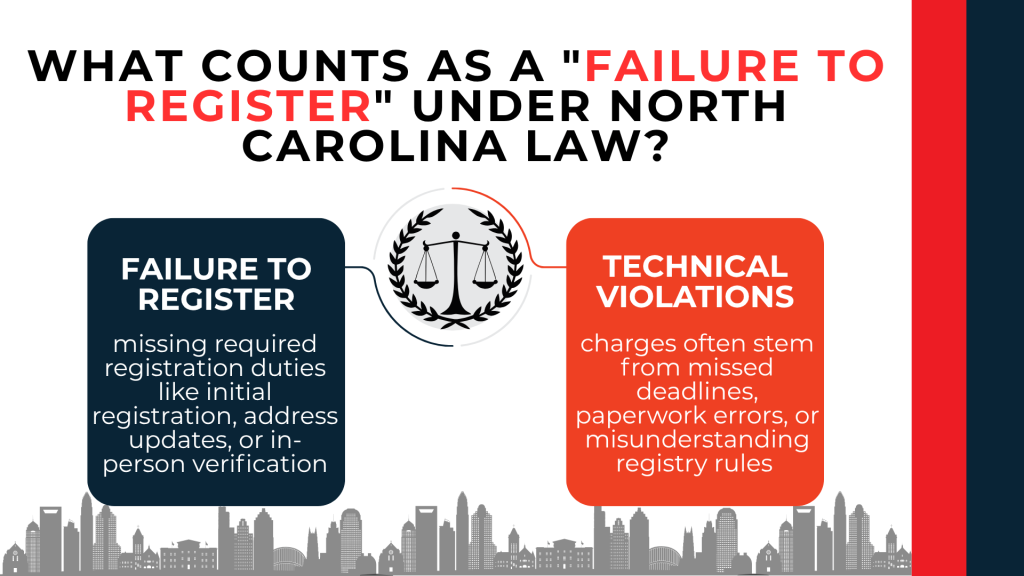
North Carolina’s sex offender registration system imposes several ongoing obligations, and a violation of any one of them can result in a separate criminal charge. The registration system under N.C.G.S. § 14-208 et seq. requires compliance across multiple categories — not just the initial registration after conviction or release.
The obligations that most commonly lead to charges include failing to complete initial registration with the county sheriff’s office. You can also be charged for failing to report an address change within the required timeframe, failing to appear for mandatory in-person verification, or failing to notify authorities of changes to employment or enrollment status.
North Carolina requires registration for 30 years under the standard period. Lifetime registration applies if you are classified as a recidivist, aggravated offender, or sexually violent predator. Location restrictions under N.C.G.S. § 14-208.18 create additional compliance requirements that, if violated, can generate separate charges.
With approximately 25,000 registered sex offenders in North Carolina — including 839 in Wake County alone — the registry system leads to a large number of charges. Many of the people charged with a registration violation did not commit a new sex offense. They missed a deadline, moved without updating paperwork, or misunderstood what their specific obligations required.
What Are the Penalties for Failing to Register as a Sex Offender in NC?
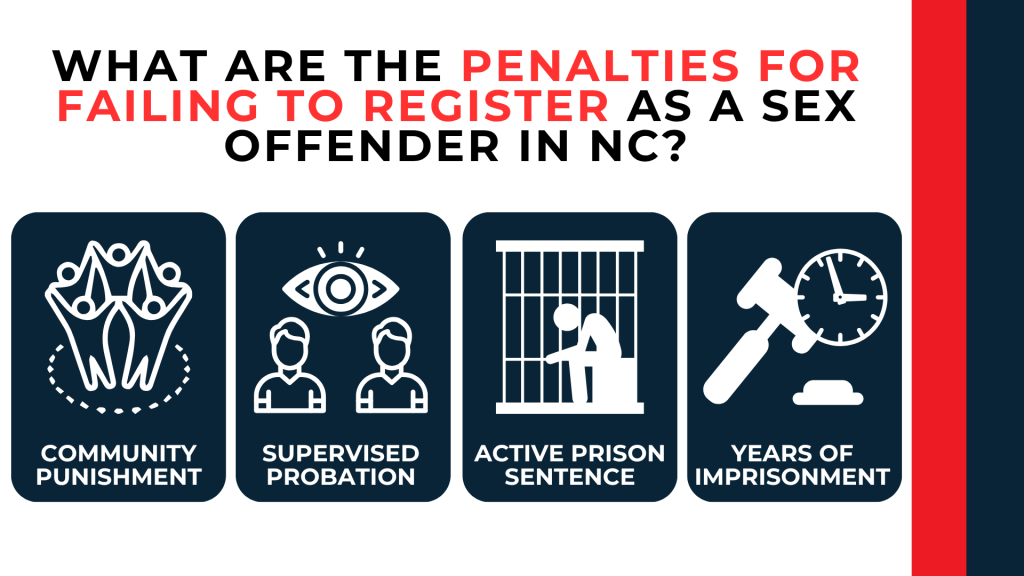
North Carolina sentences felony offenses under the Structured Sentencing Act (N.C.G.S. § 15A-1340.10 et seq.). The Act calculates a sentencing range based on two variables: the offense class and your prior record level. That means the penalty for a registration violation is not a single fixed number — it shifts depending on your criminal history.
The sentencing grid determines whether a judge can impose active imprisonment, intermediate punishment (such as supervised probation with conditions), or community punishment. If you have minimal prior criminal history, you may fall in a range where intermediate or community punishment is available. If you have a longer record, you may face a presumptive range that requires active time.
The punishment for a failure to register charge can range from structured probation to years in prison. The difference often comes down to prior record level, the circumstances of the violation, and the quality of the defense presented.
Can You Be Charged If You Didn’t Know You Had to Register?
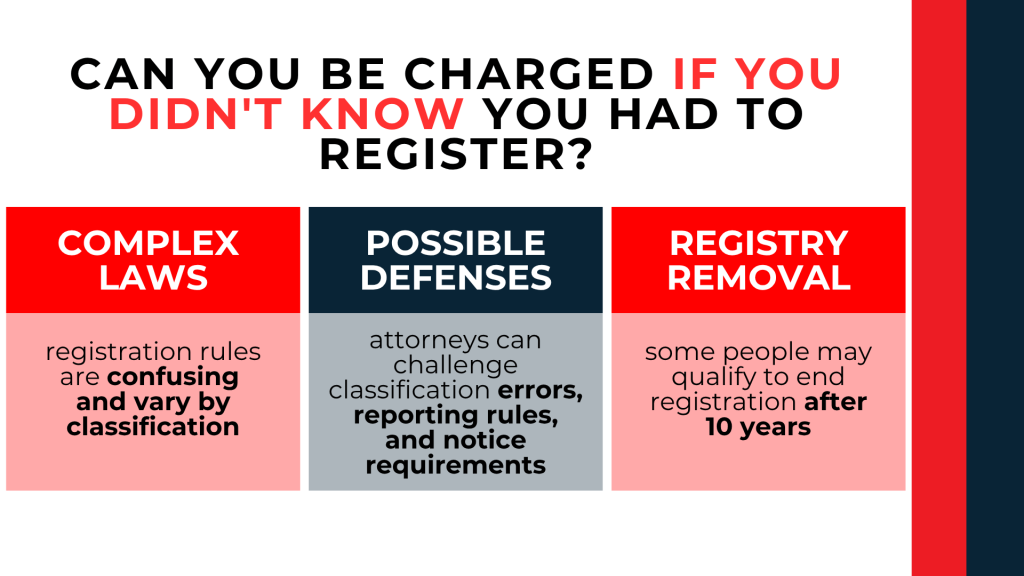
This is the question at the center of most failure-to-register defenses. The registration obligations under Article 27A are complex. They vary by classification and depend on information the state is supposed to provide to you. That complexity creates room for a criminal defense attorney to examine how the charge was built.
When defending registration cases under § 14-208 et seq., attorneys focus on the following areas:
Challenging the accuracy of the initial classification. You may not have been correctly classified when you were placed on the registry. If your underlying conviction did not legally require registration, or if you were assigned a more restrictive tier than the offense warranted, the classification itself can be challenged. A charge built on obligations that should never have applied is a charge with a built-in problem.
Challenging location restriction and verification requirements. The registration system imposes location restrictions under N.C.G.S. § 14-208.18 and periodic verification obligations that vary depending on your classification. An experienced defense attorney will examine whether the specific requirements the state claims were violated actually applied to your situation. The attorney will also examine whether those requirements were communicated to you accurately.
Petition for termination of registration. Under N.C.G.S. § 14-208.12A, a person who is not classified as a recidivist, sexually violent predator, or aggravated offender may petition for removal from the registry after 10 years. If you have been charged with a registration violation, you may also have grounds to argue that you are eligible for removal. That fact can change your defense strategy and plea negotiations.
None of these defenses are automatic. They require investigation, documentation, and an attorney who understands how the registration system works from the inside — including how classification and enforcement decisions are made in practice.
What Should You Do If You’ve Been Charged With Failure to Register?
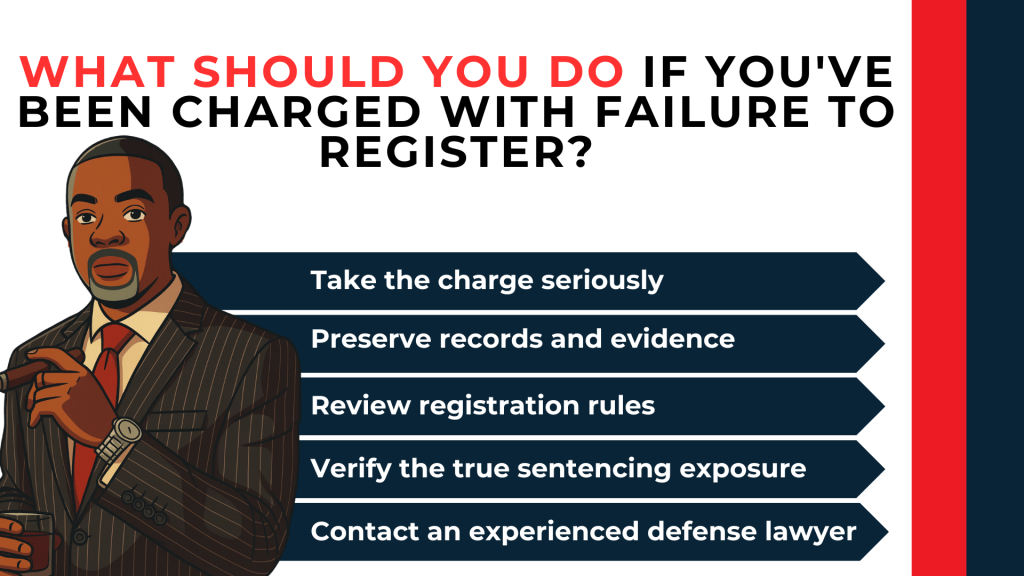
If you are facing a failure to register charge in North Carolina, two things are true at the same time: the charge is serious, and defenses may be available. Prosecutors do not treat these cases casually. But a registration violation is not the same as being charged with a new sex offense, and the defenses available are specific, practical, and based on how the registration system actually functions.
What matters now is how quickly the defense gets started. The circumstances of the alleged violation need to be documented while records are fresh — what your understanding was, whether the classification was correct, and whether the specific obligations the state says were violated actually applied. The structured sentencing calculation needs to be run accurately so the actual sentencing range is clear, not assumed.
Hire an Experienced Sex Crime Lawyer
Attorney Patrick Roberts in Raleigh has handled criminal defense cases across Wake, Durham, and the surrounding North Carolina counties for over two decades. Patrick Roberts is a former assistant district attorney in Wake, Johnston, and New Hanover counties — experience that means he understands how the state builds and evaluates cases from the inside, including how registration enforcement decisions are made at the prosecutorial level. He has co-authored a book on defending internet sex crimes and has handled thousands of criminal cases across the state.
Education & Trial Advocacy
Mr. Roberts holds a bachelor’s degree from Johns Hopkins University (ranked #7 nationally) and a Juris Doctor from Duke University School of Law, which ranks #7 overall and #9 for its criminal law program. His commitment to courtroom excellence is evidenced by his completion of the industry’s rigorous trial programs, including Gerry Spence’s Trial Lawyers College, the National Criminal Defense College (NCDC) Trial Practice Institute, and the 2025 NCDC Cross-Examination Intensive.
Professional Recognition & Memberships
With a career spanning decades, Mr. Roberts has maintained the highest possible peer and client ratings. He has held an AV Preeminent Peer Rating and the Client Champion Platinum award from Martindale-Hubbell for over five consecutive years. Additionally, he has sustained a perfect 10/10 “Superb” rating on AVVO for more than 15 years and is recognized as a Top 100 Trial Lawyer by The National Trial Lawyers. A lifetime member of the National Association of Criminal Defense Lawyers, he has also co-authored two legal texts, including a specialized guide on defending internet sex crimes.
Admissions & National Listings
He is admitted to practice before the U.S. Supreme Court, the Fourth Circuit Court of Appeals, and every federal district court in North Carolina. Furthermore, he is currently the only North Carolina attorney listed on the National Child Abuse Defense & Resource Center for 2026.
Client Review
“I highly recommend this attorney to anyone needing experienced and knowledgeable legal representation. From the beginning, he clearly explained the steps necessary to address my situation and made sure I understood the process along the way. He kept me informed as progress was being made and was always professional, responsive, and prepared. Although the legal process can move slowly at times, I always felt confident that my case was being handled properly. When my court date finally arrived, he was exceptionally well prepared and navigated the courtroom procedures with confidence and skill. His experience and attention to detail ultimately helped lead to a very positive outcome in my case. I truly appreciated his guidance and representation throughout the entire process.” – Verified client review via Avvo.com
Peer Endorsement
“I have known Patrick for years and have always been struck by his knowledge and dedication. I endorse him without hesitation or qualification.” – Verified peer endorsement via Avvo.com
Disclaimer: Testimonials and peer reviews are for informational purposes only and do not guarantee or predict the outcome of your legal matter. Every case is unique and must be evaluated on its own merits. All endorsements featured on this site are actual comments from clients and peers.
If you have been charged with failing to register or believe a charge may be coming, contact Patrick Roberts Law for a case evaluation. The earlier the defense investigation begins, the more options remain available.
The firm maintains a selective intake process to ensure that each client receives the focused professional attention their case requires.
Disclaimer: The information on this website is for general informational purposes only. Nothing herein should be taken as legal advice for any individual case or situation. Contacting us via this website, email, or contact form does not create an attorney-client relationship. Case results depend on a variety of factors unique to each case; prior results do not guarantee a similar outcome.
Former assistant district attorney
Contact Patrick Roberts
Facing criminal charges in North Carolina demands seasoned representation. Trust in the experience and dual perspective of Patrick Roberts. Reach out today for a confidential consultation.
-
Call Our Team
Calls answered 24/7






For more information on the selection criteria, go to www.martindale.com
*Each case is different and must be evaluated separately. Prior results achieved do not guarantee similar results can be achieved in future cases.