
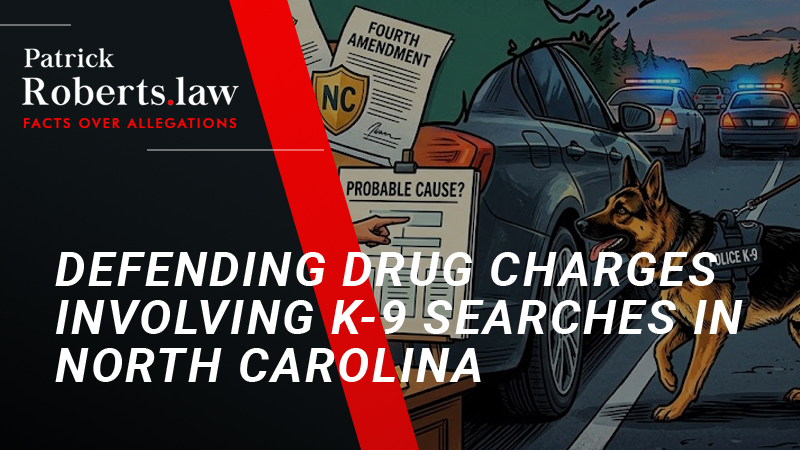
The use of narcotics-detection dogs, commonly referred to as K-9 units, is a staple of law enforcement activity across North Carolina. From the I-95 corridor to local traffic stops in Wake or Mecklenburg County, K-9 searches often serve as the bridge between a routine roadside interaction and a felony drug indictment. However, the presence of a K-9 does not grant law enforcement unfettered authority. The intersection of the Fourth Amendment and K-9 sniffs is governed by a complex web of United States Supreme Court precedents and North Carolina appellate rulings.
For individuals facing drug charges stemming from a K-9 alert, understanding the constitutional limits placed on police is the first step toward a successful defense. This guide examines the legal framework, the common pitfalls of K-9 deployments, and the strategic avenues available for challenging the evidence in court.
Is a K-9 Sniff Considered a “Search” Under the Fourth Amendment?
One of the most frequent misconceptions regarding K-9 units is what legally constitutes a “search.” Under current Fourth Amendment jurisprudence, the answer depends heavily on the location of the sniff.
Public Airspace and Traffic Stops
The North Carolina Supreme Court ruled in State v. Bullock (2017) that an officer does not unlawfully violate the Fourth Amendment during a traffic stop by completing routine tasks—such as checking a driver’s license, running warrant checks, and ordering the driver out of the vehicle—before deploying a narcotics-detection dog. The legal framework aligns with federal precedent establishing that a dog sniff of the exterior of a vehicle in public airspace during a lawful stop does not constitute a “search.” However, the boundaries are strict: the North Carolina Court of Appeals clarified in State v. Miller (2019) and State v. Bedient (2016) that if an officer stalls, pauses routine paperwork, or prolongs the detention even briefly after the initial purpose of the stop is completed, the sniff becomes unlawful unless independent reasonable suspicion exists.
The Curtilage of the Home
The rules change drastically when a K-9 is brought to a private residence within North Carolina. Following federal standards, state courts maintain that the area immediately surrounding and associated with the home—known as the “curtilage”—enjoys the highest level of Fourth Amendment protection. Operating a drug-sniffing dog on the front porch or within the curtilage of a home to investigate its contents constitutes a search. Because this space is treated with the same privacy expectations as the home itself, law enforcement officers in North Carolina must secure a valid search warrant or demonstrate a recognized emergency exception before deploying a K-9 unit on a suspect’s private residential property.
How Long Can Police Detain You for a K-9 Unit to Arrive?
The most significant legal battleground in North Carolina K-9 cases is the duration of the stop. This is governed by the landmark case Rodriguez v. United States (2015).
The “Rodriguez Rule” states that a police officer may not extend a completed traffic stop for any amount of time to conduct a K-9 sniff, absent reasonable suspicion of criminal activity beyond the initial traffic violation.
The “Mission” of the Traffic Stop
When an officer pulls a vehicle over for a speeding violation or a broken taillight, the “mission” of the stop is limited to:
Checking the driver’s license.
Checking the vehicle registration and proof of insurance.
Determining if there are outstanding warrants for the driver.
Issuing a warning or a citation.
Once these tasks are completed, or should have been completed with “reasonable diligence,” the authority for the stop ends. If an officer finishes writing a ticket but makes the driver wait five minutes for a K-9 unit to arrive without a specific reason to suspect drug trafficking, any evidence found during that search may be suppressed.
What Constitutes “Unlawful Prolongation”?
North Carolina courts scrutinize the timeline of a stop second-by-second. Factors that defense attorneys look for include:
Stalling tactics: Did the officer ask repetitive questions unrelated to the traffic stop to buy time?
Delaying the computer check: Did the officer wait to run the driver’s license until the K-9 unit was nearby?
The “De Facto” arrest: Was the driver told they were free to leave, or were they ordered to stand by the patrol car while waiting for the dog?
Establishing Probable Cause: When Does the Alert Justify a Search?
If a K-9 performs a “hit” or “alert” on a vehicle, law enforcement claims this provides the “probable cause” necessary to search the interior of the vehicle without a warrant under the “automobile exception.” However, an alert is only as reliable as the dog and the handler.
The “Reliability” Standard
Following the foundational principles applied in North Carolina courts, the state must prove a K-9 is reliable for its alert to constitute probable cause. Reliability within North Carolina’s legal framework is typically evaluated through a totality-of-the-circumstances approach focusing on:
Training records and certifications.
The dog’s performance in controlled testing environments.
The handler’s ability to accurately interpret the dog’s signals.
False Positives and Residual Odors
Drug dogs are trained to detect the odor of narcotics, not the physical presence of the drugs themselves. This distinction is vital. A dog may alert to “residual odor”—the scent left behind by a person who previously smoked marijuana in the car or handled cash that was once near narcotics. In North Carolina, the defense often argues that a “hit” without the recovery of drugs proves the dog’s unreliability or the presence of a false positive, which can weaken the prosecution’s case.
Challenging the K-9 Search: A Step-by-Step Defense Strategy
Defending against drug charges involving a K-9 requires a methodical deconstruction of the police encounter. A defense attorney will typically follow these steps to identify constitutional violations:
Step 1: Analyze the Initial Stop
The search is only legal if the initial stop was legal. If the officer did not have “reasonable suspicion” that a traffic violation or crime occurred, the entire interaction is “fruit of the poisonous tree.” We examine dashcam and bodycam footage to verify if the alleged speeding or swerving actually happened.
Step 2: Calculate the “Rodriguez” Timeline
We create a minute-by-minute chronology of the stop.
0:00: Vehicle pulled over.
2:00: Officer requests ID.
8:00: Officer finishes the citation.
12:00: K-9 unit arrives and begins the sniff.
In this scenario, if the officer had no other reason to suspect drugs at the 8-minute mark, the 4-minute delay is unconstitutional.
Step 3: Evaluate the Dog’s Behavior
Not every movement a dog makes is a legal “alert.” A dog might scratch at a door because it wants a toy or because the handler gave a subconscious physical cue (known as “cueing”). The video is reviewed to see if the handler led the dog or signaled it to sit or bark at a specific spot.
Step 4: Review K-9 Training and Field Logs
We subpoena the “longitudinal” records of the dog. If the dog has a high rate of “false alerts” (signaling drugs when none are found) in the field, we argue that the dog is not a reliable “neutral mobile magistrate” and its alert did not provide probable cause.
Step 5: File a Motion to Suppress
If any of the above steps reveal a violation of rights, the defense files a Motion to Suppress. If the judge grants this motion, the evidence (the drugs found) cannot be used against the defendant. Without the drugs, the prosecution’s case usually collapses, leading to a dismissal of charges.
The Impact of Marijuana Legalization and Decriminalization Trends
The legal landscape regarding K-9s is currently shifting due to the changing status of marijuana and hemp.
The “Hemp vs. Marijuana” Dilemma
In North Carolina, industrial hemp is legal, while marijuana remains illegal. The problem? Most K-9s currently in service are trained to alert to THC, and they cannot distinguish between the scent of legal hemp and illegal marijuana.
Furthermore, as other states move toward legalization, North Carolina courts are beginning to grapple with whether the “odor of marijuana” alone still provides probable cause for a full vehicle search. While North Carolina appellate courts have been slow to strip police of this power, a skilled defense attorney can use the “indistinguishable odor” argument to challenge the validity of a K-9 alert.
Common Questions Regarding K-9 Searches in North Carolina
Can I refuse a K-9 sniff?
You cannot physically interfere with a K-9 sniff of the exterior of your car during a valid stop. However, you should never give consent to a search. If the officer asks, “Do you mind if I run the dog around the car?” or “Can we search the vehicle?”, the answer should always be a polite but firm: “I do not consent to any searches.” This preserves your right to challenge the search in court later.
What if the dog jumped inside my car?
If the K-9 enters the interior of the vehicle through an open window or door before it has officially alerted on the outside, this may constitute an illegal search. The dog is considered an “instrument of the state,” and its entry into the private interior of the car without prior probable cause is a Fourth Amendment violation.
Do police have to show me the dog’s certification?
Not at the scene of the stop. However, your attorney has the right to demand those certifications during the discovery phase of your legal proceedings.
What happens if the K-9 was wrong?
If the K-9 alerts and the police search your car but find nothing, your rights may still have been violated, but there is no “evidence” to suppress because nothing was found. If they did find something else (like a firearm you aren’t supposed to have), the fact that the dog was “wrong” about the drugs can be used to challenge the legality of the search that uncovered the firearm.
Why Technical Knowledge Matters in K-9 Cases
Narcotics cases involving K-9s are rarely about whether the drugs were there; they are about whether the police followed the rules of the Constitution to find them. These cases are won or lost on technicalities—the timing of a radio call, the angle of a dog’s tail, or the specific wording of a training manual.
The state has significant resources, including specialized K-9 units and expert handlers. To level the playing field, a defense must be rooted in a deep understanding of:
The Science of Olfaction: Understanding how scent “cones” move and how environmental factors like wind or heat affect a dog’s performance.
The Law of Seizure: Knowing exactly when a “stop” becomes a “detention.”
Data Analysis: Scrutinizing K-9 records for patterns of bias or inaccuracy.
Potential Outcomes of Challenging a K-9 Search
When a defense attorney successfully challenges a K-9 search, several outcomes are possible:
Evidence Suppression: The most common goal. The judge rules the search was illegal and the drugs cannot be mentioned at trial.
Charge Reduction: The prosecution may realize their case is weak and offer a plea to a much lesser offense (e.g., from Trafficking to Simple Possession).
Dismissal: If the suppressed evidence was the entirety of the state’s case, the District Attorney will be forced to dismiss all charges.
Protecting Your Rights in North Carolina
A drug charge can carry life-altering consequences, including mandatory minimum prison sentences and a permanent criminal record. In North Carolina, the “Automobile Exception” gives police significant power, but that power is not absolute. The K-9 unit is a tool, but it is a tool that must be used within the strict confines of the law.
If you were arrested following a K-9 alert, the focus must shift immediately to the conduct of the officers and the history of the dog. By examining the legality of the stop, the duration of the detention, and the reliability of the K-9’s alert, it is possible to build a robust defense that protects your future and upholds your constitutional protections. Every second of the police encounter matters, and every detail of the dog’s training counts.
Navigating the complexities of North Carolina drug laws and Fourth Amendment jurisprudence requires a meticulous approach to evidence and a commitment to holding law enforcement accountable to the standards set by the highest courts in the land.
Hire an Experienced Criminal Lawyer Near You
Attorney Patrick Roberts is a Raleigh criminal defense attorney who has handled thousands of cases across North Carolina, with offices in Raleigh, Durham, Chapel Hill, and Cary.
He provides a deep level of authority and experience to the defense of complex drug interdiction and K-9 search cases. As a former prosecutor in Wake and Johnston Counties, he worked directly with drug interdiction teams to build conspiracy-level prosecutions. This background gives him firsthand knowledge of how the government constructs its cases, allowing him to identify vulnerabilities in the prosecution’s evidence to better defend his clients.
Selected to Super Lawyers for his professional achievement, Mr. Roberts has tried drug trafficking cases in state court and has managed the defense of multi-defendant drug conspiracy cases in Federal court that have lasted for weeks. His legal credentials include admission to practice before the 4th Circuit Federal Court of Appeals and the United States Supreme Court, ensuring his clients receive qualified representation throughout the entire legal process.
Education & Trial Advocacy
Mr. Roberts earned his bachelor’s degree from Johns Hopkins University, which is ranked #7 among National Universities. He is a graduate of Duke University School of Law, currently ranked #7 for best law schools and #9 for its criminal law program.
In addition to his academic background, he has completed several of the nation’s most rigorous trial advocacy programs:
- Gerry Spence’s Trial Lawyers College
- National Criminal Defense College (NCDC) Trial Practice Institute
- 2025 NCDC Cross-Examination Intensive
Professional Recognition & Memberships
For his work in the legal field, Mr. Roberts has earned several long-standing distinctions:
- AV Preeminent Peer Rating (Martindale-Hubbell): Held for over 5 consecutive years.
- Client Champion Platinum (Martindale-Hubbell): Maintained for over 5 consecutive years.
- AVVO “Superb” Rating (10/10): Maintained for more than 15 years.
- Top 100 Trial Lawyers: Recognized by The National Trial Lawyers.
He is a lifetime member of the National Association of Criminal Defense Lawyers and has co-authored two legal books, including a guide focused on defending internet sex crimes.
Professional Perspective
Mr. Roberts brings a dual perspective to complex legal matters. He served as an Assistant District Attorney in Wake, Johnston, and New Hanover counties, providing him with a firsthand understanding of how prosecutors build and evaluate sex crime cases.
Admissions & National Listings
He is admitted to practice before the U.S. Supreme Court, the Fourth Circuit Court of Appeals, and all federal district courts in North Carolina. As of 2026, he is the only North Carolina lawyer listed on the National Child Abuse Defense & Resource Center.
Client Testimonial
“I highly recommend this attorney to anyone needing experienced and knowledgeable legal representation. From the beginning, he clearly explained the steps necessary to address my situation and made sure I understood the process along the way. He kept me informed as progress was being made and was always professional, responsive, and prepared. Although the legal process can move slowly at times, I always felt confident that my case was being handled properly. When my court date finally arrived, he was exceptionally well prepared and navigated the courtroom procedures with confidence and skill.” – Verified client review via Avvo.com
Peer Endorsement
“I endorse this lawyer. Patrick is a fantastic attorney who is dedicated to his clients’ interests and truly cares for his clients. He has the experience and trial skills necessary to achieve the results his clients need. I recommend anybody in need of a criminal defense attorney use him.” – Verified peer review via Avvo.com
Disclaimer: Testimonials and peer reviews are for informational purposes only and do not guarantee or predict the outcome of your legal matter. Every case is unique and must be evaluated on its own merits. All endorsements featured on this site are actual comments from clients and peers.
If you are facing drug charges resulting from a K-9 search in North Carolina, securing experienced legal counsel is a critical step in protecting your rights. Attorney Patrick Roberts utilizes his background as a former prosecutor and his comprehensive understanding of state and federal search and seizure laws to evaluate the legality of your arrest. The firm focuses on identifying constitutional violations to build a rigorous defense for clients facing drug trafficking or conspiracy allegations. Contact Patrick Roberts Law today to schedule a confidential consultation and review the legal options available for your case.
To maintain a high standard of service and thorough oversight for each client, the firm manages a restricted caseload.
Disclaimer: The information on this website is for general informational purposes only. Nothing herein should be taken as legal advice for any individual case or situation. Contacting us via this website, email, or contact form does not create an attorney-client relationship. Case results depend on a variety of factors unique to each case; prior results do not guarantee a similar outcome.
Former assistant district attorney
Contact Patrick Roberts
Facing criminal charges in North Carolina demands seasoned representation. Trust in the experience and dual perspective of Patrick Roberts. Reach out today for a confidential consultation.
-
Call Our Team
Calls answered 24/7






For more information on the selection criteria, go to www.martindale.com
*Each case is different and must be evaluated separately. Prior results achieved do not guarantee similar results can be achieved in future cases.