
Under North Carolina law, solicitation of a minor is a felony charge that does not require contact with an actual child. N.C.G.S. § 14-202.3 makes it a crime to use a computer or electronic device to solicit a person the defendant believes to be underage to commit an unlawful sex act. The offense requires that the defendant be at least 16 years old and at least 5 years older than the person the defendant believes to be a minor. The charge is complete the moment the solicitation occurs. No meeting needs to take place. No sexual act needs to happen. The person on the other end of the conversation does not need to be a real minor.
That last point is the one most people miss. It changes everything about how these cases work, how they are defended, and what is actually at stake.
This article covers the specific elements North Carolina prosecutors must prove, the penalties a conviction carries, and the defense strategies that apply to these cases.
How Do Most Solicitation of a Minor Cases Start?
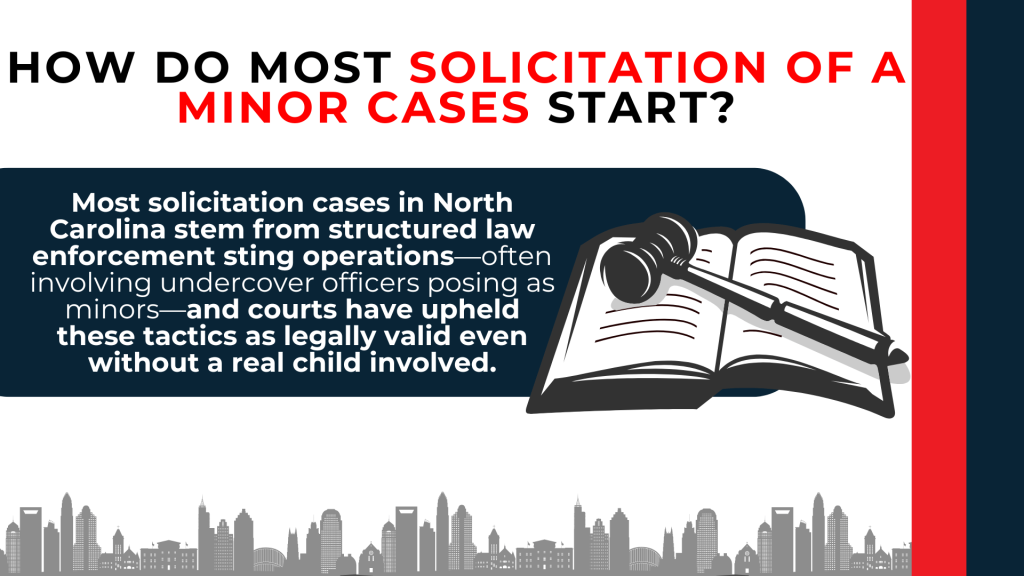
The majority of solicitation cases in North Carolina do not begin with a report from an actual child. They begin with a law enforcement sting operation — an undercover officer or agent posing as a minor in an online chat room, dating app, or social media platform.
North Carolina dedicates significant resources to these operations. The NC SBI Computer Crimes Unit coordinates over 200 law enforcement agencies through the Internet Crimes Against Children (ICAC) Task Force. 17 full-time SBI special agents are stationed across eight field districts investigating internet crimes against children. These are not informal efforts. They are structured, well-funded operations designed to generate prosecutable cases.
Here is what that means practically: the “minor” a defendant believed they were communicating with was, in many cases, a trained law enforcement officer following a script and preserving every message as evidence. NC courts have clearly approved this approach. The statute covers any person the defendant “believes to be” underage. The North Carolina Court of Appeals has confirmed that law enforcement sting operations using fake minors are legally valid. The absence of an actual child victim does not weaken the prosecution’s case under this statute — it is built into the law’s design.
Understanding this background matters because it shapes every strategic decision that follows, from how the evidence is analyzed to which defenses are available.
What Are the Penalties for Solicitation of a Minor in North Carolina?
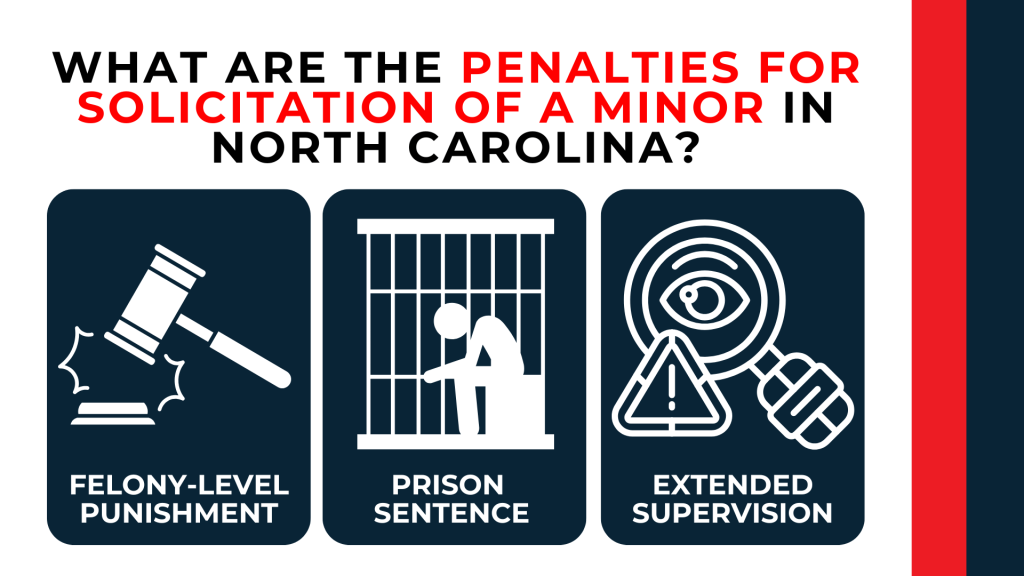
Solicitation of a minor under § 14-202.3 is charged as a Class H felony. If either the defendant or the other party appears at the proposed meeting location, the charge increases to a Class G felony.
Sentencing is determined by North Carolina’s Structured Sentencing Act under N.C.G.S. § 15A-1340.10. The law calculates punishment ranges based on two variables: the offense classification and your prior record level. If you have no criminal history, you face a different sentencing grid than someone with prior convictions, and the difference can be substantial.
Beyond the prison sentence itself, sex offense convictions carry enhanced post-release supervision of 60 months — five years of supervised release after time in prison. The standard post-release period for other felony classes is just 9 to 12 months. This means the reach of a solicitation conviction extends years beyond whatever active sentence is imposed.
North Carolina also treats sex offenses differently at the pretrial stage. Under N.C.G.S. § 15A-533(b), if you are charged with a sex offense, you cannot get pretrial release from a magistrate. Only a district or superior court judge has the authority to set bond conditions. In practice, that often means longer initial detention and more restrictive release terms.
What Defenses Work in Solicitation of a Minor Cases?
Solicitation charges are defensible. The specific defense strategy depends on the facts, but several established legal approaches apply to these cases in North Carolina.
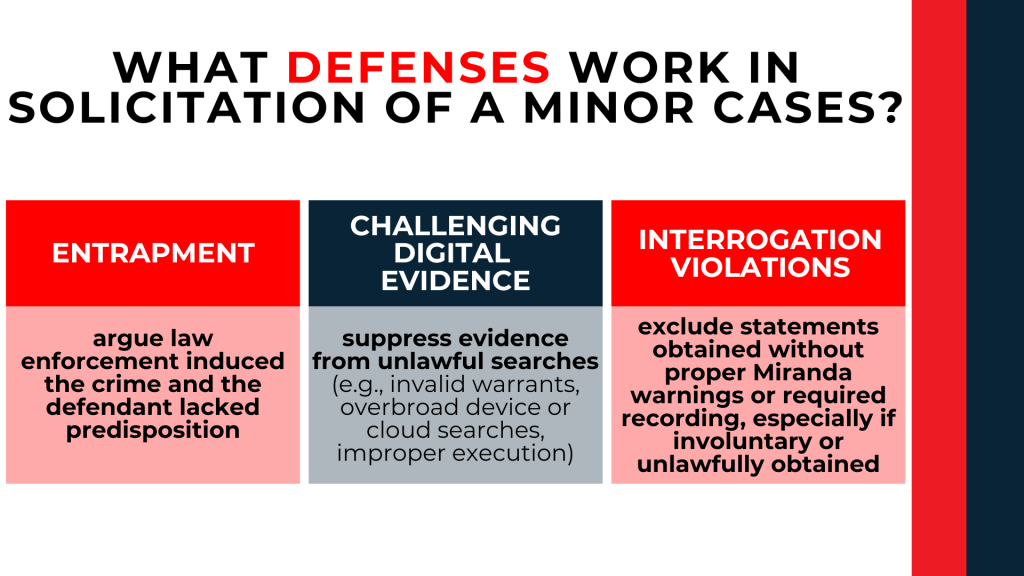
Entrapment. Because so many solicitation cases arise from law enforcement sting operations, entrapment is one of the most frequently raised defenses. Under North Carolina law, entrapment requires the defendant to prove two things: first, that the government induced the defendant to commit the offense, and second, that the defendant was not predisposed to commit it.
Predisposition is where most entrapment cases are won or lost. In State v. Keller, 265 N.C. App. 526 (2019), the North Carolina Court of Appeals analyzed predisposition by examining whether the defendant continued engaging in sexual conversations after learning the supposed “child’s” age. In State v. Morse, 194 N.C. App. 685 (2009), the court found that a defendant’s active participation in sexual conversations and meeting planning demonstrated predisposition sufficient to defeat an entrapment claim.
The critical question in every sting case is: who moved the conversation toward sexual content? Chat logs, which law enforcement preserves in their entirety, are the primary battlefield. Defense analysis focuses on three things: whether the defendant or the undercover officer initiated sexual topics, whether the defendant expressed reluctance or hesitation, and whether law enforcement applied pressure or escalation to keep the conversation going.
The statute also includes an age-differential element — the defendant must be at least 16 and at least 5 years older than the believed minor. Because of this, precise analysis of the ages represented in the conversation can also be relevant to the defense.
One procedural requirement creates real urgency: under N.C.G.S. § 15A-905(c), written notice of an entrapment defense must be filed within 20 working days of the trial setting date. Missing this deadline can lose the defense entirely.
Challenging the digital evidence. Solicitation cases are built almost entirely on electronic evidence — chat logs, device contents, IP records, and location data. Every piece of that evidence is subject to constitutional scrutiny.
The U.S. Supreme Court held in Riley v. California, 573 U.S. 373 (2014), that police generally cannot search a cell phone without a warrant, even incident to arrest. North Carolina courts require particularized warrants for electronic device searches, and under N.C.G.S. § 15A-248, search warrants must be executed within 48 hours of issuance. If law enforcement searched a phone, computer, or account without proper authorization — or exceeded the scope of the warrant they obtained — the evidence may be suppressed.
Cloud storage searches present additional weak points. No controlling North Carolina authority has resolved whether a warrant to search a physical device automatically extends to connected cloud services. Consent to search a home does not automatically include consent to search digital devices found inside it. Each of these gaps represents a potential challenge to the prosecution’s evidence.
Interrogation and Miranda violations. If you made statements to law enforcement, the circumstances of that interrogation matter. Miranda warnings are required before custodial interrogation. North Carolina’s mandatory recording statute, N.C.G.S. § 15A-211, requires electronic recording of custodial interrogations for certain serious felony classes — specifically Class A, B1, B2 felonies and Class C sex offenses. A standalone solicitation charge may not fall within those listed classes. However, the recording requirement may apply if you face additional higher-class charges arising from the same investigation. Where the statute does apply, failure to record is admissible evidence supporting a claim that a confession was involuntary. Regardless of the recording requirement, any statements obtained in violation of Miranda protections may be challenged through a suppression motion.
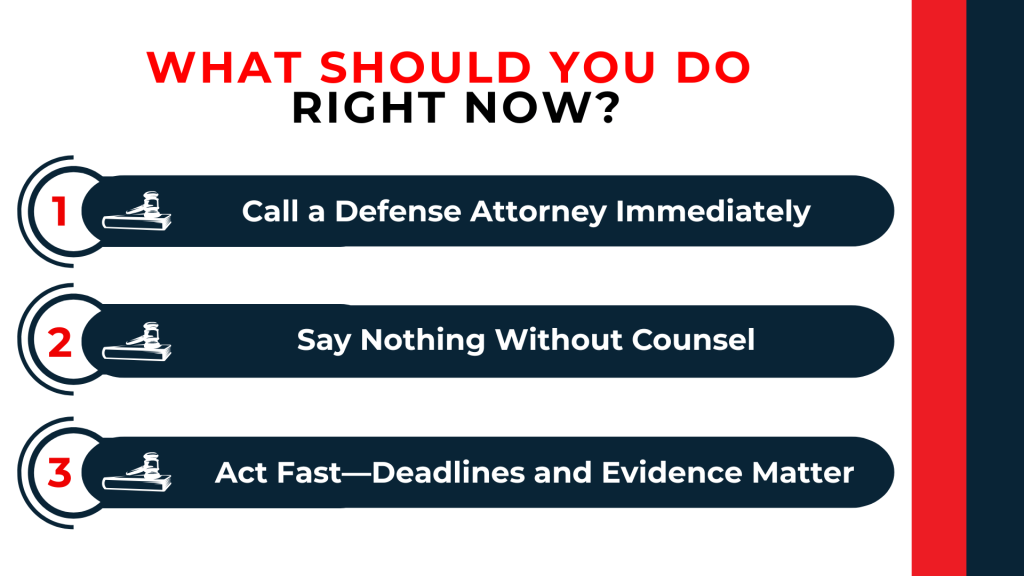
What Should You Do Right Now?
Solicitation charges move quickly. Evidence exists in digital form that can be preserved, challenged, or lost depending on how soon a defense begins. The entrapment notice deadline under § 15A-905(c) starts a clock that does not pause. Statements made to law enforcement before consulting an attorney can permanently shape the direction of a case.
If you or someone in your family is facing a solicitation of a minor charge in North Carolina, the single most important step is to speak with a criminal defense attorney who handles these cases. Do that before speaking with anyone else — including law enforcement, regardless of what they tell you about cooperation.
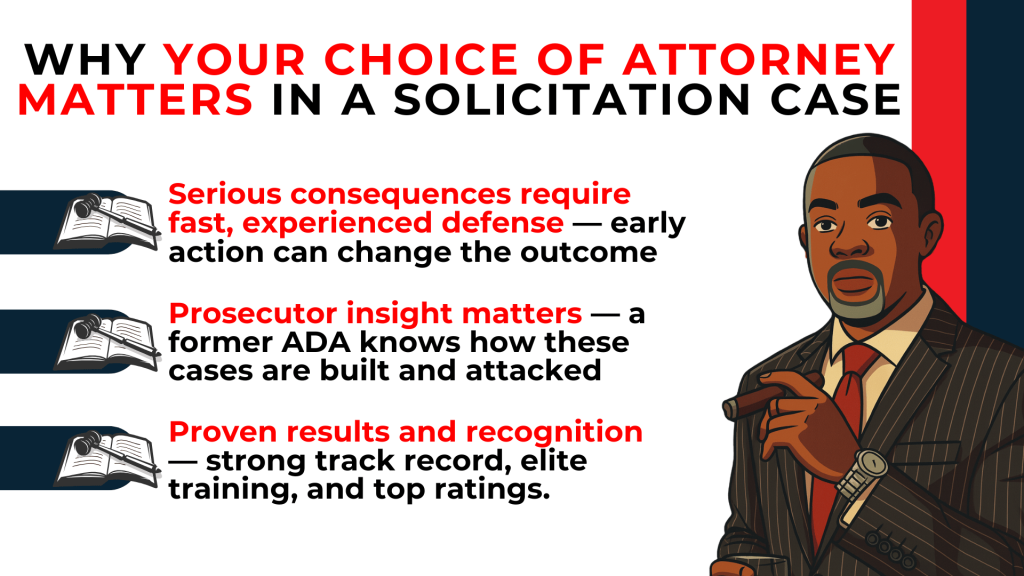
Why Your Choice of Attorney Matters in a Solicitation Case
Solicitation of a minor charges carry consequences that extend far beyond the courtroom — sex offender registration, enhanced post-release supervision, and a permanent record that reshapes every part of your life. The defense strategy that applies, and the window to execute it, depends on how quickly experienced counsel gets involved.
Attorney Patrick Roberts has defended clients facing sexual assault charges for more than two decades. A graduate of Duke University School of Law (ranked Top 9 for criminal law) and Johns Hopkins University (ranked Top 7 among National Universities), he has completed training at Gerry Spence’s Trial Lawyers College, a selective and intensive advocacy program. He also completed the National Criminal Defense College (NCDC) Trial Practice Institute and the 2025 NCDC Cross-Examination Intensive, which provide advanced, hands-on training in high-stakes witness examination.
Before founding Patrick Roberts Law, Mr. Roberts served as an Assistant District Attorney in Wake, Johnston, and New Hanover counties. That prosecutorial experience gives him direct insight into how the State structures sting operations, preserves digital evidence, and builds solicitation cases from investigation through trial. He has tried hundreds of bench and jury trials in state and federal courts since 2007.
Mr. Roberts holds an AV Preeminent peer rating from Martindale-Hubbell — the highest possible rating for legal ability and ethical standards — maintained for over five consecutive years. He carries a 10/10 “Superb” rating on Avvo for more than 15 years, has been recognized as a Client Champion Platinum by Martindale-Hubbell for over five consecutive years, and has been named among the Top 100 Trial Lawyers by The National Trial Lawyers. He is admitted to practice before the U.S. Supreme Court, the Fourth Circuit Court of Appeals, and all federal district courts in North Carolina. He is a lifetime member of the National Association of Criminal Defense Lawyers and the only North Carolina attorney listed on the National Child Abuse Defense & Resource Center as of 2026. He is the co-author of two legal books, including one on defending internet sex crimes.
Case Review
A client represented by Attorney Patrick Roberts faced multiple felony charges following an investigation by the State Bureau of Investigation (SBI) and local law enforcement. The investigation linked illegal online activity to the client’s IP address, resulting in a search warrant for the client’s residence. During the execution of the warrant, law enforcement seized digital evidence and obtained a confession from the client.
Strategy
Faced with digital evidence and a recorded confession, the defense focused on a mitigation-heavy strategy. Attorney Roberts conducted a comprehensive review of the client’s background and the specific circumstances of the case to identify mitigating factors. He presented these findings to the District Attorney’s office, engaging in extensive negotiations to demonstrate that a non-custodial resolution was appropriate. The defense focused on highlighting the client’s cooperation and potential for rehabilitation to secure a resolution that avoided active incarceration.
Outcome
The prosecution agreed to a plea arrangement that resulted in a strictly probationary sentence. The court imposed no jail or prison time, and the client was granted the opportunity to transfer their probation to their new state of residency.
Disclaimer: The case reviews provided are for informational purposes only and represent actual case results handled by Attorney Patrick Roberts. However, every legal matter is unique, and these outcomes do not guarantee or predict a similar result in any future case.
Client Review
“We couldn’t have asked for better representation! Attorney Roberts is well-versed in the law and the Wake County Court System. He’s candid and doesn’t sugarcoat things — which was exactly what we needed. His years of experience exuded a strong sense of confidence. From day one, it was clear that he’s deeply committed to advocating for his clients, no matter how tough the situation. He’s a man of his word and asked us to trust his process. We did and it worked! Due to his strong advocacy, our child now has a second chance to pursue their endless dreams and future aspirations.” — Verified client review on Avvo.com
Peer Endorsement
“I have known Patrick Roberts my entire legal career. He is a great representation of how a lawyer should be an advocate for justice and truth.” — Martindale-Hubbell Verified Peer Review
Disclaimer: Testimonials and peer reviews are for informational purposes only and do not guarantee or predict the outcome of your legal matter. Every case is unique and must be evaluated on its own merits. All endorsements featured on this site are actual comments from clients and peers.
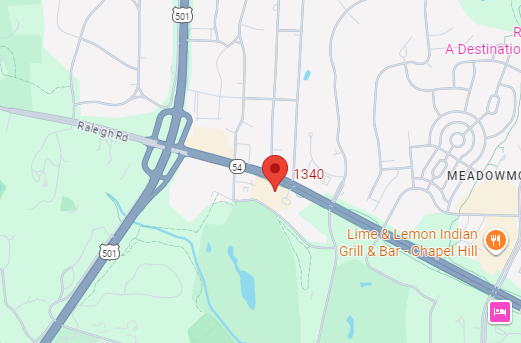
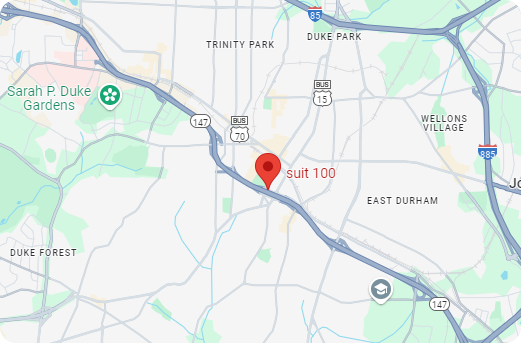
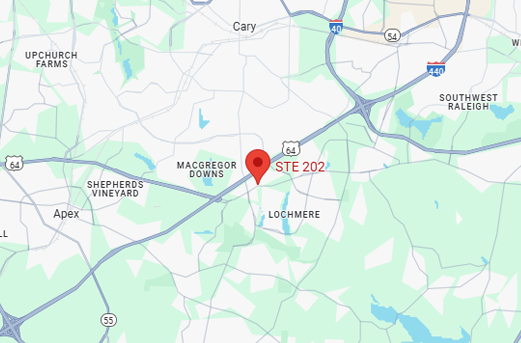
Patrick Roberts Law represents clients charged with solicitation and internet sex offenses from offices in Raleigh, Durham, Chapel Hill, and Cary. Contact the firm to discuss your case.
The firm maintains a selective intake process to ensure that each client receives the focused professional attention their case requires.
Disclaimer: The information on this website is for general informational purposes only and does not constitute legal advice for any individual case or situation. Contacting us via this website, email, or contact form does not create an attorney-client relationship. Each case is different and must be evaluated separately; prior results do not guarantee a similar outcome.
Former assistant district attorney
Contact Patrick Roberts
Facing criminal charges in North Carolina demands seasoned representation. Trust in the experience and dual perspective of Patrick Roberts. Reach out today for a confidential consultation.
-
Call Our Team
Calls answered 24/7






For more information on the selection criteria, go to www.martindale.com
*Each case is different and must be evaluated separately. Prior results achieved do not guarantee similar results can be achieved in future cases.