

When someone uses force against another person and that person dies, North Carolina law requires a careful examination of the circumstances. The difference between a justified act of self-defense and a criminal homicide often determines whether someone walks free or faces decades in prison. Understanding how North Carolina distinguishes between lawful defensive force and murder is critical for anyone involved in such a situation.
What Is the Legal Difference Between Self Defense and Murder in North Carolina?
The fundamental distinction lies in whether the use of deadly force was legally justified. Murder, as defined in N.C. Gen. Stat. § 14-17, involves the unlawful killing of another human being with malice. Self-defense, by contrast, is a legal justification that excuses what would otherwise be a criminal act because the circumstances made the use of force necessary and reasonable.
North Carolina law recognizes that people have the right to protect themselves and others from imminent harm. When deadly force is used in accordance with the state’s self-defense statutes—primarily N.C. Gen. Stat. § 14-51.2 and § 14-51.3—the killing is not considered murder. However, if the prosecution can prove the elements of murder and show that self-defense does not apply, the defendant faces serious criminal liability.
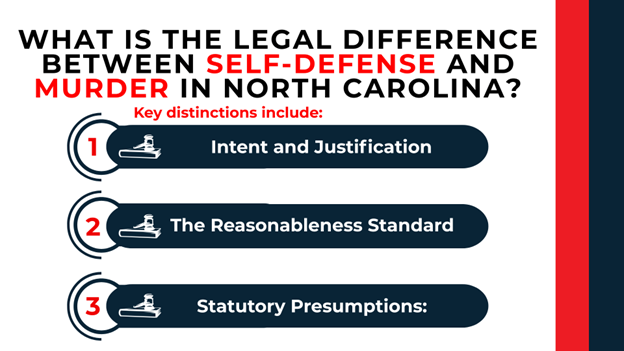
Key distinctions include:
- Intent and justification: Murder requires malice or willful conduct without legal excuse. Self-defense negates criminal liability when the defender reasonably believed deadly force was necessary to prevent imminent death or great bodily harm.
- The reasonableness standard: Self-defense claims are evaluated based on what a reasonable person in the defendant’s position would have believed and done under the circumstances.
- Statutory presumptions: North Carolina’s Castle Doctrine creates presumptions that favor defenders in certain situations, particularly when an intruder unlawfully enters a home, motor vehicle, or workplace.
What Are the Elements of First-Degree Murder Under North Carolina Law?
First-degree murder under N.C. Gen. Stat. § 14-17(a) is North Carolina’s most serious homicide offense, classified as a Class A felony. This charge applies when a killing meets specific statutory criteria that demonstrate particularly culpable conduct.
First-degree murder includes killings that are:
- Perpetrated by poison, lying in wait, imprisonment, starving, or torture
- Committed by any other kind of willful, deliberate, and premeditated killing
- Committed during the perpetration or attempted perpetration of certain felonies—including arson, rape, robbery, kidnapping, or burglary—when a deadly weapon is used (the felony murder rule)
- Perpetrated by means of a weapon of mass destruction
The statute also establishes a rebuttable presumption of first-degree murder in domestic violence cases where the victim is a current or former intimate partner and the perpetrator has a prior conviction for domestic violence offenses involving the same victim.
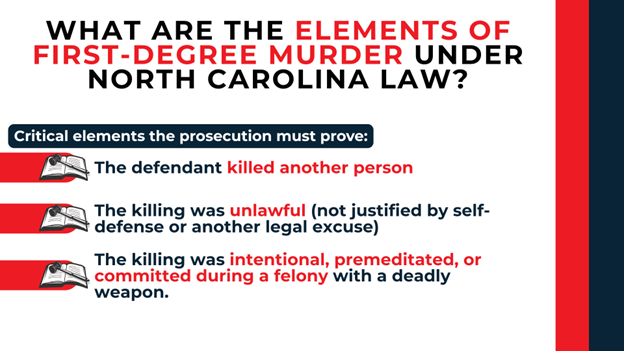
Critical elements the prosecution must prove:
- The defendant killed another person
- The killing was unlawful (not justified by self-defense or another legal excuse)
- The killing was willful, deliberate, and premeditated, or occurred during the commission of an enumerated felony with a deadly weapon
When a defendant raises self-defense, the prosecution must prove beyond a reasonable doubt that the killing was not justified. If the state cannot establish that the use of force was unlawful—because it was reasonable under the circumstances—the element of an “unlawful killing” fails, and a murder conviction cannot stand.
What Is Second-Degree Murder in North Carolina?
Second-degree murder, as defined in N.C. Gen. Stat. § 14-17(b), serves as a catch-all category for unlawful killings that do not meet the specific criteria for first-degree murder. It encompasses killings committed with malice but without the premeditation, deliberation, or felony-murder circumstances required for first-degree murder.
Second-degree murder is generally classified as a Class B1 felony, but may be reduced to a Class B2 felony when:
- The malice necessary to prove the offense is based on an inherently dangerous act or omission
- The act was done in a reckless and wanton manner
- The conduct manifested a mind utterly without regard for human life and social duty and deliberately bent on mischief
Malice, the key mental state for second-degree murder, can be shown through:
- Actual intent to kill or seriously injure
- Reckless disregard for human life demonstrated by inherently dangerous conduct
Like first-degree murder, second-degree murder requires an unlawful killing. If self-defense applies, the killing is justified and lawful, negating the foundation for a murder charge. A defendant who reasonably believed deadly force was necessary to prevent death or serious bodily harm has not acted with malice—the prosecution’s ability to establish this mental state is undermined when legitimate defensive force is used.

When Does North Carolina Law Allow the Use of Deadly Force in Self Defense?
North Carolina law authorizes the use of deadly force under specific circumstances outlined in N.C. Gen. Stat. § 14-51.3. This statute governs when a person may use force—including force likely to cause death or serious bodily harm—to defend themselves or others.
A person is justified in using deadly force when:
- They reasonably believe such force is necessary to prevent imminent death or great bodily harm to themselves or another person
- They are in a place where they have the lawful right to be
- They do not have a duty to retreat
North Carolina follows a “stand your ground” principle. A person lawfully present in a location is not required to retreat before using defensive force. This represents a significant departure from older common-law rules that sometimes imposed a duty to retreat before using deadly force outside the home.
The justification for deadly force hinges on reasonableness:
- The belief that deadly force is necessary must be objectively reasonable, not merely subjective
- Courts evaluate what a reasonable person in the defendant’s position, facing the same circumstances, would have believed
- Imminent harm means harm that is about to occur immediately—not speculative future harm
If the state cannot prove beyond a reasonable doubt that the defendant’s belief was unreasonable, or that deadly force was not necessary under the circumstances, the use of force is justified. This directly negates the unlawful killing element required for a murder conviction.

What Is North Carolina’s Castle Doctrine and How Does It Apply to Self Defense Cases?
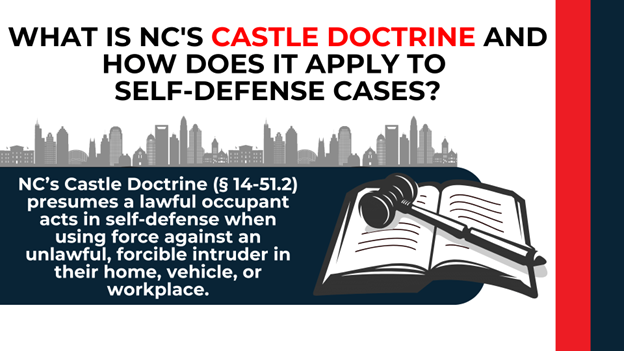
North Carolina’s Castle Doctrine, codified in N.C. Gen. Stat. § 14-51.2, provides enhanced legal protection for individuals who use defensive force in their home, motor vehicle, or workplace. This statute creates a presumption that favors the lawful occupant when an intruder unlawfully and forcefully enters or attempts to enter these protected spaces.
Under the Castle Doctrine, a lawful occupant is presumed to have held a reasonable fear of imminent death or serious bodily harm when using deadly force if:
- The person against whom defensive force was used was unlawfully and forcefully entering, had unlawfully and forcibly entered, or was attempting to remove another person against their will from the home, motor vehicle, or workplace
- The occupant knew or had reason to believe that an unlawful and forcible entry or act was occurring or had occurred
This presumption is powerful. It shifts the burden to the prosecution to rebut the presumption by proving one of the enumerated exceptions. If the state cannot do so, the occupant’s use of deadly force is legally justified, and the killing cannot constitute murder.
The presumption does not apply in the following circumstances:
- The intruder has the right to be in the premises (such as a co-owner or lawful resident) and no protective order exists against them
- The person being removed is a child or grandchild in the lawful custody of the intruder
- The defender is engaged in criminal activity or using the premises to further a crime involving force or violence
- The intruder is a law enforcement officer or bail bondsman lawfully performing official duties, and the officer identified themselves or the defender knew or should have known their identity
- The intruder has exited the premises and discontinued all efforts to enter
Recent North Carolina appellate decisions have clarified that the term “occupant” does not necessarily require physical presence inside the protected space at the exact moment force is used. What matters is whether the person had a lawful connection to the premises and whether the intruder’s forcible entry created the threatening situation.
What Happens If Someone Initially Provokes a Confrontation and Then Uses Deadly Force?
North Carolina law recognizes that self-defense claims may be undermined when the person claiming the defense was the initial aggressor or provoked the confrontation. N.C. Gen. Stat. § 14-51.4 addresses situations where the justification for defensive force is not available.
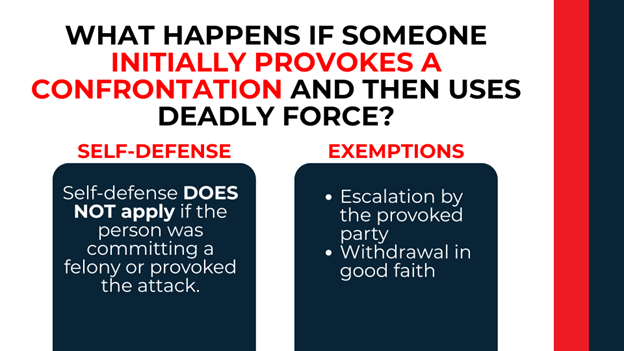
Self-defense is generally not available to a person who:
- Was attempting to commit, committing, or escaping after committing a felony
- Initially provoked the use of force against themselves
However, the statute provides exceptions. Even a person who initially provokes a confrontation may regain the right to use defensive force under limited circumstances:
Exception 1: Escalation by the provoked party
If the person who was provoked responds with such serious force that the initial provoker reasonably believes they are in imminent danger of death or serious bodily harm, and the provoker has no reasonable means to retreat, and deadly force is the only way to escape the danger, self-defense may apply.
Exception 2: Withdrawal in good faith
If the person who initially provoked the confrontation withdraws in good faith from physical contact and clearly indicates their desire to terminate the use of force, but the person who was provoked continues or resumes the use of force, self-defense may be justified.
These provisions ensure that the law does not reward aggressors while still recognizing situations where even an initial aggressor may face a legitimate need to defend their life. The question of who provoked the confrontation, and whether the defendant meets the criteria for one of the exceptions, often becomes a central factual dispute in self-defense cases.
If the prosecution proves the defendant was committing a felony or initially provoked the encounter without meeting an exception, the self-defense claim fails. This means the killing is not justified, and the elements of murder may be established.
How Do North Carolina Courts Evaluate Whether Force Was Excessive?
A critical issue in many self-defense cases is whether the amount of force used was excessive under the circumstances. Even when a person has the right to defend themselves, the law requires that the force used be proportional to the threat faced.
For non-deadly force situations:
Under N.C. Gen. Stat. § 14-51.3(a), a person may use force (but not deadly force) when they reasonably believe it is necessary to defend themselves or another against the imminent use of unlawful force. This standard applies to situations where the threat does not involve death or great bodily harm.
For deadly force situations:
Deadly force is only justified when the defender reasonably believes it is necessary to prevent imminent death or great bodily harm. Using deadly force in response to a minor threat, or continuing to use force after the threat has ended, may be deemed excessive.
Courts evaluate excessiveness based on what a reasonable person would have perceived and done in the same situation. Key factors include:
- The nature and severity of the threat
- Whether the threat was imminent
- The relative size, strength, and capabilities of the parties
- Whether the defender had knowledge of the attacker’s violent history or propensities
- Whether less forceful alternatives were available
Under the Castle Doctrine, the issue of excessive force becomes more complex. As clarified in recent case law, when the statutory presumption applies—meaning the defender is presumed to have reasonably feared death or serious bodily harm—excessive force is not possible unless the state rebuts the presumption by proving one of the enumerated exceptions under N.C. Gen. Stat. § 14-51.2(c).
If the state cannot rebut the presumption, the defender’s use of deadly force is conclusively justified. If the presumption is rebutted, the court evaluates whether the force used was reasonable under traditional self-defense principles.

Can Self Defense Apply If the Intruder Has Left the Premises?
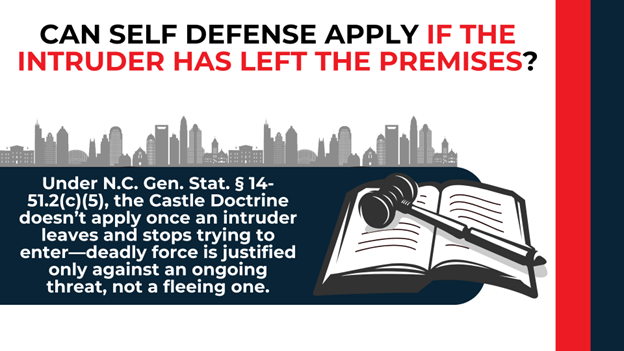
One of the most important limitations on North Carolina’s Castle Doctrine involves situations where the intruder has exited the home, vehicle, or workplace and discontinued all efforts to enter. N.C. Gen. Stat. § 14-51.2(c)(5) specifically states that the presumption of reasonable fear does not apply when the intruder has exited and discontinued all entry efforts.
This limitation reflects the principle that self-defense is about preventing imminent harm, not punishing past conduct or pursuing fleeing attackers. Once an intruder has left the premises and poses no continuing threat, the justification for using deadly force evaporates.
Recent appellate cases illustrate this principle:
In one case, a defendant pushed an intruder out of his home after being attacked with a chainsaw. The two fought across the yard, and the intruder eventually dropped the weapon, raised his hands, and backed away into an adjoining property. The defendant pursued and killed him. The court held that the Castle Doctrine did not apply because the intruder had exited the home and discontinued efforts to enter. The defendant was not entitled to the statutory presumption.
By contrast, another case involved a defendant who was attacked while sitting in his car. The attacker opened the car door, leaned in, and began punching the defendant. The defendant exited the car, and the attacker withdrew and came around to meet the defendant in the street, where the attack continued. The court held that the Castle Doctrine could apply even though the defendant was outside the car when he used deadly force. The critical factor was that the attacker had unlawfully and forcefully entered the vehicle, and the ongoing nature of the confrontation meant the attacker had not “discontinued all efforts.”
Practical considerations:
- If an intruder flees and no longer poses a threat, pursuing and using deadly force is not justified
- The determination of whether someone has “discontinued all efforts to enter” is fact-specific and often contested
- Distance, body language, and the cessation of aggressive action are all relevant
Defense attorneys must carefully analyze the facts to determine whether the Castle Doctrine’s presumption applies or whether the case must be evaluated under general self-defense principles.
What Should Someone Do Immediately After Using Force in Self Defense?
The moments and hours following a defensive force incident are critical. How a person responds can significantly impact both their legal situation and their safety.
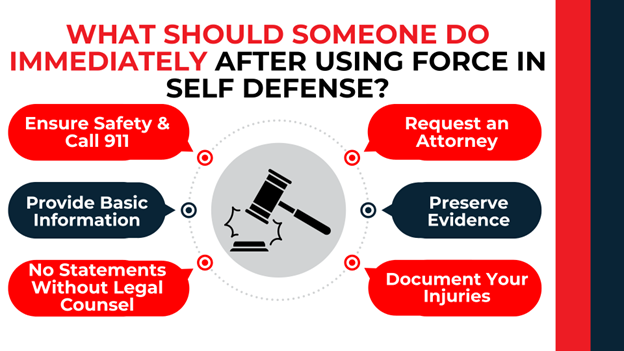
Immediate priorities include:
- Ensure safety: Move to a secure location if the threat persists. Do not assume the danger has passed.
- Call 911: Report the incident to law enforcement. Explain that you were forced to defend yourself and request medical assistance if needed.
- Provide basic information: Identify yourself and state that you acted in self-defense. Be cooperative but concise.
- Do not make detailed statements without legal counsel: While it is important to cooperate with law enforcement, making extensive statements before consulting with an attorney can be harmful. Adrenaline, shock, and confusion can lead to inaccurate or incomplete accounts that may be used against you.
- Request an attorney: Clearly state that you wish to speak with a lawyer before answering detailed questions. This is a constitutional right and should not be viewed as evidence of guilt.
- Preserve evidence: Do not disturb the scene, destroy evidence, or tamper with anything. Take photographs if it is safe to do so, but avoid interfering with the investigation.
- Document your injuries: Seek medical attention for any injuries, no matter how minor. Medical records provide objective evidence of the encounter and your condition.
Common mistakes to avoid:
- Making inconsistent statements to different officers or witnesses
- Trying to explain every detail without legal guidance
- Discussing the incident on social media or with friends and family
- Assuming that because you acted in self-defense, you will not be charged
Even justified uses of force often result in arrest and prosecution. Law enforcement and prosecutors must investigate and evaluate the circumstances, and they may not initially accept a self-defense claim. Having experienced legal representation from the outset is essential.
How Does a Criminal Defense Attorney Challenge a Murder Charge Based on Self Defense?
Defending a murder charge on self-defense grounds requires a thorough investigation, strategic use of the law, and persuasive presentation of the facts. An experienced criminal defense attorney evaluates every aspect of the case to build a compelling argument that the defendant’s use of force was justified.
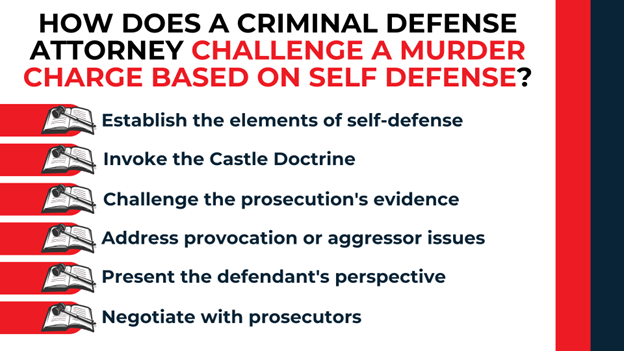
Key defense strategies include:
Establishing the elements of self-defense:
The attorney gathers evidence showing that the defendant reasonably believed deadly force was necessary to prevent imminent death or great bodily harm. This may include:
- Witness testimony describing the threat and the defendant’s response
- Physical evidence such as weapons, injuries, or the layout of the scene
- Expert testimony on the dynamics of violent encounters, threat assessment, or the defendant’s state of mind
Invoking the Castle Doctrine:
When applicable, the attorney demonstrates that the statutory presumption under N.C. Gen. Stat. § 14-51.2 applies, and that none of the exceptions that would rebut the presumption exist. This may involve:
- Showing that the intruder unlawfully and forcefully entered
- Establishing that the defendant was a lawful occupant
- Proving that the intruder had not exited and discontinued efforts to enter at the time force was used
Challenging the prosecution’s evidence:
The defense attorney scrutinizes the state’s case to identify weaknesses, inconsistencies, or gaps in the evidence. This may include:
- Cross-examining witnesses to expose biases, inaccuracies, or alternative explanations
- Highlighting forensic evidence that supports the defense account
- Demonstrating that the prosecution cannot prove the elements of murder beyond a reasonable doubt
Addressing provocation or aggressor issues:
If the prosecution argues that the defendant provoked the confrontation or was the initial aggressor, the defense attorney works to show that the defendant either did not provoke the incident or meets one of the statutory exceptions that restore the right to self-defense.
Presenting the defendant’s perspective:
The attorney ensures that the jury understands the situation from the defendant’s point of view, including:
- The perceived threat and the urgency of the moment
- The defendant’s background, including any history of violence or victimization that may inform their perception of danger
- The lack of reasonable alternatives to using force
Negotiating with prosecutors:
In some cases, the attorney may negotiate a reduction in charges or dismissal based on the strength of the self-defense claim. Prosecutors may be willing to resolve the case favorably if the evidence clearly supports justification.
Effective defense in these cases requires not only legal knowledge but also the ability to tell a compelling story that humanizes the defendant and contextualizes their actions. The goal is to show the judge or jury that the defendant did what any reasonable person would have done to protect their life.
What Are the Potential Consequences of a Murder Conviction in North Carolina?
A murder conviction in North Carolina carries severe penalties that impact every aspect of a person’s life. Understanding the stakes reinforces the importance of mounting a strong defense.
First-degree murder:
- Classified as a Class A felony
- Potential penalties include death or life imprisonment without the possibility of parole
- Juveniles under 18 at the time of the offense cannot receive the death penalty and are sentenced under different statutory provisions
Second-degree murder:
- Classified as a Class B1 felony in most cases, or Class B2 felony when based on reckless and wanton conduct
- Serious prison time may be imposed
Collateral consequences:
Beyond incarceration, a murder conviction results in:
- Loss of voting rights (which may be restored depending on the circumstances)
- Loss of the right to possess firearms
- Difficulty obtaining employment, housing, and professional licenses
- Immigration consequences for non-citizens, including deportation
- Social stigma and damaged relationships
The difference between a murder conviction and a finding of justified self-defense is the difference between decades in prison and freedom. This is why early and aggressive legal representation is critical.

Why Is Early Legal Representation Critical in Self Defense Cases?
The period immediately following a deadly force incident is when many cases are won or lost. Critical evidence may be lost, witnesses’ memories may fade, and statements made without legal counsel can irreparably harm a defense.
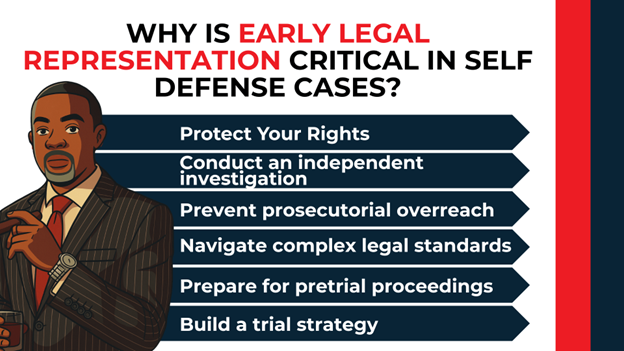
Reasons to contact an attorney immediately include:
Protecting your rights:
Law enforcement officers may pressure you to make statements or waive constitutional protections. An attorney ensures your rights are respected throughout the investigation.
Conducting an independent investigation:
Defense attorneys can hire investigators, locate witnesses, and gather evidence before it disappears. Surveillance footage, physical evidence, and witness accounts are time-sensitive.
Preventing prosecutorial overreach:
Prosecutors may initially charge first-degree murder even in cases where self-defense is evident. An attorney can present evidence to the district attorney early in the process, potentially preventing formal charges or securing a reduction.
Navigating complex legal standards:
Self-defense law in North Carolina involves nuanced statutory provisions and evolving case law. An experienced attorney understands how to apply these standards to your specific facts.
Preparing for pretrial proceedings:
Bond hearings, preliminary hearings, and pretrial motions are critical stages. An attorney ensures you are prepared and that every opportunity to strengthen your case is pursued.
Building a trial strategy:
If the case proceeds to trial, early preparation allows your attorney to develop a comprehensive strategy, retain expert witnesses, and present a cohesive defense.
Contact Patrick Roberts Law for Experienced Criminal Defense Representation
If you or a loved one has been charged with murder or is being investigated for a deadly force incident, the decisions you make now will shape the rest of your life. Self-defense cases require a deep understanding of North Carolina law, a commitment to thorough investigation, and the ability to present a compelling case to prosecutors, judges, and juries.
Attorney Patrick Roberts has extensive experience defending individuals accused of serious crimes in North Carolina. He understands the complexities of self-defense law, including the Castle Doctrine and the standards for justified use of force. His approach combines aggressive advocacy with meticulous attention to detail, ensuring that every avenue of defense is explored.
Do not wait to protect your rights. Contact Patrick Roberts Law today to schedule a confidential consultation. Early legal representation can make the difference between conviction* and acquittal,* between years in prison and the freedom to move forward with your life.
*Disclaimer: Each case is different and must be evaluated separately. Prior results achieved do not guarantee similar results can be achieved in future cases.
Former assistant district attorney
Contact Patrick Roberts
Facing criminal charges in North Carolina demands seasoned representation. Trust in the experience and dual perspective of Patrick Roberts. Reach out today for a confidential consultation.
-
Call Our Team
Calls answered 24/7










For more information on the selection criteria, go to www.martindale.com
*Each case is different and must be evaluated separately. Prior results achieved do not guarantee similar results can be achieved in future cases.