
A Class H felony in North Carolina carries a potential sentence ranging from 4 to 39 months depending on the circumstances. Beyond the sentence itself, a conviction can affect firearm rights, employment, professional licensing, and immigration status long after any sentence is served. The range is wide because North Carolina uses a structured sentencing system. The actual punishment depends not just on the offense class but on the defendant’s prior record. Two people charged with the same Class H felony can face very different outcomes.
This page walks through the specific sentencing ranges at each prior record level, whether probation is available, and the consequences that extend beyond the courtroom.
How Much Prison Time Does a Class H Felony Carry?
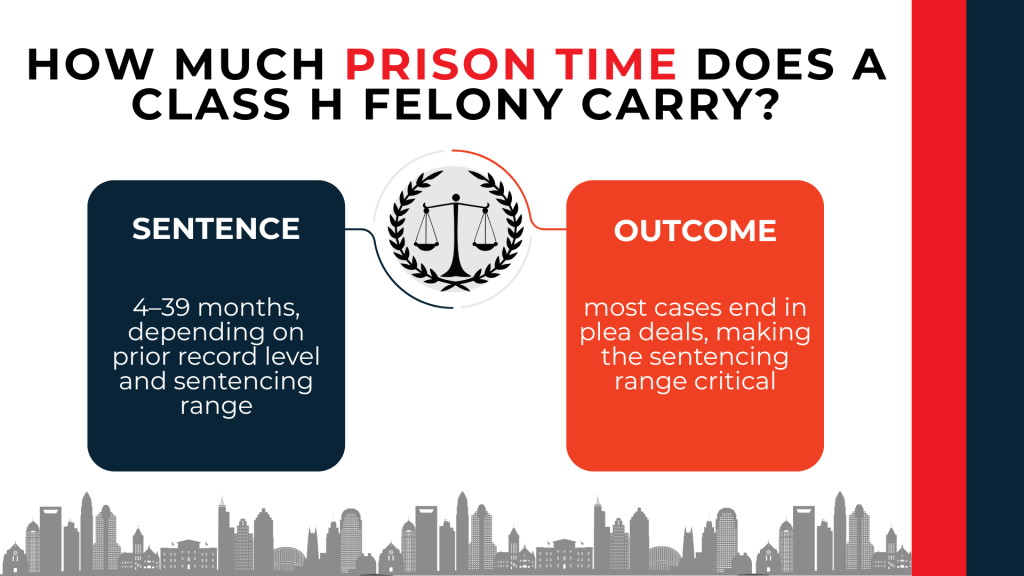
The sentencing range for a Class H felony spans from a mitigated minimum of 4 months at the lowest prior record level to a statutory maximum of 39 months at the highest. The felony punishment chart in N.C. Gen. Stat. § 15A-1340.17 sets three ranges at each prior record level — mitigated, presumptive, and aggravated. Each range specifies a minimum sentence. The maximum sentence is then calculated from the minimum using a statutory formula.
At Prior Record Level I, the presumptive minimum is 5 to 6 months. At Prior Record Level VI, the most severe, the aggravated minimum can reach 25 months, with a maximum of 39 months. The presumptive range is the default. A judge can sentence in the mitigated range if mitigating factors outweigh aggravating factors, or in the aggravated range if aggravating factors outweigh mitigating ones. Neither departure happens automatically — both depend on the facts presented at sentencing and, in many cases, on what is negotiated before sentencing ever occurs.
The numbers matter, but so does the context around them. According to the North Carolina Sentencing and Policy Advisory Commission’s FY2024 Statistical Report, approximately 98% of all felony convictions in North Carolina resulted from guilty pleas rather than jury trials. For Class G, H, and I felonies specifically, the jury trial rate was roughly 1%. That means the outcome of nearly every Class H felony case is shaped by what happens during negotiation, not at trial. The sentencing range is what drives that negotiation.
How Does My Prior Record Change My Sentence?
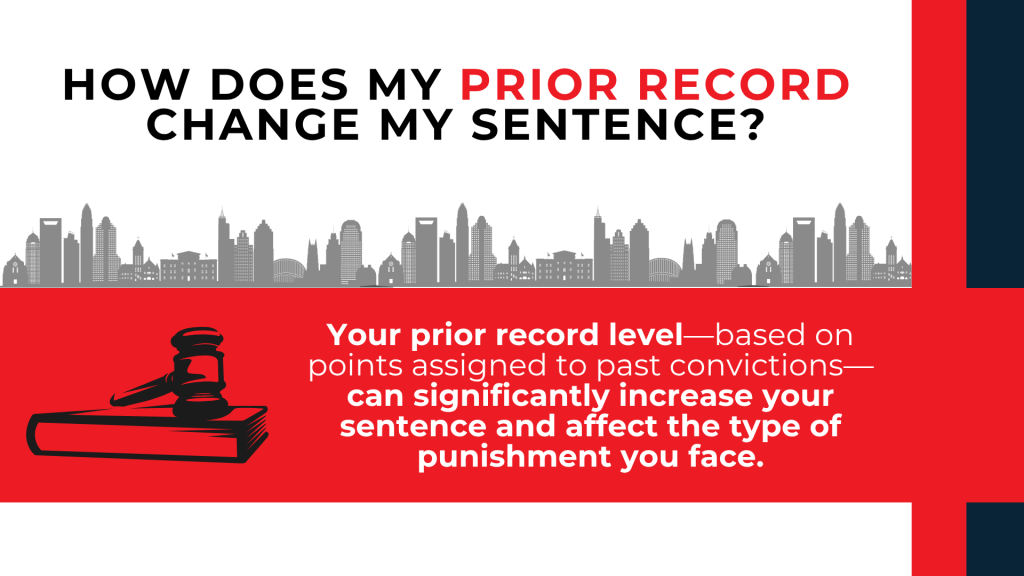
The prior record level is calculated under N.C. Gen. Stat. § 15A-1340.14 by assigning points to prior convictions. Each prior Class H or Class I felony conviction adds 2 points. Each prior Class A1 or Class 1 misdemeanor conviction adds 1 point. Higher-class felony convictions carry more points, and the total determines the prior record level, which ranges from Level I to Level VI.
This is the factor that produces the widest swing in the potential sentence. If you are at Prior Record Level I, you are looking at a presumptive minimum of 5 to 6 months. At Level VI, you could be looking at more than triple that. In domestic violence cases, this calculation often matters because prior assault-related misdemeanors — including prior convictions for assault on a female under N.C. Gen. Stat. § 14-33(c)(2), which is a Class A1 misdemeanor — each add a point to the total.
The prior record level also determines what type of sentence is available, which leads directly to the question most people facing a Class H felony are asking next.
Could I Get Probation Instead of Prison?
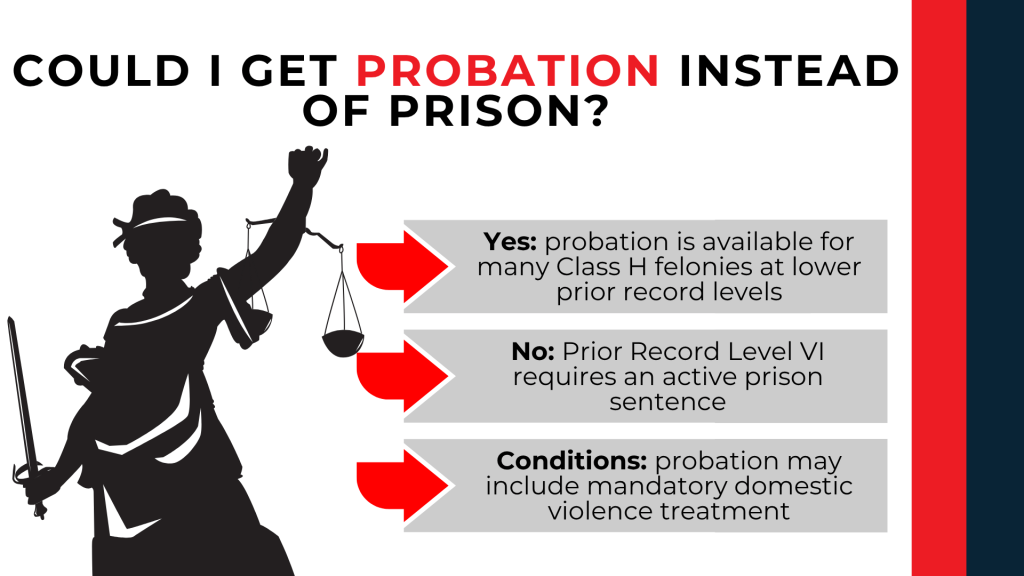
Yes, depending on the prior record level. North Carolina’s structured sentencing system assigns one of three disposition types to each cell on the felony punishment chart: community (C), intermediate (I), or active (A). Community punishment is probation-based and does not require any period of incarceration. Intermediate punishment is also probation-based but may include conditions like supervised probation, short-term confinement, or electronic monitoring. Active punishment means a sentence served in custody.
At lower prior record levels, the sentencing chart for a Class H felony includes community and intermediate options. Active time becomes mandatory at Prior Record Level VI. This is not a formality. Statewide, the felony punishment distribution in FY2024 was 40% active sentences, 36% intermediate, and 24% community. That means the majority of felony defendants in North Carolina received a probation-based sentence rather than incarceration.
In domestic violence cases, probation conditions carry their own weight. Under N.C. Gen. Stat. § 15A-1343(b)(12), a defendant found responsible for acts of domestic violence must attend an approved abuser-treatment program as a condition of probation unless the court finds it is not in the interests of justice. These programs require 39 hours of group treatment completed over 26 to 30 weeks, with groups of no more than 16 participants. Not every North Carolina county has an approved program. As of 2026, 34 programs operate across 65 of the state’s 100 counties, leaving 35 counties without one.
It is also worth noting that many Class H and I felonies resolve through plea in district court rather than superior court. In FY2024, 5,072 Class H and I felony pleas — 31% of all convictions at that level — were handled in district court. The median time from charge to sentencing in district court was 4 months, compared to 11 months in superior court.
What Happens to My Right to Own a Firearm?
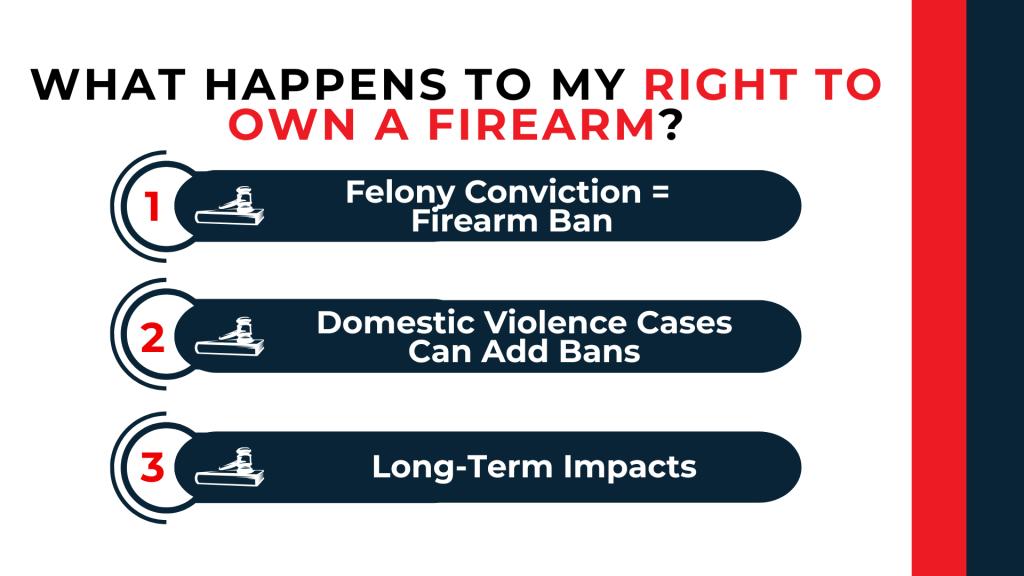
A Class H felony conviction triggers a firearms ban at both the state and federal level. Under N.C. Gen. Stat. § 14-415.1, it is unlawful for any person convicted of a felony to possess, purchase, or own a firearm in North Carolina. At the federal level, the felon-in-possession statute, 18 U.S.C. § 922(g)(1), bars firearm and ammunition possession by convicted felons.
In domestic violence cases, additional federal firearms bans may apply separately from the felony conviction itself. Under 18 U.S.C. § 922(g)(8), a person subject to a qualifying Domestic Violence Protective Order that includes a credible-threat finding is barred from possessing firearms while the order is in effect. Under 18 U.S.C. § 922(g)(9), the Lautenberg Amendment, a person convicted of a misdemeanor crime of domestic violence faces a generally permanent ban on firearm and ammunition possession. Depending on how a case is resolved, the § 922(g)(9) ban may be relevant even where the original charge was a felony — for example, if a plea to a qualifying misdemeanor offense is part of the resolution.
For many people, the loss of firearm rights is the single most consequential long-term outcome of a Class H felony conviction, particularly when employment, hunting, or personal protection depends on the ability to legally possess a firearm.
Will a Class H Felony Affect My Job or Professional License?
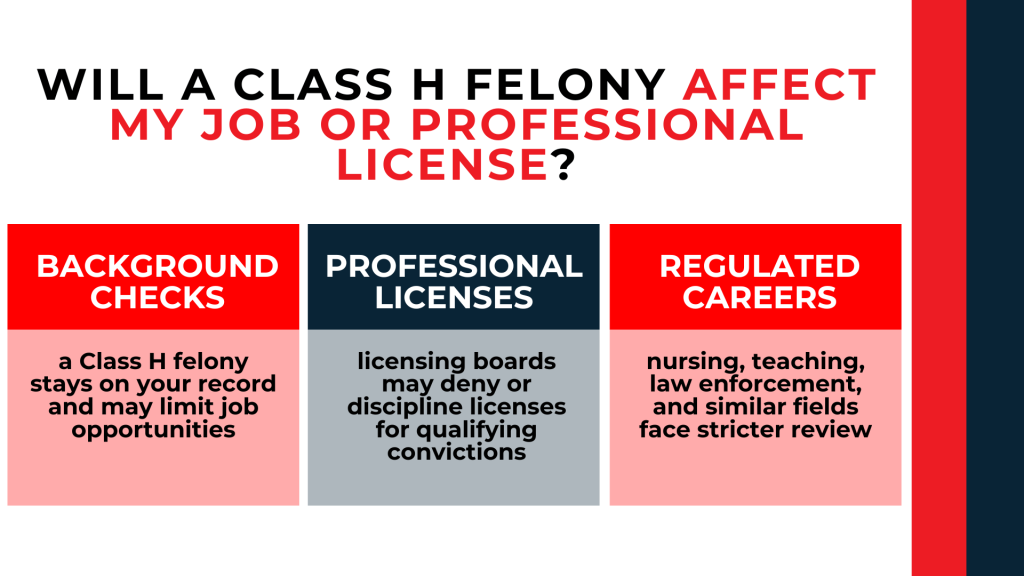
A felony conviction appears on criminal background checks. It can disqualify you from employment in a range of fields, both by employer policy and by regulatory requirement. Under N.C. Gen. Stat. § 93B-8.1, North Carolina licensing boards may deny a professional license based on a criminal conviction if the criminal history is “directly related” to the duties of the occupation or the crime is “violent or sexual in nature.” An assault-by-strangulation conviction — which the Fourth Circuit has held is categorically a crime of violence — falls within that second category.
Certain professions face additional scrutiny. The North Carolina Nursing Practice Act, N.C. Gen. Stat. § 90-171.48, expressly lists Article 8 assaults (which includes § 14-32.4) among offenses that affect fitness to practice. The NC Board of Nursing also requires self-reporting of felony or certain misdemeanor charges, typically within 30 days. Other licensed professions — teaching, law enforcement, real estate, and others regulated by state boards — apply their own standards. But the underlying conviction is reportable across the board.
Beyond licensed professions, the practical reality is that a felony conviction narrows the field. Many employers in North Carolina conduct background checks. While the law limits when and how that information can be used in some contexts, the conviction itself does not disappear from the record.
Can a Class H Felony Be Expunged in North Carolina?
Under current North Carolina law, a Class H felony conviction is generally not eligible for expunction. The expungement statutes impose strict limitations on which convictions qualify, and a violent felony conviction typically falls outside those boundaries. Beyond the conviction itself, having a Class H felony on your record can disqualify you from expunging other, lesser offenses that might otherwise be eligible.
This is one of the reasons the outcome of the case — not just the sentence imposed — carries so much long-term weight. A conviction that results in probation rather than prison may feel like a favorable resolution at the time. But the felony record it leaves behind follows you into employment, housing, licensing, and firearm eligibility for years or decades afterward. In many cases, the most consequential work a defense attorney does is not reducing the sentence but shaping the outcome in a way that avoids or limits the conviction record itself.
What Are the Immigration Consequences of a Class H Felony?
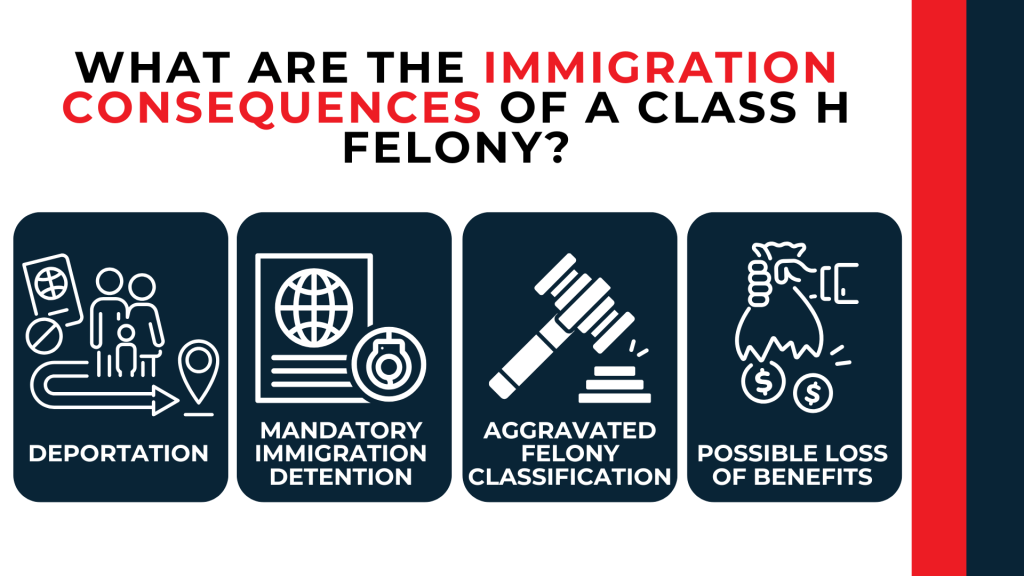
If you are not a United States citizen, a Class H felony conviction in a domestic violence case can carry immigration consequences that are more severe than the criminal sentence. In United States v. Rice, 36 F.4th 578 (4th Cir. 2022), the Fourth Circuit held that North Carolina’s assault by strangulation offense is categorically a “crime of violence” because it can only be committed with an intentional, knowing, or purposeful state of mind. That holding was confirmed in United States v. Robinson, 92 F.4th 531 (4th Cir. 2024).
Because the offense qualifies as a crime of violence, it is treated as an aggravated felony under 8 U.S.C. § 1101(a)(43)(F) when a sentence of one year or more is imposed. For immigration purposes, a suspended sentence counts. An aggravated felony classification carries mandatory detention and near-automatic removal. Separately, under 8 U.S.C. § 1227(a)(2)(E), a noncitizen convicted of a crime of domestic violence against a person in a qualifying domestic relationship is deportable regardless of the sentence length.
This sharply distinguishes a Class H felony strangulation conviction from North Carolina’s lower-level assault charges. The Fourth Circuit held in United States v. Vinson, 805 F.3d 120 (4th Cir. 2015), that ordinary North Carolina assault convictions are not categorically crimes of violence because they can be committed through culpable negligence rather than intentional force. A strangulation conviction does not benefit from that distinction. If you are facing this charge and are not a U.S. citizen, you should understand that the immigration consequences may be irreversible. They should be evaluated by someone qualified to assess them before any plea is entered.
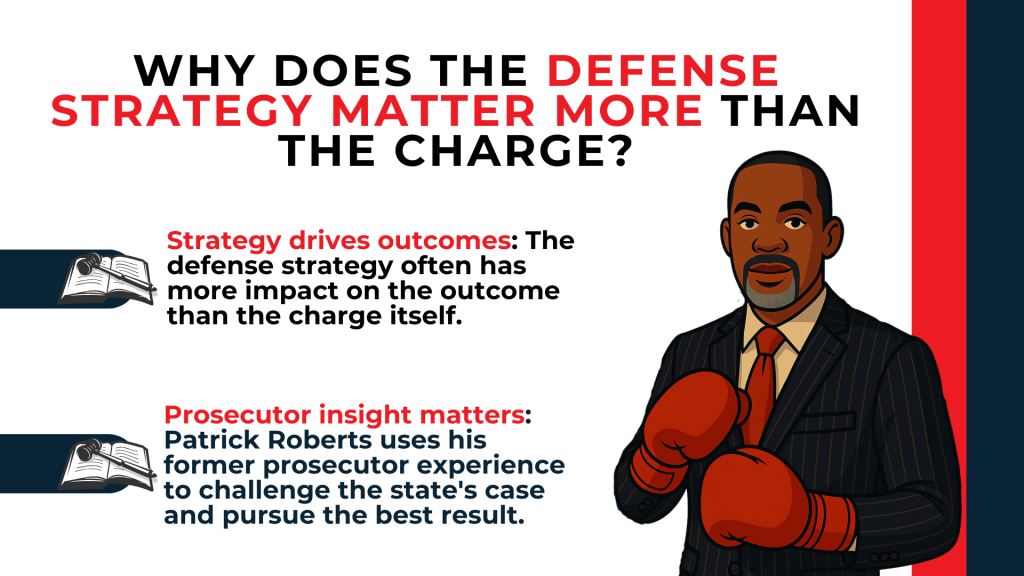
Why Does the Defense Strategy Matter More Than the Charge?
The structured sentencing system in North Carolina does something that is easy to miss when reading a statute for the first time: it creates a range of outcomes, not a fixed one. A Class H felony can result in 39 months in custody or supervised probation served in the community. It can end with a conviction that permanently alters your record or, in some cases, with a resolution that avoids the felony conviction entirely. Where you land within that range depends on the prior record, the facts, the evidence, and the quality of the defense.
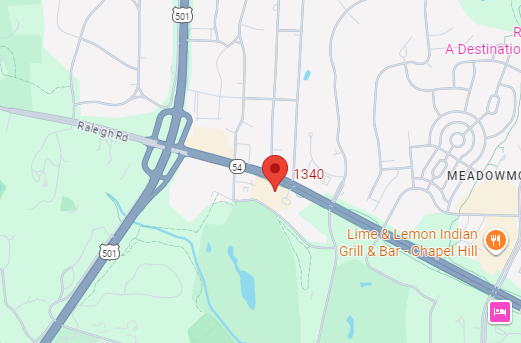
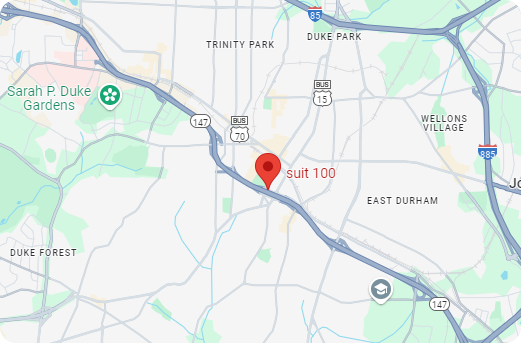
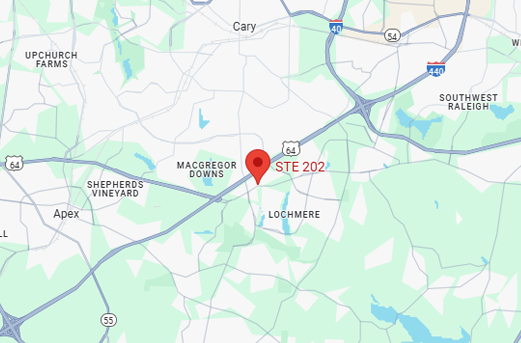
At Patrick Roberts Law in Raleigh, North Carolina, criminal defense attorney Patrick Roberts brings more than 24 years of experience and a perspective shaped by his prior service as an Assistant District Attorney in Wake, Johnston, and New Hanover counties. That background means an understanding of how the state builds and evaluates cases from the inside — and where the pressure points are that create room for a different outcome. Attorney Patrick Roberts offers comprehensive legal representation across every county in North Carolina for high-stakes cases, maintaining a core geographic focus on Wake County communities like Raleigh, Cary, Apex, Holly Springs, Garner, and Fuquay-Varina.
Client Review
“Mr. Roberts was amazing! Had a very difficult case & the outcome didn’t look bright at all. I was looking at some serious time. But he was able to get me probation (which wasn’t on the table at all before he got involved) He was honest, to the point & laid out everything that could be a possibility. Never gave false hope, just the facts & logically what we could do to possibly get this in my favor. I would recommend Mr. Roberts to anyone seeking REAL guidance, honest & qualifications to back it up.” – Verified client review via Avvo.com
Peer Endorsement
“I retained and worked with Patrick and his team for four years and my primary expectations were without a doubt satisfied. Patrick will always be my first choice for legal defense for myself or my family. Standout Points: Patrick’s clients receive bond reductions that other attorneys are unable to secure. Patrick and his team double check their own knowledge of the law so that their courtroom presentation is well organized and flawless. Patrick knows how important it is to present your particular case in the right environment to receive the most positive reception.” – Verified peer endorsement via Avvo.com
Disclaimer: Testimonials and peer reviews are actual comments from clients and peers. They are for informational purposes only and do not guarantee or predict the outcome of your legal matter. Every case is unique and must be evaluated on its own merits.
If you or someone close to you is facing a Class H felony charge in North Carolina, the gap between the worst-case scenario and a manageable resolution is not determined by the charge alone. It is a matter of preparation, strategy, and knowing how the system actually works. Contact Patrick Roberts Law to discuss your case.
Through a selective intake process, the firm caps its active case volume to protect the quality and pace of its legal oversight.
Disclaimer: The information on this website is for general informational purposes only. Nothing herein should be taken as legal advice for any individual case or situation. Contacting us via this website, email, or contact form does not create an attorney-client relationship. Case results depend on a variety of factors unique to each case; prior results do not guarantee a similar outcome.
Former assistant district attorney
Contact Patrick Roberts
Facing criminal charges in North Carolina demands seasoned representation. Trust in the experience and dual perspective of Patrick Roberts. Reach out today for a confidential consultation.
-
Call Our Team
Calls answered 24/7






For more information on the selection criteria, go to www.martindale.com
*Each case is different and must be evaluated separately. Prior results achieved do not guarantee similar results can be achieved in future cases.