Blog / Criminal Defense

What Are the Consequences of a Class H Felony in North Carolina?

Judge's gavel introduces consequences of a Class H felony in North Carolina with law firm branding.

A Class H felony in North Carolina carries a potential sentence ranging from 4 to 39 months depending on the circumstances. Beyond the sentence itself, a conviction can affect firearm rights, employment, professional licensing, and immigration status long after any sentence is served. The range is wide because North Carolina uses a structured sentencing system. The actual punishment depends not just on the offense class but on the defendant's prior record. Two people charged with the same Class H felony can face very different outcomes.

This page walks through the specific sentencing ranges at each prior record level, whether probation is available, and the consequences that extend beyond the courtroom.

How Much Prison Time Does a Class H Felony Carry?

The sentencing range for a Class H felony spans from a mitigated minimum of 4 months at the lowest prior record level to a statutory maximum of 39 months at the highest. The felony punishment chart in N.C. Gen. Stat. § 15A-1340.17 sets three ranges at each prior record level — mitigated, presumptive, and aggravated. Each range specifies a minimum sentence. The maximum sentence is then calculated from the minimum using a statutory formula.

At Prior Record Level I, the presumptive minimum is 5 to 6 months. At Prior Record Level VI, the most severe, the aggravated minimum can reach 25 months, with a maximum of 39 months. The presumptive range is the default. A judge can sentence in the mitigated range if mitigating factors outweigh aggravating factors, or in the aggravated range if aggravating factors outweigh mitigating ones. Neither departure happens automatically — both depend on the facts presented at sentencing and, in many cases, on what is negotiated before sentencing ever occurs.

The numbers matter, but so does the context around them. According to the North Carolina Sentencing and Policy Advisory Commission's FY2024 Statistical Report, approximately 98% of all felony convictions in North Carolina resulted from guilty pleas rather than jury trials. For Class G, H, and I felonies specifically, the jury trial rate was roughly 1%. That means the outcome of nearly every Class H felony case is shaped by what happens during negotiation, not at trial. The sentencing range is what drives that negotiation.
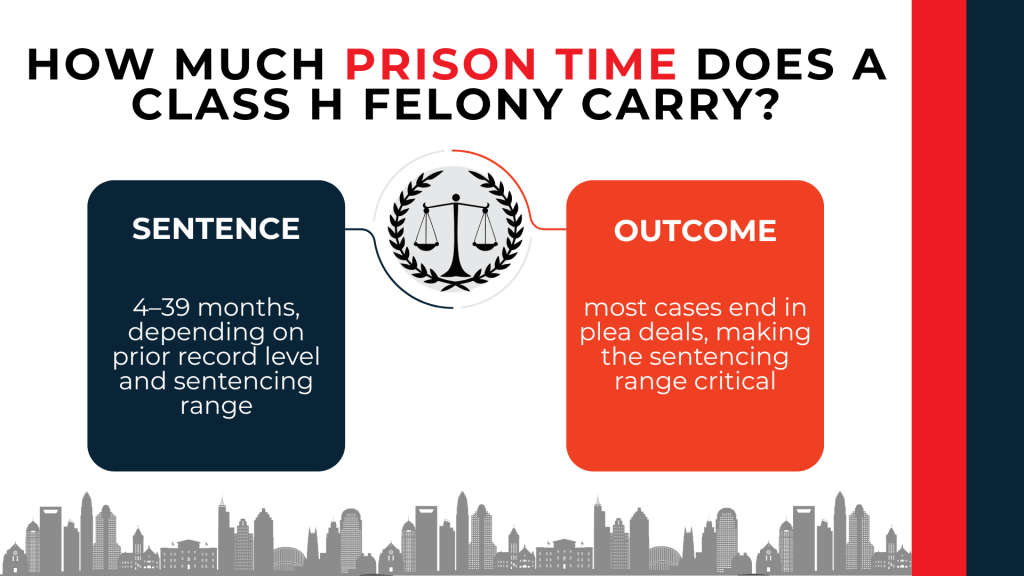
Scales of justice summarize Class H felony prison terms and sentencing outcomes based on record level.

How Does My Prior Record Change My Sentence?

The prior record level is calculated under N.C. Gen. Stat. § 15A-1340.14 by assigning points to prior convictions. Each prior Class H or Class I felony conviction adds 2 points. Each prior Class A1 or Class 1 misdemeanor conviction adds 1 point. Higher-class felony convictions carry more points, and the total determines the prior record level, which ranges from Level I to Level VI.

This is the factor that produces the widest swing in the potential sentence. If you are at Prior Record Level I, you are looking at a presumptive minimum of 5 to 6 months. At Level VI, you could be looking at more than triple that. In domestic violence cases, this calculation often matters because prior assault-related misdemeanors — including prior convictions for assault on a female under N.C. Gen. Stat. § 14-33(c)(2), which is a Class A1 misdemeanor — each add a point to the total.

The prior record level also determines what type of sentence is available, which leads directly to the question most people facing a Class H felony are asking next.
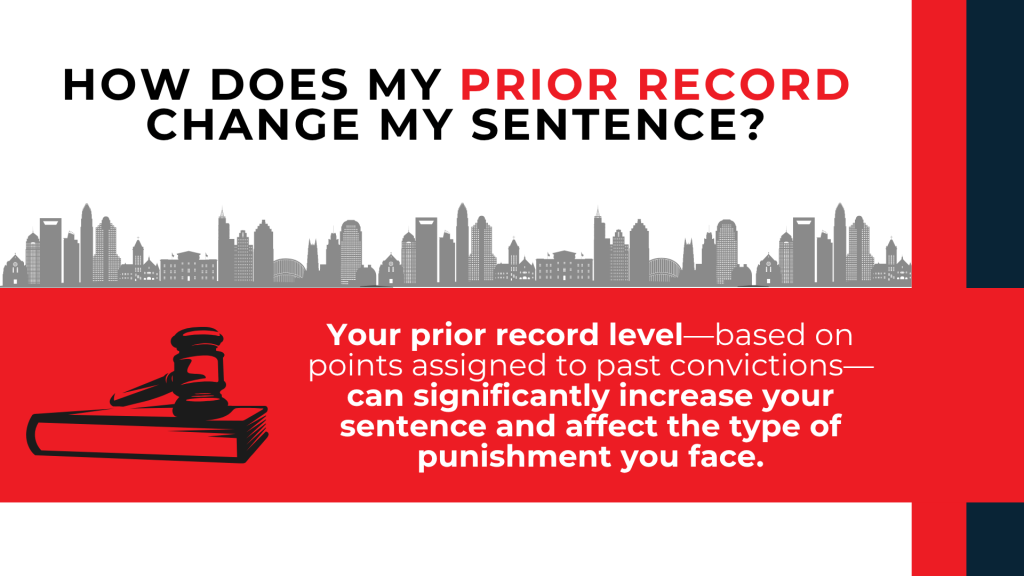
Gavel icon explains how prior record points can increase sentencing and affect punishment.

Could I Get Probation Instead of Prison?

Yes, depending on the prior record level. North Carolina's structured sentencing system assigns one of three disposition types to each cell on the felony punishment chart: community (C), intermediate (I), or active (A). Community punishment is probation-based and does not require any period of incarceration. Intermediate punishment is also probation-based but may include conditions like supervised probation, short-term confinement, or electronic monitoring. Active punishment means a sentence served in custody.

At lower prior record levels, the sentencing chart for a Class H felony includes community and intermediate options. Active time becomes mandatory at Prior Record Level VI. This is not a formality. Statewide, the felony punishment distribution in FY2024 was 40% active sentences, 36% intermediate, and 24% community. That means the majority of felony defendants in North Carolina received a probation-based sentence rather than incarceration.

In domestic violence cases, probation conditions carry their own weight. Under N.C. Gen. Stat. § 15A-1343(b)(12), a defendant found responsible for acts of domestic violence must attend an approved abuser-treatment program as a condition of probation unless the court finds it is not in the interests of justice. These programs require 39 hours of group treatment completed over 26 to 30 weeks, with groups of no more than 16 participants. Not every North Carolina county has an approved program. As of 2026, 34 programs operate across 65 of the state's 100 counties, leaving 35 counties without one.

It is also worth noting that many Class H and I felonies resolve through plea in district court rather than superior court. In FY2024, 5,072 Class H and I felony pleas — 31% of all convictions at that level — were handled in district court. The median time from charge to sentencing in district court was 4 months, compared to 11 months in superior court.
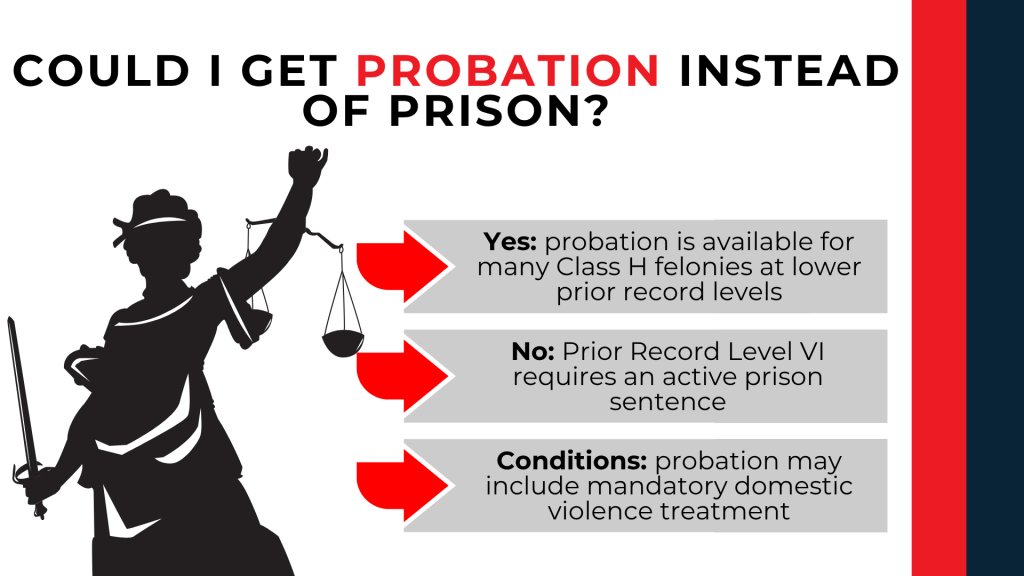
Lady Justice and arrows compare probation eligibility, prison requirements, and probation conditions for Class H felonies.

What Happens to My Right to Own a Firearm?

A Class H felony conviction triggers a firearms ban at both the state and federal level. Under N.C. Gen. Stat. § 14-415.1, it is unlawful for any person convicted of a felony to possess, purchase, or own a firearm in North Carolina. At the federal level, the felon-in-possession statute, 18 U.S.C. § 922(g)(1), bars firearm and ammunition possession by convicted felons.

In domestic violence cases, additional federal firearms bans may apply separately from the felony conviction itself. Under 18 U.S.C. § 922(g)(8), a person subject to a qualifying Domestic Violence Protective Order that includes a credible-threat finding is barred from possessing firearms while the order is in effect. Under 18 U.S.C. § 922(g)(9), the Lautenberg Amendment, a person convicted of a misdemeanor crime of domestic violence faces a generally permanent ban on firearm and ammunition possession. Depending on how a case is resolved, the § 922(g)(9) ban may be relevant even where the original charge was a felony — for example, if a plea to a qualifying misdemeanor offense is part of the resolution.

For many people, the loss of firearm rights is the single most consequential long-term outcome of a Class H felony conviction, particularly when employment, hunting, or personal protection depends on the ability to legally possess a firearm.
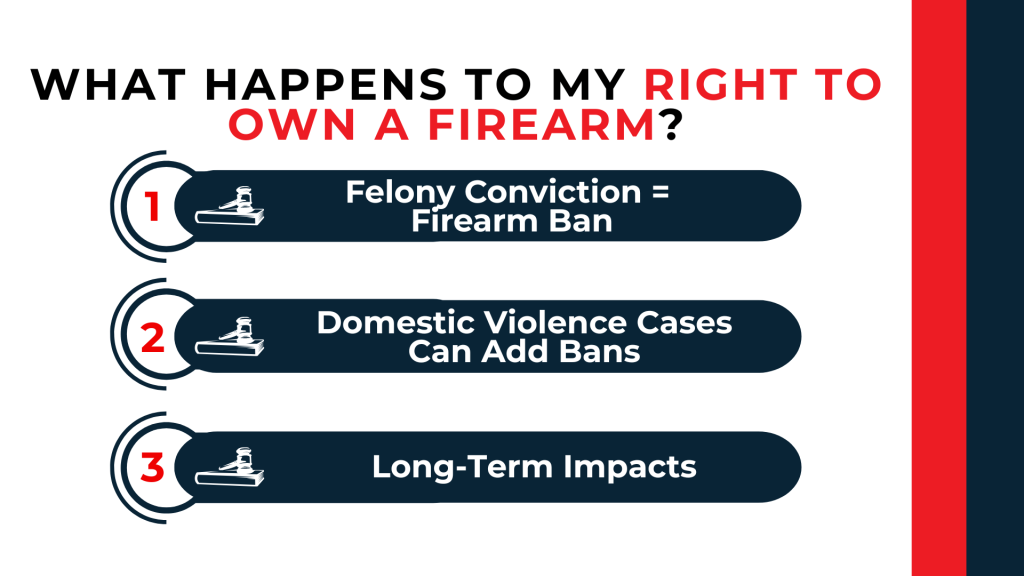
Numbered legal icons explain firearm bans and long-term restrictions after a felony conviction.

Will a Class H Felony Affect My Job or Professional License?

A felony conviction appears on criminal background checks. It can disqualify you from employment in a range of fields, both by employer policy and by regulatory requirement. Under N.C. Gen. Stat. § 93B-8.1, North Carolina licensing boards may deny a professional license based on a criminal conviction if the criminal history is "directly related" to the duties of the occupation or the crime is "violent or sexual in nature." An assault-by-strangulation conviction — which the Fourth Circuit has held is categorically a crime of violence — falls within that second category.

Certain professions face additional scrutiny. The North Carolina Nursing Practice Act, N.C. Gen. Stat. § 90-171.48, expressly lists Article 8 assaults (which includes § 14-32.4) among offenses that affect fitness to practice. The NC Board of Nursing also requires self-reporting of felony or certain misdemeanor charges, typically within 30 days. Other licensed professions — teaching, law enforcement, real estate, and others regulated by state boards — apply their own standards. But the underlying conviction is reportable across the board.

Beyond licensed professions, the practical reality is that a felony conviction narrows the field. Many employers in North Carolina conduct background checks. While the law limits when and how that information can be used in some contexts, the conviction itself does not disappear from the record.
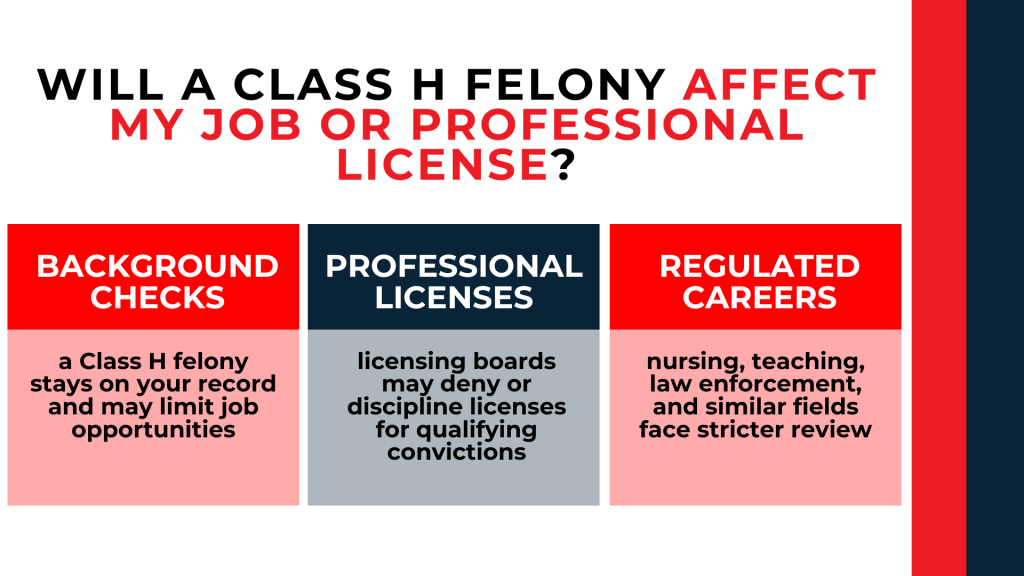
Three panels explain background checks, professional licensing, and career impacts after a Class H felony.

Can a Class H Felony Be Expunged in North Carolina?

Under current North Carolina law, a Class H felony conviction is generally not eligible for expunction. The expungement statutes impose strict limitations on which convictions qualify, and a violent felony conviction typically falls outside those boundaries. Beyond the conviction itself, having a Class H felony on your record can disqualify you from expunging other, lesser offenses that might otherwise be eligible.

This is one of the reasons the outcome of the case — not just the sentence imposed — carries so much long-term weight. A conviction that results in probation rather than prison may feel like a favorable resolution at the time. But the felony record it leaves behind follows you into employment, housing, licensing, and firearm eligibility for years or decades afterward. In many cases, the most consequential work a defense attorney does is not reducing the sentence but shaping the outcome in a way that avoids or limits the conviction record itself.
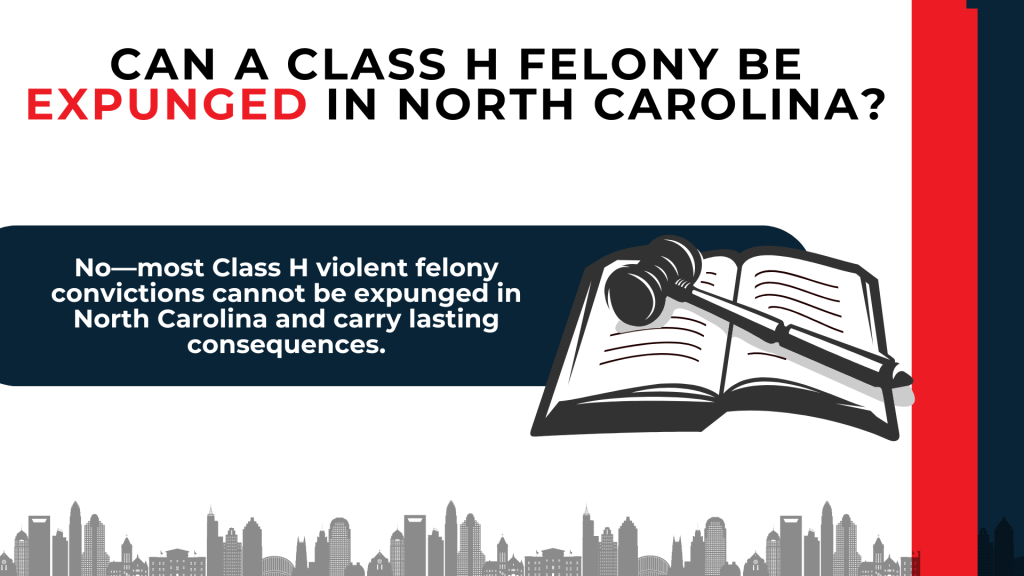
Gavel and law book explain that most violent Class H felony convictions cannot be expunged in North Carolina.

What Are the Immigration Consequences of a Class H Felony?

If you are not a United States citizen, a Class H felony conviction in a domestic violence case can carry immigration consequences that are more severe than the criminal sentence. In United States v. Rice, 36 F.4th 578 (4th Cir. 2022), the Fourth Circuit held that North Carolina's assault by strangulation offense is categorically a "crime of violence" because it can only be committed with an intentional, knowing, or purposeful state of mind. That holding was confirmed in United States v. Robinson, 92 F.4th 531 (4th Cir. 2024).

Because the offense qualifies as a crime of violence, it is treated as an aggravated felony under 8 U.S.C. § 1101(a)(43)(F) when a sentence of one year or more is imposed. For immigration purposes, a suspended sentence counts. An aggravated felony classification carries mandatory detention and near-automatic removal. Separately, under 8 U.S.C. § 1227(a)(2)(E), a noncitizen convicted of a crime of domestic violence against a person in a qualifying domestic relationship is deportable regardless of the sentence length.

This sharply distinguishes a Class H felony strangulation conviction from North Carolina's lower-level assault charges. The Fourth Circuit held in United States v. Vinson, 805 F.3d 120 (4th Cir. 2015), that ordinary North Carolina assault convictions are not categorically crimes of violence because they can be committed through culpable negligence rather than intentional force. A strangulation conviction does not benefit from that distinction. If you are facing this charge and are not a U.S. citizen, you should understand that the immigration consequences may be irreversible. They should be evaluated by someone qualified to assess them before any plea is entered.
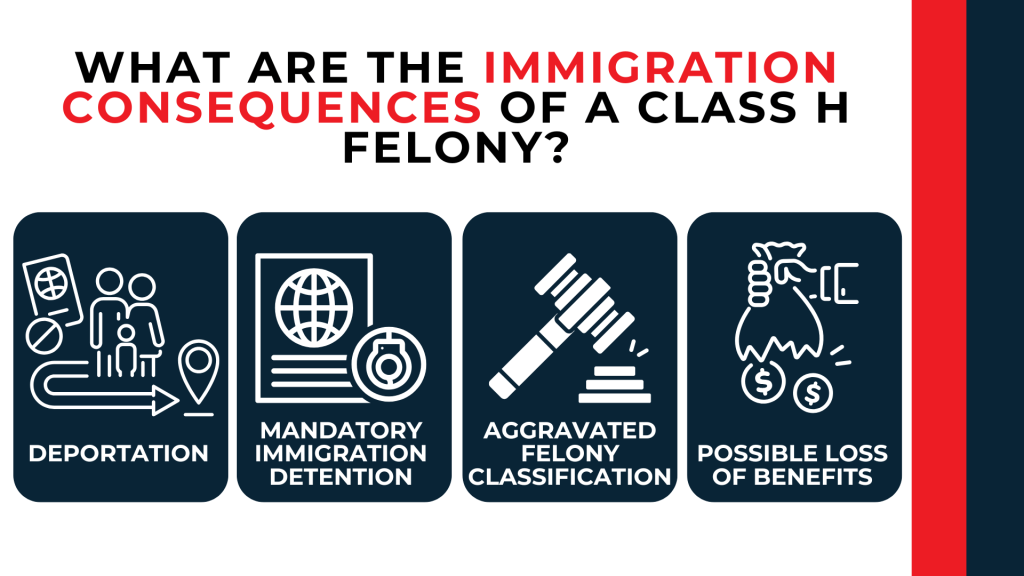
Icons highlight deportation, detention, aggravated felony classification, and possible loss of immigration benefits.

Why Does the Defense Strategy Matter More Than the Charge?

The structured sentencing system in North Carolina does something that is easy to miss when reading a statute for the first time: it creates a range of outcomes, not a fixed one. A Class H felony can result in 39 months in custody or supervised probation served in the community. It can end with a conviction that permanently alters your record or, in some cases, with a resolution that avoids the felony conviction entirely. Where you land within that range depends on the prior record, the facts, the evidence, and the quality of the defense.

At Patrick Roberts Law in Raleigh, North Carolina, criminal defense attorney Patrick Roberts brings more than 24 years of experience and a perspective shaped by his prior service as an Assistant District Attorney in Wake, Johnston, and New Hanover counties. That background means an understanding of how the state builds and evaluates cases from the inside — and where the pressure points are that create room for a different outcome. Attorney Patrick Roberts offers comprehensive legal representation across every county in North Carolina for high-stakes cases, maintaining a core geographic focus on Wake County communities like Raleigh, Cary, Apex, Holly Springs, Garner, and Fuquay-Varina. 

Client Review

“Mr. Roberts was amazing! Had a very difficult case & the outcome didn’t look bright at all. I was looking at some serious time. But he was able to get me probation (which wasn’t on the table at all before he got involved) He was honest, to the point & laid out everything that could be a possibility. Never gave false hope, just the facts & logically what we could do to possibly get this in my favor. I would recommend Mr. Roberts to anyone seeking REAL guidance, honest & qualifications to back it up.” - Verified client review via Avvo.com

Peer Endorsement

“I retained and worked with Patrick and his team for four years and my primary expectations were without a doubt satisfied. Patrick will always be my first choice for legal defense for myself or my family. Standout Points: Patrick's clients receive bond reductions that other attorneys are unable to secure. Patrick and his team double check their own knowledge of the law so that their courtroom presentation is well organized and flawless. Patrick knows how important it is to present your particular case in the right environment to receive the most positive reception.” - Verified peer endorsement via Avvo.com  

Disclaimer: Testimonials and peer reviews are actual comments from clients and peers. They are for informational purposes only and do not guarantee or predict the outcome of your legal matter. Every case is unique and must be evaluated on its own merits. 

If you or someone close to you is facing a Class H felony charge in North Carolina, the gap between the worst-case scenario and a manageable resolution is not determined by the charge alone. It is a matter of preparation, strategy, and knowing how the system actually works. Contact Patrick Roberts Law to discuss your case.

Through a selective intake process, the firm caps its active case volume to protect the quality and pace of its legal oversight. 
Attorney with boxing gloves explains how defense strategy and prosecutor insight influence case outcomes.

Disclaimer: The information on this website is for general informational purposes only. Nothing herein should be taken as legal advice for any individual case or situation. Contacting us via this website, email, or contact form does not create an attorney-client relationship. Case results depend on a variety of factors unique to each case; prior results do not guarantee a similar outcome.

Posted in:

Related Posts

Hand raising a wooden gavel over a sound block on a book, with the words “First-Degree Sexual Exploitation of a Minor in NC.”

First-Degree Sexual Exploitation of a Minor in North Carolina: What the Charge Means and What You're Facing

First-degree sexual exploitation of a minor is North Carolina's most serious child sexual abuse material (CSAM) charge. It's the offense the State brings when it believes someone used, coerced, or permitted a child to be filmed or photographed in sexual activity, or produced or profited from that material. It's a Class C felony under N.C. Gen. Stat. § 14-190.16. In North Carolina, that means a presumptive prison sentence measured in years, not months, plus lifelong consequences that outlast any sentence. This article walks through what the charge actually covers, why it matters that yours is "first degree," exactly what a prosecutor has to prove, how much prison time is realistically on the table, which defenses work and which don't, and what registration as a sex offender looks like. It ends with the concrete steps that matter most right now. What is first-degree sexual exploitation of a minor in North Carolina? It's the top-tier charge for producing child sexual abuse material, the conduct the law treats as creating the material or using a child to create it, as opposed to simply having it or passing it along. Under G.S. 14-190.16, a person commits this offense when, knowing the content and character of the material, they use, employ, induce, coerce, encourage, or facilitate a minor to take part in a live or recorded sexual performance, or permit a minor under their custody or control to do so, transport a minor for that purpose, or record or produce that material for sale or financial gain. A few things surprise people about this charge. First, it is not a statutory rape charge, and it's not the same thing as a hands-on sex offense. It’s about sexual material involving a child. Second, "material" is broad: photos, videos, and live-streamed performances all count. North Carolina's 2024 amendments (S.L. 2024-37) extended the statute to reach AI-generated or digitally modified images of an identifiable real child, and even a "child sex doll" modeled on an identifiable child. "Sexual activity" isn't left to the imagination either. It's specifically defined in G.S. 14-190.13. Why is my charge "first degree" and not second or third? Because North Carolina grades these offenses in three degrees by how close you allegedly were to creating the material. First degree is the most serious of the three. The degree you're charged with tells you where you sit on that ladder and how much prison time you're exposed to. • First degree, G.S. 14-190.16 (Class C, or Class D for the newer AI-image and child-sex-doll provisions): using, coercing, or permitting a minor to be recorded in sexual activity, or producing/profiting from that material. This is production-level conduct. • Second degree, G.S. 14-190.17 (Class E): recording, photographing, filming, or copying such material, or distributing, transporting, selling, receiving, or exchanging it. • Third degree, G.S. 14-190.17A (Class H): knowingly possessing it. The gap between the degrees is large. Third-degree possession is a Class H felony; second-degree is Class E; first-degree is a Class C felony, several classes more serious, with dramatically longer presumptive sentences. If you're charged in the first degree, the State is alleging you were involved in making the material or using a child to make it, not just that it was found on your device. What does the prosecutor have to prove to convict me? The State has to prove, beyond a reasonable doubt, that you acted "knowing the content and character of the material." It also has to prove that your conduct fits one of the specific first-degree acts in the statute: using or coercing a minor into a sexual performance, permitting a minor in your control to do so, or producing the material. The knowledge requirement is the backbone of the charge, and it's where a lot of real defense work happens. For a jury, this gets translated into the pattern jury instruction N.C.P.I.—Crim. 238.21 (the standard script a judge reads to jurors for first-degree sexual exploitation). Two points matter for how these cases are built: • The image is the unit of prosecution. North Carolina treats each individual image or file as its own offense, so a single device can generate many separate counts. In State v. Howell, 169 N.C. App. 58 (2005), each of the images on the defendant's hard drive supported a separate charge. That's why an arrest can turn into dozens of counts fast. • For AI or modified material, the child must be real and identifiable. The modification provisions reach depictions of an identifiable minor, an actual, real child. Purely fictional, computer-generated imagery that doesn't depict a real person raises a constitutional problem the State can't simply wave away (more on that below). Do they have to prove I physically touched or harmed a child? No. Proof of physical contact by you, visible injury, or a completed sex act with you is not part of what the statute requires. The offense depends on the sexual material and your knowing role in creating or producing it. This trips people up, because they assume a "sex crime" requires proof that someone was physically hurt. That cuts both ways. It means the State doesn't have to produce a physically injured witness to convict. But it also means the case rises or falls on the material and the digital evidence, which is exactly the terrain where the knowledge and identification questions live. The absence of any injury requirement is why forensic analysis of devices, files, and metadata usually matters far more in these cases than in a typical assault case. How much prison time am I actually facing? For a first-degree charge as a Class C felony, the presumptive sentence starts at a minimum of roughly 58 to 73 months (about five to six years) for someone with little or no prior record. It climbs steeply from there with prior convictions. That's the floor for a single count, before the factors that make these cases so dangerous. North Carolina sentences felonies under the Structured Sentencing Act ( G.S. 15A-1340.17), which sets the sentence from two things: the offense class and your prior record level (a point score based on past convictions). Three features drive the real risk up: 1. The reportable-offense add-on. Because this is a registrable sex offense, the maximum term isn't just the minimum plus the usual 20%. The statute adds 60 more months on top. In its own words, the maximum equals "the sum of the minimum term of imprisonment and twenty percent (20%) of the minimum term of imprisonment … plus 60 additional months." 2. Stacked counts. With each image chargeable separately (Howell), multiple counts are common. A judge has discretion under G.S. 15A-1354 to run sentences consecutively (one after another) rather than at the same time. 3. The AI/doll provisions are graded slightly lower but still severe. The newer provisions for modified images of an identifiable minor and for child sex dolls are Class D felonies, one step below Class C, but still a high-level felony carrying years of active prison time. These offenses are also not eligible for the conditional-discharge and deferral programs that can keep lower-level felonies off a record. For a Class C or Class D sex offense, that off-ramp isn't available. Can I argue I didn't know their age, or that the image was just AI? Not the way most people hope. Mistake of age is barred by the statute outright: the law says plainly that "mistake of age is not a defense to a prosecution under this section." And the person deciding your case is allowed to infer that a subject is a minor from how the material itself looks. So "I thought they were 18" is not a defense here. The "it was only AI, so there's no real victim" argument is more nuanced and easy to get wrong. There is a real constitutional line: in Ashcroft v. Free Speech Coalition, 535 U.S. 234 (2002), the U.S. Supreme Court held that entirely virtual imagery (material that "records no crime and creates no victims by its production") is protected and can't be criminalized. But North Carolina's statute is written specifically to reach modified or AI-generated depictions of an identifiable, real minor. So whether this helps you depends entirely on whether the material depicts an actual identifiable child or a purely fictional, non-identifiable creation. That's a factual and technical fight, not a slogan. What defenses could actually work in my case? The realistic defenses cluster around what the State genuinely has to prove: knowledge, control, identity, and (for modified images) whether a real child is depicted. "Charged" is not "convicted," and in first-degree cases the defense often has more to work with than clients expect. What if I didn't knowingly possess or control the material? The State must prove you knew the character and content of the material and that the specific conduct was yours. Shared devices, automatic caching by apps and browsers, and unopened downloads all directly affect whether you knowingly did anything. Digital forensics (who actually accessed a file, when, and how it got there) is frequently the center of the case. What if the image was AI-generated or not of a real child? For any count based on a modified, "deepfaked," or AI-generated image, the Ashcroft line matters. If the depiction isn't of a real, identifiable child, it may fall outside what the statute can constitutionally punish. This requires scrutinizing the State's proof that an actual minor is depicted. What if the State can't prove it was me? The prosecution has to tie you to the production conduct, not just to a device or an account. Chain of custody, account attribution, and whether the alleged conduct actually meets the first-degree definition (production/use) rather than a lesser degree are all live issues that can reduce or defeat counts. Will I have to register as a sex offender, and for how long? Yes, a conviction for first-degree sexual exploitation is a "reportable conviction," so registration on North Carolina's sex offender registry is mandatory. The baseline term is at least 30 years. There is a possibility of petitioning the court to end registration after 10 years of a clean record under G.S. 14-208.12A. Registration becomes lifetime for anyone who is a recidivist, is convicted of an "aggravated offense," or is classified as a sexually violent predator ( G.S. 14-208.23). Whether a case falls into the 30-year or lifetime category is often the single most important collateral question, so it deserves close attention early. A few practical realities: • The registry is administered by the county sheriff: in the Raleigh area, the Wake County Sheriff, which maintains 874 registered offenders; Durham County has 506. • Courts treat registration as a civil, regulatory scheme rather than punishment (Smith v. Doe, 538 U.S. 84 (2003)). That's why it can attach even when it feels like a second sentence. • Failing to keep your registration current is itself a separate felony under G.S. 14-208.11, an independent charge on top of the original case. What should I avoid doing right now? The most common post-arrest mistakes are the ones that hand the State evidence it didn't have. Before anything else, avoid these: • Don't talk to investigators. Detectives are trained to build the case. Statements, even ones meant to explain or minimize, routinely become the strongest evidence against you. You have the right to remain silent and to have a lawyer present. Use it. • Don't touch, delete, or "clean up" any devices. Deleted files are routinely recovered by forensic examiners, and destroying or altering evidence can create new criminal exposure on top of the existing charge. Leave everything exactly as it is. • Don't consent to searches of your phone, computer, or accounts. Consent gives up rights that a lawyer may otherwise be able to use, including challenging how the evidence was obtained. Politely decline and ask to speak with an attorney. What should I do right now? Three steps matter more than anything else: 1. Stop talking and invoke your rights. Say clearly that you want a lawyer and that you're not answering questions, then stop. 2. Preserve everything and change nothing. Don't delete, move, or access files or devices connected to the allegation. 3. Get a defense attorney experienced in North Carolina child-exploitation cases, immediately. Because these cases depend on digital forensics and carry years of potential prison time and lifelong consequences, the early strategic decisions are the ones that shape the outcome. That last point is where the right lawyer can change the trajectory of a case. Strategic Defense Against Serious Sex Offense Allegations Facing a charge of First-Degree Sexual Exploitation of a Minor requires an immediate, sophisticated legal response, particularly given the state’s reliance on complex digital forensics and evolving statutes. Attorney Patrick Roberts brings over two decades of focused criminal defense experience to these high-stakes matters. A former Assistant District Attorney with a career built on handling more than 250 felony sex crime cases, Mr. Roberts possesses the specific technical expertise necessary to challenge government evidence regarding identity, knowledge, and digital control. His practice is defined by rigorous trial advocacy—including experience with cases involving the Internet Crimes Against Children (ICAC) Task Force—and he regularly collaborates with independent digital forensic experts to audit the State’s findings. With a practice dedicated exclusively to criminal defense, Mr. Roberts provides the strategic counsel required to navigate the severe implications of Class C felony allegations and protect the rights of those facing investigation or prosecution in North Carolina state and federal courts. • AV Preeminent Rating (2018–2026): Consistently awarded the highest peer-review rating by Martindale-Hubbell for professional excellence in legal knowledge, analytical capabilities, and ethical standards. • Top 1 Percent Recognition: Named to the Nation’s Top 1 Percent by the National Association of Distinguished Counsel for six separate years, including 2025 and 2026. • Duke University School of Law: Earned a Juris Doctor degree (J.D.) from a top-tier legal institution, providing a foundation for high-level complex litigation strategies. • Former Prosecutor Perspective: Leveraging four years of experience as an Assistant District Attorney—including service as a juvenile sex crimes prosecutor—to anticipate and counter the State’s case strategy in exploitation allegations. • Digital Forensics Training: Completed the "Defending Digital Sex Crimes Bootcamp" (2026) and maintains ongoing training in auditing government digital forensic evidence, directly relevant to challenging allegations involving digital material. Client Review Our family turned to Attorney Patrick Roberts during an incredibly difficult chapter in our lives. Although our daughter lived in Raleigh, we are based in Central New Jersey, which meant countless hours on the road and a constant struggle to stay on top of the legal process from several states away. From the moment we met Mr. Roberts, he brought a sense of steadiness and reassurance that made an overwhelming situation feel manageable. He took the time to explain his credentials, his experience, and the steps he would take to defend our daughter, who had been accused of multiple violations stemming from a domestic incident. His confidence was never arrogant—just the calm, professional assurance of someone who knows the law, knows the system, and knows how to protect the people who depend on him. — Review by a verified client via Avvo Peer Endorsement I endorse Andy. He is a highly skilled attorney that is well respected in the legal community. — Peer endorsement by a fellow North Carolina trial attorney via Avvo Disclaimer: The client reviews and peer endorsements displayed are authentic testimonials and comments provided by clients and fellow attorneys. Every case is unique and must be evaluated individually; past client experiences and case results do not guarantee, promise, or predict similar outcomes in any future matter. Case Results A prospective client should always know the kind of work and outcomes an attorney has achieved in similar situations. Here is a look at real case results handled by Attorney Patrick Roberts: • Child Sexual Abuse Material Investigation: Following an investigation into the downloading of prohibited materials, law enforcement executed a search warrant at the client’s residence. Mr. Roberts successfully* presented mitigating evidence to the District Attorney's office, resulting in a negotiated probationary sentence rather than incarceration. ○ Outcome: Probation with a transfer of supervision permitted. • Second-Degree Child Exploitation Allegations: In a case involving charges of internet communications with a minor, Attorney Patrick Roberts utilized psychological evaluations to negotiate with the prosecution. This advocacy resulted in a plea to non-sex offense misdemeanors, preventing felony convictions, incarceration, and sex offender registration. ○ Outcome: Plea to two misdemeanors; no prison time, felony conviction, or sex offender registration. • Online Child Exploitation Charges: The client faced charges related to online communications and photo exchanges with a minor. By investigating the client's psychological history and presenting expert evaluations to prosecutors, defense counsel negotiated a plea agreement to non-sex offense misdemeanors, avoiding prison and registration requirements. ○ Outcome: Plea to two misdemeanors; no prison time, felony conviction, or sex offender registration. • Investigation of Child Pornography and Related Misdemeanors: An individual under investigation for child pornography, and separately charged with misdemeanor larceny and resisting a public officer, secured a favorable resolution after Mr. Roberts conducted an independent defense investigation and it revealed contradictory evidence. As a result, federal authorities declined to pursue charges, and the State dismissed the remaining misdemeanor counts. ○ Outcome: No charges filed; all pending charges dismissed. Disclaimer: Case outcomes depend upon a variety of factors unique to each case. Prior results do not guarantee or predict a similar outcome in any future legal matter. Experienced Criminal Defense Representation for First-Degree Sexual Exploitation Charges A charge of First-Degree Sexual Exploitation of a Minor involves complex legal, evidentiary, and forensic challenges that require an immediate, strategic defense. When facing allegations of this severity, the actions taken in the earliest stages of an investigation are critical to safeguarding your future. It is essential to secure experienced counsel who understands the nuances of state and federal digital evidence statutes and who can proactively challenge the State’s case. Patrick Roberts Law provides comprehensive defense representation for clients facing high-stakes litigation across all North Carolina counties. With a concentrated practice in Wake County—including Raleigh, Cary, Apex, Holly Springs, Garner, and Fuquay-Varina—we are prepared to advocate for your rights with discretion and precision. If you are under investigation or facing charges, do not discuss your case with law enforcement; contact us immediately at www.patrickroberts.law to discuss your legal options. Access our Sex Offense Search Tool to look up North Carolina laws, felony levels, sentencing guidelines, and mandatory registration rules. Find out how NC defense lawyer Patrick Roberts can assist with your case. To ensure the timely progression of all legal matters, we cap the number of active cases our team manages at any one time. Disclaimer: This article is general legal information, not legal advice. Reading it does not create an attorney-client relationship. North Carolina expunction law is almost entirely statutory and subject to legislative change, and how these rules apply depends on the specific facts of your case. For guidance on your situation, consult a licensed North Carolina attorney.

Person with a shaved head and hoop earring typing on a laptop in a dark room, with the words “Solicitation of a Minor by Computer.”

Solicitation of a Minor by Computer Charges North Carolina

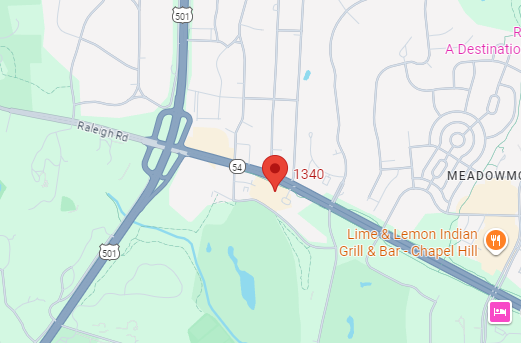
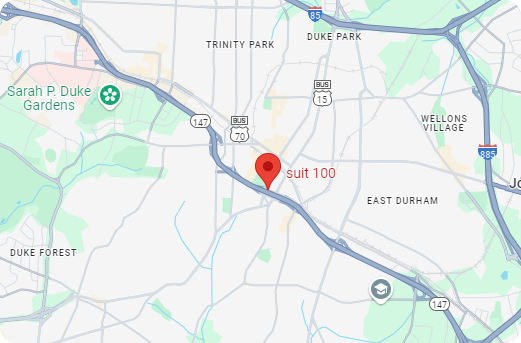
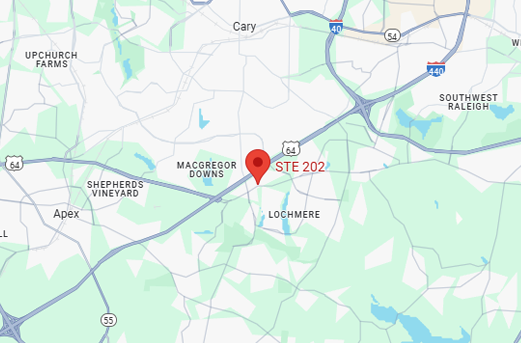
Patrick Roberts Law is a criminal defense firm based in Raleigh, North Carolina, with additional offices in Durham, Chapel Hill, and Cary. The firm and its founder, Patrick Roberts, defend people across North Carolina who are under investigation or facing charges for solicitation of a minor by computer. That includes internet-sting cases and their federal counterparts. If you are dealing with this kind of accusation, you are on the right page. These are among the most aggressively investigated offenses in the state and the country. In 2025, Internet Crimes Against Children (ICAC) task forces, a network that serves North Carolina, conducted nearly 347,000 investigations that led to more than 17,000 arrests. In the same year, the National Center for Missing & Exploited Children received about 1.4 million reports of online enticement. In practice, that enforcement volume means many of these cases are built by law enforcement from the first message forward. That changes how they have to be defended. We handle that reality directly. How We Defend Solicitation of a Minor by Computer Charges What is the state charge under G.S. 14-202.3? We represent clients charged under North Carolina's solicitation statute, G.S. 14-202.3. That statute makes it a crime for a person 16 or older to knowingly use a computer or other electronic device, with intent to commit an unlawful sex act, to entice, advise, coerce, order, or command a child under 16 who is at least five years younger in order to arrange a meeting. A first offense is a Class G felony, rising to a Class E felony for a qualifying prior conviction. The detail that surprises most people is how the statute is written. It does not require a real child. It reaches the solicitation of "a person the defendant believes to be" a child under 16. That is exactly why internet stings work as prosecutions. And it is why it is no defense that the person on the other end was an undercover detective. In State v. Fraley, the North Carolina Court of Appeals upheld a conviction where the "child" was a detective the defendant believed to be 14. The court held that the defendant's own belief controls, and that a person's words to that officer fell within the statute's broad definitions of "entice" and "advise." We build the defense around what the statute actually requires the State to prove: the intent to commit an unlawful sex act and the purpose of arranging a meeting. We do not rely on the "there was no actual minor" argument, which the law rules out. Consent is also not a defense under this statute. What happens if someone appears at the meeting? We represent clients facing the most serious version of this charge. Under G.S. 14-202.3, the charge becomes a Class D felony if the defendant, or anyone the defendant was arranging the meeting for, actually appears at the arranged meeting place. This is why sting operations are structured to end in a meet-up. North Carolina raised these penalties effective December 1, 2025 (S.L. 2025-70), moving the completed-meeting scenario up to Class D and significantly increasing the potential penalties. Appearance at the location is what triggers the enhancement. So the facts around any meeting (who proposed it, what was said, and what actually happened) are central to how we approach the case. When does this become a federal case under 18 U.S.C. § 2422(b)? We defend clients whose online cases are charged federally, most often under 18 U.S.C. § 2422(b). That statute prohibits using the internet to knowingly persuade, induce, entice, or coerce a minor into unlawful sexual activity, or attempting to do so. The federal penalties are typically more severe than the state charge. § 2422(b) carries a mandatory minimum of not less than 10 years and up to life. As with the state statute, factual impossibility is not a defense. The Fourth Circuit held in United States v. Engle that the statute targets the attempt to obtain a minor's agreement, not a completed act, and requires only a "substantial step" plus criminal intent. Its en banc rule in United States v. Hamrick confirms that an undercover officer target does not defeat an attempt charge. In North Carolina, these cases proceed in the Eastern District (E.D.N.C., which includes Wake County) or the Middle District (M.D.N.C., which includes Durham County). There is effectively no statute of limitations. The closest comparable federal offense, travel to engage in prohibited sexual conduct with a minor, carried an average sentence of 162 months, with 76% of those individuals convicted of an offense carrying a mandatory minimum in fiscal year 2025. From the outset, we take on the early decisions about how to contest the case. Where possible, that includes the forum and the elements the government must prove. Is entrapment a defense in an internet sting? We represent clients in officer-initiated online cases where entrapment is the central defense. North Carolina recognizes entrapment where law enforcement induced the offense through persuasion, trickery, or fraud and the criminal design originated with the government rather than the defendant. In State v. Keller, the North Carolina Supreme Court held that a defendant was entitled to an entrapment instruction, and that a defendant can deny criminal intent and still raise the defense. The court reached that holding where the evidence showed the person was not predisposed, had never engaged in sexual activity with an underage child, repeatedly said they would wait until the detective could give legal consent, and relented only after the undercover detective threatened to find someone else. Who first introduced the sexual subject matter, who pushed for the meeting, and whether there was any predisposition before the government made contact are the questions we examine closely. In these cases, the officers' own conduct can be central to the defense. The stakes at the resolution stage are real. In North Carolina's federal districts, the overwhelming majority of sentenced defendants were convicted by guilty plea in fiscal year 2024, about 99.2% in the Eastern District and 96.5% in the Middle District, yet sexual-abuse cases go to trial at a notably higher rate than other federal cases. Whether a case should be tried or resolved is a decision we make with each client based on the specific evidence, not a default. What to Expect When You Contact Us When you reach out to us, the first step is a confidential consultation about your situation: what has happened, what stage things are at, and what the state or federal government appears to have. Because these cases are frequently built from electronic communications, two things matter early. First, preserve evidence rather than deleting anything. Second, be careful about talking to investigators before you have a lawyer. We will walk you through where your case stands, whether it is likely to remain in state court or move to federal court, and the charges and consequences you realistically face. We will also explain the defenses available to you, including entrapment, the elements the government must actually prove, and the collateral consequences that need to be planned for from day one. From there, the firm builds a defense strategy specific to your facts. Strategic Defense Against Complex Internet Solicitation Allegations When facing serious allegations involving the solicitation of a minor by computer, securing experienced legal counsel is critical, as these cases often involve complex digital forensic evidence and high-stakes federal and state investigation protocols. Attorney Patrick Roberts offers a focused defense practice with  expertise in navigating the intersection of technology and criminal law. A former prosecutor with over two decades of courtroom experience, Mr. Roberts has dedicated his career to the rigorous defense of complex sex offense cases, including those originating from Internet Crimes Against Children (ICAC) task force investigations. His approach involves a meticulous audit of government-acquired digital data, challenging the prosecution's evidentiary burden, and providing strategic litigation for clients facing both state and federal charges. Nationally recognized for his work—including an AV Preeminent rating from Martindale-Hubbell and a consistent track record of high-level trial advocacy—Mr. Roberts provides the dedicated and sophisticated representation necessary when defending against sensitive and life-altering accusations. • AV Preeminent Rating: Consistently awarded this peer-nominated credential for professional excellence by Martindale-Hubbell for eight consecutive years (2018–2026). • National Association of Distinguished Counsel: Repeatedly selected for inclusion in the "Nation's Top 1 Percent" of attorneys, a recognition held for multiple years including 2025 and 2026. • Duke Law Education: Earned a Juris Doctor (J.D.) from Duke University School of Law, providing a foundational background for complex criminal litigation and procedural strategy. • Former Prosecutor Perspective: Leveraging four years of experience as an Assistant District Attorney across three North Carolina districts—including specialized service as a juvenile sex crimes prosecutor—to anticipate government litigation tactics. • Digital Forensic Training: Completed the "Defending Digital Sex Crimes Bootcamp" (2026) and maintains ongoing expertise in auditing government digital evidence utilized in Internet Crimes Against Children (ICAC) investigations. • Published Author: Co-authored *Strategies for Defending Internet Pornography Cases*, a professional text detailing the analysis of electronic documents and the utilization of expert witnesses in technology-based prosecutions. Client Review...Their actions and handling of my case have not only helped to restore my faith in the legal system but in myself. Too often we underestimate the power of a smile, a kind word, a listening ear or an honest act of caring, all of which have the potential to help turn a life around. My thanks to A. Patrick Roberts. — Review by a verified client via Avvo Peer Endorsement Patrick is a thoughtful and experienced attorney. When I have a client needing representation in the Raleigh area in his areas of practice, he would be my referral of choice. — Peer endorsement by a fellow North Carolina trial attorney via Avvo Disclaimer: The client reviews and peer endorsements displayed are authentic testimonials and comments provided by clients and fellow attorneys. Every case is unique and must be evaluated individually; past client experiences and case results do not guarantee, promise, or predict similar outcomes in any future matter. Case Results Taking the time to examine what a lawyer has successfully done for others helps ensure your case is in capable hands. Here is a look at real case results handled by Attorney Patrick Roberts: • Investigation Into Child Sexual Abuse Material: The client faced charges involving the downloading of child sexual abuse material based on IP address tracking. After law enforcement executed a search warrant and obtained a confession, Mr. Roberts presented mitigating evidence to the District Attorney's office, resulting in a probationary resolution. ○ Outcome: Probation with permission to transfer supervision to the client's new state of residency. • Exploitation of a Minor Allegations: An individual was charged with two counts of second-degree exploitation of a minor related to online communications. Attorney Patrick Roberts provided psychological evaluations to the prosecution, successfully negotiating a resolution that avoided prison time, felony convictions, and sex offender registration. ○ Outcome: Pleaded to two misdemeanors with probation, avoiding prison, a felony conviction, and sex offender registration. • Online Child Exploitation Charges: The client faced two counts of second-degree exploitation of a minor involving online photo exchanges and communication. By presenting the client's psychological history and expert evaluations to prosecutors, Mr. Roberts secured a plea agreement that avoided incarceration and sex offender registry requirements. ○ Outcome: Pleaded to two non-sex offense misdemeanors with probation, successfully* avoiding prison, felony convictions, and sex offender registration. *Disclaimer: Case outcomes depend upon a variety of factors unique to each case. Prior results do not guarantee or predict a similar outcome in any future legal matter. Protecting Your Rights in Complex Criminal Matters Charges involving the solicitation of a minor are among the most serious allegations an individual can face, carrying life-altering consequences at both the state and federal levels. If you are under investigation or facing charges, early legal intervention is critical to mounting an effective defense against allegations involving complex intent and electronic evidence. Patrick Roberts Law offers the focused, authoritative counsel required to navigate the nuances of these cases and aggressively challenge the prosecution’s burden of proof. Based in Wake County, we provide experienced representation for clients in Raleigh, Cary, Apex, Holly Springs, Garner, and Fuquay-Varina, while managing complex criminal matters in jurisdictions throughout North Carolina. If you require legal guidance or representation, contact the law firm at www.patrickroberts.law to schedule a confidential consultation. Use the law firm’s Sex Offense Search Tool to check North Carolina felony classifications, potential prison sentences, and sex offender registration requirements. Learn how criminal defense attorney Patrick Roberts approaches handling these charges. We limit the volume of active cases to ensure that our staff can provide consistent, comprehensive attention to every matter we handle. Disclaimer: This article is general legal information, not legal advice. Reading it does not create an attorney-client relationship. North Carolina expunction law is almost entirely statutory and subject to legislative change, and how these rules apply depends on the specific facts of your case. For guidance on your situation, consult a licensed North Carolina attorney.

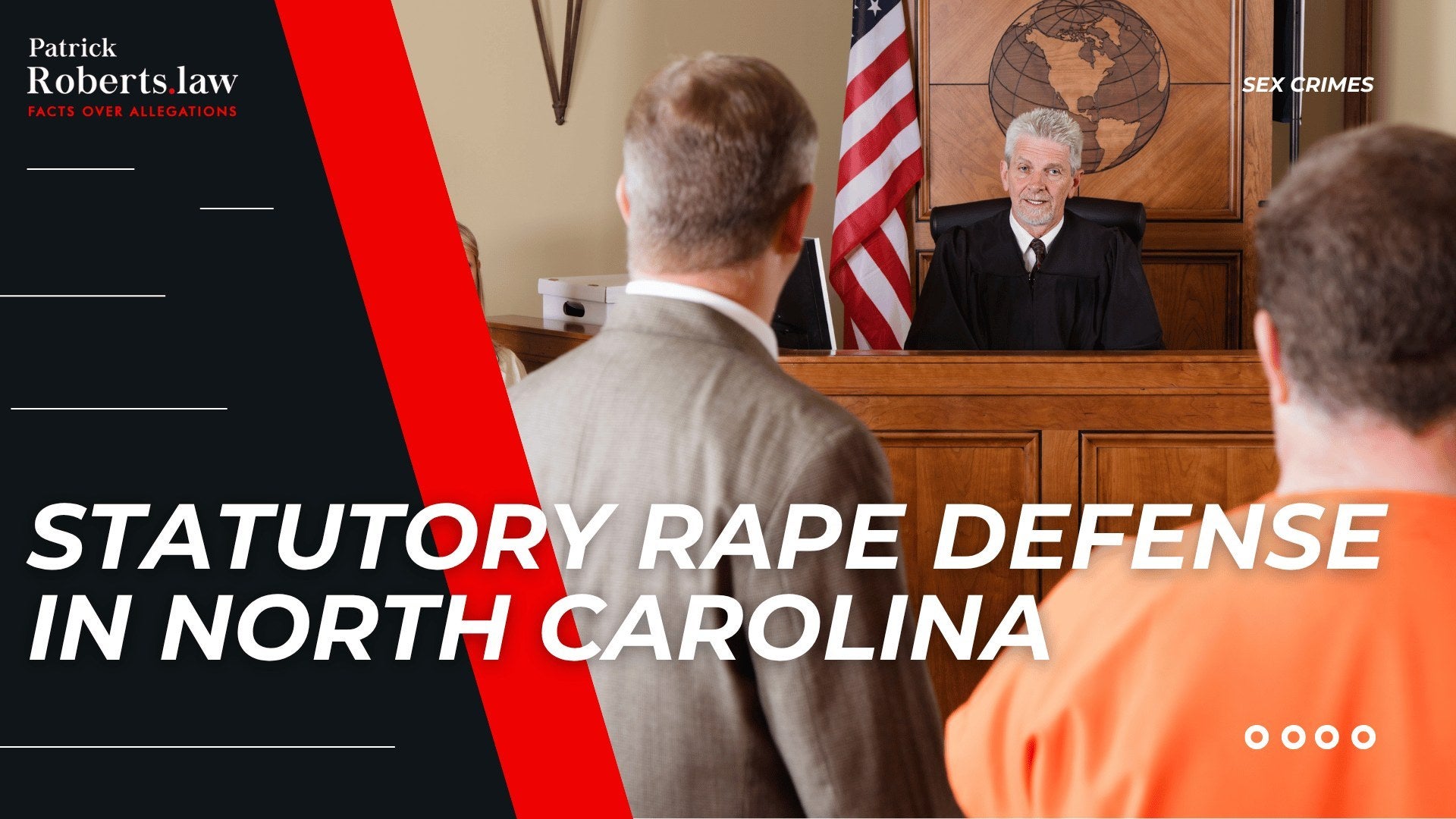
Judge at the bench facing a man in a suit and a defendant in an orange jumpsuit, with the words “Statutory Rape Defense in North Carolina.”

Statutory Rape Defense in North Carolina

Patrick Roberts Law is a criminal defense firm based in Raleigh, North Carolina, with additional offices in Durham, Chapel Hill, and Cary. The firm defends people accused of statutory rape and related sex offenses across North Carolina, in the state courts of Wake, Durham, and surrounding counties, and in federal court. If you are trying to understand a statutory rape charge, an investigation, or what an accusation like this could mean, you are on the page for it. Attorney Patrick Roberts handles these cases personally. Under North Carolina law, whether the other person agreed, and whether you believed they were older than they were, are not defenses. That single fact changes where a real defense has to be built, and it is why the choice of attorney matters so much. What follows explains the specific charges we defend, what each one carries, and how we approach them. Types of North Carolina Statutory Rape Charges We Defend North Carolina does not have one statutory rape law. It has a set of them, sorted by the age of the child, the age of the person accused, and the gap between the two. The differences are not technicalities. They decide whether a case carries a 25-year mandatory prison term or runs through the ordinary sentencing grid. They are often the ground on which a case is won or narrowed. We defend the full range. Statutory rape of a child by an adult We represent adults charged under G.S. 14-27.23 (statutory rape of a child by an adult) and its companion, G.S. 14-27.28 (statutory sexual offense with a child by an adult). These apply when the person accused is 18 or older and the child is under 13. Both are Class B1 felonies, the class North Carolina uses for its most serious statutory sexual offenses. Both carry a mandatory minimum of 300 months, or 25 years, of active imprisonment. On written findings that the offense was of unusual brutality or scope, they also carry a possible sentence of life without parole. Neither the child's consent nor a mistaken belief about the child's age is a defense. As to age, the crime is strict liability, a rule the North Carolina Supreme Court confirmed in State v. Anthony. Because the law removes the arguments a person would expect to make, we concentrate the defense on what the State must still prove beyond a reasonable doubt: identity, whether the act occurred at all, the actual ages of the people involved, and the reliability of a child's account. And where the accused is not in fact 18, or the child is not in fact under 13, we work to keep the case off the 300-month track entirely. These are rare and serious cases. Across all offense types, only 431 Class B1 felony convictions were entered statewide in fiscal year 2024, about 1.6% of every felony conviction in North Carolina. First-degree statutory rape For a younger person accused, we represent clients charged under G.S. 14-27.24 (first-degree statutory rape) and G.S. 14-27.29 (first-degree statutory sexual offense). These apply when the child is under 13 and the person accused is at least 12 years old and at least four years older than the child, but is not yet 18. They are also Class B1 felonies, but unlike the adult offenses above they do not carry the 300-month floor. Instead, they are sentenced through North Carolina's ordinary structured-sentencing grid, where a Class B1 offense carries a presumptive minimum in the range of 192 to 240 months at the lowest prior-record level and rises from there. Consent and mistake of age are still not defenses. Here the arithmetic of ages is frequently the whole case. The four-year gap is a required element, so a three-year gap does not fit the statute. And establishing that the person accused was under 18 moves the exposure off the adult mandatory minimum. We treat birth dates, the exact date of any alleged act, and the age difference as facts to be proven, not assumed, because they can decide the class of felony or defeat the charge. Statutory rape of a person 15 years of age or younger We defend charges under G.S. 14-27.25 and G.S. 14-27.30, which cover a child who is 15 or younger in cases that do not fall under the "under 13" statutes. Which felony applies depends entirely on the age gap. A person at least six years older than the child faces a Class B1 felony. A person more than four but fewer than six years older faces a Class C felony. North Carolina also recognizes a specific exception where the two people are lawfully married. As with the other tiers, this is a strict-liability offense as to age, confirmed in State v. Browning. Consent and a good-faith belief about age are off the table. That makes the precise age difference and any marriage between the parties the highest-leverage facts in the case. Narrowing the gap below six years drops a Class B1 down to a Class C. A gap under four years defeats the charge. We build the defense around exactly those facts. Why Trial Preparation Matters in Sex Offense Cases Federal sex-offense cases go to trial far more often than the average federal case: about 10.8% of people sentenced for federal sexual abuse were convicted at trial, compared with 2.7% of all other federal defendants. So having an attorney who is prepared to try a case, not just resolve one, is not a small thing. Our approach is calm, direct, and strategic, with meticulous preparation and aggressive trial advocacy. What to Expect When You Contact the Firm The first step is a confidential consultation with us. In it, the firm learns what has happened so far, whether there has been contact from a detective, an arrest, a charge, or only questions. It then explains, in plain terms, which statute is likely in play, what it carries, and what the realistic paths forward look like for your situation. One of the most important early points the firm can make is this: if law enforcement has reached out to you, you are not required to talk with investigators. What feels like an innocent explanation can become the core of the State's case. Getting advice before that conversation happens is often the single most valuable thing you can do. From there, we work through the evidence early: the accuser's account, digital records, dates of birth, and the exact ages and timeline. In statutory rape cases, those details drive both the class of felony and whether a charge holds up at all. These cases also take time to move through the courts. In North Carolina's superior courts, the median felony case took about 366 days from filing to disposition. In the federal Eastern District of North Carolina, the median time from filing to disposition was about 12.4 months. The firm keeps you informed at each stage. It prepares every case as though it may be tried, so that any resolution is reached from a position of strength rather than pressure. Experienced Representation for Serious Sex Offense Charges When navigating the severe legal consequences of statutory rape charges in North Carolina, retaining legal counsel with specific expertise in sex crime litigation is critical. Attorney Patrick Roberts brings over two decades of comprehensive legal experience to the defense of these high-stakes matters. Having served as both a former Assistant District Attorney and a dedicated defense advocate, Mr. Roberts possesses a dual-perspective understanding of how the state builds its cases—knowledge he now leverages to deconstruct evidence, scrutinize complex age and timeline factors, and challenge the reliability of prosecution claims. With a career spanning more than 250 felony sex crime cases and more than 75 jury trials, Mr. Roberts provides a rigorous, data-driven approach to defense, ensuring that every client’s constitutional rights are protected against the complexities of North Carolina’s strict-liability sentencing statutes. • Martindale-Hubbell AV Preeminent Rating: Maintains the highest peer-reviewed ranking for ethical standards and professional ability for eight consecutive years (2018–2026). • Lifetime Membership in NACDL: Holds a lifetime status within the National Association of Criminal Defense Lawyers, reflecting long-term professional commitment to criminal justice. • National Trial Advocacy Training: Completed the Trial Practice Institute at the National Criminal Defense College and the intensive three-week residential program at Gerry Spence's Trial Lawyers College. • Former Prosecutor Perspective: Possesses four years of direct experience serving as an Assistant District Attorney handling juvenile sex crimes and felony dockets, providing critical insight into state-level evidentiary strategies. • Digital Forensics Training: Holds recent certification from the 2026 Defending Digital Sex Crimes Bootcamp, focusing on the defense of cases involving complex electronic and digital evidence. • Expertise in Sex Offense Litigation: Advanced training in "Zealous Advocacy in Sexual Assault and Child Victim Cases" through the National Association of Criminal Defense Lawyers and membership in the National Child Abuse Defense & Resource Center. Client Review Mr. Roberts was amazing! Had a very difficult case & the outcome didn’t look bright at all. I was looking at some serious time. But he was able to get me probation (which wasn’t on the table at all before he got involved) He was honest, to the point & laid out everything that could be a possibility. Never gave false hope, just the facts & logically what we could do to possibly get this in my favor. I would recommend Mr. Roberts to anyone seeking REAL guidance, honest & qualifications to back it up. — Review by a verified client via Avvo Peer Endorsement I have known Patrick for years and have always been struck by his knowledge and dedication. I endorse him without hesitation or qualification. — Peer endorsement by a fellow North Carolina trial attorney via Avvo Disclaimer: The client reviews and peer endorsements displayed are authentic testimonials and comments provided by clients and fellow attorneys. Every case is unique and must be evaluated individually; past client experiences and case results do not guarantee, promise, or predict similar outcomes in any future matter. Case Results A prospective client should always know the kind of work and outcomes an attorney has achieved in similar situations. Here is a look at real case results handled by Attorney Patrick Roberts: • Statutory Sex Offense Allegations: Defense counsel utilized expert analysis, including polygraph testing and forensic child psychology reports, to challenge allegations made against the client. These efforts successfully convinced the Assistant District Attorney to drop the charges. ○ Outcome: Dismissal • First-Degree Statutory Sexual Offense Investigation: Defense counsel conducted an investigation that uncovered the accuser's history of mental instability and prior false allegations, along with contradictory medical evidence. Consequently, the government declined to prosecute the client. ○ Outcome: No Charges Filed • Child Pornography and Statutory Sex Offense Allegations: Following allegations from a family member and subsequent investigation by social services, a thorough defense inquiry established that the accusations lacked any factual basis. As a result, the state chose not to initiate formal charges. ○ Outcome: No Charges Filed • Multiple Statutory Sexual Offense and Indecent Liberties Charges: Although the client had made prior statements to counselors, Mr. Roberts was able to negotiate a plea agreement to avoid a potential life sentence. The four most serious felony charges were dismissed, and the client pleaded to a lesser charge of indecent liberties, receiving a prison sentence of 32 to 40 months followed by probation. ○ Outcome: Dismissal of all four life-qualifying Class B1 felonies; client pleaded to Indecent Liberties with a Child and received 32–40 months in prison followed by probation. Disclaimer: Case outcomes depend upon a variety of factors unique to each case. Prior results do not guarantee or predict a similar outcome in any future legal matter. Strategic Legal Defense for Statutory Rape Charges Statutory rape charges in North Carolina carry severe, strict-liability consequences where traditional defenses often fail. Because these cases hinge on precise factual details regarding age and timelines, immediate and experienced legal intervention is critical. If you or a loved one are under investigation, do not speak with law enforcement; instead, secure counsel who understands the complexities of state sentencing guidelines and statutory requirements. Patrick Roberts Law PLLC provides experienced defense for high-stakes matters throughout North Carolina, with a dedicated focus on serving clients across Wake County, including Raleigh, Cary, Apex, Holly Springs, Garner, and Fuquay-Varina. To discuss your specific situation and evaluate your defense options, please contact our firm at www.patrickroberts.law. Access our Sex Offense Search Tool to look up North Carolina laws, felony levels, sentencing guidelines, and mandatory registration rules. Find out how NC defense lawyer Patrick Roberts can assist with your case. The firm maintains a selective caseload to protect the integrity of its defense strategies and the thoroughness of its trial preparation. Disclaimer: This article is general legal information, not legal advice. Reading it does not create an attorney-client relationship. North Carolina expunction law is almost entirely statutory and subject to legislative change, and how these rules apply depends on the specific facts of your case. For guidance on your situation, consult a licensed North Carolina attorney.