

Domestic violence charges can be dropped in North Carolina, but not the way most people expect. The person who files the complaint — the alleged victim — does not have the power to make the charges go away. Once the State brings charges, the decision to dismiss, reduce, or prosecute belongs to the district attorney’s office. That decision turns on the strength of the evidence, not on whether the other party wants to move forward.
That distinction is the most important thing to understand about this process. It reshapes everything else: what your realistic options are, what a defense attorney can actually do for you, and why the steps you take in the first days after an arrest matter more than most people realize.
North Carolina does not have a single statute called “domestic violence.” Instead, the State prosecutes conduct between people in qualifying personal relationships through a set of general assault statutes. The most commonly charged offense in domestic violence cases is assault on a female by a male eighteen or older under N.C. Gen. Stat. § 14-33(c)(2), a Class A1 misdemeanor. More serious allegations can lead to felony charges like assault by strangulation under § 14-32.4(b), a Class H felony with a deliberately low injury threshold. As of December 1, 2023, North Carolina also has a dedicated misdemeanor crime of domestic violence under § 14-32.5, a Class A1 offense written to track the federal definition. The specific charge you are facing shapes what “dropped” realistically looks like — outright dismissal, reduction to a lesser offense, or a negotiated resolution that avoids the worst consequences.
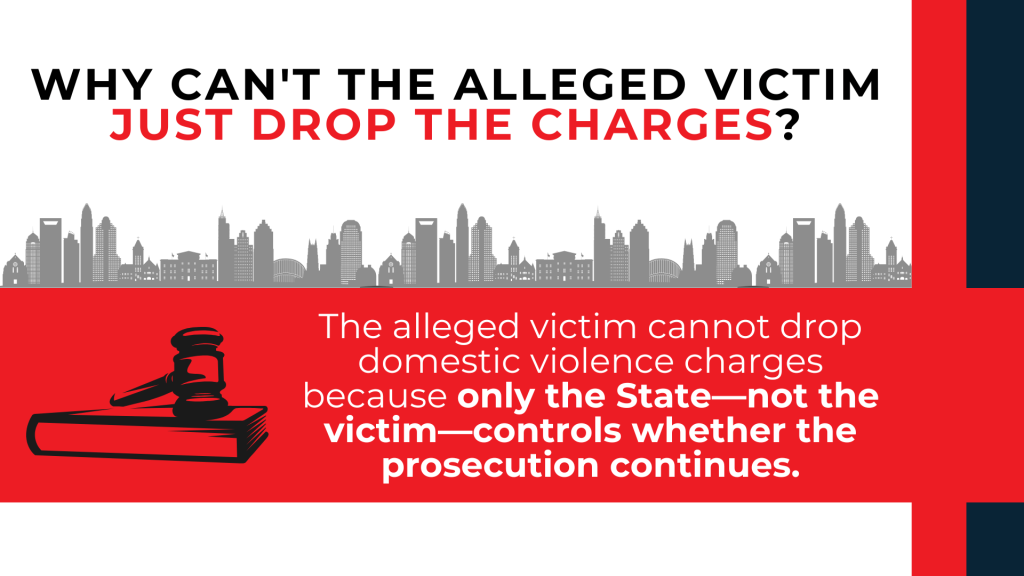
Why Can’t the Alleged Victim Just Drop the Charges?
This is the question behind the question for most people searching this topic. The short answer is that the alleged victim never owned the charges to begin with.
In North Carolina’s criminal justice system, a domestic violence case is formally titled the State of North Carolina versus the defendant — not the complainant versus the defendant. When law enforcement responds to a domestic call, officers make their own observations, collect evidence, and often make an arrest based on what they see at the scene. Once the case is in the hands of the district attorney, it belongs to the State. The alleged victim is a witness, not a party who controls the case.
The alleged victim may contact the DA’s office and ask for the charges to be dismissed. They may recant their original statement, say the situation was exaggerated, or explain that the two of them have reconciled. None of that requires the prosecutor to dismiss the charges. Many prosecutors will note the victim’s wishes and factor them into their decision. But they are not required to follow them, and they are aware that victims in domestic violence cases may recant for a variety of reasons.
The State can and sometimes does proceed with a case even when the alleged victim is uncooperative, relying on other evidence gathered during the investigation to build its case. Understanding this reality is the first step toward building an actual strategy rather than waiting for the case to resolve itself.
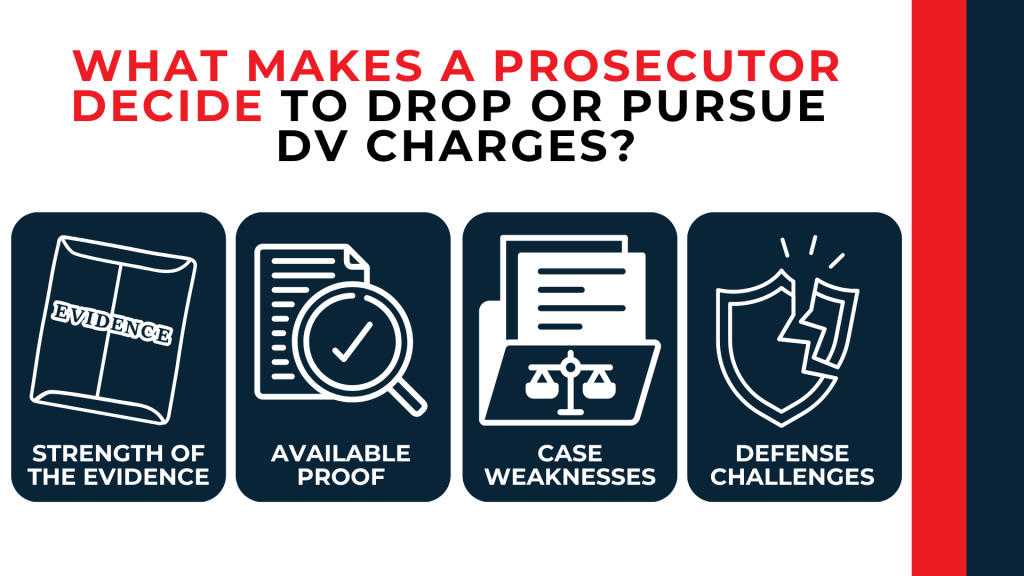
What Makes a Prosecutor Decide to Drop or Pursue Domestic Violence Charges?
If the alleged victim’s wishes don’t control the outcome, the next question is what does. Prosecutors evaluate domestic violence cases the same way they evaluate any criminal case — by asking whether they can prove each element of the offense beyond a reasonable doubt.
The factors that typically matter include the strength of the physical evidence, the consistency and availability of witness testimony, whether the incident was captured on any recording, your criminal history, and the seriousness of the alleged conduct. A case with limited supporting evidence and an alleged victim who is no longer cooperating presents different challenges for the State than one supported by extensive independent evidence. Prosecutors may be more willing to dismiss or reduce charges when the evidence raises genuine doubt about whether they can prove the case beyond a reasonable doubt.
This is where the work of a defense attorney matters most. The question is not whether the alleged victim wants to drop the case. The question is whether the State’s evidence is strong enough to prove the case — and whether a skilled attorney can expose the weaknesses in that evidence before it ever reaches a courtroom.
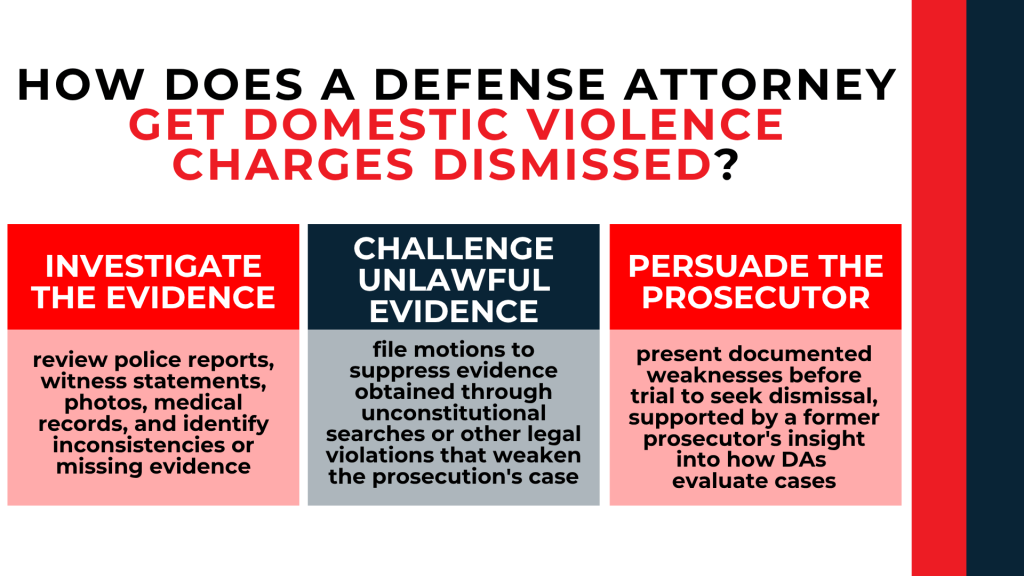
How Does a Defense Attorney Get Domestic Violence Charges Dismissed?
A dismissal does not happen by accident, and it rarely happens because you simply show up to court and hope for the best. Getting domestic violence charges dismissed in North Carolina requires a defense attorney to build a case for dismissal. That case must give the prosecutor a reason to conclude that taking it to trial is not worth the risk.
That process starts with an independent investigation of the facts. What the police report says happened and what actually happened are not always the same thing. A defense attorney reviews the officer’s report, any recorded statements, photographs, and medical records, and interviews witnesses the State may not have spoken to. The goal is to identify what the State’s case is missing and what it gets wrong.
Constitutional challenges are another avenue. If evidence was obtained through a search that violated your Fourth Amendment rights, it could be thrown out of the case. In State v. Elder, 368 N.C. 70 (2015), the North Carolina Supreme Court held that officers serving a DVPO could not search a residence, person, or vehicle for firearms based solely on the protective order’s terms. Other problems in how evidence was gathered can create similar issues for the State’s case.
In many situations, the most effective path to dismissal is presenting the results of this investigation directly to the prosecutor before trial. When a defense attorney can demonstrate specific, documented weaknesses in the State’s case, prosecutors will sometimes agree to dismiss rather than risk losing at trial. Those weaknesses might include a recanting witness with no supporting physical evidence, an inconsistent timeline, or evidence in your favor that the State did not have.
This is an area where Patrick Roberts’s background as a former assistant district attorney in Wake, Johnston, and New Hanover counties gives his clients an informed perspective. He spent years on the other side of the courtroom — building DV cases, evaluating witness credibility, and deciding which cases to take to trial. That experience gives him a firsthand understanding of the decision-making prosecutors use when deciding whether a case is worth pursuing. That perspective informs every conversation with a DA’s office about why a particular case should not move forward.
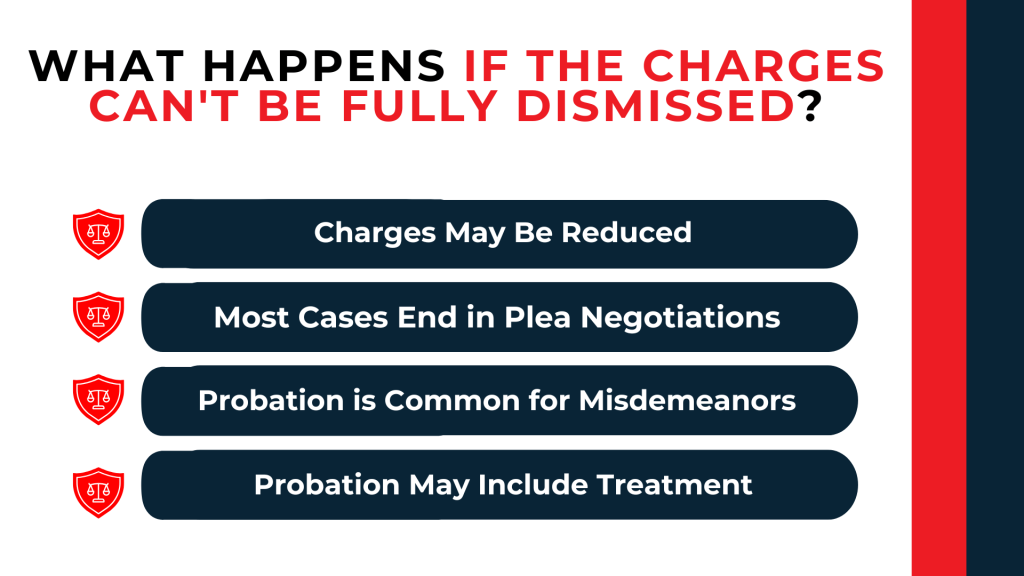
What Happens If the Charges Can’t Be Fully Dismissed?
Not every domestic violence case ends in a full dismissal, and anyone telling you otherwise is not being honest. But “not dismissed” does not mean “worst-case scenario.” Between outright dismissal and a conviction at trial, there is a wide range of negotiated outcomes. The difference between a good one and a devastating one often comes down to the quality of your defense.
Charge reductions are one of the most common resolutions. A felony assault by strangulation charge under § 14-32.4(b) may be reduced to a misdemeanor assault. A Class A1 misdemeanor like assault on a female may be resolved through a plea to a lesser offense that carries fewer collateral consequences. The specific charge on your record matters enormously — not just for sentencing, but for everything that follows.
In North Carolina, the vast majority of criminal cases are resolved through negotiation rather than trial. According to the NC Sentencing and Policy Advisory Commission’s FY2024 report, only 498 out of 26,577 felony convictions — roughly two percent — resulted from jury trials. For Class H felonies like assault by strangulation, the jury trial rate drops to approximately one percent. This does not mean the system is broken. It means that plea negotiation is where most outcomes are determined. Your attorney’s ability to negotiate effectively is one of the most important factors in your case.
For misdemeanor DV offenses, the sentencing data provides additional context. In FY2024, 68 percent of misdemeanor sentences resulted in community punishment — meaning probation rather than active jail time. The average active sentence for a Class A1 misdemeanor, the class that covers assault on a female and DVPO violations, was 66 days. These numbers mean that even where a conviction occurs, the outcome often involves probation, court-ordered treatment, and conditions of supervision rather than extended jail time — particularly if you have no prior record.
If you are found responsible for acts of domestic violence, North Carolina law requires you to attend an approved abuser-treatment program as a condition of probation under § 15A-1343(b)(12), unless the court finds it is not in the interests of justice. These programs require 39 hours of group treatment completed over 26 to 30 weeks. Your good-faith inability to pay for a required program cannot be treated as a willful probation violation, a protection established in State v. Floyd, 213 N.C. App. 611 (2011).
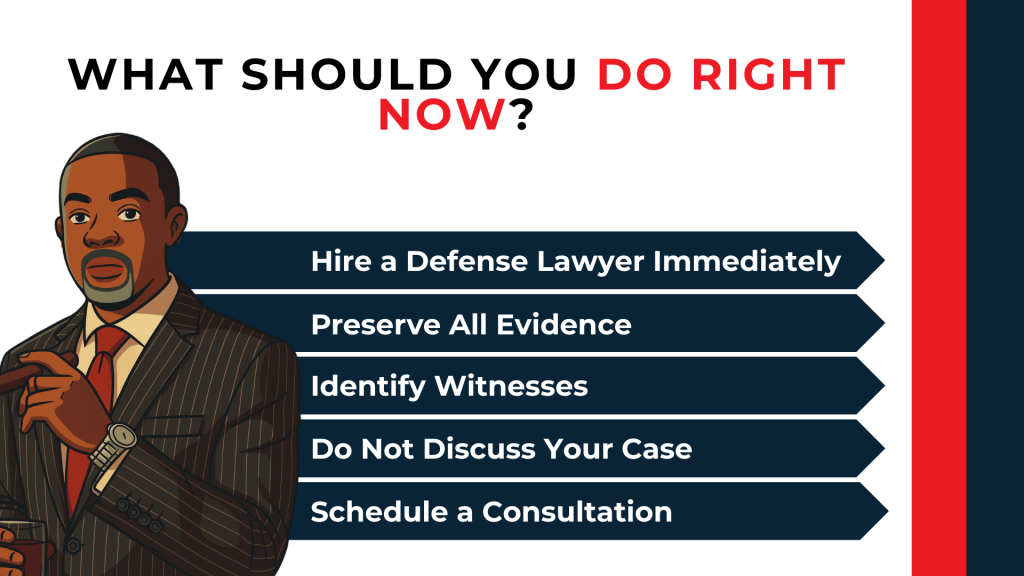
What Should You Do Right Now?
The earlier a defense attorney gets involved in a domestic violence case, the more options are available. Evidence can be preserved or lost. Witnesses’ memories fade. The prosecutor’s evaluation of the case hardens over time. The window to present a compelling reason for dismissal or reduction is widest at the beginning.
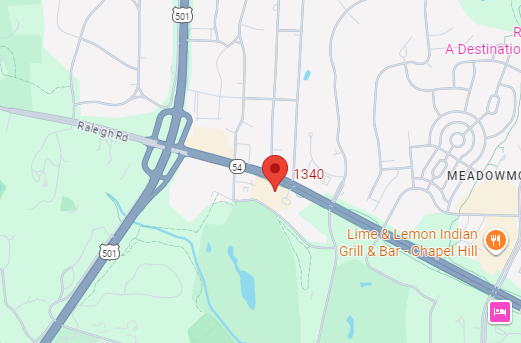
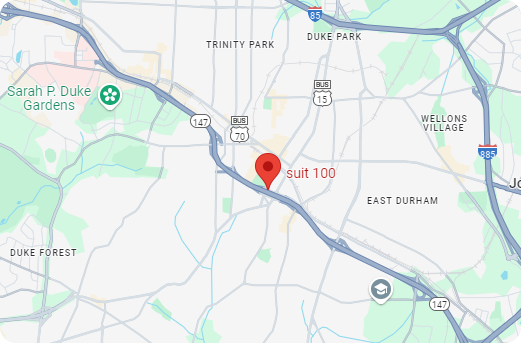
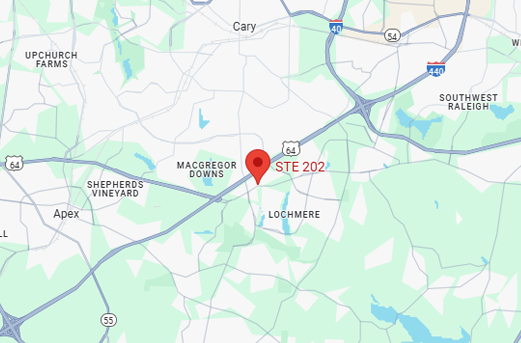
Patrick Roberts is a North Carolina criminal defense attorney and former assistant district attorney who has handled thousands of criminal cases across the state. He is a graduate of Gerry Spence’s Trial Lawyers College and the National Criminal Defense College Trial Practice Institute, rated AV Preeminent by Martindale-Hubbell, and named among the Top 100 Trial Lawyers by The National Trial Lawyers. His offices in Raleigh, Durham, Chapel Hill, and Cary serve clients throughout the Triangle and surrounding counties. His legal practice spans all North Carolina counties for high-stakes litigation, with a concentrated defense practice in Wake County—including Raleigh, Cary, Apex, Holly Springs, Garner, and Fuquay-Varina.
Client Review
“I recently hired A. Patrick Roberts as my lawyer, and I couldn’t be more pleased with the outcome of my case. He represented me in a domestic violence accusation, and thanks to his exceptional skills, my case was dismissed. From our first meeting, Patrick impressed me with his thorough understanding of the law and his strategic approach to my case. He not only provided clear and practical legal advice but also employed smart strategies that were beyond my expectations. His attention to detail and dedication to my defense made all the difference. If you’re looking for a lawyer who truly cares about his clients and knows how to navigate complex legal situations, I highly recommend A. Patrick Roberts. He is an outstanding lawyer, and I am incredibly grateful for his support.”-Verified client review via Avvo.com
Peer Endorsement
“I endorse this lawyer’s work. I have known A. Patrick Roberts for 5 years. He has always been very professional and very highly regarded in the criminal defense community. I have gotten to know Patrick over the years and come to highly respect him as a friend and an attorney.”-Verified peer endorsement via Avvo.com
Disclaimer: Testimonials and peer reviews are actual comments from clients and peers. They are for informational purposes only and do not guarantee or predict the outcome of your legal matter. Every case is unique and must be evaluated on its own merits.
If you or someone close to you is facing domestic violence charges in North Carolina, contact Patrick Roberts Law to discuss your case.
The firm manages a restricted caseload to maintain a high standard of service and thorough oversight for each client.
Disclaimer: The information on this website is for general informational purposes only. Nothing herein should be taken as legal advice for any individual case or situation. Contacting us via this website, email, or contact form does not create an attorney-client relationship. Case results depend on a variety of factors unique to each case; prior results do not guarantee a similar outcome.
Former assistant district attorney
Contact Patrick Roberts
Facing criminal charges in North Carolina demands seasoned representation. Trust in the experience and dual perspective of Patrick Roberts. Reach out today for a confidential consultation.
-
Call Our Team
Calls answered 24/7








For more information on the selection criteria, go to www.martindale.com
*Each case is different and must be evaluated separately. Prior results achieved do not guarantee similar results can be achieved in future cases.