
Child enticement, under North Carolina law, refers to using a computer or electronic device to solicit a minor — or someone believed to be a minor — to commit an unlawful sex act. The charge is set out in N.C.G.S. § 14-202.3, and it carries consequences that most people do not fully understand until they or someone they care about is facing them.
The legal definition is far broader than the everyday meaning of the word “enticement” suggests. The gap between what people assume and what the statute actually criminalizes is where serious mistakes happen.
This article breaks down exactly what the charge means in North Carolina, what prosecutors must prove, how law enforcement sting operations factor in, and what defenses may apply.
What Elements Must the State Prove for a Child Enticement Conviction?
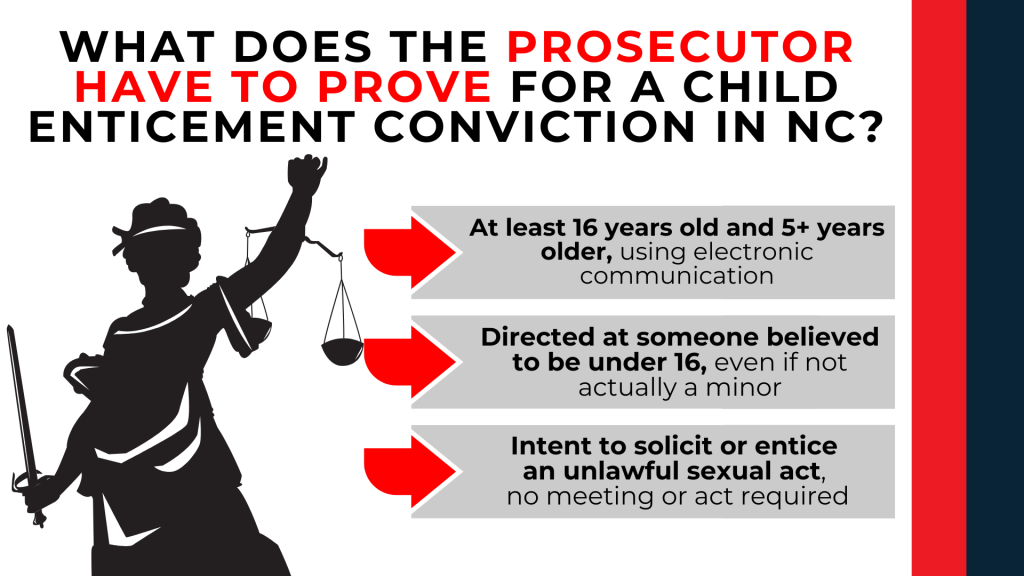
To secure a conviction under N.C.G.S. § 14-202.3, the prosecution must establish four specific elements beyond a reasonable doubt. Failure to prove any single component typically necessitates a dismissal of the charges:
- Age Requirement: The defendant must be at least 16 years old and at least five years older than the individual they are alleged to have contacted.
- Use of Technology: The defendant must have utilized a computer or a specific electronic device (such as a phone, tablet, or gaming console) to facilitate the communication.
- Subjective Belief: The communication must have been directed at a person the defendant believed to be under the age of 16.
- Specific Intent: The purpose of the message must be to solicit, entice, advise, coerce, order, or command that person to engage in an unlawful sex act.
Does the Statute Require the Involvement of an Actual Minor?
No. A critical aspect of N.C.G.S. § 14-202.3 is that it focuses on the defendant’s intent and belief rather than the actual identity of the recipient. The law applies if the defendant believes the person is underage, which allows for prosecution in cases involving undercover law enforcement officers or “decoy” operations.
Is a Physical Meeting Necessary for a Conviction?
A physical meeting or a completed sexual act is not required for a conviction. Under North Carolina law, the offense is considered legally “complete” at the moment of solicitation. The prosecution does not need to show that the defendant was close to meeting the individual or that their efforts were successful.
How Have North Carolina Courts Interpreted “Enticement”?
Judicial precedent, specifically State v. Fraley, 202 N.C. App. 457 (2010), establishes a broad interpretation of what constitutes enticement. The North Carolina Court of Appeals ruled that any digital effort to arrange a sexual encounter with someone believed to be a minor falls under the scope of the statute. This broad reading means the legal line between casual online conversation and criminal conduct is defined by the underlying intent to solicit an unlawful act.
Which Agencies Investigate Child Enticement in North Carolina?
These cases are frequently the result of coordinated state and federal efforts. The primary investigative body is the North Carolina Internet Crimes Against Children (ICAC) Task Force.
- Coordination: Managed by the NC SBI Computer Crimes Unit.
- Scope: Includes over 200 law enforcement agencies.
- Resources: Employs 17 full-time SBI special agents across eight field districts who specialize in forensic digital investigations.
Legal Standards Summary Table
| Element | Requirement under N.C.G.S. § 14-202.3 |
| Defendant Age | 16+ years old |
| Age Gap | 5+ years older than the alleged victim |
| Medium | Computer or electronic device |
| Intent | Solicitation of an unlawful sex act |
| Evidence | Does not require an actual minor or physical meeting |
Can I Be Charged If I Was Talking to an Undercover Officer, Not a Real Child?
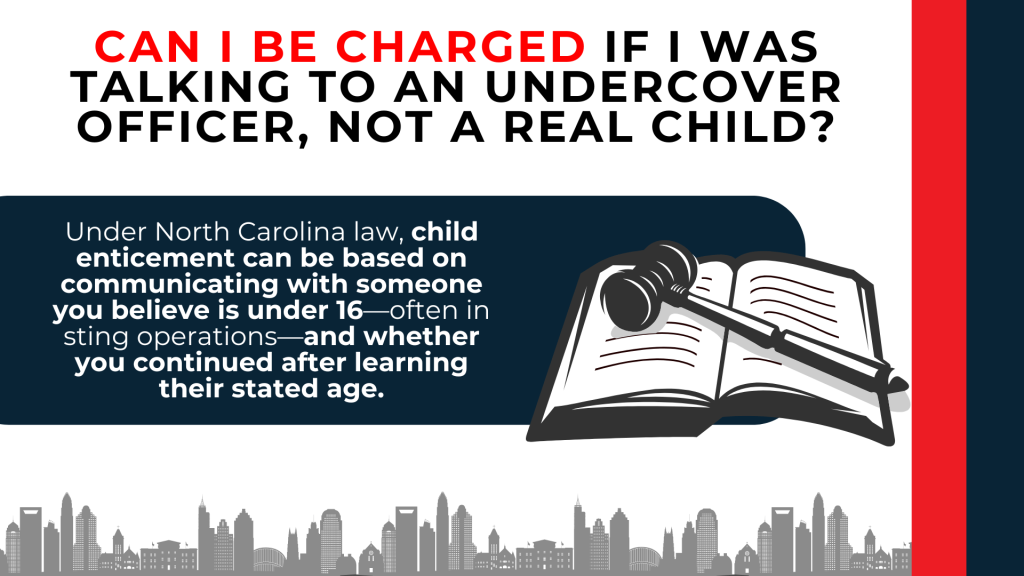
Yes. This is the single most important thing to understand about how child enticement cases are built in North Carolina.
The statute does not require that an actual child be on the other end of the conversation. N.C.G.S. § 14-202.3 applies to communications with any person you “believe to be” underage. Law enforcement sting operations — in which an officer poses as a minor online — are the primary investigative method for these cases. North Carolina courts have consistently upheld them.
Many people who find themselves charged genuinely believed they were speaking with an adult or felt uncertain about what was happening in a conversation. Others were pulled into conversations they did not initiate. Regardless of how reasonable those explanations may feel, the legal question is narrow: did you believe — at the time of the solicitation — that the person was under 16? If chat logs, text messages, or other electronic evidence show you were told the person’s supposed age and you continued the conversation toward a sexual purpose, prosecutors will argue that element is met.
In State v. Keller, 265 N.C. App. 526, 828 S.E.2d 578 (N.C. App. 2019), the Court of Appeals examined this exact issue. The court found that the defendant’s continued engagement after learning the supposed “child’s” age showed predisposition, which weakened an entrapment defense. The ruling illustrates how courts evaluate what a defendant knew and when they knew it. It also shows why the content and sequence of electronic communications become the central evidence in nearly every enticement prosecution.
How Can You Challenge a Child Enticement Charge in North Carolina?
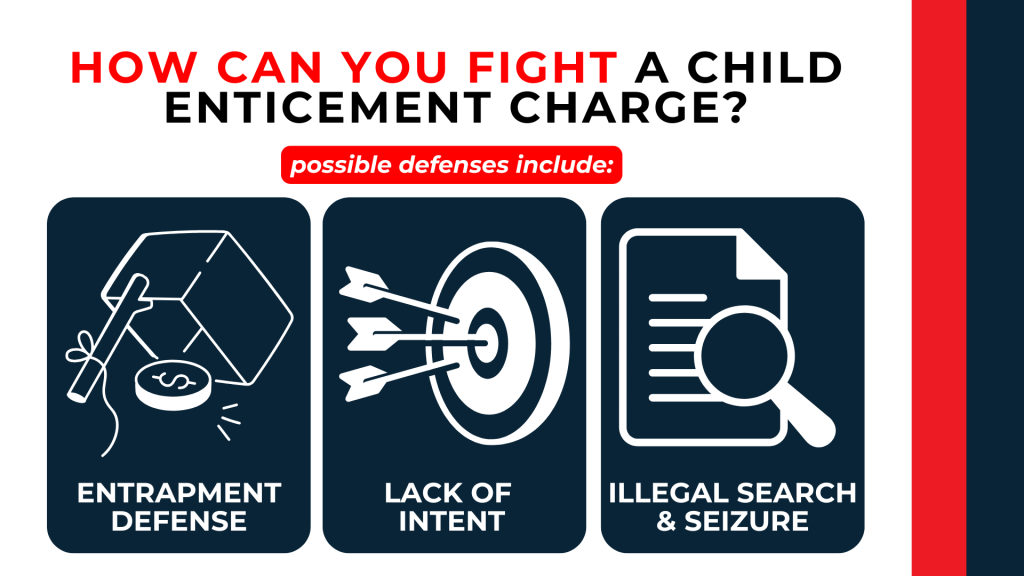
A charge under N.C.G.S. § 14-202.3 is significant, but several legal defenses may be applicable depending on the specific facts of the case. An effective defense strategy often involves evaluating the methods used by law enforcement and the clarity of the evidence presented.
What Constitutes a Valid Entrapment Defense?
Entrapment is a frequent defense in cases involving undercover “sting” operations. Under North Carolina law, establishing entrapment requires proving two specific criteria:
- Government Inducement: Law enforcement or their agents must have persuaded or induced the individual to commit the offense.
- Lack of Predisposition: The defendant must show they were not already inclined to commit the crime regardless of the government’s intervention.
The courts typically examine who initiated the sexual nature of the dialogue and whether law enforcement applied undue pressure or persistent persuasion. In State v. Morse, 194 N.C. App. 685 (2009), the court determined that active participation in sexual conversations and planning a meeting demonstrated a predisposition, which defeated the entrapment claim. Conversely, documented reluctance or statements declining sexual contact can strengthen this defense.
Procedural Note: Under N.C.G.S. § 15A-905(c), North Carolina law requires a defendant to provide written notice of an entrapment defense within 20 working days of the trial setting date.
Can the Prosecution Prove the Element of Intent?
A successful conviction requires proof that the communication was made specifically for the purpose of soliciting an unlawful sex act. If the language used in digital communications is ambiguous, non-sexual, or lacks a clear objective, there may be grounds to argue that the prosecution has not met its burden of proof.
While judicial interpretations of “enticement” are broad, the State must still prove this specific purpose beyond a reasonable doubt. Challenging the interpretation of digital slang, context, or intent is a standard defensive measure.
Are There Constitutional Protections for Digital Evidence?
The Fourth Amendment provides critical protections against unlawful searches of digital devices. Following the landmark U.S. Supreme Court decision in Riley v. California, 573 U.S. 373 (2014), law enforcement generally must obtain a warrant to search a cell phone or computer.
In North Carolina, defense strategies often focus on:
- Warrant Scope: Warrants must be “particularized.” If a forensic examination exceeds the specific scope authorized by a judge, the resulting evidence may be suppressed.
- Consent Issues: Granting law enforcement consent to search a residence does not automatically grant them the right to search digital devices or password-protected hardware found within that residence.
- Cloud Data Access: There is currently no controlling North Carolina authority regarding whether a warrant for a physical device automatically extends to connected cloud services (e.g., iCloud, Google Drive). Accessing cloud data without a specific authorization may provide grounds for a motion to suppress.
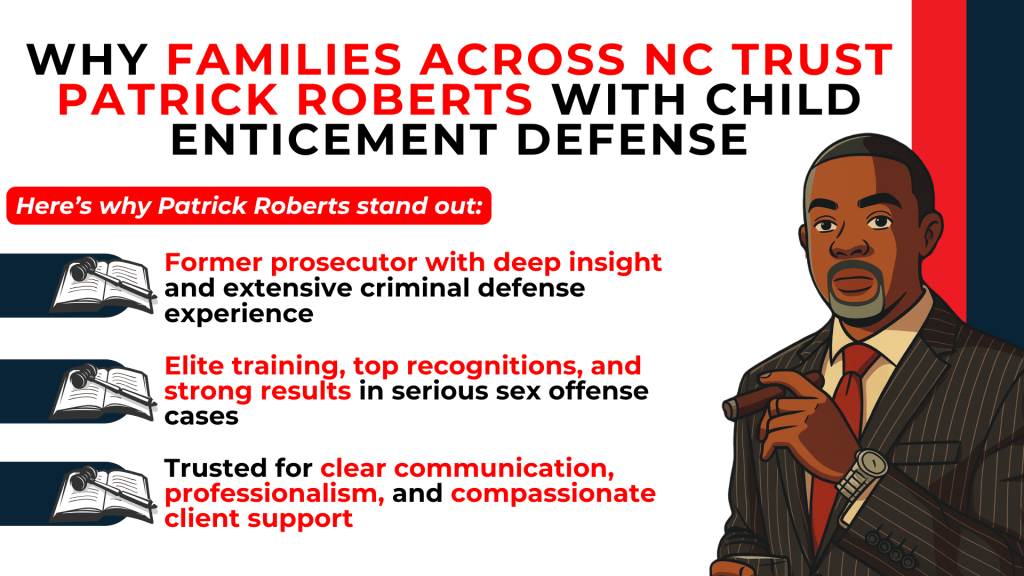
Why Families Across North Carolina Trust Patrick Roberts with Child Enticement Defense
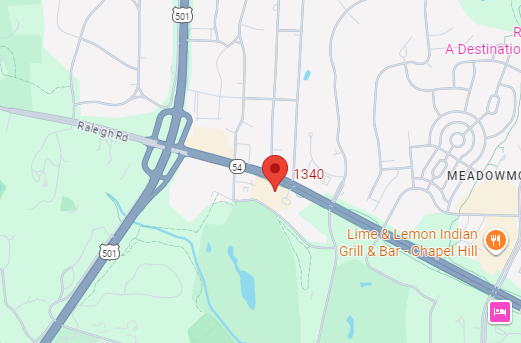
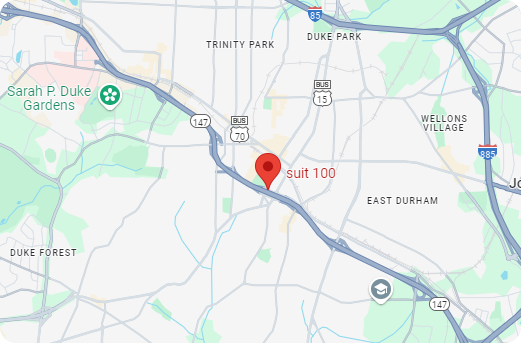
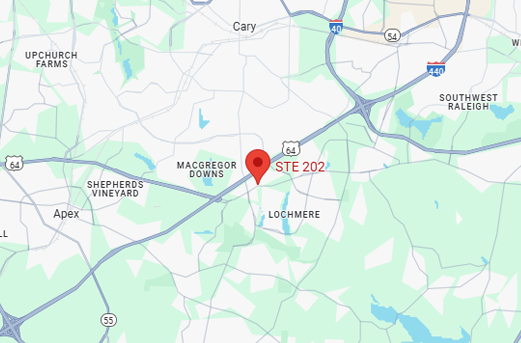
Attorney Patrick Roberts is a Raleigh criminal defense attorney who has handled thousands of cases across North Carolina, with offices in Raleigh, Durham, Chapel Hill, and Cary.
Education & Trial Advocacy
Mr. Roberts earned his bachelor’s degree from Johns Hopkins University, which is ranked #7 among National Universities. He is a graduate of Duke University School of Law, currently ranked #7 for best law schools and #9 for its criminal law program.
In addition to his academic background, he has completed several of the nation’s most rigorous trial advocacy programs:
- Gerry Spence’s Trial Lawyers College
- National Criminal Defense College (NCDC) Trial Practice Institute
- 2025 NCDC Cross-Examination Intensive
Professional Recognition & Memberships
For his work in the legal field, Mr. Roberts has earned several long-standing distinctions:
- AV Preeminent Peer Rating (Martindale-Hubbell): Held for over 5 consecutive years.
- Client Champion Platinum (Martindale-Hubbell): Maintained for over 5 consecutive years.
- AVVO “Superb” Rating (10/10): Maintained for more than 15 years.
- Top 100 Trial Lawyers: Recognized by The National Trial Lawyers.
He is a lifetime member of the National Association of Criminal Defense Lawyers and has co-authored two legal books, including a guide focused on defending internet sex crimes.
Professional Perspective
Mr. Roberts brings a dual perspective to complex legal matters. He served as an Assistant District Attorney in Wake, Johnston, and New Hanover counties, providing him with a firsthand understanding of how prosecutors build and evaluate sex crime cases.
Admissions & National Listings
He is admitted to practice before the U.S. Supreme Court, the Fourth Circuit Court of Appeals, and all federal district courts in North Carolina. As of 2026, he is the only North Carolina lawyer listed on the National Child Abuse Defense & Resource Center.
Client Review
“Our family turned to Attorney Patrick Roberts during an incredibly difficult chapter in our lives. Although our daughter lived in Raleigh, we are based in Central New Jersey, which meant countless hours on the road and a constant struggle to stay on top of the legal process from several states away. From the moment we met Mr. Roberts, he brought a sense of steadiness and reassurance that made an overwhelming situation feel manageable. He took the time to explain his credentials, his experience, and the steps he would take to defend our daughter. His confidence was never arrogant — just the calm, professional assurance of someone who knows the law, knows the system, and knows how to protect the people who depend on him. His communication was clear, timely, and compassionate, and he treated our daughter with dignity and respect throughout the entire process. He is exactly the type of attorney you want standing beside you when everything feels uncertain.” — Verified client review on Avvo.com
Peer Endorsement
“Mr. Roberts demonstrates a high level of expertise, competence and professionalism. He is well prepared for trial and represents all clients well. Mr. Roberts is dependable and he represents the legal profession well. I am confident in his ability to represent his clients.” — Martindale-Hubbell verified Peer endorsement
Disclaimer: Testimonials and peer reviews are for informational purposes only and do not guarantee or predict the outcome of your legal matter. Every case is unique and must be evaluated on its own merits. All endorsements featured on this site are actual comments from clients and peers.
If you or someone in your family is facing a child enticement investigation or charge in North Carolina, contact Patrick Roberts Law at https://www.patrickroberts.law/ to schedule a confidential consultation.
By maintaining a strictly controlled volume of active cases, the firm ensures that staff can dedicate the thorough and consistent attention each client deserves.
Disclaimer: The information on this website is for general informational purposes only and does not constitute legal advice for any individual case or situation. Contacting us via this website, email, or contact form does not create an attorney-client relationship. Each case is different and must be evaluated separately; prior results do not guarantee a similar outcome.
Former assistant district attorney
Contact Patrick Roberts
Facing criminal charges in North Carolina demands seasoned representation. Trust in the experience and dual perspective of Patrick Roberts. Reach out today for a confidential consultation.
-
Call Our Team
Calls answered 24/7






For more information on the selection criteria, go to www.martindale.com
*Each case is different and must be evaluated separately. Prior results achieved do not guarantee similar results can be achieved in future cases.