
An indecent exposure charge can be beaten by attacking the specific elements the prosecution is required to prove — willfulness, public setting, presence of another person, and in some cases, sexual intent. If any one of those elements falls apart, the charge does not hold. Below, we break down exactly what the state must prove under North Carolina law, the defense strategies that challenge each element, and what is realistically at stake if you are convicted.
What Does North Carolina Have to Prove to Convict You of Indecent Exposure?
North Carolina’s indecent exposure law, N.C.G.S. § 14-190.9, is a tiered statute. Because it contains multiple subsections, the specific elements the prosecution must prove depend entirely on which version of the offense is charged.
The common thread across all levels of this offense is the requirement that the act was done willfully, drawing a sharp legal line between intentional conduct and accidental exposure.
What Are the Elements of a Standard Indecent Exposure Charge?
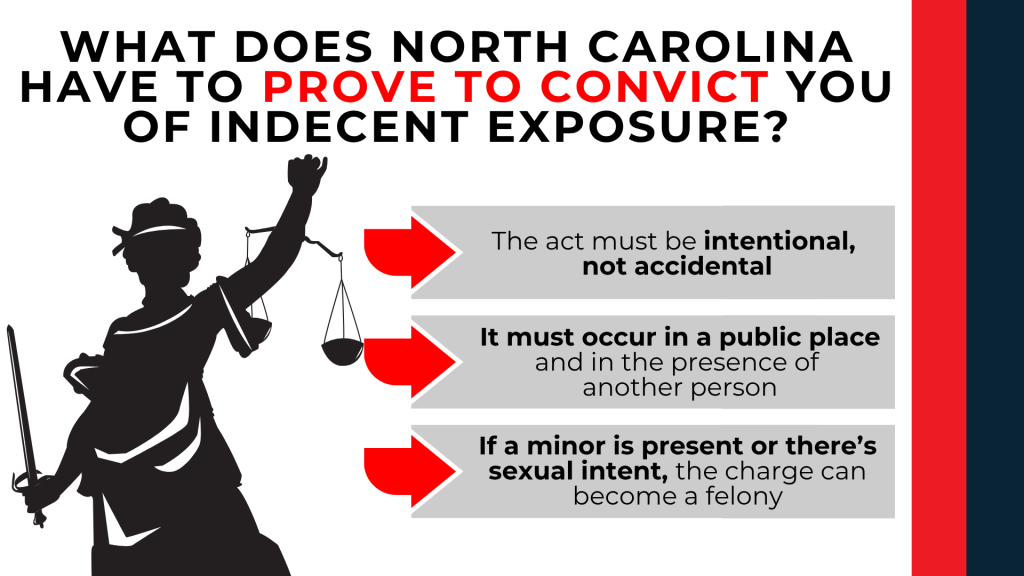
Under subsection (a), which is the most common charge, the state must prove three specific elements beyond a reasonable doubt:
- Willful Exposure: You intentionally exposed the “private parts” of your person.
- Public Place: The exposure occurred in a location accessible to the public.
- Presence of Others: The act occurred in the presence of at least one other person.
This is classified as a Class 2 misdemeanor. Notably, for this specific subsection, the state does not have to prove sexual intent—only that the act itself was willful and not accidental.
When Does Indecent Exposure Become a Felony?
The charge becomes significantly more severe under subsection (a1). The state can elevate the offense to a Class H felony if they can prove:
- The defendant is at least 18 years old.
- The exposure occurred in a public place in the presence of a minor under 16.
- The act was committed for the purpose of sexual arousal or gratification.
This additional element of sexual purpose is a critical legal distinction. Furthermore, the statute specifies that this is not a “lesser included offense” of N.C.G.S. § 14-202.1 (Indecent Liberties). This means a defendant could potentially face both charges for the same underlying conduct.
Other Specific Scenarios Under the Statute
The law also covers exposure in non-public settings, typically classified as Class 2 misdemeanors:
- Private Premises (a2): Exposure on someone else’s private property in the presence of a non-consenting adult for a sexual purpose.
- Non-Resident in a Private Home (a4): Exposure by an adult (18+) in a private residence where they do not live, while a minor resident is present.
- Intent to be Seen (a5): Exposure from a private place (such as a window) with the knowing intent to be seen by someone in a public place.
What Defenses Actually Work Against an Indecent Exposure Charge?
The “Willful” Defense
Across every subsection, the prosecution’s heaviest burden is proving that the act was willful. Because the statute excludes accidental exposure, the defense often centers on the lack of intent, which is a foundational element required for any conviction under N.C.G.S. § 14-190.9.
The right strategy depends on the facts of your case, but these are the legal arguments that a skilled sex crime defense attorney evaluates first.
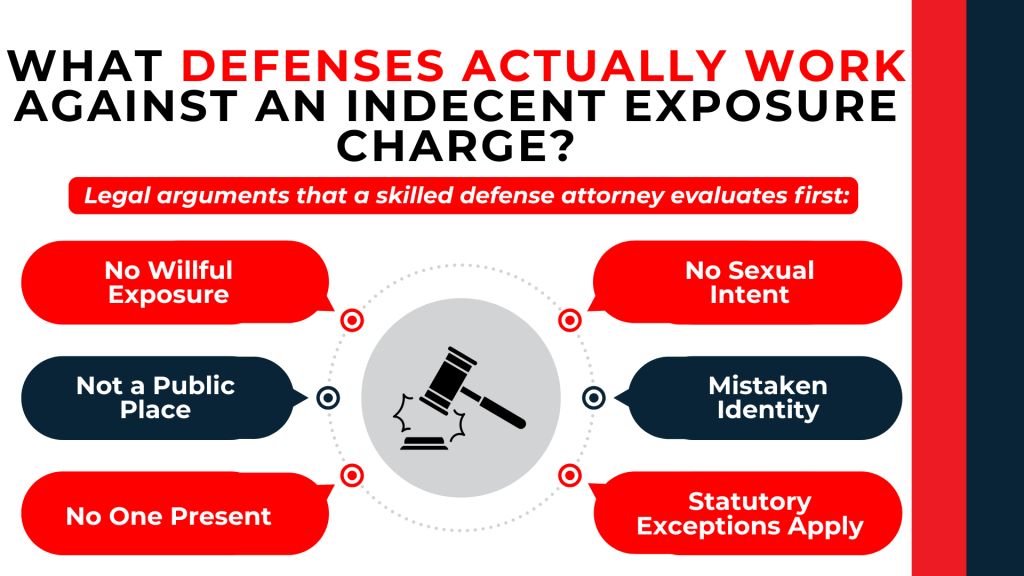
The exposure was not willful. This is the most common and often the strongest defense. If the exposure was accidental — a clothing malfunction, a medical episode, being caught mid-change in a situation where privacy was reasonably expected — the willfulness element may not be met. The statute requires that the act be willful, and an attorney can present evidence that the exposure was unintentional to challenge that element directly.
The location was not public. The statute requires that the exposure occur in a “public place” for most subsections. If the incident happened in a private home, a locked vehicle, a bathroom, or another location where you had a reasonable expectation of privacy, the prosecution may not be able to satisfy this element. The line between public and private is not always obvious, and challenging the state’s description of the location is a recognized defense.
No one was actually present. The statute requires exposure “in the presence of” another person. If the state cannot prove that another person was present at the time of the alleged exposure — or that the exposure was visible to anyone — this element fails. Witness testimony is often the only evidence in indecent exposure cases. If that testimony is inconsistent, unreliable, or unsupported, the prosecution’s case has a serious gap.
The act lacked sexual purpose. For the felony charge under subsection (a1) and the private-premises misdemeanor under (a2), the state must prove the exposure was done “for the purpose of arousing or gratifying sexual desire.” This is a state of mind that prosecutors must prove beyond a reasonable doubt. If there is no evidence of sexual motivation — no sexually suggestive conduct, no statements indicating sexual intent — the prosecution may be unable to establish this element. Nudity alone, without evidence of sexual purpose, may not satisfy the felony standard.
Mistaken identity. In cases based on witness reports rather than physical evidence, identification errors occur. Lighting conditions, distance, brief observation, and the stress of the situation can all contribute to misidentification. If you were not the person involved, your attorney can challenge the reliability of the identification through cross-examination and, where applicable, independent evidence of your whereabouts.
The statutory exception applies. The statute itself carves out an explicit exception: exposure in places “designated for a public purpose where the same sex exposure is incidental to a permitted activity.” Locker rooms, shared changing areas, and similar facilities fall under this exception. North Carolina law also explicitly protects breastfeeding under subsection (b), providing that a woman may breastfeed in any public or private location where she is otherwise authorized to be.
What Are You Facing if Convicted? Will You Have to Register as a Sex Offender?
This is the question behind most searches for how to beat an indecent exposure charge. The answer depends entirely on which subsection you are charged and convicted under.
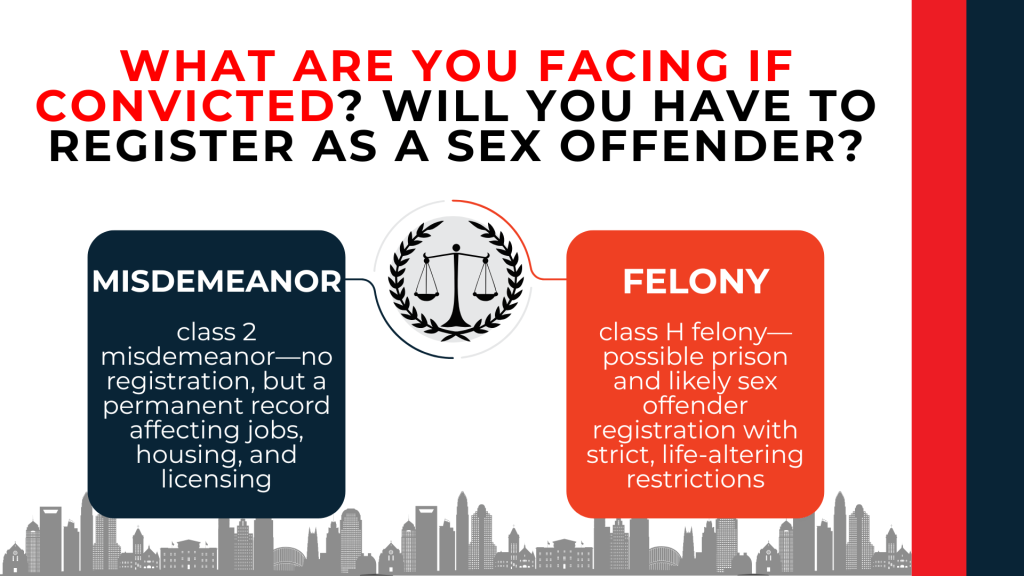
Misdemeanor indecent exposure under subsection (a) is a Class 2 misdemeanor. Penalties are determined under North Carolina’s Structured Sentencing Act and depend on your prior record level. Even without a lengthy sentence, a misdemeanor conviction still creates a permanent criminal record, which can affect employment, housing, professional licensing, and personal relationships.
Felony indecent exposure under subsection (a1) is a Class H felony. This carries potential prison time and much more severe long-term consequences. Subsection (a1) involves exposure to a minor for the purpose of sexual gratification. Because of that, it may be classified as a sexually violent offense under N.C.G.S. § 14-208.6, which can trigger mandatory sex offender registration. Under the NC Sex Offender Registry (Article 27A), standard registration lasts 30 years. You may be able to petition for termination after 10 years if you are not classified as a repeat offender, aggravated offender, or sexually violent predator. North Carolina currently has approximately 25,000 or more registered sex offenders. The consequences of being on the registry are severe: your address becomes publicly searchable, you face restrictions on where you can live and work, and you must comply with ongoing verification requirements.
Whether registration applies to your specific charge depends on the subsection, the circumstances, and the date of the offense. This is one of the most important questions to discuss with your attorney early in the process.
The additional consequences of any sex offense conviction extend further. As documented in the research, sex offense convictions can trigger immigration deportation — often mandatory for non-citizens. Padilla v. Kentucky, 559 U.S. 356 (2010), requires defense counsel to advise clients of immigration consequences before any guilty plea. Professional licensing boards may revoke or deny licenses based on a conviction. Housing and employment restrictions can follow a conviction for years.
The gap between a misdemeanor and a felony conviction in an indecent exposure case is not just a matter of degree — it is the difference between a criminal record and a permanently altered life. That gap is exactly why the quality of your defense matters.
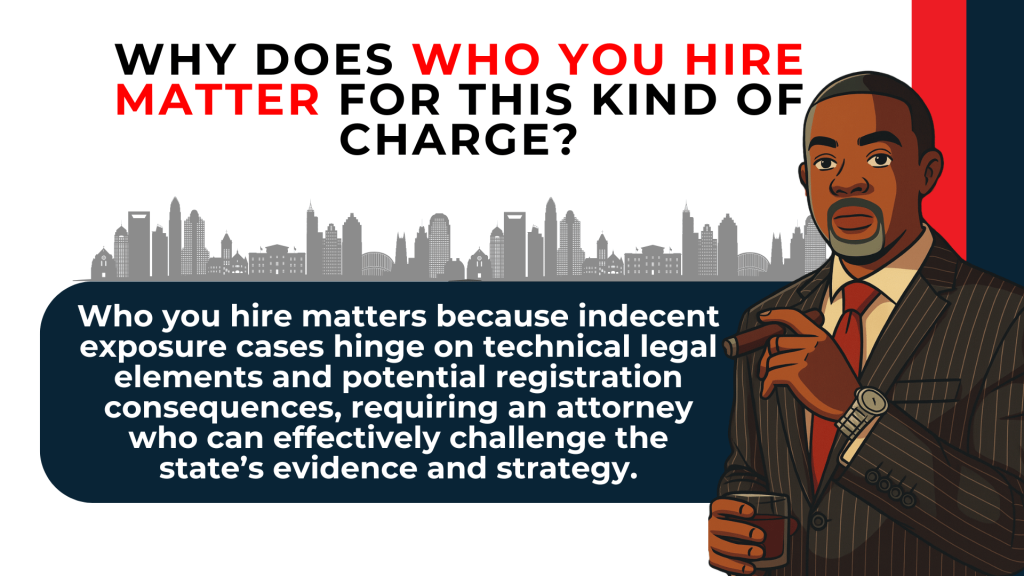
Why Does Who You Hire Matter for These Charges?
Indecent exposure cases in North Carolina depend on statutory elements that are far more technical than most realize. A conviction or a dismissal often hinges on an attorney’s ability to systematically dismantle the state’s proof regarding willfulness, the legal definition of a “public place,” and the specific presence requirements.
In felony cases, the challenge is even greater, as the prosecution must prove a specific sexual purpose. Furthermore, the long-term consequences—including potential Sex Offender Registry requirements—vary drastically depending on which specific subsection is charged.
The Advantage of Prosecutor-Side Experience
Attorney Patrick Roberts has defended clients facing sex offense allegations at every level, from misdemeanors to high-level felonies. As a former Assistant District Attorney in Wake, Johnston, and New Hanover counties, he understands the internal mechanics of how these cases are built.
- Prosecutorial Insight: He knows which evidence prosecutors prioritize and where the structural gaps in their arguments typically lie.
- Trial Record: Since 2007, he has tried hundreds of bench and jury trials in both state and federal courts.
National Credentials and Local Knowledge
Attorney Roberts’ credentials reflect a career dedicated to trial advocacy and ethical practice:
- Academic Background: Graduate of Duke University School of Law (Top 9 best criminal law program) and The Johns Hopkins University (Top 7 rank in National Universities).
- Advanced Training: Completed intensive training programs, including Gerry Spence’s Trial Lawyers College and the NCDC Cross-Examination Intensive (2025).
- Peer-Recognized: AV Preeminent Peer Rated by Martindale-Hubbell (2026)—the highest rating for legal ability and ethics, held for over five consecutive years.
- Client Commitment: Client Champion Platinum (2026) award recipient and maintains a 10/10 “Superb” Avvo rating for over 15 years.
- Targeted Resources: He is the only North Carolina lawyer listed on the National Child Abuse Defense & Resource Center (as of 2026).
Attorney Roberts is admitted to practice before the United States Supreme Court, the Fourth Circuit Court of Appeals, and all Federal District Courts in North Carolina.
Client Review
“Mr. Roberts was a great attorney to work with. From the start he was confident and transparent with us. He told us he had other strategies as back up in case his main one didn’t go as planned. That showed us that he was prepared for any obstacle that was coming his way. We went to the first court hearing and waited, we then saw Mr. Roberts walk in with confidence and his head up high. He looked fearless and ready. That day we were the first ones out, we were in there for probably 10 minutes. The one thing that stuck with me that he said was ‘don’t be scared because I’m not scared.’ He was good at communicating with us and keeping us informed with what was going on and when the next court dates would be. Overall he dedicates and puts his time into your case and will work on it for however long he needs to.” — Verified client review on Avvo.com
Peer Endorsement
“Very talented and intuitive criminal lawyer.” — Martindale-Hubbell verified Peer Endorsement
Disclaimer: The testimonials are actual comments. Every case is different and depends on its own unique facts and legal circumstances. These results are illustrative of the matters the firm handles but do not guarantee, warrant, or predict a similar outcome in your legal matter.
Indecent Exposure Defense in North Carolina
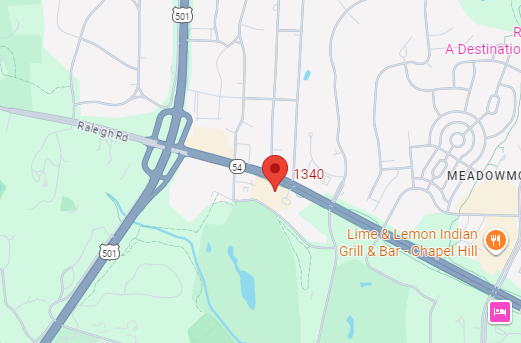
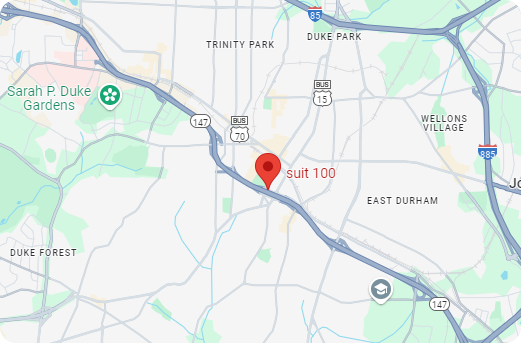
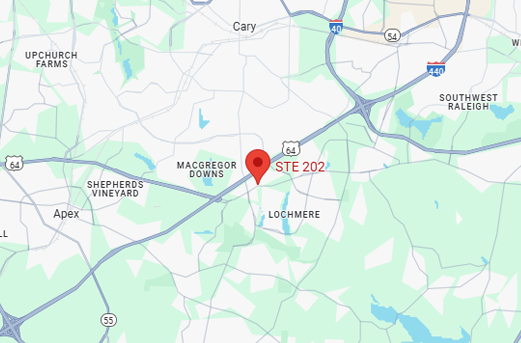
Those facing an indecent exposure charge in Raleigh, Durham, Chapel Hill, or Cary can receive a strictly confidential consultation at Patrick Roberts Law. The firm provides a professional, judgment-free environment centered on a technical analysis of the elements the state must prove under N.C.G.S. § 14-190.9.
Attorney Patrick Roberts offers a clear-eyed assessment of the defenses available and the specific legal consequences involved in both misdemeanor and felony-level accusations.
Targeted Case Management
To maintain a rigorous focus on evidence review and complex litigation, the firm limits the number of active cases the firm handles. This selective approach ensures that each defense receives the comprehensive preparation required to challenge the state’s narrative effectively.
Schedule a Private Case Evaluation
Navigating the tiered nature of North Carolina sex offense statutes requires a precise understanding of Structured Sentencing and the specific criteria for the NC Sex Offender Registry. Contact Patrick Roberts Law today to request a private evaluation.
Disclaimer: The information on this website is for general informational purposes only and does not constitute legal advice for any individual case or situation. Contacting us via this website, email, or contact form does not create an attorney-client relationship. Each case is different and must be evaluated separately; prior results do not guarantee a similar outcome.
Former assistant district attorney
Contact Patrick Roberts
Facing criminal charges in North Carolina demands seasoned representation. Trust in the experience and dual perspective of Patrick Roberts. Reach out today for a confidential consultation.
-
Call Our Team
Calls answered 24/7






For more information on the selection criteria, go to www.martindale.com
*Each case is different and must be evaluated separately. Prior results achieved do not guarantee similar results can be achieved in future cases.