
Domestic violence charges in North Carolina can range from misdemeanors to serious felonies. The severity of the charge depends on several factors, including the nature of the alleged act, the defendant’s criminal history, and specific circumstances surrounding the incident. Understanding when domestic violence becomes a felony is crucial for anyone facing these serious accusations in Wake County courts.
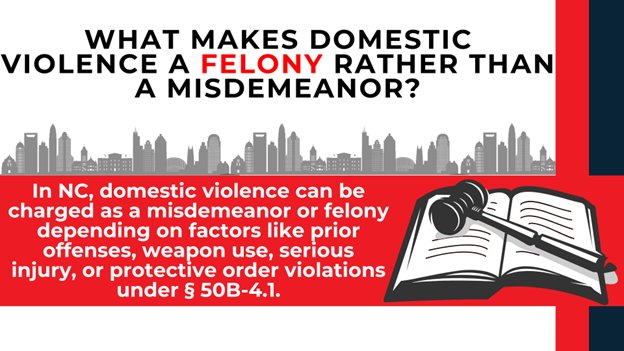
What Makes Domestic Violence a Felony Rather Than a Misdemeanor?
North Carolina law distinguishes between misdemeanor and felony domestic violence based on specific factors. Most simple domestic violence incidents are charged as misdemeanors under North Carolina law. However, certain circumstances elevate these charges to felony status.
The transformation from misdemeanor to felony typically occurs when:
- The defendant has multiple prior domestic violence convictions
- A deadly weapon was used during the incident
- The victim suffered serious bodily injury
- The defendant violated a Domestic Violence Protective Order (DVPO) under certain conditions
- The incident involved specific acts defined as felonies under North Carolina statutes
According to N.C. Gen. Stat. § 50B-4.1, even violations of protective orders can become felonies under certain circumstances. The Wake County District Attorney’s Office prosecutes these enhanced charges aggressively, particularly given Cary’s reputation as one of North Carolina’s safest communities.
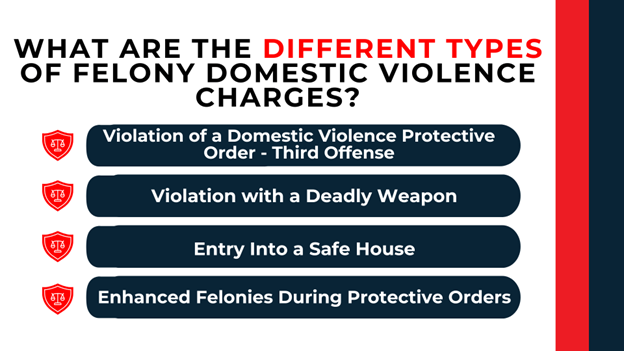
What are the Different Types of Felony Domestic Violence Charges?
North Carolina recognizes several distinct felony charges related to domestic violence. Each carries different elements and potential consequences.
Violation of a Domestic Violence Protective Order – Third Offense
Under N.C. Gen. Stat. § 50B-4.1(f), a person who violates a valid protective order after having been previously convicted of two violations under Chapter 50B faces Class H felony charges. This applies to orders issued in North Carolina or valid orders from other states.
Violation with a Deadly Weapon
According to N.C. Gen. Stat. § 50B-4.1(g), knowingly violating a protective order while in possession of a deadly weapon constitutes a Class H felony. The weapon must be on or near the defendant’s person when they fail to stay away from protected places or persons.
Entry Into a Safe House
N.C. Gen. Stat. § 50B-4.1(g1) makes it a Class H felony for someone subject to a protective order to enter property operated as a safe house or haven for domestic violence victims where the protected person resides.
Enhanced Felonies During Protective Orders
When someone commits a felony while knowing their behavior violates a valid protective order, N.C. Gen. Stat. § 50B-4.1(d) elevates the charge by one class higher than the underlying felony. This enhancement applies to most felonies except Class A or B1 offenses.
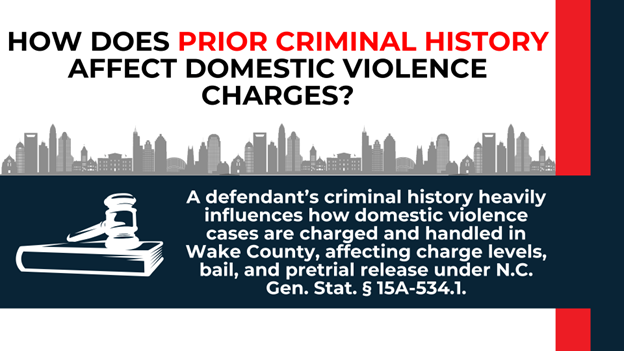
How Does Prior Criminal History Affect Domestic Violence Charges?
A defendant’s criminal history significantly impacts how domestic violence cases are charged and prosecuted in Cary and throughout Wake County. The Cary Police Department’s Special Victims Unit maintains detailed records of prior incidents, which prosecutors use to determine appropriate charges.
Key considerations include:
- Previous domestic violence convictions can transform misdemeanors into felonies
- Multiple protective order violations escalate charges to felony level
- Prior violent crimes influence bail conditions and pretrial release decisions
- Criminal history affects how the Wake County courts handle these cases
N.C. Gen. Stat. § 15A-534.1 requires judges to review criminal history reports when setting pretrial release conditions in domestic violence cases. This thorough review process reflects the serious nature of these charges in our community.
What Constitutes a “Personal Relationship” Under North Carolina Law?
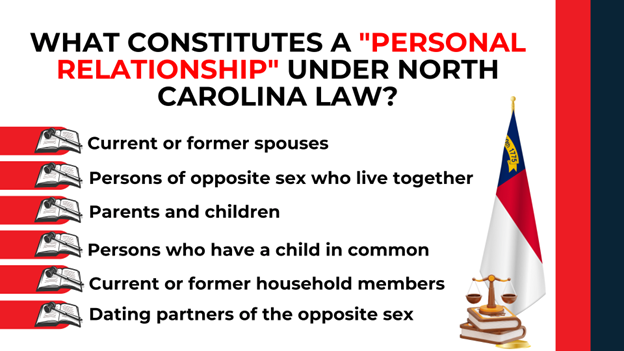
North Carolina’s domestic violence statutes apply only when specific relationships exist between the parties. According to N.C. Gen. Stat. § 50B-1(b), qualifying relationships include:
- Current or former spouses
- Persons of opposite sex who live together or have lived together
- Parents and children, including those acting in loco parentis
- Persons who have a child in common
- Current or former household members
- Persons of the opposite sex in a dating relationship
The law defines a dating relationship as one where parties are romantically involved over time and on a continuous basis. Casual acquaintances or ordinary business relationships do not qualify.
For residents in Cary’s diverse community, where over 60 nationalities are represented, understanding these relationship requirements is essential. The definition affects whether charges proceed under domestic violence statutes or general assault laws.
What Role Do Protective Orders Play in Felony Charges?
Domestic Violence Protective Orders (DVPOs) significantly impact the severity of criminal charges. These civil orders, issued under Chapter 50B, create criminal consequences when violated.
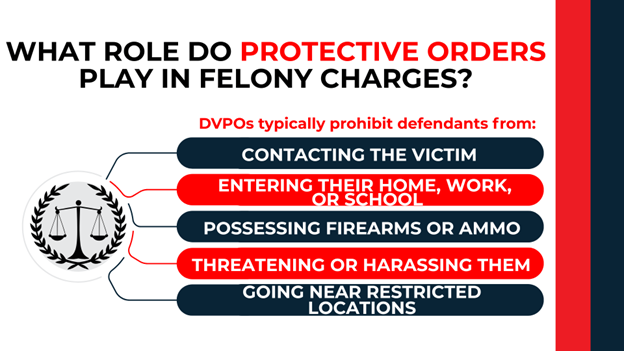
DVPOs typically prohibit defendants from:
- Contacting or approaching the protected party
- Entering the victim’s residence, workplace, or school
- Possessing firearms or ammunition
- Threatening or harassing the protected person
- Going near specific locations frequented by the victim
Violations transform civil matters into criminal cases. Multiple violations or violations involving weapons become felonies under North Carolina law.
The Wake County Sheriff’s Office maintains these orders in the National Crime Information Center registry, ensuring immediate access for law enforcement throughout the Research Triangle area.
What About Firearms and Domestic Violence Felonies?
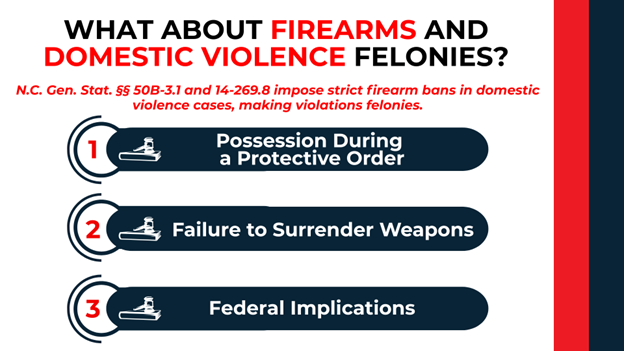
N.C. Gen. Stat. § 50B-3.1 and § 14-269.8 create strict firearm prohibitions in domestic violence cases. These provisions make certain firearm-related conduct felonious.
Possession During a Protective Order
It is a Class H felony to possess, purchase, or receive firearms while subject to a DVPO. This prohibition lasts as long as the protective order remains in effect.
Failure to Surrender Weapons
Courts may order defendants to surrender all firearms and ammunition upon issuance of emergency or ex parte orders. Failure to comply with surrender orders can result in additional criminal charges.
Federal Implications
Beyond state charges, federal law also prohibits firearm possession by those convicted of domestic violence offenses or subject to qualifying protective orders.
For Cary residents employed in the technology sector or government positions requiring security clearances, these firearm restrictions can have career-ending consequences beyond the criminal penalties.
How Does Domestic Violence Relate to Homicide Charges?
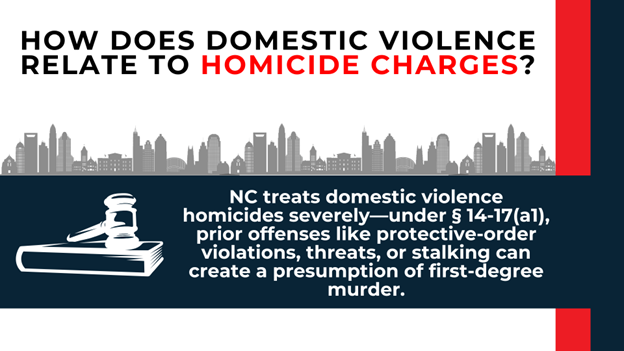
The most serious domestic violence cases involve homicide charges. N.C. Gen. Stat. § 14-17(a1) establishes special provisions for domestic violence homicides.
When certain prior convictions exist between the defendant and victim, the law creates a rebuttable presumption of first-degree murder. Qualifying prior offenses include:
- Previous acts of domestic violence under N.C. Gen. Stat. § 50B-1(a)
- Violations of protective orders
- Communicating threats
- Stalking or cyberstalking
- Domestic criminal trespass
These provisions reflect North Carolina’s recognition that domestic violence often escalates over time. The Wake County courts treat these cases with exceptional seriousness.
What Should You Do If Facing Felony Domestic Violence Charges?
Felony domestic violence charges demand immediate legal attention. The complex interplay between civil protective orders and criminal charges requires experienced navigation of both systems.
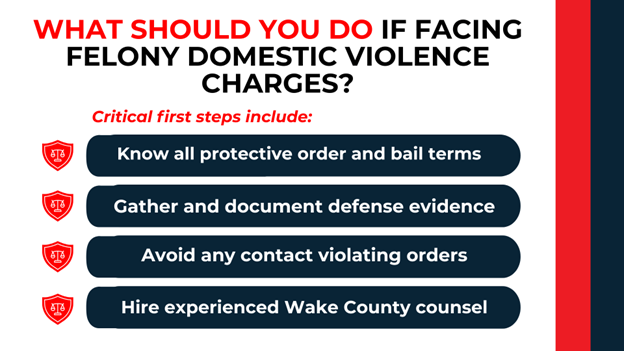
Critical first steps include:
- Understanding all conditions of any protective orders or bail requirements
- Documenting any evidence supporting your defense
- Avoiding any contact that could violate existing orders
- Securing experienced legal representation familiar with Wake County courts
The consequences of felony convictions extend far beyond criminal penalties. They affect employment opportunities, housing options, and fundamental civil rights.
Contact Patrick Roberts Law for Experienced Defense
Facing felony domestic violence charges in Cary requires an attorney who understands both sides of these complex cases. Patrick Roberts brings unique insight from his experience as a former prosecutor who handled domestic violence cases. He knows how the state builds these cases and can anticipate prosecution strategies.
Don’t navigate these serious charges alone. Patrick Roberts Law provides aggressive defense representation* for clients throughout Wake County, leveraging prosecutorial experience to protect your rights and future. Call today to discuss your case and learn how we can help defend against these life-altering accusations.
*Disclaimer: Each case is different and must be evaluated separately. Prior results achieved do not guarantee similar results can be achieved in future cases.
Former assistant district attorney
Contact Patrick Roberts
Facing criminal charges in North Carolina demands seasoned representation. Trust in the experience and dual perspective of Patrick Roberts. Reach out today for a confidential consultation.
-
Call Our Team
Calls answered 24/7









For more information on the selection criteria, go to www.martindale.com
*Each case is different and must be evaluated separately. Prior results achieved do not guarantee similar results can be achieved in future cases.