

Domestic violence affects families across North Carolina, including those in communities like Cary. Understanding what legally constitutes domestic violence under state law helps individuals recognize harmful situations and know when to seek help or legal representation.
What Does North Carolina Law Define as Domestic Violence?
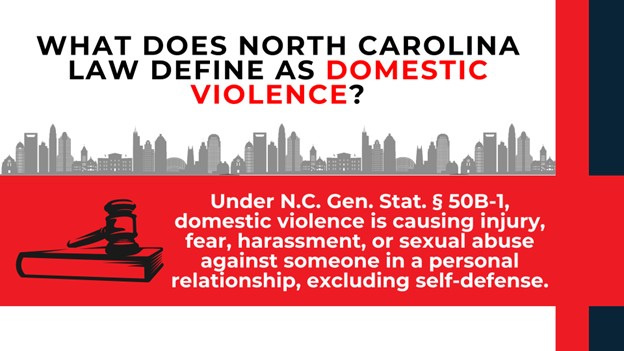
North Carolina defines domestic violence in N.C. Gen. Stat. § 50B-1 as the commission of one or more specific acts upon an aggrieved party by a person with whom that party has or had a personal relationship. The definition excludes acts of self-defense.
Under North Carolina law, domestic violence includes:
- Attempting to cause bodily injury or intentionally causing bodily injury
- Placing the aggrieved party or a family member in fear of imminent serious bodily injury or continued harassment that rises to a level inflicting substantial emotional distress
- Committing certain sexual offenses defined in North Carolina law
The legal framework recognizes that domestic violence extends beyond physical harm. Emotional abuse that creates fear or substantial distress qualifies as domestic violence when it meets the statutory requirements.
Who Can Be a Victim or Perpetrator Under the Personal Relationship Requirement?
Not every violent act between individuals qualifies as domestic violence under North Carolina law. The statute requires a “personal relationship” between the parties.
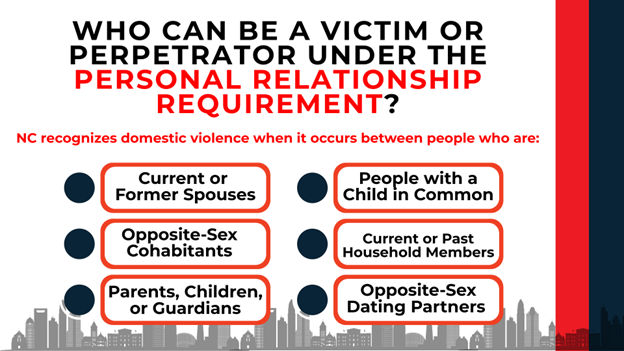
North Carolina recognizes domestic violence when it occurs between people who are:
- Current or former spouses
- Persons of opposite sex who live together or have lived together
- Parents and children, including those acting in loco parentis to a minor child, or grandparents and grandchildren (Note: an aggrieved party cannot obtain an order against a child or grandchild under 16)
- Persons who have a child in common
- Current or former household members
- Persons of the opposite sex who are in or have been in a dating relationship
The dating relationship category requires romantic involvement over time on a continuous basis. A casual acquaintance or ordinary interaction in business or social contexts does not constitute a dating relationship under the statute.
What Is Harassment in the Context of Domestic Violence?
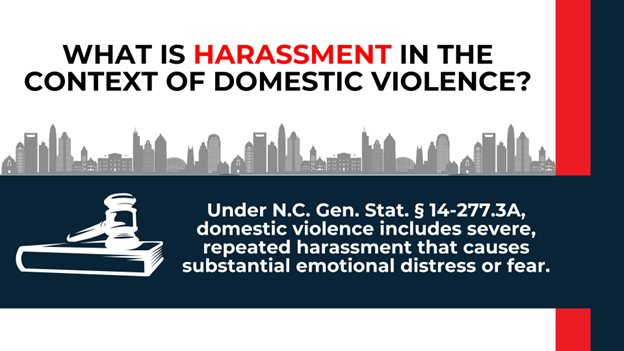
The definition of domestic violence includes placing someone in fear through continued harassment as defined in N.C. Gen. Stat. § 14-277.3A. This harassment must rise to such a level that it inflicts substantial emotional distress on the victim.
Harassment can take many forms, including repeated unwanted contact, threats, or behavior designed to intimidate or control another person. The key legal threshold requires that the harassment be severe enough to cause significant emotional harm.
How Does Domestic Violence Differ From Other Assault Cases?
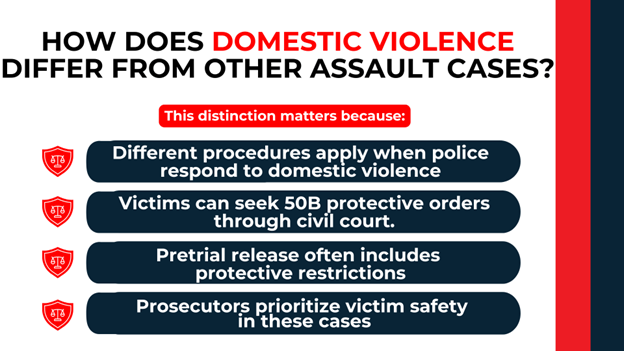
While assault charges can arise from any physical altercation, domestic violence cases involve the specific personal relationships outlined in Chapter 50B of the North Carolina General Statutes. This distinction matters because:
- Different legal procedures apply when law enforcement responds to domestic violence calls
- Protective orders become available through civil proceedings under Chapter 50B
- Pretrial release conditions often include specific restrictions to protect alleged victims
- The Wake County District Attorney’s Office may prosecute these cases with heightened attention to victim safety
In Cary, where the community maintains exceptionally low violent crime rates, domestic violence accusations receive serious attention from both the Cary Police Department and prosecutors. The department’s Special Victims Unit follows up on domestic violence cases, ensuring thorough investigation and victim support.
What Are Domestic Violence Protective Orders?
A domestic violence protective order, often called a DVPO, is a civil court order designed to protect victims from further harm. Any person residing in North Carolina may seek a DVPO by filing a civil action alleging acts of domestic violence.
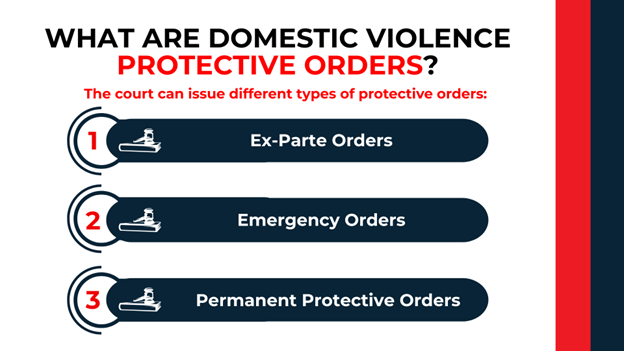
The court can issue different types of protective orders:
Ex Parte Orders: A judge may enter an emergency protective order before the defendant receives notice if specific facts show danger of domestic violence against the aggrieved party or a minor child. When an aggrieved party requests ex parte relief without an attorney, the clerk of superior court must schedule an ex parte hearing within 72 hours or by the end of the next day the district court is in session, whichever comes first.
Emergency Orders: When no ex parte order is entered, a hearing on emergency relief must occur after five days’ notice to the other party or five days from service of process, whichever occurs first.
Permanent Protective Orders: After a full hearing with both parties present or properly notified, the court may enter a protective order for a fixed period not exceeding one year. These orders can be renewed for up to two additional years.
The court may include various forms of relief in a protective order, such as:
- Directing a party to refrain from acts of domestic violence
- Granting possession of the residence to one party and excluding the other
- Requiring a party to provide alternate housing for a spouse and children
- Awarding temporary custody of minor children
- Ordering eviction and assistance in returning to the residence
- Requiring child or spousal support payments
- Determining possession of personal property, including pets
- Prohibiting contact, harassment, or other interference
- Awarding attorney’s fees
- Prohibiting firearm purchases
- Requiring completion of an abuser treatment program
Can Protective Orders Address Child Custody Issues?
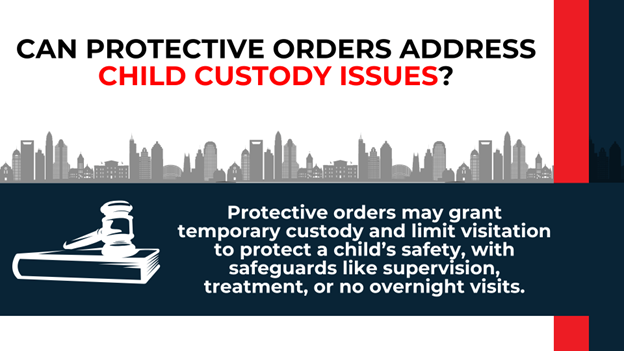
Protective orders can include temporary custody provisions when a minor child faces exposure to substantial risk of physical or emotional injury or sexual abuse. The court must find that such an order serves the best interest of the minor child and is necessary for the child’s safety.
If the court awards temporary custody in a protective order, it must also consider whether visitation is in the child’s best interest. When ordering visitation, the court implements safeguards to protect the child and the aggrieved party, which may include:
- Requiring exchange of the child in a protected setting or presence of a third party
- Ordering supervised visitation by a third party or at a supervised visitation center
- Requiring the noncustodial parent to complete an abuser treatment program as a condition of visitation
- Ordering parents to abstain from alcohol or controlled substances during visitation
- Requiring payment for supervised visitation costs
- Prohibiting overnight visitation
- Requiring a bond for the child’s return and safety
- Imposing other conditions necessary for safety
Temporary custody orders entered as part of a protective order last for a fixed period not exceeding one year. These orders do not affect the right of parties to a full custody hearing under Chapter 50 of the General Statutes.
How Long Do Protective Orders Remain in Effect?
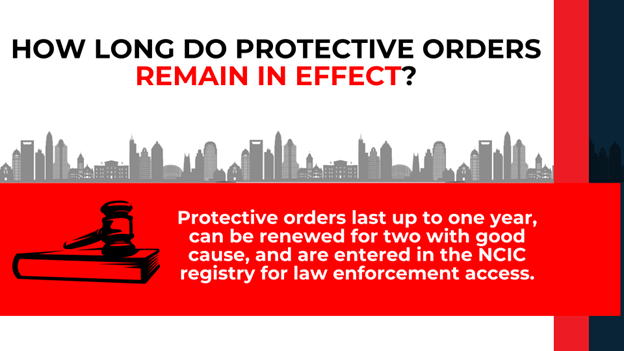
Standard protective orders remain in effect for a fixed period not exceeding one year. The orders expire at 11:59 P.M. on the indicated expiration date unless specifically stated otherwise.
The aggrieved party may seek renewal before the current order expires. The court may renew a protective order, including previously renewed orders, for up to two years if it finds good cause. The commission of a new act of domestic violence is not required for renewal.
In Wake County courts that serve Cary residents, protective orders are entered into the National Crime Information Center registry for prompt access by law enforcement agencies.
What Happens If Someone Violates a Protective Order?
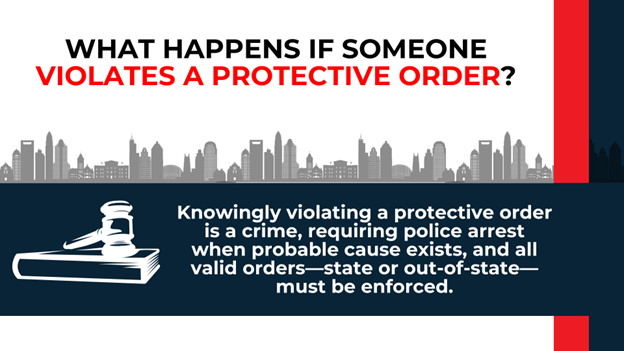
Knowingly violating a valid protective order constitutes a criminal offense. Law enforcement officers must arrest a person when they have probable cause that the person knowingly violated a protective order that excludes them from a residence or directs them to refrain from certain acts like threatening or contacting the victim.
The Cary Police Department enforces all valid protective orders, whether issued by North Carolina courts or courts in other states. Officers can rely on a copy of the protective order and the protected person’s statement that the order remains in effect.
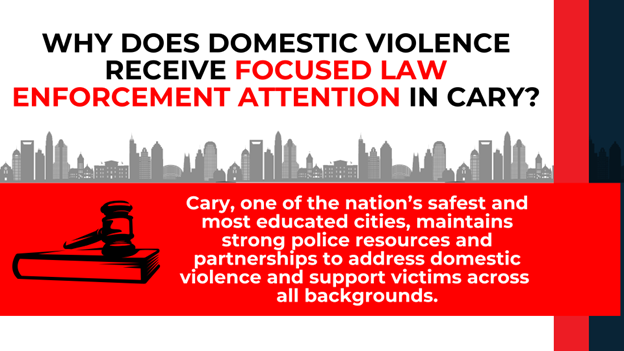
Why Does Domestic Violence Receive Focused Law Enforcement Attention in Cary?
Cary consistently ranks among the safest communities in the United States, with violent crime rates significantly below national averages. The town’s 2.8 percent unemployment rate and median household income exceeding $125,000 reflect economic stability, yet domestic violence can affect families across all socioeconomic levels.
The Cary Police Department maintains specialized capabilities to respond to domestic violence situations. With a Field Operations Bureau comprising approximately 110 officers and a Special Operations Bureau supporting specialized functions, the department dedicates significant resources to investigating domestic violence allegations thoroughly.
When residents of Cary’s diverse community—where over 70 percent of adults hold college degrees and nearly 25 percent were born outside the United States—face domestic violence situations, they have access to comprehensive support systems. The department works closely with the Wake County District Attorney’s Office and connects victims with resources including the National Domestic Violence Hotline, which offers 24/7 crisis intervention, safety planning, and referrals.
How Can Legal Representation Help in Domestic Violence Cases?
Whether facing accusations of domestic violence or seeking protection from abuse, individuals benefit from experienced legal counsel who understands both the criminal and civil aspects of these cases.
Attorney Patrick Roberts brings a unique perspective to domestic violence defense, having served as a prosecutor handling domestic violence cases before entering private practice. This prosecutorial background provides critical insight into how the Wake County District Attorney’s Office evaluates these cases, what evidence prosecutors consider compelling, and how cases typically proceed through the court system.
Understanding prosecution strategies allows for more effective defense representation. Early involvement of experienced counsel can make a substantial difference in protecting your rights, developing your defense, and working toward the best possible outcome* in your situation.
*Disclaimer: Each case is different and must be evaluated separately. Prior results achieved do not guarantee similar results can be achieved in future cases.
Former assistant district attorney
Contact Patrick Roberts
Facing criminal charges in North Carolina demands seasoned representation. Trust in the experience and dual perspective of Patrick Roberts. Reach out today for a confidential consultation.
-
Call Our Team
Calls answered 24/7









For more information on the selection criteria, go to www.martindale.com
*Each case is different and must be evaluated separately. Prior results achieved do not guarantee similar results can be achieved in future cases.