
Child pornography charges in North Carolina are prosecuted under a three-tiered felony structure that distinguishes between production, distribution, and possession. The penalties, consequences, and long-term effects differ substantially depending on which tier applies. Whether you are facing charges, expect to be charged, or are trying to understand what someone close to you is up against, this page covers how North Carolina defines and classifies these offenses. It explains what you are facing at each sentencing level and what a conviction means for registration, immigration, employment, and daily life going forward.
What Do Child Pornography Charges Actually Mean in North Carolina?
North Carolina prosecutes child pornography offenses under the label “sexual exploitation of a minor,” and the law divides these charges into three degrees based on the nature of the alleged conduct.
First-degree sexual exploitation of a minor under N.C.G.S. § 14-190.16 covers production and facilitation — using, employing, inducing, or coercing a minor to engage in sexual activity for the purpose of producing material, or producing, directing, or financing such material. This is a Class C or Class D felony, carrying a sentencing range of 44 to 182 months for Class C and 38 to 160 months for Class D.
Second-degree sexual exploitation under N.C.G.S. § 14-190.17 covers distribution and receipt — recording, photographing, reproducing, or sharing material depicting a minor engaged in sexual activity. This is a Class E felony with a sentencing range of 15 to 63 or more months.
Third-degree sexual exploitation under N.C.G.S. § 14-190.17A covers possession — knowingly possessing material depicting a minor engaged in sexual activity. This is a Class H felony, with sentences ranging from 5 to 29 months depending on prior record level.
Two things about these statutes catch people off guard. First, mistake of age is explicitly not a defense at any level. The prosecution does not need to prove that you knew the person depicted was a minor. Courts allow the jury or judge to infer that a person depicted as a minor is in fact a minor based on the title, text, or visual representation of the material. Second, North Carolina has no teen-specific sexting statute. That means minors — beginning at age 16, when they can be tried as adults — can technically be prosecuted for sexually exploiting themselves through consensual sexting. This creates significant prosecutorial discretion issues that a defense attorney needs to navigate carefully.
These cases can also be prosecuted federally, particularly when the material crossed state lines, involved the internet, or was identified through a federal investigation. The distinction between state and federal prosecution matters enormously for sentencing, as discussed below.
What Penalties Am I Facing?
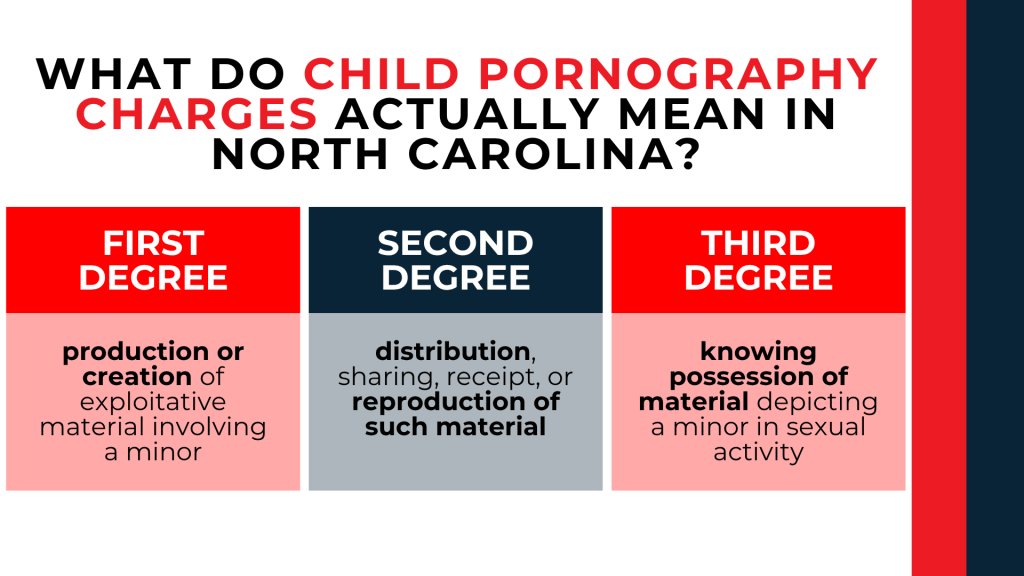
Your potential sentences depend on the degree of the charge, your prior record, and whether the case is prosecuted in state or federal court.
North Carolina uses a Structured Sentencing system that calculates punishment ranges based on the offense class and your prior record level. For sexual exploitation charges specifically, the law imposes an enhanced maximum sentence: for Class B1 through Class E felonies requiring sex offender registration, the maximum sentence is calculated at 120% of the minimum plus an additional 60 months, under N.C.G.S. § 15A-1340.17(f).
At the state level, all Class B1 through D felony sex offense convictions result in mandatory active imprisonment — 100% of convictions in those classes received active prison time in FY 2024. For Class E and H felonies, the court has more discretion, and intermediate or community punishments are possible depending on the circumstances and prior record.
Federal prosecution changes the picture dramatically. The average federal sentence for child pornography production is 273 months — nearly 23 years. Federal sexual abuse offenses carry a 99.2% imprisonment rate, and many of these offenses carry mandatory minimum sentences.
These cases also move slowly. The median time from charge filing to sentencing for Class B1 felonies in North Carolina is 30 months — two and a half years — which is three times the overall felony median. Defendants convicted of serious sex offenses spent an average of 27 months in pretrial detention. The weight of the process itself is part of what makes early legal representation critical.
Will I Have to Register as a Sex Offender?
Yes. All three degrees of sexual exploitation of a minor require mandatory sex offender registration in North Carolina. There is no exception, no judicial discretion on this point, and no version of a conviction at any tier that avoids the registry.
The standard registration period under North Carolina’s Sex Offender Registry (N.C.G.S. § 14-208 et seq.) is 30 years. After 10 years, if you are not classified as a repeat offender, sexually violent predator, or aggravated offender, you may ask the court to end the registration requirement under N.C.G.S. § 14-208.12A. But that request is discretionary — it is not guaranteed to be granted.
North Carolina currently has approximately 25,000 or more registered sex offenders, and the registry carries real daily consequences. If you are registered, you face residential restrictions, periodic in-person verification requirements, and potential GPS electronic monitoring. 581 sex offenders were enrolled in active GPS monitoring during FY 2022–2023. Registration status is publicly searchable, which affects housing, employment, and community life in ways that persist long after any sentence is served.
What Are the Consequences Beyond Prison and the Registry?
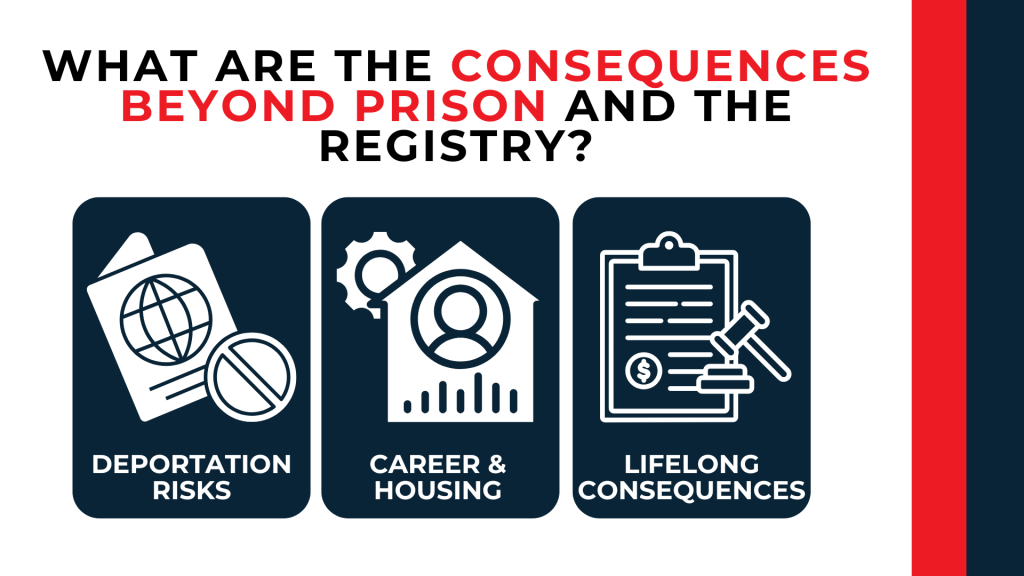
The consequences beyond your sentence extend into areas that many people do not consider until it is too late to address them.
For non-citizens, the consequences can be immediate and permanent. Sexual abuse of a minor is classified as an aggravated felony under federal immigration law, which triggers mandatory deportation. Most sex offenses also qualify as crimes involving moral turpitude. Under Padilla v. Kentucky, 559 U.S. 356 (2010), defense counsel has a constitutional obligation to advise you of the immigration consequences of a guilty plea. That means any plea negotiation must account for these effects from the start.
Beyond immigration, a conviction creates barriers to employment and professional licensing. Many licensing boards treat sex offense convictions as disqualifying under “good moral character” requirements. Housing options narrow significantly due to both registry restrictions and landlord screening practices. Military service and law enforcement careers are no longer an option.
These consequences matter for defense strategy because they affect how a case should be negotiated. An outcome that looks acceptable when measured only in months of prison time may be devastating when its full long-term consequences are understood. This is one of the reasons that working with an attorney who regularly handles these cases — and who understands the full picture, not just the sentencing grid — matters.
Talk to a North Carolina Criminal Defense Attorney Who Handles These Cases
Patrick Roberts is a Raleigh criminal defense attorney who has handled sex crime cases across North Carolina for more than 24 years, including internet-based exploitation offenses. He is a former assistant district attorney in Wake, Johnston, and New Hanover counties, which means he understands how prosecutors classify and pursue these charges. He has co-authored a legal book on defending internet sex crimes and is admitted to practice before all three U.S. District Courts in North Carolina, the Fourth Circuit Court of Appeals, and the United States Supreme Court.
Education & Advanced Training
An alumnus of Johns Hopkins University (#7 National University) and Duke University School of Law (#7 National Law School; #9 Criminal Law Program), Mr. Roberts has dedicated his career to honing his trial craft. He is a graduate of the Gerry Spence’s Trial Lawyers College and the National Criminal Defense College (NCDC) Trial Practice Institute, including the 2025 Cross-Examination Intensive.
Accolades & Peer Review
• Martindale-Hubbell AV Preeminent Rating: 5+ Consecutive Years
• Martindale-Hubbell Client Champion Platinum: 5+ Consecutive Years
• AVVO 10/10 “Superb” Rating: 15+ Consecutive Years
• The National Trial Lawyers: Top 100 Trial Lawyers
Mr. Roberts is a published author of two legal books and a lifetime member of the National Association of Criminal Defense Lawyers.
Client Review
“Patrick was professional, honest, and the best lawyer I could have asked for during a very tough situation. Throughout the process, he remained a constant calm and reassuring presence during a challenging time in my life. His guidance and dedication made a difficult experience much more manageable.” – verified Client Review via Avvo.com
Peer Endorsement
“I endorse this lawyer. Patrick is a great trial lawyer and a person who I go to for legal advice in my own practice. Patrick is dedicated to his clients and a master at criminal defense. I would not hesitate to hire him if I was in trouble and needed a lawyer.” – verified Peer Review via Avvo.com
DISCLAIMER: Testimonials and peer reviews are for informational purposes only and do not guarantee or predict the outcome of your legal matter. Every case is unique and must be evaluated on its own merits. All endorsements featured on this site are actual comments from clients and peers.
Case Review
Case Summary: The State Bureau of Investigation (SBI) and local law enforcement traced illegal online activity to the client’s IP address, leading to accusations of downloading child pornography. Following the execution of a search warrant at the residence, authorities seized multiple items suspected of containing illicit material, and the client provided a confession. Attorney Patrick Roberts intervened to present mitigating factors directly to the district attorney’s office, countering the evidence gathered by law enforcement.
Result: The state offered a favorable resolution, resulting in a strictly probationary sentence with no jail or prison time imposed.
*Disclaimer: Each case is different and must be evaluated separately. Prior results achieved do not guarantee similar results can be achieved in future cases.
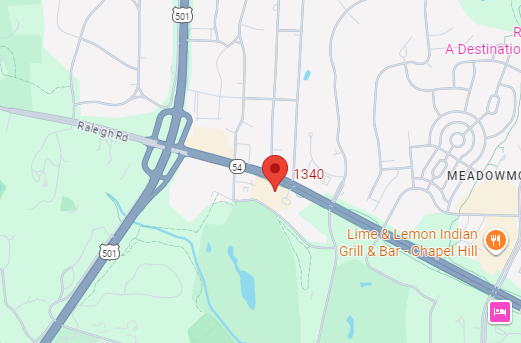
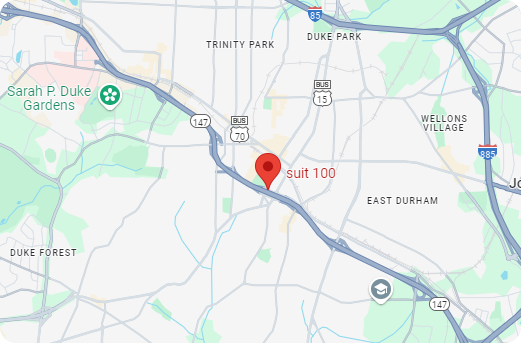
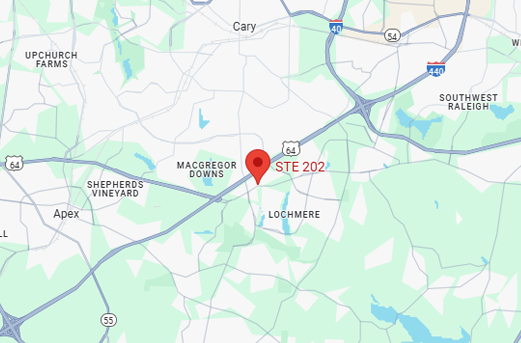
Patrick Roberts Law serves clients from offices in Raleigh, Durham, Chapel Hill, and Cary. If you are facing child pornography charges or expect to be charged, contact the firm to discuss your case.
The law firm limits the volume of active cases to ensure that their staff can provide consistent, comprehensive attention to every matter they handle.
Disclaimer: The information on this website is for general informational purposes only. Nothing herein should be taken as legal advice for any individual case or situation. Contacting us via this website, email, or contact form does not create an attorney-client relationship. Case results depend on a variety of factors unique to each case; prior results do not guarantee a similar outcome.
Former assistant district attorney
Contact Patrick Roberts
Facing criminal charges in North Carolina demands seasoned representation. Trust in the experience and dual perspective of Patrick Roberts. Reach out today for a confidential consultation.
-
Call Our Team
Calls answered 24/7






For more information on the selection criteria, go to www.martindale.com
*Each case is different and must be evaluated separately. Prior results achieved do not guarantee similar results can be achieved in future cases.