
Few criminal accusations carry the immediate, devastating weight of solicitation of a child by computer charges. In Cary—a community where nearly 70% of adults hold bachelor’s degrees and thousands work in positions requiring security clearances at companies like Lockheed Martin, SAS Institute, and Epic Games—these charges threaten to destroy everything you’ve built. Your career, your family relationships, your standing in a community known for its safety and family-oriented character: all of it hangs in the balance from the moment an investigation begins.
North Carolina prosecutes these offenses under N.C. Gen. Stat. § 14-202.3, a statute that criminalizes using computers or electronic devices to arrange sexual contact with minors. What makes these cases particularly complex is that Cary Police Department operates the only dedicated Cyber Intelligence Unit among the Triangle’s four major police departments—a specialized team focused specifically on identifying online offenders and investigating child exploitation cases. Understanding what you’re facing requires experienced defense counsel who has handled these matters from both sides of the courtroom. Patrick Roberts’ years as a prosecutor handling sex crime cases gives him direct insight into how the state builds these prosecutions and where weaknesses in the evidence may exist.
What Does North Carolina Law Define as Solicitation of a Child by Computer?
What Elements Must Prosecutors Prove to Secure a Conviction?
Wake County prosecutors must establish several specific elements beyond a reasonable doubt to secure a conviction under G.S. 14-202.3. The statute requires proof that the defendant was 16 years of age or older and knowingly, with the intent to commit an unlawful sex act, enticed, advised, coerced, ordered, or commanded another person to meet for the purpose of committing that unlawful sex act. The communication must have occurred through a computer or any device capable of electronic data storage or transmission.
North Carolina courts have interpreted “entice” and “advise” broadly. Having prosecuted these cases, Patrick Roberts understands that prosecutors typically argue any effort to arrange a sexual meeting with someone believed to be underage falls within the statute’s scope—even without explicit promises or inducements. This broad interpretation means that conversations Cary residents might dismiss as mere online fantasy can form the basis for serious felony charges.
Does the Alleged Victim Have to Be an Actual Child?
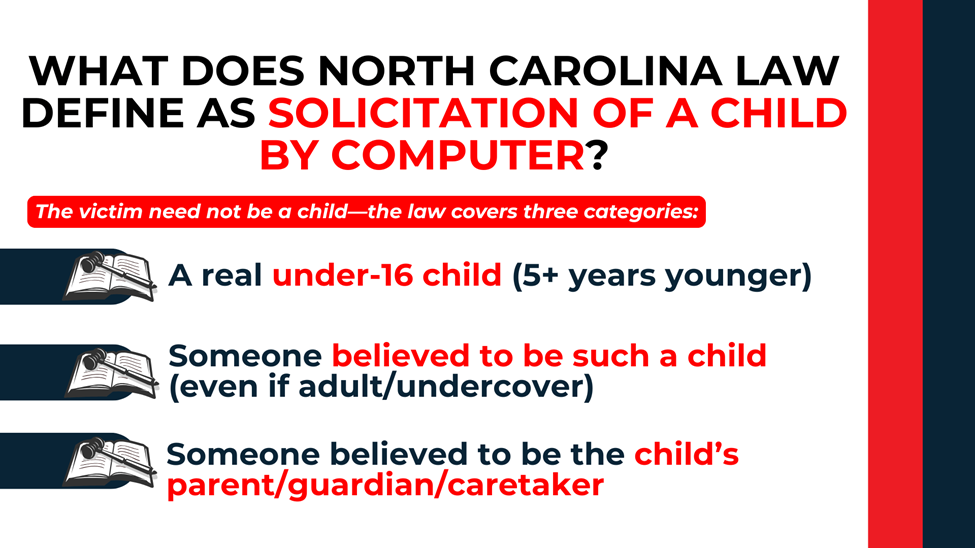
One of the most critical aspects of this statute is that the alleged victim does not need to be an actual child. The law covers three distinct categories of individuals:
- An actual child who is less than 16 years of age and at least five years younger than the defendant
- A person the defendant believes to be a child meeting those age requirements, even if that person is actually an adult (such as an undercover officer)
- A person the defendant believes to be the parent, guardian, or caretaker of such a child
This means that undercover operations conducted by Cary Police Department’s Cyber Intelligence Unit or federal task forces can result in charges even when no actual minor was ever involved in the communications. Many solicitation prosecutions in Wake County arise from precisely these undercover scenarios.
What Electronic Devices Fall Under This Statute?
The statute applies to computers and “any other device capable of electronic data storage or transmission.” This expansive language covers smartphones, tablets, gaming consoles with messaging capabilities, and any other device used for electronic communication. In Cary’s tech-driven environment—where residents often have multiple connected devices including work-issued laptops and phones—the scope of potential evidence is vast. Text messages, social media direct messages, dating app conversations, and communications through gaming platforms all fall within the statute’s reach.
How Do Cary Police and Wake County Prosecutors Investigate These Cases?
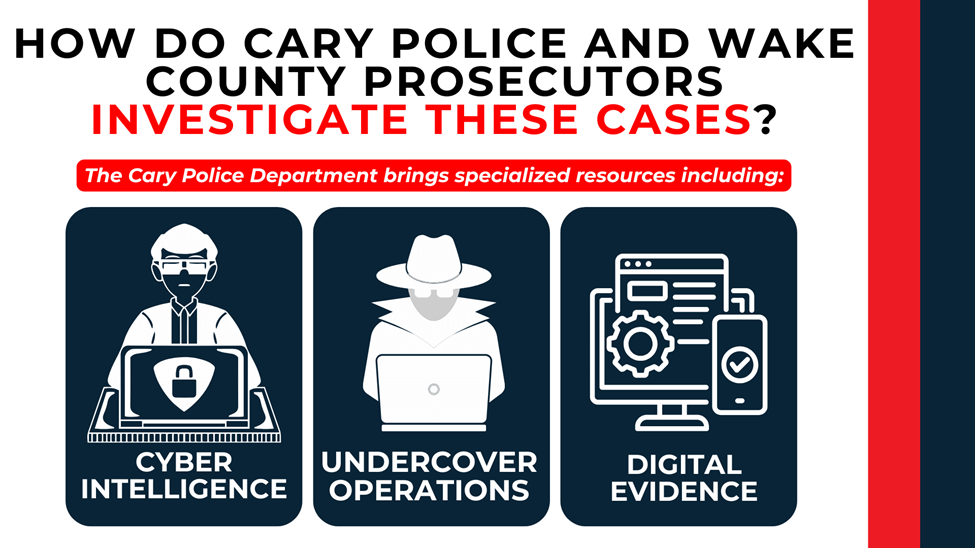
What Role Does Cary’s Cyber Intelligence Unit Play in These Investigations?
Unlike Raleigh, Durham, or Chapel Hill, the Cary Police Department maintains a dedicated Cyber Intelligence Unit with particular expertise in online offender identification and child exploitation investigations. This team proactively works to identify potential offenders rather than simply responding to reports after the fact. For Cary residents, this means these investigations often begin before any suspect knows they are under scrutiny.
To counter the technical methods used by Cary’s specialized units, Attorney Patrick Roberts utilizes a defense strategy informed by high-level training:
- Advanced Cross-Examination Skills: In 2025, Mr. Roberts completed a 3-day intensive hands-on training with the National Criminal Defense College (NCDC). This program focuses on advanced techniques to challenge the credibility of digital witnesses and investigators who rely on “Cyber Intelligence” to build their cases.
- Procedural Insight: His training through the National Association of Criminal Defense Lawyers (NACDL)—including multiple seminars focused on defending complex digital and sex-crime cases—provides critical insight into how these proactive investigations unfold. He knows where procedural gaps in digital evidence collection typically exist.
Credentials Prepared for Complex Investigations
Mr. Roberts’ standing in the legal community is built on more than two decades of handling serious cases in Wake County and federal courts:
- 2026 AV Preeminent® Peer Rated Attorney: Martindale-Hubbell’s highest rating for legal ability and ethics, held for more than 5 consecutive years.
- 2026 Client Champion Platinum: Recognized for more than 5 consecutive years for excellence in client communication and support during high-stakes investigations.
- 10/10 “Superb” AVVO Rating: Maintained for over 15 years, reflecting a long-term commitment to defense excellence.
A Strategic Advantage in Intent Defense
The statute requires proof that a defendant acted “knowingly” and “with the intent to commit an unlawful sex act.” Understanding how the Wake County District Attorney’s office approaches intent arguments—and having handled these cases from the prosecution side—allows for strategic defense planning.
As the only North Carolina attorney listed on the NCADRC website at falseallegation.org as of December 2025, Attorney Patrick Roberts applies his training to challenge cases where the evidence of intent may be ambiguous or where allegations may not reflect actual criminal conduct.
A Powerful Presence in State and Federal Courts
Attorney Patrick Roberts provides effective representation that extends beyond local North Carolina courtrooms. His ability to navigate complex legal hurdles is backed by his admission to practice before the most influential courts in the country. This respected legal standing ensures that whether your case remains in Wake County or moves into the federal system, you are represented by an advocate recognized by the highest levels of the American judiciary.
Admissions and Jurisdictions
- U.S. Supreme Court: Admitted to practice before the highest court in the nation.
- Fourth Circuit Court of Appeals: Admitted to handle complex federal appellate matters.
- All Federal District Courts in North Carolina: Providing a fearless defense in the Eastern, Middle, and Western Districts.
How Do Undercover Operations Typically Work?
Many solicitation cases in Wake County originate from undercover operations where law enforcement officers pose as minors in online environments. Officers may create profiles on social media platforms, dating apps, or chat rooms, then engage in conversations with individuals who initiate contact. These operations often involve officers from Cary PD’s Special Victims Unit coordinating with the North Carolina State Bureau of Investigation’s Cyber Crimes Unit and federal task forces like Operation Southern Impact or the Internet Crimes Against Children task force.
The conversations are meticulously documented, with officers trained to allow the suspect to direct the conversation toward sexual topics and meeting arrangements. Understanding these tactics is essential for mounting an effective defense.
What Digital Evidence Will Prosecutors Try to Use Against You?
In Cary’s technology-driven community, digital evidence plays a central role in these prosecutions. Investigators typically seek to collect and analyze several categories of evidence:
- Complete chat logs and message histories from all platforms where communications occurred
- Device forensic analysis including deleted messages, browser history, and location data
- IP address records and account registration information
- Any images, videos, or files exchanged during communications
- GPS and cell tower data showing movement patterns, particularly if a meeting was arranged
For professionals working at tech companies like SAS or Epic Games, investigations may extend to work-issued devices. IT departments sometimes discover and report suspected communications, triggering investigations that involve both employer cooperation and law enforcement access to corporate systems.
What Are the Potential Penalties for a Conviction?
What Is the Difference Between Class H and Class G Felony Charges?
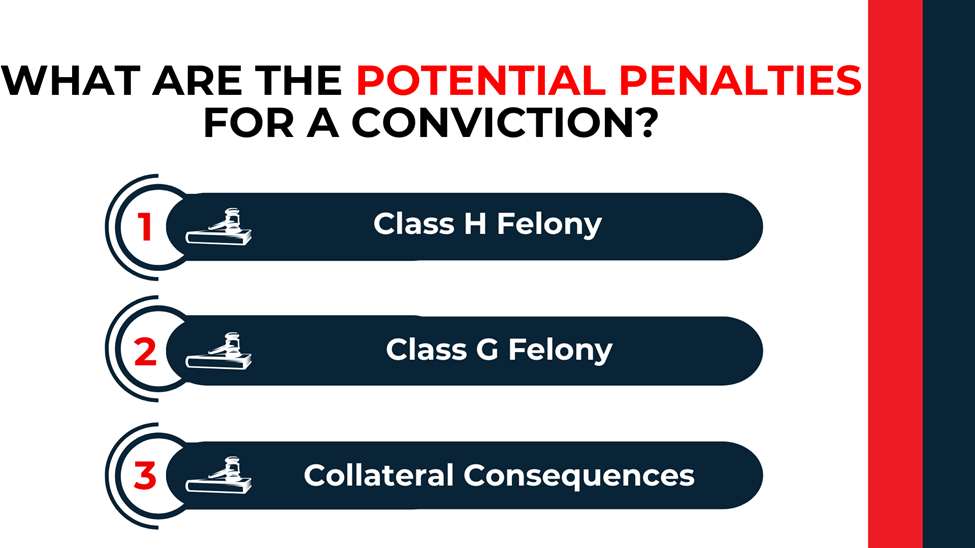
North Carolina classifies solicitation of a child by computer as either a Class H or Class G felony depending on specific circumstances. A standard violation—where communications occurred but no meeting took place—constitutes a Class H felony. However, if either the defendant or any other person for whom the defendant was arranging the meeting actually appears at the meeting location, the charge elevates to a Class G felony.
This distinction carries significant implications for Cary residents facing these charges. Wake County Superior Court handles all felony matters, and the difference between Class H and Class G classifications affects potential sentencing ranges, probation terms, and long-term consequences.
How Does Appearing at the Meeting Location Affect the Charges?
The elevation from Class H to Class G felony when someone appears at the meeting location reflects the legislature’s view that showing up demonstrates more concrete intent. From a defense perspective—and drawing on advanced training from the National Criminal Defense College—this distinction creates important strategic considerations. Some federal courts have found that when defendants never appear at a meeting location and make no unmistakable preparations like booking travel or reserving hotel rooms, evidence of actual intent may be insufficient. While North Carolina courts have sometimes reached different conclusions, the appearance issue remains a significant factor in case evaluation.
What Collateral Consequences Apply Beyond Prison Time?
For Cary professionals, the consequences extending beyond potential incarceration often prove most devastating. A conviction triggers sex offender registration requirements that follow you for decades. Security clearances held by employees at Lockheed Martin and other defense contractors are revoked immediately upon charge—often before any trial occurs. Professional licenses in fields from healthcare to financial services face suspension or revocation.
The median household income of $129,399 that supports Cary families depends on careers that a conviction would permanently destroy. For the 22% of Cary residents who are foreign-born—many working in the tech sector on employment visas—a conviction carries immigration consequences including deportation.
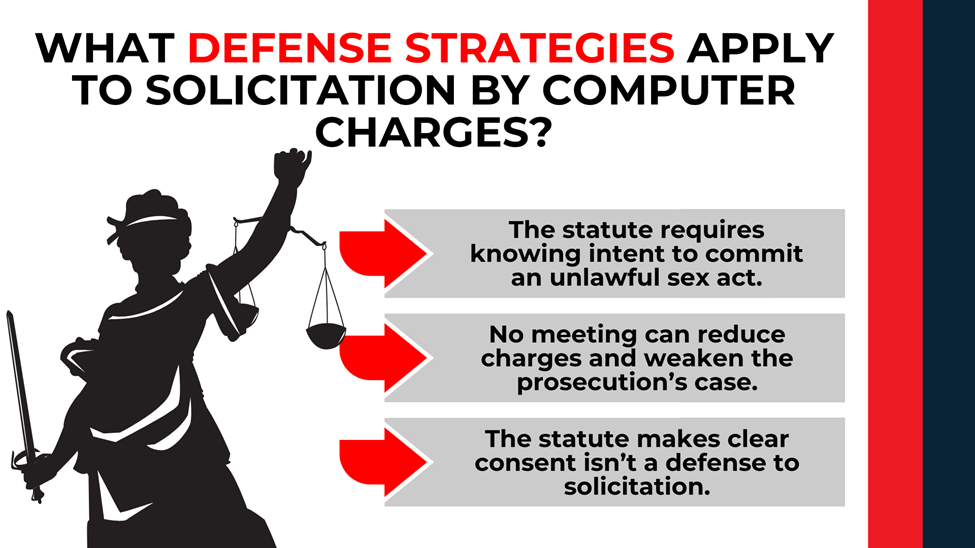
What Defense Strategies Apply to Solicitation by Computer Charges?
Can Lack of Intent Be a Valid Defense?
Under North Carolina law, the state must prove that a defendant acted “knowingly” and “with the intent to commit an unlawful sex act.” This intent element is a critical component of the prosecution’s case. Communications that could be characterized as fantasy, role-playing, or lacking a genuine intent to meet in person may not satisfy the statutory requirements for a conviction.
Attorney Patrick Roberts uses creative defense techniques to challenge the State’s narrative regarding intent. His approach is supported by a deep background in criminal litigation, including:
- Advanced Cross-Examination Training: In 2025, Mr. Roberts completed a 3-day intensive hands-on training with the National Criminal Defense College (NCDC), focusing exclusively on advanced cross-examination techniques. This training is designed to help attorneys effectively dismantle weak or ambiguous testimony in court.
- Unique Registry Distinction: As the only North Carolina attorney listed on the NCADRC website at falseallegation.org as of December 2025, Mr. Roberts brings focused training to cases where accusations may not align with actual conduct.
- Prosecutorial Insight: Understanding how the Wake County District Attorney’s office builds intent arguments allows for fearless strategic planning that anticipates the State’s likely responses.
What If No Meeting Actually Occurred?
The absence of an actual meeting affects both the severity of charges and the strength of the prosecution’s case. Some courts have found that online communications alone, without concrete steps toward a meeting, may constitute mere “hot air” rather than criminal solicitation. While North Carolina courts have sometimes upheld charges even without meetings, the distinction remains relevant for defense strategy and potential negotiations with Wake County prosecutors.
Defense approaches may focus on demonstrating that communications never progressed beyond online discussion, that no concrete meeting arrangements were made, or that the defendant took no real-world steps suggesting genuine intent to follow through.
Why Doesn’t Consent Provide a Defense Under This Statute?
The statute explicitly states that consent is not a defense to solicitation charges. This provision eliminates arguments that the purported minor agreed to or initiated the sexual discussions or meeting arrangements. Even if an undercover officer actively encouraged the conversations or suggested meeting, this cannot form the basis for a consent defense.
However, this limitation makes other defense strategies more critical. Potential approaches include:
- Challenging the sufficiency of evidence establishing the required elements
- Questioning the reliability or completeness of digital evidence
- Examining whether entrapment principles may apply to aggressive undercover tactics
- Analyzing whether communications actually rise to the level of “enticing” or “advising” under the statute’s requirements
- Investigating procedural violations in the investigation or evidence collection
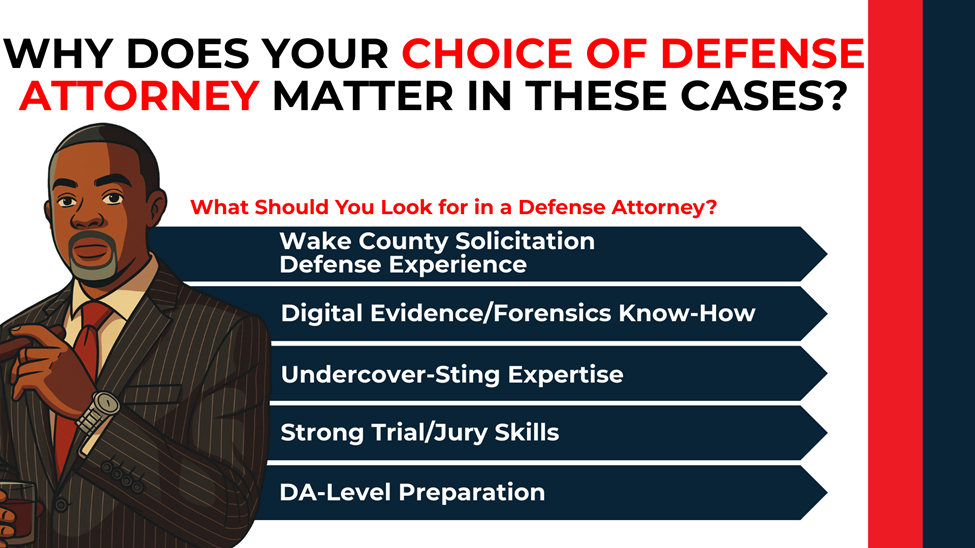
Why Does Your Choice of Defense Attorney Matter in These Cases?
What Should You Look for in a Defense Attorney for These Charges?
Solicitation cases involve complex intersections of technology, psychology, and criminal law. Effective defense requires an attorney who understands digital forensics, knows how undercover operations function, and can navigate the specialized procedures Wake County courts apply to sex offense cases. The Wake County District Attorney’s office has prosecutors who handle these matters regularly, and defense counsel must match their experience and preparation.
Attorney Patrick Roberts’ training at Gerry Spence’s Trial Lawyers College—where he was mentored directly by one of America’s most accomplished trial advocates—shapes his methodology for humanizing clients facing serious allegations. In cases where Cary residents’ reputations and futures are at stake, this unique approach to storytelling allows for an effective connection with juries, ensuring your side of the story is heard with clarity and impact.
How Does Prosecutorial Experience Benefit Your Defense?
Having served as a prosecutor handling sex crime cases, Attorney Patrick Roberts understands how the state constructs these prosecutions. He knows what evidence prosecutors prioritize, how they prepare witnesses, and where their cases may be vulnerable to challenge. This perspective—combined with ongoing advanced training in cross-examination techniques through the National Criminal Defense College—allows him to anticipate prosecution strategies and develop effective responses.
For professionals whose careers at companies like MetLife, SAS, or defense contractors depend on resolving these matters, having defense counsel who has been on both sides of the courtroom provides a strategic advantage that generalist attorneys cannot offer.
Frequently Asked Questions
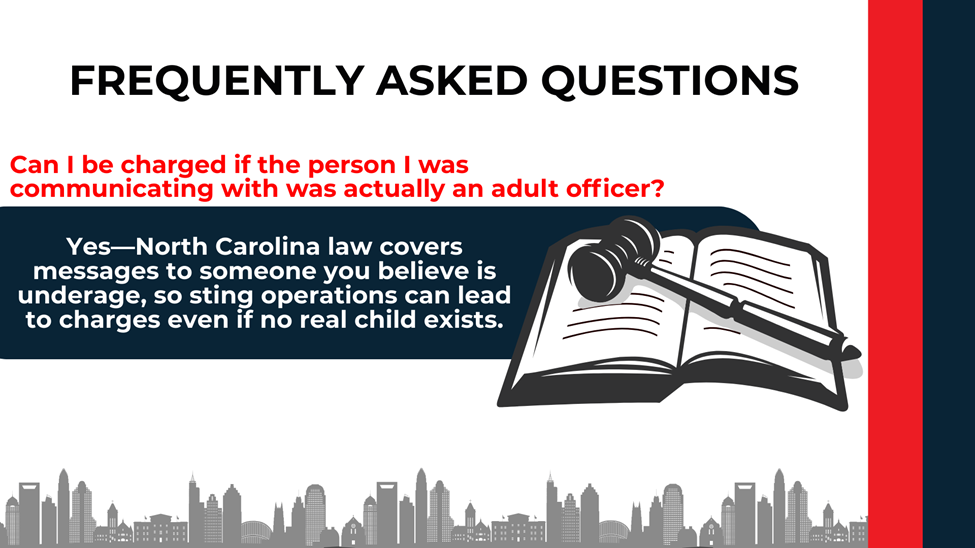
Can I be charged if the person I was communicating with was actually an adult officer?
Yes. North Carolina’s statute explicitly covers communications with a person the defendant believes to be an underage child, regardless of the person’s actual age. This means undercover operations where officers pose as minors can result in valid charges even though no actual child was ever involved.
Where will my case be prosecuted if I live in Cary?
Cary is located in Wake County, and all felony matters are handled in Wake County Superior Court at the Justice Center in Raleigh. The Wake County District Attorney’s office prosecutes these cases, often with prosecutors who focus specifically on sex offense matters.
Will I have to register as a sex offender if convicted?
A conviction for solicitation of a child by computer triggers sex offender registration requirements under North Carolina law. These requirements affect where you can live, work, and travel, and remain in effect for extended periods following conviction.
What should I do if Cary police want to question me about online communications?
You have the right to remain silent and the right to have an attorney present during any questioning. Politely decline to answer questions and contact a defense attorney immediately. Statements made during police questioning can significantly impact your case.
How quickly should I contact a defense attorney? Immediately. Early involvement of defense counsel allows for preservation of potentially exculpatory evidence, prevents harmful statements to investigators, and begins building your defense strategy before charges are formalized.
Protect Your Future with Experienced Defense
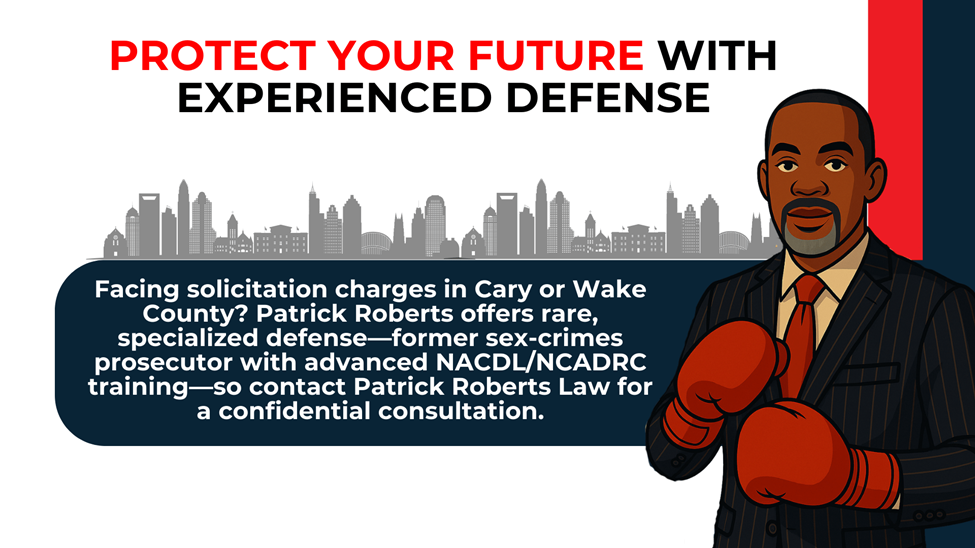
When you’re facing solicitation charges in Cary, you need a fearless defense counsel who understands these cases from every angle. Attorney Patrick Roberts brings a rare combination of prosecutorial experience with sex crime cases, rigorous training at NACDL and NCADRC, advanced cross-examination skills from the National Criminal Defense College, and the trial advocacy methods learned at Gerry Spence’s Trial Lawyers College. As the only North Carolina attorney listed on falseallegation.org‘s registry of NCADRC-trained defenders, he offers the specific trial focus that matters in these high-stakes cases.
Serving Cary residents and families throughout Wake County, Attorney Patrick Roberts understands what’s at stake for your career, your family, and your future. Contact Patrick Roberts Law today for a confidential consultation about your case.
Professional Peer Endorsement
“Patrick is an extremely talented lawyer who has the highest ethical standards. He works extremely hard for his clients and is a very skilled adversary in court. Patrick’s expertise in the field, experience in the courtroom and professionalism are the reasons he is my top recommendation. He is trustworthy, reliable and highly esteemed by his peers.”* — Peer review from a fellow attorney via Martindale-Hubbell on October 29, 2018
Disclaimer: The testimonials and peer reviews on this site are for informational purposes. They do not constitute a guarantee, warranty, or prediction regarding the outcome of your legal matter. Every case is different and must be evaluated on its own merits.
*Testimonials and peer endorsements found on this website are actual comments.
Disclaimer: The information on this website is for general information purposes only. Nothing on this site should be taken as legal advice for any individual case or situation. Case results depend upon a variety of factors unique to each case. Prior results do not guarantee a similar outcome.
Former assistant district attorney
Contact Patrick Roberts
Facing criminal charges in North Carolina demands seasoned representation. Trust in the experience and dual perspective of Patrick Roberts. Reach out today for a confidential consultation.
-
Call Our Team
Calls answered 24/7






For more information on the selection criteria, go to www.martindale.com
*Each case is different and must be evaluated separately. Prior results achieved do not guarantee similar results can be achieved in future cases.