

If you’re facing accusations of being an accessory to murder in North Carolina, you need to understand how state law treats these serious charges. The consequences can be severe, and the legal distinctions between different types of accessory charges can dramatically affect your case outcome.
What Is an Accessory to Murder in North Carolina?
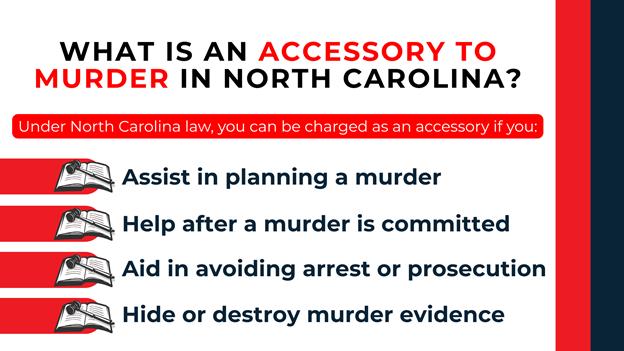
An accessory to murder is someone who helps another person commit murder or assists them after the crime occurs. North Carolina law divides accessories into two distinct categories with very different legal consequences.
Under North Carolina law, you can be charged as an accessory if you:
- Help plan or facilitate a murder before it happens
- Provide assistance to someone after they’ve committed murder
- Help a murderer avoid arrest or prosecution
- Conceal evidence of a murder
The key distinction lies in when you provided assistance—before or after the murder occurred. This timing determines whether you face the same charges as the actual killer or reduced charges as an accessory after the fact.
What’s the Difference Between Accessory Before and After the Fact?
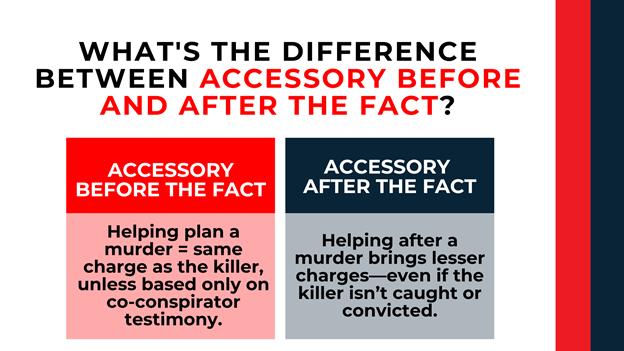
North Carolina treats accessories before the fact and accessories after the fact completely differently under the law.
Accessory Before the Fact
According to N.C. Gen. Stat. § 14-5.2, North Carolina has abolished all distinctions between accessories before the fact and principals. This means if you helped plan a murder, provided the weapon, or assisted in any way before the crime occurred, you face the same charges as the person who actually committed the murder.
The statute specifically states: “Every person who heretofore would have been guilty as an accessory before the fact to any felony shall be guilty and punishable as a principal to that felony.” This applies whether the murder is classified as first degree (N.C. Gen. Stat. § 14-17(a)) or second degree (N.C. Gen. Stat. § 14-17(b)).
However, there’s one important exception in N.C. Gen. Stat. § 14-5.2: if someone is convicted of capital murder based solely on uncorroborated testimony from co-conspirators or other accessories, the charge reduces to a Class B2 felony.
Accessory After the Fact
Being an accessory after the fact is treated as a separate, less serious offense under N.C. Gen. Stat. § 14-7. If you helped someone after they committed murder—such as helping them hide, destroying evidence, or lying to police—you face reduced charges compared to the actual murderer.
The law allows prosecutors to charge you as an accessory after the fact even if:
- The principal murderer hasn’t been convicted yet
- The principal murderer can’t be brought to trial
- The principal murderer was acquitted
How Does North Carolina Punish Accessories to Murder?
The punishment for being an accessory to murder depends entirely on whether you acted before or after the murder occurred.
Punishment for Accessories Before the Fact
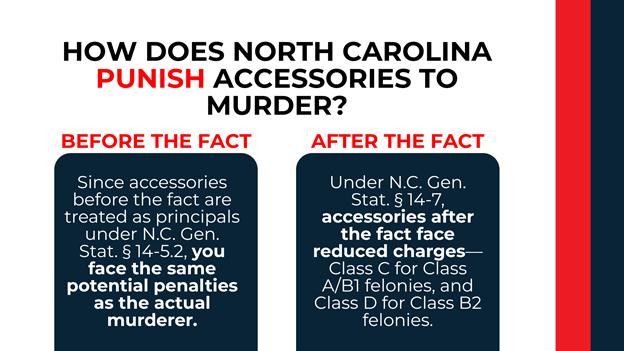
Since accessories before the fact are treated as principals under N.C. Gen. Stat. § 14-5.2, you face the same potential penalties as the actual murderer:
- For first-degree murder: Class A felony charges
- For second-degree murder: Class B1 or B2 felony charges
These are among the most serious charges in North Carolina’s criminal code, carrying the possibility of life imprisonment or other severe penalties.
Punishment for Accessories After the Fact
Under N.C. Gen. Stat. § 14-7, accessories after the fact face reduced charges based on a specific formula:
- Accessory after the fact to Class A felony (first-degree murder): Class C felony
- Accessory after the fact to Class B1 felony (most second-degree murder): Class C felony
- Accessory after the fact to Class B2 felony (certain second-degree murder): Class D felony
While these charges still carry serious consequences including potential prison time, they represent a significant reduction from murder charges.
What Must Prosecutors Prove for an Accessory to Murder Charge?
For prosecutors to convict you as an accessory to murder, they must prove specific elements beyond a reasonable doubt. The required proof differs based on when you allegedly provided assistance.
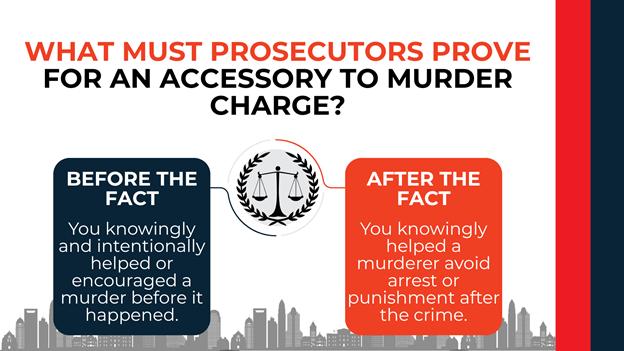
Elements for Accessory Before the Fact
Since you’re charged as a principal under N.C. Gen. Stat. § 14-5.2, prosecutors must prove:
- A murder occurred
- You knowingly assisted, encouraged, or facilitated the murder
- You acted with intent to help commit the crime
If prosecutors cannot prove you knew about the planned murder or intended to help, the charges may not stand. Similarly, if your actions were too remote or insignificant to constitute actual assistance, this could serve as a defense.
Elements for Accessory After the Fact
For charges under N.C. Gen. Stat. § 14-7, prosecutors must establish:
- Someone committed murder
- You knew the person committed murder
- You provided assistance to help them avoid arrest or punishment
- You acted with intent to help the murderer escape justice
The prosecution must show you had actual knowledge that murder occurred. If you helped someone without knowing they committed murder, or if you were coerced into helping, these circumstances could provide viable defenses.
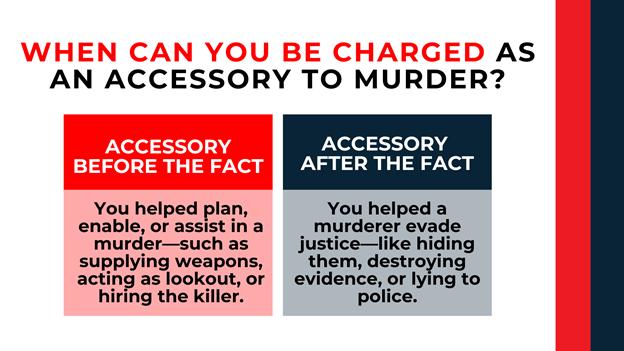
When Can You Be Charged as an Accessory to Murder?
Understanding when accessory charges apply helps clarify the boundaries of criminal liability for murder in North Carolina.
Common Scenarios for Accessory Before the Fact Charges
You might face principal murder charges under N.C. Gen. Stat. § 14-5.2 if you:
- Planned or conspired to commit murder
- Provided weapons knowing they’d be used for murder
- Acted as a lookout during the crime
- Drove the getaway car
- Hired someone to commit murder
Common Scenarios for Accessory After the Fact Charges
Accessory after the fact charges under N.C. Gen. Stat. § 14-7 typically involve:
- Helping someone flee after a murder
- Hiding or destroying evidence
- Providing false alibis to police
- Harboring someone you know committed murder
- Lying to investigators about the crime
The key distinction remains timing—any assistance provided before or during the murder makes you a principal, while help provided afterward makes you an accessory after the fact.
What Happens If the Principal Isn’t Convicted?
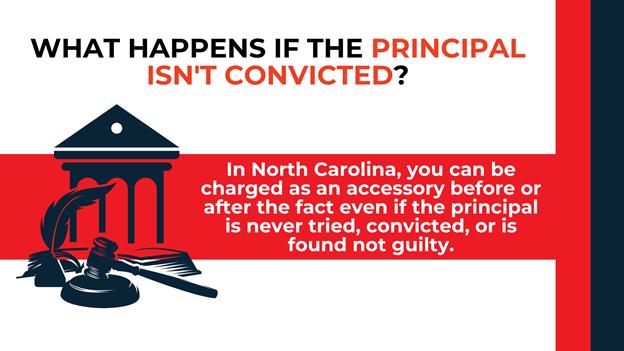
One unique aspect of North Carolina’s accessory laws is that your fate doesn’t depend on what happens to the principal murderer. According to N.C. Gen. Stat. § 14-7, you can be prosecuted as an accessory after the fact regardless of whether the principal:
- Has been convicted
- Will ever be brought to trial
- Was found not guilty
This means even if the actual murderer is acquitted or never caught, you can still face accessory charges if prosecutors prove you provided assistance. However, prosecutors still must prove that a murder actually occurred and that you knowingly helped the perpetrator.
For accessories charged as principals under N.C. Gen. Stat. § 14-5.2, the same principle applies—your case proceeds independently of the actual killer’s case.
Can You Face Murder Charges Without Being Present?
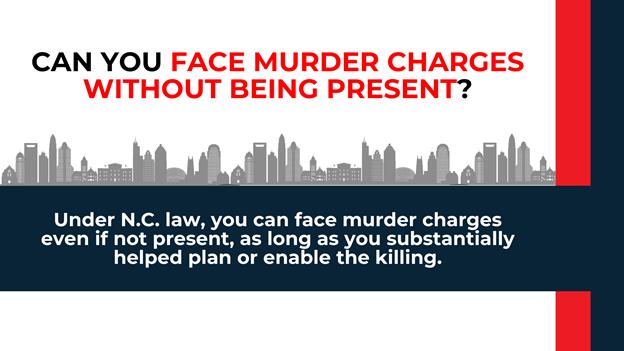
Yes, under North Carolina law, you don’t need to be present at the scene to face murder charges. If you helped plan or facilitate a murder beforehand, N.C. Gen. Stat. § 14-5.2 treats you as equally guilty as the person who pulled the trigger.
This principle reflects North Carolina’s view that those who help plan murders bear equal moral and legal responsibility for the death. Courts recognize that organizing or enabling a murder from afar can be just as culpable as being present during the killing.
However, the prosecution must still prove your involvement was substantial enough to warrant criminal liability. Mere knowledge of a planned crime, without any action to assist, typically isn’t enough for conviction.
Why You Need Immediate Legal Representation
Accessory to murder charges in North Carolina carry life-altering consequences. Whether you’re charged as a principal or as an accessory after the fact, you face the possibility of significant prison time and a permanent criminal record.
The complexities of North Carolina’s accessory laws—particularly the distinction between acting before versus after the murder—make experienced legal representation essential. The difference between being charged under N.C. Gen. Stat. § 14-5.2 versus N.C. Gen. Stat. § 14-7 can mean the difference between facing murder charges or significantly reduced charges.
Attorney Patrick Roberts has extensive experience handling serious criminal cases throughout North Carolina.* His thorough understanding of state criminal law helps clients navigate these complex charges and work toward the best possible outcome.
Don’t wait to get help. Early intervention by an attorney can make a crucial difference in how your case develops. Contact Patrick Roberts Law today to discuss your situation and learn about your legal options. Time is critical when facing accessory to murder charges, and having skilled legal representation from the start protects your rights throughout the legal process.

*Disclaimer: Each case is different and must be evaluated separately. Prior results achieved do not guarantee similar results can be achieved in future cases.
Former assistant district attorney
Contact Patrick Roberts
Facing criminal charges in North Carolina demands seasoned representation. Trust in the experience and dual perspective of Patrick Roberts. Reach out today for a confidential consultation.
-
Call Our Team
Calls answered 24/7









For more information on the selection criteria, go to www.martindale.com
*Each case is different and must be evaluated separately. Prior results achieved do not guarantee similar results can be achieved in future cases.