
A strangulation charge in North Carolina is a Class H felony under N.C.G.S. § 14-32.4(b) — not a misdemeanor, regardless of whether the alleged victim has visible injuries. That single fact changes everything about the penalties, the process, and what’s at stake long after the case ends.
This page covers what the charge means under North Carolina law, why the felony classification catches people off guard, what the actual potential sentences look like, the permanent consequences that follow a conviction, and what realistic defense options exist.
What Does a Strangulation Charge Actually Mean in North Carolina?
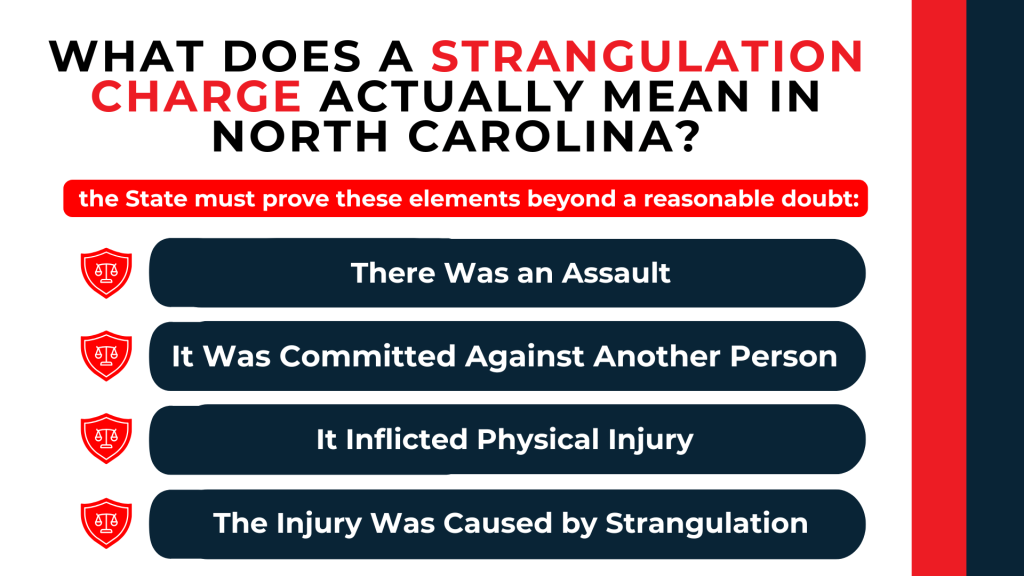
Under N.C.G.S. § 14-32.4(b), a person commits assault by strangulation when they assault another person and inflict physical injury by strangulation. The statute is short. But it contains four distinct elements the State must prove beyond a reasonable doubt: that there was an assault, that it was committed against another person, that it inflicted physical injury, and that the injury was caused by strangulation.
Two of those four elements — “strangulation” and “physical injury” — are not defined anywhere in the statute itself. Their meaning comes from case law and the North Carolina Pattern Jury Instructions.
The pattern jury instruction (N.C.P.I.—Crim. 208.61) defines strangulation as a form of asphyxia caused by closure of the blood vessels and/or air passages of the neck as a result of external pressure. That pressure can come from hanging, a ligature, or manual force applied to the neck. The definition does not require complete airway closure or a complete inability to breathe. Evidence that sufficient pressure was applied to the throat to cause difficulty breathing is enough.
This matters because most people hear “strangulation” and picture something extreme. The legal threshold is lower than the common understanding. Pressure on the neck that restricts breathing or blood flow — even briefly, even without loss of consciousness — can satisfy the element.
Why Is Strangulation a Felony When There’s Barely a Mark?
This is usually where the gap between expectation and reality hits hardest. Someone expecting a misdemeanor domestic violence charge learns they are facing a felony, and the reason is the physical injury threshold under this statute.
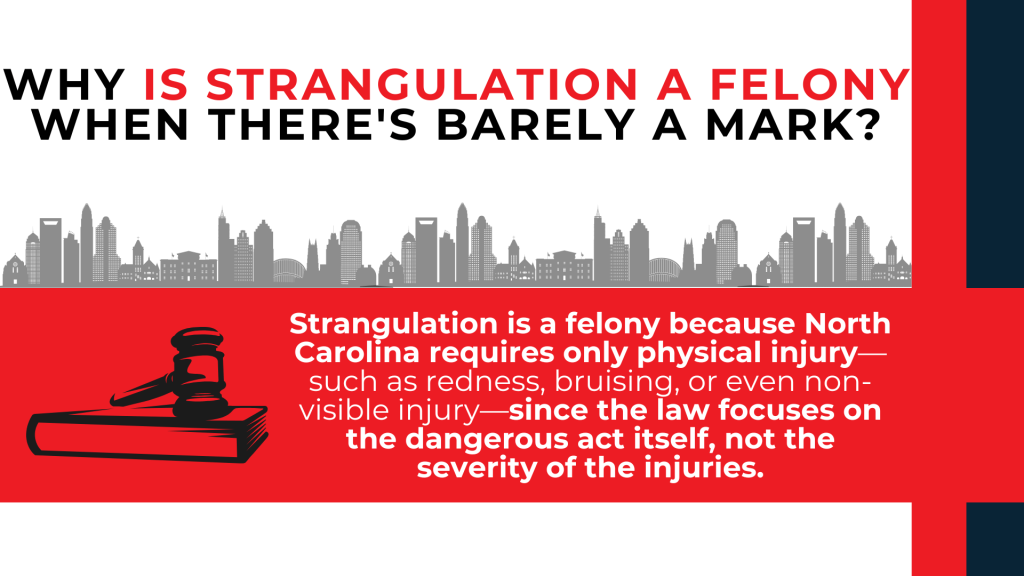
The physical injury required for a strangulation conviction is not “serious injury” and not “serious bodily injury.” It is simply “physical injury.” The parallel definition in G.S. § 14-34.7(c) explains this standard: cuts, scrapes, bruises, or other physical injury that does not constitute serious injury. North Carolina courts have found sufficient physical injury from cuts and bruises, petechiae (small broken blood vessels in the eyes or skin), redness, soreness, blurred vision, and difficulty swallowing. Courts have also recognized that physical injury may exist even where no injuries are externally visible.
To put that in context, consider where strangulation sits on North Carolina’s assault severity ladder. Simple assault is a Class 2 misdemeanor with no felony injury element. Assault inflicting serious injury is a Class A1 misdemeanor requiring a higher injury showing. Assault by strangulation jumps to a Class H felony while requiring only “physical injury” — the lowest injury standard in the felony range. Above it, assault inflicting serious bodily injury is a Class F felony. That charge requires proof of injury creating a substantial risk of death, serious permanent disfigurement, coma, a permanent or protracted condition that causes extreme pain, permanent or protracted loss or impairment of the function of a bodily member or organ, or prolonged hospitalization.
The legislature drew the line where it did deliberately. Strangulation requires only minimal physical evidence for felony treatment because the act itself, not the severity of the resulting injury, is what the statute targets.
What Kind of Prison Time Does a Class H Felony Carry?
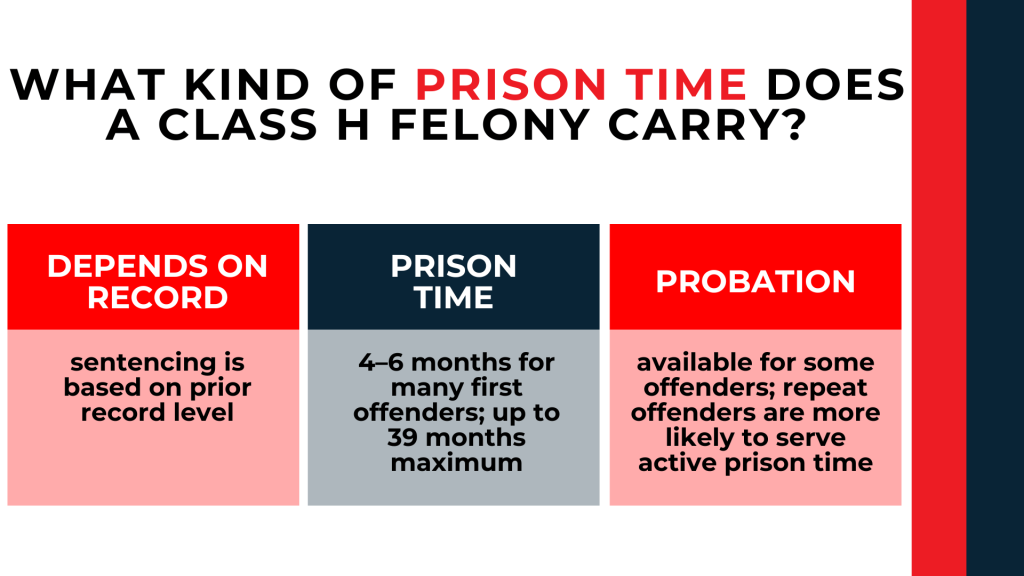
North Carolina sentences felonies under the Structured Sentencing Act, which sets punishment based on two variables: the offense class and the defendant’s prior record level. Prior record levels run from Level I (little or no criminal history) to Level VI (extensive history). Each prior Class H or I felony conviction adds 2 points, and each prior Class A1 or Class 1 misdemeanor adds 1 point.
For a Class H felony at Prior Record Level I, the presumptive sentencing range is a 5 to 6 month minimum, with the mitigated range starting at 4 months. At the other end of the spectrum, the absolute statutory maximum for any Class H felony is 39 months, which is a Level VI aggravated sentence. Each cell on the sentencing grid also designates a disposition type: community, intermediate, or active. That designation determines whether the sentence can be served on probation or must be served in custody. Community and intermediate dispositions (both probation-based) are available at lower prior record levels, while active time becomes mandatory at Prior Record Level VI.
Probation conditions in these cases commonly include supervised probation, substance-abuse or domestic-violence treatment, potential periods of short-term confinement, electronic monitoring, and restitution. A fine may also be imposed at the court’s discretion.
Across all North Carolina felonies in FY2024, 40% of sentences were active (incarceration), 36% were intermediate, and 24% were community. And it is worth understanding how these cases typically resolve: only about 2% of all North Carolina felony convictions resulted from jury trials in FY2024 — 498 out of 26,577. The vast majority were resolved through guilty pleas. For Class G, H, and I felonies specifically, the jury trial rate drops to roughly 1%. That does not mean trial is off the table, but it does mean the negotiation and preparation that happen before trial often determine the outcome.
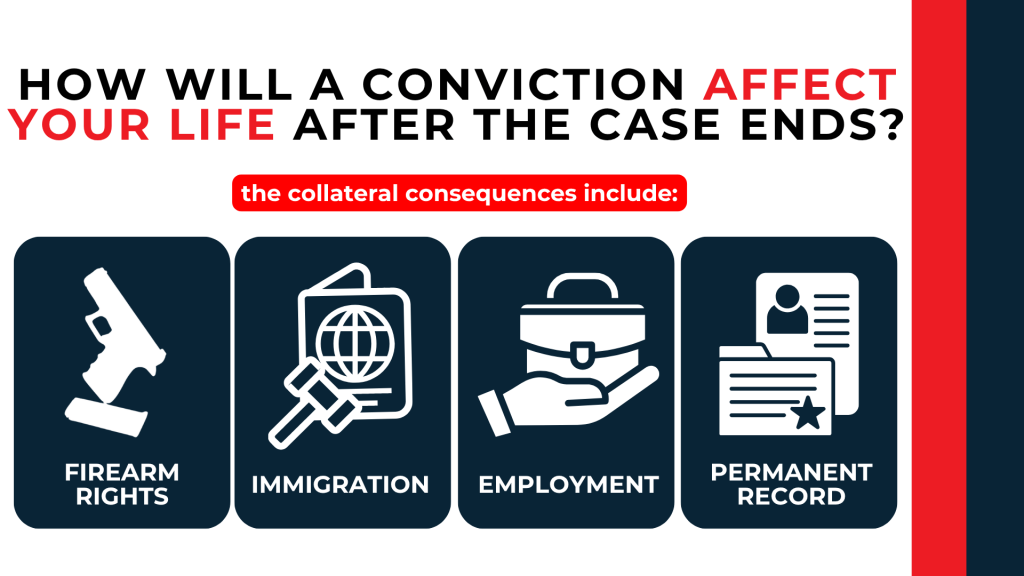
How Will a Conviction Affect Your Life After the Case Ends?
A strangulation conviction is a felony conviction, and in North Carolina, the collateral consequences extend well beyond whatever sentence the court imposes.
Firearms. A felony conviction triggers the federal firearms ban under 18 U.S.C. § 922(g)(1), which bars possession of firearms and ammunition. When the offense involves a domestic relationship, the Lautenberg Amendment under 18 U.S.C. § 922(g)(9) imposes a separate lifetime ban on firearms and ammunition. Section 922(g)(8) also bars firearm possession by anyone subject to a qualifying protective order. The 2022 Bipartisan Safer Communities Act expanded domestic-relationship coverage to include dating partners. North Carolina state law under G.S. § 14-415.1 independently bars felons from possessing, purchasing, owning, or controlling firearms.
Immigration. The Fourth Circuit held in U.S. v. Rice, 36 F.4th 578 (4th Cir. 2022), that North Carolina’s assault inflicting physical injury by strangulation is categorically a crime of violence. United States v. Robinson, 92 F.4th 531 (4th Cir. 2024), confirmed that holding remains binding. The immigration consequences that result from this classification are severe. The offense can be treated as an aggravated felony under 8 U.S.C. § 1101(a)(43)(F) when a sentence of one year or more is imposed. For immigration purposes, a felony’s maximum term is what matters. That means even a suspended sentence can trigger this classification. It is separately deportable as a crime of domestic violence under 8 U.S.C. § 1227(a)(2)(E) when committed against a victim in a qualifying domestic relationship. This distinguishes strangulation from simple assault or assault on a female, which the Fourth Circuit has held are not crimes of violence because they can be committed through mere culpable negligence.
Professional licensing. Under G.S. § 93B-8.1, a North Carolina licensing board may deny a license based on a conviction. The board can act when the criminal history is directly related to the occupation’s duties, or when the crime is violent or sexual in nature. An assault-by-strangulation conviction fits the latter category. The Nursing Practice Act, for example, expressly lists Article 8 assaults — which includes § 14-32.4 — among offenses related to fitness to practice.
Criminal record. This conviction is generally not eligible for expunction under current North Carolina law and makes you ineligible for other expungements that might otherwise be available.
The sentence itself may end. These consequences, in most cases, do not.
What Defenses Work Against a Strangulation Charge?
The realistic options depend entirely on the facts, and understanding which defenses actually apply to this specific charge matters.
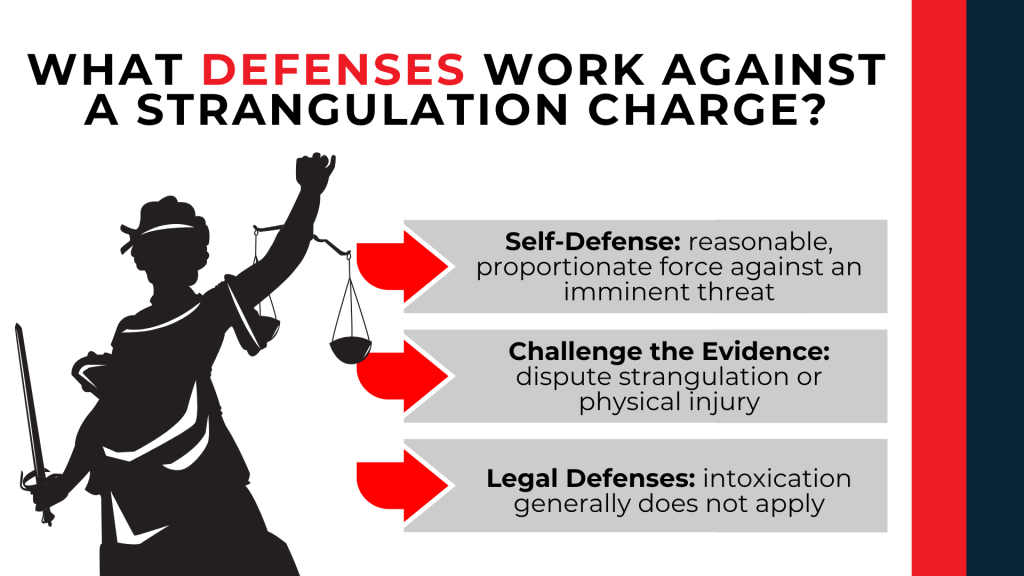
Self-defense and defense of others. North Carolina’s self-defense statute, N.C.G.S. § 14-51.3, authorizes the use of force — including in defense of another person — when the person reasonably believes the force is necessary to defend against the imminent use of unlawful force. North Carolina imposes no duty to retreat from any place a person is lawfully present. The same statute authorizes deadly force where a person reasonably believes it is necessary to prevent imminent death or great bodily harm.
The critical requirements are imminence and proportionality. The threat must be happening or about to happen — not something that occurred earlier or might happen later. The force used must also be proportionate to the threat as it existed at the moment. In a strangulation prosecution, the practical question is whether your actions were a proportionate, necessary response to an imminent threat you reasonably perceived.
Challenging the elements. Because “strangulation” and “physical injury” are undefined in the statute and interpreted through case law, there is room to challenge both elements. The two challenges that most often matter are whether the pressure applied actually constituted strangulation as opposed to incidental neck contact, and whether any qualifying physical injury resulted. Both challenges are heavily evidence-driven. Photographs of the neck and surrounding area, the complainant’s testimony about pain or difficulty breathing, medical records, and any petechiae evidence all factor in. Evidence preservation and early investigation directly affect the strength of these challenges.
What typically does not work. Assault by strangulation is a general-intent crime. The Fourth Circuit confirmed in Rice that the offense requires intentional, knowing, or purposeful conduct. But the prosecution does not need to prove you intended a specific injury. Intent is shown by deliberate rather than accidental conduct. Because it is a general-intent offense, voluntary intoxication is essentially unavailable as a defense under North Carolina law. Even in the rare cases where voluntary intoxication applies to specific-intent crimes, you would need to show you were utterly incapable of forming intent — not merely impaired or intoxicated.
The strength of any defense depends on facts that can shift or disappear quickly. Witness recollections change. Physical evidence fades. The earlier the facts are investigated and preserved, the more options remain available.
Do I Need a Lawyer for a Strangulation Charge?
A Class H felony with potential prison time, a permanent criminal record, federal firearms restrictions, possible immigration consequences, and professional licensing implications is not a charge that resolves favorably on its own. Decisions made in the first days after an arrest — in early interactions with law enforcement and the court — shape the course of the entire case. Many of those decisions happen before you fully understand what you are facing.
Patrick Roberts is a Raleigh criminal defense attorney and former prosecutor who has handled thousands of criminal cases across North Carolina. His experience as an Assistant District Attorney in Wake, Johnston, and New Hanover counties means he understands how strangulation cases are built, charged, and evaluated from the prosecution’s side — and where they are vulnerable. He is a graduate of Duke University School of Law (Top 9 in criminal law for year 2026), Gerry Spence’s Trial Lawyers College, the National Criminal Defense College Trial Practice Institute, and the White Collar Criminal Defense College, and has been recognized among the Top 100 Trial Lawyers by The National Trial Lawyers.
Client Review
“I cannot speak highly enough of Mr. Patrick Roberts. From the moment we connected over the phone, he demonstrated confidence, support, and a sharp analytical mind, providing our family with much-needed reassurance during one of the most difficult periods in our lives.
Mr. Roberts took the time to fully understand our situation and walked us through various scenarios regarding how he could defend our case—which he ultimately won. What sets Mr. Roberts apart is his combination of legal expertise, in-depth knowledge of judicial procedures, and genuine compassion for his clients. He goes above and beyond to ensure your needs are met. I am incredibly grateful for his services and highly recommend him to anyone needing legal representation.” – Verified client review via Avvo.com
Peer Endorsement
“I have had the challenge of working with Atty Roberts when he served as Asst. District Atty in Wake Co. and have worked closely with him as fellow defense counsel. As an ADA, I found him to be professional, reasonable and fair in every regard. He represented the State of North Carolina with integrity. As private counsel, his intelligence and knowledge of procedure and law has been even more impressive. Attorney Roberts is not your “run of the mill” lawyer. While he’s sharp and knows his stuff, he is also approachable and relates well with clients, colleagues, judges and courthouse personnel. He never, never walks away from a challenge. In the courtroom, his experience as both prosecutor and criminal defense attorney provides him with a unique perspective and ability to process each matter he handles quickly, efficiently and effectively. I highly recommend Attorney Roberts and place full confidence in his abilities.” – Verified peer endorsement via Avvo.com
Disclaimer: Testimonials and peer reviews are actual comments from clients and peers. They are for informational purposes only and do not guarantee or predict the outcome of your legal matter. Every case is unique and must be evaluated on its own merits.
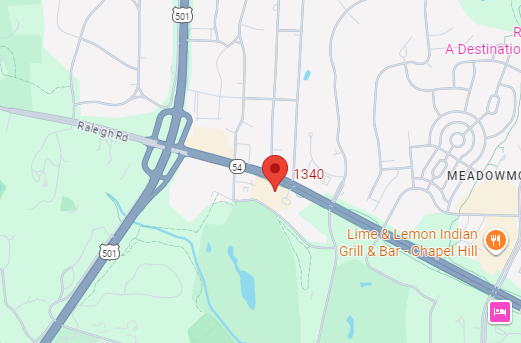
Patrick Roberts Law serves clients facing strangulation and domestic violence charges throughout the Triangle, with offices in Raleigh, Durham, Chapel Hill, and Cary. He maintains a dominant presence in Wake County—including Raleigh, Cary, Apex, Holly Springs, Garner, and Fuquay-Varina—while handling critical litigation in all North Carolina counties.
If you or someone close to you is facing a strangulation charge, the time to act is now — not after the next court date. Call Patrick Roberts Law at 919-746-7206 to discuss your case.
To maintain a high standard of service and thorough oversight for each client, the firm manages a restricted caseload.
Disclaimer: The information on this website is for general informational purposes only. Nothing herein should be taken as legal advice for any individual case or situation. Contacting us via this website, email, or contact form does not create an attorney-client relationship. Case results depend on a variety of factors unique to each case; prior results do not guarantee a similar outcome.
Former assistant district attorney
Contact Patrick Roberts
Facing criminal charges in North Carolina demands seasoned representation. Trust in the experience and dual perspective of Patrick Roberts. Reach out today for a confidential consultation.
-
Call Our Team
Calls answered 24/7








For more information on the selection criteria, go to www.martindale.com
*Each case is different and must be evaluated separately. Prior results achieved do not guarantee similar results can be achieved in future cases.