
Facing rape or statutory rape charges in Apex or anywhere in Wake County demands immediate clarity about what you’re up against. According to the NC Sentencing and Policy Advisory Commission’s FY 2024 Statistical Report, North Carolina courts recorded 431 Class B1 felony convictions, the most serious sex offense classification in a single fiscal year. These two charge types operate under fundamentally different legal frameworks, and understanding the distinction affects every aspect of your defense. Statutory rape focuses entirely on the alleged victim’s age, while forcible rape requires the State to prove force and lack of consent. This article breaks down the elements, penalties, and defense approaches for each offense category so you can understand exactly what prosecutors must prove and how a defense attorney can challenge their case.
What Is the Difference Between Statutory Rape and Forcible Rape in North Carolina?
North Carolina’s criminal code treats statutory rape and forcible rape as distinct offenses with different elements, defenses, and underlying legal theories. The NC State Bureau of Investigation’s 2024 Annual Summary Report documented 2,944 reported rape offenses statewide, reflecting the scope of prosecution activity across all rape categories. Understanding the distinction between these charges is essential because the available defenses and the State’s burden of proof differ significantly.
What Elements Must the State Prove For Forcible Rape?
Forcible rape under North Carolina law requires the State to prove specific elements beyond a reasonable doubt. The prosecution cannot secure a conviction simply by proving sexual contact occurred, they must establish both force and lack of consent as separate elements under the statutory scheme.
For a first-degree or second-degree forcible rape conviction, prosecutors must prove:
- Vaginal intercourse occurred between the defendant and the alleged victim
- The act was accomplished by force sufficient to overcome resistance or through fear, coercion, or threats
- The sexual act occurred against the will of the alleged victim
- For first-degree charges, an aggravating factor was present (such as use of a weapon, infliction of serious injury, or multiple perpetrators)
The North Carolina Supreme Court in State v. Alston, 310 N.C. 399 (1984), established that force must be specific to the charged act general fear from a prior relationship is insufficient. This means prosecutors cannot rely on the overall dynamics of a relationship but must prove force connected directly to the alleged offense.
How Do Statutory Rape Charges Differ From Forcible Rape?
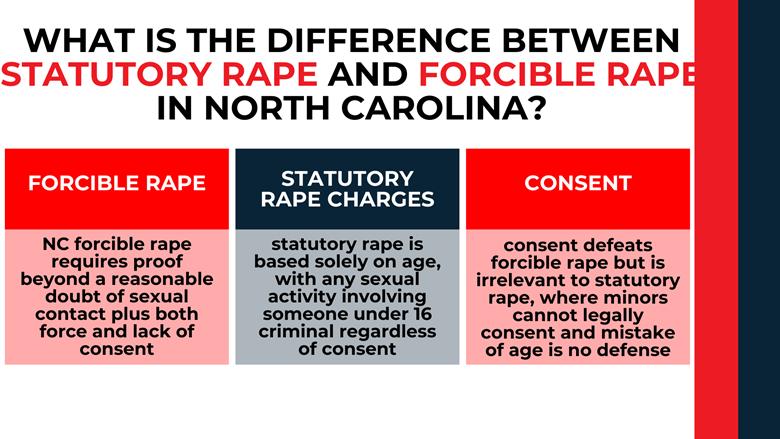
Statutory rape operates under an entirely different legal framework. These charges focus exclusively on the alleged victim’s age rather than force or consent. North Carolina’s age of consent is 16 years old, meaning sexual activity with anyone under 16 can result in statutory rape charges regardless of whether the minor agreed to participate.
The National Children’s Alliance Statistics Report documented 3,127 children reported for sexual abuse at North Carolina Children’s Advocacy Centers during a six-month period in 2023 illustrating the significant enforcement activity in cases involving minors.
Statutory rape charges are strict liability offenses. The State does not need to prove force, threats, or coercion. The prosecution’s burden is limited to proving the defendant engaged in sexual activity with someone below the statutory age.
Why Does Consent Matter For One Charge But Not the Other?
Consent serves as a complete defense to forcible rape charges because the “against the will” element requires proving the alleged victim did not consent. If the defense can establish the sexual activity was consensual, the State cannot meet its burden on this essential element.
For statutory rape, consent is legally irrelevant. The North Carolina Court of Appeals in State v. Breathette, 202 N.C. App. 697 (2010), confirmed that mistake of age is NOT a defense to statutory offenses. Even if a defendant genuinely believed the alleged victim was 16 or older, this belief provides no legal protection. The law presumes minors below the age of consent cannot legally agree to sexual activity.
How Does North Carolina Classify Statutory Rape Offenses?
North Carolina uses a tiered classification system for statutory rape based on the alleged victim’s age and the age differential between the defendant and the minor. The penalties increase dramatically as the victim’s age decreases and the age gap widens.
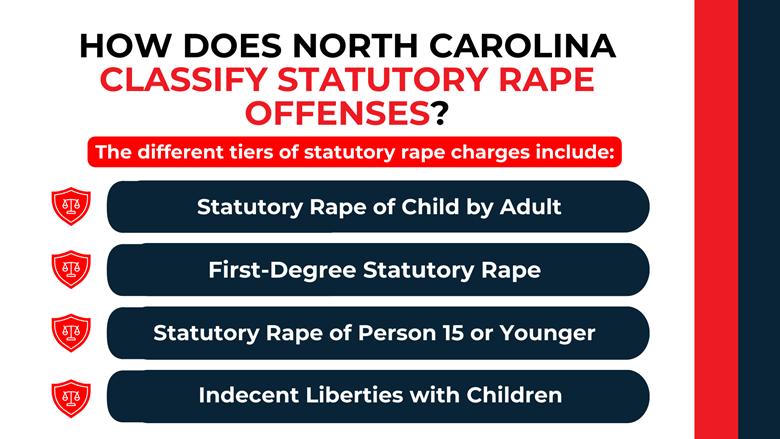
What Are the Different Tiers of Statutory Rape Charges?
North Carolina’s statutory rape scheme creates distinct offense classifications with corresponding penalties:
- Statutory rape of child by adult (N.C.G.S. § 14-27.23): Defendant is 18 or older, victim is under 13 Class B1 felony with a mandatory minimum of 300 months (25 years)
- First-degree statutory rape (N.C.G.S. § 14-27.24): Defendant is 12 or older and at least 4 years older than a victim under 13 Class B1 felony
- Statutory rape of person 15 or younger (N.C.G.S. § 14-27.25): Defendant is at least 12 and 6 or more years older than victim 15 or younger Class B1 felony; if victim is 15 and defendant is more than 4 but less than 6 years older Class C felony
- Indecent liberties with children (N.C.G.S. § 14-202.1): Defendant 16 or older and at least 5 years older than victim under 16 Class F felony
The age differential requirements in each tier determine both the applicable charge and the potential sentence.
What is North Carolina’s Age of Consent?
North Carolina sets the age of consent at 16 years old. Sexual activity with anyone under 16 can result in criminal charges, though the specific charge and penalty depend on both the victim’s exact age and the defendant’s age.
The law recognizes that younger victims require greater protection. A defendant who engages in sexual activity with a 12-year-old faces significantly more severe charges than one involving a 15-year-old, even though both situations involve minors below the age of consent.
Does North Carolina Have a Romeo and Juliet Law?
North Carolina provides limited close-in-age protections through its statutory structure rather than a separate “Romeo and Juliet” law. The age differential requirements built into each offense tier create some protection for relationships between teenagers close in age.
For example, under N.C.G.S. § 14-27.25, a defendant must be at least 6 years older than the victim to face a Class B1 felony when the victim is 15 or younger. Similarly, indecent liberties charges under N.C.G.S. § 14-202.1 require the defendant to be at least 5 years older than the victim.
However, these provisions are narrow. A 19-year-old who engages in sexual activity with a 14-year-old could still face serious felony charges despite being only 5 years apart in age. The statutory scheme does not provide blanket protection for all teenage relationships.
What Are the Degrees of Forcible Rape in North Carolina?
North Carolina distinguishes between first-degree and second-degree forcible rape based on the presence of aggravating factors. According to the NC Sentencing Commission’s FY 2024 report, Class B1 felonies which include first-degree rape have the highest jury trial rate (15%) of any felony class, with 85% resolving through guilty pleas.
What Makes Rape a First-Degree Felony in North Carolina?
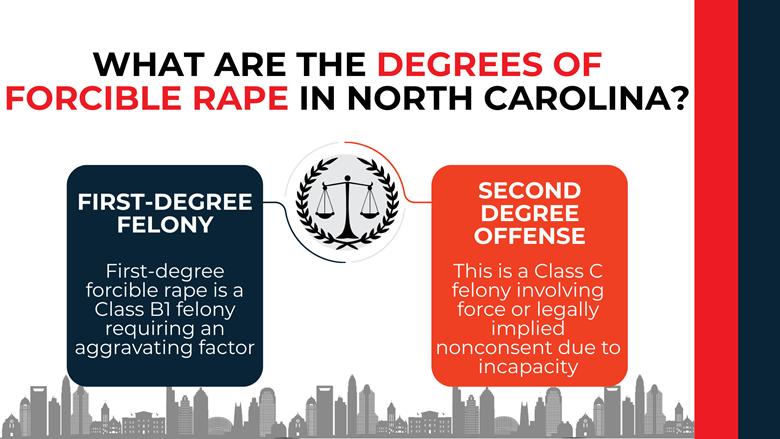
First-degree forcible rape under N.C.G.S. § 14-27.21 is a Class B1 felony the most serious classification for sex offenses. To elevate a rape charge to first-degree, the State must prove the presence of at least one aggravating factor beyond the basic elements of force and lack of consent.
Aggravating factors that elevate rape to first-degree include:
- The defendant employed or displayed a dangerous or deadly weapon or an article the victim reasonably believed to be a weapon
- The defendant inflicted serious personal injury upon the victim or another person
- The offense was committed with the aid of one or more other persons
- The victim was physically helpless or mentally incapacitated
Without one of these aggravating factors, prosecutors must charge the offense as second-degree rape.
When is Rape Charged as a Second-Degree Offense?
Second-degree forcible rape under N.C.G.S. § 14-27.22 is a Class C felony. This charge applies when the State can prove force and lack of consent but cannot establish any aggravating factor required for first-degree.
Second-degree rape also applies to incapacity-based prosecutions where the alleged victim was mentally disabled, mentally incapacitated, or physically helpless. In these cases, the State must prove the defendant knew or reasonably should have known of the victim’s condition. The North Carolina Supreme Court in State v. Moorman, 320 N.C. 387 (1987), held that force and consent are implied by law when the victim is sleeping or incapacitated.
What Penalties Do These Charges Carry in North Carolina?
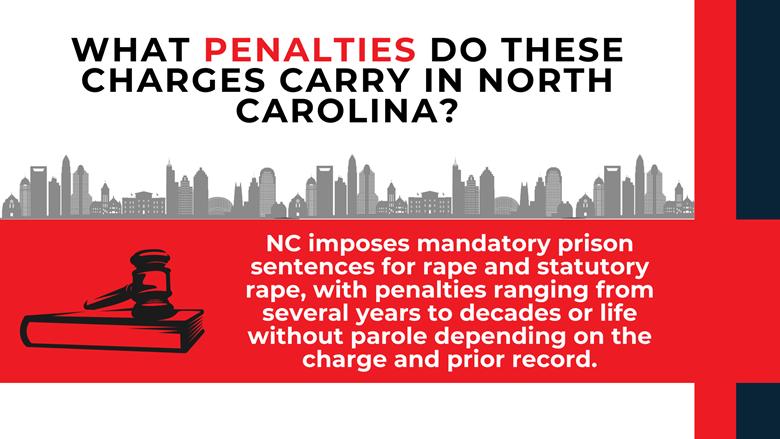
The penalties for rape and statutory rape convictions rank among the most severe in North Carolina’s criminal code. According to the NC Sentencing Commission, 100% of Class B1-D felony sex offense convictions result in active imprisonment probation or intermediate punishment is not an option.
What Sentences Do Statutory Rape Convictions Carry?
Statutory rape sentences depend on the specific charge classification and the defendant’s prior record level under Structured Sentencing:
- Class B1 statutory rape (child by adult, first-degree, or 6+ year age gap): Average sentences of 236-315 months (approximately 19.7 to 26.25 years)
- Statutory rape of child by adult (N.C.G.S. § 14-27.23): Mandatory minimum of 300 months (25 years) when defendant is 18+ and victim is under 13
- Class C statutory rape (15-year-old victim, 4-6 year age gap): Presumptive range of 58-73 months for a first-time offender
- Class F indecent liberties: Presumptive range of 13-16 months for a first-time offender, though active imprisonment is discretionary
The FY 2024 Sentencing Report documented one life without parole sentence imposed for a statutory sex offense with a child under 15 during the fiscal year.
How Are Forcible Rape Sentences Determined?
Forcible rape sentences follow NC’s Structured Sentencing grid based on offense class and prior record level:
- First-degree forcible rape (Class B1): Presumptive range of 192-240 months (16-20 years) for a first-time offender; can reach 300+ months with aggravating factors or prior record
- Second-degree forcible rape (Class C): Presumptive range of 58-73 months (approximately 5-6 years) for a first-time offender
The average sentence for all Class B1 felony convictions including both statutory and forcible rape was 236 months minimum to 315 months maximum according to FY 2024 data.
What Factors Increase or Decrease a Sentence?
North Carolina’s Structured Sentencing Act permits sentences in the presumptive, aggravated, or mitigated range based on case-specific factors. According to the NC Sentencing Commission, 8% of person offense convictions received aggravated sentences, the highest percentage among all crime types.
Sex offenses also carry an enhanced maximum sentence under N.C.G.S. § 15A-1340.17(f). For Class B1 through Class E felonies requiring sex offender registration, the maximum sentence equals 120% of the minimum plus 60 additional months. This formula significantly extends potential incarceration beyond standard ranges.
The defendant’s prior record level has substantial impact. A Prior Record Level I defendant faces dramatically different exposure than a Level VI defendant, even for identical charges.
How Do Defense Strategies Differ Between These Charges?
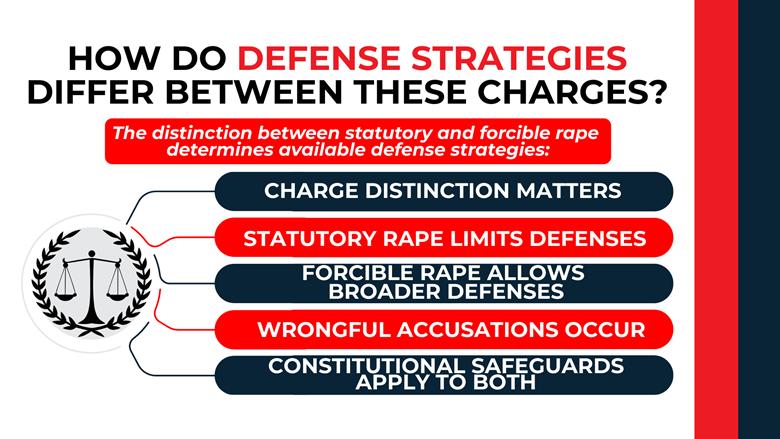
The fundamental difference between statutory rape and forcible rape shapes every aspect of defense strategy. What works for one charge type may be completely unavailable for the other.
Can Consent Be a Defense to Statutory Rape Charges?
No. Consent is not a legal defense to statutory rape in North Carolina. The law presumes that minors below the age of consent cannot legally agree to sexual activity, making the minor’s willingness irrelevant to the prosecution’s case.
The North Carolina Court of Appeals in State v. Breathette, 202 N.C. App. 697 (2010), specifically held that mistake of age is NOT a defense. Even evidence that the minor lied about their age, presented a fake ID, or appeared significantly older provides no legal protection.
Defense strategies for statutory rape must focus on other grounds:
- Challenging whether sexual activity actually occurred
- Disputing the alleged victim’s testimony through inconsistencies or credibility issues
- Verifying the alleged victim’s exact age and calculating age differentials precisely
- Investigating whether charges were filed under the correct statute
- Examining constitutional violations in evidence collection
How Can Defendants Challenge Forcible Rape Accusations?
Forcible rape defenses have more avenues available because the State must prove both force AND lack of consent. The defense can attack either element.
Effective defense approaches for forcible rape include:
- Consent defense: Presenting evidence the sexual activity was consensual, negating the “against the will” element
- Challenging the force element: Under State v. Alston, force must be specific to the charged act general relationship dynamics are insufficient
- Attacking witness credibility: NC does not require corroboration for victim testimony, but credibility challenges can create reasonable doubt
- Rape Shield exceptions: While NC Rule 412 limits evidence of the complainant’s sexual history, exceptions exist for prior sexual conduct with the defendant, evidence showing an alternative source of injury, and bias/motive evidence under State v. Martin, 241 N.C. App. 602 (2015)
- Constitutional challenges: Suppression of illegally obtained evidence, Miranda violations, or Confrontation Clause issues
The National Registry of Exonerations reports that 10% of all exonerations nationally are for sexual assault and 9% for child sex abuse underscoring the reality that wrongful accusations occur. Additionally, according to End Violence Against Women International, methodologically rigorous research places the false reporting rate for sexual assault at 2-8%.
What Constitutional Protections Apply to Both Charge Types?
Constitutional protections under the Fourth and Fifth Amendments apply equally to both statutory rape and forcible rape investigations.
Fourth Amendment protections require police to obtain warrants before searching cell phones and digital devices. The U.S. Supreme Court in Riley v. California, 573 U.S. 373 (2014), held that cell phone searches incident to arrest require a warrant. NC courts apply this standard, and evidence obtained through illegal searches may be suppressed.
Fifth Amendment protections require Miranda warnings before custodial interrogation. NC also mandates recording of interrogations for serious felonies under N.C.G.S. § 15A-211, including Class C sex offenses. Failure to record can support claims of involuntariness.
What Collateral Consequences Follow a Conviction?
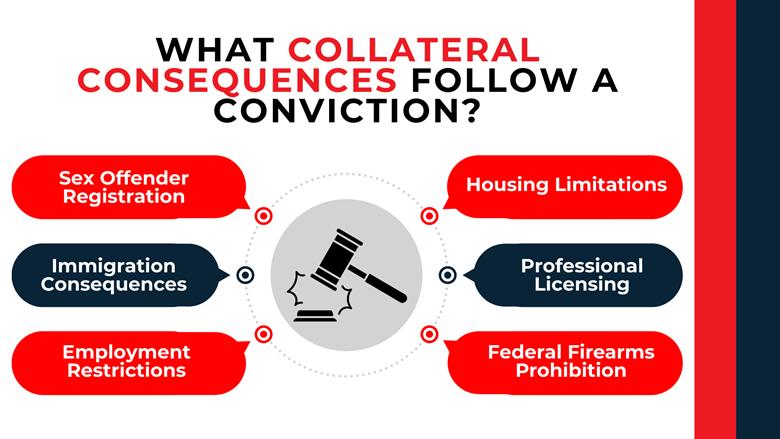
Beyond imprisonment, sex offense convictions trigger severe collateral consequences that extend far beyond the sentence. According to the NC SBI Sex Offender Registry, in 2025, North Carolina has approximately 28,200 registered sex offenders statewide, with 839 registered offenders in Wake County alone.
How Long Does Sex Offender Registration Last?
North Carolina’s Sex Offender Registry under N.C.G.S. § 14-208 et seq. requires registration for 30 years as the standard period. However, certain classifications require lifetime registration:
- Recidivists with prior sex offense convictions
- Aggravated offenders based on offense characteristics
- Sexually violent predators (SVP designation)
Defendants may petition for termination of registration after 10 years under N.C.G.S. § 14-208.12A if they do not fall into a lifetime registration category. The registration requirements include address verification, restrictions on where offenders can live and work, and GPS monitoring for certain offenders. According to NC Department of Adult Correction data, 581 sex offenders were enrolled in GPS electronic monitoring in FY 2022-2023.
What Other Consequences Follow a Conviction?
Sex offense convictions create lasting consequences beyond registration:
- Immigration consequences: Sexual abuse of a minor is an aggravated felony under federal law, triggering mandatory deportation for non-citizens. The U.S. Supreme Court in Padilla v. Kentucky, 559 U.S. 356 (2010), requires defense counsel to advise clients of immigration consequences before any plea
- Employment restrictions: Many professions require background checks, and sex offense convictions bar employment in education, healthcare, childcare, and other fields
- Housing limitations: Registered sex offenders face restrictions on where they can live, particularly near schools and childcare facilities
- Professional licensing: Convictions affect “good moral character” determinations for professional licenses
- Federal firearms prohibition: Felony convictions result in permanent loss of firearm rights
The NC Sentencing Commission reports that defendants convicted of Class B1 felonies spent an average of 27 months in pretrial detention before sentencing highlighting the immediate life disruption these charges create even before conviction.
Frequently Asked Questions
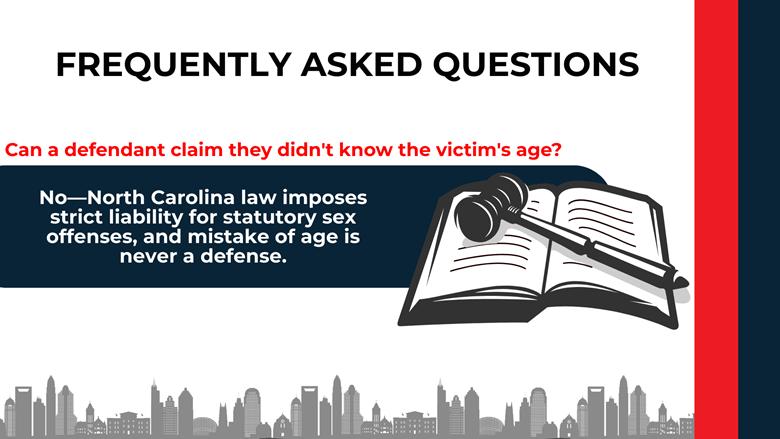
Can a defendant claim they didn’t know the victim’s age?
No. North Carolina courts have consistently held that mistake of age is not a defense to statutory sex offenses. In State v. Breathette, the Court of Appeals confirmed this rule applies to indecent liberties charges, and the same principle extends to statutory rape. Even if the alleged victim lied about their age or presented false identification, this provides no legal defense. The law imposes strict liability based on the victim’s actual age.
What if the alleged victim consented to the sexual activity?
Consent matters only for forcible rape charges. If someone faces statutory rape charges involving a minor under 16, the minor’s consent is legally irrelevant North Carolina law presumes minors cannot consent to sexual activity. For forcible rape charges involving adults, consent is a complete defense because the State must prove the act occurred “against the will” of the alleged victim.
How long do defendants typically wait in jail before trial?
According to NC Sentencing Commission data, defendants convicted of Class B1 felonies which includes serious rape charges spent an average of 27 months in pretrial detention. The median time from charge filing to sentencing for Class B1 felonies is 30 months, significantly longer than the 10-month median for all felonies. This extended timeline reflects the complexity of these cases and the difficulty of obtaining pretrial release.
Can statutory rape charges be reduced through plea bargaining?
While 98% of all NC felony convictions result from guilty pleas rather than trials, Class B1 felonies have the highest jury trial rate at 15%. This suggests defendants facing the most serious charges are more likely to proceed to trial. Plea negotiations depend on case-specific factors including the strength of evidence, the defendant’s prior record, and the prosecutor’s assessment. An experienced defense attorney can evaluate whether negotiation or trial offers the better path forward.
What happens if someone is falsely accused of rape in North Carolina?
False accusations, while representing a small percentage of reports, do occur and have devastating consequences. Defendants maintain the presumption of innocence, and the State bears the burden of proving every element beyond a reasonable doubt. Defense strategies focus on challenging the accuser’s credibility, identifying inconsistencies in testimony, presenting alibi evidence, and ensuring constitutional protections are enforced. NC law does not require corroboration for victim testimony, making vigorous cross-examination and independent investigation critical.
Protecting Your Future Against Serious Charges
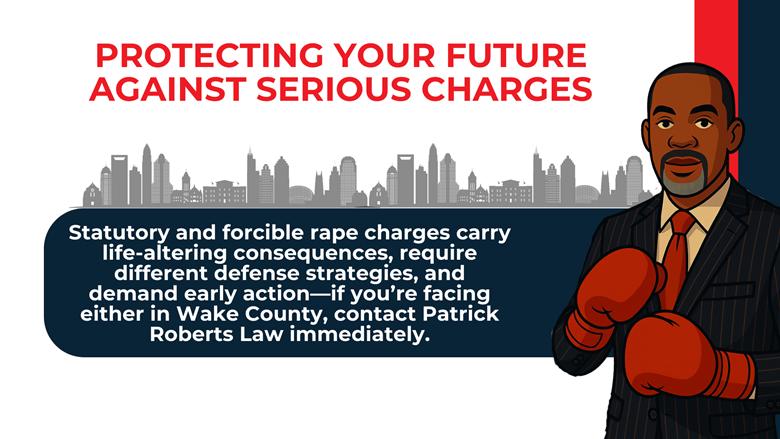
Both statutory rape and forcible rape charges carry life-altering consequences decades of potential imprisonment, mandatory sex offender registration, and permanent collateral effects on employment, housing, and relationships. The critical differences between these charge types determine what defenses are available and how the case should be approached.
Forcible rape charges require the State to prove force and lack of consent, creating opportunities to challenge both elements. Statutory rape charges eliminate consent as a defense entirely, requiring different strategic approaches focused on witness credibility, accurate age verification, and constitutional protections.
When facing allegations that carry life-altering penalties, the caliber of your legal representation is a critical factor in the protection of your rights. Attorney Patrick Roberts offers a defense informed by two decades of criminal law experience, including a perspective gained as a former prosecutor. This background allows him to analyze cases from both sides of the courtroom, developing strategic legal approaches tailored to the complexities of North Carolina’s state and federal courts. Having tried hundreds of bench and jury trials, Mr. Roberts is a dedicated advocate for the accused, a commitment reflected in his designation as a Martindale-Hubbell Client Champion Platinum recipient for over five consecutive years (2021–2026). In a legal system where your future is at stake, you deserve a seasoned trial lawyer who will provide a rigorous defense and uphold your right to a fair trial.
*Disclaimer: The information provided does not constitute a guarantee of outcome. Prior results do not guarantee a similar result in future cases.
“Patrick is an excellent lawyer and I trust him to handle my important legal matter.” – Peer review on November 2, 2018 via Martindale-Hubbell*
Disclaimer: The testimonials and peer reviews on this site are for informational purposes. They do not constitute a guarantee, warranty, or prediction regarding the outcome of your legal matter. Every case is different and must be evaluated on its own merits.
*Testimonials and peer endorsements found on this website are actual comments.
Disclaimer: The information on this website is for general information purposes only. Nothing on this site should be taken as legal advice for any individual case or situation. Case results depend upon a variety of factors unique to each case. Prior results do not guarantee a similar outcome.
Former assistant district attorney
Contact Patrick Roberts
Facing criminal charges in North Carolina demands seasoned representation. Trust in the experience and dual perspective of Patrick Roberts. Reach out today for a confidential consultation.
-
Call Our Team
Calls answered 24/7








For more information on the selection criteria, go to www.martindale.com
*Each case is different and must be evaluated separately. Prior results achieved do not guarantee similar results can be achieved in future cases.