
In North Carolina, “sexting” is not a specific legal term found in the criminal code. Instead, the state relies on aggressive felony sexual exploitation of a minor statutes—the same laws used to prosecute high-level child pornography cases. This means that a single digital image involving anyone under the age of 18 can instantly transition from a “teen mistake” into a Class C, E, or H felony.
Understanding this distinction is critical for parents, teenagers, and adults alike. Under N.C.G.S. § 14-190.16 and § 14-190.17, prosecutors do not distinguish between “consensual sexting” and exploitation. If a minor is depicted, the law treats the creation, possession, or distribution of that image as a serious sex offense.
What Charges Can Sexting Lead To in North Carolina?
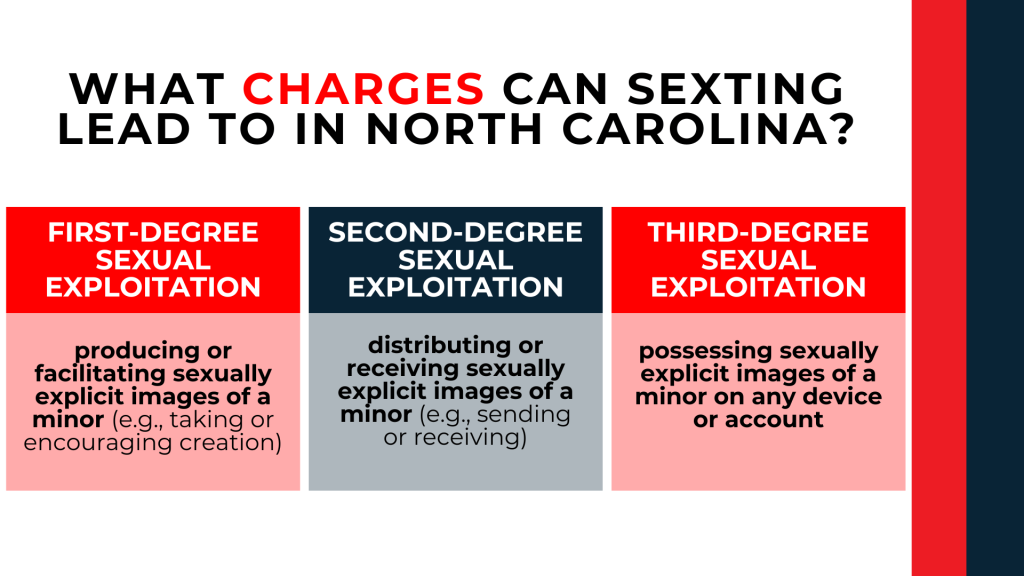
Because North Carolina has no standalone “sexting” statute, law enforcement utilizes the state’s three-tiered sexual exploitation of a minor system. These charges are governed by N.C.G.S. § 14-190.16 through § 14-190.17A.
All three tiers are classified as felonies, and the specific charge depends on whether the material was produced, distributed, or simply possessed.
The Three-Tiered Felony System for Digital Images
1. First-Degree Sexual Exploitation (Production)
- Statute: N.C.G.S. § 14-190.16
- Conduct: Producing or facilitating sexually explicit material involving a minor. This includes taking a photo of a minor or convincing a minor to take one.
- Classification: Class C or D Felony.
- Sentence: 38 to 182 months in state prison.
2. Second-Degree Sexual Exploitation (Distribution)
- Statute: N.C.G.S. § 14-190.17
- Conduct: Distributing, sending, or receiving sexually explicit digital images of a minor.
- Classification: Class E Felony.
- Sentence: 15 to 63+ months in state prison.
3. Third-Degree Sexual Exploitation (Possession)
- Statute: N.C.G.S. § 14-190.17A
- Conduct: Simply possessing an image of a minor on a phone, cloud account, or device.
- Classification: Class H Felony.
- Sentence: 5 to 29 months in state prison.
Critical Sentencing and Legal Facts
| Fact Category | Data & Consequences |
| Incarceration Rate | 100% of defendants convicted of Class B1 through D felony sex offenses in FY 2024 received active prison time (per the NC Sentencing Commission). |
| Case Duration | High-level sex offense cases carry a median timeline of 30 months from charge to sentencing. |
| “Mistake of Age” | Legally not a defense. The state only needs to prove you knew the content of the image, not the age of the person in it. |
The “Knowing” Requirement
Under North Carolina law, the “knowing” element refers to the defendant’s knowledge of the character or content of the material. This creates a high burden for the defense, as prosecutors do not have to prove that the defendant intended to exploit a child—only that they knowingly possessed or sent the digital file.
Can a Teenager Be Charged With a Felony for Sexting?
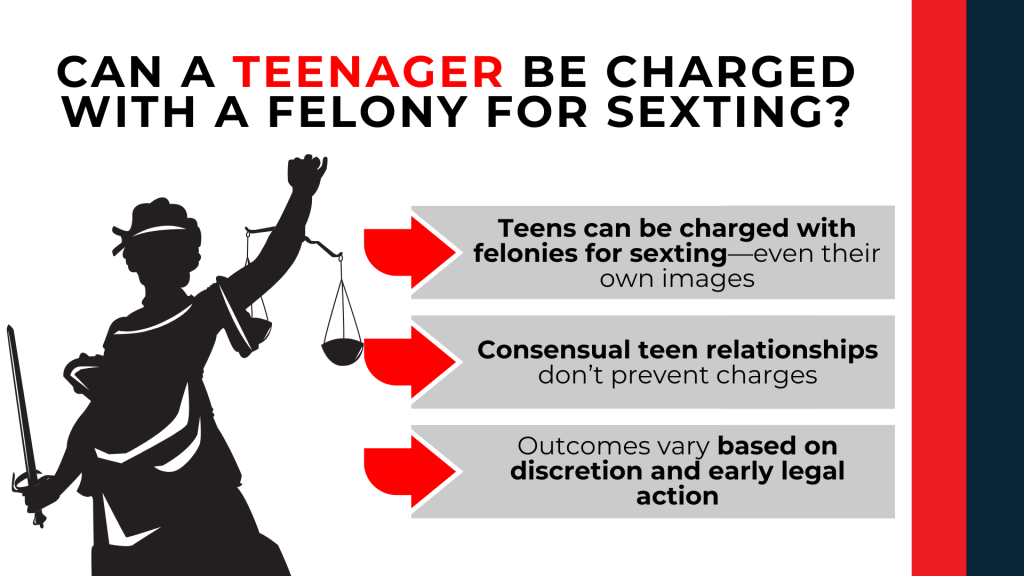
Yes. North Carolina law permits minors to be prosecuted under these same sexual exploitation statutes — including for images they created of themselves.
A 16- or 17-year-old who takes a sexually explicit selfie and sends it to a boyfriend or girlfriend can be charged with both producing and distributing sexually explicit material involving a minor. The minor in the image and the person facing charges are the same person. The recipient — even if they are the same age and in a consensual relationship — can be charged with possession.
North Carolina has limited close-in-age protections for certain sexual contact offenses. For example, N.C.G.S. § 14-202.2 creates a separate Class 1 misdemeanor for indecent liberties when the defendant is under 16 and the child is at least three years younger. But no equivalent protection exists for sexting. There is no Romeo-and-Juliet exception, no diversion program written into the exploitation statutes, and no reduced charge category for consensual image-sharing between teenagers.
Whether a teenager is actually charged as an adult, handled in the juvenile system, or diverted depends heavily on prosecutorial discretion. That discretion varies by county, by district attorney, and by the specific facts of the case. It is exactly why early legal intervention matters. The difference between a juvenile petition and an adult felony prosecution is not automatic. It is negotiated.
What About Adults Involved in Sexting With Someone Under 18?
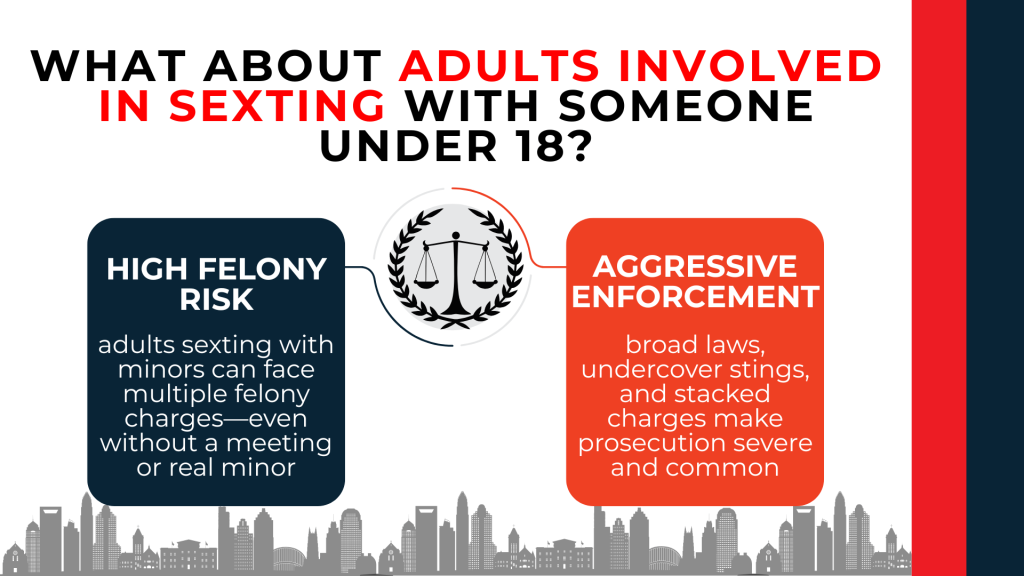
When an adult sends or receives sexually explicit images involving a minor, the risk is greater and the charging options multiply.
Beyond the sexual exploitation charges described above, an adult who uses a phone, computer, or any electronic device to solicit a minor for sexual purposes can also face charges under N.C.G.S. § 14-202.3 — solicitation of a child by computer or electronic device. This is a Class H felony, increasing to a Class G felony if either party appears at a proposed meeting location.
Several features of this statute make it particularly aggressive. The offense is complete upon solicitation — no meeting has to occur, no sexual act has to take place, and there does not have to be an actual minor on the other end of the conversation. If the defendant believed the person was underage, that belief alone is enough for a conviction.
NC appellate courts have applied broad interpretation to the terms “entice,” “advise,” “coerce,” “order,” and “command.” Law enforcement sting operations using fictional minors are specifically allowed under the statute.
The defendant must be at least 16 years old and at least five years older than the believed minor for this statute to apply. But when it does apply, it stacks on top of any exploitation charges — meaning a single sexting exchange can produce multiple felony counts.
North Carolina’s enforcement resources reflect how seriously the state treats these cases. The NC SBI Computer Crimes Unit coordinates a task force of more than 200 law enforcement agencies across the state. The unit has 17 full-time special agents stationed across eight field districts dedicated exclusively to investigating internet crimes against children. Nationally, the CyberTipline operated by the National Center for Missing & Exploited Children received 20.5 million reports of suspected child sexual exploitation in 2024 alone. These reports routinely generate referrals to state and local agencies, including North Carolina law enforcement.
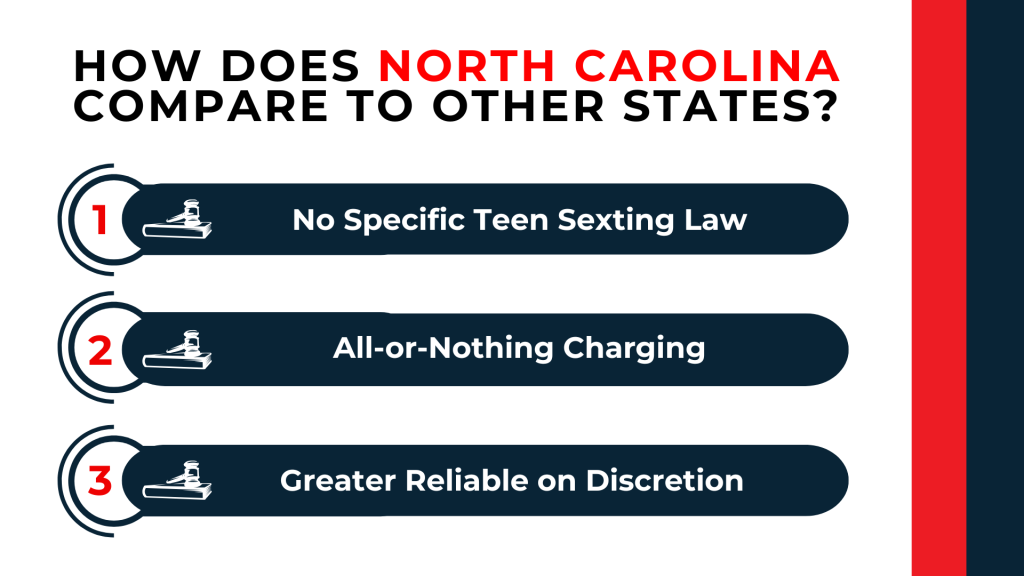
How Does North Carolina Compare to Other States?
Many states have enacted laws that specifically address teen sexting — reducing charges to misdemeanors, creating diversion programs, or distinguishing consensual image-sharing between peers from exploitative conduct involving adults. North Carolina has not.
The lack of a teen sexting statute means North Carolina prosecutors have only two options when a sexting case involving minors crosses their desk: charge it as a felony under the exploitation statutes or decline to prosecute entirely. There is no middle-ground charging option built into the law.
This gap places enormous weight on how a case is handled before formal charges are filed. In states with dedicated sexting laws, the statute itself provides a pathway to appropriate outcomes. In North Carolina, that pathway has to be built by the defense attorney and the prosecutor on a case-by-case basis. That makes the quality of legal representation one of the most important factors in how a sexting case ends.
How Can a Defense Attorney Fight Sexting Charges?
Sexting cases prosecuted under North Carolina’s exploitation statutes carry severe penalties. However, these cases present specific technical and procedural pressure points that a defense attorney can challenge to protect a client’s rights.
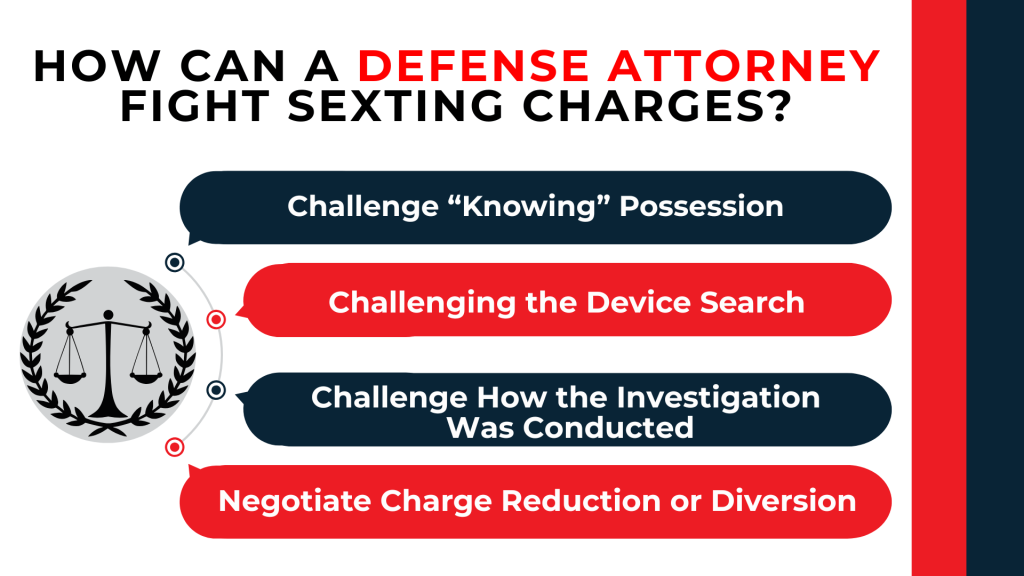
1. Challenging “Knowing” Possession
The prosecution must prove you knowingly possessed the material. In the digital age, images are frequently:
- Automatically downloaded by messaging apps (e.g., WhatsApp or Telegram).
- Cached by web browsers without direct user action.
- Stored in cloud backups (i.e., iCloud or Google Photos) that a user may never have opened.
- Placed on a shared device by another individual.
A forensic analysis of metadata, timestamps, and file access logs can often establish that a user never intentionally saved, viewed, or interacted with the material in question.
2. Challenging the Search of Digital Devices
Law enforcement generally cannot search a cell phone incident to arrest without a warrant.
- Particularity: The warrant must specifically authorize a forensic examination.
- Scope: If police exceeded the scope of the warrant or accessed cloud data without separate authorization, the evidence may be subject to suppression (exclusion from trial).
3. Reviewing Investigative Conduct and Entrapment
In digital sting operations conducted under N.C.G.S. § 14-202.3, the defense may look for evidence of entrapment. This requires showing government inducement and a lack of predisposition by the defendant.
Under N.C.G.S. § 15A-905(c), written notice of an entrapment defense must be filed within 20 working days of the trial setting date, making early legal intervention vital.
4. Negotiating Charge Reductions or Diversion
For cases involving teenagers or first-time offenders, counsel may negotiate for:
- Reduced Charges: Moving a felony down to a misdemeanor level.
- Juvenile Handling: Keeping the case in the juvenile system to avoid adult criminal records.
- Alternative Outcomes: Seeking paths that avoid mandatory Sex Offender Registration.
Strategic Defense Data
| North Carolina Legal Reality | |
| Plea Rate | 98% of felony convictions in NC result from guilty pleas. The strength of the defense determines the terms of that plea. |
| Trial Rate | The jury trial rate for serious sex offenses is 15%—the highest of any felony class, reflecting how aggressively these cases are contested. |
| Critical Window | Pre-charge negotiation options often disappear once a case is formally indicted or moved to adult court. |
Why Families Choose Patrick Roberts for Sex Offense Cases in North Carolina
When facing charges that carry mandatory prison time and registration, the quality of legal representation is the most significant factor in the trajectory of a case. Attorney Patrick Roberts has defended clients against sex offense allegations across North Carolina for more than two decades.
The Value of Prosecutorial Perspective
Patrick Roberts served as an Assistant District Attorney in Wake, Johnston, and New Hanover counties. This background provides an inside look at how the state:
- Evaluates the credibility of digital evidence.
- Determines whether to elevate a charge to a higher felony tier.
- Approaches plea negotiations in sensitive sex offense matters.
This experience allows for an informed anticipation of the prosecution’s strategy throughout the investigative and trial phases.
Credentials and Professional Standing
Attorney Roberts’ credentials reflect a commitment to rigorous trial advocacy and ethical practice:
- Legal Education: Graduate of Duke University School of Law (Top 9 best criminal law program) and The Johns Hopkins University (Top 7 rank in National Universities).
- Advanced Advocacy Training: Alumnus of the Gerry Spence Trial Lawyers College and the NCDC Trial Practice Institute, including the 2025 Cross-Examination Intensive.
- Lifetime member of the National Association of Criminal Defense Lawyers (NACDL)
- Highest Peer Ratings: Holds the AV Preeminent® rating from Martindale-Hubbell (2026)—the highest possible peer-reviewed honor for legal ability and ethics.
- National Recognition: The only North Carolina attorney listed on the National Child Abuse Defense & Resource Center (as of 2026).
- Federal Authority: Admitted to practice before the United States Supreme Court and the Fourth Circuit Court of Appeals.
Recent Cases
Attorney Patrick Roberts has successfully* resolved high-stakes allegations, preventing formal charges from being filed in complex criminal investigations:
- 2025 | Allegation of Sexual Assault: Investigated claim of molestation by a stepfather against a child under 13.
- Result: No Charges Filed.*
- 2025 | Allegation of Sexual Assault: Investigated claim of sexual touching by a 15-year-old teenager.
- Result: No Charges Filed.*
- 2026 | Allegation of Rape: Investigated claim of rape following a meeting at a bar.
- Result: No Charges Filed.*
*Disclaimer: Each case is different and must be evaluated separately. Prior results achieved do not guarantee similar results can be achieved in future cases.
Peer Endorsement
“Patrick is an experienced and knowledgeable criminal attorney. I highly recommend him if you’re seeking competent and professional representation in a state or federal criminal matter.” — Martindale-Hubbell Verified Peer Endorsement
Client Review
“Patrick was professional, honest, and the best lawyer I could have asked for during a very tough situation. Throughout the process, he remained a constant calm and reassuring presence during a challenging time in my life. His guidance and dedication made a difficult experience much more manageable. ” —Verified Avvo Client Review
Disclaimer:The testimonials are actual comments. Every case is different and depends on its own unique facts and legal circumstances. These results are illustrative of the matters the firm handles but do not guarantee, warrant, or predict a similar outcome in your legal matter.
Talk to a North Carolina Sexting Defense Attorney Now
Allegations involving digital media or physical contact move rapidly through the North Carolina justice system. The strategy implemented in the first few days of an investigation often determines whether a case ends in a felony conviction or is dismissed before reaching a courtroom.
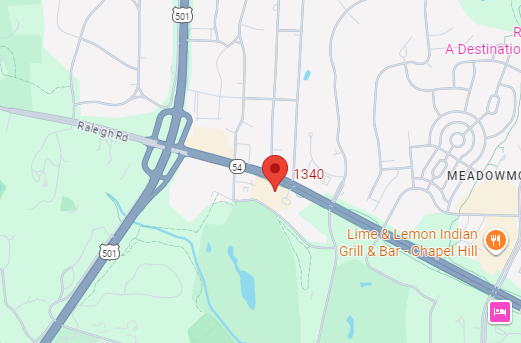
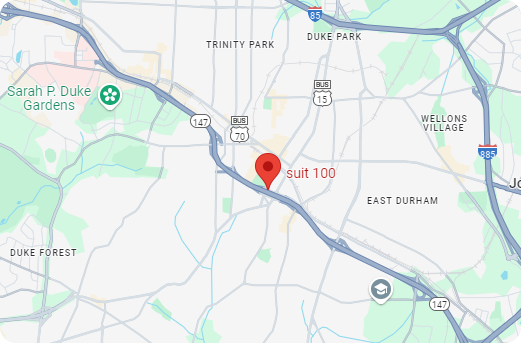
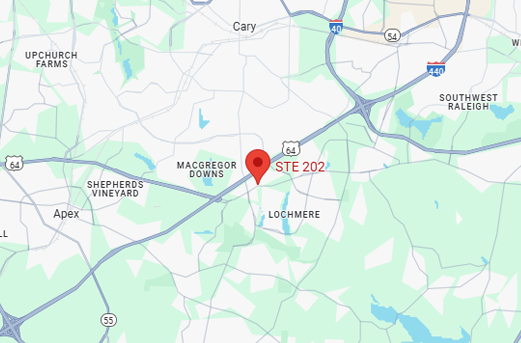
Contact Patrick Roberts Law for a private case evaluation in Raleigh, Durham, Chapel Hill, or Cary.
The firm limits the number of active cases it accepts. This ensures that every client receives the exhaustive forensic and procedural review necessary to challenge the state’s technical proof.
Disclaimer: The information on this website is for general informational purposes only and does not constitute legal advice for any individual case or situation. Contacting us via this website, email, or contact form does not create an attorney-client relationship. Each case is different and must be evaluated separately; prior results do not guarantee a similar outcome.
Former assistant district attorney
Contact Patrick Roberts
Facing criminal charges in North Carolina demands seasoned representation. Trust in the experience and dual perspective of Patrick Roberts. Reach out today for a confidential consultation.
-
Call Our Team
Calls answered 24/7






For more information on the selection criteria, go to www.martindale.com
*Each case is different and must be evaluated separately. Prior results achieved do not guarantee similar results can be achieved in future cases.