

The first 48 hours after a sex crime accusation are often the most consequential of the entire case. What you say, who you talk to, and whether you have legal counsel guiding those decisions can determine whether the investigation leads to charges, whether evidence is preserved or lost, and whether your constitutional rights are protected or waived before you fully understand what is happening.
If you are wondering what to do if accused of a sex crime in North Carolina, this article walks through the legal framework you are dealing with and the steps that matter most.
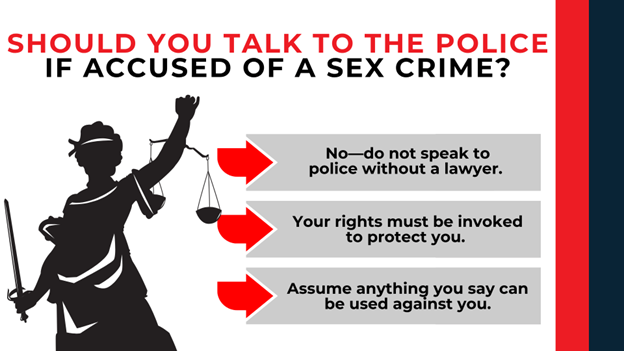
Should You Talk to the Police If Accused of a Sex Crime?
No — not without an attorney present. This is the single most important step, and it is the one most people get wrong.
The Fifth Amendment and N.C. Const. art. I, § 23 protect against compelled self-incrimination, but these protections only activate when you invoke them. Miranda warnings are required before custodial interrogation, and under N.C.G.S. § 15A-211, North Carolina mandates recording of custodial interrogations for Class A, B1, B2 felonies and Class C sex offenses. Failure to record is admissible evidence supporting a claim that any resulting statement was involuntary.
But here is what catches people off guard: you do not have to be formally arrested to make a damaging statement. Detectives often conduct interviews in non-custodial settings — at your home, at the station under the guise of “just a conversation” — where Miranda does not technically apply. In State v. Jackson, 308 N.C. 549 (1983), the NC Supreme Court held that police deception during interrogation does not automatically render a confession involuntary, meaning investigators can and do use misleading tactics during questioning.
North Carolina is also a one-party consent state under N.C.G.S. § 15A-287. That means pretext phone calls — where the complainant calls the accused while law enforcement records the conversation — are perfectly legal. If you receive a call from the accuser after an allegation has been made, assume it is being recorded. Do not discuss the allegations with anyone except your attorney.
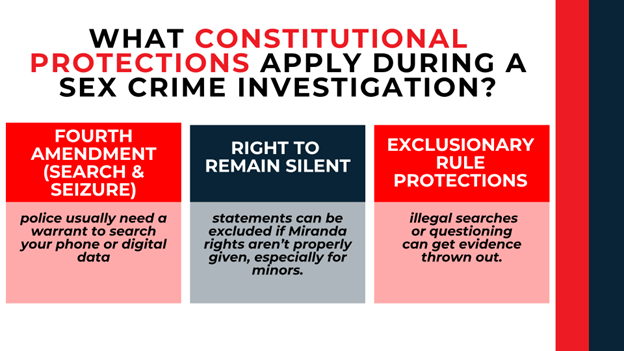
What Constitutional Protections Apply During a Sex Crime Investigation?
Understanding your rights during the investigation phase is critical because this is where evidence is gathered, preserved, or destroyed — and where constitutional violations by law enforcement can provide the basis for suppression motions that weaken or eliminate the State’s case.
Following Riley v. California, 573 U.S. 373 (2014), police cannot search your cell phone or digital devices without a warrant, even if you are under arrest. This is significant in sex crime cases because digital evidence — texts, photographs, social media messages — is often central to the prosecution’s theory. Under N.C.G.S. § 15A-248, search warrants must be executed within 48 hours of issuance. Consent to search your home does not extend to digital devices found inside.
For juvenile defendants or young adults, J.D.B. v. North Carolina, 564 U.S. 261 (2011) — a case from our state — established that a child’s age is relevant to the Miranda custody analysis. If you are under 18, law enforcement must consider your age when determining whether you were effectively “in custody” during questioning.
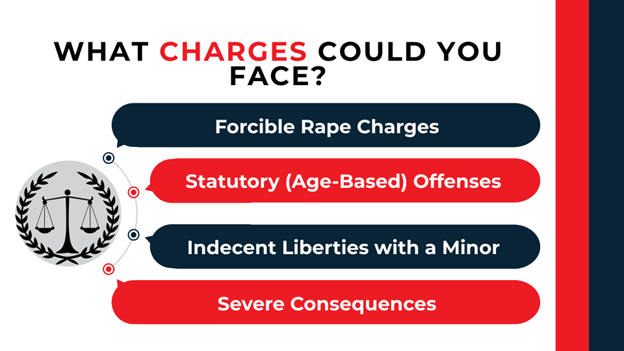
What Charges Could You Face?
North Carolina’s sex offense framework is graduated and complex. The specific charge depends on the nature of the alleged conduct, the age of the parties, and the relationship between them.
Forcible offenses include first-degree forcible rape under N.C.G.S. § 14-27.21 (Class B1 felony) and second-degree forcible rape under N.C.G.S. § 14-27.22 (Class C felony). The State must prove both force AND lack of consent as separate elements. State v. Alston, 310 N.C. 399, 312 S.E.2d 470 (1984), held that force must be specific to the charged act — general fear from a prior relationship is insufficient.
Age-based offenses are strict liability. Statutory rape charges under N.C.G.S. §§ 14-27.23 through 14-27.25 carry classifications from Class C to Class B1 felony depending on victim age and age differential. Indecent liberties under N.C.G.S. § 14-202.1 is a Class F felony. Mistake of age is not a defense — State v. Breathette, 202 N.C. App. 697, 690 S.E.2d 1 (2010).
North Carolina reported 2,944 rapes in 2024 according to the NC SBI, and the NC Sentencing Commission reported 431 Class B1 felony convictions in FY 2024 — the most serious sex offense classification. These cases carry severe consequences including mandatory sex offender registration under N.C.G.S. § 14-208 et seq. for a minimum of 30 years.
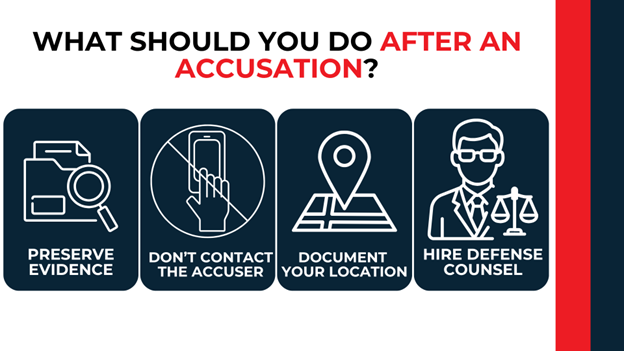
What Should You Do After an Accusation?
Beyond exercising your right to remain silent, the practical steps in the first days after an accusation are:
Preserve evidence. Do not delete text messages, social media conversations, photographs, or any digital communication with the accuser. This evidence may prove consensual contact, establish a motive to fabricate, or contradict the complainant’s account. Your attorney needs access to everything.
Do not contact the accuser. Any communication — direct, through friends, or through social media — can be characterized as witness intimidation or obstruction. Even an attempt to “clear things up” can be used against you.
Document your whereabouts. If you have receipts, GPS data, surveillance footage access, or witnesses who can establish where you were at the time of the alleged offense, preserve that information immediately. Time-stamped evidence degrades quickly.
Hire defense counsel before the first interview. If police have contacted you requesting an interview, you have the right to have an attorney present. An experienced defense attorney can advise you on what to say, what not to say, and whether to participate at all.
Recent Case Result: In 2026, Attorney Roberts closed an allegation of rape after a client met a woman at a bar who claimed he raped her.
Result: No charges filed.
Disclaimer: Each case is different and must be evaluated separately. Prior results achieved do not guarantee similar results can be achieved in future cases.
What Do Clients and Peers Say About Attorney Patrick Roberts?
“I recently hired A. Patrick Roberts as my lawyer. He not only provided clear and practical legal advice but also employed smart strategies that were beyond my expectations. His attention to detail and dedication to my defense made all the difference.” — Review originally posted by a verified client on Avvo.com.
“I have known Patrick Roberts my entire legal career. He is a great representation of how a lawyer should be an advocate for justice and truth. He has great relationships with attorneys and judges alike across countless cities and counties.” — Martindale-Hubbell Peer Review
Disclaimer: The testimonials and peer reviews on this site are for informational purposes. They do not constitute a guarantee, warranty, or prediction regarding the outcome of your legal matter. Every case is different and must be evaluated on its own merits.
Testimonials and peer endorsements found on this website are actual comments.
Case Review
Case Filed: First Degree Statutory Sex Offense
Attorney: Patrick Roberts
Case Description: The client faced a high-stakes felony investigation involving allegations of a First Degree Statutory Sex Offense brought by a minor. Given the severity of these sex crime charges, the defense required a comprehensive approach to challenge the prosecution’s narrative. Patrick Roberts, acting as a criminal defense lawyer for sex crimes, coordinated an extensive defense team that included a polygraph examiner, a child psychologist, a forensic expert, and a private investigator. This multi-disciplinary strategy allowed the defense to conduct a deep analysis of the allegations and provide the Assistant District Attorney with a compelling, evidence-based argument for why the case should not proceed to trial.
Outcome: Charges Dismissed
As a criminal defense attorney for sexual offenses, Mr. Roberts utilized a comprehensive defense team, including a polygraph examiner, a child psychologist, a forensic specialist, and a private investigator. By presenting evidence-based arguments and a detailed factual analysis, he demonstrated to the Assistant District Attorney that a dismissal was the appropriate course of action. This result ensured the client did not face a criminal trial, demonstrating the importance of a thorough defense in sex crime cases.
*Disclaimer: Each case is different and must be evaluated separately. Prior results achieved do not guarantee similar results can be achieved in future cases

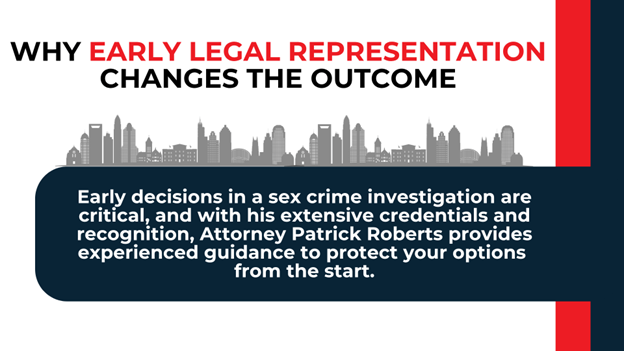
Why Early Legal Representation Changes the Outcome
The decisions made in the early stages of a sex crime investigation — whether to give a statement, how to handle digital evidence, whether to consent to a search — shape the trajectory of the case. Having defense counsel involved from the beginning preserves options that may not be available later.
Attorney Patrick Roberts is a graduate of the Duke University School of Law (#6 National Rank; #7 Criminal Law Specialty). He provides a defense methodology rooted in the analytical precision of a B.A. in Engineering from The Johns Hopkins University (#7 National University). This evidence-based approach is informed by his tenure as an Assistant District Attorney in Wake, Johnston, and New Hanover counties. Having managed the prosecution of sex crimes, drug trafficking, and violent felonies, he possesses a technical understanding of the State’s evidentiary and charging priorities.
Trial Advocacy and National Recognition
Since transitioning to defense in 2007, Patrick has directed hundreds of bench and jury trials in both state and federal courts. His trial advocacy is supported by extensive training at the Gerry Spence Trial Lawyers College, the NCDC Trial Practice Institute, the 2025 NCDC Cross-Examination Intensive, and the NACDL White Collar Crimes College.
Attorney Patrick Roberts is currently the only North Carolina lawyer listed on the National Child Abuse Defense & Resource Center (as of 2026). He is a Lifetime Member of the National Association of Criminal Defense Lawyers (NACDL) and has served as a Former Commissioner of the North Carolina State Ethics Commission and as a member of the North Carolina Juvenile Justice Planning Committee.
Federally Admitted and Peer-Verified
Attorney Patrick Roberts leads a practice defined by broad jurisdictional authority, with admissions to the Supreme Court of the United States, the Fourth Circuit Court of Appeals, and all U.S. Federal District Courts in North Carolina. His professional standing is reflected in the AV Preeminent® Peer Rating and the Martindale-Hubbell Platinum Client Champion recognition, both maintained for over five consecutive years. Additionally, he has held a 10/10 “Superb” Avvo rating for more than 15 years.
As a co-author of two legal books, his work has been featured in Super Lawyers Magazine and on the cover of Attorney-at-Law Magazine. His legal analysis has been cited by national media outlets, including USA Today and Fox News, for his experience in high-stakes litigation.
Contact Patrick Roberts Law to Request a Case Evaluation
Contact Attorney Patrick Roberts for a case evaluation. The firm manages a limited number of cases to ensure each matter receives focused attention. This approach allows for a thorough discovery process and a precise application of North Carolina statutes to the specific facts of your defense.
Disclaimer: The information on this website is for general informational purposes only. Nothing herein should be taken as legal advice for any individual case or situation. Contacting us via this website, email, or contact form does not create an attorney-client relationship. Case results depend on a variety of factors unique to each case; prior results do not guarantee a similar outcome.
Former assistant district attorney
Contact Patrick Roberts
Facing criminal charges in North Carolina demands seasoned representation. Trust in the experience and dual perspective of Patrick Roberts. Reach out today for a confidential consultation.
-
Call Our Team
Calls answered 24/7








For more information on the selection criteria, go to www.martindale.com
*Each case is different and must be evaluated separately. Prior results achieved do not guarantee similar results can be achieved in future cases.