

Statutory rape charges in North Carolina carry some of the most severe penalties in the state’s criminal code — and they are among the most difficult to defend because the law eliminates what many defendants assume is their strongest argument. Consent is not a defense. Mistake of age is not a defense. The statutory framework is built on strict liability principles that focus almost entirely on the ages of the parties involved. But that does not mean these charges are indefensible. North Carolina law still requires the prosecution to prove every element of the offense beyond a reasonable doubt, and experienced defense counsel can challenge those elements at every stage.
If you are researching how to fight statutory rape charges, this article explains the legal framework and the defense strategies that apply.
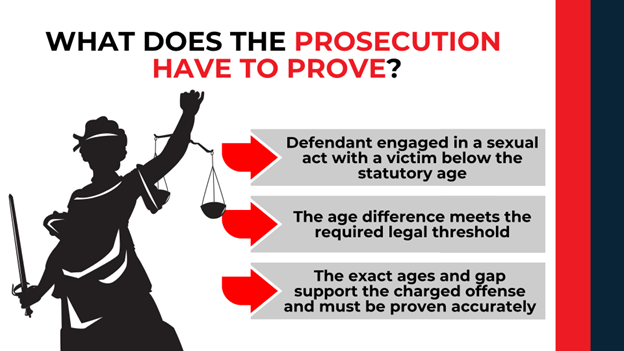
What Does the Prosecution Have to Prove?
North Carolina’s statutory rape laws are organized in a graduated scheme where the charge classification depends on the victim’s age, the defendant’s age, and the age differential between them.
N.C.G.S. § 14-27.23 — statutory rape of a child by an adult — applies when the defendant is 18 or older and the victim is under 13. This is a Class B1 felony.
N.C.G.S. § 14-27.24 — first-degree statutory rape — applies when the defendant is at least 12 and at least four years older than a victim under 13. Also a Class B1 felony.
N.C.G.S. § 14-27.25 — statutory rape of a person 15 or younger — classifies as either Class B1 or Class C felony depending on the age gap. When the defendant is at least 12 and six or more years older, it is Class B1. When the victim is 15 and the defendant is more than four but less than six years older, it is Class C.
Each of these statutes requires the State to prove the specific ages and age differentials with precision. Defense counsel verifies exact birth dates through documentary evidence because charging errors in age differential calculations occur — and they can be case-dispositive.
The NC Sentencing Commission reported 431 Class B1 felony convictions in FY 2024. These cases carry severe consequences: 100% of Class B1 through D sex offense convictions received active imprisonment, and enhanced sentencing provisions under N.C.G.S. § 15A-1340.17(f) apply to Class B1 through E sex offenses.
Why Can’t Consent or Mistake of Age Be Used as a Defense?
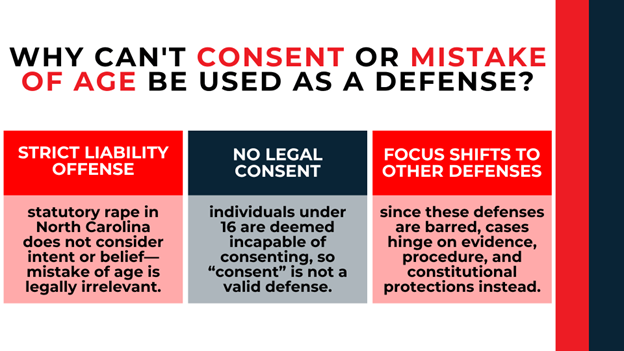
Statutory rape is a strict liability offense in North Carolina. State v. Breathette, 202 N.C. App. 697, 690 S.E.2d 1 (2010), explicitly held that mistake of age is not a defense — even to the related charge of indecent liberties under N.C.G.S. § 14-202.1. The same principle applies to all statutory rape charges. The defendant’s subjective belief about the alleged victim’s age is legally irrelevant, regardless of the victim’s appearance, statements, or presentation of identification.
Consent is also not a defense because the law treats persons below the age of consent — 16 in North Carolina — as legally incapable of consenting to sexual activity. Whether the encounter was “consensual” in the everyday sense has no legal significance in a statutory rape prosecution.
This reality is precisely why experienced defense counsel is critical. When the most intuitive defenses are foreclosed by statute, the attorney’s work shifts to the remaining elements, the quality of the evidence, the reliability of the investigation, and the constitutional protections that still apply.
What Defense Strategies Are Effective in Statutory Rape Cases?
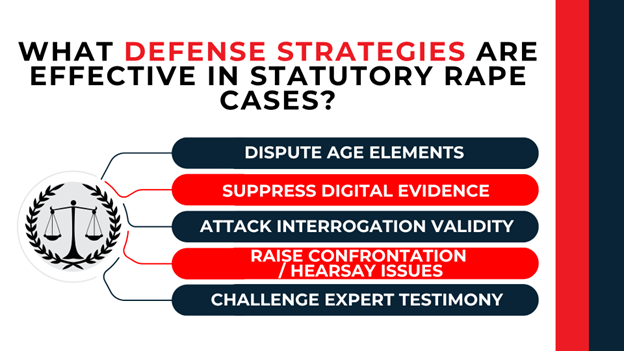
Age verification and differential challenges. The prosecution must prove exact ages and the precise age gap. Defense counsel obtains and cross-references birth certificates, hospital records, and identification documents. Where the age differential falls near a statutory threshold — the difference between four and six years, for example — the defense may challenge whether the correct charge was filed.
Challenging the investigation. Under Riley v. California, 573 U.S. 373 (2014), digital device searches require a warrant. In statutory rape cases, text messages and social media conversations are often key evidence. Defense counsel challenges warrant particularity, scope, and execution timing under N.C.G.S. § 15A-248. Any evidence obtained in violation of these protections is subject to suppression.
Interrogation challenges. North Carolina’s mandatory recording requirement under N.C.G.S. § 15A-211 applies to interrogations for serious sex offenses. Failure to record is admissible as evidence of involuntariness. For juvenile defendants, J.D.B. v. North Carolina, 564 U.S. 261 (2011), requires that the defendant’s age be considered in the Miranda custody analysis.
Confrontation and hearsay challenges. Under Crawford v. Washington, 541 U.S. 36 (2004), testimonial statements require the declarant’s availability for cross-examination. Forensic interview recordings of alleged victims are often testimonial. State v. Locklear, 363 N.C. 438, 681 S.E.2d 293 (2009), found a Confrontation Clause violation where substitute testimony was used. For child hearsay admitted under the medical diagnosis exception (N.C.G.S. § 8C-1, Rule 803(4)), State v. Hinnant, 351 N.C. 277, 523 S.E.2d 663 (2000), requires the statement to have been made for the purpose of obtaining medical treatment.
Expert testimony. State v. Hall, 330 N.C. 808, 412 S.E.2d 883 (1992), permits prosecution expert testimony about victim behavior patterns but not to prove that abuse occurred. Defense counsel files Daubert motions under State v. McGrady, 368 N.C. 880, 787 S.E.2d 1 (2016), and retains defense experts on suggestibility, false memory, and forensic interview technique flaws.
What Do Clients and Peers Say About Attorney Patrick Roberts?
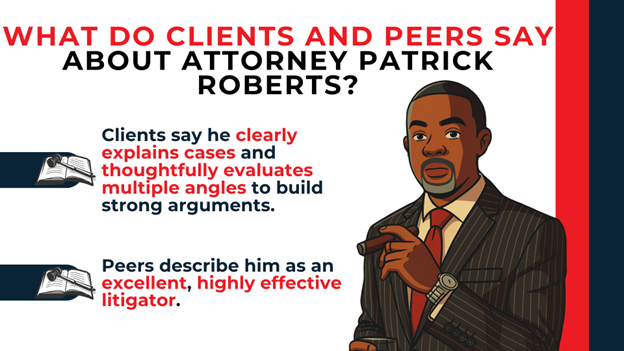
“He always took the time to explain to us what was going on which I appreciated. Patrick is able to see many different angles for a case and determine the best argument.” — Review originally posted by a verified client on Avvo.com.
“Awesome attorney. Great litigator.” — Martindale-Hubbell Peer Review
Disclaimer: The testimonials and peer reviews on this site are for informational purposes. They do not constitute a guarantee, warranty, or prediction regarding the outcome of your legal matter. Every case is different and must be evaluated on its own merits.
Testimonials and peer endorsements found on this website are actual comments.
Case Review
Lead Attorney: Patrick Roberts
Primary Charge: Statutory Rape
Result: Charge Dismissed; Negotiated Plea to Misdemeanor Assault on a Female; No Sex Offender Registration
Case Summary
The client was accused of statutory rape after being discovered with a fifteen-year-old girl following an episode of heavy consumption of alcohol. The case was initiated when the girl’s sister discovered them together, and the State’s file included numerous eyewitnesses whose testimony supported the girl’s accusations.
Legal Challenge and Defense
The presence of multiple eyewitnesses and the sensitive nature of the allegations created a high-risk environment for the client. A conviction for statutory rape would have carried mandatory prison time and lifelong registration as a sex offender.
Attorney Patrick Roberts focused the defense on the technical requirements of the statute. While the State’s witnesses provided testimony regarding the circumstances of the encounter, Roberts focused the litigation on the specific legal element of penetration. By effectively contesting the evidence regarding this element, the defense demonstrated that the State could not meet its evidentiary burden for the felony charge.
The Outcome
As a result of this focused contest of the evidence, the prosecution agreed to a significant reduction in the case:
- The Statutory Rape charge was dismissed.*
- The client was permitted to plead to a misdemeanor charge of Assault on a Female.
- The client avoided the requirement to register as a sex offender, effectively preserving his professional future and personal liberty.
*Disclaimer: Each case is different and must be evaluated separately. Prior results achieved do not guarantee similar results can be achieved in future cases
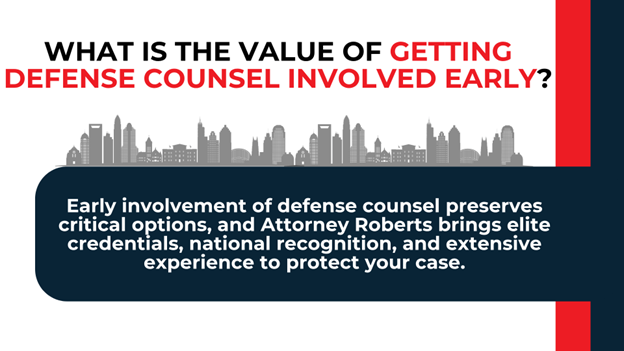
What Is the Value of Getting Defense Counsel Involved Early?
Having defense counsel involved early preserves options that may not be available later — from challenging the investigation in real time to identifying weaknesses in the State’s theory before the case is locked in.
Advanced Scholarship in Criminal Law
Attorney Patrick Roberts provides a defense built on the foundations of a Duke University School of Law education, an institution currently ranked #7 in the nation for Criminal Law (U.S. News & World Report, 2025–2026). This ranking, combined with Duke’s overall Top 6 national standing (tied with Harvard Law), positions the firm’s advocacy within the highest tier of the American legal profession.
As a graduate of both The Johns Hopkins University and Duke Law, Patrick Roberts operates within the academic lineage of the Duke Center for Criminal Justice and Professional Responsibility. This background ensures that every statutory rape defense is managed with a sophisticated understanding of Constitutional law, specifically the Fourth, Fifth, and Sixth Amendment protections that often serve as the technical turning point in high-stakes criminal litigation.
To provide a comprehensive defense in both state and federal jurisdictions, Patrick Roberts is admitted to practice before the nation’s highest judicial bodies:
- The Supreme Court of the United States
- The U.S. Court of Appeals for the Fourth Circuit
- All Federal District Courts in North Carolina (EDNC, MDNC, WDNC)
Prosecutorial Insight & Trial Advocacy
Since 2007, Patrick Roberts has directed hundreds of bench and jury trials in both state and federal courts. Before transitioning to defense, he served as an Assistant District Attorney in Wake, Johnston, and New Hanover counties. Having managed the prosecution of the same categories of offenses he now defends, he possesses a technical understanding of the State’s charging priorities and evidentiary thresholds.
To maintain the exacting standards required for complex sex offense litigation, Patrick Roberts has completed advanced training at the nation’s most recognized trial institutes:
- The NCDC Trial Practice Institute (2011) and the 2025 NCDC Cross-Examination Intensive Training
- Gerry Spence’s Trial Lawyers College.
These programs are specifically designed to sharpen cross-examination and witness credibility analysis essential to challenging the State’s narrative in statutory allegations.
Secure a Strategic Evaluation of Your Case
The resolution of a high-stakes statutory allegation depends on the analytical depth applied to the State’s evidence and the constitutional precision of the defense motions. Because every case involves unique evidentiary challenges and permanent legal consequences, securing a defense grounded in high-level academic and trial standards is a necessary step in navigating the North Carolina justice system.
To ensure that every client benefits from the analytical precision and dedicated oversight their defense requires, Patrick Roberts Law maintains a limited case volume. By prioritizing quality over high-volume intake, the firm preserves the capacity to conduct the deep-tier legal research and constitutional analysis essential to a sophisticated criminal defense.
Contact our office to schedule a confidential evaluation of your case and to discuss your available legal options.
Disclaimer: The information on this website is for general informational purposes only. Nothing herein should be taken as legal advice for any individual case or situation. Contacting us via this website, email, or contact form does not create an attorney-client relationship. Case results depend on a variety of factors unique to each case; prior results do not guarantee a similar outcome.
Former assistant district attorney
Contact Patrick Roberts
Facing criminal charges in North Carolina demands seasoned representation. Trust in the experience and dual perspective of Patrick Roberts. Reach out today for a confidential consultation.
-
Call Our Team
Calls answered 24/7









For more information on the selection criteria, go to www.martindale.com
*Each case is different and must be evaluated separately. Prior results achieved do not guarantee similar results can be achieved in future cases.