

An indecent liberties with a minor charge under North Carolina law is a felony that carries serious penalties, mandatory sex offender registration, and a range of collateral consequences that can affect every part of a person’s life for decades. It is also one of the most broadly interpreted sex offense statutes in the state — covering conduct that many people would not expect to meet the threshold of a criminal offense. If you are facing this charge or researching what it means, understanding the statute, the case law, and the available defenses is an essential first step.
What Does the Indecent Liberties Statute Actually Say?
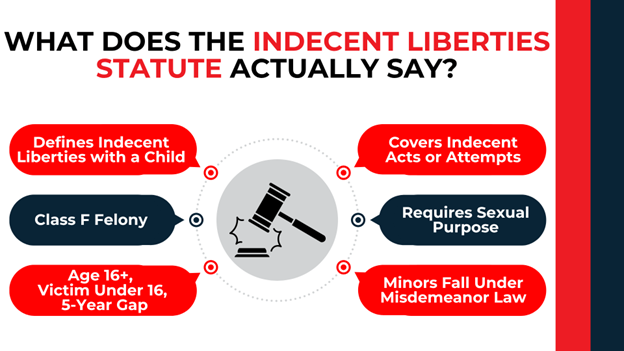
The core statute is N.C.G.S. § 14-202.1. It makes it a Class F felony for any person who is 16 years of age or older and at least five years older than the alleged victim to willfully take or attempt to take any immoral, improper, or indecent liberty with a child under 16 for the purpose of arousing or gratifying sexual desire — or to willfully commit or attempt to commit any lewd or lascivious act upon or with the body of a child under 16.
The prosecution must establish three threshold requirements: the defendant was 16 or older, the child was under 16, and the defendant was at least five years older than the child. That five-year age differential is a built-in close-in-age protection. If the defendant and the alleged victim are fewer than five years apart in age, this statute does not apply — though other sex offense statutes with different age gap thresholds may.
Defense counsel verifies these calculations with precision. Charging errors in age differential calculations happen more often than the system would like to admit, and they can be dispositive.
For defendants under 16, North Carolina provides a separate, less severe provision. N.C.G.S. § 14-202.2 creates a Class 1 misdemeanor for defendants under 16 who take indecent liberties with children at least three years younger. This distinction recognizes that minor-on-minor situations warrant different treatment than adult-on-child offenses.
How Broadly Do Courts Interpret “Indecent Liberties”?
Very broadly — and this is where many defendants and their families are caught off guard.
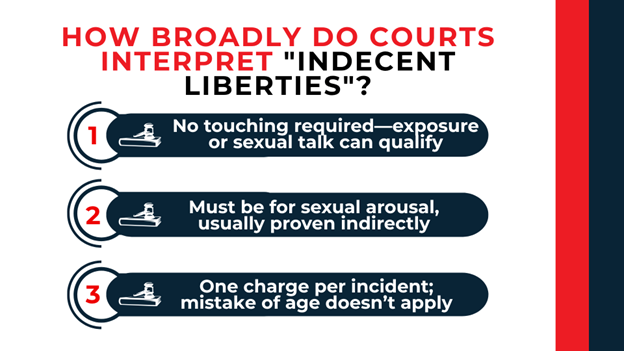
In State v. Every, 157 N.C. App. 200, 578 S.E.2d 642 (2003), the NC Court of Appeals held that physical touching is not required for an indecent liberties conviction. Exposing a child to sexual activity, engaging in sexually explicit conversations with a child, or performing sexual acts in a child’s presence can all constitute indecent liberties under North Carolina law.
The critical element in most contested cases is purpose: the State must prove the conduct was “for the purpose of arousing or gratifying sexual desire.” This is a subjective element that prosecutors typically prove through circumstantial evidence — the nature and context of the conduct, the relationship between the parties, the setting, and statements made before or after the alleged act. Defense counsel challenges this element by demonstrating alternative explanations, questioning the reliability of the evidence used to infer purpose, and exposing weaknesses in how the allegation was investigated.
State v. Laney, 178 N.C. App. 337, 631 S.E.2d 522 (2006), established an important limiting principle: multiple acts of touching during a single encounter support only one conviction for indecent liberties. This prevents the State from stacking charges based on what was, in legal terms, a single continuous episode.
Mistake of age is not a defense. State v. Breathette, 202 N.C. App. 697, 690 S.E.2d 1 (2010), held that a defendant’s belief about the alleged victim’s age provides no legal defense — regardless of the victim’s appearance, statements, or behavior.
According to the NC Department of Adult Correction’s FY 2023–2024 Annual Statistical Report, “other sexual offenses” accounted for 29% of all Class F felony probation entries — making it the most common Class F felony category on probation in North Carolina.
What Constitutional and Evidentiary Protections Apply?
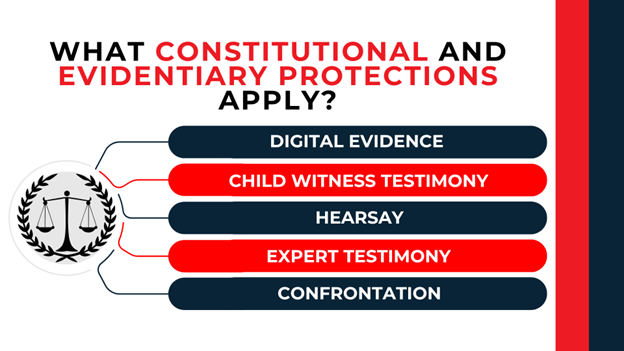
Indecent liberties cases frequently involve child witnesses, forensic interviews, and digital evidence — each raising distinct constitutional issues.
Digital evidence. Following Riley v. California, 573 U.S. 373 (2014), warrants are required for cell phone and device searches. Under N.C.G.S. § 15A-248, warrants must be executed within 48 hours. Defense counsel challenges warrant scope, particularity, and chain of custody — especially where text messages or social media communications are central to the prosecution’s case.
Child witness testimony. There is no minimum age for witness competency in North Carolina under N.C.G.S. § 8C-1, Rule 601. Defense counsel requests competency voir dire to test the child’s ability to express matters clearly and their understanding of the duty to tell the truth. Closed-circuit testimony under N.C.G.S. § 15A-1225.1 requires specific judicial findings that testifying in the defendant’s presence would cause serious emotional distress.
Hearsay. Child statements are often admitted under the medical diagnosis exception, Rule 803(4). The NC Supreme Court’s State v. Hinnant, 351 N.C. 277, 523 S.E.2d 663 (2000), two-prong test requires that the statement was made for the purpose of obtaining medical treatment and was reasonably pertinent to that purpose. State v. Corbett, 376 N.C. 799, 855 S.E.2d 228 (2021), allowed child advocacy center statements under this exception — but statements taken primarily for investigative purposes may fail the test.
Expert testimony. State v. Hall, 330 N.C. 808, 412 S.E.2d 883 (1992), permits CSAAS testimony to explain victim behavior but not to prove abuse occurred. State v. Hammett, 361 N.C. 92, 637 S.E.2d 518 (2006), requires physical evidence to support an expert opinion that abuse occurred. Daubert motions under State v. McGrady, 368 N.C. 880, 787 S.E.2d 1 (2016), are the mechanism for excluding prosecution experts who exceed these boundaries.
Confrontation. Under Crawford v. Washington, 541 U.S. 36 (2004), testimonial hearsay requires the declarant’s availability for cross-examination. State v. Locklear, 363 N.C. 438, 681 S.E.2d 293 (2009), found a Confrontation Clause violation where non-testifying expert opinions were admitted through a substitute witness.
What Are the Consequences of an Indecent Liberties Conviction?
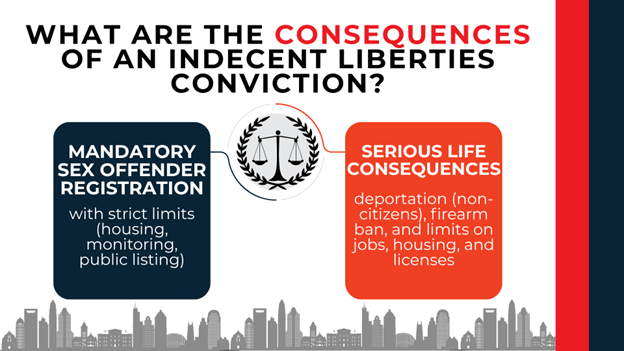
Mandatory sex offender registration under N.C.G.S. § 14-208 et seq. follows every indecent liberties conviction. Standard registration lasts 30 years. Registrants face residential restrictions under N.C.G.S. § 14-208.18, potential GPS monitoring, and public listing. A petition for removal under N.C.G.S. § 14-208.12A may be filed after 10 years for those not classified as aggravated offenders.
For non-citizens, Padilla v. Kentucky, 559 U.S. 356 (2010), requires defense counsel to advise of immigration consequences. Sexual abuse of a minor triggers mandatory deportation under federal law. Additional consequences include federal firearms prohibitions, professional licensing bars, housing restrictions, and employment limitations.
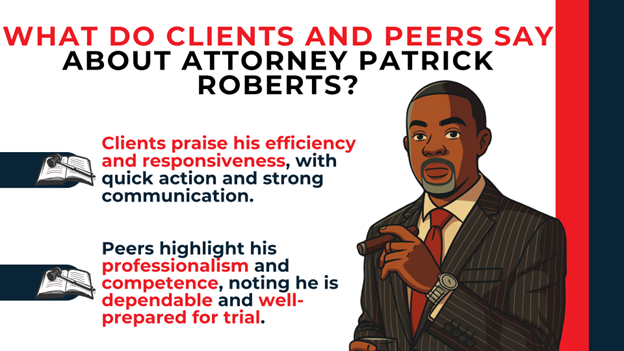
What Do Clients and Peers Say About Attorney Patrick Roberts?
“We knew from the consultation that we were in good hands. Mr. Roberts wasted no time obtaining the report and jumping into action. His practice is very efficient and receptive in every way.” — Review originally posted by a verified client on Avvo.com.
“Mr. Roberts demonstrates a high level of competence and professionalism. He is well prepared for trial and represents all clients well. Mr. Roberts is dependable and he represents the legal profession well. I am confident in his ability to represent his clients.” — Martindale-Hubbell Peer Review
Disclaimer: The testimonials and peer reviews on this site are for informational purposes. They do not constitute a guarantee, warranty, or prediction regarding the outcome of your legal matter. Every case is different and must be evaluated on its own merits.
Testimonials and peer endorsements found on this website are actual comments.
Where Do You Go From Here?
An indecent liberties charge is a serious matter that benefits from experienced defense counsel. Having an attorney involved early preserves options and allows for a thorough review of the evidence and the investigation before the case progresses further.
Case Review
The Legal Challenge
Attorney Patrick Roberts’ client was the subject of an investigation involving several high-level felonies, including Indecent Liberties with a Minor (N.C.G.S. § 14-202.1), Statutory Sex Offense (N.C.G.S. § 14-27.25), and Statutory Rape (N.C.G.S. § 14-27.30). In North Carolina, these charges carry mandatory prison sentences and permanent registration requirements. The allegations arose within the context of a domestic dispute involving the client’s spouse and stepchild. The client was falsely accused by his wife of sexually abusing his stepdaughter.
The Strategy: Pre-Charge Advocacy and Constitutional Protection
The critical turning point in this matter occurred during the “pre-charge” phase, before a formal arrest or indictment took place. Attorney Patrick Roberts utilized a strategic approach to prevent the case from entering the criminal court system:
- Constitutional Safeguards: Attorney Roberts ensured the client’s Fifth Amendment rights were strictly protected throughout the investigative process. By managing all communication with law enforcement, the defense prevented the creation of self-incriminating statements that are often used to justify a formal charge.
- Evidentiary Scrutiny: Leveraging his experience as a former prosecutor of sex crimes, Roberts conducted a technical audit of the claims. He identified a lack of concrete, corroborating evidence and highlighted significant inconsistencies within the accuser’s narrative.
- Analytical Case Deconstruction: Applying the precision of his Johns Hopkins Engineering background, Roberts presented a logical analysis to the State that undermined the feasibility of the allegations.
The Result: No Prosecution and Case Closure
Following the presentation of the defense’s preliminary findings and the demonstration of evidentiary gaps, the State of North Carolina determined there was insufficient cause to proceed. The District Attorney’s office chose not to file charges, effectively clearing the client’s name and allowing him to avoid the prolonged uncertainty and public nature of courtroom litigation.
Result: No Charges Filed.
*Disclaimer: Each case is different and must be evaluated separately. Prior results achieved do not guarantee similar results can be achieved in future cases
Decades of High-Stakes Litigation and Prosecution Experience
Effective criminal defense of indecent liberties charges is built on an intimate understanding of State evidentiary priorities. Patrick Roberts served as an Assistant District Attorney across three North Carolina counties before transitioning to defense in 2007. His professional standing is reflected in the Client Champion Platinum recognition and the AV Preeminent® Peer Rating for over five consecutive years. Educated at Duke Law (#6 National Rank) and Johns Hopkins (#7 National Rank), he utilizes an evidence-based approach to challenge State allegations.
Patrick has served on the North Carolina Juvenile Justice Planning Committee and the State Ethics Commission. A graduate of the NACDL White Collar Crimes College and the NCDC, he is admitted to practice in all Federal District Courts in North Carolina (EDNC,MDNC,WDNC). His work has been featured in Super Lawyers Magazine and he has been quoted by national media outlets including USA Today and Fox News.
Contact Patrick Roberts Law and Request a Private Case Evaluation. We prioritize quality over volume. To ensure every client receives the necessary strategic focus, our firm maintains a limited number of cases. This allows for the meticulous discovery and stringent application of North Carolina statutes required for your defense.
Disclaimer: The information on this website is for general informational purposes only. Nothing herein should be taken as legal advice for any individual case or situation. Contacting us via this website, email, or contact form does not create an attorney-client relationship. Case results depend on a variety of factors unique to each case; prior results do not guarantee a similar outcome.
Former assistant district attorney
Contact Patrick Roberts
Facing criminal charges in North Carolina demands seasoned representation. Trust in the experience and dual perspective of Patrick Roberts. Reach out today for a confidential consultation.
-
Call Our Team
Calls answered 24/7








For more information on the selection criteria, go to www.martindale.com
*Each case is different and must be evaluated separately. Prior results achieved do not guarantee similar results can be achieved in future cases.