

In North Carolina, larceny (theft) can be either a felony or a misdemeanor. Which one you might be charged with depends on several key factors. Let’s break down how North Carolina law decides whether theft counts as a felony or not.
Larceny as a Felony in North Carolina
According to North Carolina law (§ 14-70), the state no longer makes a distinction between petit (small) and grand larceny. Unless the law says otherwise, larceny is generally treated as a Class H felony in North Carolina.
What Makes Larceny a Class H Felony?
Your theft charge will likely be a Class H felony in North Carolina when:
- You steal property worth more than $1,000
- You receive or have stolen property that’s worth more than $1,000, and you knew (or should have known) it was stolen
- Your theft involves certain situations regardless of the property’s value, such as:
- Stealing directly from a person (like pickpocketing)
- Stealing during a break-in
- Stealing explosives or devices that can start fires
- Stealing guns
- Stealing official records or papers from the North Carolina State Archives
- Getting caught stealing after you’ve already been convicted of larceny four times before
A defense attorney might challenge the value of the stolen items if it’s close to the $1,000 threshold. For example, if the state claims a stolen laptop was worth $1,100 but you can show it was actually a used device worth only $900, this could potentially reduce the charge from a felony to a misdemeanor.

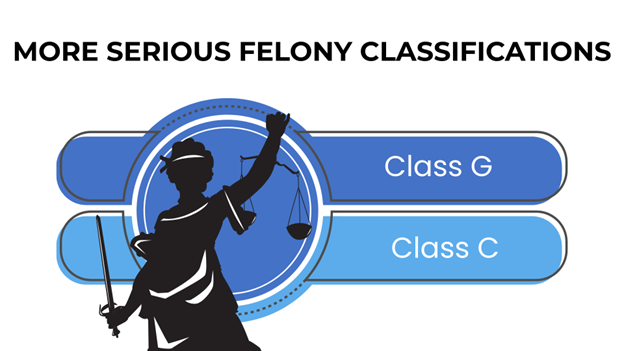
What Are the More Serious Felony Classifications?
In some cases, larceny can be charged as an even more serious felony:
- Class G Felony: Activities related to “chop shops” (where stolen vehicles are dismantled for parts) under § 14-72.7
- Class C Felony: When employees or servants steal from their employers and the value exceeds $100,000 (§ 14-74)
If you’re charged with one of these more serious felonies, the prosecution must prove additional elements beyond simple theft. For instance, in a chop shop case, they must show you knew the vehicle was stolen and were part of dismantling it for parts.
When Is Larceny a Misdemeanor in North Carolina?
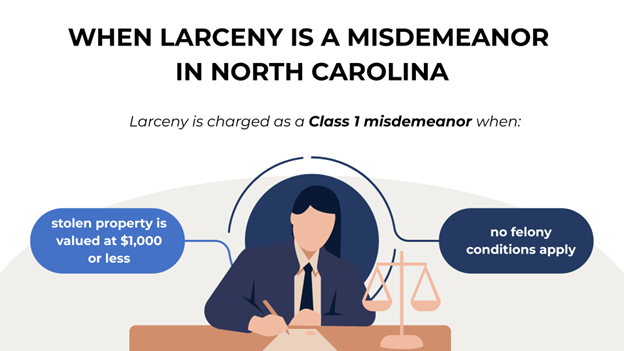
Under § 14-72(a), larceny is charged as a Class 1 misdemeanor when:
- The stolen property is worth $1,000 or less
- None of the special circumstances that would make it a felony apply
This distinction is important because misdemeanors carry much lighter penalties than felonies in North Carolina. If you’re charged with felony larceny for items valued slightly over $1,000, your attorney might dispute the valuation to try to get the charge reduced to a misdemeanor.
What Are the Special Types of Larceny in North Carolina?
North Carolina has created several specific types of larceny offenses, each with its own rules:
What Is Shoplifting and Merchant Theft? (§ 14-72.11)
Taking items from stores becomes a Class H felony when:
- You take property worth more than $200 through emergency exits
- You remove or disable anti-shoplifting devices
- You steal infant formula worth more than $100
Many shoplifting cases involve security camera footage. A potential defense might involve challenging the quality of this footage or questioning whether it clearly identifies you as the person who took the items.
How Is Stealing Car Parts Treated Under Law? (§ 14-72.8)
Taking parts from vehicles is a Class I felony if:
- Fixing the damage to the vehicle costs $1,000 or more, or
- You steal a catalytic converter (regardless of value)
Catalytic converters are specifically mentioned in the law because they contain valuable metals and are frequently targeted by thieves. The state doesn’t need to prove the value of the converter – just that you took it.
What Counts as Construction Site Theft? (§ 14-72.6)
This becomes a Class I felony when:
- You steal goods worth between $300 and $1,000 from construction sites that have building permits
Construction sites are often targeted because they contain valuable materials and equipment that can be difficult to secure. If you’re found with construction materials, having proof of purchase could be crucial to your defense.

What Are Common Defenses to Larceny Charges?
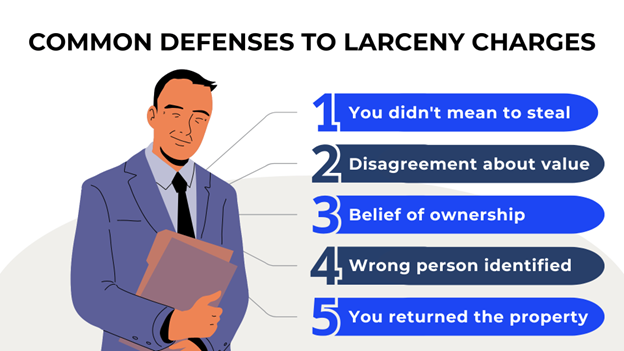
If you’re facing larceny charges in North Carolina, several possible defenses might apply:
- You didn’t mean to steal: Larceny requires that you intended to take someone else’s property permanently. If you honestly thought the property was yours or that you had permission to take it, this could be a valid defense.
- Disagreement about value: Since the value determines whether larceny is a felony or misdemeanor, challenging how much the property is actually worth can be very important.
- Belief of ownership: If you truly believed you had a right to the property, this might show you didn’t have the intent required for a larceny conviction.
- Wrong person identified: The prosecution must prove beyond a reasonable doubt that you were the person who committed the theft. If witnesses are uncertain or if identification is based on poor-quality video, this could be challenged.
- You returned the property: While not a complete defense, voluntarily returning property before being charged might sometimes result in reduced charges.
What Are the Penalties for Larceny in North Carolina?
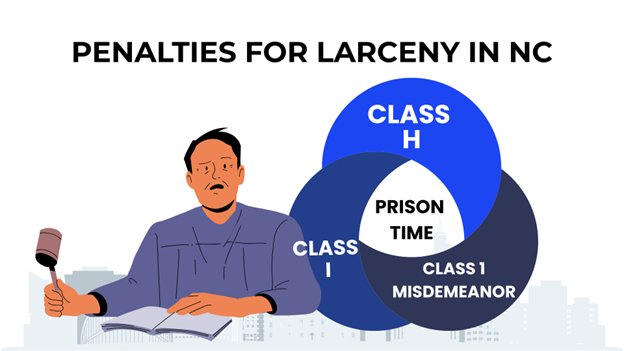
What happens if you’re convicted of larceny depends on how it’s classified:
- Class H Felony: You could face years in prison
- Class I Felony: You could face up to months, even over a year, in prison
- Class 1 Misdemeanor: You could face months in jail
Beyond potential jail time, a larceny conviction can also mean:
- Probation with regular check-ins with a probation officer
- Fines that can add up to thousands of dollars
- Having to pay back victims for what was stolen or damaged
- A permanent criminal record that makes it harder to get jobs, rent apartments, or obtain professional licenses
- Possible immigration consequences for non-citizens
Why Do You Need a Lawyer for Larceny Charges?
If you’re facing larceny charges in North Carolina, having an experienced criminal defense attorney is extremely important. A good lawyer can:
- Look at all the evidence the state has against you
- Find weaknesses in the prosecution’s case
- Create a defense strategy based on your specific situation
- Negotiate with prosecutors to potentially get charges reduced
- Represent you at trial if necessary
- Help first-time offenders explore diversion programs that might be available
- Advise on collateral consequences like effects on employment or housing
Even for misdemeanor larceny charges, having legal representation can make a significant difference in the outcome of your case and your future opportunities.

Conclusion
In North Carolina, larceny is typically charged as a Class H felony, but can be a misdemeanor when the property is worth $1,000 or less and no special circumstances apply. The exact charge depends on factors like what was stolen, how much it was worth, how it was taken, and whether you have prior theft convictions. Understanding these distinctions is crucial if you or someone you know is facing theft-related charges in North Carolina.
Remember that each case is unique, and the specific facts of your situation will determine the best defense strategy. An experienced North Carolina criminal defense attorney can help you understand your options and work toward the best possible outcome.
Felony larceny charges in North Carolina can threaten your freedom, your record, and your future. If you or a loved one is facing this kind of allegation, it’s critical to have an experienced defense attorney on your side. Attorney Patrick Roberts has extensive experience defending clients against the most serious charges. Contact our office now to set up a confidential
consultation and start building your defense.
Former assistant district attorney
Contact Patrick Roberts
Facing criminal charges in North Carolina demands seasoned representation. Trust in the experience and dual perspective of Patrick Roberts. Reach out today for a confidential consultation.
-
Call Our Team
Calls answered 24/7






For more information on the selection criteria, go to www.martindale.com
*Each case is different and must be evaluated separately. Prior results achieved do not guarantee similar results can be achieved in future cases.