
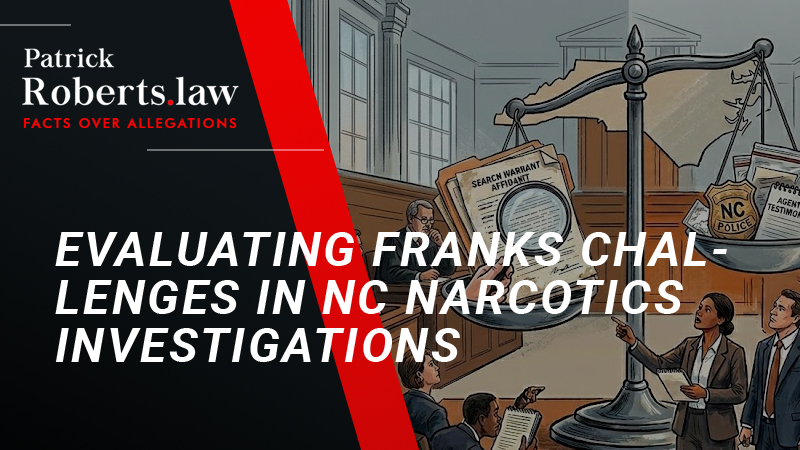
In North Carolina narcotics operations, law enforcement officers heavily rely on search warrants to seize evidence from vehicles, storage units, and private residences. These warrants are granted based on an officer’s sworn affidavit. Under the Fourth Amendment, a search warrant is valid only if it establishes probable cause within its “four corners.”
However, when an officer includes deliberate falsehoods or omits critical facts to secure a warrant, the defense can challenge its validity using the framework established in the landmark U.S. Supreme Court case Franks v. Delaware, 438 U.S. 154 (1778).
Applying Franks to drug trafficking cases in North Carolina requires navigating complex statutory rules and distinct federal and state court precedents. This analysis details the legal standards, the evidentiary hurdles, and the strategic mechanisms used to litigate these issues.
What Is the Legal Standard for a Franks Challenge in an NC Narcotics Case?
A Franks challenge is a constitutional mechanism used to attack the truthfulness of factual assertions made in a search warrant affidavit. In North Carolina, this process is governed by federal Fourth Amendment jurisprudence and state-level statutory procedures under N.C. General Statutes § 15A-978. To successfully contest a search warrant, the defense must meet specific criteria established by appellate courts.
How the Fourth Circuit Court of Appeals Defines Material Omissions
The Fourth Circuit Court of Appeals recognizes that a Franks violation can occur through two distinct actions in an affidavit:
- Commission: The inclusion of affirmative false statements.
- Omission: The deliberate or reckless exclusion of material facts.
In drug trafficking investigations, material omissions occur when an officer leaves out information that would directly undermine a magistrate’s finding of probable cause. The Fourth Circuit evaluates an omission by determining if the excluded facts were “material.”
To establish materiality, the defense must demonstrate that if the omitted facts had been included in the affidavit, the updated text would no longer contain sufficient information to guide a reasonable magistrate to find probable cause.
Why the Defendant Bears a High Burden of Proof When Challenging Omitted Facts
Appellate courts, including the Fourth Circuit and the North Carolina Court of Appeals, place a heavy burden on the defendant to secure an evidentiary hearing. There is a strong legal presumption that an officer’s search warrant affidavit is valid.
| Phase of Challenge | Legal Threshold | Required Evidentiary Showing |
| Initial Request (Motion) | Substantial Preliminary Showing | Specific allegations of falsehood or reckless omission, supported by detailed offers of proof (e.g., cell logs, track records, third-party affidavits). |
| Evidentiary Hearing (Franks Hearing) | Preponderance of the Evidence | Direct or strong circumstantial proof that the affiant acted intentionally or with reckless disregard for the truth, and that the remaining content lacks probable cause. |
Challenging an omission is significantly more difficult than challenging an affirmative lie. The defense must prove that the investigator omitted the facts with the specific intent to mislead, or with a reckless disregard for whether the omission made the affidavit misleading. Simple inadvertence, administrative oversight, or negligent record-keeping by the officer does not satisfy this constitutional standard.
How a Court Reviews an Affidavit Under the Totality of the Circumstances Framework
When a North Carolina court reviews a challenged affidavit, it does not isolate individual statements. Instead, it applies the “totality of the circumstances” framework outlined in Illinois v. Gates, 462 U.S. 213 (1983) and adopted by the North Carolina Supreme Court in State v. Arrington, 311 N.C. 633 (1984).
The reviewing judge must perform a specific two-step subtraction or addition test:
- For False Assertions: The court strikes the falsified sections from the affidavit. If the remaining text still provides a substantial basis for probable cause, the warrant remains valid, and the motion to suppress is denied.
- For Material Omissions: The court inserts the hidden, unstated facts back into the affidavit. If the newly revised text no longer supports a finding of probable cause to search that location for narcotics, the warrant is invalidated.
How Do Omissions About Confidential Informants Invalidate a Drug Search Warrant?
Narcotics investigators frequently rely on confidential informants (CIs) to establish probable cause. Affiants often present these sources as highly reliable individuals who have provided dependable tips in the past. However, when an officer conceals negative information regarding a CI’s background, credibility, or motivation, the affidavit may become vulnerable to a Franks challenge.
Is an Officer Required to Disclose a Confidential Informant’s Criminal History to a Magistrate?
As a general rule, an officer is not required to disclose every detail of an informant’s criminal past in a search warrant application. Magistrates understand that individuals operating within the drug trade often have criminal records.
However, a constitutional issue arises if the officer intentionally conceals severe credibility defects that directly impact the truthfulness of the specific tip provided. For example, if a CI has an active conviction for a crime of dishonesty, such as perjury, filing a false police report, or forgery, omitting this information can be viewed as a reckless attempt to artificially inflate the informant’s credibility.
What Happens if Law Enforcement Conceals Financial Payments or Plea Deals Made to a Narcotics Source?
Financial incentives and leniency regarding pending criminal charges are powerful motivators for informants to fabricate or exaggerate claims. If an affidavit states that a CI “honestly and reliably observed trafficking quantities of cocaine inside the target residence,” but conceals that the CI was paid several thousand dollars or promised the dismissal of a pending active felony charge in exchange for the tip, the defense can argue that the magistrate was misled.
Under the Franks framework, if the omission of a significant financial payment or a formal non-prosecution agreement is deemed reckless, a court must evaluate the affidavit as if those facts were fully disclosed. If the unmasked bias of the informant neutralizes the reliability of the tip, and no independent corroboration exists within the affidavit, probable cause fails.
How Defense Teams Expose an Informant’s Documented Track Record of Providing Unreliable Tips
A common phrase found in North Carolina narcotics affidavits is: “This applicant has worked with this confidential source in the past, and this source has provided reliable information that has led to multiple arrests and seizures.”
To mount an effective Franks challenge, the defense must scrutinize this boilerplate assertion. Defense attorneys look for instances where:
- The informant previously provided false tips to the same task force.
- The informant failed multiple polygraph examinations.
- Controlled buys failed to yield the targeted substances.
By cross-referencing state and federal discovery materials, a defense team can demonstrate that the officer deliberately omitted a history of unreliability to create a false impression of consistency. If the defense can show the informant’s prior tips routinely resulted in dead ends, the assertion of reliability becomes a reckless misrepresentation.
Can “Boilerplate” Training and Experience Statements Meet the Probable Cause Bar?
Most narcotics warrants include several paragraphs detailing the affiant’s professional background, specialized training, and years of service. Officers often use this section to justify searching a suspect’s residence, arguing that based on their “training and experience,” drug traffickers routinely store drugs, financial ledgers, weapons, and currency at their homes.
The Legal Definition of the Constitutional Nexus Requirement for an NC Residence Search
Under the Fourth Amendment and North Carolina law, there must be a clear “nexus”—a direct, logical connection—between the illegal items sought and the specific place to be searched.
Simply stating that an individual is suspected of trafficking drugs somewhere in a city is insufficient to search their private home. The affidavit must contain timely, concrete facts indicating that drugs or related contraband are currently located inside that specific structure.
When Using Copied-and-Pasted Template Language Constitutes a Reckless Disregard for Facts
The use of pre-drafted, boilerplate language is a common practice in law enforcement. However, when an officer relies entirely on copied-and-pasted template paragraphs while ignoring contradictory facts unique to the case, the practice can cross the line into a reckless disregard for the truth.
If an investigator uses standard language claiming that “traffickers maintain records at their primary residence,” while possessing explicit surveillance or GPS tracking data showing the suspect has not visited that location in months, the generalized template contradicts the known facts of the ongoing investigation.
How a Defense Lawyer Can Challenge Generic Assertions That Drug Traffickers Store Records at Home
North Carolina appellate courts have ruled that an officer’s generic “training and experience” statement cannot serve as a substitute for specific, independent facts connecting a crime to a residence. In cases like State v. Severn, 130 N.C. App. 319 (1998), the court emphasized that an officer’s background cannot bridge a complete lack of factual support within the affidavit.
Defense lawyers challenge these assertions by isolating the boilerplate paragraphs during an analysis of the warrant:
- Isolate the Experience Claims: Identify and temporarily remove all generalized claims regarding what drug traffickers typically do as a class.
- Examine Case-Specific Facts: Review the remaining portions of the affidavit for actual, observed behavior connecting the home to illegal narcotics (e.g., controlled buys at the door, high volume of short-term traffic, odors, or direct observations by witnesses).
- Argue the Deficiency: If the case-specific section lacks substantive observations, the defense argues that the warrant relies entirely on a generic profile, which fails to establish the necessary constitutional nexus.
How Is Reckless Disregard for the Truth Distinguished from Negligence in NC Drug Cases?
The legal boundary between negligence and reckless disregard for the truth is the central battleground in a North Carolina narcotics Franks hearing. While an officer’s careless reporting or administrative errors will not invalidate a search warrant, a showing that the investigator intentionally ignored contradictory evidence or fabricated facts will trigger the total exclusion of the seized drugs under the Fourth Amendment.
Under the standard established in Franks v. Delaware, simple negligence, typographical mistakes, or an honest misinterpretation of facts by an officer do not violate the United States Constitution. To pierce the presumption of validity that attaches to a signed search warrant, the defense must establish a higher level of culpability. The defense must prove that the affiant officer either explicitly knew a statement was false when they swore to it, or acted with reckless disregard—meaning they entertained serious doubts about the truth of the allegations but chose to present them to the magistrate anyway.
In drug trafficking investigations, where officers deal with fast-moving surveillance, multiple targets, and chaotic environments, separating a bad-faith distortion from an innocent oversight requires a precise evaluation of what the officer knew versus what they wrote.
What constitutes an honest or negligent mistake by an investigating officer?
An honest or negligent mistake occurs when an officer makes an error due to poor record-keeping, a misunderstanding of a technical report, or an incorrect observation that was still made in good faith under the circumstances.
North Carolina courts recognize that criminal investigations are frequently fluid and imperfect. Examples of negligent or innocent mistakes that generally will not result in the suppression of narcotics evidence include:
- Minor Typographical Errors: Writing an incorrect license plate number or misspelling a street name in one paragraph of the affidavit, provided the rest of the document clearly identifies the correct target.
- Good-Faith Misidentification during Surveillance: Stating that a suspect drove a black sedan to a suspected stash house when video footage later reveals the vehicle was actually dark blue, as long as the officer reasonably believed the color under prevailing lighting conditions.
- Passing Along an Informant’s Lie: Including false statements provided by a confidential source, provided the officer had a reasonable basis to trust the source at that time and did not know the information was fabricated.
As clarified by the North Carolina Supreme Court in State v. Fernandez, 346 N.C. 1, 484 S.E.2d 350 (1997), the Franks inquiry is strictly confined to the truthfulness of the law enforcement affiant, not the truthfulness of the civilian source. If the officer was merely negligent in verifying an informant’s claim, the warrant remains legally intact.
How does the defense prove an officer entertained serious doubts about the truth of their surveillance assertions?
To prove that an officer acted with reckless disregard, the defense must present an objective baseline of facts showing that the investigator was in possession of data that directly contradicted the claims written into the search warrant affidavit.
Because it is rarely possible to get an officer to admit on the witness stand that they had internal doubts, the defense must rely on a data-driven cross-examination. This involves contrasting the polished final affidavit against the raw records generated during the active investigation:
| Assertion in Search Warrant Affidavit | Reality Exposed by Raw Investigative Logs |
| “The target vehicle was observed arriving at the stash house at 2:00 PM, and the suspect carried a heavy duffel bag inside.” | GPS Tracker Data & Radio Logs: Show the suspect’s vehicle was miles away at a grocery store at 2:00 PM, and a completely different individual entered the home. |
| “Through physical surveillance, this applicant personally verified that high-volume short-term foot traffic was occurring at the front door.” | Body-Worn Camera / Pole Camera Footage: Reveals the street was entirely empty during the hours the officer claimed to be conducting active surveillance. |
When a defense attorney exposes a clear gap between the officer’s actual observations and their sworn text, the defense establishes that the officer could not have reasonably believed the accuracy of their statements. This satisfies the reckless disregard standard.
Can circumstantial evidence prove an officer deliberately closed their eyes to facts that defeated probable cause?
Yes, circumstantial evidence can prove reckless disregard when the defense establishes a pattern of selective reporting where an officer systematically gathered data but purposefully excluded every fact that weakened their theory of the case.
This concept, known as “deliberate ignorance” or “willful blindness,” occurs when an investigator realizes that a fact completely undermines their ability to get a search warrant, so they intentionally omit it from the narrative to present a sanitized, artificial version of events to the magistrate.
The North Carolina Court of Appeals addressed this type of selective filtering in State v. Severn, 130 N.C. App. 319, 502 S.E.2d 882 (1998). The court affirmed that the deliberate or reckless omission of material, exculpatory information is legally identical to making an affirmative false statement.
If an officer receives an analytical laboratory report indicating that a package intercepted in the mail does not contain illegal narcotics, but they proceed to write a search warrant affidavit for the recipient’s home based entirely on an earlier, unverified field-test result while concealing the formal lab denial, they have deliberately closed their eyes to the truth. Circumstantial proof of the existence of that lab report in the officer’s case file is sufficient to prove a Franks violation.
Anticipatory Search Warrants & Promptness
An anticipatory search warrant is valid under the Fourth Amendment if there is a fair probability that the triggering condition will occur and that evidence will be found at the targeted location once it does (Groh v. Ramirez, 540 U.S. 551).
In North Carolina, the execution of any search warrant is governed by a strict statutory timeline designed to ensure that the probable cause supporting the warrant has not grown stale before officers act. Under N.C. Gen. Stat. § 15A-248, a search warrant must be executed within 48 hours from the time it is issued. If a warrant is not served within this 48-hour window, it automatically becomes void and must be returned to the clerk of court.
Key Precedents on Warrant Veracity and Timing
When challenging the validity of a search warrant based on the truthfulness of the supporting affidavit or the timing of the search, North Carolina courts rely on several foundational cases:
- State v. Severn, 130 N.C. App. 319, 502 S.E.2d 882 (1998): This case reinforces that a factual showing sufficient to support probable cause requires a truthful showing of facts. Under the standard established in Franks v. Delaware, if a defendant makes a substantial preliminary showing that an affiant knowingly, intentionally, or with reckless disregard for the truth included a false statement in the warrant affidavit, the false information must be set aside. Severn notes that probable cause may be founded upon hearsay, provided the reporting of the circumstances is done in good faith.
- State v. Louchheim, 296 N.C. 314, 250 S.E.2d 630 (1979): The North Carolina Supreme Court established that if an affidavit contains exaggerated or false information, the court must examine whether the remaining, untainted content on the face of the affidavit is sufficient to establish probable cause. If the remaining facts support a finding of probable cause after the false statements are disregarded, the warrant remains valid. Additionally, Louchheim emphasizes that the facts must be closely related to the time of the issuance of the warrant to justify a finding of probable cause at that specific moment, noting that the likelihood that evidence is still in place depends heavily on the character of the crime and the nature of the items sought.
Statutory Voidance Rule: A warrant that exceeds the 48-hour execution window specified in N.C. Gen. Stat. § 15A-248 is legally dead. Any evidence seized during a search conducted after this window has closed is subject to suppression as a warrantless search, regardless of whether the triggering event for an anticipatory warrant occurred.
What Is the Procedural Standard for a Franks Hearing Based on Material Omissions?
In North Carolina, a defendant’s right to challenge the truthfulness of a search warrant affidavit is governed by the United States Supreme Court’s decision in Franks v. Delaware, 438 U.S. 154 (1978), as adopted and interpreted by the North Carolina Supreme Court in cases such as State v. Fernandez, 346 N.C. 1, 484 S.E.2d 350 (1997).
While Franks originally addressed affirmative misrepresentations, North Carolina courts extend this framework to material omissions. To secure an evidentiary Franks hearing based on an omission, a defendant faces a rigorous burden divided into clear procedural, state-of-mind, and materiality requirements.
1. The Pleading and Evidentiary Threshold
A defendant cannot simply allege that information was left out. Under N.C.G.S. § 15A-977 and Franks, the motion to suppress must be accompanied by a detailed affidavit or specific offer of proof.
- Specificity Requirement: The motion must point out the exact information that was omitted from the warrant affidavit.
- Supporting Documentation: Allegations of omissions must be accompanied by reliable statements from witnesses, affidavits, or otherwise explained absences. Conclusory assertions or a simple “fishing expedition” will result in a summary denial of the motion without a hearing.
2. The Two-Prong Analysis for Material Omissions
To overcome the presumption of validity attaching to an affidavit, the defendant’s preliminary showing must satisfy a two-pronged test demonstrating both a culpable intent by the affiant and the legal impact of the omitted information.
Prong I: The Intentional or Reckless Mental State
The defendant must make a substantial preliminary showing that the law enforcement affiant omitted the facts knowingly and intentionally, or with reckless disregard for the truth.
- Negligence Is Insufficient: Innocent omissions, oversight, or simple negligence by the officer do not satisfy this prong.
- Deliberate Omission: In omission cases, the defendant must show that the affiant omitted facts with the intent to make the affidavit misleading, or with reckless disregard for whether the omission made the affidavit materially misleading.
Prong II: The Materiality Test (The “Insert-Back” Approach)
The standard for materiality differs structurally between affirmative misstatements and omissions. For an omission, North Carolina courts apply an “insert-back” or “inclusionary” analysis rather than the “strike-out” method used for false statements.
- The Rewritten Affidavit: The reviewing court will mentally take the omitted exculpatory or clarifying information and insert it back into the original search warrant affidavit.
- The Probable Cause Assessment: The court then evaluates the newly revised affidavit under a totality-of-the-circumstances review.
- The Threshold for a Hearing: If the affidavit—with the omitted information included—would no longer support a finding of probable cause, the omission is deemed material, and the defendant is entitled to a Franks hearing. If probable cause still exists despite the new information, the hearing is denied.
3. Legal Consequences and the Evidentiary Hearing
If the defendant successfully makes this substantial preliminary showing, the trial court will schedule an evidentiary Franks hearing.
- Burden of Proof at the Hearing: At the actual hearing, the burden remains on the defendant to establish the intentional or reckless omission, as well as its materiality, by a preponderance of the evidence.
- The Remedy: If the defendant meets this burden at the hearing, the search warrant is voided, and any evidence obtained as a direct result of the executed warrant is suppressed under the exclusionary rule as a violation of the Fourth and Fourteenth Amendments.
Key Distinction: The initial showing required to secure a hearing is a substantial preliminary showing. The final standard required to win suppression at the hearing itself is a preponderance of the evidence.
Substantial Preliminary Showing vs. Preponderance of the Evidence: The Two-Tiered Burden of Proof
Here is the breakdown of the two standards as established by the U.S. Supreme Court:
1. The Initial Showing: Substantial Preliminary Showing
To overcome the presumption of validity that attaches to a search warrant affidavit and successfully secure an evidentiary hearing, the defense must make a substantial preliminary showing.
- Requirements: This requires more than a simple denial or conclusory allegations. The defendant must point specifically to the parts of the affidavit alleged to be false, accompanied by a detailed offer of proof. This includes affidavits, sworn statements, or reliable witness accounts (or a reliable explanation for their absence).
- The Threshold: The preliminary showing must demonstrate that the affiant (the officer) included a false statement knowingly and intentionally, or with reckless disregard for the truth, and that the allegedly false statement was necessary to the finding of probable cause.
2. The Final Standard: Preponderance of the Evidence
If the court grants the Franks hearing, the burden remains on the defendant to prove the allegations at the hearing itself. The legal standard required to win suppression is a preponderance of the evidence.
- Requirements: The defense must prove by a preponderance of the evidence (meaning it is more likely true than not) that the misstatements or material omissions were made intentionally or with reckless disregard for the truth.
- The Outcome: If the defendant meets this burden, the reviewing court will strip the false information from the affidavit (or insert the missing facts if it is an omission case) and re-evaluate the remainder. If the remaining content is insufficient to establish probable cause, the search warrant is voided, and the resulting evidence is suppressed under the exclusionary rule.
Note on Burden Shifting: While the defendant bears the burden of proof for the Franks violation itself (the intentional or reckless falsehood), once a warrant is successfully invalidated or if a warrantless search is challenged, the procedural burden typically shifts to the prosecution to establish that the evidence is otherwise admissible.
Navigating a Franks Challenge with a Skilled North Carolina Defense Attorney
To navigate a high-stakes Franks challenge in North Carolina state or federal courts, a defendant requires a legal advocate with deep institutional perspective and an extensive understanding of how drug trafficking and sex crimes investigations are constructed.
Attorney Patrick Roberts brings over two decades of dedicated criminal law experience to the defense of the accused. His background provides a critical advantage when auditing defective law enforcement search warrants. Mr. Roberts served as an Assistant District Attorney across three North Carolina jurisdictions, including Wake County, New Hanover County, and Johnston County. This foundational experience as a former prosecutor gives him firsthand insight into how state and federal task forces evaluate evidence, where police investigations structurally break down, and how affidavits can cross the line into material misrepresentation.
Having worked with interdiction teams to build complex conspiracy cases, he understands exactly how the government constructs its evidence, allowing him to strategically dismantle the prosecution’s case. His extensive trial experience includes multi-week federal conspiracy litigation across the Eastern, Middle, and Western Districts of North Carolina. Admitted to practice before the 4th Circuit Court of Appeals and the United States Supreme Court, Mr. Roberts provides a dominant defense in Wake County—including Raleigh, Cary, Apex, Holly Springs, Garner, and Fuquay-Varina—and handles “bet the house” matters in all North Carolina counties.
Professional Credentials & Honors
- Juris Doctor (J.D.): Duke University School of Law
- Ranked #7 Nationally (overall) by U.S. News & World Report
- Ranked #9 Nationally in Criminal Law by U.S. News & World Report
- Bachelor of Arts (B.A.): The Johns Hopkins University (Major: Engineering)
- Ranked #7 Nationally among National Universities by U.S. News & World Report
- Professional Memberships & Distinctions:
- Lifetime Member of the National Association of Criminal Defense Lawyers (NACDL)
- Nation’s Top 1 Percent, National Association of Distinguished Counsel, 2026
- Trial Advocacy & Forensic Training:
- Alumnus of Gerry Spence’s Trial Lawyers College (2010)
- National Criminal Defense College (NCDC) Trial Practice Institute (2011)
- Advanced Cross-Examination Training at NCDC (2025)
- Forensic Evidence Training at NCDC (2026)
- Bar Admissions: Supreme Court of the United States; U.S. Court of Appeals for the Fourth Circuit; North Carolina State Bar; and the U.S. District Courts for the Eastern, Middle, and Western Districts of North Carolina
- Peer Ratings: Maintained an AV Preeminent® rating from Martindale-Hubbell (from 2018-present), a peer-voted recognition indicating the highest levels of legal ability and ethical standards
- Public Appointments: Former Commissioner on the North Carolina State Ethics Commission and past member of the North Carolina Juvenile Justice Planning Committee
- Features: Featured in Super Lawyers Magazine, selected for the cover of Attorney-at-Law Magazine, and has handled thousands of state and federal criminal matters across North Carolina
Reviews from Clients and Peers
The practical execution of a statutory defense is best demonstrated by the case resolutions and assessments provided by clients and fellow members of the North Carolina bar.
Client Review
“Mr. Roberts was amazing! Had a very difficult case & the outcome didn’t look bright at all. I was looking at some serious time. But he was able to get me probation (which wasn’t on the table at all before he got involved) He was honest, to the point & laid out everything that could be a possibility. Never gave false hope, just the facts & logically what we could do to possibly get this in my favor. I would recommend Mr. Roberts to anyone seeking REAL guidance, honest & qualifications to back it up.” – Verified Client Review via Avvo.com
Peer Endorsement
“His experience as a former prosecutor is invaluable to any client seeking an attorney who knows the ropes. His honesty, integrity, and straightforwardness are qualities every client should seek in an attorney. I would, without hesitation, strongly recommend Mr. Roberts to anyone seeking an outstanding criminal defense lawyer.” -Verified Peer Endorsement via Avvo.com
Disclaimer: Testimonials and peer reviews are for informational purposes only and do not guarantee or predict the outcome of your legal matter. Every case is unique and must be evaluated on its own merits. All endorsements featured on this site are actual comments from clients and peers.
Case Review
Charges:
- Trafficking in Opium or Heroin (N.C.G.S. § 90-95(h)(4))
- Possession with Intent to Manufacture, Sell, or Deliver (PWIMSD) Heroin (N.C.G.S. § 90-95(a)(1))
- Possession of Heroin (N.C.G.S. § 90-95(d)(1))
- Possession of a Firearm by a Felon (N.C.G.S. § 14-415.1)
- Possessing a Stolen Firearm (N.C.G.S. § 14-71.1)
- Maintaining a Vehicle, Dwelling, or Place for Controlled Substances (N.C.G.S. § 90-108(a)(7))
- Misdemeanor Possession of Marijuana up to 1/2 oz (N.C.G.S. § 90-95(d)(4))
- Misdemeanor Possession of Marijuana Paraphernalia (N.C.G.S. § 90-113.22A)
Facing: A mandatory active prison sentence of 70 to 93 months for the trafficking offense alone, plus up to an additional 126 months in prison for the remaining felony and misdemeanor charges.
Result: All Charges Dismissed following a successful Motion to Suppress.*
Case Summary
The State initiated a high-stakes prosecution against a defendant represented by Attorney Patrick Roberts. The case centered on allegations of structured narcotics distribution, with law enforcement relying on information gathered from confidential informants to secure a search warrant for an alleged “stash house.” Upon executing the warrant, officers seized heroin, firearms, and related contraband.
After conducting a meticulous technical review of the search warrant affidavit, Mr. Roberts identified critical legal insufficiencies and filed a comprehensive motion to suppress the seized evidence. On behalf of his client, he demonstrated that the affidavit failed to establish the reliability or veracity of the confidential informants. Furthermore, Mr. Roberts argued that while the police investigation referenced a series of controlled buys, the affidavit provided insufficient summaries and lacked the temporal and factual details necessary to link those transactions to the target residence.
Following arguments, the Court agreed with the defense position, ruling that the search warrant lacked the requisite probable cause under the Fourth Amendment. Because the evidence obtained during the illegal search was suppressed, the State subsequently dismissed all pending charges against Mr. Roberts’ client.
Disclaimer: Each case is different and must be evaluated separately. Prior results achieved do not guarantee similar results can be achieved in future cases.
Defending Your Constitutional Rights Against Illegal Narcotics Searches
A search warrant based on unreliable confidential informants, flawed surveillance, or reckless omissions does not have to dictate the outcome of a drug trafficking case. When state or federal task forces cross constitutional boundaries to secure a warrant, prompt and meticulous legal analysis is required to challenge the admissibility of the seized evidence.
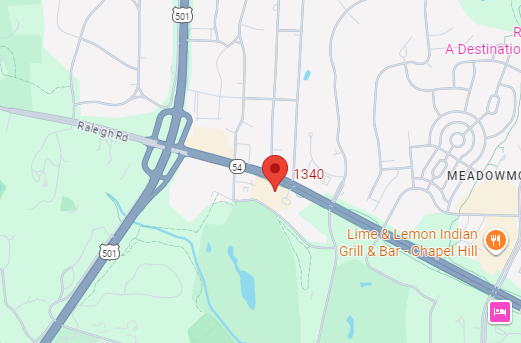
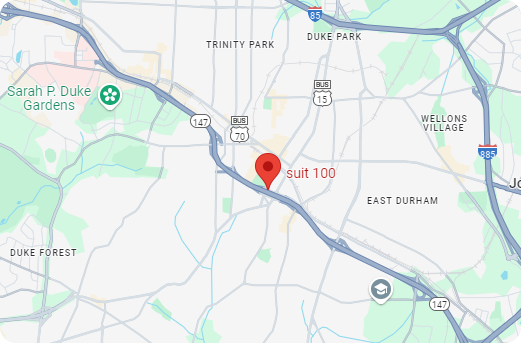
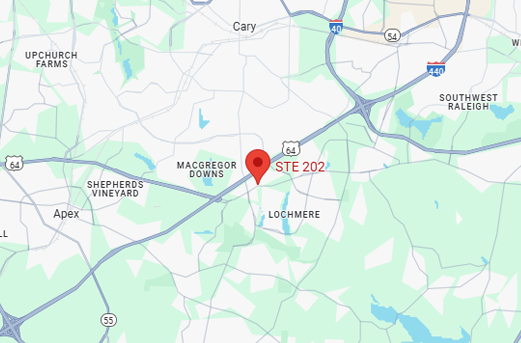
Patrick Roberts Law PLLC maintains strategically located offices across the Research Triangle to provide accessible defense advocacy throughout North Carolina. You may contact any of the offices near you, namely law offices in Raleigh, Durham, Chapel Hill, and Cary.
Because dismantling complex multi-agency narcotics investigations requires deep technical review and exhaustive case auditing, the firm limits the number of active cases it accepts. This operational policy ensures that your defense receives the rigorous focus, strict quality control, and individualized strategic planning necessary to challenge high-stakes state and federal drug charges.
If you are facing drug trafficking allegations and believe law enforcement relied on false pretenses or misrepresentations to search your property, contact Patrick Roberts Law PLLC to arrange a confidential case evaluation.
We limit the volume of active cases to ensure that our staff can provide consistent, comprehensive attention to every matter we handle.
Disclaimer: The information on this website is for general informational purposes only. Nothing herein should be taken as legal advice for any individual case or situation. Contacting us via this website, email, or contact form does not create an attorney-client relationship. Case results depend on a variety of factors unique to each case; prior results do not guarantee a similar outcome.
Former assistant district attorney
Contact Patrick Roberts
Facing criminal charges in North Carolina demands seasoned representation. Trust in the experience and dual perspective of Patrick Roberts. Reach out today for a confidential consultation.
-
Call Our Team
Calls answered 24/7







For more information on the selection criteria, go to www.martindale.com
*Each case is different and must be evaluated separately. Prior results achieved do not guarantee similar results can be achieved in future cases.