

When facing the North Carolina criminal justice system, understanding the difference between first and second degree murder is crucial. For those dealing with criminal charges or simply trying to understand North Carolina’s homicide laws, knowing these differences can greatly impact defense strategies and possible outcomes. This guide breaks down these important legal distinctions in clear terms.
What Are the Murder Charges in North Carolina?
North Carolina law groups homicide offenses based on the killer’s mindset, the situation surrounding the death, and other factors that make the crime more serious. North Carolina General Statute § 14-17 clearly defines first and second degree murder, with each carrying very different elements and punishments.
What Constitutes First Degree Murder in North Carolina?
First degree murder is the most serious homicide charge in North Carolina. According to North Carolina law G.S. § 14-17(a), a killing counts as first degree murder when it meets specific criteria that show higher blame.
How Does Premeditation Factor into First Degree Murder?
The main feature of first degree murder in North Carolina is planning ahead and thinking about the killing before doing it. This means the killer:
- Decided to kill before actually doing it
- Had time, even just a moment, to think about the killing
- Made a conscious choice to go ahead with the killing after thinking about it
Planning doesn’t need to be extensive or take a long time. North Carolina courts have ruled that planning can happen in just seconds—what matters is that some thought occurred before the killing.
Which Specific Methods Automatically Count as First Degree Murder?
North Carolina law specifically lists certain ways of killing as first degree murder, regardless of how long the planning took. Under G.S. § 14-17(a), these methods include:
- Using nuclear, biological, or chemical weapons of mass destruction as defined in G.S. 14-288.21
- Using poison
- Waiting for the victim in hiding (lying in wait)
- Killing through imprisonment
- Causing death by starvation
- Killing through torture
These methods are considered so deliberately harmful that the law assumes the necessary planning was involved.
The Felony Murder Rule
Another way to be charged with first degree murder in North Carolina is through the felony murder rule. Under G.S. § 14-17(a), a killing that happens during certain dangerous crimes automatically counts as first degree murder, even without proof of planning. These qualifying crimes include:
- Arson (fire-setting)
- Rape or sex crimes
- Robbery
- Kidnapping
- Breaking and entering (burglary)
- Other serious crimes committed or attempted with the use of a deadly weapon
The felony murder rule greatly expands what counts as first degree murder, as it can apply even when someone didn’t mean to kill but was doing something dangerous that resulted in death.
Special Rules for Domestic Violence Cases
North Carolina has stronger protections for victims of domestic violence through a special part of the murder law. Under G.S. § 14-17(a1), if someone with a previous domestic violence conviction kills their victim, the law assumes the killing is first degree murder.
This applies when:
- The murder was committed against a spouse, ex-spouse, partner, dating partner (as defined in G.S. 50B-1(b)(6)), or co-parent
- The killer had been previously convicted of specific domestic violence offenses against the same victim, including:
- An act of domestic violence as defined in G.S. 50B-1(a)
- Violation of a domestic violence protective order under G.S. 50B-4.1
- Communicating a threat under G.S. 14-277.1
- Stalking as defined in G.S. 14-277.3A
- Cyberstalking as defined in G.S. 14-196.3
- Domestic criminal trespass as defined in G.S. 14-134.3
This reflects North Carolina’s commitment to addressing domestic violence that often ends in death.

Second Degree Murder in North Carolina: When and How It Applies
Second degree murder, while still very serious, lacks the planning element of first degree murder. Under G.S. § 14-17(b), second degree murder includes killings done with evil intent (malice) but without planning ahead.
What Is “Malice” in Second Degree Murder Cases?
Evil intent (malice) is the key element that separates murder from manslaughter in North Carolina. This evil intent can show up in three ways:
- Actually wanting to kill someone
- Wanting to cause serious harm likely to cause death
- Showing extreme disregard for human life that demonstrates wickedness
The lack of planning separates second degree from first degree murder, while the presence of evil intent separates second degree murder from voluntary manslaughter (G.S. § 14-18).

Two Types of Second Degree Murder
North Carolina law divides second degree murder into two different types with different sentences:
Standard Second Degree Murder
This type applies to killings done with evil intent but without planning ahead. It’s classified as a Class B1 felony under G.S. § 14-17(b).
Extremely Dangerous Act Murder
This type applies when “the malice necessary to prove second degree murder is based on an inherently dangerous act or omission, done in such a reckless and wanton manner as to manifest a mind utterly without regard for human life and social duty and deliberately bent on mischief.” This type carries a reduced classification as a Class B2 felony under G.S. § 14-17(b).
An example might be driving while extremely drunk at very high speeds through a school zone, causing a deadly crash. While the driver didn’t specifically want to kill anyone, the behavior shows such extreme recklessness that it meets the evil intent requirement.

How Do Punishments Differ Between First and Second Degree Murder?
The difference between first and second degree murder charges extends significantly into punishments, with first degree murder carrying North Carolina’s harshest penalties.
First Degree Murder Punishments
First degree murder is a Class A felony in North Carolina—the most serious criminal classification. According to G.S. § 14-17(a), possible punishments include:
- Death penalty (for eligible adult offenders where factors making the crime worse outweigh factors making it less severe)
- Life in prison without the possibility of parole as determined under G.S. 15A-2000
- For offenders under 18 years old when the crime happened, special sentencing according to Part 2A of Article 81B of Chapter 15A of the General Statutes
Second Degree Murder Punishments
The punishments for second degree murder vary depending on the type:
- Standard second degree murder (Class B1 felony): Potentially decades in prison, depending on past criminal record and other factors
- Extremely dangerous act second degree murder (Class B2 felony): Potentially decades in prison, with the same variable factors
This big difference in sentencing shows that the legal system views planned killings as deserving more severe punishment than those committed without planning, even when both involve evil intent.

What Special Cases Exist in North Carolina Murder Law?
North Carolina murder laws include several provisions addressing special situations that may come up in homicide cases.
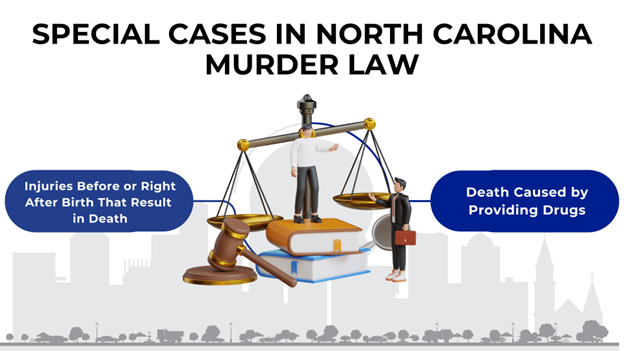
Injuries Before or Right After Birth That Result in Death
Under G.S. § 14-17(c), North Carolina recognizes as murder situations where a baby is born alive but later dies due to:
- Injuries that happened before birth
- An intentional, overt act done after the child is born alive
The degree of murder is determined using the same standards as other murders, looking at planning and evil intent.
Death Caused by Providing Drugs
While separate from the murder statute, North Carolina has created specific crimes related to deaths caused by providing drugs under G.S. § 14-18.4. These include:
- Death by Distribution Through Unlawful Delivery of Certain Controlled Substances (Class C felony) under G.S. § 14-18.4(a1)
- Death by Distribution Through Unlawful Delivery with Malice of Certain Controlled Substances (Class B2 felony) under G.S. § 14-18.4(a2)
- Death by Distribution Through Unlawful Sale of Certain Controlled Substances (Class B2 felony) under G.S. § 14-18.4(b)
- Aggravated Death by Distribution Through Unlawful Sale of Certain Controlled Substances (Class B1 felony) under G.S. § 14-18.4(c)
These laws specifically target drug dealers and people who provide substances that result in fatal overdoses.
Why Do These Differences Matter for Your Defense Strategy?
Understanding the difference between first and second degree murder is crucial for creating an effective defense strategy. Key points include:
Different Levels of Proof Needed
For first degree murder, prosecutors must prove beyond a reasonable doubt that the defendant planned the killing. This creates potential defense strategies by challenging the evidence of planning.
Impact on Plea Deals
The substantial difference in punishments creates significant room for plea negotiations. In some cases, prosecutors may agree to reduce a first degree murder charge to second degree in exchange for a guilty plea, particularly if evidence of planning is questionable.
Different Possible Defenses
While self-defense can apply to both first and second degree murder charges, other defenses may work better depending on the specific charge. For instance, challenging the existence of planning is key to defending against first degree murder charges but doesn’t matter for second degree murder.
Mental Health Considerations
Evidence about a defendant’s mental state can play different roles depending on the murder degree charged. For first degree murder, mental health evidence may weaken the prosecution’s claim that the defendant could form the specific intent required for planning.

The Importance of Experienced Legal Help
The complexities of murder charges in North Carolina highlight the critical importance of getting experienced legal help. An experienced North Carolina criminal defense attorney familiar with homicide law can:
- Thoroughly investigate the circumstances of the alleged crime
- Find weaknesses in the prosecution’s evidence regarding planning or evil intent
- Develop strategic defenses based on the specific facts of your case
- Handle complex pretrial motions and evidence issues
- Negotiate with prosecutors when appropriate
- Present a compelling case at trial if necessary
Murder charges carry life-changing consequences in North Carolina, making experienced legal representation not just helpful but essential for those facing such serious allegations.
Conclusion: Understanding the Key Differences
The difference between first and second degree murder in North Carolina mainly centers on whether there was planning involved, with significant effects on both legal proceedings and possible sentences. First degree murder involves calculated, planned killing or deaths occurring during specified serious crimes, while second degree murder involves evil intent without planning.
For people dealing with North Carolina’s criminal justice system, understanding these differences provides a foundation for making informed decisions about defense strategies. However, the complexities of homicide law require professional legal guidance tailored to each specific case. If you or a loved one are facing murder charges, you deserve a legal advocate with the experience and dedication to secure the best possible outcome. Attorney Patrick Roberts of Patrick Roberts Law has successfully defended numerous clients facing first and second degree murder. Contact our firm today for a confidential consultation.
Former assistant district attorney
Contact Patrick Roberts
Facing criminal charges in North Carolina demands seasoned representation. Trust in the experience and dual perspective of Patrick Roberts. Reach out today for a confidential consultation.
-
Call Our Team
Calls answered 24/7









For more information on the selection criteria, go to www.martindale.com
*Each case is different and must be evaluated separately. Prior results achieved do not guarantee similar results can be achieved in future cases.