

When a person uses deadly force to protect themselves or others, the aftermath can be legally complex and emotionally overwhelming. Understanding what happens when you kill someone in self-defense in North Carolina is critical to protecting your rights and your future. While the law recognizes your right to defend yourself under certain circumstances, the legal process that follows a homicide—even one committed in self-defense—is serious and requires experienced legal representation.
Read more: If You Murder Someone in Self-Defense, What Happens? A North Carolina Legal GuideThis article explains North Carolina’s self-defense laws, the castle doctrine, when deadly force is justified, and what you can expect if you’ve been involved in a fatal encounter where you claim self-defense.
What Happens When You Kill Someone Claiming Self-Defense in North Carolina?
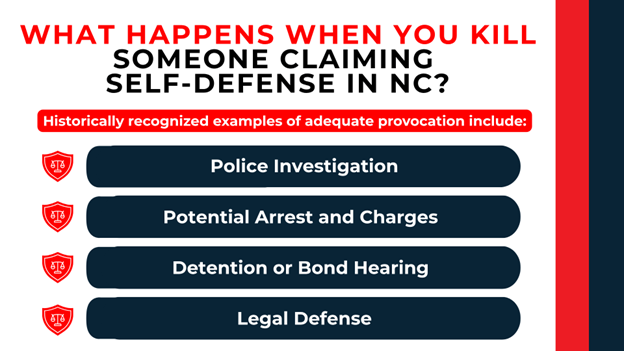
If you kill someone and claim self-defense, you will face an immediate and thorough investigation by law enforcement. Even if you believe your actions were justified, you may still be arrested, charged with murder or manslaughter, and required to defend yourself in court.
Here’s what typically happens:
- Police investigation: Officers will examine the scene, interview witnesses, collect physical evidence, and evaluate whether your use of deadly force appears justified under North Carolina law.
- Potential arrest and charges: Depending on the initial findings, you may be arrested and charged with first-degree murder, second-degree murder, or manslaughter.
- Detention or bond hearing: If arrested, you will likely appear before a judge who will determine whether you can be released on bond while your case proceeds.
- Legal defense: You will need to present evidence and legal arguments showing that your use of deadly force was lawful under North Carolina’s self-defense statutes.
The outcome depends heavily on whether the evidence supports that you acted reasonably, faced an imminent threat, and met the legal requirements for self-defense.
How Does North Carolina Law Define Self-Defense in Homicide Cases?
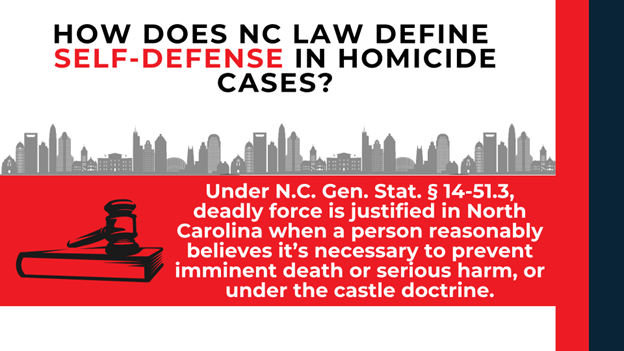
North Carolina law permits the use of deadly force in self-defense under specific circumstances. According to N.C. Gen. Stat. § 14-51.3, a person is justified in using deadly force if:
- They reasonably believe such force is necessary to prevent imminent death or great bodily harm to themselves or another person, or
- The circumstances fall under the protections of the castle doctrine as outlined in N.C. Gen. Stat. § 14-51.2.
Key Elements of Lawful Self-Defense
For deadly force to be justified in North Carolina, several critical elements must be present:
- Reasonable belief: You must have reasonably believed that deadly force was necessary. This is evaluated from the perspective of a reasonable person in the same situation, not based solely on your subjective fear.
- Imminent threat: The danger must have been immediate and unavoidable. A threat of future harm, or harm that has already passed, does not justify deadly force.
- Proportional response: The force used must have been proportional to the threat. Deadly force is only justified when facing the threat of death or serious bodily injury.
- No duty to retreat: Under N.C. Gen. Stat. § 14-51.3(a), you do not have a duty to retreat from any place you have the lawful right to be before using deadly force in self-defense.
If the state cannot prove that you lacked a reasonable belief in the necessity of deadly force, or if the evidence shows you faced an imminent threat of death or great bodily harm, a self-defense claim may prevent a murder conviction.
What Is the Castle Doctrine and How Does It Apply to Deadly Force?
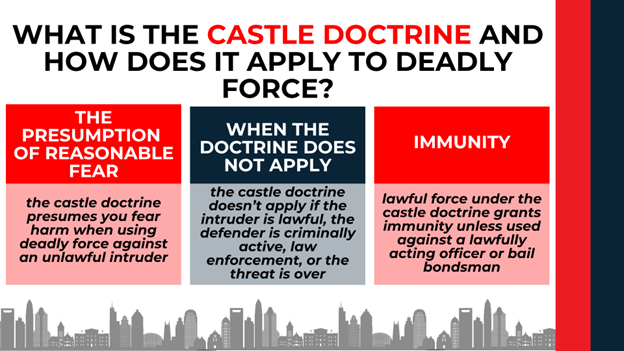
North Carolina’s castle doctrine, codified in N.C. Gen. Stat. § 14-51.2, provides enhanced protections for individuals who use deadly force against intruders in their home, motor vehicle, or workplace.
The Presumption of Reasonable Fear
Under the castle doctrine, the lawful occupant of a home, motor vehicle, or workplace is presumed to have held a reasonable fear of imminent death or serious bodily harm when using deadly force if:
- The person against whom defensive force was used was unlawfully and forcefully entering, or had unlawfully and forcibly entered, the home, motor vehicle, or workplace, and
- The occupant knew or had reason to believe that an unlawful and forcible entry was occurring or had occurred.
This presumption can significantly strengthen a self-defense claim because it shifts the burden to the state to rebut the presumption by proving specific circumstances where the castle doctrine does not apply.
When the Castle Doctrine Does NOT Apply
The presumption under N.C. Gen. Stat. § 14-51.2(c) is rebuttable and does not apply in the following circumstances:
- The intruder has the right to be in the home, motor vehicle, or workplace (such as an owner, lessee, or lawful resident), and there is no protective order against that person.
- The person sought to be removed is a child, grandchild, or otherwise in the lawful custody of the person against whom defensive force is used.
- The person using defensive force is engaged in criminal activity involving the use or threat of force.
- The intruder is a law enforcement officer or bail bondsman lawfully performing official duties, and the officer or bondsman identified themselves or the person using force knew or should have known their identity.
- The intruder has exited the premises and discontinued all efforts to unlawfully enter.
Recent North Carolina Court of Appeals decisions, including State v. Carwile and State v. Williams, have clarified that the castle doctrine’s protections hinge on whether the threat is ongoing. If an intruder has left the home or vehicle and is no longer attempting to enter, pursuing and killing that person will likely not be justified under the castle doctrine.
Immunity from Civil and Criminal Liability
N.C. Gen. Stat. § 14-51.2(e) provides that a person who uses force as permitted under the castle doctrine is justified in using such force and is immune from civil or criminal liability, unless the person against whom force was used is a law enforcement officer or bail bondsman acting lawfully in their official duties.
When Is Self-Defense NOT Available as a Legal Defense?
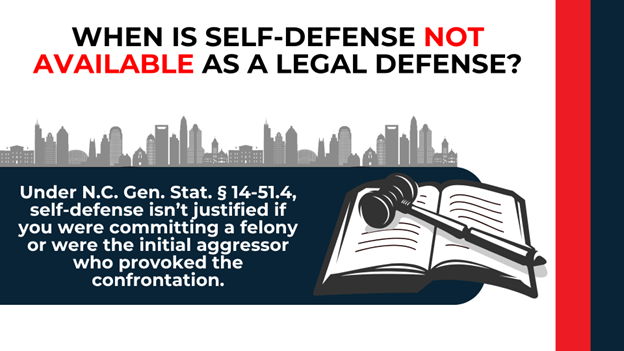
Not every killing claimed as self-defense will be legally justified. North Carolina law, specifically N.C. Gen. Stat. § 14-51.4, expressly prohibits the use of self-defense as a justification in certain situations.
Self-defense is not available if you were:
- Committing, attempting to commit, or escaping after committing a felony at the time you used deadly force.
- The initial aggressor who provoked the use of force against yourself.
Exception for Initial Aggressors
Even if you initially provoked the confrontation, you may still be able to claim self-defense if:
- The force used by the person you provoked became so serious that you reasonably believed you were in imminent danger of death or serious bodily harm, you had no reasonable means to retreat, and deadly force was the only way to escape the danger, or
- You withdrew in good faith from the physical contact, clearly indicated your desire to withdraw and terminate the use of force, but the other person continued or resumed using force against you.
These exceptions are narrow and fact-specific. If you were engaged in illegal activity or were the aggressor, your ability to claim self-defense may be significantly limited or entirely unavailable.
What Is the Difference Between Murder and Justified Homicide?
Understanding the distinction between murder and justified homicide is essential when evaluating what happens if you kill someone in self-defense.
First-Degree Murder
Under N.C. Gen. Stat. § 14-17(a), first-degree murder is a Class A felony that includes any killing that is willful, deliberate, and premeditated. It also includes murders committed during the perpetration of certain felonies, such as arson, rape, robbery, kidnapping, or burglary.
If the state proves that you acted with premeditation and deliberation, and cannot establish that you acted in lawful self-defense, you may be convicted of first-degree murder.
Second-Degree Murder
Second-degree murder, defined in N.C. Gen. Stat. § 14-17(b), is any murder that does not meet the definition of first-degree murder. It is generally classified as a Class B1 felony, though it may be reduced to a Class B2 felony if the malice is based on an inherently dangerous act done in a reckless and wanton manner.
If the evidence shows you killed someone unlawfully but without premeditation, you may face second-degree murder charges.
Justified Homicide
If you can establish that you acted in lawful self-defense under N.C. Gen. Stat. § 14-51.3 or within the protections of the castle doctrine under N.C. Gen. Stat. § 14-51.2, the killing may be deemed a justified homicide. In such cases:
- You should not be convicted of murder or manslaughter.
- You may be immune from both criminal prosecution and civil liability.
However, claiming self-defense does not automatically prevent charges from being filed. You must present credible evidence supporting your claim, and the state must fail to prove beyond a reasonable doubt that your use of force was unlawful.

What Should You Do If You’ve Used Deadly Force in Self-Defense?
If you have killed someone in what you believe was self-defense, your actions in the immediate aftermath can significantly impact your legal case.
Immediate Steps to Take
- Ensure your safety: If the threat has ended, move to a safe location and avoid further confrontation.
- Call 911: Report the incident immediately. Provide basic information, but avoid making detailed statements without legal counsel present.
- Preserve evidence: Do not disturb the scene or discard any items. Physical evidence, witness statements, and the condition of the scene will be critical to your defense.
- Seek medical attention: If you were injured, seek medical care immediately. Your injuries can corroborate your claim that you faced a serious threat.
- Contact an attorney immediately: Do not speak to law enforcement beyond providing basic identifying information until you have legal representation. Anything you say can and will be used against you.
What NOT to Do
- Do not flee the scene. Leaving can be interpreted as consciousness of guilt and may result in additional charges.
- Do not make detailed statements to police without an attorney. Even truthful statements can be misinterpreted or used against you.
- Do not post on social media. Any public statements about the incident can undermine your defense.

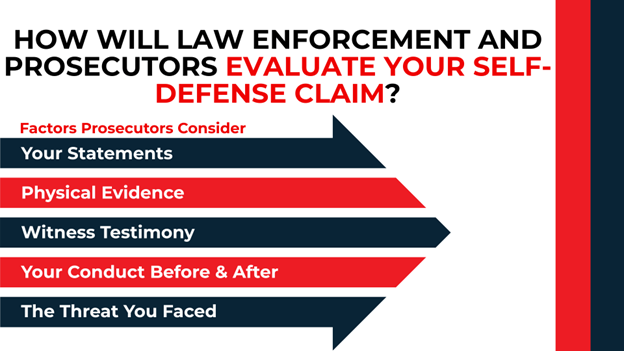
How Will Law Enforcement and Prosecutors Evaluate Your Self-Defense Claim?
Law enforcement and prosecutors will scrutinize every aspect of the incident to determine whether your use of deadly force was justified.
Factors Prosecutors Consider
- Your statements: What you said to police, witnesses, and others will be carefully analyzed for consistency and credibility.
- Physical evidence: The location of wounds, the presence of weapons, forensic evidence, and the condition of the scene can support or undermine your claim.
- Witness testimony: Statements from bystanders, neighbors, or others present during the incident will be weighed heavily.
- Your conduct before and after: Were you the aggressor? Did you attempt to retreat or de-escalate? Did you call for help?
- The threat you faced: Was the other person armed? Were they physically larger or more powerful? Was there a history of violence or threats?
If the evidence suggests you did not face an imminent threat, that you were the aggressor, or that you used excessive force, prosecutors may pursue murder or manslaughter charges.
Can You Still Be Charged with Murder Even If You Acted in Self-Defense?
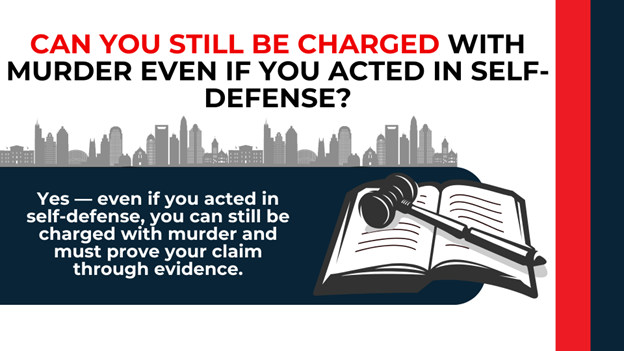
Yes. Even if you believe you acted in self-defense, you can still be arrested and charged with murder. Self-defense is an affirmative defense, meaning you must present evidence supporting your claim.
Burden of Proof
While you must introduce credible evidence of self-defense, the ultimate burden remains on the state to prove beyond a reasonable doubt that you did not act in lawful self-defense. If the jury has a reasonable doubt about whether you acted unlawfully, you should be acquitted.
The Role of the Jury
In a murder trial where self-defense is claimed, the jury will determine:
- Whether you reasonably believed deadly force was necessary.
- Whether you faced an imminent threat of death or serious bodily harm.
- Whether the circumstances support the castle doctrine presumption.
- Whether any of the exceptions to self-defense apply.
This is why strong legal representation is essential. Your attorney must present compelling evidence, cross-examine witnesses, and argue persuasively that your actions were lawful.
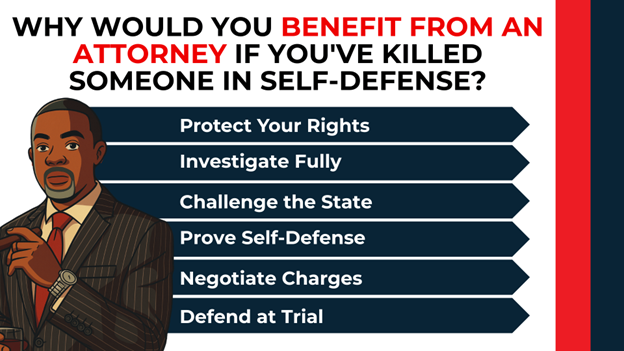
Why Would You Benefit from an Attorney If You’ve Killed Someone in Self-Defense?
Facing a murder charge—even when you acted in self-defense—is one of the most serious legal situations you can encounter. The consequences of a conviction can include life imprisonment or even the death penalty in first-degree murder cases involving aggravating factors.
How an Experienced Criminal Defense Attorney Can Help
Attorney Patrick Roberts has extensive experience defending individuals charged with serious violent crimes in North Carolina. When you retain legal counsel early, your attorney can:
- Protect your rights during police questioning: Prevent you from making statements that could be misinterpreted or used against you.
- Investigate the incident thoroughly: Gather evidence, interview witnesses, and consult experts to build a strong defense.
- Challenge the state’s case: Scrutinize the prosecution’s evidence and identify weaknesses in their arguments.
- Present a compelling self-defense claim: Introduce evidence supporting your reasonable belief in the necessity of deadly force.
- Negotiate with prosecutors: In some cases, charges may be reduced or dismissed if the evidence strongly supports self-defense.
- Represent you at trial: If your case goes to trial, your attorney will advocate aggressively on your behalf.
Contact Patrick Roberts Law Today
If you have been involved in a fatal encounter and believe you acted in self-defense, do not wait to seek legal representation. The decisions you make now may determine the outcome of your case.
Patrick Roberts Law is committed to providing skilled, aggressive defense for individuals facing serious criminal charges* in North Carolina. Attorney Patrick Roberts understands the complexities of self-defense law, the castle doctrine, and the legal strategies necessary to protect your freedom.
Contact Patrick Roberts Law today to schedule a confidential consultation. Your future and your freedom are too important to leave to chance.
*Disclaimer: Each case is different and must be evaluated separately. Prior results achieved do not guarantee similar results can be achieved in future cases.
Former assistant district attorney
Contact Patrick Roberts
Facing criminal charges in North Carolina demands seasoned representation. Trust in the experience and dual perspective of Patrick Roberts. Reach out today for a confidential consultation.
-
Call Our Team
Calls answered 24/7









For more information on the selection criteria, go to www.martindale.com
*Each case is different and must be evaluated separately. Prior results achieved do not guarantee similar results can be achieved in future cases.