

Being charged as an accessory to murder in North Carolina carries severe legal consequences that can permanently alter your life. Whether you’re accused of helping someone before or after a killing occurred, understanding the potential penalties and your legal options is critical. This article explains what North Carolina law says about accessory to murder charges, the minimum sentence you could face, and why securing experienced legal representation matters.
What Does It Mean to Be an Accessory to Murder in North Carolina?
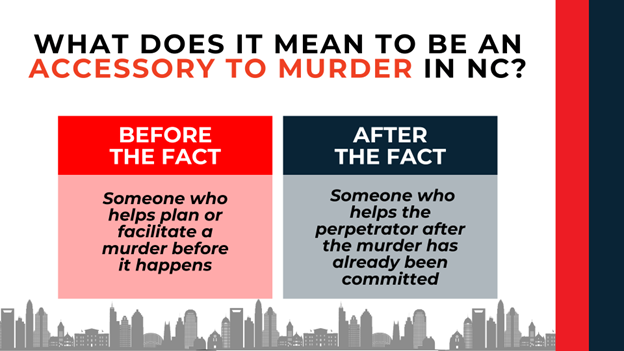
An accessory to murder is someone who assists another person in committing or concealing a murder, but who does not directly commit the killing itself. North Carolina law recognizes two distinct types of accessories, and the timing of your involvement determines which category applies and what penalties you may face.
The two categories are:
● Accessory before the fact – Someone who helps plan or facilitate a murder before it happens
● Accessory after the fact – Someone who helps the perpetrator after the murder has already been committed
Understanding which type of accessory charge applies to your situation is essential because North Carolina law treats these offenses very differently.
How Does North Carolina Define Accessory Before the Fact?
Under N.C. Gen. Stat. § 14-5.2, North Carolina has abolished the traditional distinction between accessories before the fact and principal offenders. This means that if you helped someone plan, prepare for, or carry out a murder before it occurred, the law treats you as if you committed the murder yourself.
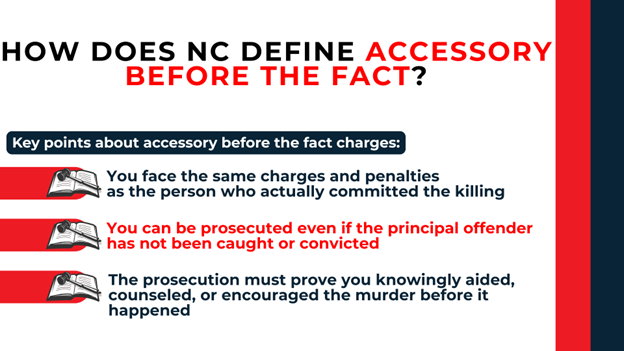
Key points about accessory before the fact charges:
- You face the same charges and penalties as the person who actually committed the killing
- You can be prosecuted even if the principal offender has not been caught or convicted
- The prosecution must prove you knowingly aided, counseled, or encouraged the murder before it happened
If the murder qualifies as first-degree murder under North Carolina law, you could face first-degree murder charges yourself—even if you never physically harmed the victim. First-degree murder is a Class A felony under N.C. Gen. Stat. § 14-17, the most serious category of criminal offense in North Carolina.
However, there is one important exception. If you are convicted of a capital felony (a crime punishable by death) and the jury determines your conviction was based solely on uncorroborated testimony from principals, co-conspirators, or other accessories, you would instead be guilty of a Class B2 felony. This provides some protection against convictions that rest entirely on the word of other participants without independent evidence.
What Are the Consequences for Accessory After the Fact to Murder?
Being an accessory after the fact means you knowingly helped someone after they committed murder. This might include hiding the perpetrator, destroying evidence, providing false information to police, or helping them flee from law enforcement.
N.C. Gen. Stat. § 14-7 establishes that accessories after the fact face different—and typically less severe—penalties than those who helped before the crime occurred. The law creates a sentencing structure based on the classification of the underlying offense.
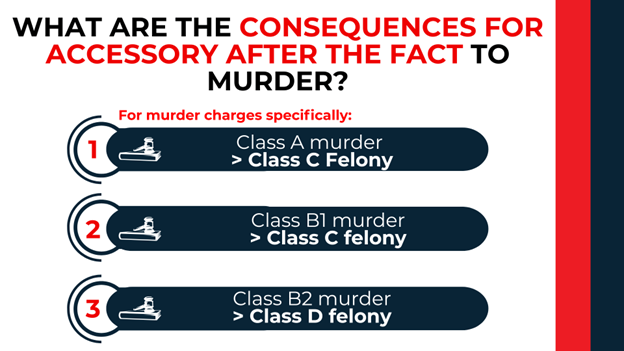
For murder charges specifically:
- If the principal committed first-degree murder (a Class A felony), an accessory after the fact would be charged with a Class C felony
- If the principal committed second-degree murder (typically a Class B1 felony), an accessory after the fact would normally face charges two classes lower—however, because first-degree murder has special rules, the statute explicitly states that an accessory after the fact to a Class A or B1 felony is charged with a Class C felony
- If the principal committed second-degree murder under circumstances making it a Class B2 felony, an accessory after the fact would be charged with a Class D felony
The statute provides that unless a different classification is expressly stated, an accessory after the fact is punished for an offense that is two classes lower than the felony the principal committed. The law includes specific exceptions for the most serious offense categories to ensure proportionate punishment.
What Is the Minimum Sentence for Accessory to Murder in North Carolina?
North Carolina’s structured sentencing system means there is no single “minimum sentence” that applies to all accessory to murder cases. The actual sentence depends on multiple factors, including:
- Whether you are charged as an accessory before or after the fact
- The degree of murder involved (first or second degree)
- Your prior criminal record
- Aggravating or mitigating circumstances in your case
- Whether the case is resolved through plea negotiations or trial
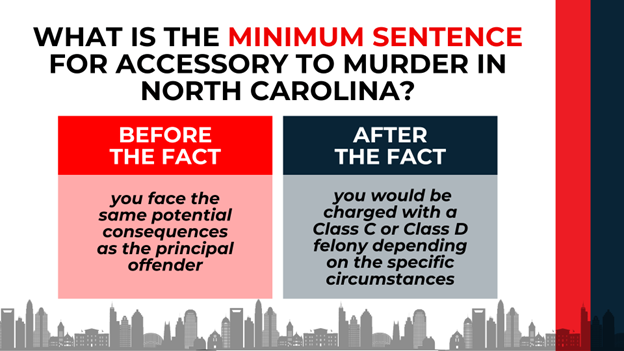
For accessory before the fact charges, you face the same potential consequences as the principal offender. First-degree murder under N.C. Gen. Stat. § 14-17 is a Class A felony that can result in the most severe penalties available under North Carolina law, including life imprisonment without the possibility of parole. Defendants under 18 years of age at the time of the murder are sentenced under different provisions that prohibit certain maximum penalties.
For accessory after the fact charges, you would be charged with a Class C or Class D felony depending on the specific circumstances. These felony classifications carry serious prison time, though the exact length depends on your prior record level and the judge’s application of the structured sentencing guidelines.
It’s important to understand that even though accessory after the fact charges may be “lower” than the underlying murder charge, they still represent serious felony offenses that can result in years of imprisonment and permanent consequences for your future.
What Factors Affect Sentencing in Accessory to Murder Cases?
North Carolina uses a structured sentencing system that considers numerous factors when determining an appropriate sentence. Understanding these factors helps explain why two people charged with similar offenses might receive different sentences.
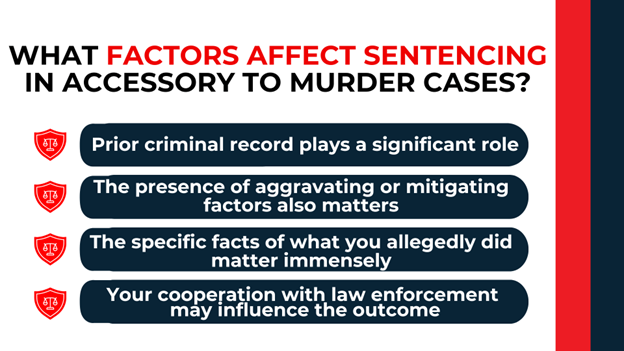
Prior criminal record plays a significant role. North Carolina assigns defendants a “prior record level” based on their criminal history. Someone with no prior convictions will face a different sentencing range than someone with an extensive criminal record, even if they’re convicted of the same offense.
The presence of aggravating or mitigating factors also matters. Aggravating factors are circumstances that make the crime more serious and may justify a longer sentence. These might include whether the crime involved particular cruelty, whether a vulnerable victim was targeted, or whether the defendant played a leadership role. Mitigating factors work in the opposite direction—they are circumstances that may warrant a more lenient sentence, such as the defendant playing a minor role, showing genuine remorse, or having limited criminal history.
The specific facts of what you allegedly did matter immensely. For accessory before the fact charges, prosecutors must prove you knowingly helped facilitate the murder before it occurred. If the evidence shows you merely had knowledge that something bad might happen but took no active steps to encourage or assist, this could affect whether the charges can be sustained at all. Similarly, for accessory after the fact charges, the prosecution must demonstrate that you knew a felony had been committed and that you intentionally took steps to help the perpetrator avoid justice. If you can show you lacked this knowledge, or that your actions were not intended to help someone evade law enforcement, these facts could provide a defense.
Your cooperation with law enforcement may influence the outcome. While this doesn’t guarantee leniency, defendants who provide truthful information that assists investigations may receive more favorable consideration during plea negotiations or sentencing.
How Do Murder Classifications Affect Accessory Charges?
Understanding the difference between first-degree and second-degree murder is essential because it directly impacts the charges and penalties you could face as an accessory.
First-degree murder under N.C. Gen. Stat. § 14-17(a) includes killings that are:
- Perpetrated by means of a weapon of mass destruction, poison, lying in wait, imprisonment, starving, torture, or any other willful, deliberate, and premeditated killing
- Committed during the perpetration or attempted perpetration of certain serious felonies, including arson, rape, robbery, kidnapping, or burglary when a deadly weapon is used
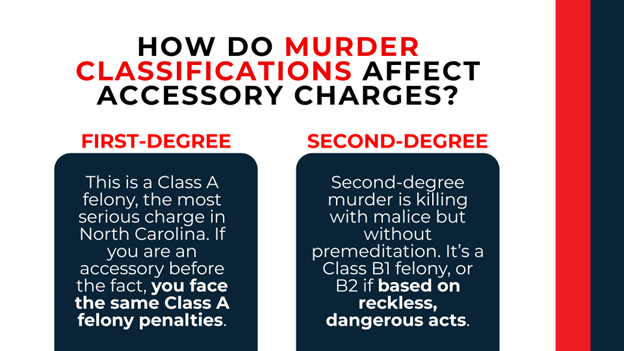
First-degree murder is classified as a Class A felony, the most serious offense classification in North Carolina. If you are charged as an accessory before the fact to first-degree murder, you face Class A felony charges yourself.
Second-degree murder is defined as any murder that doesn’t meet the criteria for first-degree murder. It typically involves killings committed with malice but without the premeditation and deliberation required for first-degree murder. Second-degree murder is generally a Class B1 felony, though it may be classified as a Class B2 felony if the malice necessary to prove second-degree murder is based on an inherently dangerous act or omission done in a reckless and wanton manner.
For someone charged as an accessory after the fact, these classifications determine your own charge level. An accessory after the fact to first-degree murder (Class A) faces a Class C felony charge. An accessory after the fact to second-degree murder (Class B1 or B2) would also face charges adjusted according to the statutory formula.
When Can You Be Charged as an Accessory to Murder?
Prosecutors can bring accessory charges under various circumstances, and understanding when these charges apply helps you recognize the seriousness of your situation.
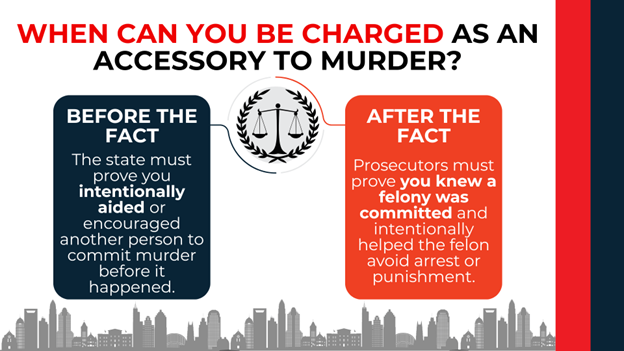
For accessory before the fact charges, the prosecution must prove several elements:
- A murder was committed by another person
- You aided, counseled, commanded, or encouraged that person to commit the murder
- You acted with the intent to help facilitate the crime
- Your assistance or encouragement occurred before the murder took place
If the state cannot show you intended to help facilitate a murder—for instance, if you unknowingly provided assistance or if your actions were taken for an entirely different, innocent purpose—the charges may not be appropriate. Similarly, if you withdrew from participation before the crime occurred and took steps to prevent it, this could provide a defense.
For accessory after the fact charges, prosecutors must establish:
- A felony (in this case, murder) was committed by another person
- You knew the felony had been committed
- You received, relieved, comforted, or assisted the felon
- You acted with the intent to help the felon avoid arrest, trial, conviction, or punishment
According to N.C. Gen. Stat. § 14-7, you can be charged, tried, and convicted as an accessory after the fact even if the principal felon has not yet been convicted or is not “amenable to justice” (cannot be prosecuted). This means prosecutors can move forward with charges against you independently.
If you can demonstrate you did not know a murder had occurred when you provided assistance, this lack of knowledge could be critical to your defense. Similarly, if your actions were not intended to help someone evade law enforcement but instead had another legitimate purpose, this could challenge a key element of the offense.
Can You Be Convicted If the Principal Is Not Convicted?
Yes. North Carolina law explicitly allows for the prosecution and conviction of accessories even when the principal offender has not been convicted or cannot be brought to justice. This is true for both accessory before the fact and accessory after the fact charges.
Under N.C. Gen. Stat. § 14-7, an accessory after the fact “may be indicted and convicted for such crime whether the principal felon shall or shall not have been previously convicted, or shall or shall not be amenable to justice.” This gives prosecutors significant flexibility in how they pursue cases.
However, the state must still prove every element of the charged offense beyond a reasonable doubt. Just because the law permits prosecution without the principal’s conviction doesn’t mean the prosecution’s job becomes easier. They must still establish that a murder occurred, that you had the requisite knowledge and intent, and that you took the actions alleged.
If the prosecution’s case relies heavily on establishing facts about the underlying murder but the principal has not been convicted, your attorney may be able to challenge the sufficiency of the evidence regarding whether a murder actually occurred or whether the facts align with the state’s theory.

What Role Does Intent Play in Accessory Charges?
Intent is a critical element that the prosecution must prove in all accessory cases. Simply being present when a crime occurs, or even knowing about it afterward, does not automatically make you an accessory. The state must show you acted with specific intent to assist or facilitate the crime.
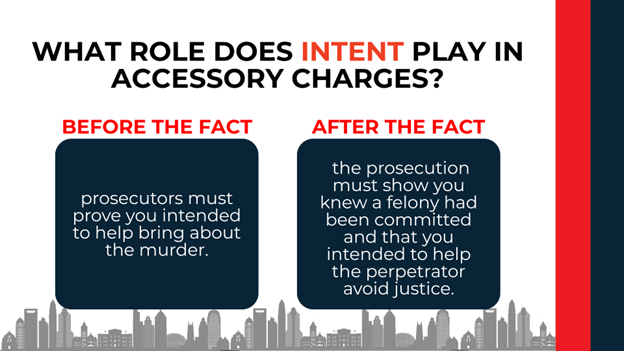
For accessory before the fact charges, prosecutors must prove you intended to help bring about the murder. If you provided assistance without knowing it would be used for criminal purposes, or if you believed you were helping with a lawful activity, the intent element may not be satisfied. For example, if someone borrowed your car claiming they needed to run errands, but they actually used it to travel to commit a murder, your lack of knowledge about their true intentions could be crucial.
For accessory after the fact charges, the prosecution must show you knew a felony had been committed and that you intended to help the perpetrator avoid justice. Mere sympathy for someone in trouble, or providing ordinary assistance that any friend or family member might offer, does not necessarily constitute criminal conduct. The state must prove your actions were specifically designed to help someone evade law enforcement, prosecution, or punishment.
If your attorney can demonstrate that you lacked the necessary intent—whether because you were unaware of key facts, were coerced or manipulated, or had a different purpose for your actions—this could prevent the state from meeting its burden of proof.
How Does North Carolina Handle Accessories in Court?
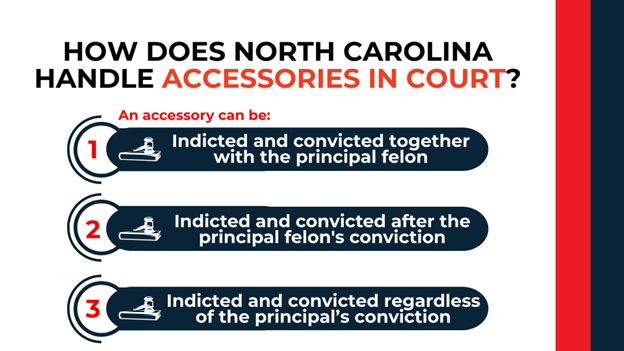
N.C. Gen. Stat. § 14-7 provides flexibility in how accessory after the fact cases can be prosecuted. An accessory can be:
- Indicted and convicted together with the principal felon
- Indicted and convicted after the principal felon’s conviction
- Indicted and convicted regardless of whether the principal has been convicted
The statute also addresses venue—where the case can be tried. If the principal felony occurred in one county and your acts as an accessory occurred in a different county, you can potentially be prosecuted in either county. This gives prosecutors strategic options about where to bring charges.
Additionally, the law includes a protection against double jeopardy: “no person who shall be once duly tried for such felony shall be again indicted or tried for the same offense.” If you are acquitted of accessory charges, the state cannot bring the same charges against you again based on the same conduct.
Understanding these procedural aspects is important because they affect how your case moves through the system and what strategic options your attorney may have for defending you.
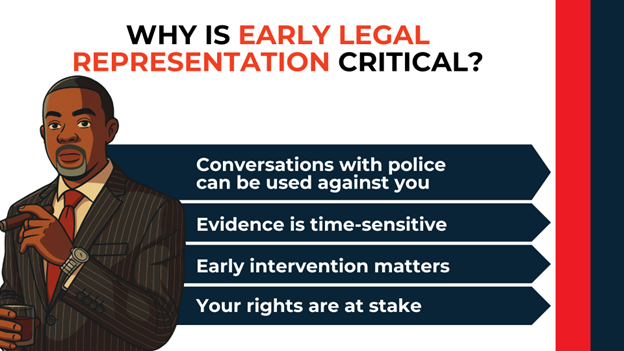
Why Is Early Legal Representation Critical?
When facing potential accessory to murder charges, time is not on your side. The decisions you make in the early stages of an investigation or after arrest can have permanent consequences for your case.
Law enforcement may contact you seeking information. What you say during these conversations can be used against you, even if you believe you’re simply cooperating or explaining your side of the story. Anything you say can be taken out of context or interpreted in ways that support the prosecution’s theory. Having an attorney present ensures your rights are protected and that you don’t inadvertently damage your defense.
Evidence may be time-sensitive. Your attorney can immediately begin investigating the facts, identifying witnesses, and preserving evidence that could support your defense. Waiting to hire an attorney means potentially valuable evidence could be lost or harder to obtain later.
Early intervention may prevent charges from being filed. In some cases, an experienced attorney can communicate with prosecutors before charges are formally filed, potentially presenting information that leads to charges being reduced or not filed at all. Once charges are filed, your options become more limited.
Your constitutional rights are at stake. You have the right to remain silent and the right to counsel. Exercising these rights is not an indication of guilt—it’s a recognition that the criminal justice system is complex and that even innocent people can be harmed by making statements without proper legal guidance.
What Should You Do If You’re Under Investigation?
If you believe you are under investigation for accessory to murder, or if you’ve already been arrested, taking the right steps immediately can make a significant difference in the outcome of your case.
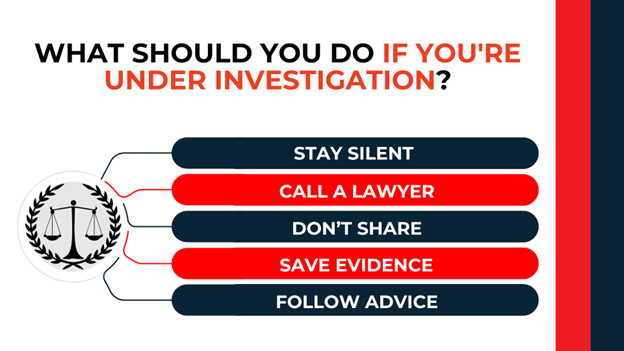
Exercise your right to remain silent. Politely decline to answer questions without an attorney present. You can simply say, “I am exercising my right to remain silent and would like to speak with an attorney.” Do not let investigators pressure you into talking by suggesting that invoking your rights makes you look guilty. Experienced defense attorneys understand that many innocent people make damaging statements simply because they’re unfamiliar with how their words can be used against them.
Contact an experienced criminal defense attorney immediately. Do not wait to see what happens or hope the situation resolves itself. Criminal investigations move forward whether you participate or not, and having skilled legal representation from the beginning provides the best protection for your rights and your future.
Do not discuss your case with anyone except your attorney. Conversations with friends, family members, cellmates, or others can be used as evidence against you. Even if you trust these people, they can be subpoenaed to testify about what you told them. The only conversations that are protected by privilege are those between you and your attorney.
Preserve any evidence that could support your defense. This might include text messages, emails, receipts, witness names and contact information, or documentation of your whereabouts at relevant times. Provide this information to your attorney so they can properly investigate and prepare your defense.
Follow your attorney’s advice. Your lawyer understands the legal system and has experience navigating complex criminal cases. Following their guidance gives you the best chance of achieving a favorable outcome.
Why Choose Patrick Roberts Law?
Facing accessory to murder charges in North Carolina requires aggressive, experienced legal representation from an attorney who understands both the law and the high stakes involved. Attorney Patrick Roberts has extensive experience handling serious criminal cases and is committed to protecting the rights and futures of his clients.
When you work with Patrick Roberts Law, you get:
- A thorough investigation of the facts and evidence in your case
- Strategic legal advocacy designed to achieve the best possible outcome
- Clear communication about your options and realistic assessments of your case
- Aggressive representation in negotiations with prosecutors and in court
- A defense strategy tailored to the specific circumstances of your situation
Attorney Roberts understands that accessory to murder charges can be brought against people who never intended to be involved in such serious criminal conduct. Whether you’re facing charges based on actions taken before or after an offense occurred, you deserve a defense attorney who will fight to protect your rights and your future.
Don’t face these charges alone. Contact Patrick Roberts Law today for a confidential consultation about your case. The sooner you have experienced legal representation, the better your chances of achieving a favorable resolution.*
*Disclaimer: Each case is different and must be evaluated separately. Prior results achieved do not guarantee similar results can be achieved in future cases.

Former assistant district attorney
Contact Patrick Roberts
Facing criminal charges in North Carolina demands seasoned representation. Trust in the experience and dual perspective of Patrick Roberts. Reach out today for a confidential consultation.
-
Call Our Team
Calls answered 24/7











For more information on the selection criteria, go to www.martindale.com
*Each case is different and must be evaluated separately. Prior results achieved do not guarantee similar results can be achieved in future cases.