
If you’re facing criminal charges in North Carolina, knowing the difference between homicide and murder could greatly impact your case. While many people use these terms to mean the same thing in everyday talk, North Carolina law makes important distinctions that affect everything from possible penalties to defense strategies.
What is Homicide in North Carolina?
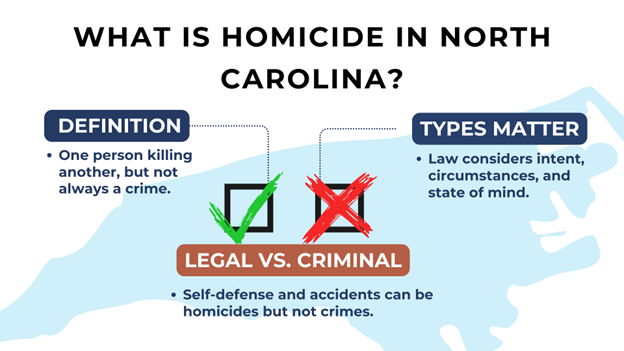
Homicide simply means one person killing another person. This broad legal term covers many situations, and it’s important to understand that:
- Not all homicides are crimes – some are legally justified
- Self-defense killings are homicides but may not be criminal
- Accidental deaths can be homicides without criminal intent
- Homicide is the main term covering various types of killings
North Carolina law sorts criminal homicides based on the specific circumstances, the accused person’s intent, and their state of mind during the act.
How Does North Carolina Law Define Murder?
According to North Carolina General Statute § 14-17, “Murder in the first and second degree defined; punishment,” the state recognizes different types of murder:
What Qualifies as First-Degree Murder in North Carolina?
First-degree murder is the most serious homicide charge in North Carolina’s criminal code. A killing counts as first-degree murder when it is:
- Planned ahead of time (willful, deliberate, and premeditated)
- Done with evil intent (malice)
- Carried out using poison, lying in wait, imprisonment, starvation, or torture
- Or committed while doing another serious crime (like arson, rape, robbery, or kidnapping)
First-degree murder in North Carolina is a Class A felony under § 14-17(a). This carries the harshest penalties in the state – either death or life in prison without the possibility of parole.
How Is Second-Degree Murder Different?
Under § 14-17(b), second-degree murder covers killings that don’t meet the requirements for first-degree murder but still involve evil intent. These killings typically:
- Are done with evil intent but without planning
- Lack the planning element of first-degree murder
- Show extreme recklessness or disregard for human life
- Show what the law calls a “depraved heart”
North Carolina punishes second-degree murder as either a Class B1 or B2 felony, depending on the circumstances. The difference between B1 and B2 often depends on whether the killing was from an “inherently dangerous act or omission, done in such a reckless and wanton manner as to manifest a mind utterly without regard for human life.”

What Types of Manslaughter Does North Carolina Recognize?
North Carolina law recognizes two different types of manslaughter under § 14-18, entitled “Punishment for manslaughter”:
Voluntary Manslaughter
Voluntary manslaughter involves killing without planning but during the “heat of passion” after being strongly provoked. Key elements include:
- A killing done during an emotional state that would upset a reasonable person
- No “cooling off” period between what provoked the person and the killing
- No evil intent needed for murder charges
- Classified as a Class D felony in North Carolina
A classic example is finding a spouse cheating and immediately responding with deadly force – while still a crime, the law sees this as less serious than murder.
Involuntary Manslaughter
Involuntary manslaughter covers unintentional killings caused by recklessness, carelessness, or during a minor crime. Common examples include:
- Deaths caused by extreme carelessness
- Deaths during minor criminal activities
- Unintentional killings where the person should have known their actions created serious risk
- Classified as a Class F felony in North Carolina
Examples often include drunk driving deaths or deaths from handling weapons carelessly.

How Do Death by Distribution Laws Work in North Carolina?
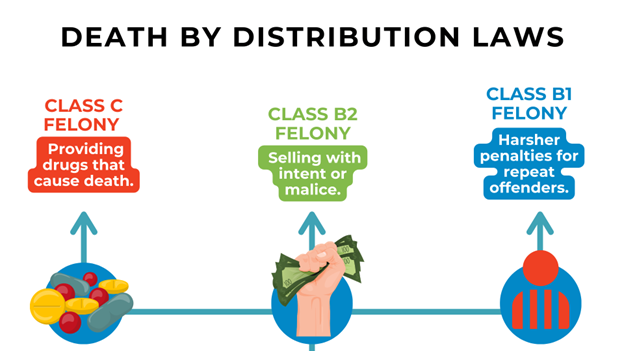
In response to the drug crisis, North Carolina created specific homicide laws under § 14-18.4, “Death by distribution of certain controlled substances; aggravated death by distribution of certain controlled substances; penalties.” These laws target people who provide drugs that cause fatal overdoses:
- Death by Distribution Through Unlawful Delivery of Certain Controlled Substances (Class C felony) – when someone provides drugs that cause death
- Death by Distribution Through Unlawful Delivery with Malice of Certain Controlled Substances (Class B2 felony) – when evil intent comes with the drug delivery
- Death by Distribution Through Unlawful Sale of Certain Controlled Substances (Class B2 felony) – specifically targeting drug sellers whose products cause death
- Aggravated Death by Distribution Through Unlawful Sale of Certain Controlled Substances (Class B1 felony) – applies to repeat offenders with prior drug convictions
These newer laws aim to hold drug dealers responsible when their products lead to fatal overdoses, particularly with opioids, meth, cocaine, and other dangerous drugs.
What Are the Key Differences Between Homicide and Murder?
Understanding the main differences between homicide and murder in North Carolina is essential for anyone facing charges:
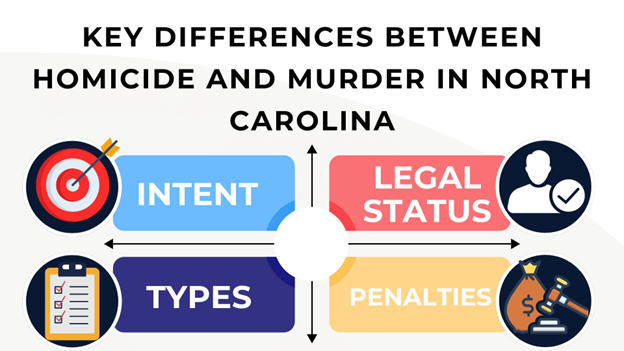
- Intent and Mental State: Murder requires evil intent or planning; homicide just describes the act of killing regardless of mental state
- Legal Status: Not all homicides break the law; all murders are crimes
- Relationship: Murder is one specific type of criminal homicide among several possibilities
- Penalties: Different homicide types carry very different penalties, from possible death sentences to much shorter prison terms
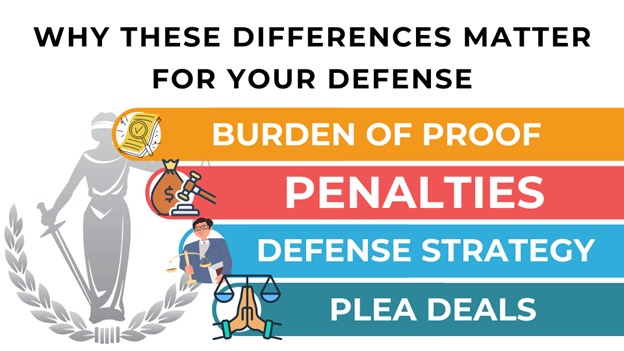
Why These Differences Matter for Your Defense
The specific homicide charge you face greatly impacts your case because:
- Each charge requires prosecutors to prove different things beyond a reasonable doubt
- Sentence ranges vary dramatically between homicide categories
- Defense strategies change based on the exact charge
Plea deal possibilities depend significantly on the nature of the initial charge
Why Should You Seek Legal Help for Homicide Charges?
If you’re facing homicide charges in North Carolina, getting experienced legal help is absolutely essential. The difference between a murder charge and a lesser homicide offense can literally mean decades in your sentence.
A good North Carolina criminal defense lawyer can thoroughly examine the evidence, find weaknesses in the prosecution’s case, challenge improper evidence, and develop an effective defense strategy for your specific situation. They will also protect your rights throughout every stage of the criminal justice process.
If you or a loved one are facing a charge for committing a homicide, you deserve a legal advocate with the experience and dedication to secure the best possible outcome. Attorney Patrick Roberts of Patrick Roberts Law has successfully defended numerous clients facing the most serious homicide charges. Contact our firm today for a confidential consultation.

Former assistant district attorney
Contact Patrick Roberts
Facing criminal charges in North Carolina demands seasoned representation. Trust in the experience and dual perspective of Patrick Roberts. Reach out today for a confidential consultation.
-
Call Our Team
Calls answered 24/7






For more information on the selection criteria, go to www.martindale.com
*Each case is different and must be evaluated separately. Prior results achieved do not guarantee similar results can be achieved in future cases.