
Domestic violence accusations carry serious consequences in North Carolina. If you face these charges in Cary or surrounding Wake County communities, you need to understand how the criminal justice system handles these cases. The question of whether domestic violence charges can be dropped is more complex than many realize.
The Wake County District Attorney’s Office prosecutes domestic violence cases aggressively. Even in a community known for safety like Cary—consistently ranked among North Carolina’s safest cities—these charges demand immediate attention and experienced legal representation.
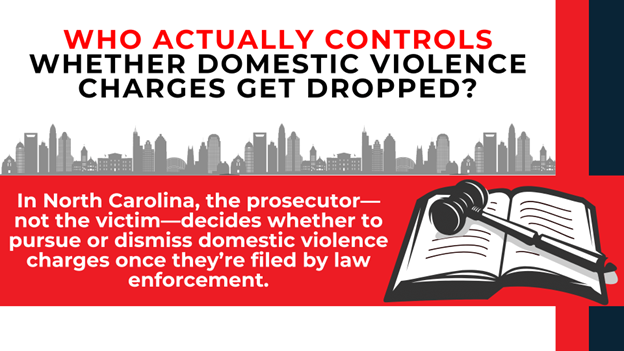
Who Actually Controls Whether Domestic Violence Charges Get Dropped?
The prosecutor controls the decision to pursue or dismiss domestic violence charges in North Carolina. This fundamental fact surprises many defendants and alleged victims alike. Once law enforcement files charges, the case becomes a matter between the State of North Carolina and the defendant—not between two private parties.
The Wake County District Attorney’s Office maintains policies about domestic violence prosecution that limit when charges might be dismissed. Key factors prosecutors consider include:
- The severity of alleged injuries
- The defendant’s criminal history
- Whether weapons were involved
- The presence of children during the incident
- Prior domestic violence incidents
- Available evidence beyond victim testimony
- Public safety concerns
Even when an alleged victim wants charges dropped, prosecutors can proceed with the case. North Carolina law treats domestic violence as a crime against the state, not just against an individual.
What Happens When the Alleged Victim Doesn’t Want to Prosecute?
Many alleged victims in Cary contact the prosecutor’s office wanting to “drop charges.” However, victims cannot unilaterally dismiss criminal charges under North Carolina law. The prosecutor makes this decision independently.
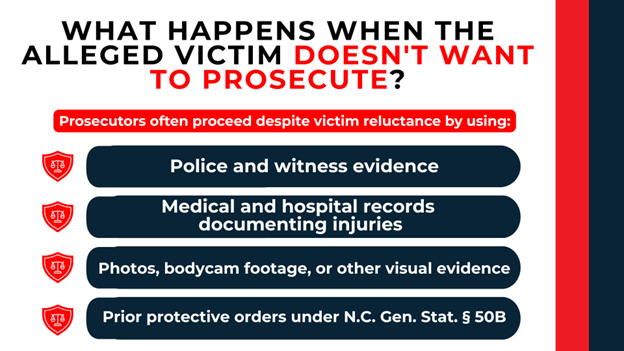
Prosecutors often proceed despite victim reluctance by using:
- Police officer testimony about injuries observed
- 911 call recordings
- Medical records from WakeMed Cary Hospital or other facilities
- Photographs of injuries or property damage
- Body camera footage from Cary Police Department officers
- Witness statements from neighbors or family members
- Prior domestic violence protective orders under N.C. Gen. Stat. § 50B
The Cary Police Department’s Special Victims Unit follows specific protocols for domestic violence cases. Officers document evidence thoroughly, knowing prosecutors may need to proceed without victim cooperation.
When Might a Prosecutor Actually Dismiss Domestic Violence Charges?
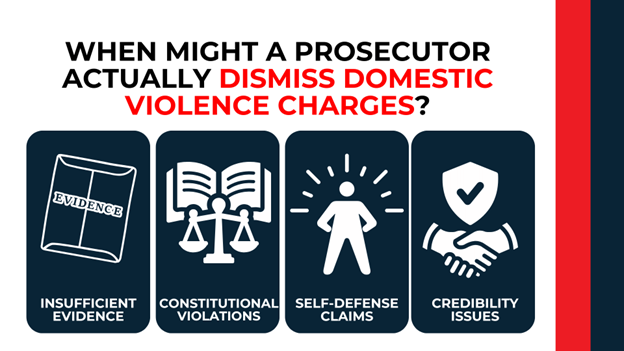
While prosecutors rarely dismiss domestic violence charges outright, certain circumstances might lead to dismissal or reduction of charges:
Insufficient Evidence
The prosecutor must prove guilt beyond a reasonable doubt. Without sufficient evidence, they cannot ethically proceed. This might occur when:
- No witnesses exist besides the parties involved
- Physical evidence contradicts the allegations
- Medical records don’t support claimed injuries
- Video evidence disproves the accusations
Constitutional Violations
Evidence obtained through illegal searches or violations of Miranda rights cannot be used at trial. If key evidence gets excluded, prosecutors may lack sufficient proof to proceed.
Self-Defense Claims
North Carolina recognizes the right to self-defense. Under N.C. Gen. Stat. § 50B-1(a), domestic violence specifically excludes acts of self-defense. Strong evidence supporting self-defense might lead to dismissal.
Credibility Issues
Serious inconsistencies in witness statements or evidence of false accusations might prompt dismissal. However, prosecutors typically investigate thoroughly before making this determination.
How Do Protective Orders Affect Criminal Charges?
Domestic Violence Protective Orders (DVPOs) under Chapter 50B operate separately from criminal charges. These civil orders can exist with or without criminal prosecution.
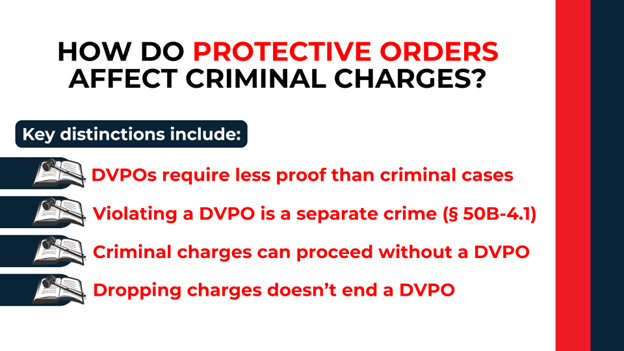
Key distinctions include:
- DVPOs require a lower burden of proof than criminal cases
- Violating a DVPO becomes a separate criminal charge under N.C. Gen. Stat. § 50B-4.1
- Criminal charges can proceed even if no DVPO exists
- Dismissal of criminal charges doesn’t automatically terminate a DVPO
For residents near Bond Park or elsewhere in western Cary, the Wake County Courthouse handles both protective order hearings and criminal proceedings. Understanding both processes proves crucial for comprehensive legal defense.
What Role Does the 48-Hour Rule Play in Domestic Violence Cases?
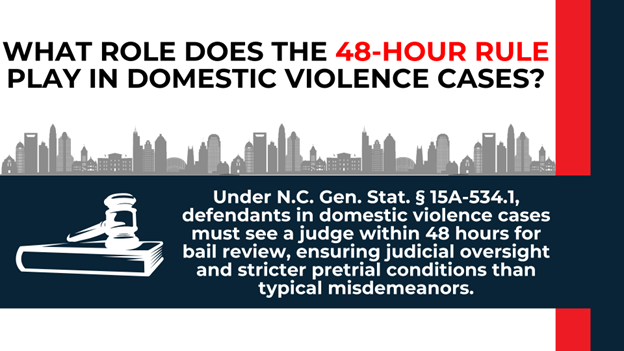
Under N.C. Gen. Stat. § 15A-534.1, defendants in domestic violence cases must see a judge within 48 hours of arrest. This “48-hour rule” ensures judicial review of bail conditions rather than magistrate release.
During this hearing, judges consider:
- Criminal history reports
- Danger to the alleged victim
- Likelihood of witness intimidation
- Appropriate release conditions
- Stay-away provisions from homes, schools, or workplaces
Cary’s educated population—over 68% hold bachelor’s degrees—often assumes reasonable bail practices. However, domestic violence cases involve stricter pretrial requirements than other misdemeanors.
Can Completing Treatment Programs Help Get Charges Dismissed?
North Carolina law under N.C. Gen. Stat. § 50B-3(a)(12) allows courts to order abuser treatment programs. While completing treatment doesn’t guarantee dismissal, it might influence prosecutorial decisions or sentencing.
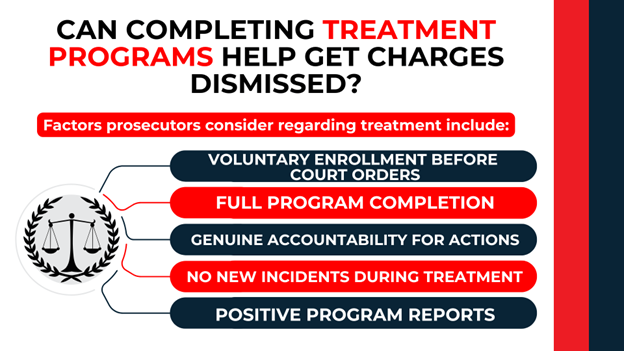
Factors prosecutors consider regarding treatment include:
- Voluntary enrollment before court orders
- Full program completion
- Genuine accountability for actions
- No new incidents during treatment
- Positive program reports
Wake County offers several approved treatment programs. Early enrollment demonstrates taking responsibility, though it never guarantees charge dismissal.
What Happens at the First Court Appearance?
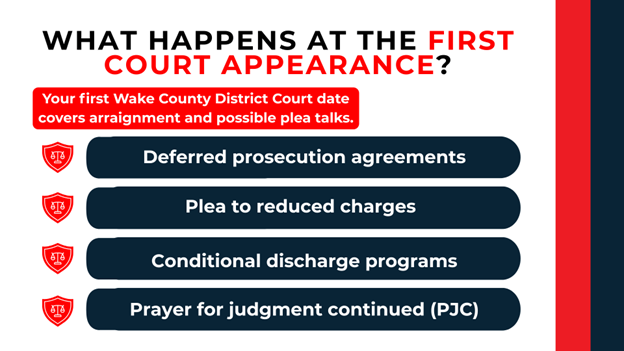
Your first court date in Wake County District Court typically involves arraignment and potentially discussing plea negotiations. The prosecutor might offer:
- Deferred prosecution agreements
- Plea to reduced charges
- Conditional discharge programs
- Prayer for judgment continued (PJC)
Each option carries different consequences for your record, gun rights, and immigration status. Residents working in Research Triangle Park’s technology sector should particularly consider employment implications.
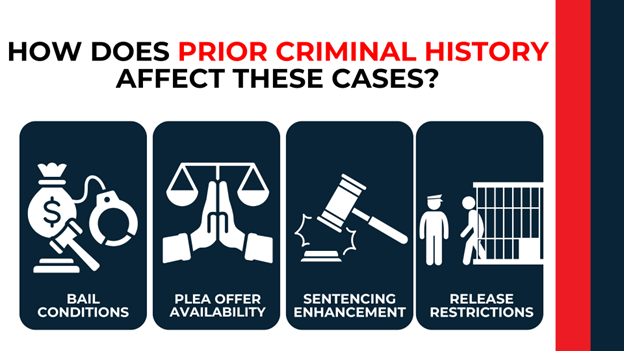
How Does Prior Criminal History Affect These Cases?
Prosecutors treat repeat offenses more seriously. Under N.C. Gen. Stat. § 50B-4.1(f), a third DVPO violation becomes a Class H felony. Prior convictions also affect:
- Bail conditions and amounts
- Plea offer availability
- Sentencing enhancement eligibility
- Pretrial release restrictions
Even in Cary’s low-crime environment, prosecutors pursue enhanced penalties for repeat domestic violence offenses.
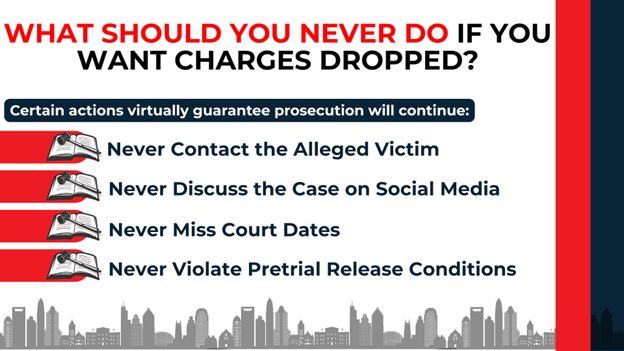
What Should You Never Do If You Want Charges Dropped?
Certain actions virtually guarantee prosecution will continue:
Never Contact the Alleged Victim
Violating no-contact orders or attempting to influence testimony constitutes witness intimidation. This adds new charges and eliminates any chance of dismissal.
Never Discuss the Case on Social Media
Prosecutors monitor social media. Posts about the incident become evidence. Cary’s tech-savvy population should remember that deleted posts can be recovered.
Never Miss Court Dates
Failing to appear results in arrest warrants and eliminates goodwill with prosecutors. Wake County courts don’t excuse absences lightly.
Never Violate Pretrial Release Conditions
Any violation—even technical ones—can result in jail detention pending trial. Prosecutors view violations as evidence you cannot follow court orders.
How Can Patrick Roberts Law Help Your Case?
Attorney Patrick Roberts brings unique insight* to domestic violence defense. His experience as a former prosecutor handling domestic violence cases provides invaluable perspective on how the Wake County District Attorney’s Office evaluates these cases. He understands the evidence prosecutors seek, the weaknesses they fear, and the factors that influence charging decisions.
*Disclaimer: Each case is different and must be evaluated separately. Prior results achieved do not guarantee similar results can be achieved in future cases.
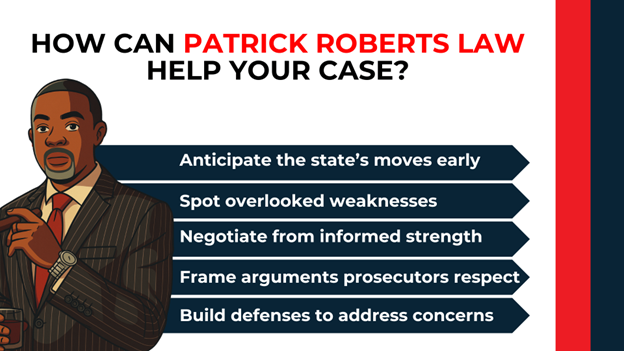
This prosecutorial background means Patrick Roberts Law can:
- Strategically anticipate the likely direction of the state’s prosecution.
- Rigorously analyze the state’s case to identify procedural or evidentiary weaknesses.
- Negotiate effectively by leveraging knowledge of internal prosecutorial standards and policies.
- Present facts and defenses in a manner structured to address prosecutorial standards.
- Develop defenses informed by an understanding of prosecutorial concerns.
Every domestic violence case involves unique circumstances. What works in one case might fail in another. The stakes—including potential jail time, criminal records, and loss of gun rights—demand experienced representation from the beginning.
Don’t navigate the Wake County criminal justice system alone. Contact Patrick Roberts Law immediately to protect your rights and explore every option for defending against these serious charges. Former prosecutor Patrick Roberts knows how these cases develop and can guide you through each critical decision. Call today to discuss your specific situation and learn how prosecutorial experience can strengthen your defense.
Disclaimer: Each case is different and must be evaluated separately. Prior results achieved do not guarantee similar results can be achieved in future cases.
Former assistant district attorney
Contact Patrick Roberts
Facing criminal charges in North Carolina demands seasoned representation. Trust in the experience and dual perspective of Patrick Roberts. Reach out today for a confidential consultation.
-
Call Our Team
Calls answered 24/7







For more information on the selection criteria, go to www.martindale.com
*Each case is different and must be evaluated separately. Prior results achieved do not guarantee similar results can be achieved in future cases.